Showing posts with label Things Belonging to the Emperor. Show all posts

Friday, March 10, 2023

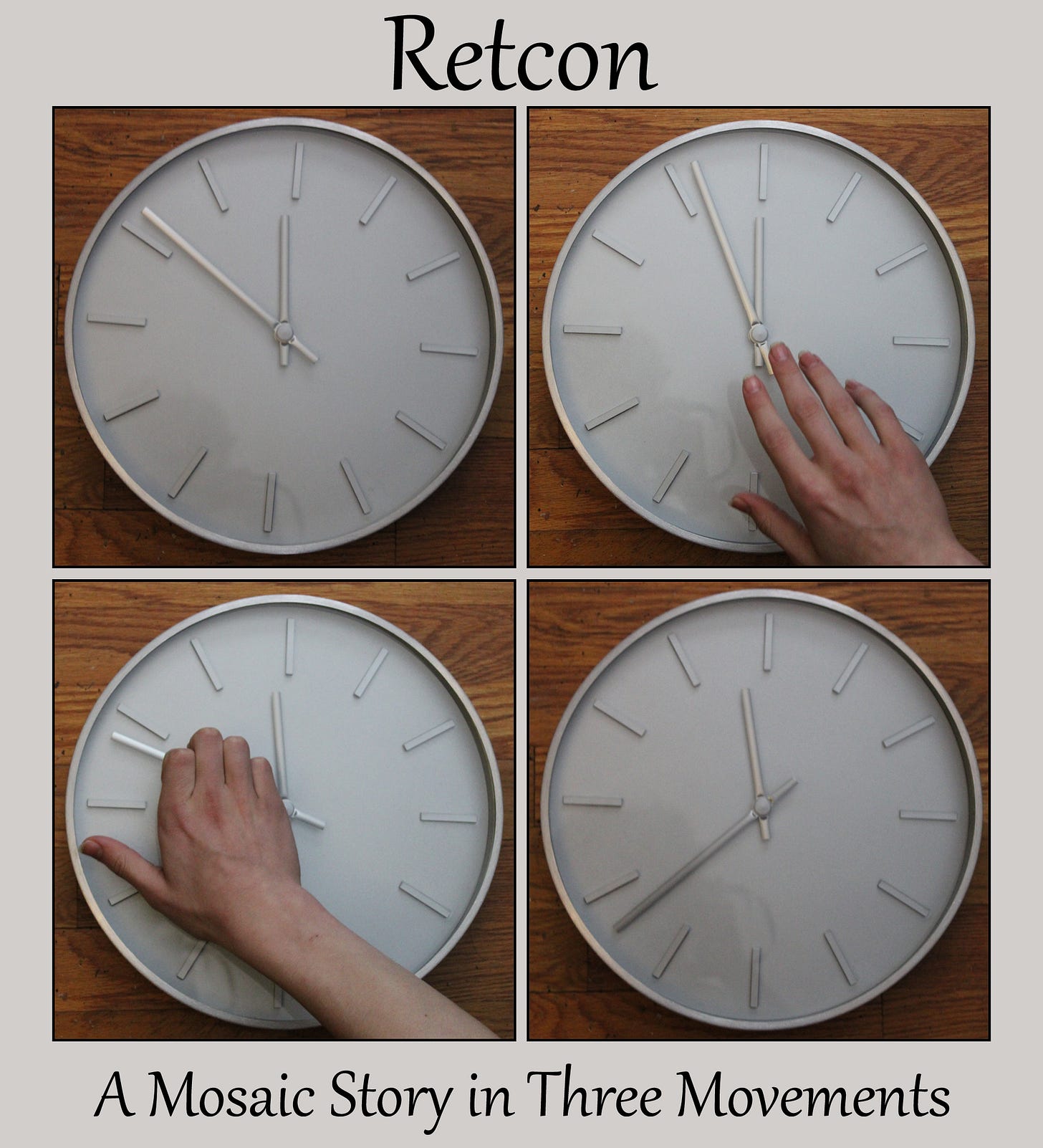
Introducing Retcon: A Mosaic Story in Three Movements

This is cross-posted from Attempts's new home on substack. If you are reading this, you should go subscribe to the substack!  New updates will be mostly there, and new essays & other substantive material will be exclusively there.  We now return you to your regular post, already in progress:

I am debuting a new project—a big project—one I've been working on for a few years and which I have been gathering ideas for for longer than that. And I am hoping that you will  give the first installment a try.

What is this project? you ask. Why, say I, I am glad you asked that.1

Well, you remember that last week I put forward the term "mosaic stories" to refer to the general form of stories where small, to-some-degree self-contained stories make up a larger one? It so so happens, in an astonishing coincidence, that that's precisely the form of the story I've been working on.

The story's name is Retcon.

It will be a large story composed of twenty-seven smaller ones, divided into three sections, or "movements" as I've decided to call them.2 The smaller stories are (prose) short stories, averaging about 15,000 words each. 3 The stories are going to be released as ebooks (to begin with), although I have plans for print collections too. I am planning to release them on a monthly schedule, with a break between movements, so there will be one a month for nine months, and then a break, and then another movement will begin. 4

And the first one is available now. It's called "Zero Second"

So how can I read this story?

You can buy the ebook! It’s only $0.99.5

As for where to buy it, there are lots of options.

• If you want to buy it at Amazon (for Kindle), which is where the majority of ebooks are sold, you can do so at this link.

• Or, if you’d prefer, you can buy it directly from me at my web site.

• Or you could buy it from another ebook vendor; it is available at Smashwords, Barnes & Noble, and Kobo. (So far Apple is being difficult, but I hope to get it up there too before too long).

• Or, if you are willing to commit to the whole narrative (and/or are interested in supporting the series, and this substack in the bargin), you can pre-order the entire series in advance, and I will send them to you as they are released. Note that this offer is exclusive to my web site.6

As I mentioned a few weeks ago, a number of people have offered to support my Substack, for which I was very grateful. Well, if you are interested in supporting this Substack, the best way to do it would be to support me, and the best way to do that would be to support my series. So please: go buy it, and read it!

And, just as important: if you like it, please tell people! Reviews (on Amazon or elsewehere) are really helpful. Even better: tell a friend that you think might like it, and get them to read it.7 Word of mouth is how this series will find its audience, if it does.

So… go! Now! Read! Enjoy!

But what's this story actually about?

A fair question!

I wrote a blurb for the series, which I will share in a moment. But while it fairly represents the whole series, it is something of a spoiler for parts of the first story. So before you read any further, you should go buy or listen to “Zero Second”!

All right, everyone back? Or at least not too spoiler-phobic?

Here’s what the story is about:

In 1951, a pair of scientists at Cornell discovered time-travel. With the specter of the atomic bomb in the immediate background, they decide not to replicate Einstein's mistake of drawing the attention of the political authorities to what might be a weapon. Instead, they decide to set up a clandestine research program to investigate the phenomenon, swearing all those who work on it to keep the secret.

Then, in 1991, a time traveler returns from 2031 with a disturbing message: no traveler and no message has ever come farther back from the moment in time when he left; beyond that instant—dubbed "zero second"—is unreachable. No one knows why. All people know is that something happens on April 4, 2031, to prevent any news of the future.

This is the story of what happens next... if "next" is the right word for a narrative which, in the way of things, is necessarily non-linear.

A Final Repeat of the Basic Point

I hope you will all go read the story; and then go and tell a friend, or three. This is the work of my heart, which I have been pouring myself into, “the heart’s reflections, writ in tears”, as the poet said.8 I hope you’ll give it a try.

1 It's easier when you're playing both parts.
 
2 I was going to call them three "series", as British TV does its sub-sections, but given that the entirety is also a series, I thought that would be confusing.
 
3 Actually, given their length, those more plugged into the terminology of the writing business they are "novelettes" or, in one or two cases, "novellas", but I don't think these are distinctions that need detain ordinary readers.
 
4 Yes, yes, just like a television show with its seasons (although closer together in time). Pity the poor fiction writer, always scuttling about in the shadow of those larger beasts, like tiny mammals dodging dinosaurs.
 
5 If that honestly, no kidding represents a financial difficulty to anyone, then drop me an email at stephenfrug - that little symbol for at - gmail.
 
6 Read: I don’t know how to set it up elsewhere or if it’s even possible.
 
7 And if you want to support this substack qua substack, do the same for it: tell people about it! Forward the link to essays they might like! Share!
 
8 Actually, Pushkin’s entire description of his own work resonates with me in contemplating mine:
Half humorous, half pessimistic,
Blending the plain and idealistic—
Amusement's yield, the careless fruit
Of sleepless nights, light inspirations,
Born of my green and withered years...
The intellect's cold observations,
The heart's reflections, writ in tears.
     — Pushkin, Eugene Onegin, trans. James Fallen

…although I should say “l’havdil”, the Talmudic term for saying that a comparison made on one front is not a comparison in other ways (so that to compare God to a king is not to say that kings are like gods, nor that God is like a king in living with bread, feeling want,
tasting grief, and needing friends): I am not comparing myself to Pushkin! Save that my work, howevermuch lesser than his, is also half humorous, half pessimistic, and also mixes “the intellect’s cold observations/the heart’s reflections, writ in tears”.

Friday, January 04, 2019

My Photographic Novel, Happenstance, Is Nearly 3/4 Posted! Start Reading Now!

A graphic novel I wrote & illustrated (using photographs and photoshop) has been serializing online for about a year and a half, now.  It's about two friends who change their religious views in opposite ways, but in dialogue with each other; and about the fallout from those changes in each of their lives.  I thought I'd pop up here and say it's still posting! You can go read it!  Two new pages go up twice a week, on Mondays & Thursdays.  It's nearly 3/4 up — I just put up pp. 332-333 out of an eventual 444 yesterday, and we're nearing the end of chapter 9 (of 12).  So click here and check it out:


The graphic novel to date can be read here: http://happenstance.thecomicseries.com/

If you haven't read it, give it a try; and if you like it, share it with your friends!

Tuesday, June 13, 2017

My Photographic Novel, Happenstance, Is Now Being Serialized Online

So some of you know that I spent much of the past decade working on a (photo-based) graphic novel titled Happenstance. I'm pleased to announce I've begun serializing it online. My plan (kenina hara) is to post new images twice a week, Monday and Thursday (where each image is a two-page spread: the contrast between the pages becomes important down the line).


The graphic novel to date can be read here: http://happenstance.thecomicseries.com/

So please check it out, like & share with your friends!

Tuesday, January 21, 2014

I Swear I Don't Know Why But Sometimes These Things Just Pop Into My Head

Rudolph, the red-eyed dragon,
Had a very flamey breath,
And if you ever saw him,
It would be a firey death.

All of Santa's reindeer
Used to scream and run away,
Because they knew that Rudolph
Ate about one per day.

Then one foggy Christmas eve
It was Santa's turn,
But when Rudolph ate him up
It gave him quite bad heartburn.

So now it's back to reindeer,
No more plump elvish men:
Rudolph, the red-eyed dragon
Won't be eating them again!

Thursday, March 21, 2013

The Four Questions: A Modern Day Version

Why is this night different from all other nights?

On all other nights, the house is a total mess, but tonight, the house is clean.

On all other nights, we don't eat vegetables, but tonight, we're eating vegetables.

On all other nights, we wolf down dinner in front of the TV, but tonight, we're actually sitting at a table together.

On all other nights, Daddy drinks four beers, but tonight, he's drinking four cups of wine.

Tuesday, January 10, 2012

Working Title of the Memoir of the Last Human Being Alive

No One But Myself To Blame.

(It will never get out of draft, of course: oh, it's good enough -- everyone who's read it liked it -- but all the remaining publishers think there won't be any sort of audience for it.)

Monday, August 01, 2011

Thursday, March 31, 2011

A Poem of My Own Composition (Accidental Poetry Month, Part 22)

I write a lot of things -- SF, comics scripts, history papers, blog posts -- and have plans, schemes and hopes to write a lot of other things as well; -- but not, for the most part, poetry. I like to think I write prose well; I can't bring myself to think I write poetry well. Generally speaking.

But I did go through a period (nearly two decades ago now) of writing poems, in which I wrote perhaps a dozen that I thought ranged from the pretty good to the good (tout court). (There were also another dozen or so that showed promise, although they never got beyond the needing revision/incomplete work phase.) I even tried to publish a few, with no luck (although I wasn't very persistent nor very realistic about where I might be published the first time out). But since it's not an area I am currently planning to pursue (although who knows) I thought I'd share one with my Noble Readers as a climax (or anti-climax) to my Originally-Accidental-But-Long-Since-Quite-Deliberate Poetry Month™ that I've been indulging in.

If you like it, or even find it interesting, leave an encouraging comment, and maybe I'll post another.

Midas

So will I end:
Stand overlooking the vast reed plain
Bent in periodic waves by the wind;
Eternally poised,
With a solid sort of dignity--
The wisdom of a king
Etched upon a not quite human face;
Lifelike-- once-life-- the finest
Details of scarf and nail
Preserved in glimmering gold:
Eyes on the mountain,
Hand carelessly on a thigh;
Statue, not carved,
But an ellipsis in time:
Iridescent flesh
Made solid by my own caress.

-- Stephen Saperstein Frug (1994)

Thursday, December 16, 2010

The Purple Cow and Its Parodies

Saying nursery rhymes to my son recently I happened to quote the famous poem by... well, I had to look up his name: it's Galett Burgess. And as is so common I omitted the first two lines of this six-line poem -- it's usually, but erroneously, treated as a four-line poem. Anyway, here it is, in its majestic entirety:
The Purple Cow

Reflections on a Mythic Beast,
Who's Quite Remarkable, at Least
.

I never Saw a Purple Cow;
I never Hope to See One;
But I can Tell you, Anyhow,
I'd rather See than Be One.

-- Gelett Burgess

And Wikipedia (bless it) has an image of its original appearance:

...which, you'll note, also leaves off the opening two lines (which definitely are in some versions, e.g. here); so I suppose there's a reason for the common, truncated form of the quotation.

But I've always liked even better the sequel that Burgess wrote -- twenty years after, if the title is to believed. Wikipedia claims that the sequel is "almost as well-known as the original"; in my experience that's not true, although I think it ought to be true: one of several motivations for this little post on the topic. Anyway, the sequel goes like this:
Cinq Ans Apres

(Confession: and a Portrait, Too,
Upon a Background that I Rue!
)

Ah, yes! I wrote the "Purple Cow"--
I'm Sorry, now, I Wrote it!
But I can Tell you, Anyhow,
I'll Kill you if you Quote it!

-- Gelett Burgess
It's a good thing I'll never meet the late Mr. Burgess, as he'd have killed me many dozens of times over.

Burgess's poem has inspired numerous parodies -- Wikipedia quotes several, although I'm certain there's more. (For none of the parodies do they quote opening lines to parallel the opening lines of "The Purple Cow"; whether this is an omission by the quoter or the author I don't know.) This is one of the most famous (and justly so), after Burgess's own sequel:
I've never seen a purple cow.
My eyes with tears are full.
I've never seen a purple cow,
And I'm a purple bull.

-- Anonymous
(If Martin Gardner couldn't find an author for that one, I suspect it can't be found.)

That one I'd seen before -- in the Gardner collection, I think. This one, however, is new to me -- and, I think, almost as funny:
I never was a vitamin;
I never hope to be one;
but I can tell you anyhow;
I'd rather C than B1!

-- Tom Montgomery
And I also like:
I've never seen a purple cow.
I never hope to see one.
But from the milk we're getting now,
There certainly must be one!

-- Ye Old Prolific Author Anonymous

Oddly, I don't particularly care for the ones by famous writers that are quoted either by Wikipedia (Ogden Nash) nor by Gardner (O. Henry). Not as good as the unknowns and anonymouses, in this case.

And, of course, with all that Purple Cowy Goodness sloshing around in my brain, it was perhaps only a matter of time until I got into the game. So I herewith present a World! Exclusive! Premiere! of Yet Another Parody of "The Purple Cow", by yours truly:
The Purple Postmodernist

Reflections, in a meta way,
On how I'm saying what I now say.


I never pastiched "A Purple Cow",
I'd never hoped to do it;
But reading what I'm writing now
I'm very nearly through it.

-- Stephen Saperstein Frug
And I wish to note for the record that, even an hour before I wrote this, the claim in the antepenultimate line was perfectly true.

Tuesday, October 07, 2008

The "Biographical Sketch" Draft I Was Too Cowardly To Actually Use In My Finished Dissertation

Born in Cuba in 1899, son of a Cuban woman raped by an American soldier during the Spanish-American war, Stephen Saperstein Frug passed the first ninety-nine years of his misspent life struggling for the liberation of Spanish America from its Imperialist American overlords. In 1998, however, he accidentally wandered into a lecture by Newt Gingrich, during which he finally saw the error of his communist ways. Weeping for his lost years, he decided to pursue sheer selfish monetary advancement as the best means to further the moral interests of humankind. As the first step in pursuit of this goal, he enrolled in a Ph.D. program in the humanities at Cornell University -- perhaps a sign that after ninety-nine years as a communist guerrilla, his understanding of market forces left something to be desired.

Thursday, August 14, 2008

From a Hitherto Unreported Conversation in the Studio of Peter Gabriel, 1984

"I need some help with this. It's a great tune, but I'm struggling with the lyric. I can't figure out which tool works best."

"Tool? Lyrics? You lost me."

"Let me play you a few."

I want to be.... your lawn mower

"Lawn mower? What?"

"Y'know... I want to keep you in shape, help you look good, be the thing that caresses you..."

"Cuts you down if you grow too high?"

"Okay, maybe not. How about this:"

I want to be.... your screwdriver

"Screwdriver?"

"The most useful tool there is. Plus, y'know, the pun."

"Spare me. Next?"

I want to be.... your bread toaster

"Toaster? You've got to be kidding me."

"Sure. The toaster is the friendliest kitchen appliance. 'Lives there a man with a soul so dead/He's never to his toaster said--'"

"Enough. No. Toaster will not do. And adding "bread" to make the rhythm work is just lame. You got anything else?"

"Yeah, but nothing I like. Y'know... Egg beater, air conditioner, tape recorder, sledgehammer... nothing seems to work."

"Wait, what about that last one?"

"What, egg beater?"

"No, the other. Sledgehammer."

"Sledgehammer? You've got to be kidding me. I want to smash her to bits?"

"No you want to build her things. Y'know... train tracks, airplanes..."

"That's ridiculous. Way too violent. Anyway a screwdriver is much more useful in building generally."

"Yeah, but you have the whole juvenile-sex pun thing working against you."

"What, like you've never heard the expression 'hammer her?' No way. I am not going with sledgehammer."

"Fine, whatever. You asked my advice, I gave it."

"Hmm. We'll work on it later. In the meantime, what about this other lyric I'm working on: Bunker hill? Highgate hill? Sparrow hill? Signal hill? What do you think sounds best?"

Tuesday, February 27, 2007

A Zen Tale

This is my retelling of an old Zen story, which I've come across in a number of places.

A man was running from a tiger, and he came to a cliff. He began climbing down a vine, hoping that the tiger could not follow him down and he could thereby escape. As he was on his way down, however, he spied a second tiger waiting for him at the bottom of the cliff. As he hung there on the vine, wondering what to do, he saw a rat begin to chew through the top of the vine.

Then he spied a strawberry, just in arm's reach. He reached out, plucked the berry, and ate it. It was the most sweet and succulent berry he had ever tasted. He closed his eyes and tasted the berry with his whole being, and said aloud, "what a wonderful berry this is!"

Then the rat finished chewing through the vine and the man fell to the ground, breaking his leg. With his leg broken, he could not run. The tiger on the ground came up to him and batted him around as kittens do mice, giving him one painful cut after another. One swipe tore out his left eye. Eventually the tiger tired of playing with him, and bit a large chunk out of the man's stomach for its dinner.

The man went into shock, the pain of the wound coursing through his entire body. But he did not die: he hung on to life for five more days as the two tigers (who, it turned out, were mates) used him as a source of food. His mind was dulled by shock, but not enough to keep the fear and pain from filling his world like a bright light. After five days of agony unlike any that can be described, he finally died.

His corpse continued to serve as a food source for the tigers for several more days. After that, the rat that had chewed through the vine came to gnaw on what was left of his bones.

Saturday, January 27, 2007

In Which the Terrifying but True Story of Recent Events

-- Whose Results Appear to the General Public To Be the Outcome of a Simple, Ordinary Haircut Performed Upon Your Humble Author -- Are At Last Revealed to the World, a Circumstance Which Only the Inevitable Disbelief of a Skeptical Audience Allows; a Tale Told Somewhat More Tersely Than the Present Title Might Indicate.

Haunted lawnmower.

Monday, February 27, 2006

Continuity #1: A Creative Commons Comics Script

Continuity1_Script.html
Continuity1_Script.pdf
Continuity1_Script.doc

Above, in a few different formats, are links to a script I've written for a 24-page comic book -- Continuity #1. It's intended as a one-shot, i.e. a single issue without follow-up. I am releasing the script under a creative commons license (Attribution-NonCommercial-ShareAlike 2.5), as described here (human-readable summary) and here (legal text).

This is (to the best of my knowledge) the first time a comics script has been released under a creative commons license. (Lots of complete comics, but no scripts that I've seen.)

The license I've released it under allows anyone (without getting any special permission from me) to read and distribute the strip, so long as they don't release it commercially or attempt to make any money from it. It also allows anyone (again, without getting any special permission from me) to make derivative artworks, so long as 1) I am give adequate credit; 2) those artworks are non-commercial and are 3) released under the same creative commons license that I am releasing this script under. I don't know of any way of writing this into the legal license, but I am in addition asking people who make a derivative work to send me a copy (link to your web site, a scan or jpeg of the artwork, etc.) unless it is wholly for your private practice and not distributed at all. Basically, if anyone draws any of this (or paints or whatever), I'd really like to see it. My email address is sfrug [symbol for at] post.harvard.edu.

The point of the "derivative works" is not to allow people to go write endless stories about these characters (although of course that is allowed, presuming they follow the given restrictions) but to allow any artists who want to to illustrate it. This could be for anything. It could simply be good practice for someone, a way to test out skills and stretch artistic muscles. Perhaps someone who wants to draw a 24 hour comic but doesn't want to write it at the same time could use this script (it might not, therefore, be strictly according to the rules, but what the hey). Or whatever.

I should note, incidentally, that it is possible to release this work commercially and not under a creative commons license if you get my permission. The point of mentioning this is that if anyone wants to illustrate it and try to publish it as an independent, for-sale comic (whether self-published or through some established comic publisher), then I'm certainly open to the idea. We just need to talk terms (which I would imagine as share-and-share-alike). Anyway, if you're interested, do contact me.

For anyone else who is interested, I hope you enjoy reading my script. And please forward it (or a link to it) to anyone else who might be interested!

(A hopefully-permanent version of this post will be found on its own page here.)

Tuesday, November 15, 2005

Frost + 7 = Fruit

One Oulipian technique -- and in all honesty, I've always thought, one of the silliest -- is "n+7" which is defined by the Oulipo Compendium as follows:

Choose a text and a dictionary. Identify the nouns in the text and replace each one by counting seven nouns beyond it in the dictionary...
With classical poetry, meter and rhyme can be ignored or respected. In the latter case, one selects the first noun to satisfy the prosodic requirements of the original starting with the seventh noun listed in the chosen dictionary. The search for a suitable replacement may extend over several successive letters...

While some oulipians have denied that this is an aleatory technique, I think they are basically wrong. (I should explain that Oulipo is generally opposed to -- or at least, conducted in a different spirit than -- chance-based artistic movements.) While other Oulipian techniques involve trying to come up with the best artistic product given certain constraints (avoiding certain letters or whatever), the n+7 technique is essentially mechanical: once a text and a dictionary has been chosen, one applies it and sees what chance (in the form of the conjunction of the text & dictionary) produces.

The argument that n+7 is not chance based is that it is determined, i.e. that a certain, repeatable result will be obtained every time the same text is submitted to the n+7 method with the same dictionary. But this strikes me as, essentially, irrelevant. What makes n+7 an essentially aleatory technique is that the choices made are not (largely) artistic: the original text might be an artistic choice (although even here the chooser is acting more as an editor than an author), and to a lesser extent the dictionary might be too, but the artistic results are not chosen: they arise from chance conjunction. The fact that this chance conjunction is repeatable is irrelevant. (Sorting a list alphabetically is, in essence, random, despite its repeatability, because things' names have (generally) nothing to do with whatever purposes one sorts them for.) One might exercise artistic choice by picking one result to keep and others to discard -- but then this is true of all aleatory techniques.

So to my mind, n+7 is an aleatory technique, or at the very least operates under the same aesthetics as aleatory approaches. (Its pleasures and limitations are basically those produced by (other) aleatory techniques.) I suppose this is why I find it silly, compared to other oulipian techniques, as I am not a big fan of aleatory approaches to composition.

But it does share this with other oulipian techniques: it's tempting, even seductive. And so, a few days after receiving the new Compendium, I found myself trying an n+7 or two.

I discarded a few -- or, rather, failed to finish a few that after one or two substitutions seemed like they would be uninteresting. I found that using smaller dictionaries produces better results, as the words are more likely to be common ones (which then go in strange places) than simply obscure words, which are basically less fun. Similarly, using poetry rather than prose adds an additional level of weeding -- obscure words (e.g. long technical terms) tend not fit with the meter/rhyme scheme, while simpler ones do. (This isn't absolute, of course, but it's more true than not.)

So I found myself, finally, taking a famous Robert Frost poem and applying the N+7 technique to it. The dictionary I used was the English half of (an old edition of) Ultralingua's English-French dictionary. When it came to rhymes, I resorted to an online rhyming dictionary, taking the first meter-appropriate noun that appeared after the original; I was simply too lazy to actually count all the way through the dictionary for given one-syllable rhymes (which would have taken an enormous amount of time), and this seemed a reasonable substitute for it. Finally, I did the variation where, with repeated words, one does an additional +7 at each occurrence, rather than having the same substitute word stand in for every appearance of the word in the original.

Here's what I got:

Whose wools are these I think I know.
His howl is in the vineyard though;
He will not see me stopping here
To watch his works fill up with woe

My little hose must think it queer
To stop without a fasces near
Between the worm and frozen rake
The darkest evidence of the beer.

He gives his harvest bench a snake
To ask if there is some fruitcake.
The only other sow's the veep
Of easy wine and downy hake.

The wounds are lovely, dark and deep,
But I have properties to keep,
And milks to go before I sleep,
And mimes to go before I sleep.
(It's quite arguable that, even if I pick different substitutes the various appearances of 'woods', I ought to let the last two lines remain identical. If you feel that's better, the substitution is easy. I've put in the extra line because (if I'd given the two identical lines reading) the reverse is hardly true.)

If you're wondering why we got "fruitcake" from "mistake" -- cycling through the alphabet to Z and then back up to F -- the answer is that practically every two-syllable noun rhyming with "take" has its emphasis on the first syllable (e.g. namesake, newsbreak, pancake), while "mistake" has its emphasis on the second. "Fruitcake", to my ear, sounds about evenly emphasized -- so in it went. It's marginal, but there isn't really a better choice (not in the rhyming dictionary I used, anyway.)

The whole thing is, basically, nonsense -- the usual result of the n+7 technique. But some of it is interesting nonsense (as cunningly-produced nonsense often is). I like quite a few phrases in it (I can say this without boasting since, given my argument that it is essentially an aleatory technique, I don't think that the results are to my credit in any way). I think a few of the phrases are actually nice:

"His howl is in the vineyard though"
"To watch his works fill up with woe"
"The darkest evidence of the beer"
"The wounds are lovely, dark and deep"
"But I have properties to keep"

When I went through this at first, I got "But I have propensities to keep" for the antepenultimate line, which is nice in its own way; but of course it didn't scan, as I saw upon rereading it. And I like the new version too.

And given our current Torture Promoter, I think that

Thee only other sow's the veep
Of easy wine and downy hake.

-- is a nice bit of snark, although not a terribly accurate one (the president, not the veep, is probably better described as "of easy wine". (A hake, btw, is a type of fish; and while I'm at it, a fasces is a Roman symbol of rulership (its the root of "fascism".)) Actually, once the Veep is the subject, several of the other phrases -- "To watch his works fill up with woe" not to mention "The wounds are lovely, dark and deep,/But I have properties to keep" -- take on an appropriate resonance too.

But in sum, while the result produced some nice -- and nicely odd -- images, it certainly isn't a good poem.

Actually, the aesthetics of n+7 is essentially the same as that of mad-libs, which I (and I suspect many of you) used to do as a kid. The difference is that mad-libs are candidly meant as games, while oulipo is, as that middle "li" indicates, supposed to aim at literature. There's no question that some oulipian techniques have been successful in this. But on n+7, I'm still a skeptic -- at least as anything longer than phrases go: that good phrases have been produced is not a question (e.g. Harry Mathews' "I wandered lonely as a crowd..."); -- but it's also not, in the end, very impressive.

But. I said above that n+7 was like other oulipian techniques in being tempting. I fear it might also be like others in being addictive. (I was stuck on lipograms for weeks.) So perhaps I'll be doing more of them, after all. Compulsion rarely channels itself naturally along aesthetic lines; and good games are quite compelling...

Wednesday, August 03, 2005

On Being a Cracked Pot

I do not believe that George W. Bush stole the 2004 election.

But what I want to examine in this blog post is why I don't believe that. The answers are not encouraging.

Shortly before the 2004 election, Ron Suskin wrote a New York Times Magazine article in which he quoted an anonymous Bush administration official as follows:

The aide said that guys like me were ''in what we call the reality-based community,'' which he defined as people who ''believe that solutions emerge from your judicious study of discernible reality.'' I nodded and murmured something about enlightenment principles and empiricism. He cut me off. ''That's not the way the world really works anymore,'' he continued. ''We're an empire now, and when we act, we create our own reality. And while you're studying that reality -- judiciously, as you will -- we'll act again, creating other new realities, which you can study too, and that's how things will sort out. We're history's actors . . . and you, all of you, will be left to just study what we do.''

The phrase "reality-based community" became a sort of rallying cry on the internet among those opposed to Bush, for, I believe three reasons: first of all, it summed up so much of what seemed to be wrong with Bush's policies, namely, that they simply ignored reality (WMDs in Iraq, Massive tax cuts, ignoring science on multiple issues, etc, etc); secondly, since so much of the (internet) opposition to Bush was ideologically heterogeneous -- including libertarians, traditional conservatives who actually cared about what they claimed to care about and simply people disgusted by one aspect or another of Bush's appalling policies as well as liberals and leftists -- "reality-based community" was a point of unity. And finally, of course, it was just so !@#$% crazy that the guy actually said it. So those opposed to Bush pledged themselves to reality. Didn't seem controversial, really.

Of course, we all know how that ended up: in the apt words of Mark Danner, "[Those] who would come to support Bush on election day, faced a stark choice: either discard the facts, or give up the clear and comforting worldview that they contradicted. They chose to disregard the facts." So much for the reality-based community.

But it's still a rallying-cry, of sorts. You'll notice that at the top of this blog I adopt it as my own. And I think it's important: there's been a fair amount of talk on the net about needing to definite, for ourselves and others, what the left believes in with the clarity and simplicity that the right has over the past few decades (a debate I intend to weigh in on when I have the time and energy to spare). But when those principles are defined, I think that basic empiricism will be one such principle. It seems ridiculous that it would need to be -- surely adherence to reality should be bipartisan? -- but the truth is that it's not: the right has been opposing simple facts in issues across the board for years now -- increasingly so. Many of these are scientific issues -- evolution and global warming being two of the most significant examples. (The point here is ignoring the science: one can have legitimate policy disagreements about what to do about global warming or how to approach evolution in public schools, but the scientific facts of those two issues can't be ignored. In the words of Daniel Patrick Moynihan, "Everyone is entitled to his own opinion – but not his own facts.") But, of course, it goes beyond science: there's Iraq, not only the WMDs but the administration's assessment of what's going on there, plus their pre-war assessment of what would be needed for the occupation, etc. There's the right's ignoring evidence about the effectiveness of their own programs (e.g. abstinence-only education, programs for "curing" gays, etc.). And there's the general attitude of the right-wing commentators and bloggers in this country, who seem to be able and willing to spin on a dime and adopt whatever new talking points the RNC comes up with, no matter how greatly it contradicts their previously stated positions or principles, like the Stalinists of old. We have always been at war with Eurasia. So I think, when we tally up the principles, empiricism will have a place of pride. We on the left believe in facts -- recognizing them, and adopting our political programs to them.

But I think that a responsibility to facts come with a price, namely, you have to be willing to do it when the facts are against you as well as for you. Fortunately, I think for the most part we are.

But. What about the election?

The truth of the matter seems to be that there is hard evidence that Bush might have stolen it. None of it is conclusive -- but it's enough that (in a country with a functioning press, a vertebrate opposition party and/or politicians with basic allegiance to principles of democracy rather than political party) the issue would have to be investigated, fully and carefully and properly -- by which I mean with subpoenas, forcing the rot into the light.

This first hit home to me when I read this blog post by Paul Velleman, who happened to be a former teacher of mine (I took his intro statistics course in the fall of 1999). He talks about exit polling, and makes the following points (the following is heavily edited; click the link for the full version):

Nationwide, exit polls predicted that Kerry had won by 3%, but the final tally showed Bush ahead by 2.5%. Errors in some key states were even larger. As a statistician, I have been concerned that the errors were unexplained ... All who have considered the problem agree that there are three plausible explanations: 1. Chance error, 2. Bias in the exit polls, and 3. Inaccurate election tallies, or (say it softly) election fraud. Edison/Mitofsky [the firm which conducted the exit polls] and all who have examined the data agree that (1) is not plausible. The errors were so extraordinarily beyond what could occur simply by chance that we can safely exclude this possibility... This analysis of the E/M data makes it clear that the E/M report fails to provide such an explanation. And, of course, if the exit polls were not themselves flawed, that would raise questions about the honesty of the vote itself... if there are biases inherent in the E/M exit polls, we should expect them to follow their own consistent patterns. For example, it isn’t plausible to posit different biases in different places without offering any account of the differences. Such ad hoc explanations are not scientifically or statistically supportable.... States that voted with paper ballots showed only small random errors between exit polls and votes, well within statistical error. States that used automated systems showed large errors fairly consistently biased toward Kerry.... Let me be very clear. I do not assert there was extensive fraud. I would prefer not to think that, and I had hoped the E/M report would reveal a systematic flaw in their methods that accounted for the errors. But it hasn’t, and the issue is still open... E/M have not released precinct-level data, which would be necessary to determine whether voting technology is a factor.

Professor Velleman notes, in his conclusion, that America "cite[s] discrepancies between exit polls and votes in elections in other countries as evidence of problems." He doesn't point out that the U.S. government -- i.e. the Bush administration itself -- did so a few weeks after our own election in calling into question the vote in Ukraine.

So far as I can determine, these questions have yet to be answered in any satisfactory way.

So. We have exit polls saying that Kerry won by 3% (note, by the way, that these are not the early exit polls that were misleading people throughout election day, but the final set of poll results); we have states which used paper ballots not showing such discrepancies, while those with electronic machines showing them.

Before the election, a lot of people loudly and repeatedly worried about the electronic voting machines. They noted that the executives of the companies which made them were largely Bush partisans. They noted that the security on the machines was a joke; that there was no paper trail, so that the accuracy of the vote was unverifiable, and if there was fraud there would be no way to know. This was fairly widely discussed, at least in the left-wing blogosophere.

And all this aside from numerous other problems, such as "standard" American discrimination by income and race (better machines at richer districts, long lines at poorer ones), reports of harassment of African American voters, and the like. (There's a good summary here, with links to lots of other information. (via))

So why weren't more people convinced that Bush stole the election (or stole another election, if you're of that view)? Put aside the right wing and Bush supporters for a moment. Why weren't more people in the reality-based community concerned about it? Why weren't die-hard Kerry partisans suspicious?

Why wasn't I?

Right after the election -- in the day or two, the week or two after -- I think the answer was sheer exhaustion and numb dread. There was the sheer exhaustion of the most intense, important election campaign of (most of) our lifetime's. And there was the numb dread of another Florida -- of another bitter, protracted dispute. An important factor in this was that, at least at first, it seemed that if the vote was to be challenged, it would be challenged in Ohio alone -- in other words, we would be fighting to show that Kerry won the electoral vote and not the popular vote. Given the 2000 fight -- when so much of the legitimacy of Gore's struggle rested in the fact that he had won the popular vote -- it seemed like we couldn't push it. Some combination of commitment to principle and commitment to previous positions stopped us.

(Not that that would have stopped the right in similar positions: recall that, in the week before the 2000 election, the right-wing noise machine was explicitly gearing up to challenge the legitimacy of the election if Gore won the electoral vote but not the popular vote (as many thought possible at the time): a challenge that they would have maintained, it seems clear, throughout Gore's term if he had prevailed in such a circumstance. (Hell, they challenged Clinton's simply due to his being elected in a three-way race!) These arguments and principles were, of course, dropped immediately upon the real situation presenting itself, and the right made the counter-argument with a straight face. But never mind: we stick to our principles. That's what they're for. That's who we are.)

Add to this the attitude of the media -- always powerful, no how much we may believe that they are a bunch of lemming-like echoes of the right -- that anyone who questioned the result was a crackpot, and it became impossible. (Of course, they media had been immeasurably important in securing Bush the presidency in 2000 by presenting the issue as if he was the legitimate winner and Gore the one trying to overturn the election, rather than the other way around or simply that it was flat-out undecided -- a stance whose roots were, in large part, the result of Fox news' calling Florida for Bush (a decision made -- I kid you not! -- by Bush's own first cousin.))

But this whole election-poll results thing was new. This put the issue in a different light -- not that Kerry might have had a TKO stolen from him, but that Bush might have flat-out stolen the election. And not stolen it in the quaint, old-fashioned way he stole 2000 (illegally disenfranchising African Americans (in this case, with wildly inaccurate "felon" lists in Florida drawn up under the supervision of Bush's brother and Florida campaign manager); nor stealing it in the stylish new way of getting the Supreme Court to intervene on your behalf. No, this would be theft in what seems the worst way (emotionally, though for rational reasons I can't see why it is): flat-out rigging the vote, like LBJ in 1948.

And the truth is, for about twenty-four hours I walked around in the world thinking that this was true. Kerry had really, unquestionably won: won the popular vote, been the choice of the American people, who were not so foolish as it had seemed. And the forces of Mordor had stolen it away.

It was a weird experience, to tell you the truth. It's one I've had a few times: walking around the world, seeing it in fundamentally different light -- most recently, I walked around looking at industrial civilization as if it was about to end due to the effects of Peak Oil (a belief I set aside for reasons similar to the present issue, actually). The artistic experience that most closely captures this feeling is one that occurs frequently in fantasy (and also, if less frequently, in SF): it's the experience of the person who has just found out, in the strongest possible way, that "there are more things in heaven and earth, Horatio, then are dreamt of in your philosophy" -- like the kids in the Narnia books after the get out of the wardrobe, or E. C. Gordon in the final pages (save the last) of Heinlein's Glory Road wondering if it was all a dream. The feeling that is captured in these words from one of the finest fantasy writers out there:

If it was true... Then nothing makes any sense. If my dream was true, then everything we know, everything we think is a life. It means the world's about as solid and reliable as a layer of scum on the top of a well of black water which goes down forever, and there are things in the depths that I don't even want to think about.... It means that we're just dolls. We don't have a clue what's really going down, we just kid ourselves that we're in control of our lives while a paper's thickness away things that would drive us mad if we thought about them for too long play with us, and move us around from room to room, and put us away at night when they're tired, or bored. (Sandman 16, "Lost Hearts")

So it's a weird feeling. I felt it; I thought these things. -- And then, after about twenty-four hours, I gave it up. Bush won. I believed that. I beleive it now.

Why?

Not because of any facts or analyses that would convince me. But just because it was too weird not to.

Part of this is because everyone else believed the contrary; and to believe that Bush stole, flat-out stole, the election makes one a crackpot -- like a scientologist or a believer in new-age auras or someone who thinks that the freemasons control history. It doesn't matter that, in this case, there are facts and reasons to believe it; it doesn't matter that one might believe it based on the preponderance of the evidence, willing to listen to counter-arguments (just so long as they are reality-based), rather hoping it wasn't true but brought there by the evidence at hand. You'd still be a crackpot -- and listened to, or not listened to, as such. People wouldn't take what you'd said seriously -- not on this topic, maybe not on other topics. So you -- I -- drop it. Move on. Don't believe it.

It is a victory of group-think over empiricism, of believing what everyone else thinks because everyone else thinks it. It's not being reality-based, but community-based, with all which that implies.

But there's another part of it, too. (I mean, why does everyone else think it?) And that's the part captured in the lines that "...we don't have a clue what's really going down, we just kid ourselves that we're in control of our lives...". If Bush stole the election, then U.S. democracy is over -- basically. I mean, U.S. democracy has taken a lot of hits recently, from the acceptance of the idea that people can be locked up without trial forever ("enemy combatants") to the notion that wars can be based on lies and nobody cares to, yes, the Supreme Court ending vote counting. But if the rot is serious, it's not terminal. I mean, it can be repaired, right? We can still win, reform, rebuild. The foundations are solid, however weak the new construction.

But if Bush stole the election... How can we win our country back? Oh, maybe the forces wouldn't stay solid for the next round: maybe it was a one-time thing, the Bush family machine and not a broader Republican machine. Or maybe the Republican machine wouldn't hold in the face of internal divisions, or in the face of a sufficiently overwhelming victory by the other side -- one that would be harder to hide.

Still, if the election was stolen, if Kerry really won and the government is illegitimate... It's just hard to go there. I mean, we know that the Republican congress has been arranging spending like they're a banana republic, but elections are something else. Our sense of this country -- not as always good (uh, slavery?) but as fundamentally sound -- is too strong. Bad may prevail for a while but it can't last -- can't win out in the open like that. So we don't believe it. I don't believe it. And then, because no one does, no one can -- the peer pressure is too strong. Too strong to even seriously consider it. So we don't look at the evidence -- don't even say 'Maybe it's true, maybe not, we need more information and an investigation'. We simply proceed with our lives, as if it's not true. Because it makes us too uncomfortable to think that it might be true. I think this is part of what Goebbels meant by "If you tell a lie big enough and keep repeating it, people will eventually come to believe it." Some things are simply too big to be disbelieved.

No one wants to be a crackpot.

So did Bush steal the election? No. I don't believe it. I really don't. Bush won -- fair and square. Maybe he shouldn't have been reelected, but he was. We lost. I'm a little teapot, short and stout: not a crack anywhere. Don't toss me out.