Saturday, January 28, 2006

In Which I Participate in a Meme

Always Remember...

Meme_Morrison

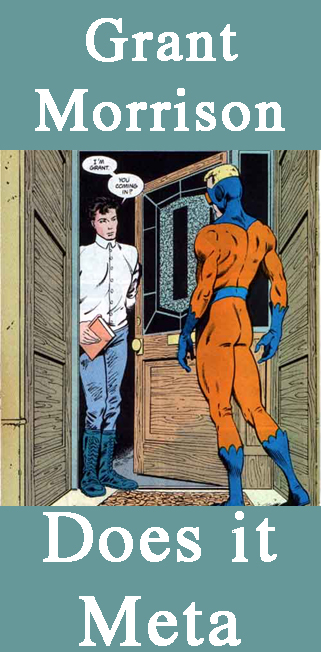
Okay, I don't know if this will make any sense to most of you... Hell, the whole thing doesn't make much sense to me. But if you want to see the rest of the meme, the links to the whole batch are here.

(Image source, with information on Morrison's Animal Man.)

Thursday, January 26, 2006

Hamas's Electoral Victory: Links in Lieu of Thoughts

In thinking about the politics of Israel/Palestine, I've come around to the side of the angels -- that is, the angels who fear to tread where fools rush in: best to talk about other things, where I have some hope of shedding some light, and some hope of avoiding much heat.

But on hearing of Hamas's electoral victory, I thought of Harvey Pekar's characteristically understated reaction to the news of 9/11:


(Art by Tony Millionaire; from the book 9-11 Emergency Relief.)

I don't feel certain of anything in this area -- not even of my overwhelming sense that this cannot be good. So I won't say much else. But here are a few perspectives that I found interesting to read today; no other endorsement of their views is implied.

• Abu Aardvark advises caution. (via)
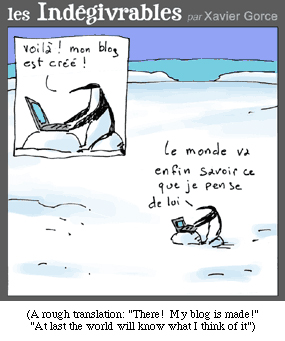
• Patrick Belton, who is currently reporting from the West Bank (and whose blog is probably a good one to watch), says that Hanan Ashrawi told him that she "thought Hamas would bring the West Bank and Gaza into theocracy."
• Yossi Klein Halevi says that this means that the Palestinians have rejected the notion of peace entirely.
• Ali Abunimah sees this as Palestinian rejection of an unjust, Israeli & American-imposed settlement.
• Andrew Sullivan says Hamas's victory "represents one critical pillar beneath the Bush foreign policy crumbling into dust". (Update: Ezra Klein adds that Sullivan "doesn't quite mention that [hispoint] applies primarily to the writings of Andrew Sullivan.")
• Eric Alterman says that this shows that "things can always get worse", and dwells on dismal ironies.
• The Head Heeb offers a number of thoughts. (via)

More links if/as I see any. If anyone here has any to share, feel free to leave them in comments.

TV for Buffy Fans

As those of you who know me probably know, I'm a big fan of Buffy the Vampire Slayer -- one of the best shows ever to air on TV. (If you haven't watched it... try it. 'Nuff said.) So when I promote a show by saying it's as good as Buffy, that's meant as a huge compliment.

Veronica Mars is as good as Buffy.

Veronica Mars, for those of you who don't know, is a TV show whose second season is currently airing on UPN Wednesdays at 9. (So far as can be told thus far, the new network that will result from the just-announced merger of WB and UPN will renew the show and continue to carry it -- though nothing's guaranteed, to be sure.)

The first season is out on DVD. For those thinking of getting into it, I strongly recommend getting the DVDs and starting from the beginning. While each episode makes a fairly good effort to be self-contained, there is definitely a season-long arc each season (so far), and the shows are much stronger when watched in order, from the beginning. (Buffy's first season, as nearly all of the even the most diehard fans will admit, was more inconsistent than its latter seasons and, as a whole, not as good; Veronica Mars's first season, in contrast, is superb and worth seeing from the get-go.)

But the comparison with Buffy is not merely in terms of quality. The two shows are, one might say, in the same genre -- a new genre (so far as I know) that I never considered as one until Veronica Mars made me see the pattern. This genre results from taking another genre (for Buffy, horror/fantasy; for Veronica Mars, mysteries/noir) and focusing it on a high-school girl (indeed, a short, blond high-school girl from southern California) in an hour-long drama that includes a great deal of comedy.

But this doesn't mean that Veronica Mars is the least bit derivative -- it isn't. (Interestingly, Veronica-creator Rob Thomas noted in an interview that he had only seen a few episodes of Buffy before creating his show.) Rather, like any good pair of examples from the same genre, the two shows do very different things with similar premises. (Grant Morrison once compared writing a superhero story to composing a rock song: it all comes down to the same three chords -- the trick was to make them new.) In fact, while I don't mean to engage in what is apparently a small-scale trend of praising Veronica Mars by bashing Buffy, it seems to me inarguable that, in some areas, Veronica Mars is better than Buffy (heresy as that claim might sound to Buffy fans (save for another fact I'll get to shortly.))

Three examples. First, Veronica Mars is infused with a complex politics of race and class that is never simplistic or preachy but makes for extraordinary drama. Second, it portrays a relationship of the heroine with her single parent (a father in Veronica Mars's case) as far more positive and interesting than the comparable relationship in Buffy while never being simplistic or treacly. Finally, the social interaction of Veronica with other high school students seems far more complex and nuanced than in Buffy -- rather than a stable group of allies, she has complex, often fraught relationships with everyone (even her best friend, Wallace). -- Anyway, the point, as I said, is not to bash Buffy, which was superb, but to point out that Veronica Mars is equally superb.


I'm far from the first one to notice the comparison, either in terms of the nature of the show or in terms of quality. Just as one example, Salon.com gave the show it's second annual Buffy award for most underrated show. (It's first one was given to The Wire, a show which, although very different from them in feel, was equal in quality to Veronica Mars and Buffy -- and hence also a show that I'd recommend -- though that's a whole 'nother post.) And lots of other writers & critics have made the comparison.

Most prominently for Buffy fans, however, one of those to praise the show is none other than Buffy-creator Joss Whedon, who went on an internet bulletin board and wrote:

My peeps and I just finished a crazed Veronica Marsathon, and I can no longer restrain myself. Best. Show. Ever. Seriously, I've never gotten more wrapped up in a show I wasn't making, and maybe even more than those. Crazy crisp dialogue. Incredibly tight plotting. Big emotion, I mean BIG, and charsimatic actors and I was just DYING from the mystery and the relationships and PAIN, this show knows from pain and no, I don't care, laugh all you want, I had to share this. These guys know what they're doing on a level that intimidates me. It's the Harry Potter of shows. There. I said it. People should do whatever they can to check out this first season so the second won't be a spoiler fest. I'm nutty.... Some of you may already be all up on this, and some may disagree, but I'm urging peeps to check it out, 'cause there is great TV afoot, and who doesn't want that?

After this, Joss has praised the show in a number of other places, and then done a cameo as an actor on a second season episode. (Alas, he hasn't written nor directed an episode yet... so far as I can tell from a bit of googling, the hang up seems to be Joss's own willingness to do so -- which he attributes to being intimidated by the show's quality (!?!) -- and not Veronica Mars creator Rob Thomas's willingness to have him do one.) There's also a bit of other Buffy/Veronica overlap: in actors. Alyson Hannigan has a role as an occasionally-recurring character, and Charisma Carpenter plays a recurring character in season two.

So if you don't believe me, believe Joss: Veronica Mars is superb. (I won't say "Best. Show. Ever" -- but I bet Joss was just being modest.) Anyone looking for some good television -- or good narrative art regardless of medium -- should check it out.

Thursday, January 19, 2006

All Politics Ought To Be Discussed In the Language of a Wacky Superhero Comic

...it's just more fun that way.

Today's example: Ezra Klein channels Grant Morrison:
...what's always baffled me about the Bush administration is that despite their unconcerned, craven approach to policy-making, they refuse to capture enormously popular issues by correctly appropriating liberal policies. When they try, as on Medicare Part D, they end up talking like progressives, but legislating like transdimensional beings composed entirely of greed.
(Emphasis added to show the Morrisony part.)

Aesthetic note: "wacky" is meant simply as a description, not a critique.

Political note: I think EK's basic point here is actually off -- while it's true that the Bush Administration often has a "unconcerned, craven approach to policy-making", they also have a sufficient adherence to conservative ideology that of course they would never genuinely appropriate liberal policies (as opposed to liberal rhetoric, which as EK correctly notes they do appropriate). It's not surprising at all.

...I'm struggling with a formulation that will correctly capture the administration's underlying consistency in being craven in some circumstances and ideologically dogmatic in others -- but I do feel fairly sure there is one. It may be that correctly solving this problem will actually require getting a handle on related ones, e.g. to what degree (and in which cases) does the administration believe their own bullshit and to what degree (and in which cases) are they simply trying to (and often succeeding in) putting one over a gullible and apathetic public, i.e. are they stupid or lying?

Tuesday, January 17, 2006

Free OED (for a limited time only!)

Via Language-Hat, I see that the new BBC TV show, Balderdash and Piffle (about which I know nothing), is offering free online OED searches from now until February 13. It's on a bit of an odd pattern, though: for the most part you can only search the current "letter of the week" -- as I type it's N. (Very Sesame Street, if you ask me.) But for 48 hours every week -- 21:30 GMT on Mondays to 21:30 GMT on Wednesdays (that's 4:30 p.m. on Monday to 4:30 p.m. on Wednesday for us East-coast folks) -- you can search the whole OED. For free.

So if you'll excuse me, I need to go look up a word or two...

(I actually own a dead-trees version of the OED, so theoretically this shouldn't be such a big deal, but it's a bit of a pain what with the microscopic print (even with the accompanying magnifying glass), flipping through the huge, unwieldy volume and so on...)

Monday, January 16, 2006

Happy Martin Luther King Day

Just a few links (mostly borrowed from other bloggers) to celebrate the occasion.

The text of MLK's famous "Letter from Birmingham Jail".

Audio versions of some of MLK's most famous speeches:

The speech he gave at the 1963 March on Washington (the "I Have a Dream" speech) (via)

His 1967 speech against the Vietnam war

The speech he delivered the day before his death. (Bonus: Bobby Kennedy's speech about MLK's assassination, delivered (of course) one day later.)

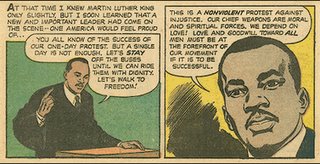
And, finally, a 1956 comic book, Martin Luther King and the Montgomery Story, available on-line. (via)

(Update: new link added.)

Monday, January 09, 2006

Alito à la Lemieux

I quote others only to better express myself. -- Montaigne.

Scott Lemieux gets at the crux of the politics here:

The fact that conservatives are not openly touting Alito's conservative jurisprudence but rather trying to claim that his record doesn't mean what it obviously means tells you that conservatives themselves don't think that overturning Roe and many of the other long-held goals of conservatives are supported by the public. Democrats should not be running scared, and there is no reason to believe--pace Matt--that there is any kind of significant political downside if they strongly oppose Alito, which they clearly should on the merits.

I won't detail the "on the merits" comment -- see Lemieux's links for details (and see here for more). Of course, "the merits" mean the political merits -- unlike Harriet Miers, no one is claiming that Alito is unqualified. But those merits are perfectly valid reasons for rejecting a nominee. As Lemieux wrote about Robert Bork:

He was appointed for political reasons, of course, and rejected for political reasons, and in both cases the reaction was perfectly appropriate. It was Reagan's right to appoint somebody who believes that the Court's entire line of privacy cases is wrongly decided and that the federal government can legally segregate and that the 1st Amendment should be read extremely narrowly. And it was the Senate's prerogative to reject someone with these views.

It's nonsense to pretend that judicial nominations aren't political; so we shouldn't be ashamed or reticent about making explicitly political arguments and judgments about them. The Democrats should filibuster Alito because he is a right-wing judge who will make right-wing political judgments; it's the right political move, both in the sense of the moral thing to do and in the sense of the canny thing to do (if done properly).

Nor do any of the non-political arguments against filibustering stand up. The notion that judges shouldn't be filibustered is just silly -- the filibuster is more reasonable for judicial appointments, which are for life, than for political ones, which are time-limited, or political bills, which can be repealed. As for the notion that one shouldn't filibuster because it's counter-majoritarian, well, the Senate is counter-majoritarian; as Hendrik Hertzberg is wont to point out, "if each of every state’s two senators is taken to represent half that state’s population, then the Senate’s fifty-five Republicans represent 131 million people, while its forty-four Democrats represent 161 million". And -- the silliest argument of all -- the fact that the nuclear option might be invoked is not a reason not to use the filibuster: as Matt Yglesias has argued, the worst possible outcome is for Alito to get on the Court and for the filibuster to remain; ideally, Alito would be blocked, but if that can't happen, getting rid of the filibuster (which historically tends to help conservative causes more than liberal ones) would be a nice consolation prize.*

Filibuster Alito!
_____

* Even if it is gotten rid of in an illegitimate way -- remember, the nuclear option is so-called not because it's getting rid of the filibuster, but because it is doing so in a way that breaks Senate rules. Still, breaking the rules is a bad thing -- so the best result would be a Democratic filibuster which the Republicans would simply fail to overcome.

Wednesday, January 04, 2006

Happy New Year

Sorry to have been absent -- I've been sick, I fear. More posts when I have the time & energy.

In the meantime, if you like, you can check out some of my old posts. Additionally, let me share with you this quote from John Stuart Mill's Autobiography (chapter 5), which I came across in a recent op-ed by historian Darrin M. McMahon:
Those only are happy... who have their minds fixed on some object other than their own happiness; on the happiness of others, on the improvement of mankind, even on some art or pursuit, followed not as a means, but as itself an ideal end. Aiming thus at something else, they find happiness by the way.... Ask yourself whether you are happy, and you cease to be so. The only chance is to treat, not happiness, but some end external to it, as the purpose of life.
More soon, deus volent. Please stand by...

Tuesday, December 20, 2005

Seeing Through the Lies

Some good news: Bush 43-appointed Judge John E. Jones III struck a blow for the separation of Church and State, and against the infestation of secular science with partisan religious advocacy, and ruled for the plaintiffs in the Dover Intelligent Design creationism case. Not only ruled for science and a religiously-neutral state, but did so in powerful terms which cut to the heart of the controversy. And he deliberately gave a through ruling, covering issues he might have by-passed (i.e. considering all the legal issues even after ones sufficient for a ruling had been decided) "in the hope that it may prevent the obvious waste of judicial and other resources which would be occasioned by a subsequent trial involving the precise question which is before us." (p. 64)

His ruling (in PDF format) is here (also here). It's long (139 pages) but it's a surprisingly good read -- if you're a geek who's into that sort of thing, I suppose is the inevitable rider, but I guess I would say that it had broader appeal than the average legal ruling or 100+ page discussion of the evolution/creationism issue; not saying much maybe. But (while I can't say I read every word of it, I read far more than I thought I would. It's engrossing. -- And encouraging in these dark times. (Update: Neil Gaiman (!) agrees, calling it "fascinating reading -- remarkably lucid and interesting". (via))

The go-to blogger on this issue is clearly PZ Myers -- he's got four posts up already, including lengthy excerpts, and I'm sure there are more to come. (His first post on today's ruling is here.) His site is clearly swamped; most of his posts seem to be mirrored at The Panda's Thumb (also swamped, but at least that's two longshots, not one). And, of course, other science & evolution bloggers are covering this too. (For pre-decision posting, see this post by a surprisingly perceptive and startlingly handsome blogger who will, for modesty's sake, go unnamed (but not unlinked -- modesty has its limits, after all.)) (Update: the Questionable Authority has a one-shot blog carnival with a huge number of links. And don't miss PZ Myers's day-after hangover.)

What strikes me above all is the level of mendacity by the creationist side. It's not surprising -- it's fundamental to their approach on every level. But it's just so ubiquitous, so blatant, so overwhelming by anyone who supports their position.

They have to lie about the evidence in order to try and rebut the overwhelmingly-supported theory of evolution ("Plaintiffs’ science experts, Drs. Miller and Padian, clearly explained how ID proponents generally and Pandas specifically, distort and misrepresent scientific knowledge in making their anti-evolution argument." -- Judge Jones, p. 84). Then, since the Supreme Court earlier decisively rejected creationism being taught in public school science classrooms, they have to lie and pretend that ID is not creationism; as part and parcel of this lie, they have to pretend that there is a real science of ID and real scientific controversy around its acceptance. ("The overwhelming evidence at trial established that ID is a religious view, a mere re-labeling of creationism, and not a scientific theory." -- p. 43) They have to lie about whether or not they believe the creator is Christ and whether or not they have religious motives. ("A significant aspect of the IDM is that despite Defendants’ protestations to the contrary, it describes ID as a religious argument. In that vein, the writings of leading ID proponents reveal that the designer postulated by their argument is the God of Christianity." -- p. 26)

Then there are the specific lies in this case. Since -- after openly stating that they wished creationism (under its true name) taught -- the leading school board members were informed that this was legally untenable, they had to lie about their earlier actions ("...the inescapable truth is that both Bonsell and Buckingham lied at their January 3, 2005 depositions about their knowledge of the source of the donation for Pandas... This mendacity was a clear and deliberate attempt to hide the source of the donations by the Board President and the Chair of the Curriculum Committee to further ensure that Dover students received a creationist alternative to Darwin's theory of evolution." -- p. 115) as well as about their motives. ("Although Defendants attempt to persuade this Court that each Board member who voted for the biology curriculum change did so for the secular purposed of improving science education and to exercise critical thinking skills, their contentions are simply irreconcilable with the record evidence. Their asserted purposes are a sham, and they are accordingly unavailing, for the reasons that follow." -- p. 130) Jones is openly and repeatedly scathing on the level of lying by the (mostly former I believe) pro-creationism members of the Dover School Board. ("Simply put, [former Dover school board president] Bonsell repeatedly failed to testify in a truthful manner about this and other subjects." -- p. 97) Nor does the irony of the 'religious' side being so dependent on lies escape the good Judge. ("It is ironic that several of these individuals, who so staunchly and proudly touted their religious convictions in public, would time and again lie to cover their tracks and disguise the real purpose behind the ID Policy." -- p. 137)

And then there are all the implicit lies -- Behe twisting his claims to try and ignore voluminous counter-evidence ("By defining irreducible complexity in the way that he has, Professor Behe attempts to exclude the phenomenon of exaptation by definitional fiat, ignoring as he does so abundant evidence which refutes his argument." -- p. 75); the implicit lie in the 'teach-the-controversy' meme ("ID, as noted, is grounded in theology, not science. Accepting for the sake of argument its proponents’, as well as Defendants’ argument that to introduce ID to students will encourage critical thinking, it still has utterly no place in a science curriculum. Moreover, ID’s backers have sought to avoid the scientific scrutiny which we have now determined that it cannot withstand by advocating that the controversy, but not ID itself, should be taught in science class. This tactic is at best disingenuous, and at worst a canard. The goal of the IDM is not to encourage critical thought, but to foment a revolution which would supplant evolutionary theory with ID." -- p. 89); and the astonishing mendacity revealed in the fact that the ID textbook simply replaced the words 'creationism' with 'intelligent design' after the court ruling on the former ("By comparing the pre and post Edwards drafts of Pandas, three astonishing points emerge: (1) the definition for creation science in early drafts is identical to the definition of ID; (2) cognates of the word creation (creationism and creationist), which appeared approximately 150 times were deliberately and systematically replaced with the phrase ID; and (3) the changes occurred shortly after the Supreme Court held that creation science is religious and cannot be taught in public school science classes in Edwards. This word substitution is telling, significant, and reveals that a purposeful change of words was effected without any corresponding change in content, which directly refutes FTE’s argument that by merely disregarding the words “creation” and “creationism,” FTE expressly rejected creationism in Pandas." -- p. 32)

And. frankly, I could keep going and going. Given all of that, it's not surprising that the proponents of Intelligent Design creationism are now issuing mendacious press releases about the verdict.

What was wonderful about Jones's ruling is that he saw through all these lies -- he called them on it, in the way that (for example) our pusillanimous press refuses to. I can't judge whether or not his ruling was solid on the law (although everything I've seen leads me to believe it was); but it was solid on the facts. And, these days, that is something to be grateful for.

Monday, December 19, 2005

On the Dangers of George Bush's Unconstitutional Wiretaps

These Fourth Amendment freedoms cannot properly be guaranteed if domestic security surveillances may be conducted solely within the discretion of the Executive Branch. The Fourth Amendment does not contemplate the executive officers of Government as neutral and disinterested magistrates. Their duty and responsibility are to enforce the laws, to investigate, and to prosecute.... But those charged with this investigative and prosecutorial duty should not be the sole judges of when to utilize constitutionally sensitive means in pursuing their tasks. The historical judgment, which the Fourth Amendment accepts, is that unreviewed executive discretion may yield too readily to pressures to obtain incriminating evidence and overlook potential invasions of privacy and protected speech.

-- Justice Powell writing for a unanimous Supreme Court
United States v. United States District Court (1972) [via]

Impeach George Bush. Impeach him now. (As Brad DeLong would say.)

Friday, December 16, 2005

Best Attempts So Far

So I began this blog six months ago today -- what the blogosphere would call my six-month blogiversary. To celebrate I thought I'd link to the posts which I consider my best and which most embody what I hope to do here. Often, of course, it's just a blog -- a place for random thoughts and quotations. I've done a number of book reviews, and some brief commentaries reacting to news stories and the like. But at its best blogging is a home to the essay; and that's what I am for in my more substantial posts. Here are a few where I think I've achieved that -- these are, I think, my best attempts so far. Time permitting and fortune willing, there will be more to come.

On Being a Cracked Pot
Another Argument Against Intelligent Design
Kirk Poland and Bulwer-Lytton
Frost + 7 = Fruit
Four Years Ago
Why Does It Still Matter?
Sixty Years Ago Today

MonBlog

Thursday, December 15, 2005

Winter Journeys

I just finished a strange little book called Winter Journeys (if it sounds familiar, it may be because I referred to it once before, in this post). It's a collection of ten related stories by members of the French literary group the Oulipo (and the Oulipo, collectively, is listed as its author). Along with the earlier Oulipo Laboratory, it's one of two collections of translations from the group's series of limited-run pamphlets known as the Bibliothèque Oulipienne. Of the two, however, it is the less representative of the Bibliothèque Oulipienne as a whole, since most of it (based on the descriptions in the Oulipo Compendium) are exercises, essays and experiments such as those in the Oulipo Laboratory. Winter Journeys, on the other hand, are short stories -- of a particular sort, but stories none the less.

It all started with a short story by Georges Perec (1936 - 1982) called " Le Voyage d’hiver", or "The Winter Journey". It's a brief little tale, very Borgesian in spirit, about a person briefly finding -- and then loosing -- a book which proves to have been the source of all the best lines for a century of French poetry. Unlike the rest of the book, the story is comparatively widely published; it was first published in 1979, was translated into English in 1995 by John Sturrock, and is included in the English-language collection of Perec's writings Species of Spaces and Other Pieces. (The Sturrock translation seems to be the main one, the one included in all the published collections, etc; there is another translation, which I can't vouch for, but which is posted on the web if you want to have a look at it.) It's a neat little story, and on the strength of it I bought the larger collection. (I called it, as many others have called it, "Borgesian", put perhaps the piece of writing that I know of which it most resembles is Umberto Eco's preface to The Name of the Rose, where he makes up a story about how he came up with the manuscript you're about to read.)

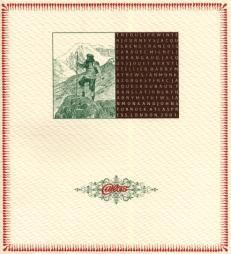
WinterJourneys

This collection, I should explain, is a very rare book. It was published by Atlas Press in a print run of less than 1000 copies. (My copy is #288, which may mean that as of a year or so ago they've only sold that many -- but perhaps they don't sell them in order.) It's not in any library in the U.S. that I've seen (not at Cornell or any of the affiliated Ivy League libraries, not in Harvard's library and not in the Library of Congress); for the most part U.S. bookstores haven't heard of it, either. If you want to read it, you'll probably have to buy it -- and buying it directly from Atlas Press seems to be the best way to do so.

In any event, in 1992, another member of the Oulipo, Jacques Roubaud, published a short story which is a sort of comment on Perec's story -- a story about Perec's story, which implies (or assumes) that most of Perec's story was, in fact, true, but not all of it. (Roubaud's story also deals in some way with Perec's last, unfinished novel, 53 Days, but since I haven't read this I can't really comment on this aspect.) Roubaud's story was "Le Voyage d’hier", which sounds almost (but not quite) identical to the title of Perec's story; it translates as "Yesterday's Journey". This story completes, alters and plays with Perec's story, but doesn't seem to demand any further additions.

A few years later, it appears, many other members of the group decided to get into the act, and wrote eight more stories, each building on the last in a similar fashion to the manner in which Roubaud's story built on Perec's story. I can't tell from reading them if they all planned things in advance, making as it were a collective novel; or if it just hit the group like craze (each trying out outdo the other); or if they planned to do a series of them but each worked individually after seeing what the previous writers in the chain had come up with. (I'm rather curious, to tell you the truth.) The entirety forms a chain, each altering the next, sometimes subtly, sometimes drastically -- adding new details to alter the meaning of what has gone before. (It reminds me somewhat of the comic strip Art Spiegelman did, "The Malpractice Suit" where he took an established cartoon and embedded it in larger drawings so as to totally change the meaning of each image (a few panels from it are here.)) All in all, there were ten stories -- Perec's original 1979 piece, Roubaud's 1992 follow-up, and then a series of eight more, half of which were first published in the Bibliothèque Oulipienne in 1999, half of which were first published in English translation in Winter Journeys itself (but which were published, in the original, in the Bibliothèque Oulipienne in 2001). Just as Roubaud's title did, the various titles are puns on Perec's original title in various forms. For the record, its contents are as follows:

Georges Perec, Le Voyage d’hiver (The Winter Journey)
Jacques Roubaud, Le Voyage d’hier (Yesterday’s Journey)
Hervé Le Tellier, Le Voyage d’Hitler (Hitler’s Journey)
Jacques Jouet, Hinterreise
Ian Monk, Le Voyage d’Hoover (Hoover’s Journey)
Jacques Bens, Le Voyage d’Arvers (Arvers’s Journey)
Michelle Grangaud, Un Voyage divergent (A Divergent Journey)
François Caradec, Le Voyage du ver (The Worm’s Journey)
Reine Haugure, Le Voyage du vers (Verse’s Journey)
Harry Mathews, Le Voyage des verres (A Journey Amidst Glasses)

Perec's story was, as I said, translated by John Sturrock; Harry Mathews, the American Oulipian, translated his own; all the rest were translated by Ian Monk. "Reine Haugure", incidentally, doesn't seem to exist; at least one web site claims that it is a pseudonym for Jacques Roubaud (which makes sense -- presumably once it became a group thing he wanted in on it, but didn't want to seem to do two pieces).

As a whole, I enjoyed the book tremendously. I will say that I found that it flags in the middle -- by the fourth piece the joke is getting a bit old, as well as drifting a bit from the original premise, a problem which increases in the fifth, sixth and seventh pieces -- although each of them has their good points, and it was only by "Un Voyage divergent" that I was starting to tire of the whole thing. But the last three each take a very different tack, and the collection rallies to end as strongly as it began. You definitely need to have a taste for scholarly mysteries of a slightly absurdist sort. But I found myself utterly entranced.

And for all that, I'm not (in some sense) the target audience. The basic story (although in the middle, as I said, it drifts off into other areas) is about late Nineteenth and early Twentieth Century French poetry -- which I've read fairly little of (and that in translation or, in a few cases, with the help of an English-language crib). I don't have much invested in that tradition -- which, I think, one really should if the pieces are to make the impact they're supposed to. Oh, one can imagine that when you read a list about Rimbaud, Mallarmé, Lautréamont, Kahn and Verlaine that it was about Yeats, Eliot, Pound, Frost and Stevens (not that the poets are alike -- I really wouldn't know -- but that the level of impact on French poetry of the first group is equivalent to the level of impact on English poetry of the second). But it's just not the same. -- Of course, anyone who really gets the impact can probably read these pieces in their original French (although I don't believe they've been collected in French, and the original Bibliothèque Oulipienne pamphlets are even rarer than the Atlas press book). And, despite not being its optimal audience, I did enjoy it, as I said. (There are also a fair number of Oulipo in-jokes that I noticed -- and probably many more that I didn't. A familiarity with the group and its works isn't essential, but it definitely helps.)

All in all, a very enjoyable read, and one which deserves to be far better known than it is -- easy to say, given that it basically isn't known at all. If you read the Perec story and enjoy it, I suspect you'll like the book overall (although the book takes on a bit more of a spy-story feel than Perec's story ever does -- although other works of Perec definitely are in that mode, and the spying is always centered around literary works) so do seek it out: it's not a book you'll stumble across.

(If you can read French, a brief summary of the book's contents -- with, so far as I can tell (I didn't take the time to decipher it properly), massive spoilers -- can be found here.)

Interestingly, it looks as if the series didn't end with those stories that were collected in Winter Journeys. Based solely on their titles -- I have nothing else to go on -- two recent numbers of the Bibliothèque Oulipienne look like they might be continuations of the chain. The first (#129, published 2003) pretty clearly is: it's called "Si par une nuit un voyage d'hiver". This is, of course, a direct reference to Perec's original story; it is also a reference to the novel If on a Winter's Night a Traveler by Italo Calvino -- himself a member of the Oulipo. Its author is named as one Mikhaïl Gorliouk, a character in Winter Journeys (presumably this is another pseudonym for a member of the Oulipo, although I have no idea which.) The second case isn't quite as clear from the title; it (#139, published 2005) is called "Le voyage des rêves" (by newly-minted Oulipian Frédéric Forte), which continues the "voyage to" theme and thus seems like it might be related -- but of course I can't be sure.

These, of course, haven't been translated into English yet -- nor reprinted. But I am intrigued enough that, if I can find the time, I may seek them out in Cornell's library (which does get the Bibliothèque Oulipienne pamphlets) and see if I can decipher the French. Most of the Bibliothèque Oulipienne pamphlets are beyond me, being not only in French but based on puns, literary allusions, etc; but these stories are, for the most part, more straightforward, so perhaps I'll be able to make something of it. If I do, I'll post a follow-up.

In the meantime, journey safely, this winter.
Wednesday, December 14, 2005

So THAT'S What Got Bill O'Riley Started...

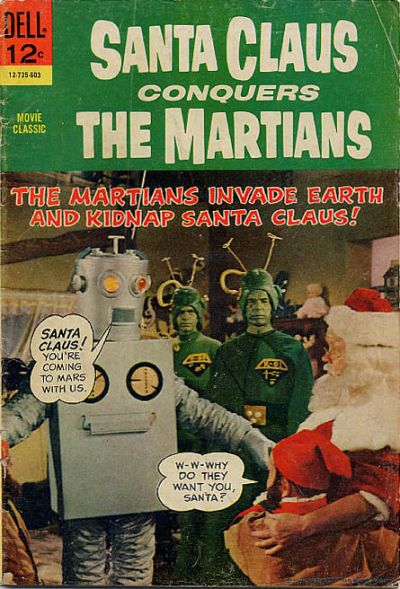
Obviously, Bill O'Riley's been reading the wrong comic books:

Santa Claus vs Martians

(via Yet Another Comics Blog's Christmas Cover Advent Calendar; click on the image for the picture in its full-sized glory...)

Update: It turns out that the movie that this comic book is based on is in the public domain -- and can be downloaded for free on the internet. Really, who could pass that up? (Once again via YACB)

I Have a Question! I Have a Question!


From the excessively interesting 3QuarksDaily:

Starlings are great mimics, which is mainly why Meredith West and Andrew King spent a decade studying nine of them at the University of Indiana. They kept four birds in isolation, while the other five lived "in close proximity to their human caretakers, with extensive and friendly bird- human interaction". Not surprisingly, only these five learned to copy human sounds, which they reproduced "in odd ways". "'Basic research' one said. 'Basic research, it's true, I guess that's right.' One bird, which needed to have its claws treated for an infection, squirmed while held, screaming, 'I have a question!'."

Disclaimer: the image above has nothing to do with the quote. It's not even a starling.

Wednesday, December 07, 2005

Recommended Reading: On Fiction

1. Strange Reading

One of the best uses of the blogosphere is for extended discussions of serious issues among many people. Doesn't happen as often as it should perhaps: but it happens a lot. The discussion about Off Center which I recommended in my previous post is one example; here's another, this time on a book I have read.

Norrell

One of my favorite novels from the past few years is Susanna Clarke's Jonathan Strange and Mr. Norrell. It's a superb book, one I'd recommend pretty much to anyone who likes to read fiction. Well, the good folks at Crooked Timber have done a seminar on it, where a number of posters have put up fascinating discussions of various aspects of the book. And they got Ms. Clarke herself to reply. The discussion isn't one that will mean much to those who haven't read the book, I don't think, but if you've read it, check it out. (If not, read the book! And then go read the seminar.)

2. Even Stranger Reading

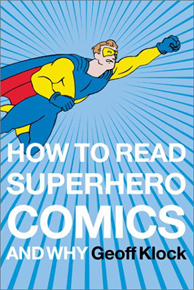
Geoff Klock wrote a bizarre, fascinating book called How to Read Superhero Comics and Why. As the title might indicate, it is a Harold Bloom-ian reading of recent superhero comics, starting with The Dark Knight Returns and Watchmen and ending with Planetary. I'm not sure I agree with Klock's central thesis but it's still a fascinating book, highly recommended for those interested in literary theory or comics or both (although his language may be a bit theory-drenched for some tastes). Strangely, I think his book is least interesting on Watchmen, which is probably the single best comic he discusses. But the book as a whole is very interesting.

How to Read Superher#62A2A8

Anyway, Klock has now published his first new writing since that book (that I've seen or can find, anyway), an essay entitled "X-Men, Emerson, Gnosticism". In it he reads (again in a highly Harold Bloom-influenced way) two recent runs on the X-Men, Grant Morrison's New X-Men and Mark Millar's run on Ultimate X-Men. I had actually read most of the former and all of the latter, so I can't tell how accessible the essay will be to those who haven't read them -- which doesn't mean it won't be accessible, it just means I don't know. But give it a try, because it's fascinating (it actually made me want to reread Millar's run, something of an accomplishment given that I previously had no interest in doing so (Millar's X-Men is fun but quite disposable)); and if you have read either comic, then do make a point of reading it. Kock's book, incidentally, is definitely accessible to those who haven't read all of the comics he talks about -- I read most of them because of Klock's book rather than the other way around.

3. Extraordinary Reading

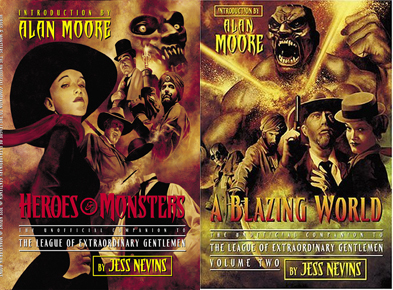
Jess Nevins did an amazing series of annotations of Alan Moore's comics series League of Extraordinary Gentlemen. These are on the web (here and here), but have also been published as two books, Heroes and Monsters and A Blazing World. The former included a brief, fascinating essay on the history of the notion of literary crossovers, from ancient Greece to, well, Alan Moore. The essay was not online for a long time -- but now he's posted it. Whether or not you've read Moore's comics (and they're terrific, highly recommended) the essay is wonderful, so take a look.

Nevins2

Recommended Reading: On Politics

1. Wars of Aggression are Wrong, and Other Facts We've Forgotten

I'm not a big fan of Huffington Post -- not against it, per se, just a bit turned off by the whole celebrity atmosphere of it -- so I almost never surf over there just to see what's being written. But I do follow links there and, via A Tiny Revolution, I've found that Larry Beinhart (author of the novel Wag the Dog, on which the film was based) has been posting up a righteous storm. His full of simple fury, and hasn't forgotten things that people like to forget, such as the fact that Al Gore really, truly won the 2000 election. But best of all he remembers this, from the genuine trial of the 20th Century:

War is essentially an evil thing ... To initiate a war of aggression, therefore .... is the supreme international crime, differing only from other war crimes in that it contains within itself the accumulated evil of the whole.

This was one of the chief accusations at the Nuremburg trials: that Germany made aggressive war. (It was the basis of two of the four counts of the indictment.) And Beinhart makes the point, the basic, indisputable point (hardly original, but made with simplicity and angry grace), that the U.S. War on Iraq was an act of aggression. It was not necessary for our self defense -- and that this would have been true even if Iraq had had WMDs (which of course it didn't) and that this is not changed by the fact that Saddam was a murderous tyrant (which of course he was). So go read. And then, while you're there, read Beinhart's other posts too.

2. Off-Centered Ideas

Over at TPM Cafe, Jacob Hacker & Paul Pierson are discussing their recent book Off Center, which everyone seems to agree is the best political analysis yet of our situation here in the Land of the Increasingly Less Free. While it definitely makes me want to read their book, I can attest that the conversation is valuable even for those who haven't. Start with their initial post which will give you a sense of where they're coming from, and then go on to read the whole thread. The one warning here is that theirs is not, ultimately, an optimistic reading of our current situation.

3. Quick Hits: State of the Union

Speaking of our current situation, we now live in a country where...

- Someone can be threatened with jail for maintaining his Catholicism and not converting to Pentecostal Christianity; (via via)
- Our CIA arrests a man on foreign soil, tortures him and holds him for five months before realizing he's innocent (his name was similar to someone else's (via)
- We hire mercenaries who kill Iraqi civilians without consequence (also via)

... And what's sad is how long this list could be continued. But those will do for today.

4. Arthur Silber has a new blog

I saw this some time ago, and added it to the blog roll, but haven't gotten around to mentioning it. My bad. He's one of the most interesting bloggers out there, so check out Once Upon a Time... (which, despite its title, is still mostly about politics, just as his former blog, Light of Reason, was.)

Saturday, December 03, 2005

An Even Briefer Poem

Having just updated my previous poem post (now in two languages!) about a six-line poem I really like, I thought I'd post an even briefer poem I like equally well.

Creation Myth On a Moebius Band

This world's just mad enough to have been made
By the Being his beings into Being prayed.

-- Howard Nemerov

(If you don't know what a Moebius strip is, start here. Incidentally, I've seen it spelt both Moebius and Möbius; I presume the former is an English adaptation to avoid the Germanic umlaut; if this is wrong, or you have more information on this, though, please do add a comment.)

Thursday, November 24, 2005

Happy Thanksgiving!

Serve the LORD with gladness: come before his presence with singing.... Enter into his gates with thanksgiving, and into his courts with praise: be thankful unto him, and bless his name.

-- Psalm 100:2, 4

Tuesday, November 22, 2005

Poem of the Day (Updated)

This is a long-time favorite of mine. It's from Stanislaw Lem's novel The Cyberiad, translated by Michael Kandel (pp. 50 - 51 of the Harcourt Brace paperback). In it, the robot inventor Klapaucius comes up with an assignment for his competitor Turl's new electronic bard...

The Assignment:

"Have it compose a poem -- a poem about a haircut! But lofty, noble, tragic, timeless, full of love, treachery, retribution, quiet heroism in the face of certain doom! Six lines, cleverly rhymed, and every word beginning with the letter s!"

The Solution:

Seduced, shaggy Samson snored.
She scissored short. Sorely shorn,
Soon shackled slave, Samson sighed,
Silently scheming,
Sightlessly seeking
Some savage, spectacular suicide.

Well, what do you say to that?

It's a marvelous poem, I think -- in itself, and particularly given the stipulations. But of course it is also an astonishing piece of translation: it is hard to believe it wasn't written in English. (Douglas Hofstadter talks about this aspect of Kandel's translations, though not that I recall in relation to this particular poem, in his delightful book about translation, Le Ton beau de Marot.) And a real question in my mind has always been what the original looks like. Alas, the Cornell library doesn't seem to have a copy of Cyberiada in the original Polish... (If anyone out there happens to know, do please leave a comment or email me!)

Incidentally, Googling around, I found that the opening of The Cyberiad, "How the World Was Saved" is available (in English) on Lem's web site. Check it out!

Update: Well, if I hadn't misspelled "Samson", my earlier Googling would have been more successful. It turns out that the Polish version of Lem's Cyberiada is online -- it appears in its entirety. At any rate, it gives us:

The Assignment in Polish:

Niech ułoży wiersz o cyberotyce! - rzekł nagle, rozjaśniony. - Żeby tam było najwyżej sześć linijek, a w nich o miłości i o zdradzie, o muzyce, o Murzynach, o wyższych sferach, o nieszczęściu, o kazirodztwie, do rymu i żeby wszystkie słowa były tylko na literę C!!

The Solution in Polish:

Cyprian cyberotoman, cynik, ceniąc czule
Czarnej córy cesarskiej cud ciemnego ciała,
Ciągle cytrą czarował. Czerwieniała cała,
Cicha, co dzień czekała, cierpiała, czuwała...
...Cyprian ciotkę całuje, cisnąwszy czarnulę!!
Now, I don't know a word of Polish. But even so it seemed pretty obvious that Kandel's version was an equivalent rather than a translation. (Note that that "d" in the third word of the fourth line is sic. I don't know what's up with that.) And the automated Polish-English translation program which I copied each into confirmed it (well, it produced a mishmash, especially of the poem -- but it was enough to show that the original was clearly something quite different than the translation.) So what does the original mean -- how would it translate literally?

Fortunately, it turns out that Michael Kandel himself has answered this question. Greg Keogh at the Nancy Street Network has a Stanislaw Lem page on which he describes emailing this question to Kandel. Kandel provided the following literal gloss on the Polish:

Cyprian the cyber sex fiend and a cynic, appreciating tenderly the miracle of the dark body of the Negro daughter of Caesar, constantly wove charms with a zither. She blushed all over, silent, waiting every day, suffering, watching ... Cyprian kisses her aunt, have abandoned the black beauty!

(Of course the paradigms given the machine are quite different.)
Unfortunately, Kandel didn't give a literal gloss on the Polish paradigms (the "assignment" as I've called it). But this gives a sense of what the original is like -- and hence what Kandel was up against.

I still think "Seduced, shaggy Sampson snored..." is a terrific little poem. The question is: given that it isn't really a translation of Lem's poem (but rather an English equivalent of it), but one that occurs in a translation of Lem's novel and wasn't offered for independent publication -- who should be credited as the author of the poem? Lem? Kandel? Lem as translated by Kandel? Both in collaboration?

Hirshman on the Home Front

Linda Hirshman's article, "Homeward Bound", in the American Prospect, is bound to create a lot of controversy. It's almost axiomatic: it's about gender relations which, along with sex and religion, is what controversy is largely about in the U.S. these days. (Though it hasn't yet. I rather thought that the feminist blogosphere would start in on the piece immediately; but checking around a few sites -- Pandagon, Alas, Feministe, Majikthise, Echidne, some of the sites that took the articles which Hirshman mentions early on to task -- I haven't seen anyone mention it yet, to complement it, critique it or any combination.) But it's coming, I'd think. Indeed, I rather suspect that the controversy will touch every bit of it as time goes on. For starters, then, here are a few off-the-cuff reactions to the article.

(Note: I won't be talking about every aspect of it. For example, I won't talk about the question of data and whether the phenomenon she is talking about is, contra the blogosphere's reaction to earlier articles on the topic, real or an anecdotal mirage. I won't be talking about it because I have neither knowledge on the matter nor the impulse to go get some. So these reactions are simply to things that caught my attention.)

What I liked in the article was the counter to the conservative it's-biology's-fault answer to the problem of female under-representation in the professions. I also liked one of her central replacement answers: ask more of men. I think that she's probably right that domestic relations remain unequal, that this has a big effect on women's careers, and that this is, ultimately, an unjust social situation that must be changed. And that to do this, men must take on childrearing and household duties to the same degree that women do.

There were things I didn't like. She acknowledges the elitism of the topic -- " most people aren’t rich and white and heterosexual, and they couldn’t quit working if they wanted to", she writes towards the article's end -- but I think it's a more central fact than she gives it credit for. Some of her suggestions (marry older? marry poorer?) make my skin crawl, if only at the sheer, relentless pragmatism they show. (I think her other answer -- marry someone with a raised conscience -- is a much better one; even better is one she doesn't raise -- make sure you raise the conscience of whomever you would otherwise marry (hard, to be sure -- but so are the other possibilities on offer.))

Even more, I didn't like her taking of the culture of elite work -- that elite work must demand extraordinary hours and a willingness to make everything else in one's life secondary if not tertiary or quaternary -- for granted. She writes as if this inevitable, and that the answer is (therefore) to negotiate around it. But I think that if we are going to set out to chance family life -- no small task! -- we should change our culture's insane notion of workplace expectations, too. Nor are these separate tasks: if enough men as well as women prioritized family, then workplaces would have to change, since they couldn't find people to fulfill their insane schedules.

As part of this, she has a brief section casting scorn on liberal arts degrees, encouraging women to pick their educations with career-goals in mind. Good for people's careers, maybe (although not definitely). Good for people's humanity, our society's sense of priorities -- not at all. I wish more people, men and women alike, majored in the liberal arts; I wish that our society valued things besides careers more.

And the same goes double for her suggestion that careers be evaluated on the money they pay since that is our society's currency. (And I have to say that, personally, I think the world would have been much better off if Condoleezza Rice had in fact been a pianist. And if George Bush had been the brink-of-bankruptcy used-car salesman he was clearly made to be. But that's another issue.)

Towards the end of her essay, Hirshman writes that "a good life for humans includes the classical standard of using one’s capacities for speech and reason in a prudent way, the liberal requirement of having enough autonomy to direct one’s own life, and the utilitarian test of doing more good than harm in the world." Well put. But a good life for humans requires keeping work in its place, evaluating life choices by standards besides monetary ones and learning for reasons apart from cold calculation (at least in societies and sub-cultures rich enough to afford these luxuries, which are clearly the ones Hirshman is discussing.

Hirshman argues that the home front must be for feminism what the workplace was in the 1960's and the vote in the 1920's, suggesting that this requires a more radical feminism than we have grown accustomed to. Fair enough. But I'd like to see a feminism (and a humanism) radical enough to challenge the workplace values that saturate our culture at the same time, too.

Preliminary thoughts, as I said. In any event, the article is interesting, and, agree or disagree, is well worth reading.