Thursday, September 13, 2007

The Writer as Werwolf: Mixed Thoughts on a Wizard Knight

I just finished reading Gene Wolfe's two-volume novel, The Wizard Knight, made up of The Knight (2004) and The Wizard (2005). The following is a long essay reviewing (in some sense) the work, focusing on what I found problematic about it, rather than the (quite considerable number of things) I liked in it. This review-essay will have spoilers -- not major ones, but existent ones -- for the entirety of the work. Now, I'm not spoiling, I don't think, any of the Big Secrets from the book -- certainly not from the second half, where they cluster. So, in my opinion, there's nothing here that would really "spoil" a first reading of the work if you haven't read it yet. But if you want to approach it with no knowledge whatsoever, you should stop reading here. (Oh, and I guess there are spoilers for The Lord of the Rings too.) And if you're wondering why I tagged this with politics, keep reading -- I'll get to it in the end.


I think my most basic reaction is that it's good but not Wolfe's best -- not up there with The Book of the New Sun or The Fifth Head of Cerberus, say. That it's well written is not in doubt: it's by Wolfe, after all. But I had some problems with it -- some of which are probably in my head, some of which are in the work, and some of which are in the chemical mixture of the two.

It's hard to criticize Wolfe, though, because of his reputation as a trickster: if you present a negative opinion of anything the man writes, you instantly lay yourself open to the charge that you just didn't get it. And not infrequently the charge will be valid. But it won't always be valid: Wolfe is human, humans are imperfect, and even Shakespeare wrote some clunkers. And while a lot of aspects of Wolfe's fiction are far more complex than they appear even at third glance, other aspects are, finally, not: they are straightforward, despite the efforts of Wolfe's more serious fans (an overlapping but not identical group to Wolfe's more serious readers) to try and make them so.

And, for me at least, it's even more intimidating when the backs of the books are filled with breathless praise from some of my other favorite writers: Neil Gaiman! Kim Stanley Robinson! Everyone seems to agree that this is the very best book since Wolfe's last very best book, and you just have to love it!

Well, I didn't. I liked it, but also had some real problems with it. So at the risk of derision for missing the point, I'm going to begin with some straightforward critiques of a writer who (in John Clute's apt words) "has never in his life told a straightforward tale".

I think the first half of The Knight was slow. There were a number of places where, if the book hadn't said Gene Wolfe on the cover, I would have given up. Partly this was because the book, while being slow, presented itself mostly as an adventure book: it was not slow in the good way that, say, Proust is. It was slow where it shouldn't have been. For me, at least, this lessened as I went along, and by the end of The Knight I was fully gripped, and stayed so through The Wizard.

In a related criticism, the book was unevenly paced. This is related, not identical, because I'm not just referring to the first half of volume one. The rest of volume one and the first two-thirds or so of volume two, while never (for me) dull, proceeded at a stately pace through the events of the tale -- leaving the ending to be told at breakneck speed and with more-than-usual abridgement. Parts of this are due to Wolfe's habit of telling the most serious parts of his stories by indirection -- but only, I think, parts.

Wolfe's uneven pacing is actually habitual for him -- there are traces of it in The Book of the New Sun, and it's a more serious problem in The Book of the Long Sun. And at this point I'm coming around to the belief that while this is partly due to careful authorial craft, it is also partly a failure of it: Wolfe simply gets too wrapped up in the early stages of some of his adventures and tells them at (at times) tedious length.

Wolfe, as has been frequently noted, writes puzzles, works which hint at stories and cosmology and theology which are only partly and obscurely visible on the surface. But he also writes (and clearly likes to write and, from what he's said of his reading tastes, likes) adventure stories which form the surface under which those puzzles move. And while Wolfe is a genius at writing puzzles, he is, I think, uneven at writing adventures. He likes it more than he's good at it. And I find that my favorite Wolfe works are often those where he doesn't try -- in his short stories, for instance, in which he is often simply doing something else.

There are a lot of interpretive puzzles in The Wizard Knight, as there are in all of Wolfe's work. Some of them I got the first time around. Others I didn't; still others I probably even missed the existence of. And I feel that if I reread it -- particularly, if I reread it right now, with the first reading fresh in my mind -- I would probably get a lot more of them -- might understand, to pick one example out of many, what the complex relationship between Mythgarthr and America was supposed to be, a relationship (along with the relationship of parallel or crossing characters) which Wolfe hinted a lot about but did not make clear -- at least to me -- on the first reading.

But, frankly, I didn't like it enough to want to reread it -- certainly not now. (Other Wolfe works I have liked enough to reread them, whether I found time to or not.) I'd rather read something else -- even something else of Wolfe's. Wolfe's puzzles are marvelous, but if the supporting structure isn't good enough, I don't want to take the time to figure them out. And at least in the case of The Wizard Knight, I didn't.

On to other topics.

I think Wolfe's writing of Able's voice was profoundly uneven. Usually in a high and archaic register, it would lapse at times into slang -- into (to my ear) outdated slang, slang that uneasily mixed contemporary life (macs) with some sort of parody of fifties usage (swell!). The slang itself was jarringly inconsistent; and the mixture of slang into otherwise unbroken pages of high-register speech (both dialogue and the narrator's voice) was frequently awkward in the extreme. Wolfe has said in an interview that he didn't have any trouble writing a modern teenager, since he knows them and lives near them; but I think there was a real failure of tone here. Now, maybe, this is all part of some complex Wolfean trick, some deliberate mixture of tone which served some thematic, portraiture or other purpose... but I sure didn't see it. Until someone convinces me otherwise, I think this is simply a failure on his part.

I should perhaps mention that there was a lot to like here, since I've so far been mostly negative. It is, as I said, well-written (save for the -- thankfully not all that frequent -- lapses in tone just noted); it is mostly exciting. The cosmology was fascinating, the magic mysterious, many of the characters quite interesting. The reinvention of by-now standard fantasy elements -- the Norse mythos, elves, and lots more -- was refreshing and fun. There's a lot to like here.

But I think my biggest complaint -- my biggest stumbling block -- was a pair of intertwined issues: the character of Able, and the ethics (even, politics) of the book.

First off, I found Able frequently insufferable. Pompous, self-righteous, frequently a bully, he also came off as a Mary Sue (at least in one sense of that polyvalent term of fan critique): not only was he the most courageous and noble person about, but he also had the writer stacking the deck for him at every turn. He had more magical allies, artifacts, assistants, companions, than you could shake a stick at: an invisible ogre doing his bidding! A sky-wolf who happened to be totally loyal! Elves (called Aelf) who were his slaves (yes, not always reliable, but often enough). A magic sword, the blessing and friendship of Odin, various other magic devices he got at the end (the helmet, another sword). Heck, he even becomes a god halfway through the work! Talk about favoritism!*

This sort of stacking the deck is hard enough to take when the writer has some self-consciousness about what he's doing, but I didn't see any sign that Wolfe did. He simply loved his creation, and showered him with so many cheats and advantages that any honor he might have accrued felt like a cheat.

Able adjusted with damning speed to the hierarchy of a medieval society. Here his American origins were least convincing, if not downright morally foul. It's natural for those raised in a profoundly hierarchical society to accept it as normal, to expect deference from the lower-born and give it to the higher. But it's inexplicable for an American -- even an American boy. It makes Able seem like a deeply immoral man -- in a way that no one else in the novel seems immoral, since after all, no one else in the novel ought to have a cultural grounding in notions of equality and the malevolence of fixed class. Oh, sure, this is not absolutely true: Able makes no effort to hide his peasant ancestry, and seems to think it doesn't matter, so he's certainly less class conscious, more egalitarian, than most of the people he meets. But he also expects an enormous level of deference from his "inferiors", and seems to regard his "superiors" has being due a great deal of it. And yes, he was frequently kind, even generous to those below him -- but in such a way that their status was perfectly clear.

For me, the incident that stuck with me was the one early on in The Knight where Able went to get a sea-berth on a ship. Quoted a price by the captain, he insisted on having the best cabin (turning the captain out) at less than half the price quoted... and to get it, he literally threatened the man's life. He acted, in short, like the brigands whose thievery he used to justify their slaughter not a few chapters before, taking what he wanted because he wanted it, and -- and in some sense this was, to me, even more damning -- because he clearly felt that it was his due as a knight.

Again, if there was any sign that all of this that Wolfe was presenting a critique of Able, that would be fine. If he was being presented as a boy who hadn't learned better, or a man trying but failing to be good... but while Wolfe's reputation as a subtle writer might make one reach for such an interpretation, I didn't see any real signs of it in the text. I got the impression that we were simply supposed to think Able was a good and admirable person, that Wolfe certainly thought so, that he was blind to all his (quite damning) flaws.

Adam Stephanides, who hated The Knight (which, I hope I have made clear, I didn't), nevertheless has a passage in his self-described "rant" about it that strikes me as sadly on the mark:
Sir Able of the High Heart, the Uberknight who his inferiors willingly submit to (if not, they're treacherous curs, whom he rightfully punishes), not any of the other characters, not the world, and not the plot, such as it was. Able doesn't behave like an adolescent, magically given an adult body or not: what he does behave like is an adolescent boy's fantasy of how he would behave if given a powerful adult body. Nor does he sound in the least like an adolescent, contemporary or otherwise. When Able talks to other characters, he sounds like the generic Wolfe Competent Male; when he's narrating, he mostly sounds like Hoof, except when Wolfe throws in some incongruous "poetic" passages, or remembers that Able is supposed to be a modern teenager and tosses in a reference to Macs or baseball.
Overly-strongly put. But not, I think, fundamentally mistaken about the problems of the book.

And Wolfe's apparent (and, I believe, genuine) fundamental admiration for Able connects to the deeply problematic ethics of the work as a whole -- and, finally, to its politics.

One of modernity's powerful cultural changes was the rotting of the chivalric code. It's crucial to remember that this happened, not due to our inability to live up to, but to historical events' revealing of its essential malevolency -- at least in the context of a (technologically, socially) modern society, if not in general. The most famous articulation of this point, I believe, is Hemmingway's, in A Farewell to Arms:
Abstract words such as glory, honor, courage, or hallow were obscene beside the concrete names of villages, the names of roads, the names of rivers, the numbers of regiments and the dates.
What I found most profoundly disturbing was the sense that what Wolfe was ultimately trying to do was to redeem words such as glory, honor, courage or hallow -- words that, for inescapably important moral reasons, have indeed become (if indeed they were not always) obscene.

And this, at least, I don't think was my simplifying the work of a complex writer. (Rather, I think this was my (liberal) reaction to an essentially very conservative writer.) For Wolfe said as much in an interview he did with Neil Gaiman. -- True, he can be as cagey and mysterious in interviews as he is in fiction... sometimes. But not always: and I submit that anyone who sees the following as other than straightforward is probably over-reading. Here is the exchange (I've abridged Gaiman's question):
Gaiman: [A] hundred years from now... a teenager [reads The Wizard Knight]. Where do you hope The Knight and The Wizard will take her?

Wolfe: To a country where honor, courage, and fidelity actually mean something. The whole knightly ideal came into being because the fighting was so close. Ordinary people saw who defended the castle and who hid in the wine cellar, who went for the enemy while his followers, well, actually followed instead of doing all the fighting for him. Communities were small; everybody knew how everybody else behaved. I want her to see what those qualities can mean to the person who has them and to those around him.

Gaiman: That's really cool. And, for want of a better word, noble.
Actually, I don't think it's cool. And I certainly don't think it's noble. I think it's, at a minimum, profoundly disturbing... arguably even, in Hemingway's word, "obscene".

And along with honor and glory and fidelity come hierarchy, and servitude, and subservience, and caste: all right there in Wolfe's book, just like the world. Along comes all the horrors of pre-modern society that were destroyed by it, even as it introduced new horrors of its own.

Now a great deal of fantasy -- not all of it, but a lot of it -- is written in a spirit of nostalgia for the pre-modern world. This nostalgia takes different forms and has different (moral, literary, personal) meanings. But I must admit I've never found it as disturbing as in Wolfe's Wizard Knight. For comparison, let me talk about Tolkien's Lord of the Rings, not only the inescapable point of comparison for almost any high fantasy work (at least in a basic sense, i.e. a fantasy work set in a world different from our own), but as a book which Wolfe and I (and half the reading world) share a love for. Because, despite Tolkien's clear nostalgia for pre-modern times, I didn't, and don't, find it nearly as problematic as I did Wolfe's Wizard Knight. Why?

Well, first off, Wolfe brings a purportedly modern voice and perspective into his pre-modern times... and has it swallow them whole. Tolkien, of course, sets his work wholly within a different time, so the lack of a modern ethical perspective is reasonable, even essential. But for Wolfe not to confront these issues implicitly ratifies things that Tolkien needn't deal with.

More importantly, for Tolkien, the good is more complex than it is for Wolfe, at least for Wolfe here. While Tolkien's characters strive to do right, The Lord of the Rings is above all about the corruption of power, the corruptibility of good intent, and the terrible dangers for even those who strive to do right. I don't see any of that in Wolfe's Wizard Knight. As my favorite reader of Tolkien, T. A. Shippey, has noted, the ring and its thematic motif of the corrupting nature of power bring into Tolkien the one modern element in an otherwise pre-modern work. That is, Tolkien brought into his work some of the complexity from the modern world -- and it made his work as rich as it is. Wolfe brought in a modern element, seemingly just to show that nothing from America really needed saving or really had any valuable perspective lacking in the pre-modern world.

Similarly, for Tolkien, the evil seems far more evil than it does for Wolfe -- and far more tied to the basic issues of war and power. It is the desire for control, for gain, that is fundamentally wrong in Tolkien's work... and we see, quite powerfully, their result in things such as the powerful, Great War Trench-influenced depictions of the broken land of Mordor, and in the vivid depictions of the scouring of the shire.** Now, we see, at the end of The Wizard, some of the ruinous effects of war... but not with anything like the vividness and power in Tolkien. More to the point, Wolfe doesn't portray this as the outcome of war, but the outcome of the good guys loosing: you don't see any sense that if the humans had simply beat the Osterlings (and we are told very specifically that this begun with a raid on their lands for gain, something presented as straightforward and not at all morally troubling) that there would be anything wrong. In Tolkien, war is shown as something necessary due to a fallen world, something which is itself part of the corruption even of the good: in Wolfe, it's only too bad when you loose, and all the jousting and ridiculous fights of honor he portrays are simply something it would be jolly good to have back. (I exaggerate, but not as much as I wish I did.)

And finally, of course, Tolkien was writing long before our time -- before my time. The Lord of the Rings was written, in significant part, during the Second World War; The Wizard Knight was written, in significant part, during the so-called War on Terror. The world is different now. And that means I experience the works differently.

And here we get to something which is probably more my failure than anything else.

You see, I am far, far more suspicious of "words such as glory, honor, courage, or hallow" in the present -- say, the last six years -- than I am from before. And I think that is because so many Americans experienced the attacks of September 11 as an immediate and unproblematic redemption of them. Yet it seems to me that one crucial component of the horrible mistakes and unforgivable evils that our country has committed in the past six years was precisely that redemption: of our thinking, far too much, about glory and honor and courage -- not to mention "evil doers" -- and far too little about the names of villages.

The truth is, I read The Wizard Knight with these words -- Wolfe's reaction to the 9-11 attacks -- ringing in my ears:
We will be told that the perpetrators (and only the perpetrators) must be punished, and that the greatest pains must be taken to make certain no innocent person suffers. That sounds much better than saying no action should be taken, but it comes to the same thing. The perpetrators cannot be punished. They died in the planes they hijacked and are beyond our reach. It is not possible to fight a war (not even a losing war) without causing innocent people to suffer.
And I thought a lot of things about them. For example, I thought that with only the smallest tweaking, they could sound like the justifications that the 9-11 attackers might themselves have used: oh, unlike what Wolfe is saying, the "perpetrators" that they would have been talking about were probably not doing crimes that I would say were clearly such. But the argument would have been the same: we can't fight a war without causing innocent people to suffer. If we aren't willing to kill the innocent, then we can't do anything. The actual perpetrators (say, the government of the U.S.) are beyond our reach, but that doesn't mean that no action should be taken. And so forth.***

(I don't want to get too sidetracked here, but of course Wolfe's comment makes an assumption, the basic mistake that has been at the root of so much of our national crimes and mistakes and lost opportunities in the past six years: assuming that "action" means "war", and that no war means no action. After all, in the legal prosecutions of criminal gangs, it is possible to make sure that only the guilty suffer -- or, at least, far, far more sure than in any war. That if we had responded to Al Queada not by comparing them to the Nazis, but by comparing them to the Mafia, all might have been different.)

But hate it or not, the politics clearly effected me here. I'm sure that the complexities in Tolkien that were lacking in Wolfe's Wizard Knight are a large part of my reaction to it. But the fact that Wolfe, a conservative writing in my time, a time when conservatives have done so much horrible damage to our country and the world, was a big part too.

And I hate this. I hate that my experience of what is, after all, a fantasy story unconnected to the present day, is colored by politics. I hate that my experience of the writer who, for all his failings, is one of the best writers working today (in fantasy or out of it), is colored by my knowledge of his politics.**** I hate that I can't just see the dragons and The Knights, but instead see the calls for further U.S. crimes and blunders and wars.

One of the personal things I blame Bush and his followers for is that they have created such a terrible, poisonous, and down-right evil atmosphere that I am far less capable of seeing things in political terms than I used to be -- far less capable than I would like to be.

I suspect that even in happier times I would have found The Wizard Knight flawed -- for its pacing, for its main character, and, yes, for its deeply problematic medieval ethics. But only nowadays would I experience this as finding it flawed for its politics.

In this sense, and this sense only, I guess I, too, wish I could go back to simpler times.

Update, 9/18: In a "where angels fear to tread" spirit, I cross posted this review to the Gene Wolfe discussion board at urth.net. As you might expect, the people who frequent that board are, typically, huge Gene Wolfe fans (as am I, really, this review notwithstanding). So there have been a few responses to my review -- three so far, although I hope there will be more. So if you're interested in a fairly different perspective than mine here, surf over there and check it out (the link is to the first post; clicking "next post" should get you to the other two). Later Update: there have indeed been more posts; lots of interesting points of view. Keep clicking next post from that link above, or see this page for links to all the responses.

_____________________________________
* Other writers have complained about the split focus in The Wizard between Able and Toug. I, actually, felt that that was one of the things that The Wizard had going for it: it spent more time focusing on people who were more complex, less Blessed by The Gods (i.e. by Wolfe), and thereby were, to me, far more sympathetic and (ultimately) admirable characters.

** Not in the films: to me, this was the single least excusable change in Jackson's adaptation.

*** Well, if he was worried we wouldn't kill enough innocent people, Wolfe can rest assured that we have done a bang-up job of it. (/political bitterness)

I don't mean here to say that any support of a war is equivalent to terrorist thinking; I'm not a pacifist. (Why do we always feel we have to say that? That must be one of the most repeated sentences in the country in the last few years.) I don't think war is always wrong. But I don't think war should be used to punish; I think it should be use to defend. And the latter involves not killing civilians. I'm not talking about anything more complicated than just war theory here -- a theory that the Catholic church has done a lot to develop, mostly (from what little I've seen of it) along extremely sensible lines. Wolfe, famously, is a Catholic; but I don't see the influence of Catholic thinking about war in this statement.

**** Wolfe has said (I don't have the reference handy) that he used to be a Bucklean conservative, but that now his politics are unique and personal. Of course, there are a number of political positions in this country -- minority positions, but ones with millions of followers -- whose adherents frequently view themselves as possessing unique, personal, non-partisan politics which they alone have the objectivity and distance to see. Many of these are some variety of conservative; and I think there's plenty of evidence that Wolfe fits into one of these camps. If someone wishes to correct me -- not by saying I shouldn't use his politics to judge his works (I agree), but that I've gotten his politics wrong -- then please do so.

Wednesday, September 12, 2007

Shana Tova!

Happy New Year to any and all of my fellow Red Sea Pedestrians out there. And, if you'll accept the cross-cultural salutation, to everyone else too. May you all have a good and sweet new year.

As seasonally appropriate amusement, check out this video, Shofar So Good. Watch it sometime over the next two days, to get the year going right, and then say a blessing hoping for a light and funny year. We could use one.

Shana Tova!

Two of Our Finest Have Fallen

Less than a month ago, seven American soldiers had the courage to tell the truth about what they saw in Iraq.

Monday, two of those seven died. (via)

RIP Sgt. Omar Mora; RIP Sgt. Yance T. Gray.

Update: Actually, it turns a third already fell: Fred Kaplan notes that "
One of the other NCOs, Staff Sgt. Jeremy A. Murphy, was shot in the head during a firefight before the op-ed piece was published. (Rushed to a military hospital, he is alive but recovering slowly.)" (via) If Bush and Cheney had a tenth of the honor and courage of any one of these soldiers, they would have resigned by now. If not turned themselves into the Hague and plead guilty of war crimes.

Tuesday, September 11, 2007

Grief and the Uses of Grief

Six years ago today.

It is always tempting to turn the dead into a symbol, because it allows us to avoid, in some small way, the actual death by focusing on something else. Death means gone, vanished, annihilated: it leaves only a gap in the world, a hole where something -- a human being, endlessly rich in its strange uniqueness -- used to be. Even if you believe in an afterlife, death means that the dead are utterly gone from this world -- the only world we, here, can know.

Symbols are easier. Symbols allow us to mitigate, to some degree, the loss, by focusing on themselves, the reflection which remains, and not the reflected which is gone. Thus we speak of the things, the people, the ideas, the causes, to which people were committed: their work, their ideals, their memories shall live on. It's a form of denial: embracing tasks, beliefs, communities, or stories in the place of the actual human being, who is just dead.

Human beings can't stand meaninglessness, so we make the void mean something. Or we submerge the person to a large whole, and focus on that.

It can be moving. It can be powerful. It can be all that holds us together in the face of simultaneously unbearable and undeniable absence. Let me be clear: I am not saying that it's always wrong. We all do it. It may even be inevitable.

But it is inevitably distorting. Distorting of the dead, who are reduced to a fragment of their real selves, a reflection of a full human being. And distorting of our loss, which is lessened by a focus on things which continue -- ideals, institutions, surviving people, necessary work, memories of those gone -- and not on the actuality of what is not.

One powerful example for me comes by way of Hendrik Hertzberg, who describes the following scene at the recent Yearly Kos convention:
In his closing keynote at the closing session of the convention that will no longer bear his nickname, Markos Moulitsas ZĂșniga chokes up a bit when he mentions the recent deaths of two longstanding friends and colleagues in developing the liberal blogosphere, Steve Gilliard and Jim Capozzola. He says he had first thought of asking for a moment of silence in their honor. But no, he adds with a sad smile. “We don’t do silence.” The crowd responds with a standing, cheering ovation.
It's an incredibly moving moment, even reading about it; I can't imagine what it was like to actually be there. A marvelous affirmation in the face of loss. If I'd been asked to speak, and had had the wit to think of it, I'd have said it to.

But look at what it does. It cheers the living by focusing on what exists, turning away from what is gone. "We don't do silence": an affirmation of the (genuinely quite important, in my view) ethic and importance of the left blogosphere, an affirmation of the work that was (I'm sure quite genuinely) so important to both Steve Gilliard and Jim Capozzola, a call to continue. Rather than a focus on what was gone.

As I said, maybe inevitable. Not always wrong, certainly. But always distorting.

And often we are upset when the dead are (as we see it) distorted. To take another recent example, the blogger Jewish Atheist relates:
Once, I attended a funeral of one of the most loving, cheerful, generous, and entertaining men I'd ever known.... During the eulogies at his funeral, I was dismayed to hear nothing about his kindness, good cheer, or overwhelming generosity. All of the speeches were about how religious he was and how devoted to learning Torah. Those things were also true about him, but they didn't reflect what he was like as a human being and I was sad to know that what had been to me his most unique and affecting qualities were not even related to the enormous crowd that attended.
The writer felt that the specificities of his friend (which I have, perhaps wrongly, omitted with an ellipsis) were being distorted: that a real human being was reduced to one aspect, one cause -- learning Torah. And note, again, why: the very real absence of the dead was mitigated for the mourners by drawing their attention to something which would continue to exist -- something which they could themselves do, and thereby (the implication is) lessen the loss, to however small a degree.

But it's not the dead we're remembering. It's their shadows: their outlines, alike in form, different in being a flat patch of shade rather than a real, live person. We look at what remains.

If it's distorting for one person, it's all the more distorting for a group. Any one person, after all, probably did have particular causes, ideals, efforts, things or people to which they were committed; so that to cast our attention that way is at least something of which they might have approved. Since we are all, inevitably, lost in death, we often wish to be remembered for our work, our loves, our struggles, our hopes. So this distortion, in addition to being inevitable, is perhaps welcome. It is, at least, reasonable.

But when we reduce a group, we reduce them to something even more general, even more distorting, than almost any reduction of a single individual. Something that, inevitably, some of them weren't focused on; perhaps something that they didn't even know about.

It is a double distortion, in which the dead vanish even more rapidly than in our normal memorial practices.

So in the best circumstances, now, six years later, most of us would be hardly able to see those lost on September 11, 2001. Not their family, not their friends, not their colleagues; but those of us who didn't know anyone, personally, would have, inevitably, reduced the 2,973 innocents murdered on 9/11 to the shadow of a shadow.

But, of course, the situation is worse than that. The double distortion -- a mass death, a group of human beings dissolved to a mass, and then filtered through the distance of six years -- has itself been radically distorted in the past six years, to the point where I, for one, can hardly see through the haze any more.

I speak, of course, of the political use of 9/11 -- the foul and evil use to which the memories of those 2,973 murdered individuals have been put. The tragically and foully murdered have been hijacked a second time, and become, again, helpless passengers on a death-ride to the slaughter of innocents. For practically since the day they died the malevolent leaders of our benighted country have invoked -- in a slippery way, a way hard to pin down and call for the essential lie that it is -- the memories of those slain six years ago to justify an immoral war, a war of aggression, a crime against peace, against a country that had nothing to do with the murders invoked to justify invading and occupying it.

And, of course, to this very day they are still dishonestly invoked, not only to retroactively justify an unjustifiable war, but to argue for the continuance of the occupation. Our grief is still distorted beyond recognition, and mis-aimed, to justify ongoing death and destruction. Like a plane, meant for travel but turned into an instrument of death, our fear and grief and loss is repurposed into a psychological instrument for the continuation of immoral war

So how, now, are we -- the majority of us, who did not personally know someone who died six years ago in those horrific murders -- to grieve?

How are we to experience the damage done to our country, to our world? After all, even ignoring (as Americans all-too-often do) the hundreds of thousands (perhaps a million or more) of Iraqis who have died due to Bush's war of aggression, even focusing (against the dictates of our common humanity) only on the loss of our fellow citizens, still, more Americans have died in Bush's war than died in the murders which he mendaciously used to justify it. If it's innocent death you want, Bush has caused far more than his share.

How can we now mourn?

I'm not sure we can. -- At least, I'm not sure I can.

I, for one, am not sure I can any longer truly see the event, so overlain it has become in my mind by the foul misappropriation of it. A horror that should have brought us together, to repair and heal the world, has become another tool of immoral violence and fear-tactic politics.

A genuine tragedy has been graffitied with war-mongering propaganda. Deaths have become justifications for more death. Grief has become a slogan, a call for war.

Alas for our country!

We come today to grieve, to remember: and we find that the grave has been defiled. Now, look as we might for a symbol of our loss, all we see are the sprawled symbols of the defilers, those who have so proudly stood upon the missing shadow of two ruined towers, and called for more war.

Six years ago today. I would say "rest in peace", but the words stick in my throat. They are not allowed to rest: and there will be no peace.

Six years ago today. But still the air is too thick with smoke to see it. We should grieve: struggle to remember the real people behind the shadows that are all, inevitably, that we can now see. But all I can do today is choke.

Monday, September 10, 2007

RIP Alex the Loquatious Parrot

I just found out that one of the most famous birds in the world died last week. Alex was an African Grey Parrot who had been taught by Brandeis professor Irene Pepperberg for years. He knew more words than any other known bird, I believe (more than a hundred); Dr. Pepperberg believed he understood all sorts of abstract concepts, including that of zero.

Dr. Pepperberg wrote a book based on her work with Alex called The Alex Studies: Cognitive and Communicative Abilities of Grey Parrots, published by Harvard University Press in 1999.

Alex died at the age of 31. He worked through the last week of his life -- "on compound words and hard-to-pronounce words" according to the NY Times obituary from today.

More Alex Links:
Alex's home page (with information about Dr. Pepperberg's research) is here.
Video of Alex (and Alan Alda) here. Really worth watching him in action (Alex, not Alda).
An older article about Alex from the Times can be found here.
Alex's Wikipedia page is here.
NPR Story about Alex's death is here.
An article by Dr. Pepperberg about her research with Alex is here.
(Update, 9/18) Alex's obituary in the L.A. Times is here. (via)
and the Boston Globe's article (not as obituary like as the NY or LA Times) about Alex's death & bird intelligence more broadly is here. (via)

Rest in peace, little guy.

Update: Just to be clear, I had not yet seen Grrlscientist's blogging about Alex when I chose the same picture that she did (I got it from here), and when I came up with the same final line as she did. Her posts are worth a visit, though (the former is her main post on the topic); Grrlscientist is a biologist, and even met Dr. Pepperberg, so actually, y'know, knows what she's talking about.

Link Round-Up for September 10, 2007

All politics this time...

• Two bleak but elegant summations of where we are now. Although I don't agree with it completely, I think that the first of these is the one link from this round-up that I would most hope my Noble Readers would read:
- Chris Floyd, Post-Mortem America
- Tom Engelhardt, Empire of Stupidity

• As Petraeus delivers his oh-so objective report, a very good post by Kevin Drum called "The Chaos Hawks", about the devolution of pro-war hawks and what they are arguing for. The call for the utmost suspicion of these people is implied, but no less convincing for that. (I'm not going to link to the numerous proofs of Petraeus's political hackery or the essential mendacity of the supposed success of the surge, because they're all over the place and I assume everyone's seen them. If you haven't, leave a comment and I'll add them in an update. Or just open your !@#$% eyes.) (Update: Drum has a follow-up post here.)

• Jonathan Schwartz on the Iron Law of Institutions. He's writing in the context of those of us who are furious at the Democrats right now, but I think he's onto something bigger about how institutions work in general.

• Reporter Chris Hedges on the Next Quagmire.

• Did I ever link to Matt Taibbi's hilarious take-down of Thomas Friedman's The World is Flat? I don't remember, but I don't think so. But I know for certain that Friedman never read it because he's still writing his columns, rather than having quit and pursued a career as a sidewalk car window-washer.

• Have all of you seen the latest video at the Real Rudy site about Giuliani and 9/11? Well, most of you probably don't need to. But if anyone thinks well of Giuliani's 9/11 performance, have them watch it. (Also on youtube.)

• Famous English-language Baghdad blogger Riverbend finally posts to let us all know she's okay. But she is an exile, in Syria: one more casualty of Bush's criminal war.

Friday, September 07, 2007

Waiting for Nixon

The front-runner in the Democratic presidential primary is -- rather unexpectedly -- Richard Nixon.

What do I mean by that? I mean simply this: the Democrats will most likely run a candidate who claims to want to end the war, but will in fact continue it. The Democrats will most likely run a candidate who presents themselves as a peace candidate -- and yes, improbable as it seems in retrospect, it's important to remember that Nixon ran as a peace candidate -- but is in fact a war candidate. And the Democrats will most likely run a candidate who takes an immoral, failed, unpopular and disastrous war largely begun by one party and achieve true bipartisanship with it.

And it seems that the Democratic voters don't know this. (via)

As Chris Bowers said, it'd be one thing if the Democrats knowingly put forward candidates who want to continue the war. (A war which, its boosters claim, will "require the presence of roughly 100,000 American troops for 20 years — and that, even so, it would be a "long-shot gamble."" That's what the pro war people are saying.) But to do so in ignorance? To have 76% of Democrats think that Hilary Clinton wants to end rather than perpetuate the war?

It's hard to stomach. I mean, no wonder Hilary's leading if more people think Hilary wants to end the war: as Atrios keeps saying, people hate the war and want it to end. Only our political class seems not to notice this -- or to agree. Our political class -- including most of the Democrats.

How could they think so? Why are people so misinformed about the leading candidates' support for the war?

Well, maybe because the candidates are lying about their positions:

A damning video. (via) One that -- in a sane world -- would cripple Hilary Clinton's candidacy. But, of course, we don't live in a sane world.

Now, Obama is saying some terrible things too. And his Iraq stance is, so far as I can tell, not much better than Clinton's. (Edwards' might be better -- I frankly don't know; I haven't looked into it enough. I'll have to study the issue if my primary vote will actually matter. Otherwise I'm voting for Kucinich as a protest vote. (Update: Edwards is certainly saying some good things.))

But what the candidates are saying isn't everything. And there's at least one very telling indication that Obama would be significantly better than Clinton (once again via):
The well-publicized contrast between Hillary Clinton's early backing of the Bush administration's war effort and Barack Obama's early opposition, has to a degree been replicated in the less visible network of foreign policy advisers that each candidate has cultivated -- the early war opponents by Obama, and the one-time hawks by Clinton. The differing histories of the candidates on Iraq, reinforced by the parallel commitments of their advisers, suggests - but does not guarantee - that Clinton and Obama would, if elected, adopt substantially dissimilar approaches to international relations and to national security threats. If the past and the advisers are a guide, then Clinton would be expected to adopt a tougher line, and would be likely to threaten, and perhaps use, force more readily than Obama.
Clinton supported the war; Clinton is hiring people who supported the war. Obama didn't, and isn't. Thus for now I'm supporting Obama, on the theory that he is the realistic anti-Clinton.

But for the most part I am bitterly disappointed in the Democrats. Not only for what they are likely to do in the next week about the Petraeus sham -- but for what they are likely to do in 2008.

Krugman, in his justifiably-widely-linked but NYT-firewalled column today, (update: try here), said:
Voters are exasperated with the Democrats, not because they think Congressional leaders are too liberal, but because they don’t see Congress doing anything to stop the war.
And also said that he's afraid that
Democrats will look at Gen. Petraeus’s uniform and medals and fall into their usual cringe. They won’t ask hard questions out of fear that someone might accuse them of attacking the military. After the testimony, they’ll desperately try to get Republicans to agree to a resolution that politely asks President Bush to maybe, possibly, withdraw some troops, if he feels like it.
And part of me is afraid of that too. Afraid that they're too cowardly to stand up to a despised president on his most-despised policy.

But more of me is afraid that they're not afraid. More of me is afraid that they're doing it, not out of fear, but out of conviction.

And lying to us about it. Because, like Nixon, they know the public wants the war to end. And so their secret plan for peace will be the same as his was: more war.

Wednesday, September 05, 2007

Alison Bechdel Has (As Always) Her Finger On the Pulse of the Times

A background detail from this week's cartoon:

Humor speaks aloud the truths we only mumble.

You can read the rest here, but if you're new, remember that it's an ongoing story -- hard to step in in the middle. (My advice about where to start is here; archives of some of her old strips are here and here.)

Totally Detached From Reality: Today's Evidence

Exhibit A:
The president still believed that Saddam had possessed weapons of mass destruction. He repeated this conviction to Andy Card all the way up until Card’s departure in April 2006...

-- Robert Draper's new book on W, excerpted at Think Progress
Exhibit B:
We’re kicking ass.

-- Bush's evaluation of our Iraq progress, yesterday
More to come tomorrow, and every day for the next 502 days, I'm sure...

Monday, September 03, 2007

The Fierce Urgency of Now

We are now faced with the fact, my friends, that tomorrow is today. We are confronted with the fierce urgency of now. In this unfolding conundrum of life and history, there is such a thing as being too late. Procrastination is still the thief of time. Life often leaves us standing bare, naked, and dejected with a lost opportunity. The tide in the affairs of men does not remain at flood-it ebbs. We may cry out desperately for time to pause in her passage, but time is adamant to every plea and rushes on. Over the bleached bones and jumbled residues of numerous civilizations are written the pathetic words, "Too late." There is an invisible book of life that faithfully records our vigilance or our neglect. Omar Khayyam is right: "The moving finger writes, and having writ moves on."

-- Martin Luther King, April 4, 1967
I was reminded of that quote by Ray McGovern, in this essay about whether the forthcoming war on Iran can be stopped. (via Arthur Silber; and I doubt that anyone but Silber would call McGovern's grim essay overly-optimistic.)

More talk about Iran today around the blogosphere. As regular readers will know, I have been very worried about the possibility of the Bush administration waging an aggressive war against Iran for some time now. And I'm not alone; as I linked to recently, even sober, "serious" people like former Iraq-hawk George Packer have expressed their concern recently.

Today's piece du jour -- linked to by both Kevin Drum and Steve Benan -- is by Todd Gitlin, who writes:
[W]hile I... might only be adding a link to a child's game of Telephone, I'd rather do that than shut up. If there's anything we understand about the occupants of the White House, it is that worst-case scenarios are, if not dead certain, to use the phrase of the day, worth taking seriously.
That point is basically seconded by both Drum and Benan. Drum, for instance, says:
Iran rumors make the rounds of the liberal blogosphere every couple of months, and they never pan out. So I'm skeptical about the latest round of stories, despite the fact that I have little doubt about the underlying desire of George Bush and Dick Cheney to bomb Iran into the stone age if they think they can get away with it... There may be nothing to this, but I'd rather get paranoid now and feel a little embarrassed later than shut up now and feel like an idiot later.
I actually don't think that this is a needless panic even under the best scenario. The basic point is this: everyone seems to agree that Bush -- or at least Cheney -- would like to wage an aggressive war against Iran if they could. And there are certainly signs that they are trying to: see the links that Scott Horton and Todd Gitlin have assembled, plus various other pieces of evidence too.

So it seems to me that the hopeful interpretation is that they are testing the waters -- trying to see if they can get away with it. In which case a hysterical reaction might well save us from a horrendous crime and a history-making blunder. It's simply not true that if we raise a hue and cry, and nothing happens, that we were worrying over nothing; we were, most likely, adding to the atmosphere that ultimately convinced the madmen that they could not, in fact, get away with starting yet another war (a few people have called it a second war, but it's worth remembering that it would, in fact, be Bush's third war, after Afghanistan and Iraq.) As Matt Ygelsias noted, the concerns of 2006 (including, e.g., the warnings of Seymour Hersh in the New Yorker) might well have been, not groundless, but rather productive: they might have helped convince the powers that be that they couldn't get away with it... at least not yet.

Of course, they have less to loose now (it's quite possible Bush & Cheney simply don't care if the Republicans loose big in 2008; and they may see this as doubling down on their bad Iraq gamble). And they might well have a sense that they want to do it before they leave office, convinced that no one will.

All of which is to say: I think we need to worry. Since, as I said, the hopeful scenario is that our worry will help convince them that they can't. The pessimistic scenario is that nothing will convince them otherwise, that they have, in fact, already made the decision to commit this terrible blunder, this awful crime.

Now is fiercely urgent. Let us do what we can to stop this war before it is, in fact, too late.

Update (9/4): At TPMmuckraker, Spencer Ackerman presents reporting supporting what I called the "hopeful" scenario, or rather a version thereof:
Cheney's likely motivation for issuing such instructions to his think-tank allies would be to win an inter-administration battle over the future of Iran policy. Cheney, an advocate of confronting the Iranians militarily, faces opposition from the Joint Chiefs of Staff, where the primary concern is preventing an open-ended Iraq commitment from decimating military preparedness for additional crises. A new war is the last thing the chiefs want, and on this, they're backed by Defense Secretary Bob Gates. "It may be that the president hasn't decided yet," says Rubin. On this reading, the real target of any coordinated campaign between the VP and right-wing D.C. think tanks on Iran isn't the Iranians themselves, or even general public opinion, but the Pentagon. Cheney needs to soften up his opposition inside the administration if Bush is to ultimately double down on a future conflict...
Read the whole thing. It's better than the "they've already decided" interpretation. Still very, very scary. Josh Marshall says a bit more about this here. In contrast, Lance Mannion argues for the pessimistic view.

Once again. The big debate now is whether or not the current U.S. administration has already decided to launch an aggressive war against Iran, or whether there's still an ongoing debate about whether or not to launch an aggressive war against Iran, with probably the most powerful man in the administration -- Cheney -- on the pro-war side.

That's where we are, now.

Sunday, September 02, 2007

"I quote others only in order the better to express myself"

So my recent mucking about with quotes got me to thinking about a Montaigne quote that I've long loved and frequently quoted: "I quote others only in order the better to express myself." A great sentiment; hits the nail on the head.

But did he say it?

A google search turned up... that quote on a lot of quotation sites, such as brainyquote. (I hate those sites: they never give the source for anything, but just clog up google results with useless repetitions.) Which led me to believe that perhaps the quote was apocryphal.

But it's not, quite. Wikiquote had an alternative version of it, and that led me to the source.

The quote is from Book One, Chapter 26 of Montaigne's Essays. (According to that site, it was added in a later version of the text.) The original French context is this:
De ma part il n'est rien que je veuille moins faire. Je ne dis les autres, sinon pour d'autant plus me dire. Cecy ne touche pas des centons qui se publient pour centons: et j'en ay veu de tres-ingenieux en mon temps, entre autres un, sous le nom de Capilupus, outre les anciens.
I have put the words that became the quote under discussion in bold.

The only widely available online translation of Montaigne (at least of the complete text) is the Charles Cotton version. Now Cotton lived in the 17th century, so he hardly translated Montaigne into contemporary English. (He may have translated Montaigne into something closer to the English of Montaigne's own day, which has another sort of advantage.*) In any event, here's how he translates that passage:
For my own part, there is nothing I would not sooner do than that, neither have I said so much of others, but to get a better opportunity to explain myself. Nor in this do I glance at the composers of centos, who declare themselves for such; of which sort of writers I have in my time known many very ingenious, and particularly one under the name of Capilupus, besides the ancients.
(Again, the passage under discussion is in bold.) Not precisely clear; and the bolded part, you may notice, isn't even given its own sentence... as Montaigne does in French (at least if the on-line text is accurate.)

Most of the other versions of Montaigne I could find online didn't seem to have this passage. (I searched for "Capilupus", a word I thought unlikely to be altered in translation and which was right by the passage. No luck.)

I happened to have a copy of the Donald Frame translation on dead trees handy -- a far more modern version, first published in 1943. Here's how Frame translates the passage:
For my part, there is nothing I want less to do. I do not speak the minds of others except to speak my own mind better. This does not apply to the compilations that are published as compilations; and I have seen some very ingenious ones in my time; among others, one under the name of Capilupus, besides the ancients.
This seems to be where Wikiquote's alternate version comes from.

Thanks to the miracle of GoogleBooks, however, William Hazlitt's 1850 translation is online (courtesy of Harvard's library). And here's how the passage runs there:
For my own part there is nothing I would not sooner do than that; I quote others only in order the better to express myself. In this I do not, in the least, glance at the composers of centos, who declare themselves for such ; of which sort of writers I have, in my time, seen many very ingenious, particularly one, under the name of Capilupus, besides the ancients.
So there you have it: the quote itself, in the form I knew it.

So it's not a misquotation; it's just a particular translation of a quote. But I have to admit I think the Frame version is better. The Frame version gets across the emphasis -- that the only valid purpose of quoting is to "speak my own mind better" (as opposed to flashily (and poorly) display erudition, which is what Montaigne is actually speaking against here); the Hazlitt version, particularly as excerpted in "compilations" (which, I admit, is where I first saw it -- quite an irony, had I but known), makes it sound like that is the only purpose of quotation, full stop. Though perhaps this is because Hazlitt's English is a century and a half (give or take) older than mine, and I just hear it differently.

But that's where the quote is from.

Post-Script: If you're curious, as I was, about who Capilupus is, you'll find that Google knows him almost entirely in reference to this single passage of Montaigne. The most I could find out about him was a footnote in the Hazlitt translation I linked to above. Here's what Hazlitt says (I reproduce his footnote in full):
Lelius Capilupus, a native of Mantua, who flourished in the sixteenth century, was famous for compositions of this kind, as may be seen under his name in Bayle's Dictionary, who says that the Cento, which he wrote against the monks, is inimitable; it is to be found at the end of the Regnum Papistieum of Neogorgas. He wrote one also against the women, which Mr. Bayle also mentions as a very ingenious piece, but too satirical. It was inserted in a collection, entitled Baudii Amores, printed at Leyden, in 1638. This Lelius had a nephew, named Julius Capilupus, who signalized [sic] himself by Centos, and even had a talent for it superior to his uncle, if we may believe Possevin. Poet. Select. Lib. xvii. 24.
They don't make footnotes quite like that any more.

Hazlitt also lists one of Capilupus' works in one of his other books, saying of it that "The whole poem is made up, Mr Aldis Wright informs me, of bits of Virgil pieced together, with marginal references. Not in Herbert." -- And that's about it, as far as Capilupus and Google go. (Actually, if you read French, you can read the entry from Bayle's Dictionary (pp. 402-3) at Google Books. Doesn't seem to have made it into any of the available bits of available English translations, though.)

Talented as a Cento-writer or not, neither Capilupus seems to have made it very far on the electronic frontier as yet.

Ah, the vagaries of fame!

_______________________
* Actually, there is an even older translation online -- I think in full -- that of John Florio from
1603
. Here's how Florio translates this passage:
As for me, there is nothing I will doe lesse. I never speake of others, but that I may the more speake of my selfe. This concerneth not those mingle-mangles of many kinds of stuffe, or as the Grecians call them Rapsodies, that for such are published, of which kind I have (since I came to yeares of discretion seen divers most ingenious and wittie; amongst others, one under the name of Capilupus; besides many of the ancient stampe.
"I never speake of others, but that I may the more speake of my selfe" -- maybe that's how I should quote it from now on!

New to Attempts: Random Sidebar Quotes

This is still, as they say, in Beta -- which is to say I'm still figuring out; I haven't had time to enter many quotes yet; I am still unsure about the formatting; I have a certain concern that it is slowing down load time; etc. But I'm experimenting with adding a random quote to my sidebar over there (look to the right). This is actually something I've wanted to do since I began to blog, so I'm happy to be doing it.

I got the instructions from how to do it from here
, in case you want to do this on your own blog.*

You can read all the quotes here (back-dated to keep it tucked safely away). As I said, I'm still adding quotes to this file -- may be a while before I get a reasonable number in there.

If anyone sees any typos, broken links, obvious bugs in the quote-selection process (e.g. truncated author's name, attribution without quote, etc.) please leave a comment letting me know!

In the meantime, enjoy!

_______________
* Well then start one, silly.

Saturday, September 01, 2007

War Mongering Kirchick

While Andrew Sullivan has been off getting married (and congrats, by the way), Jamie Kirchick has been besmirching people based on little evidence and otherwise lowering the quality of Sullivan's blog as a guest-blogger. I know that I am not the only one who has been driven to distraction by it. For that matter, Sullivan's other guest bloggers have worked hard to combat Kirchick's malign influence. But his latest post (not quite latest any more, but nearly) seemed to cry out for comment, and none of Sullivan's sane pinch-hitters have stepped forward yet, so here goes.

Skipping the first paragraph as intro (you can go read it here), Kirchick writes:
Today, it seems that a "neo-con" (at least in the fevered imaginations of the net-left)...
Not a good start: anyone who talks about "the fevered imaginations of the net-left" is probably deluding themselves on a great many things. This is because, for the most part, the so-called "net-left" is quite moderate, save in tone; and because what really bothers them above all is the war in Iraq which practically the entire universe now understands was a disaster, but which we have been warning about since before it occurred. We're also pretty concerned about Bush's violations of the constitution, of the rule of law, and so forth. I guess you might even say we're fevered. But we sure as hell ain't as imaginative as the neocons, who somehow imagine that things are going well.
...is someone who frequently calls attention to the unprovoked aggression of despotic regimes (e.g. Iran and Syria), the violation of human rights in other countries, and advocates the moral superiority of democratic countries in international affairs.
I don't think that just because you draw attention to unprovoked aggression of despotic countries or the violation of human rights elsewhere you're a neocon. (People who worry about Darfur are not, for the most part, neocons, for example.) What makes you a neocon is a focus on the violation of human rights in countries with which the neocons in the U.S. are itching to go to war. Iran and Syria are, indeed, despotic countries in which human rights are violated; so, for that matter, is Saudi Arabia and Russia and all sorts of places. Focusing on Iran and Syria makes sense only as part of a pre-planned campaign to try to make them into an enemy suitable for aggressive warfare.

It's also worth noting the absence of any concern about the violation of human rights in our country. I grant you we probably don't torture as many people as do the aforementioned despotic regimes (although I haven't studied it and can't say for sure, but I'm guessing so). But we are torturing people (as Kirchick's host has often been at pains to point out); we are picking people off the street (or buying them from bounty-hunters and imprisoning them without trial or due process indefinitely. Surely the fact that these offenses are lesser is mitigated by the fact that these are crimes in which we are complicit: this is our government doing these things. We have a decent chance of stopping them -- without traveling a long distance to kill foreigners at great expense, to borrow Jim Henley's apt phrase. Perhaps without that angle, Kirchick doesn't find the process of caring about human rights as much fun.

And then there's that phrase about "the unprovoked aggression of despotic regimes". As in the case of human rights violation, it seems there is a powerful and important moral case to be made for focusing on the "unprovoked aggression" of our country, since we bear moral culpability for it and are better placed to affect it. I presume that Kirchick, like other Very Serious People, has a blind spot that causes him to equate "unprovoked aggression" with only "despotic regimes". But the fact is that in the past decade neither Iran nor Syria invaded another country without provocation or threat, threw over its government, and occupied the country during a time in which hundreds of thousands (if not millions) of people were killed, and many millions more made refugees. The U.S. did that. (With, I'm guessing, Kirchick's support.) And there is reason to believe that the same gang of war criminals (unprovoked aggression being, after all, a war crime -- the supreme war crime, we said at Nuremberg) are planning on doing the same thing all over again with Iran.

In that context, an excessive focus on the problems of Iran is war mongering -- unless you say very specifically what you are calling for (and arguably even then). But as Matt Yglesias has been good about pointing out, the current crop of war mongers (my term, not his) on Iran have been saying a lot of things about how "something must be done" without spelling out what should be done -- perhaps because the notion of a second act of unprovoked aggression in a decade seems a bit much. But by being vague, they are supporting the forthcoming roll-out of a pro-war campaign.

War-mongering, in other words.
A "neo-con" is now anyone who dares make an issue out of the aggressions and inhumanity of despotisms without explaining them away, and for advocating America do something about these aggressions and inhumanities.
No one's explaining away the aggressions and inhumanity of despotisms. We might be, at times, seeking to explain them, but that's because, y'know, understanding is a good thing -- at least in the fevered imaginations of the net-left.

But "making an issue" is nice and vague, as is "advocating America do something about": because in most of these cases there's precious little we can do. A lot of neocons seem to think that one thing we can still do is to travel a long distance to kill foreigners at great expense. The fact of the matter is that that would be a disaster, which would kill far more people than the despotic regimes can currently do any more than, perhaps, dream of.

To speak vaguely about "do[ing] something about" a country that other people are advocating attacking (in an act of unprovoked aggression) is at best unintentional war-mongering. Most likely it is simply war-mongering that dare not speak its name.

I'm going to skip Kirchick's comments about Bayard Rustin, a man for whom I have great admiration on many fronts, but the details of whose complex ideological transformations I don't want to get into here and now; and proceed directly on to:
And so, simply for stating uncomfortable realities about the world, someone is called a "neocon" (which in today's political discourse--not just left-wing discourse--is akin to labeling someone a "pinko" in the 1950's) and readily dismissed.
...Except that unlike "pinko" (which was, of course, always a conscious slur) neocon was originally a self-chosen term; it has become a term of abuse, to the degree that it has, because its policies have been so overwhelmingly and self-evidently disastrous that even died-in-the-wool-neocons have to disavow the label, not unlike WorldCom and Philip Morris changing their names to try to avoid the trashing that their own actions have done to their brand.

Further, "pinko" was a slur in the 1950's because it erroneously associated liberals with communists, making a false claim that there were a significant number of communists in the U.S. in the 1950's; whereas neocons are in fact still highly influential both in the administration that is actually running the country and in writing for influential magazines (and, it seems, blogs).

The comparison, in short, is absurd.

...Similar remarks apply to Kirchick's flagrantly dishonest parallel between calling people "traitors" and "warmongers". No one is actually committing treason; people are, in fact, calling for further war.

As for his line about "the dictates of Chairman Kos", that is a ludicrous line that has long since been cited as a parody of precisely these sorts of diatribes.

Finally, let's deal with Kirchick's final sentence, that "not everyone who advocates for an internationalist, engaged, muscular foreign policy is a "neo-conservative."" This is probably true -- there is a liberal contingent of war-mongers, often allied with TNR, a magazine Kirchick writes for. So yes: they're not necessarily neocons. They're just useful idiots for the neocons, at best supporting neocon warmongering for stupid if idealistic reasons, and at worst being indistinguishable for them.

War-mongering? Yes. Unless Kirchick wants to say what "muscular" and "do something about" means, I will assume that he is in fact part -- perhaps an unwitting part -- of the current effort to whip up a (disastrous, and on our side aggressive and immoral) war against Iran.

Kirchick, judging by his blogging at Sullivan's place for the past week or so (the only writing of his I am familiar with), is a warmonger: he is, indeed, a particularly slimy type of war-monger -- he is a disingenuous one, who does not admit what he is doing. Like racists who flinch at the word, Kirchick finds a description of his actual views offensive: he likes a nice, soft euphemism -- "muscular", say.

Kirchick is busy scaring us about Iran at a time when very powerful people are hoping that the U.S. will attack Iran (in an act of unprovoked aggression). If he's not intentionally war-mongering, he's just plain being dumb.

But I will admit that it gives me pause to see people so blatantly and openly embrace the position that, to most sane people, was so utterly discredited by the disasters of the past five or so years (at least among those not wise enough to see beforehand that these ideas were disastrous). They'll say it all over again, and we'll fall for it -- all over again.

Gulf of Tonkin! Iraq's WMDs! And....

The Central Goal is to Stay Longer

From tomorrow's New York Times:
Bush told the author, Robert Draper, in a later session, “I’m playing for October-November.” That is when he hopes the Iraq troop increase will finally show enough results to help him achieve the central goal of his remaining time in office: “To get us in a position where the presidential candidates will be comfortable about sustaining a presence,” and, he said later, “stay longer.”
At this point, the purpose of staying is to stay. (Actually, this has always been one of the central reasons for the invasion.)

And, of course, the spineless, hapless Democrats have gotten themselves played again and will sign up for another extension of the war - based on lies, and spin, and fiction. -- Unless you think Arthur Silber's right, and the Democrats haven't gotten played because they are as sincerely for the war as the Republicans. (Me, I'll split the difference: some the former, some the latter -- and the rest are just as helpless as you, Noble Readers, and I.)

But in any event, as Slate reports:
[A]lmost nobody in a position of power or much influence is advocating a complete withdrawal from Iraq.
Note that this is not said, as it should be, with wailing and the gnashing of teeth. It's said, frankly, as a reassuring statement. Of course we'll have some draw down, but we won't, y'know, stop occupying the country. Imperialism forefend!

And by Nobody, that statement is including Obama, and Edwards, and Clinton. (Bill Richardson is talking about ending it; but he's not a front-runner candidate. Ditto Dennis Kucinich.) Even the Democrats aren't planning on ending the war. They're just planning on turning it down a few notches.

But about one thing we can be clear: Bush's legacy. That would be many hundreds of thousands of dead Iraqis -- quite likely as many as a million by this point.

The shredding of the American constitution, the corruption and politicalization of our government, the destruction of a great American city, the years of lost time on global warming, to say nothing of thousands of dead American soldiers -- all those are but pendants to his central legacy of blood and death.

Unless, of course, he attacks Iran. That would shift the deaths of Iraqis from the center of his legacy. Probably the only thing remaining that could.

Bush says in that Times piece that he fights against self-pity. I'm sure he does. But only a sociopath could think that he is the one to be pitied in the ruins of his works.

But the central goal, the central goal, of his remaining term is to ensure that we stay even after he leaves.

Half a league, half a league, half a league onwards...

Update: James Fallows has some reactions to a different part of the same NY Times story. (via)

Update 2: Keith Olbermann has some reactions to the same part of that NY Times story that caught my eye. The only part to which I take strong exception is Olbermann's statement -- repeated more than once, in different words -- that Bush "hope[s] that those from his political party fighting to succeed him, will prolong this unendurable disaster into the next decade". I don't think he is only hoping that Republican nominees will "be comfortable about sustaining a presence"; if the news article is to be trusted, that's not what he said. He hopes the nominees -- all the nominees, at least all the major ones, including the Democrats -- will sustain a presence if they win. And you know what? As Slate pointed out, en passant, Bush has reasons to be hopeful on that score. He isn't just "playing" for the Republicans: he's playing us all. And he's succeeding.

Friday, August 31, 2007

Links! Get Your Red-Hot Links Here!

Once more around the web, by categories. I may add to this post without further update labels, just 'cause I'm ornery.

Literary

• It was Andrew Rilestone's writings on J. R. R. Tolkein that first attracted my attention to his writing. And while those links are, at the moment, not working, Rilestone's most recent blog post on Tolkein is absolutely fascinating, with really interesting discussion of reading Tolkein's posthumously edited writing, and how that's presented, as well as about the various extant drafts of The Hobbit. Take a look.

• Ayn Rand, Kafka and Ray Bradbury -- together at last! (That link is to the cover; see here for the table of contents.)

• Michael Swanwick surveys contemporary SF (on his new blog).

Comics

• Stuart Moore makes a persuasive case that the forthcoming volume of Fantagraphics' ongoing series of the Collected Peanuts cartoons -- the 1965-1966 volume (eighth of a projected twenty-five, being published at the rate of two per year) -- shows Schulz at the height of his powers, and is the one to get if you're only going to get one. I've seen a number of the volumes, and they're beautifully done -- and Schulz, of course, is a master.

• Congratulations to Scott McCloud & family on completing the 50-state tour for Making Comics! (I saw him speak at the very beginning of the tour; you can read about it here if you're interested.)

• The reason everyone's linking to this Star Trek-related item is that it's so bloody awesome, comics edition: What if Edward Gorey adapted the Star Trek episode "The Trouble with Tribbles"?

Politics

• Given Bush's recent citing (as "a historian") of John Dower work on Japan to urge the ongoing occupation of Iraq (which Dower reacted angrily to), this seems like a good time to revisit Dower's prewar article on why the history of the American occupation of Japan does not offer hope for the Iraqi occupation. (Bush said this in his recent speech more famous for mangling the history of the U.S. in Vietnam.)

• Scott Horton has a good round-up of recent signs that "the next war draws nearer", i.e. that the Administration is actually going to commit the war-crime of aggressive war and attack Iran (something that would be deeply, irreparably stupid, even if you don't care about the gross immorality involved). If you think that they can't do this because Bush is a lame duck, or because even they aren't that dumb... you haven't been paying attention.

• For that matter, a non-Vietnam-centric speech of Bush's this week, was, at the very least, "what might actually be the most disturbing speech of his presidency, in which he issued more overt war threats than ever before towards Iran" as Glenn Greenwald described it in a characteristically insightful post. Arthur Silber, more simply, called it the formal declaration of war.

• Even some Serious People are starting to worry about the possibility that we're living out a rerun of the 2002 war run-up. New Yorker regular George Packer -- who, it's worth remembering, was on the side of the war-mongers last time -- says that "If there were a threat level on the possibility of war with Iran, it might have just gone up to orange."

• I recently mentioned the problems of undoing the structural, legal damage that Bush has done to our country and our system of governance, the problem of how not to make their crimes become precedents. (And there was some further dialogue on the issue in comments, so take a look.) One very interesting possibility was raised by Mark Schmitt here. Schmitt sees both the importance of the issue and the impracticality of impeachment, and so has an interesting idea. Not, honestly, much more likely than impeachment. But it's worth considering. This via Kathy G chez Ezra, who has further thoughts of her own on the topic.

• Rev. Joe Fuiten: If you're not a Christian, you're an illegal alien. As Sara Robinson says about this in the linked post: "Fuiten's little toss-off statement is giving his fellow-believers a fresh rationalization -- pre-loaded with more connotations that I can reasonably list here -- for a cleansing campaign of eliminationism targeting anyone who doesn't share their beliefs... If they're willing to talk like this on national TV, you know that whatever they're saying in private among themselves is far, far worse.... He said it. Right out loud on CNN, without even trying to make it sound PC. We'd best start taking these people at their word."

• The reason everyone's linking to this Star Trek-related item is that it's so bloody awesome, politics edition: Explaining right-wing discourse through the ST:NG episode Darmok.

Wednesday, August 29, 2007

New Orleans Yartzeit (Year Two)

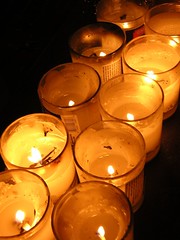
yartzeit candles2

Two years ago today Hurricane Katrina made landfall in New Orleans.

Let us remember, again, our fellow citizens who died because of that.

Let us remember our historic city of New Orleans -- still abandoned by its government, the collective agent of its people. Still abandoned, therefore, by us.

And let us remember, once again, that while it was the storm that struck the blow, it was our government that left it half-dead by the side of the road -- saw it and passed by on the other side; and it was our government that had so weakened its defenses that a storm could take it from us.

It was our government -- which means that, in some very real sense, it was us. We did this. And we have still not made it right.

In addition to the dead to remember, there are living victims to help. There is a city to rebuild.

There are debts to pay.

For the dead: rest in peace.

For the living: Remember:

New Orleans Yartzeit2

Tuesday, August 28, 2007

New Springsteen Song -- Free!

Starting today, and for a week, the first single from Bruce Springsteen's upcoming new studio album Magic -- "Radio Nowhere" -- is available for free on iTunes. (Yeah, it comes with iTunes' crappy DRM. But hey, it's free.)

If you want a direct link, there's one here, along with more information about the album.

Based on one listen, it's great. But hey, it's Springsteen, what do you expect?

Incidentally, while I'm sorta vaguely on the topic, I should mention that Springsteen's all-covers album We Shall Overcome: the Seeger Sessions, is one of my favorite of his albums, and one of my favorite albums period from the past few years. If you like either Pete Seeger, or Springsteen, or either folk or rock music at all (but I repeat myself), and you haven't heard it, do check it out.

But in the meantime, go download "Radio Nowhere" while the price is right.

(Via Altercation.)