Since my wife and I moved to Ithaca -- more than a dozen years ago now -- it has been represented by a Democrat, Representative Maurice Hinchey. He's a quite progressive Democrat, and I've always been happy with him as our Congressman. Sadly, after the 2010 census, New York lost two Congressional seats, and, since Hinchey is 73 and has just dealt with a case of cancer, he's decided to retire, letting the Democrats try to save other seats through redistricting.
So as of this upcoming election, Ithaca, New York will no longer be part of the 29th Congressional District, but will instead be part of the 23rd District. Tom Reed, a Republican first elected to Congress in 2010, is an incumbent in the district -- which is to say, even though Ithaca's not been represented by him before, he's running for reelection. And there's a primary, with three Democrats running, to be his opponent in the newly-organized district. The primary is a month from today -- Tuesday, June 26.
So I thought I'd ask if anyone knows anything about any of the three. Any thoughts?
Here's a set of brief interviews with each of the three on Ithaca.com. The three candidates are (in alphabetical order) Leslie Danks Burke, Melissa Dobson and Nate Shinagawa. (The links are to their official campaign web sites.) My slight bias is towards Shinagawa, because he's cross listed on the Working Families Party ticket, so I'm guessing that he might be the most progressive of the three. But that's not a great heuristic and my preference is weak. So I'd love some more information, if anyone has nay.
Showing posts with label Ithaca. Show all posts
Showing posts with label Ithaca. Show all posts
Saturday, May 26, 2012

Saturday, February 26, 2011
An Ode to My Hometown... 's Namesake
On being (delightfully!) contacted by an old friend who was passing through Ithaca, I was informed that this blog gave no indication of my current residence. And, I guess, that's right. I mean, there are some clues -- on my about page, updated last fall, I mentioned that we're still living in Ithaca; last fall I blogged about an Ithaca-based book group that I was running; and I've mentioned teaching at HWS, which is in Geneva, NY, about an hour's drive north. But it's hardly blazoned. I should blog more about Ithaca! (Where, yes, I still live. If I ever leave, I promise I'll make it obvious here.)
So, of course, I thought of C. P. Cavafy.
Cavafy is an important, foundational (modern) Greek poet. I was first introduced to his work on my trip to Greece (over two decades ago) when I bought an English-language anthology of modern Greek poetry (this one); Cavafy was the first in the book. He wasn't one of the two Nobel-prize winners included, but he was clearly central to the cannon of modern Greek poetry.
Interestingly, however -- and I only learned this when googling around a big for this blog post -- he was actually born in, and lived most of his life in, Alexandra, Egypt. His parents were Greek, he spoke Greek and wrote in Greek, but he lived in Egypt -- part of the Greek diaspora there, I suppose. I think that's kinda cool, myself.
He also -- and as someone about to turn forty in less than a month, this really won him my heart -- is described by Wikipedia as someone who's "most important poetry was written after his fortieth birthday." God bless you, Cavafy! There's hope for us after all.
Anyway, his Cavafy's most famous poems -- in English, that is; I have no idea what works his Greek reputation rests on -- are "Waiting for the Barbarians" (whose title was borrowed for a novel by the Nobel-prize winning J. M. Coetzee) and "Ithaca", which is our topic here. It was first published, if Wikipedia can be trusted in this instance, exactly a century ago -- in 1911. (Update: In his anthology, Kimon Friar lists it as 1910. Darn.)
Anyone who can read modern Greek can read the original poem here. On the other hand, I suspect that anyone who can read the original doesn't need me to tell them about it. So let's move on to English-language translations.
Cavafy's official site presents five different translations of the poem -- and it's not a complete list. I first read the poem in a translation by Kimon Friar; there also seems to be a version by Rae Dalven, and (another?) by Edmund Keeley without Philip Sherrard's revisions, which have that word in the first line; but most of the reposting I can find online don't list translators at all (highly annoying), and I'm not sure of the translators for any but those at the official site.
Just to give you a sense of how they compare -- I like this sort of thing, after all -- here are the opening three lines in each of the various translations included on Cavafy's official site. (Some of the poems used the spelling "Ithaka" instead of "Ithaca", a spelling which is, I think, more accurate as far as strict transliteration goes, but not the typical English spelling.)
But rather than simply reprint any of those five -- which, again, are already available online on the official Cavafy site -- here is the translation by Kimon Friar, from his 1982 anthology Modern Greek Poetry, which is my favorite -- quite possibly simply because I read it first. But here it is:
(I've kept the original capitalization, rather than changing it to the English standard custom of a capital letter for each new line.)
I find it sort of odd to read this poem as someone who lives in Ithaca -- even though I know that my Ithaca is not that Ithaca, and that for that matter that Ithaca isn't really Ithaca either, since Ithaca here is just a symbol. Nevertheless.
Or maybe it's just a didactic poem by a didactic author. Who knows.
But I will maintain that it's quality survives both its didacticism and translation: and thus I present it to you, Noble Reader, as an ode to my hometown... 's namesake.
(Note: This post was substantively updated after its first posting (once I laid my hands on my dead-tree copy of Friar's Modern Greek Poems.))
So, of course, I thought of C. P. Cavafy.
Cavafy is an important, foundational (modern) Greek poet. I was first introduced to his work on my trip to Greece (over two decades ago) when I bought an English-language anthology of modern Greek poetry (this one); Cavafy was the first in the book. He wasn't one of the two Nobel-prize winners included, but he was clearly central to the cannon of modern Greek poetry.
Interestingly, however -- and I only learned this when googling around a big for this blog post -- he was actually born in, and lived most of his life in, Alexandra, Egypt. His parents were Greek, he spoke Greek and wrote in Greek, but he lived in Egypt -- part of the Greek diaspora there, I suppose. I think that's kinda cool, myself.
He also -- and as someone about to turn forty in less than a month, this really won him my heart -- is described by Wikipedia as someone who's "most important poetry was written after his fortieth birthday." God bless you, Cavafy! There's hope for us after all.
Anyway, his Cavafy's most famous poems -- in English, that is; I have no idea what works his Greek reputation rests on -- are "Waiting for the Barbarians" (whose title was borrowed for a novel by the Nobel-prize winning J. M. Coetzee) and "Ithaca", which is our topic here. It was first published, if Wikipedia can be trusted in this instance, exactly a century ago -- in 1911. (Update: In his anthology, Kimon Friar lists it as 1910. Darn.)
Anyone who can read modern Greek can read the original poem here. On the other hand, I suspect that anyone who can read the original doesn't need me to tell them about it. So let's move on to English-language translations.
Cavafy's official site presents five different translations of the poem -- and it's not a complete list. I first read the poem in a translation by Kimon Friar; there also seems to be a version by Rae Dalven, and (another?) by Edmund Keeley without Philip Sherrard's revisions, which have that word in the first line; but most of the reposting I can find online don't list translators at all (highly annoying), and I'm not sure of the translators for any but those at the official site.
Just to give you a sense of how they compare -- I like this sort of thing, after all -- here are the opening three lines in each of the various translations included on Cavafy's official site. (Some of the poems used the spelling "Ithaka" instead of "Ithaca", a spelling which is, I think, more accurate as far as strict transliteration goes, but not the typical English spelling.)
As you set out for IthakaNot knowing Greek, I can judge these only on the basis of their quality as English-language poetry. And reading through the entire poem (I'm not going to reprint the entirety of all five here; you can go look on Cavafy's site if you're curious), I think that I have a slight preference for the Haviaras -- although, truth be told, I don't have as strong feelings about this as I do about, say, Onegin.
hope the voyage is a long one,
full of adventure, full of discovery.
-- trans. Edmund Keeley & Philip Sherrard
When you set out for distant Ithaca,
fervently wish your journey may be long, —
full of adventures and with much to learn.
-- trans. John Cavafy
As you set out on the way to Ithaca
hope that the road is a long one,
filled with adventures, filled with understanding.
-- trans. Daniel Mendelsohn
When you set out on your way to Ithaca
you should hope that your journey is a long one:
a journey full of adventure, full of knowing.
-- trans Stratis Haviaras
When you start on the way to Ithaca,
wish that the way be long,
full of adventure, full of knowledge.
-- trans George Valassopoulo
But rather than simply reprint any of those five -- which, again, are already available online on the official Cavafy site -- here is the translation by Kimon Friar, from his 1982 anthology Modern Greek Poetry, which is my favorite -- quite possibly simply because I read it first. But here it is:
Ithaca
When you set out on the voyage to Ithaca,
pray that your journey may be long,
full of adventures, full of knowledge.
Of the Laestrygones and the Cyclopes
and of furious Poseidon, do not be afraid,
for such on your journey you shall never meet
if your thought remain lofty, if a select
emotion imbue your spirit and your body.
The Laestrygones and the Cyclopes
and furious Poseidon you will never meet
unless you drag them with you in your soul,
unless your soul raises them up before you.
Pray that your journey may be long,
that many may those summer mornings be
when with what pleasure, what untold delight
you enter harbors you've not seen before;
that you stop at Phoenician market places
to procure the goodly merchandise,
mother of pearl and coral, amber and ebony,
and voluptuous perfumes of every kind,
as lavish an amount of voluptuous perfumes as you can;
that you venture on to many Egyptian cities
to learn and yet again to learn from the sages.
But you must always keep Ithaca in mind.
The arrival there is your predestination.
Yet do not by any means hasten your voyage.
Let it best endure for many years,
until grown old at length you anchor at your island
rich with all you have acquired on the way.
You never hoped that Ithaca would give you riches.
Ithaca has given you the lovely voyage.
Without her you would not have ventured on the way.
She has nothing more to give you now.
Poor though you may find her, Ithaca has not deceived you.
Now that you have become so wise, so full of experience,
you will have understood the meaning of an Ithaca.
-- C. P. Cavafy; translated by Kimon Friar
(I've kept the original capitalization, rather than changing it to the English standard custom of a capital letter for each new line.)
I find it sort of odd to read this poem as someone who lives in Ithaca -- even though I know that my Ithaca is not that Ithaca, and that for that matter that Ithaca isn't really Ithaca either, since Ithaca here is just a symbol. Nevertheless.
I like this poem -- and "Waiting for the Barbarians" too -- but I will admit that, at least to this English-language reader in 2011, they both seem rather didactic. They make Points, and make them heavily. They have a Moral. It's not subtle. Oh, they're both good points, but still: heavily made. I'm somewhat reluctant to label this as a criticism, for a variety of reasons: I'm reading them in translation, which undoubtedly weakens the effect; I'm reading them in 2011, and I'm not sure that they seemed quite as didactic a century ago. And maybe the points (the journey not the arrival matters, a foreign enemy gives a culture focus and meaning although not in a good way) didn't seem so cliched then. (If anyone reading this knows either Greek or the historical context (or both) better than I, I hope you'll enlighten us in the comments.) Perhaps this is a case like the apocryphal reader who thought Hamlet was just a bunch of quotations strung together.
Or maybe it's just a didactic poem by a didactic author. Who knows.
But I will maintain that it's quality survives both its didacticism and translation: and thus I present it to you, Noble Reader, as an ode to my hometown... 's namesake.
(Note: This post was substantively updated after its first posting (once I laid my hands on my dead-tree copy of Friar's Modern Greek Poems.))
Tuesday, August 10, 2010
Ithaca-Focused Post
To any Ithacans who happen to be reading this blog: this fall, our local bookstore Buffalo Street Books is organizing a series of reading groups, and I'm offering one called "Literature of Constraint", about four novels written either by members of the French literary group the Oulipo, or (in one case) done by an American working on parallel lines. Follow the second link for more information. (There's also a facebook page here.) Any readers of this blog are invited to come!
Update (Sunday, December 12): Sadly, even before our final discussion on Wednesday, Buffalo Street Books has taken down the above-linked page about the group. So, more for my own reference than anything else, I'm going to list the four books that we discussed, and the dates (all dates from 2010).
September 15: Italo Calvino, If on a Winter's Night a Traveler
October 20: Georges Perec, A Void
November 17: Walter Abish, Alphabetical Africa
December 15: Harry Mathews, Cigarettes
Incidentally, my rereading of Perec's A Void and my reading of Abish's Alphabetical Africa each produced two blog posts, and my reading of Mathews's Cigarettes produced one, all linked in this selfsame sentence.
Update (Sunday, December 12): Sadly, even before our final discussion on Wednesday, Buffalo Street Books has taken down the above-linked page about the group. So, more for my own reference than anything else, I'm going to list the four books that we discussed, and the dates (all dates from 2010).
September 15: Italo Calvino, If on a Winter's Night a Traveler
October 20: Georges Perec, A Void
November 17: Walter Abish, Alphabetical Africa
December 15: Harry Mathews, Cigarettes
Incidentally, my rereading of Perec's A Void and my reading of Abish's Alphabetical Africa each produced two blog posts, and my reading of Mathews's Cigarettes produced one, all linked in this selfsame sentence.
Saturday, November 15, 2008
Ithaca's Protest for Marriage Equality
I just returned from the protest I mentioned yesterday -- Ithaca, New York's version of today's national protests against California's proposition eight, and for equal marriage rights for all citizens, straight and gay.
It went well, I think. There was a very good turnout -- more than a hundred, easily (I was up near the front, and couldn't easily see the whole crowd). This was impressive given the weather here: most of today has seen a heavy November rain, although it let-up for (most but not all) of the rally itself. (I was planning to bring a camera, but the rain dissuaded me; if I find any links to others' photos, though, I'll link. Update: here's a photo I swiped from the Facebook page for the event. (I'm in the second row, behind the woman with the "you can't amend love" sign.) More photos at the link.)

There were more than a half a dozen speakers -- three members of the "Ithaca 50", 25 local couples who sued (unsuccessfully) for marriage rights here; two of the organizers (one of whom identified as a Catholic "straight ally" with a gay father and transgendered cousin, and spoke movingly of her wish that her church support marriage rights); a local Tompkins County board member; two who read other people's testimony from the net... and maybe another one or two I forgot. We had the (apparently) nation-wide moment of silence at 2:00; lots of people waved signs. The sign I brought (pdf link) said "equality for all families", with little icons of three couples -- one straight, one gay, one lesbian.
Unusually for these events, I didn't strongly disagree with anything any of the speakers said; I wouldn't myself have waved all of the signs there, but most of them seemed reasonable. There was a pretty good avoidance of issue-drift -- a problem that some people have with left-sided protests in general -- in the speeches and the signs; and a strong appeal at the beginning for tolerance within the movement, and peacefulness and non-violence in protest. The strongest speakers -- unsurprisingly -- were the three members of the Ithaca 50: having a personal connection to an issue always adds a lot to a speech regardless of its content, and all three speeches were moving.
The one thing I would have liked to see was a greater focus on marriage equality in New York state. (It was mentioned a lot, but not focused on.) While the march was motivated by the defeat in California, it was about the issue generally; and New York is where we live. Also, as it happens, New York is arguably the new central front in this struggle: after the highest court here kicked the issue back to the rest of the state government, the state house passed an equal marriage rights bill, and the Governor said he'd sign it; the hold-up was the state legislature. Well, last week Democrats got a majority in the NY state senate for the first time in more than four decades (although not, alas, by defeating any of the anti-gay legislatures who represented this area). So, in theory, New York state should now pass -- in both houses -- equal marriage rights, and the Governor should sign it.* So I would I have liked more focus -- rhetorical and practical -- on trying to make that happen.
But a good protest.
I must admit these events bring out the cynic in me. Left-wing rallies have a very ritualistic feel to them, and it's not a ritual I always find easy to take very seriously, however much I support the cause. Additionally, I wonder about their efficacy in recent years (as opposed to in the 60's, say) -- the anti-war rallies in 2003 were IMS the largest in history, and had no visible impact whatsoever. I think that as a practical matter new strategies need to be devised -- and as a cultural matter, much of the feel of such events is silly. When one of the speakers started a chant about "the power of the people", I found my cynicism making out: wasn't it the power of the people that just voted against us? Isn't this -- alas -- a matter of justice in the face of popular opposition to it? I think the cause is just, and that we will, thanks to good demographics as well as changing minds, have a majority on the side of equality before long. But chants about power to the people felt like a really silly piece of misplaced 60's nostalgia (changed, ironically enough, by a 22-year-old who might have well been my student, since I taught at Cornell while he was there). And it's hard to get around the feel that these events are a ritual which always bring out the usual suspects, particularly in a town like Ithaca...
On the other hand, my wife recognized someone she knew, a law student at Cornell, who said it was her first protest -- ever, on anything; she'd come to support a friend of hers. And Ithaca being a small, liberal town that is practically a physical instantiation of silly misplaced 60's nostalgia, it probably isn't a good place to see the efficacy or importance of such events even if there was lots of it in the other marches today.
And, in the end, none of this matters: it's an important issue, an issue of justice and equality, and I think that going there was worthy, an act of political speech that has moral worth in and of itself, apart from the issue of efficacy or my cynicism about the culture of these things.
So I'm glad I went.
Now let's start pressuring New York to be third** after Massachusetts and Connecticut -- and the first state to establish equal marriage rights legislatively rather than through the courts. That'd be a landmark worth achieving.
And, of course, it's the right thing to do.
_______________
* Yeah, we have a new Governor since then, but he's said he'll sign the bill if it's passed.
** Alas, since it should have been fourth, had California done the right thing...
It went well, I think. There was a very good turnout -- more than a hundred, easily (I was up near the front, and couldn't easily see the whole crowd). This was impressive given the weather here: most of today has seen a heavy November rain, although it let-up for (most but not all) of the rally itself. (I was planning to bring a camera, but the rain dissuaded me; if I find any links to others' photos, though, I'll link. Update: here's a photo I swiped from the Facebook page for the event. (I'm in the second row, behind the woman with the "you can't amend love" sign.) More photos at the link.)

There were more than a half a dozen speakers -- three members of the "Ithaca 50", 25 local couples who sued (unsuccessfully) for marriage rights here; two of the organizers (one of whom identified as a Catholic "straight ally" with a gay father and transgendered cousin, and spoke movingly of her wish that her church support marriage rights); a local Tompkins County board member; two who read other people's testimony from the net... and maybe another one or two I forgot. We had the (apparently) nation-wide moment of silence at 2:00; lots of people waved signs. The sign I brought (pdf link) said "equality for all families", with little icons of three couples -- one straight, one gay, one lesbian.
Unusually for these events, I didn't strongly disagree with anything any of the speakers said; I wouldn't myself have waved all of the signs there, but most of them seemed reasonable. There was a pretty good avoidance of issue-drift -- a problem that some people have with left-sided protests in general -- in the speeches and the signs; and a strong appeal at the beginning for tolerance within the movement, and peacefulness and non-violence in protest. The strongest speakers -- unsurprisingly -- were the three members of the Ithaca 50: having a personal connection to an issue always adds a lot to a speech regardless of its content, and all three speeches were moving.
The one thing I would have liked to see was a greater focus on marriage equality in New York state. (It was mentioned a lot, but not focused on.) While the march was motivated by the defeat in California, it was about the issue generally; and New York is where we live. Also, as it happens, New York is arguably the new central front in this struggle: after the highest court here kicked the issue back to the rest of the state government, the state house passed an equal marriage rights bill, and the Governor said he'd sign it; the hold-up was the state legislature. Well, last week Democrats got a majority in the NY state senate for the first time in more than four decades (although not, alas, by defeating any of the anti-gay legislatures who represented this area). So, in theory, New York state should now pass -- in both houses -- equal marriage rights, and the Governor should sign it.* So I would I have liked more focus -- rhetorical and practical -- on trying to make that happen.
But a good protest.
I must admit these events bring out the cynic in me. Left-wing rallies have a very ritualistic feel to them, and it's not a ritual I always find easy to take very seriously, however much I support the cause. Additionally, I wonder about their efficacy in recent years (as opposed to in the 60's, say) -- the anti-war rallies in 2003 were IMS the largest in history, and had no visible impact whatsoever. I think that as a practical matter new strategies need to be devised -- and as a cultural matter, much of the feel of such events is silly. When one of the speakers started a chant about "the power of the people", I found my cynicism making out: wasn't it the power of the people that just voted against us? Isn't this -- alas -- a matter of justice in the face of popular opposition to it? I think the cause is just, and that we will, thanks to good demographics as well as changing minds, have a majority on the side of equality before long. But chants about power to the people felt like a really silly piece of misplaced 60's nostalgia (changed, ironically enough, by a 22-year-old who might have well been my student, since I taught at Cornell while he was there). And it's hard to get around the feel that these events are a ritual which always bring out the usual suspects, particularly in a town like Ithaca...
On the other hand, my wife recognized someone she knew, a law student at Cornell, who said it was her first protest -- ever, on anything; she'd come to support a friend of hers. And Ithaca being a small, liberal town that is practically a physical instantiation of silly misplaced 60's nostalgia, it probably isn't a good place to see the efficacy or importance of such events even if there was lots of it in the other marches today.
And, in the end, none of this matters: it's an important issue, an issue of justice and equality, and I think that going there was worthy, an act of political speech that has moral worth in and of itself, apart from the issue of efficacy or my cynicism about the culture of these things.
So I'm glad I went.
Now let's start pressuring New York to be third** after Massachusetts and Connecticut -- and the first state to establish equal marriage rights legislatively rather than through the courts. That'd be a landmark worth achieving.
And, of course, it's the right thing to do.
_______________
* Yeah, we have a new Governor since then, but he's said he'll sign the bill if it's passed.
** Alas, since it should have been fourth, had California done the right thing...
Friday, November 14, 2008
Protests Tomorrow in Favor of Equal Marriage Rights
In case any of my readers don't know, there is a national day of protests tomorrow against California's now-passed Proposition 8 (which removed civil marriage rights from gay and lesbian Californians). While the protests are aimed at specifically Prop 8 specifically, they are also (at least I presume) in favor of equal marriage rights for all citizens, straight and gay, in all states. The protests are meant to be simultaneous, taking place at 10:30 a.m. on the west coast and 1:30 p.m. on the east (and others as appropriate.*)
For me, as for many others, my happiness at last week's election was severely tempered by the terrible news about proposition eight. I am glad there will be an opportunity to voice continued commitment to equal rights on a national scale.
Note for any Ithaca readers: there is a local protest here, 1:30 p.m. on the Commons. (Web site here; facebook page here.) I plan (bli neder) to be there. Everyone else can find the protest in your area on this web site here.
Just watching the developing reaction to Prop 8 online (largely on these three blogs, although I'd love to hear about others; please leave them in comments (update: two more)) has been extraordinary. It's already been called a turning point in the gay rights movement equivalent to Stonewall or the founding of Act Up. For myself, I keep thinking about the renewed and expanded energy that took hold of the Civil Rights Movement in the early months of 1960 when the sit-in movement spread virally through the South from city to city (soon formalized with the reaction of SNCC). Whatever analogy you wish to use, this is, I believe (and have believed for a long time) the Civil Rights Movement of our day. Tomorrow is a day to stand up and be counted on the side of equality and justice.
I'll be there. I hope you will too.
____________
*Poor Hawaii got stuck with 8:30 a.m. Ugh.
For me, as for many others, my happiness at last week's election was severely tempered by the terrible news about proposition eight. I am glad there will be an opportunity to voice continued commitment to equal rights on a national scale.
Note for any Ithaca readers: there is a local protest here, 1:30 p.m. on the Commons. (Web site here; facebook page here.) I plan (bli neder) to be there. Everyone else can find the protest in your area on this web site here.
Just watching the developing reaction to Prop 8 online (largely on these three blogs, although I'd love to hear about others; please leave them in comments (update: two more)) has been extraordinary. It's already been called a turning point in the gay rights movement equivalent to Stonewall or the founding of Act Up. For myself, I keep thinking about the renewed and expanded energy that took hold of the Civil Rights Movement in the early months of 1960 when the sit-in movement spread virally through the South from city to city (soon formalized with the reaction of SNCC). Whatever analogy you wish to use, this is, I believe (and have believed for a long time) the Civil Rights Movement of our day. Tomorrow is a day to stand up and be counted on the side of equality and justice.
I'll be there. I hope you will too.
____________
*Poor Hawaii got stuck with 8:30 a.m. Ugh.
Thursday, January 31, 2008
Obama in Ithaca: An Anecdotal Report
The lawn signs started going up this week: I don't think I saw any last week, but on Monday I saw several; and now, going around downtown Ithaca, you see a lot of Obama signs.
I haven't yet seen any Clinton signs, however -- which truth to tell I find slightly more discouraging than if I'd seen one or two; strongly out-signing your opponent is a mark of powerful support, but if the opponent has no signs, it implies that they are simply not contesting that district. Ithaca is, of course, a college town, and it seems quite possible that Clinton has simply decided that it's not worth her while to have an office here, when there is so much more favorable terrain nearby.
I stopped by at the Obama office today to pick up my own lawn sign; their headquarters is right at the west end of the Commons, for anyone in the area. There were a few volunteers there, who seemed friendly and enthusiastic and rather new and like everything was still unsettled. I hope to go back to volunteer some this weekend, my (currently terribly busy) work schedule permitting.
It looks likely that we won't know who will be the Democratic nominee next Wednesday -- most likely they'll each win some states and some delegates, and the race will go on. But New York is not a winner-take-all state, so get-out-the-vote operations matter even if it looks inevitable that Clinton will take the state as a whole -- the bigger a percentage Obama gets, the more delegates he'll get in a likely-to-be-long-and-close race.
Judging by the lawn sign situation, it looks like Ithaca will do its part to add to that total next Tuesday.
Update: For a basic explanation of the progressive case for Obama, I highly recommend this endorsement by Christopher Hayes in the Nation. He captures very well both the reasons for progressives to hesitate, and the reasons why -- ultimately -- the choice between Obama and Clinton is fundamentally quite clear. (via)
I haven't yet seen any Clinton signs, however -- which truth to tell I find slightly more discouraging than if I'd seen one or two; strongly out-signing your opponent is a mark of powerful support, but if the opponent has no signs, it implies that they are simply not contesting that district. Ithaca is, of course, a college town, and it seems quite possible that Clinton has simply decided that it's not worth her while to have an office here, when there is so much more favorable terrain nearby.
I stopped by at the Obama office today to pick up my own lawn sign; their headquarters is right at the west end of the Commons, for anyone in the area. There were a few volunteers there, who seemed friendly and enthusiastic and rather new and like everything was still unsettled. I hope to go back to volunteer some this weekend, my (currently terribly busy) work schedule permitting.
It looks likely that we won't know who will be the Democratic nominee next Wednesday -- most likely they'll each win some states and some delegates, and the race will go on. But New York is not a winner-take-all state, so get-out-the-vote operations matter even if it looks inevitable that Clinton will take the state as a whole -- the bigger a percentage Obama gets, the more delegates he'll get in a likely-to-be-long-and-close race.
Judging by the lawn sign situation, it looks like Ithaca will do its part to add to that total next Tuesday.
Update: For a basic explanation of the progressive case for Obama, I highly recommend this endorsement by Christopher Hayes in the Nation. He captures very well both the reasons for progressives to hesitate, and the reasons why -- ultimately -- the choice between Obama and Clinton is fundamentally quite clear. (via)
Sunday, July 29, 2007
Ithaca is 95% Walkable!
...or at least our house is. We live in downtown Ithaca; I presume other neighborhoods wouldn't be nearly as walkable (which is one of the reasons we wanted to live here.)
I get this score from this is a neat little internet toy which calculates how walkable an address is (via PZ), using Google maps and a "patent pending" algorithm to crunch accessibility of various things (stores, parks, etc) into a single score on a 1 - 100 scale. Our address scored a 95, which they translate as: "Walkers' Paradise: Most errands can be accomplished on foot and many people get by without owning a car." In contrast, the house I grew up in in Cambridge, Massachusetts scored only a 69 out of 100. ("50 - 70 = Some Walkable Locations: Some stores and amenities are within walking distance, but many everyday trips still require a car.")
Now, it's true that we live in a very walkable place, particularly as small towns in the middle of nowhere* go. And you can get by without a car -- although it's a bit of a pain, frankly. The unfactored variable here is public transportation: Ithaca has a reasonably good bus system, given that it is a STinTMofN, but it's a lot harder to get to things that aren't walkable than it would be in a big city. I'd certainly think it's more important to have a car in Ithaca than in Cambridge... although we sure live nearer a grocery store now than we did when I was growing up. (Not a great grocery, store, but it's there, and it is walkable.)
Still, yay, hometown!
_________________________
* Really, the middle. If you get out a map, you can (more or less) draw a circle through Boston, New York, Philadelphia, Washington DC, Toronto and Montreal with its center at Ithaca -- equidistant from all somewheres in the northeast.
I get this score from this is a neat little internet toy which calculates how walkable an address is (via PZ), using Google maps and a "patent pending" algorithm to crunch accessibility of various things (stores, parks, etc) into a single score on a 1 - 100 scale. Our address scored a 95, which they translate as: "Walkers' Paradise: Most errands can be accomplished on foot and many people get by without owning a car." In contrast, the house I grew up in in Cambridge, Massachusetts scored only a 69 out of 100. ("50 - 70 = Some Walkable Locations: Some stores and amenities are within walking distance, but many everyday trips still require a car.")
Now, it's true that we live in a very walkable place, particularly as small towns in the middle of nowhere* go. And you can get by without a car -- although it's a bit of a pain, frankly. The unfactored variable here is public transportation: Ithaca has a reasonably good bus system, given that it is a STinTMofN, but it's a lot harder to get to things that aren't walkable than it would be in a big city. I'd certainly think it's more important to have a car in Ithaca than in Cambridge... although we sure live nearer a grocery store now than we did when I was growing up. (Not a great grocery, store, but it's there, and it is walkable.)
Still, yay, hometown!
_________________________
* Really, the middle. If you get out a map, you can (more or less) draw a circle through Boston, New York, Philadelphia, Washington DC, Toronto and Montreal with its center at Ithaca -- equidistant from all somewheres in the northeast.
Wednesday, December 20, 2006
Carl Sagan's Ithaca Memorial
As part of today's Carl Sagan memorial blogswarm (via) marking the tenth anniversary of Sagan's death, I thought I'd write, not about Carl Sagan directly, but about a memorial to him -- one that happens to be my favorite piece of public art in my home town of Ithaca, New York. Sagan, of course, taught at Cornell (located in Ithaca) for many years, which is his connection to the town; hence the location for the memorial.
The sculpture in question is the Sagan Planet Walk, a scale model of the solar system on a 5,000,000,000:1 scale. The sun is represented as a window in a large black monolith:
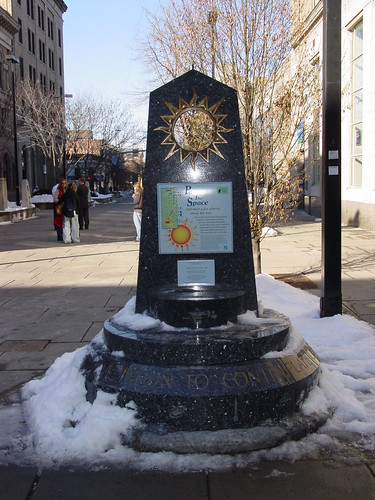
It's about six feet tall (I'm afraid the photos are just what I happen to have, I have no time today to go get new ones, and I didn't think to get a photo of someone standing next to it.) It's in the middle of the Ithaca Commons, a pedestrian-only walkway at the center of downtown Ithaca. The next for monoliths (which are each a bit smaller) are all on the same block. In fact, in the background of the photo above, you can see the Earth and Mars megaliths:
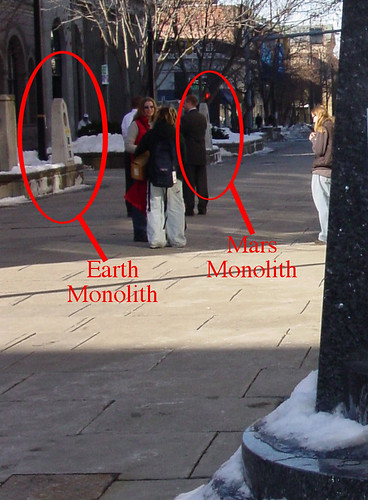
(The Venus monolith is directly behind the Sun monolith in this shot; Mercury is off to the left, beyond the edge of the photo.)
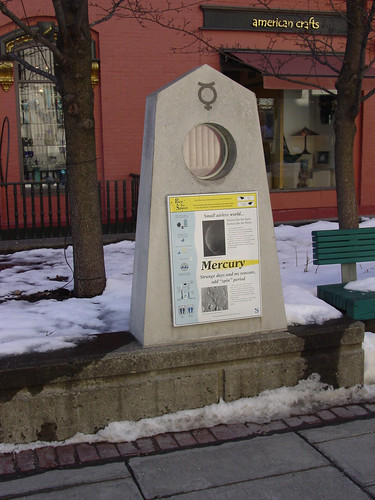
Each of the planets is represented by a slightly smaller grey monolith (except Pluto (yes, this was back before Pluto's demotion) which has a monolith matching that of the Sun, to anchor the other end of the Planet Walk). Here, for example, is the one for Mercury:
And here's the one for Jupiter:
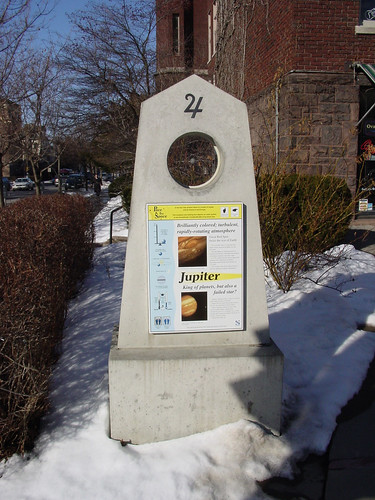
The window in the center of each Monolith is identical in size to the window which represents the sun, in order to give a sense of scale. The actual planet is represented by a to-scale size model of the planet embedded in the window. In most cases, you can only see it by going right up to the window and looking very closely; it's often hard to tell the planet from a speck of dirt (although the planet is in the center of each window, and of course you can tell if you look closely enough.) But the larger planets you can see even from a few feet away. For example, here is an enlargement of the Jupiter window above:

And here is an enlargement for the Saturn window:
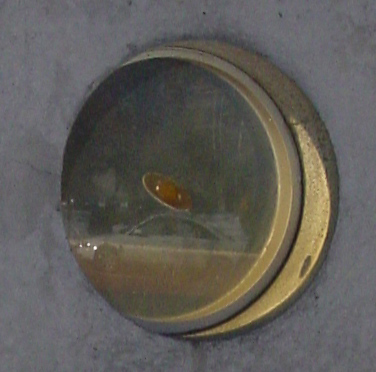
For Jupiter, they also include several moons (the four big ones, I think) and the Saturn window includes Triton; but you can't see them with the level of detail in these pictures. Incidentally, in those two pictures, Jupiter looks smaller than Saturn, but that's a result of the framing and angle of the photos; in the actual monument, Jupiter is quite clearly bigger than Saturn (aside from the latter's rings, which even things out a bit.)
On the front of each monolith is a plaque giving information about the planet. There's also a podcast by Bill Nye which you can listen to as you do the walk (although I've never heard it -- it's fairly new -- even though I've done the walk more than a dozen times from end to end, not counting passing it just strolling around town (we live near Uranus, so I go by parts of the walk all the time.))
What's really cool about the memorial, however -- it's purpose, really -- is not possible to capture in photos, and that's the visceral sense of the sheer size of the space, and of the extraordinary emptiness of it. It takes about half an hour to walk from the Sun (at the heart of downtown) to Pluto, right in front of the Sciencenter, the local science museum. But walking it you imagine almost all of it as empty, save for these tiny little specks of nothing captured in the windows. Even the sun seems tiny. It's dizzying: our universe is basically extended void, a vast amount of nothing, with just a few insignificant specks of fire and dust. It is, in a powerful sense which gets lost in the common use of the phrase, awe-inspiring.
And of course the distances vary greatly. It's a matter of moments to walk from the Sun to Mars; each of the other distances gets progressively longer, save for the Neptune - Pluto distance which is shorter (although still long on the Sun - Mars scale). Here is the official map from the Sciencenter web site:
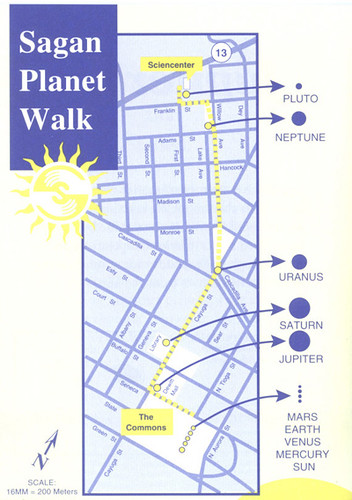
You can get a slight sense of the distances from this map -- but not as well as you can from an ordinary astronomy textbook. What really works is the sculpture itself: putting the entirety on a human scale, so you can feel it, get the variations under your shoes and in your legs.
It is a marvelous memorial for the late, lamented Carl Sagan, who spent his life trying to educate the public about astronomy and science: a beautiful piece of public art that also serves to convey, on a marrow-in-the-bones level, the feeling of awe that our universe can inspire when looked at through science's lens.
But my favorite thing about the planet walk I don't have a photograph of. It isn't on the map; it isn't in Ithaca -- it doesn't even exist yet, and it probably never will. But there has been talk apparently about building a matching, to-scale monolith for Alpha Centauri, the nearest star to the Sun.
It would be in Hawaii.
I love to imagine that it will be built: making the Sagan Planet Walk one of the largest public sculptures in the world (since, after all, the space between the monoliths is an integral part of the sculpture), and boggling the mind with the true vastness and emptiness of this extraordinary cosmos that we live in.
In any event, next time you are in Ithaca (which, to be sure, is in the middle of nowhere -- it's not even directly on a major interstate -- so it may be a while for most of you) take the time to walk the planet walk. It's a wonderful bit of public art, and worth taking the time to appreciate properly. And a wonderful tribute to an amazing man.
Update: Joel Schlosberg has now put up a post linking to the various entries of the blog memorial. Go there to check 'em out.
The sculpture in question is the Sagan Planet Walk, a scale model of the solar system on a 5,000,000,000:1 scale. The sun is represented as a window in a large black monolith:
Each of the planets is represented by a slightly smaller grey monolith (except Pluto (yes, this was back before Pluto's demotion) which has a monolith matching that of the Sun, to anchor the other end of the Planet Walk). Here, for example, is the one for Mercury:
On the front of each monolith is a plaque giving information about the planet. There's also a podcast by Bill Nye which you can listen to as you do the walk (although I've never heard it -- it's fairly new -- even though I've done the walk more than a dozen times from end to end, not counting passing it just strolling around town (we live near Uranus, so I go by parts of the walk all the time.))
What's really cool about the memorial, however -- it's purpose, really -- is not possible to capture in photos, and that's the visceral sense of the sheer size of the space, and of the extraordinary emptiness of it. It takes about half an hour to walk from the Sun (at the heart of downtown) to Pluto, right in front of the Sciencenter, the local science museum. But walking it you imagine almost all of it as empty, save for these tiny little specks of nothing captured in the windows. Even the sun seems tiny. It's dizzying: our universe is basically extended void, a vast amount of nothing, with just a few insignificant specks of fire and dust. It is, in a powerful sense which gets lost in the common use of the phrase, awe-inspiring.
And of course the distances vary greatly. It's a matter of moments to walk from the Sun to Mars; each of the other distances gets progressively longer, save for the Neptune - Pluto distance which is shorter (although still long on the Sun - Mars scale). Here is the official map from the Sciencenter web site:
It is a marvelous memorial for the late, lamented Carl Sagan, who spent his life trying to educate the public about astronomy and science: a beautiful piece of public art that also serves to convey, on a marrow-in-the-bones level, the feeling of awe that our universe can inspire when looked at through science's lens.
But my favorite thing about the planet walk I don't have a photograph of. It isn't on the map; it isn't in Ithaca -- it doesn't even exist yet, and it probably never will. But there has been talk apparently about building a matching, to-scale monolith for Alpha Centauri, the nearest star to the Sun.
It would be in Hawaii.
I love to imagine that it will be built: making the Sagan Planet Walk one of the largest public sculptures in the world (since, after all, the space between the monoliths is an integral part of the sculpture), and boggling the mind with the true vastness and emptiness of this extraordinary cosmos that we live in.
In any event, next time you are in Ithaca (which, to be sure, is in the middle of nowhere -- it's not even directly on a major interstate -- so it may be a while for most of you) take the time to walk the planet walk. It's a wonderful bit of public art, and worth taking the time to appreciate properly. And a wonderful tribute to an amazing man.
In Memoriam
Carl Sagan
1934 - 1996
Carl Sagan
1934 - 1996
Update: Joel Schlosberg has now put up a post linking to the various entries of the blog memorial. Go there to check 'em out.
Subscribe to:
Posts (Atom)