Showing posts with label Literary. Show all posts

Sunday, July 09, 2023

I'm Now Writing Elsewhere, Come Read Me There

To put this all in one post for the top of this page: I've moved.

If you want to read my essays and link round-ups—the sort of thing I used to put here, but now delivered to your inbox, and at a steady once-a-week rate—you should go and subscribe to Attempts 2.0 over on Substack:

https://stephenfrug.substack.com/

And I am also publishing a series of short stories, which you should go read! Learn more about them here:

https://stephenfrug.com/retcon-a-mosaic-narrative-in-three-movements/

I will of course leave this up for its archives, but if you want to see anything new, go to those places. I hope to see you there!

Friday, March 10, 2023

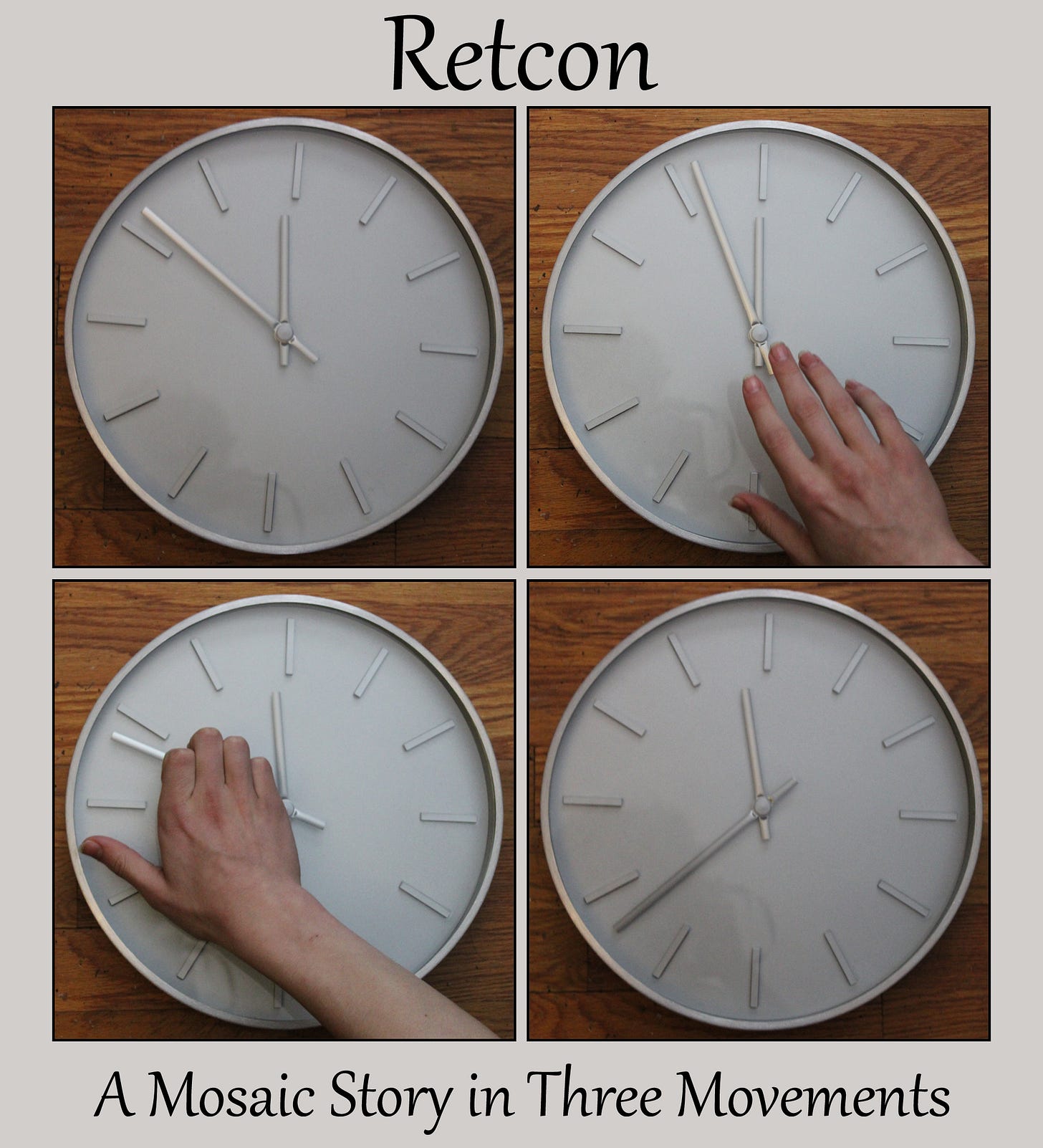
Introducing Retcon: A Mosaic Story in Three Movements

This is cross-posted from Attempts's new home on substack. If you are reading this, you should go subscribe to the substack!  New updates will be mostly there, and new essays & other substantive material will be exclusively there.  We now return you to your regular post, already in progress:

I am debuting a new project—a big project—one I've been working on for a few years and which I have been gathering ideas for for longer than that. And I am hoping that you will  give the first installment a try.

What is this project? you ask. Why, say I, I am glad you asked that.1

Well, you remember that last week I put forward the term "mosaic stories" to refer to the general form of stories where small, to-some-degree self-contained stories make up a larger one? It so so happens, in an astonishing coincidence, that that's precisely the form of the story I've been working on.

The story's name is Retcon.

It will be a large story composed of twenty-seven smaller ones, divided into three sections, or "movements" as I've decided to call them.2 The smaller stories are (prose) short stories, averaging about 15,000 words each. 3 The stories are going to be released as ebooks (to begin with), although I have plans for print collections too. I am planning to release them on a monthly schedule, with a break between movements, so there will be one a month for nine months, and then a break, and then another movement will begin. 4

And the first one is available now. It's called "Zero Second"

So how can I read this story?

You can buy the ebook! It’s only $0.99.5

As for where to buy it, there are lots of options.

• If you want to buy it at Amazon (for Kindle), which is where the majority of ebooks are sold, you can do so at this link.

Or, if you’d prefer, you can buy it directly from me at my web site.

• Or you could buy it from another ebook vendor; it is available at Smashwords, Barnes & Noble, and Kobo. (So far Apple is being difficult, but I hope to get it up there too before too long).

• Or, if you are willing to commit to the whole narrative (and/or are interested in supporting the series, and this substack in the bargin), you can pre-order the entire series in advance, and I will send them to you as they are released. Note that this offer is exclusive to my web site.6

As I mentioned a few weeks ago, a number of people have offered to support my Substack, for which I was very grateful. Well, if you are interested in supporting this Substack, the best way to do it would be to support me, and the best way to do that would be to support my series. So please: go buy it, and read it!

And, just as important: if you like it, please tell people! Reviews (on Amazon or elsewehere) are really helpful. Even better: tell a friend that you think might like it, and get them to read it.7 Word of mouth is how this series will find its audience, if it does.

So… go! Now! Read! Enjoy!

But what's this story actually about?

A fair question!

I wrote a blurb for the series, which I will share in a moment. But while it fairly represents the whole series, it is something of a spoiler for parts of the first story. So before you read any further, you should go buy or listen to “Zero Second”!

All right, everyone back? Or at least not too spoiler-phobic?

Here’s what the story is about:

In 1951, a pair of scientists at Cornell discovered time-travel. With the specter of the atomic bomb in the immediate background, they decide not to replicate Einstein's mistake of drawing the attention of the political authorities to what might be a weapon. Instead, they decide to set up a clandestine research program to investigate the phenomenon, swearing all those who work on it to keep the secret.

Then, in 1991, a time traveler returns from 2031 with a disturbing message: no traveler and no message has ever come farther back from the moment in time when he left; beyond that instant—dubbed "zero second"—is unreachable. No one knows why. All people know is that something happens on April 4, 2031, to prevent any news of the future.

This is the story of what happens next... if "next" is the right word for a narrative which, in the way of things, is necessarily non-linear.

A Final Repeat of the Basic Point

I hope you will all go read the story; and then go and tell a friend, or three. This is the work of my heart, which I have been pouring myself into, “the heart’s reflections, writ in tears”, as the poet said.8 I hope you’ll give it a try.

1 It's easier when you're playing both parts.
 
2 I was going to call them three "series", as British TV does its sub-sections, but given that the entirety is also a series, I thought that would be confusing.
 
3 Actually, given their length, those more plugged into the terminology of the writing business they are "novelettes" or, in one or two cases, "novellas", but I don't think these are distinctions that need detain ordinary readers.
 
4 Yes, yes, just like a television show with its seasons (although closer together in time). Pity the poor fiction writer, always scuttling about in the shadow of those larger beasts, like tiny mammals dodging dinosaurs.
 
5 If that honestly, no kidding represents a financial difficulty to anyone, then drop me an email at stephenfrug - that little symbol for at - gmail.
 
6 Read: I don’t know how to set it up elsewhere or if it’s even possible.
 
7 And if you want to support this substack qua substack, do the same for it: tell people about it! Forward the link to essays they might like! Share!
 
8 Actually, Pushkin’s entire description of his own work resonates with me in contemplating mine:
Half humorous, half pessimistic,
Blending the plain and idealistic—
Amusement's yield, the careless fruit
Of sleepless nights, light inspirations,
Born of my green and withered years...
The intellect's cold observations,
The heart's reflections, writ in tears.
     — Pushkin, Eugene Onegin, trans. James Fallen

…although I should say “l’havdil”, the Talmudic term for saying that a comparison made on one front is not a comparison in other ways (so that to compare God to a king is not to say that kings are like gods, nor that God is like a king in living with bread, feeling want,
tasting grief, and needing friends): I am not comparing myself to Pushkin! Save that my work, howevermuch lesser than his, is also half humorous, half pessimistic, and also mixes “the intellect’s cold observations/the heart’s reflections, writ in tears”.

Wednesday, September 29, 2021

The Aeneid, Book 1, Line 203

…forsan et haec olim meminisse iuvabit.

 — Virgil (19 BCE)

 An hour will come, with pleasure to relate
Your sorrows past, as benefits of Fate.

Trans. John Dryden (1697) 

  It well may be
some happier hour will find this memory fair.

Trans. Theodore C. Williams (1910)

Perhaps one day you will remember even
these our adversities with pleasure.

— Trans. Allen Mandelbaum (1971)

Some day, perhaps, remembering even this
Will be a pleasure.

— Trans. Robert Fitzgerald (1983) 

A joy it will be one day, perhaps, to remember even this. 

— Trans. Robert Fagels (2006)

Maybe the day’ll come when even this will be joy to remember.

— Trans. Frederick Ahl (2007) 

…perhaps one day you’ll even delight in remembering this.

Trans. A. S. Kline (2016) 

Thursday, January 14, 2021

Piranesi: a Spoiler-Free Review

I just finished reading Susana Clarke's second novel, Piranesi (2020) and it is just as wonderful as her first novel, Jonathan Strange and Mr. Norrell (2004) while being so utterly unlike it that you would never guess that they were by the same author. Their only commonality is that both are distinctly British fantasy novels.  Basically, if you like good fantasy novels, pick it up & read it.


That's the long and the short of it, except that I should add that I think it's a particularly good book to go into blind.  After I finished reading it, I glanced at a few reviews, and I was very glad I hadn't done so first.  Of course, for many of you, "by the author of Jonathan Strange and Mr. Norrell" is sale enough. The rest of you should go read Jonathan Strange and Mr. Norrell.—Ok, I kid: I know that that latter book was not for everyone, although for a large number of people it was utterly superb. But I will say that if you generally like fantasy but were put off by Jonathan Strange and Mr. Norrell, then probably the parts that put you off are absent from Piranesi.


Beyond that? Try to learn nothing.  The first page or two of Piranesi can be confusing, but the immediate mysteries are cleared up within another few pages. You'll be quite comfortable with them before the new mysteries, the ones you don't want spoiled, start piling up.


There's more to say about this book — a lot more — but for now, that's where I'll stop. It's great, go read it, avoid reviews.

Thursday, December 03, 2020

The Inscription Over a Modern Gate to Hell

Philip Terry is a writer who works in the oulipian tradition.  He is the author of a novel, The Book of Bachelors (1995) (which was published in its entirety in an issue of The Review of Contemporary Fiction), which consists of nine chapters, each a lipogram on a different letter of the alphabet. He wrote a book of versions of Shakespeare's Sonnets, each modified by a different oulipian constraint (the results are predictably mixed).  And he did a... you can't really call it a translation... adaptation of Dante's Inferno.

For comparison, here are the opening five stanzas of Alan Mandlebaum's translation of the Inferno, Canto III:

THROUGH ME THE WAY INTO THE SUFFERING CITY,
THROUGH ME THE WAY TO THE ETERNAL PAIN,
THROUGH ME THE WAY THAT RUNS AMONG THE LOST.

JUSTICE URGED ON MY HIGH ARTIFICER;
MY MAKER WAS DIVINE AUTHORITY,
THE HIGHEST WISDOM, AND THE PRIMAL LOVE.

BEFORE ME NOTHING BUT ETERNAL THINGS
WERE MADE, AND I ENDURE ETERNALLY.
ABANDON EVERY HOPE, WHO ENTER HERE.

These words—their aspect was obscure—I read
inscribed above a gateway, and I said:
“Master, their meaning is difficult for me.”

And he to me, as one who comprehends:
“Here one must leave behind all hesitation;
here every cowardice must meet its death.

And now, here are the opening lines of Philip Terry's Canto III:

THROUGH ME THE WAY TO THE DOLEFUL CAMPUS,

THROUGH ME THE WAY TO ETERNAL DEBT,

THROUGH ME THE WAY TO THE FORSAKEN GENERATION.


FREEDOM OF THOUGHT INSPIRED MY FOUNDERS;

POLITICAL EXPEDIENCY RUINED ME,

COUPLED BY BETRAYAL OF PRINCIPLE AND PLEDGE.


BEFORE ME NOTHING BUT ETERNAL THINGS WERE MADE,

NOW I SHALL MARK YOU ETERNALLY.

ABANDON ALL HOPE, YOU WHO ENTER HERE.


I saw these words spelled out on a digital display

Above the entrance to the Knowledge Gateway.

‘Master,’ I said, ‘this is scary.’


He answered me, speaking with a drawl:

‘Now you need to grit your teeth,

This isn’t the moment to shit yourself.

It's quite funny— the first nine lines are, I think, a very good joke.

But I am rather uncertain, having read (thanks to Amazon's "see inside" feature) the opening two and a half cantos, whether it's a joke that can be sustained over an entire book.  So I am hesitant to plunk down $16 to get a copy.

Anyone know if the whole thing works at all?

Friday, January 26, 2018

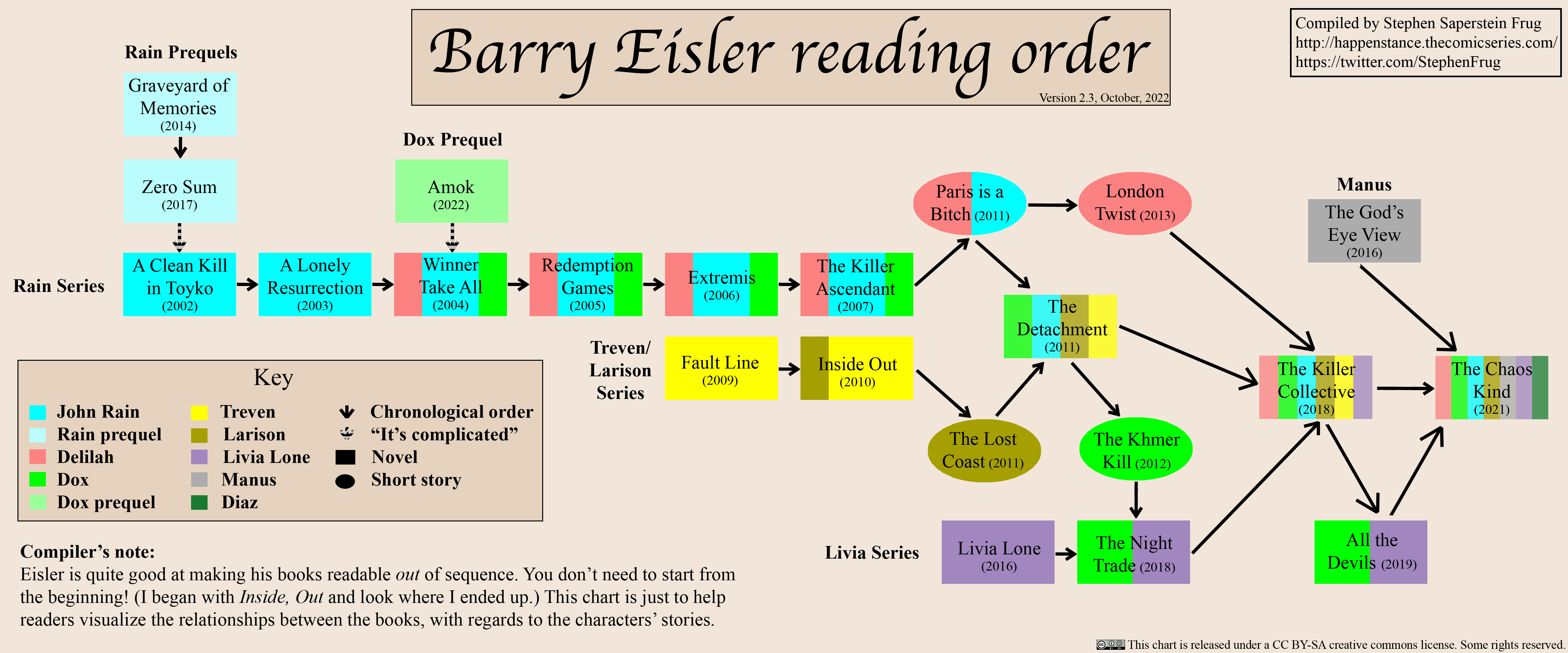
Barry Eisler Reading Order

Charted updated as of December, 2022.

Some of my favorite light reading are the thrillers of Barry Eisler. As he's gone along, the overlaps in his characters/series have become more complicated.  So, in a fit of OCD and with a nod to the Terry Pratchett Reading Order guide, I made this chart. I offer it here for the edification of all and sundry.  But do take the compiler's note about how you can start anywhere seriously.

(Click for a larger version.)

Incidentally, I got into this because I had just bought my aunt the second Livia Lone book as a present — she'd liked the first — and was trying to think of how to explain who Dox was and how he fits in.  It's tricky!

 (Now updated for his forthcoming novel The Chaos Kind (October, 2021). Also released under a Creative Commons BY-SA license, in case anyone feels inspired to improve upon it. (Email me for the photoshop file if you want it.)

Wednesday, November 29, 2017

Secondary Sources On Gene Wolfe's Book of the New Sun

A friend of mine, seeing my previous post (on FB), asked whether there were "annotations" of Gene Wolfe's SF masterpiece, The Book of the New Sun.  Since I wrote a lengthy reply, I thought I'd repost it here, with links.  (In the following, the "you" is my friend, natch.)

I don't think there's quite what you're looking for. The closest that there is—and in any event the first secondary work devoted to The Book of the New Sun that one should lay hands on—is Lexicon Urthus: A Dictionary for the Urth Cycle, by Michael Andre-Druisi. It defines many of the obscure words, and also has a certain amount of commentary/exposition, although hardly a complete reading. Beyond that I can think of three other books, none quite perfect for your needs: there is Attending Daedalus by Peter Wright, which is about Wolfe's work in general but which focuses on The Book of the New Sun; there is Marc Aramini's Between Light and Shadow, volume one of a projected three-volume work discussing all of Wolfe's fiction, but its entry on The Book of the New Sun, while good, is brief (c. 40 pages) and is more thematic than annotational. And then there's Solar Labyrinth by Robert Borski, which has a number of essays on specific puzzles in the Urth cycle. All three are worthwhile; none are quite what you're looking for.

That's mostly it for books. There are a few essays scattered around — in review collections by John Clute, for instance — but nothing systematic. Three web resources might have some more of what you're looking for. First, there's the Wolfe Wiki, which is variable (some works get only a skeleton treatment, some a very detailed reading), but it looks like there's some good stuff there. There are the archives of the Urth List, which is the mailing list/forum for discussion of Wolfe's work, which has a lot of stuff in it, but so far as I know it's not indexed & you'd have to do a tremendous amount of searching. And then there's Reddit, about which I don't know much, but it looks like there's a fairly active Gene Wolfe section there. Again, while I imagine there's some good stuff in all three, none are quite what you're looking for.

One more set of resources to discuss. There are now two podcasts devoted to close readings of GW's work. One, The Gene Wolfe Literary Podcast, seems good, but it's just starting (and I've heard only one episode), and is doing a lot of short stories & many novels before they get to the The Book of the New Sun. So they probably won't get to it for years. The other, Alzabo Soup, is actually doing The Book of the New Sun now. But at this point I can't quite recommend it. I find many of their readings simply careless: some strike me as flatly disprovable, others as wholly wrongheaded even if not flatly contradicted by clear textual evidence. I'm getting a lot out of it — even with its problems, they pick out details & things I missed on my several times through the books — but I think their overall interpretation is questionable, and I think that, unless you feel you have a good grasp on the text, they will mislead as much as provide insight. I wish this wasn't so; after the first ep or two I had great hopes for it, but I have been disappointed as I've kept listening. I haven't stopped listening yet, but I may; at this point it's more frustrating than enlightening, although it is that, too, at least in certain local observations if not more broadly considered. Alas! I really wanted it to be great. (It's gotten a fair amount of positive attention, so I may simply be an outlier here, but for what it's worth a Wolfean whom I respect a great deal — whom I can't name, because it was a private communication — said they dislike it too, for some of the same reasons.)

Beyond that, I would suggest that a large number of the mysteries—not all, by any means, but more than you'd think—can be cleared up by simply reading the entire work (i.e. both The Book of the New Sun and The Urth of the New Sun, the sequel) closely & carefully, and then doing so a second time, while the first is still fresh in your mind. That's a huge time commitment, of course — five books, each twice — but it's the best route I know of.

I do wish someone would put out a proper annotated edition. (No one will, and if they did they wouldn't hire me to do it, but I would love to if both of these counterfactuals were miraculously overcome.) Or that there was a "rereader's companion", online annotations that went chapter-by-chapter.

will say, in conclusion (after far more than you wanted to read, I'm sure!), that the best route is to get Lexicon Urthus, do a careful reading with it to hand, and then either do a careful rereading, or read the Wright, the Aramini & the Borski volumes, the WolfeWiki pages, and possibly explore other online stuff as well, and then do a careful rereading. Wolfe is work. Personally I think it's well worth it. But many others, doubtless, won't find it so. (Of course the books can also be enjoyed on a surface level, as a sword & sorcery romp, although that's obviously, A) not what they are when read closely, and B) not what you were asking about.)  

Tuesday, November 28, 2017

In Which, as a Throwaway Notion in a Letter, the Origin of the Autarch's Social Role In THE BOOK OF THE NEW SUN Can Perhaps Be Found

And—though I pale to admit it—I have my vice. It is writing, and in everyday circles that is viewed a good deal more seriously than, say, pot probably is in yours. In short, your business is my besetting weakness; your business letters are my pornography; your shop talk my dissipation.

Which gives me a story idea. A nobleman, a pillar of the Jockey Club, who (on alternate Thursdays) creeps away from the Fabourg St. Germain to become (heh, heh!) a Montmarte used-lace merchant. Can't you just see him gloating fierce gloats as he speculates on Society's reaction to the news that he is secretly a petit commerçant? That's me except that I reverse it—I steal way to become a nobleman.

And you know what the petite bourgeoisie think of that.

— Letter from Gene Wolfe to Damon Knight, December 3, 1969
Reprinted in The Best From Orbit (1976), p. 337

Friday, November 17, 2017

"…a cosmos in which rude pictures of beats and monsters had been painted with flaming suns"

I spent the remainder of the night staring at the stars; it was the first time I had ever really experienced the majesty of the constellations… How strange it is that the sky, which by day is a stationary ground on which the clouds are seen to move, by night becomes the backdrop for Urth's own motion, so that we feel her rolling beneath us as a sailor feels the running of the tide. That night the sense of this slow turning was so strong that I was almost giddy with its long, continued sweep.

Strong too was the feeling that the sky was a bottomless pit into which the universe might drop forever. I had heard people say that when they looked at the stars too long they grew terrified by the sensation of being drawn away. My own fear—and I felt fear—was not centered on the remote suns, but rather on the yawning void; and at times I grew so frightened that I gripped the rock with my freezing fingers, for it seemed to me that I must fall off Urth.…

At first all the stars seemed like a featureless mass of lights, however beautiful, like sparks that fly upward from a fire. Soon, of course, I began to see… shapes, some corresponding to constellations of which I had heard, others that were, I am afraid, entirely of my own imagining…

When these celestial animals burst into view, I was awed by their beauty. But when they became so strongly evident (as they quickly did) that I could no longer dismiss them by an act of will, I began to feel as frightened of them as I was of falling into that midnight abyss over which they writhed; yet this was not a simple physical and instinctive fear like the other, but rather a sort of philosophical horror at the thought of a cosmos in which rude pictures of beats and monsters had been painted with flaming suns.

— Gene Wolfe, The Sword of the Lictor, chapter 13

Tuesday, November 14, 2017

Puzzle Literature: A Querry

-->
I have a question.  I'd like to list examples of a genre I shall call (for want of a better term), "puzzle literature".  I will define puzzle literature as literature whose narrative essence is a puzzle: which is to say, which can't be understood on a surface level (what Jews refer to as pshot) without unraveling various mysteries.  I want to refer to it not as a genre (since I don't think it has the social support and interlocking influence networks of a genre) but as a mode: a type of writing different writers can use, occasionally or regularly.

I shall take as my twin holotypes (yes, yes, I know you can't have more than one, feh) for the mode Vladimir Nabokov's Pale Fire and Gene Wolfe Book of the New Sun.  (Both authors write in that mode repeatedly, but those are my favorite examples.)  The most basic facts about the plots of each book — who is Kinbote (is he Botkin? Shade wearing a disguise? A real king? A madman actually named Kinbote?) in the case of Pale Fire; the nature of multiple basic events in the plot in the case of Book of the New Sun — are not only up for grabs, but are not remotely clarified.

Narrative games are a commonality here, as are games and jokes of other sorts. Unreliable narrators are another, although not all unreliable narrators qualify (I wouldn't say that Ford Maddox Ford's A Good Soldier qualifies, for instance.)

To further clarify my definition, let me list some things that it is quite specifically not.
• It is not mysteries, that is, works which present conundrums as part of their plot but which then overtly and clearly solve them.  So not Dickens, and not Agatha Christie.
• It is not works which are, in a sentence localized-way, hard to parse, or thematically/symbolically rich.  Ulysses is, as Joyce famously said, sufficiently full of puzzles that it will capture a generation of scholars; but the basic narrative is more or less clear.  That's not what I mean.  (This is presumably the category which is going to be hardest to distinguish from puzzle literature; but I think it is different.)
• Similarly, puzzle literature tends not to be extremely difficult on a sentence-by-sentence level; the puzzles are larger. So not Finnegans Wake, and probably not The Sound and the Fury either, although I am less sure about that one (does Faulkner count? I dunno.)
• In some sense, one can use the reading protocols of puzzle literature on anything.  James Kugel, in effect, argues that "scripture" as a textual category is created by treating a text as puzzle literature, so that minor inconsistencies become theological, require unraveling, etc.  It creates rich readings. But I am talking about books (presumptively although not necessary post-Gutenberg ones, with identifiable authors) which are written to be puzzle literature.

That hopefully clarified, my question: can we list works of puzzle literature beyond the basic holotypes?  Who else writes in this mode, whether occasionally or routinely?

I am also interested in some related questions:
• Are there writers who work in puzzle mode only sometimes?  (Do Wolfe and/or Nabokov ever not work in that mode? Could one tell, since once one is expecting it it tends to dominate reading?)
• Are their works of other forms that are in puzzle mode? (Some candidates: the films of Shane Caruth (Primer, Upstream Color) and Christopher Nolan (Memento, The Prestige, Inception). Alan Moore's comics come close, but I think ultimately fall into the Ulysses category: thematically rich with lots of decipherable puzzles, but there is no basic question as to what happens in them).
• Are there any good critical essays/books about this topic (including, presumably, better names for this category than I am using)?

So: thoughts?

Update: I posted this on my Facebook page as a public post; much discussion ensued, so if you're interested you can read the comments here.  But let me also add some of the clarifications/emendations I made in that discussion to this post. So:
• I should stress that whether or not something is puzzle literature is not an evaluative judgment. I do love both Nabokov and Wolfe; but to say a work is or is not puzzle literature is not, in my mind, to praise it. (I actually go back and forth on the whole notion, which is one reason I asked the question.)
• (in response to some suggestions)  I don't think either difficulty of the text, nor ambiguity about the story, nor the unreliability of the narrator counts. What distinguishes VN/GW for me is that there are puzzles in the work, and ones that touch on the fundamental nature of the narrative. Puzzles: meaning there are pretty clear and definitive answers. But puzzles, meaning also you can read the book, even several times, and NOT get it (and some, doubtlessly, we still don't get). It's different than ambiguity or difficulty. (One further example: the name of the narrator in "The Fifth Head of Cerberus" is never given. It was several years, I believe, before ANYONE figured it out. Most people didn't even SEE that it was a puzzle! But once you see it, it is SO obvious that it is hard to imagine that anyone ever did NOT see it.)
Two possible criteria that might help clarify: to count, the puzzle must be missable: that is, it's not something that anyone who's read the book (seen the movie) would get; but the puzzle must also be solveable, that is to say, it's not simply an ambiguity that can be read multiple ways. Maybe that'll help.
Another one that I think clearly fits: Mark Z. Danielewski's House of Leaves. 

Thursday, October 13, 2016

A Few Words on Little, Big

A few days ago I finished listening to the audiobook (read by the author) of John Crowley's Little, Big — my second time through the audiobook specifically and third time through the text of the novel as a whole.*  I come away once again overwhelmed by what an amazing, marvelous book it is.

I want to recommend it to everyone.  Virginia Woolf famously said that George Eliot's Middlemarch was "one of the few English books written for grown-up people", a remark that strikes me as about 15% insightful and 85% silly.  But in the same way one could say that Little, Big was one of the few English books about faeries written for grown-up people.**  Middlemarch contains a village, at a fairly brief moment in time; Little, Big contains a family (it is family chronicle, a rather old-fashioned but marvelous form), stretched out over time and space (or, if not space, then location, the locations being the country house and the City).  It's breathtaking and heartbreaking and wonderful.  Its prose is not as pyrotechnic in a way that Nabokov's or Updike's can (at times excessively) be; but it is as good as theirs are, which is to say, as good as English prose gets.  Gene Wolfe (one of the few living writers in his class) said that Little, Big was "an education in modern fantasy all by itself"; Ursula Le Guin said it is "a book that all by itself calls for a redefinition of fantasy".  Harold Bloom's canonized it.  Seriously, people, this is an amazing book.

I want to recommend it to everyone: but with a word of warning.  It's not an easy book to get into.  Several very fine readers whom I have pushed it upon have begun it, seen its merits, but not finished it.  I myself began it several times before finishing it.  After I did so, I went online and searched for information about it, and found person after person saying some variation of, "it took me several tries to get into it but now it's one of my favorite books".  Well, me too.  It reminds me of what Umberto Eco said in his Postscript to the Name of the Rose:
After reading the manuscript, my friends and editors suggested I abbreviate the first hundred pages, which they found very difficult and demanding. Without thinking twice, I refused, because, as I insisted, if somebody wanted to enter the abbey and live there for seven days, he had to accept the abbey's own pace. If he could not, he would never manage to read the whole book. Therefore those first hundred pages are alike a penance or an initiation, and if someone does not like them, so much the worse for him. He can stay at the foot of the hill.  Entering a novel is like going on a climb in the mountains: you have to learn the rhythm of respiration, acquire the pace; otherwise you stop right away.
Just so: the same is true of the life of a family that lives in the country and waits for a Tale to unfold.

It is not a book that you "can't put down": it is that much deeper and more wonderful thing, a book that you must continually put down to catch your breath, to marvel at the view, to hold a phrase tightly in your mind in sheer delight.  But it is a journey worth taking.  Some reviewers have complained that "nothing happens" in the book: which is not at all true, though I grant that there is no punching or shooting (well, except for the person who ends up getting shot, I mean.  But not that sort of shooting).  But it is not a novel paced to the attention spans of the digital age.  It's the richer for it: but it has become for us, I think, a harder read than it was when it first came out.  But it will repay you richly if you make the effort.  Sometimes long journeys need to be taken on foot, to be the more marvelous when you finally, dusty and tired, arrive.

Two notes on two ancillary works of art that spring from the novel.

First, as I mentioned, I listened to the audiobook, read by Crowley himself.  It's marvelous.  Crowley is not a professional audiobook narrator, and does not have the characteristic style they do (with, for instance, their multiple voices for multiple characters); but the text is his, and his voice makes it (if possible) even better.  If you've gotten stuck in the book, try the audiobook.  (Local Ithaca folks might note it's in the TCPL system, though housed at a different library.)

Second, my friend Ron Drummond has been working for some years on a special limited edition of Little, Big, one with an author's corrected text*** and illustrations by Peter Milton — pictures not created for the book, but used to illustrate it.  That last — the entwining of a text with pictures made separately from it — sounds as implausible as, well, a novel about faeries for (in a Wolfian sense) grown-up people.  But, implausibly, miraculously, it works.  The other day Ron was kind enough to show me several chapters as laid out for the in-process edition.  What was remarkable to me about it is not only how well they graced the text, but the way in which Ron, taking details from various pictures, sometimes reversing or reusing them in creative and counterintuitive ways, has made out of Milton's art and Crowley's masterpiece something yet other, a third work of art, with its own aesthetic surprises and joys and marvels.  It is, perhaps, the art of curating (a underappreciated art in any event); but it is a first-rate example of it.  Ron has hit some speedbumps, and the edition as yet has no publication date,  but keep an eye out for it, and catch it when you can.

In the meantime, don't let that hold you up: get any old edition of the novel and read it — or get the audiobook and listen.  If you get stuck, keep going.  Don't let the amazing transition that occurs in the first sentence of part three throw you (it threw me, when I first hit it).  It's worth it.  If you finish it once, you'll want to read it again.

__________________________

* The first time I used the admittedly old-fashioned medium of trees, pulped & smashed flat, and systematically dirtied in specific patterns.  Weird, I know.

** Don't let the word ''faeries" turn you off; these are neither Peter Pan's cute comrades nor Tolkien's wise warriors.  They are marvelous and terrifying and convincing in a way that I might have said, before reading the book, was impossible.

*** Used as the text for the audiobook edition, incidentally.

Dylan, Nobel Laureate

I am genuinely quite, quite thrilled by this news.

There has been no better writer than Dylan in the years Dylan has been writing. The Nobel for Literature has never gone to anyone more worthy than he.

There are, to be sure, other writers equally worthy: I would love to see someone from the SF field win it (Le Guin is most frequently named, and would be a fitting winner, as would Wolfe, Delany, Crowley, and others). I'd plug Alan Moore. The various sneers at Philip Roth are misplaced; he, too, would be a great winner. All that said: there is no better choice. Dylan is entirely and fully deserving.

A splendid, perfect choice.

Two further points:

First, I would like to thank the Nobel committee for taking my mind off this genuinely stomach-turning election (due, I should add, entirely to one candidate: I mean no false equivalence here), and giving me something to be genuinely happy about this morning.

Second, note to self: really, really gotta resist getting into it with the people who are, in various fashions, sneering. Shouting doesn't help people be less tone deaf.

PS: Ted Gioia totally called it some years ago (fun list all around, incidentally).

Wednesday, May 14, 2014

Three Exciting Pieces of Humument News


I just found out three exciting pieces of Humument news!

— News about what now?

A HumumentA Humument is a book by artist Tom Phillips  Kinda.  Maybe it's three books.  Or not a book.  It's a something.

...Let me start over.

Once upon a time, there was a novel by one W. H. Mallock (1849-1923) called A Human Document (1892).  It came out, was presumably read by someone at some point, and then was completely forgotten, until an artist named Tom Phillips (b. 1937) found it at an old store when he was looking for a book to alter, to treat, to change, as part of an artistic project.  He bought it and began to alter its pages.  He crossed out, painted over and drew on each page — leaving, however, some words to make up a new (hidden, revealed) story running through the art.  The first edition — which was unnumbered, but which given subsequent events should perhaps be considered edition zero —came out, from a small press, in 1970.  A edition came out from a larger publisher, Thames & Hudson, in 1980.  (It is considered, I believe, the "first" edition, although so far as I know it isn't formally numbered.)

But.  Phillips continued to work on it.

He'd altered the entire book into a single, amazing artwork. But he kept altering pages — replacing old ones with new versions.  And then he'd publish a new edition with the new pages substituting for the old versions.  (Thus each edition is slightly different.)  The second edition (so-called, actually third) came out in 1986; the third in 1998; the fourth in 2004.  I own the fourth, having read it (Browsed it?  Looked at it?  What does one do with A Humument, anyway?) from the library.  Apparently Mr. Phillips's ambition is to replace every page from his original 1970 edition.  With a new version.

I understand that.  The various pages from the original edition is simply not as rich, not as wonderful, as the pages from the later editions.  Here, see for yourself: here is the third page from the original (1970) edition, paired with the current (AFAIK) page three:


You see what I mean.

On the other hand, sometimes he replaces a page I really like.  For instance, I really like both versions of p. 15:


And of p. 20:


So the process of replacement is a loss, too.  At least sometimes.

Not all of the replaced pages are originaly from the 1970 edition; some pages he has replaced more than once.  So far as I can tell (I don't have access to all the editions) these are often great pages replacing equally great pages (or nearly so).  (I should say at this point that not all of Phillips' treatment of this book is even part of the Humument project.  He's done altered pages of Mallock's novel separately, as part of other projects, e.g. as part of an illustrated version of Dante he did.)  What's really wanted is A Complete Humument, with all the versions of all the pages included.  Perhaps someday someone will publish one.

In the meantime, it's a marvelous book, highly, highly recommended.

Which leads me to the first of the three pieces of exciting Humument news.

1. The Fifth Edition of A Humument Has Been Published

Two years ago (why does no one tell me these things?) Phillips published his Fifth Edition (not counting, as always, the original, small-press, Zeroith edition.  So you can go buy it & read it.  It's great.

But what if you don't want that book?  That leads us to...

2. A Humument has an Ap (= an Ebook version)

Yes, there is an iPad — and iPhone — version of A Humument.  It seems to be based largely on the Fifth Edition (op. cit.), but also has brand-new, never-before-seen pages.  — Actually, I haven't checked out the iPhone version, but given Phillips's record, I have no confidence that the art in the two Aps are at all identical.

I just downloaded the iPad version.

It has one feature — an "not-too-serious oracle", which displays two paired random pages (a feature which Phillips seems very taken with) — not in the book, although I suppose you could flip through the book and pick two pages.  Or roll a 367-sided die, twice.  Or something,

It also has one flaw: it doesn't seem to remember your place if you close & reopen the ap — there's no bookmark function.  (It does, fortunately, have a "go to" function, albeit not one with the easiest to use UI.)  Or maybe I've just missed it so far.

But mostly it's the latest version of A Humument, with all the astonishing brilliance that implies, as an ebook.  (And about 1/3 - 1/4 of the price of the paperback.)  So go ahead and get that, too.

Still, it would be nice to see various versions of a single page, wouldn't it?

Which leads us to...

3. A Humument had an art show, and it's now online.

Through most of 2013 — and I really rue that I only found this out in 2014 (why does no one tell me these things?) — there was a show of A Humument up at the Mass MoCA museum in North Andover, Massachusetts.  The show displayed two versions of each page (it doesn't seem they ever included more than two, which is a pity).  They also presented the unaltered version of Mallock's book along with them.

Yeah, it's over.  It sucks.  But: they now have an online gallery of it.

With three versions of each page: Mallock's unaltered, and two by Phillips.  (A few of the latter versions — maybe 1/10? — are missing, perhaps to encourage you to buy the book and/or ap, which you should do anyway.)  But it's A Humument.  Twice.  Online.

'Nuff said.

Go see it. It's one of the great books — great art projects — great nested collection of various related....

Aw hell.  Who knows what it is.  But whatever it is, it's one of the great ones of our time.

Update:

Here are some Humument-related links from my bookmarks folder.
Enjoy.

Wednesday, October 23, 2013

Quote of the Day

Courage, I seemed to think, comes to us in finite quantities, like an inheritance, and by being frugal and stashing it away and letting it earn interest, we steadily increase our moral capital in preparation for that day when the account must be drawn down. It as a comforting theory. It dispensed with all those bothersome little acts of daily courage; it offered hope and grace to the repetitive coward; it justified the past while amortizing the future.

— Tim O'Brien, The Things They Carried, "On the Rainy River"
I'm teaching the first of three classes (in my seminar on the 1960s) on Tim O'Brien's amazing book The Things They Carried tomorrow.  It will be the fifth or sixth time, I think, I've taught it.  At least fifth, plus one time I taught the title story by itself.

Anyway, now, rereading it for class tomorrow, for the sixth or seventh or whateveritisth time, this quote struck me.  I've read those words before, of course, many times.  But each time through, of course, different quotes stand out; this one stood out tonight.

Friday, August 30, 2013

Seamus Heaney (1939 - 2013)

As anyone who has been online today has probably already heard, the Irish poet (and Nobel laureate) Seamus Heaney died today.

It would be an exaggeration to say that I knew Heaney, but he was to more more than simply a name signed to incredible verse (although he was that too).  His daughter spent a year at my high school -- she was a year or two below me -- and during that year he came to speak at my school.  I remember asking him a question during the Q&A; what he answered wasn't quite what I meant to ask, but it was sort of thrilling anyway.

Then, in college, I went to Harvard, where he was teaching, and I took his course on Modern British and Irish poetry.  It was a great class, and I remember a great deal of the poetry we read in it.  (We did a day on Heaney himself of course -- we couldn't not; a guest lecturer, professor Helen Vendler, came in and gave the lecture on that day.)  I also remember bits and pieces of things he said in class.  (From the first day, winding up talking about the class: "Tough grading -- nothing for nothing.")  He wasn't a perfect teacher -- he had the bad habit of quoting poems he almost, but didn't quite, know from memory, when we all had the texts open in front of us: the mistakes grated.  But he was a good one, and I learned a lot.

A number of years later I saw him on Mass Ave, across from Harvard yard.  I introduced myself as a former student.  In memory, he pretended to recognize me, but I quite doubt he did (I certainly wouldn't have, in his place.  Maybe he was better with faces than I.)  He had won the Nobel prize, and I asked if he was still teaching.  Some, he said; but he limited things so that he didn't have to grade papers any more.  (He hadn't graded them in the class I had with him; like nearly every Harvard lecture class, they were graded by TAs.)

And then we said goodbye.

The poem of his that I didn't know, that I've seen most quoted today which I like best, is actually from his translation/adaptation of Sophocles’ Philoctetes (quoted variously here and here).  Here are the lines being quoted:
Human beings suffer,
they torture one another,
they get hurt and get hard.
No poem or play or song
can fully right a wrong
inflicted or endured.

The innocent in gaols
beat on their bars together.
A hunger-striker's father
stands in the graveyard dumb.
The police widow in veils
faints at the funeral home.

History says, Don't hope
on this side of the grave.
But then, once in a lifetime
the longed for tidal wave
of justice can rise up,
and hope and history rhyme.

So hope for a great sea-change
on the far side of revenge.
Believe that a further shore
is reachable from here.
Believe in miracles
and cures and healing wells.

Call the miracle self-healing:
The utter self-revealing
double-take of feeling.
If there's fire on the mountain
Or lightning and storm
And a god speaks from the sky

That means someone is hearing
the outcry and the birth-cry
of new life at its term.
This passage seems to have been separately published under the title "Doubletake", but I'm not quite sure about that; it's definitely from The Cure of Troy (pp. 77-78, spoken by the Chorus).

Now I guess I need to track down the whole thing.

RIP, Professor Heaney.

Monday, April 29, 2013

Wednesday, April 03, 2013

An Essential Part of Fantasy is the Self-Consciousness of Being in Story

This is a point that John Clute makes in The Encyclopedia of Fantasy*:
Part of the definition of fantasy is that its protagonists tend to know they are in a Story of some sort, even if at first they do not know which one... It would of course be injudiciously restrictive to claim that all fantasy texts convey a sense that their protagonists are under the control of an already-existing Story, and that sooner or later they come to an awareness of the fact; it is, however, the case that many fantasy texts are clearly and explicitly constructed so as to reveal the controlling presence of an underlying Story, and that the protagonists of many fantasy texts are explicitly aware they are acting out a tale. ("Story", section 2 (p. 901))
Clute gives many examples.  (One famous one is Frodo and Sam's talking, towards the end of The Two Towers, talking about what sort of story they are in, and what it would be like to hear it.)

All of which is a lengthy prologue to why these sentences in Alice's Adventures in Wonderland -- a taproot fantasy text (to use Clute's technical term) as well as foundational children's book -- caught my attention:
`It was much pleasanter at home,' thought poor Alice, `when one wasn't always growing larger and smaller, and being ordered about by mice and rabbits. I almost wish I hadn't gone down that rabbit-hole--and yet--and yet--it's rather curious, you know, this sort of life! I do wonder what can have happened to me! When I used to read fairy-tales, I fancied that kind of thing never happened, and now here I am in the middle of one! There ought to be a book written about me, that there ought! And when I grow up, I'll write one--but I'm grown up now,' she added in a sorrowful tone; `at least there's no room to grow up any more here.' (Chapter 4, "The Rabbit Sends in a Little Bill")

As you were.

_____________________________
* Which, incidentally, is a brief, marvelous critical book on the nature of fantasy, cut into pieces and distributed alphabetically among a lot of more standard encyclopedic material, making up a lengthy tome.  The critical book is very highly recommended if you haven't read it: start at the "Story" entry and follow cross-references.  The rest is a useful if (by this point) slightly outdated reference.

Wednesday, December 12, 2012

Poem of the Day: Farewell, Rewards and Fairies

Farewell, Rewards and Fairies

Farewell, rewards and fairies,
Good housewives now may say,
For now foul sluts in dairies
Do fare as well as they.
And though they sweep their hearths no less
Than maids were wont to do,
Yet who of late for cleanness
Finds sixpence in her shoe?

Lament, lament, old Abbeys,
The Fairies’ lost command!
They did but change Priests’ babies,
But some have changed your land.
And all your children, sprung from thence,
Are now grown Puritans,
Who live as Changelings ever since
For love of your demains.

At morning and at evening both
You merry were and glad,
So little care of sleep or sloth
These pretty ladies had;
When Tom came home from labour,
Or Cis to milking rose,
Then merrily went their tabor,
And nimbly went their toes.

Witness those rings and roundelays
Of theirs, which yet remain,
Were footed in Queen Mary’s days
On many a grassy plain;
But since of late, Elizabeth,
And later, James came in,
They never danced on any heath
As when the time hath been.

By which we note the Fairies
Were of the old Profession.
Their songs were ‘Ave Mary’s’,
Their dances were Procession.
But now, alas, they all are dead;
Or gone beyond the seas;
Or farther for Religion fled;
Or else they take their ease.

A tell-tale in their company
They never could endure!
And whoso kept not secretly
Their mirth, was punished, sure;
It was a just and Christian deed
To pinch such black and blue.
Oh how the commonwealth doth want
Such Justices as you!

-- Richard Corbet (1582–1635)
This poem, I believe, is now quite obscure: but in Rudyard Kipling's day it was apparently common enough that his child protagonists of Puck of Pook's Hill (1906) had memorized it.

It's a strange poem. On a first read it may seem -- at least it seemed to me -- largely a poem about disenchantment: the sense that the old magic has gone from the world that so much fantasy is based on, even about. (Which is one of the reasons that fantasy can seem, at times, such an essentially anti-modernist genre.) In which case nothing may surprise about it save that it's so early -- the first few decades of the Seventeenth century, after the ascent of James to the throne of England (1603), but before Corbet's death in 1635. And there, of course, we may be surprised, but we shouldn't be: that sense of modernist disenchantment is in other works from the period, too, such as the famous passage by Corbet's more famous contemporary poet-in-arms, John Donne:

And new philosophy calls all in doubt,
The element of fire is quite put out,
The sun is lost, and th'earth, and no man's wit
Can well direct him where to look for it.
And freely men confess that this world's spent,
When in the planets and the firmament
They seek so many new; they see that this
Is crumbled out again to his atomies.
'Tis all in pieces, all coherence gone,
All just supply, and all relation;
Prince, subject, father, son, are things forgot,
For every man alone thinks he hath got
To be a phoenix, and that then can be
None of that kind, of which he is, but he.

But though we have become distracted by Donne, and recognize that it is a better poem and wish to follow that particularly path with leaves no step has trodden black (no, no, don't go on another tangent--), reread the Corbet. And on a second reading you may zero in, as I did, on the somewhat puzzling religious politics of the poem.

At second glance the poem may seem simply anti-Catholic: the Faeries are declared gone because they were Catholic, and the new spirit of the age is equated with protestantism:
...the Fairies
Were of the old Profession.
Their songs were ‘Ave Mary’s’,
Their dances were Procession.
But now, alas, they all are dead;
Or gone beyond the seas;
Or farther for Religion fled;
Or else they take their ease.
(The "old Profession", of course, is not the proverbial oldest profession (though faeries of that sort might make an interesting story, should anyone wish to write it), but the former faith (profession, that which you profess, i.e. your religion.))

Except is that right? Because the metaphor of the changeling, the faerie put in place of a babe, is used to explain the replacement of Catholicism by Protestantism:
Lament, lament, old Abbeys,
The Fairies’ lost command!
They did but change Priests’ babies,
But some have changed your land.
And all your children, sprung from thence,
Are now grown Puritans,
Who live as Changelings ever since
For love of your demains.
So is it in fact a pro Catholic poem, since Protestants are equated with changelings (not, traditionally, a positive association)?  Possible, I suppose, but given that its author was a bishop in the Church of England, it seems unlikely.  I presume such a bishop was unlikely to be a secret Catholic?

Except that that last stanza seems to praise Faeries specifically for their punishment of (what we would now call) snitching, and actually wishes that England had similar "Justices":
A tell-tale in their company
They never could endure!
And whoso kept not secretly
Their mirth, was punished, sure;
It was a just and Christian deed
To pinch such black and blue.
Oh how the commonwealth doth want
Such Justices as you!
What is that all about?

My guess is that the answer to this mystery would be more-or-less obvious to anyone well versed in the history of early Stewart England, but that I (whose period is far off from that in both space and time) am just missing it.

So anyone have a sense of what is going on -- in terms of religious politics, and the sense of the changing metaphysical beliefs -- in this poem?