Showing posts with label Reposts. Show all posts

Friday, March 10, 2023

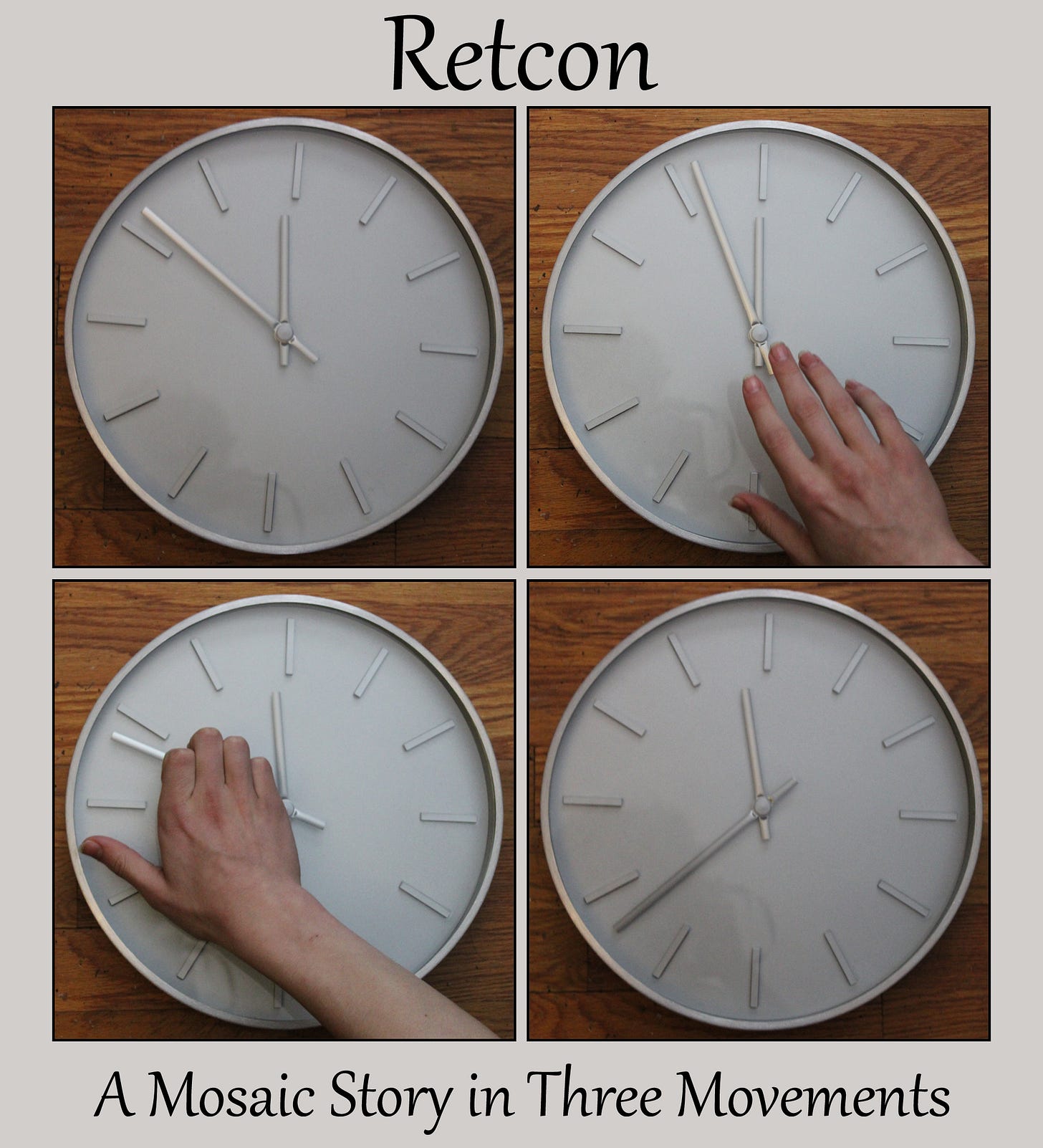
Introducing Retcon: A Mosaic Story in Three Movements

This is cross-posted from Attempts's new home on substack. If you are reading this, you should go subscribe to the substack!  New updates will be mostly there, and new essays & other substantive material will be exclusively there.  We now return you to your regular post, already in progress:

I am debuting a new project—a big project—one I've been working on for a few years and which I have been gathering ideas for for longer than that. And I am hoping that you will  give the first installment a try.

What is this project? you ask. Why, say I, I am glad you asked that.1

Well, you remember that last week I put forward the term "mosaic stories" to refer to the general form of stories where small, to-some-degree self-contained stories make up a larger one? It so so happens, in an astonishing coincidence, that that's precisely the form of the story I've been working on.

The story's name is Retcon.

It will be a large story composed of twenty-seven smaller ones, divided into three sections, or "movements" as I've decided to call them.2 The smaller stories are (prose) short stories, averaging about 15,000 words each. 3 The stories are going to be released as ebooks (to begin with), although I have plans for print collections too. I am planning to release them on a monthly schedule, with a break between movements, so there will be one a month for nine months, and then a break, and then another movement will begin. 4

And the first one is available now. It's called "Zero Second"

So how can I read this story?

You can buy the ebook! It’s only $0.99.5

As for where to buy it, there are lots of options.

• If you want to buy it at Amazon (for Kindle), which is where the majority of ebooks are sold, you can do so at this link.

Or, if you’d prefer, you can buy it directly from me at my web site.

• Or you could buy it from another ebook vendor; it is available at Smashwords, Barnes & Noble, and Kobo. (So far Apple is being difficult, but I hope to get it up there too before too long).

• Or, if you are willing to commit to the whole narrative (and/or are interested in supporting the series, and this substack in the bargin), you can pre-order the entire series in advance, and I will send them to you as they are released. Note that this offer is exclusive to my web site.6

As I mentioned a few weeks ago, a number of people have offered to support my Substack, for which I was very grateful. Well, if you are interested in supporting this Substack, the best way to do it would be to support me, and the best way to do that would be to support my series. So please: go buy it, and read it!

And, just as important: if you like it, please tell people! Reviews (on Amazon or elsewehere) are really helpful. Even better: tell a friend that you think might like it, and get them to read it.7 Word of mouth is how this series will find its audience, if it does.

So… go! Now! Read! Enjoy!

But what's this story actually about?

A fair question!

I wrote a blurb for the series, which I will share in a moment. But while it fairly represents the whole series, it is something of a spoiler for parts of the first story. So before you read any further, you should go buy or listen to “Zero Second”!

All right, everyone back? Or at least not too spoiler-phobic?

Here’s what the story is about:

In 1951, a pair of scientists at Cornell discovered time-travel. With the specter of the atomic bomb in the immediate background, they decide not to replicate Einstein's mistake of drawing the attention of the political authorities to what might be a weapon. Instead, they decide to set up a clandestine research program to investigate the phenomenon, swearing all those who work on it to keep the secret.

Then, in 1991, a time traveler returns from 2031 with a disturbing message: no traveler and no message has ever come farther back from the moment in time when he left; beyond that instant—dubbed "zero second"—is unreachable. No one knows why. All people know is that something happens on April 4, 2031, to prevent any news of the future.

This is the story of what happens next... if "next" is the right word for a narrative which, in the way of things, is necessarily non-linear.

A Final Repeat of the Basic Point

I hope you will all go read the story; and then go and tell a friend, or three. This is the work of my heart, which I have been pouring myself into, “the heart’s reflections, writ in tears”, as the poet said.8 I hope you’ll give it a try.

1 It's easier when you're playing both parts.
 
2 I was going to call them three "series", as British TV does its sub-sections, but given that the entirety is also a series, I thought that would be confusing.
 
3 Actually, given their length, those more plugged into the terminology of the writing business they are "novelettes" or, in one or two cases, "novellas", but I don't think these are distinctions that need detain ordinary readers.
 
4 Yes, yes, just like a television show with its seasons (although closer together in time). Pity the poor fiction writer, always scuttling about in the shadow of those larger beasts, like tiny mammals dodging dinosaurs.
 
5 If that honestly, no kidding represents a financial difficulty to anyone, then drop me an email at stephenfrug - that little symbol for at - gmail.
 
6 Read: I don’t know how to set it up elsewhere or if it’s even possible.
 
7 And if you want to support this substack qua substack, do the same for it: tell people about it! Forward the link to essays they might like! Share!
 
8 Actually, Pushkin’s entire description of his own work resonates with me in contemplating mine:
Half humorous, half pessimistic,
Blending the plain and idealistic—
Amusement's yield, the careless fruit
Of sleepless nights, light inspirations,
Born of my green and withered years...
The intellect's cold observations,
The heart's reflections, writ in tears.
     — Pushkin, Eugene Onegin, trans. James Fallen

…although I should say “l’havdil”, the Talmudic term for saying that a comparison made on one front is not a comparison in other ways (so that to compare God to a king is not to say that kings are like gods, nor that God is like a king in living with bread, feeling want,
tasting grief, and needing friends): I am not comparing myself to Pushkin! Save that my work, howevermuch lesser than his, is also half humorous, half pessimistic, and also mixes “the intellect’s cold observations/the heart’s reflections, writ in tears”.

Tuesday, September 15, 2020

A Longer-Term Problem


I know we're all (rightly) paralyzed with fear and anxiety about the next few months, but allow me a moment for a longer-term worry.

I heard some of Biden's speech on climate change this morning. And I had two thoughts. First, it was (as far as a Democratic candidate goes) superb: a level of alarm and seriousness which is very welcome (and, yes, long over due). I doubt that Bernie could have done better.

But I fear he fell into a trap not specific to him, but broadly arising out of liberal politics. He said that if we reelect a "climate arsonist" (great term), more of America will burn, more will flood. But he seemed to imply that if we elect him instead, this won't happen. The horrible truth, of course, is that at this point 20-30 years of ever-increasing climate misery are already baked in. We're going to spend the next three decades paying for the last three decades of emissions (you know, the 50% of all emissions throughout history which were produced after we were thoroughly warned & had supposed begun to react).

This doesn't mean that reducing our emissions rapidly is not a priority; it has to be. But that's because if we don't act now things will be unimaginable—perhaps literally unendurable—in the second half of the century. We need to ensure a future for later generations. But the near-term present will be increasingly worse regardless. — Of course, there are things we can and should do to help the next few decades, adaptation and social strengthening of all sorts. But those are to live through the climate misery, not avert it.

Again: nothing Biden said was wrong, precisely. Certainly a vote for the climate arsonist is as immoral as it is possible to imagine—solely on these grounds, even aside from everything else. But he hasn't done anything to prepare people for the longer-term struggles ahead. I don't think that's a failure of Biden's; I think it's a problem with liberal democracy, which must sell people the idea that they will have a better life if they vote for us. Whereas now we have reduced ourselves to choosing between bad and worse for the rest of our natural lives.

Not now, not in the next two months, but soon, we're going to have to learn, as a political movement, as a society, to talk about these things. We don't want Joshua Hawley or Tucker Carson or Don Jr to get up and say in 2024, "you said you'd fix this!". We need to communicate to people the urgency, but also the length of the storm. This won't be fixed in four years, nor even in forty, although in forty we will make some serious strides (or else have dug our own graves). We need to learn to speak of care; of struggling together to survive the damage already done; of preparing for the long term. Because that's what we need to do, now.
 
Housekeeping: this is reposted from FB. Preparing it for blog publication, it occurs to me I've been nattering about this long enough that the tag is "global warming" and not the more up-to-date "climate change" — or the currently trending "climate emergency". What will we call it in a decade?  Just ordinary life, I suppose.  Or perhaps our long twilight struggle.

Wednesday, June 05, 2019

"But What Can I Do?"

A friend on facebook (who will be anonymous unless they say they'd like to be named) asked. re climate change: "But what can we do? I have yet to come up with anything we can do as individuals that could possibly help. Have anything?"

My reply:

"As individuals"? No. Nothing we can do as individuals is remotely equal to the scale of the problem. I mean, sure, drive less, fly never, get solar panels — all good things. But if everyone who cared did this it won't help. Only a radical restructuring of society and the economy can save us.

So what can we do? What we need to do is to elect politicians committed to a restructuring of the economy and society to a degree consonant with the problem. Not just Democrats; AOC Democrats, not Biden Democrats. (Along those lines: go to marches. Sign petitions. Give money. Make sure Jay Inslee is in the debates, at least.)

How do we do this? The only thing I know of, broadly, is to change the way people think. The best thing to do, I suppose, would be to find conservatives you know and convert them. That's tough, though. Second best? Try to convince liberals you know to treat the problem with the seriousness that is its due.

That's why I post on it all the time. If enough of us get that this is an emergency, one that will need to be solved by greater-than-WW2 style mobilization starting yesterday, then maybe, *maybe*, we can overcome this.

So talk about it, as often as you can stand or more. Be that annoying person who always points out that the house is on fire. And get everyone you know to talk about it.

If enough of us talk, if enough of us listen, then we won't be individuals any more, but a collective. And then maybe we can do something that can help.

Thursday, November 28, 2013

The Same Thanksgiving Post I Have Put Up Every Year Since 1621

Serve the LORD with gladness: come before his presence with singing.... Enter into his gates with thanksgiving, and into his courts with praise: be thankful unto him, and bless his name.

-- Psalm 100:2, 4

ANYA: I love a ritual sacrifice.
BUFFY: It's not really a one of those.
ANYA: To commemorate a past event, you kill and eat an animal. It's a ritual sacrifice. With pie.

-- Buffy the Vampire Slayer, "Pangs" by Jane Espenson
Thanksgiving is a holiday, and holidays are rituals. And one of my holiday rituals is to give thanks to you, Noble Reader, for reading. Not all sentences said ritualistically are heartfelt -- it goes with the territory -- but this one always is.* I am thankful that you have dropped by; I hope you will come back again.

I wish everyone a joyful Thanksgiving, however (and whether) you celebrate it, and to whomever (and however) you give thanks.

But I must admit to you all that the title of this post is a lie. The first Thanksgiving feast was in 1621; so obviously I did not put up my first blog post commemorating the event until the following year, 1622. My apologies for the inaccuracy.

_________________________
* Yes, that sentence noting that the ritualistic sentence is said not just ritualistically but sincerely is now, itself, a part of my Thanksgiving ritual. I will note that it, too, is said sincerely and not just realistically, and shudder at the inevitable extrapolation of this trend. (As, for instance, the slightly odd shudder I get at copying & pasting the previous sentence from last year's post... (A parenthesis which, unlike this second-order parenthesis (which, along with this third-order one, is the only original text in this increasingly convoluted footnote (nay, post (this way madness lies!))), was itself cut & paste from last year's post...))

Thursday, October 03, 2013

3/10/2013

I have blogged about palindromic dates once before, and at the time discussed two of my very favorite* palindromes: Georges Perec's Grand Pallindrome, and J. A. Lindon's brilliant palindromic poem "Doppelgänger".  (The latter is posted in its entirety at the link.)

Once you pass out of 2012, palindromic dates become in short supply -- although, of course, it all depends on what date system you use (search for "palindrome", or just scroll down.)  And if you just write the necessary numbers -- thus, "3" for the day and not "03" -- and put them in the European rather than the usual American order (which, to be fair, makes more sense (although not as much as the Chinese manner, which styles today 2013-10-3)), then today, yes, is a palindromic date.

So to celebrate, I thought I'd post** one of my very favorite artistic uses of palindromes -- up there with Perec and the Lindon -- Weird Al Yankovic's marvelous song/video parody, "Bob".

Incidentally, while the lyrics to this stand on their own (after all, they're perfectly balanced), the video itself is a parody of a famous video (avant la lettre) by Bob Dylan of his song Subterranean Homesick Blues.  If you don't know the latter, you might want to watch it first, not only 'cause it's great, but in order to properly enjoy the parody.

And now, ladies and gentlemen, I give you Weird Al:


Happy palindrome day!

____________
* Yes, I'm claiming the Perec as a favorite without ever having read it (see post for details); I like the idea of it, the fact of it, enough for it to qualify.

** Actually repost, but the earlier post was buried in a link dump and you probably missed it (close attention that I know you pay notwithstanding).

Thursday, July 04, 2013

Words Hard to Take Seriously Enough, However Seriously You Take Them (Repost)

We hold these truths to be self-evident, that all men are created equal, that they are endowed by their Creator with certain unalienable Rights, that among these are Life, Liberty and the pursuit of Happiness. — That to secure these rights, Governments are instituted among Men, deriving their just powers from the consent of the governed, — That whenever any Form of Government becomes destructive of these ends, it is the Right of the People to alter or to abolish it, and to institute new Government, laying its foundation on such principles and organizing its powers in such form, as to them shall seem most likely to effect their Safety and Happiness. Prudence, indeed, will dictate that Governments long established should not be changed for light and transient causes; and accordingly all experience hath shewn that mankind are more disposed to suffer, while evils are sufferable than to right themselves by abolishing the forms to which they are accustomed. But when a long train of abuses and usurpations, pursuing invariably the same Object evinces a design to reduce them under absolute Despotism, it is their right, it is their duty, to throw off such Government, and to provide new Guards for their future security.

--The unanimous Declaration of the thirteen united States of America

They're hard words to live by. Jefferson, who wrote them (with some later editing by committee), had trouble living by them, seeing his role in personally denying hundreds of people their inalienable right to liberty. Indeed, many of those who signed the declaration, people who took them very seriously indeed (the pledge of their lives, fortunes and sacred honors was not simply a rhetorical flourish, since they could have been hung if they'd lost the war), had trouble taking them seriously enough.

But it was hardly the only time. When Elizabeth Cady Stanton repeated those words, adding only a few self-evident edits ("all men and women are created equal"), it took decades for her to be taken seriously enough. When Ho Chi Min said those words (in Vietnamese) in saying that his colonized people also wanted to "dissolve the political bands which have connected them with another and to assume among the powers of the earth, the separate and equal station to which the Laws of Nature and of Nature's God entitle them", we did not take him seriously enough, and sent troops to aid his colonizers (who had, ironically, themselves aided us when we were the colonized).

And today, our government is threatening the life and liberty and pursuits of happiness of its citizens (not to mention its non-citizens: and after all those inalienable rights are due to all men and all women, not simply to American citizens), but somehow, we don't take those rights seriously, or the idea that governments derive just powers only from consent of the governed, and only to protect those rights, seriously enough.

Yet those words, written in haste by a slaveowner, derived from commonplaces of enlightened thought of his day, edited by a committee and passed hurriedly so they could return to the managing of a war, those words remain worthy of being taken seriously. The words were larger and better than he or they meant; larger and better than he or they knew; and larger and better than we have yet fully and truly grasped. Indeed, the question we should continually ask our government -- and ourselves -- is whether we are acting worthy of them.

Happy July 4, everyone.

(Reposted from 2010.)

Thursday, November 22, 2012

My Increasingly-Self Conscious Annual Thanksgiving Wish

Serve the LORD with gladness: come before his presence with singing.... Enter into his gates with thanksgiving, and into his courts with praise: be thankful unto him, and bless his name.

-- Psalm 100:2, 4

ANYA: I love a ritual sacrifice.
BUFFY: It's not really a one of those.
ANYA: To commemorate a past event, you kill and eat an animal. It's a ritual sacrifice. With pie.

-- Buffy the Vampire Slayer, "Pangs" by Jane Espenson
Thanksgiving is a holiday, and holidays are rituals. And one of my holiday rituals is to give thanks to you, Noble Reader, for reading. Not all sentences said ritualistically are heartfelt -- it goes with the territory -- but this one always is.* I am thankful that you have dropped by; I hope you will come back again. That I am copying and pasting this paragraph from last year's post -- save for this self-referential sentence -- does not in any way alter or diminish this fact (he said speech act-ily.)

And please note that, with the exception of this paragraph, this entire post was cut & paste from last year's, which means that all the sentences talking about how I just cut & paste everything save that sentence were themselves cut & paste, and the other sentences were copied from copies.  If I wasn't always so busy right before Thanksgiving, perhaps I might some day write something new.  In the meantime, I will point out that, once again, this post is no less heartfelt for my heart having felt it last year at the same season.

I wish everyone a joyful Thanksgiving, however (and whether) you celebrate it, and to whomever (and however) you give thanks.

_________________________
* Yes, that sentence noting that the ritualistic sentence is said not just ritualistically but sincerely is now, itself, a part of my Thanksgiving ritual. I will note that it, too, is said sincerely and not just realistically, and shudder at the inevitable extrapolation of this trend. (As, for instance, the slightly odd shudder I get at copying & pasting the previous sentence from last year's post...)

Saturday, October 20, 2012

Accelerating Towards Hell

I've posted a version of this video once before, but I'm going to post it again, because Ryan Cooper has taken Dave Robert's TED talk, "Climate Change is Simple", and jazzed it up with cool music & visuals to make his bleak news even more exciting to see.  So here it is:


Roberts has a post giving all the slides along with links to studies, etc, here, if you want more detail.

But the basic point is summed up in his sentence "our present course leads to certain catastrophe".  We are headed -- we are accelerating -- towards a situation where, in a few generations, half the Earth's surface will be so hot that you will die simply by going outside (170Âş Fahrenheit).  We are heading -- we are accelerating -- towards a situation where feedback loops means that climate change will become self-sustaining and will continue indefinitely even if humans stop emitting carbon tomorrow (which we won't).

WE ARE RACING TOWARDS DEATH, AND WE NEED TO STOP.

And I respectfully suggest that if you think this is too horrible to contemplate, or if you think other political issues are more important or more urgent, or, really, if you are more concerned about ANYTHING ELSE, then you haven't really grasped the magnitude and urgency of this.

(Oh, the election?  Well, climate change is being ignored by both parties (h/t).  I think it's quite, quite clear that Obama will be better than Romney -- but "better" here means not anywhere near good enough to save us, but more susceptible to being influenced by the massive direct action campaign that we need.  Obama won't save us: but he might -- might -- give us enough room to save ourselves.  If we accomplish a level of political mobilization that seems, at this point, miraculous to contemplate.)

We need to do something drastic, and to do something now.  To borrow a phrase from another writer speaking of another crisis, "if this article doesn’t rouse you to anger, fury, rage, and action, [human beings] may have no future on this earth."

Friday, March 02, 2012

Repost: Options on the Table

Since there seems to be a lot of saber-rattling about Iran these days -- from Israel, but also, sadly, from the U.S. media and even from Obama -- I thought I'd dig up this post from almost four years ago and repost it. Back then I was worried about the Bush administration attacking Iran; now I (and the world) are worried about Israel doing it, with or without U.S. backing. (And since they're far more likely to do it with U.S. backing, the latter should be unmistakably and forthrightly withheld in order to help deter such a crime.) Since an unprovoked attack would be the war crime of aggressive war (and far from being an excuse for it, fearing that your enemy is developing a new weapon or going to gain a strategic advantage is actually a common rationale for aggressive war) aiding Israel in such an attack, either beforehand or afterwards, would be a grave crime. We should remember this, and not do it.

***

(Originally posted July, 2008)

This is a simple attempt to get a new phrase, meme, talking point -- call it what you will -- out into the world. I've never seen anyone advocate it or suggest it before, although if someone has, that's great, since the point is to get people saying it and thinking it.

There's a ritual invocation now said by American politicians across the spectrum that "all options are on the table". What they mean by this, of course, is that military action is on the table -- usually that unilateral military action is on the table. After all, Bush and McCain have been pretty explicit about taking diplomatic talks between the US President and high-level Iranian leaders off the table -- which would be covered in the normal usage of "all options" (that is, when non-politicians use the phrase). (There's a good recent analysis of this phrase, this idea and this possibility here.)

"All options" is a phrase that thinly veils a threat of force -- aggressive force, force against a weaker adversary who has not attack us -- within what purports to be simple open-mindedness. Who's against keeping all options open? It sounds, in principle, so reasonable. (Of course, as I just noted, Bush and McCain are against keeping all options open: they're closing off some types of diplomacy. But that's not brought up in this context.) Which is one reason that it's said equally by people on the left as the right -- Obama (and Clinton, and everyone else) constantly say they want to "keep all options on the table" too.

It's a way to threaten that sounds like simple reasonableness, simple open-mindedness. Anyone who objects to the threat can be made to seem like they are (narrow-mindedly, dogmatically, prematurely) closing off options.

The reason that politicians of all stripes repeat it so often is because, in this framework, it works. It's effective. It's a good meme (even if it's a very bad idea).

So here's a counter-meme. One designed to work on its own, but also -- more importantly -- to try to render the currently common meme ineffective. The idea here is rhetorical counter-punching. If this doesn't work, maybe someone will suggest something better. But here's my idea.

I think we should always keep all legal options on the table. The key here is the clear but not-sufficiently-mentioned fact that an aggressive war (including its subcategory, preventative war) is illegal -- at least under international law.*

But rather than emphasizing the prudence, morality, efficacy or other virtues of not committing aggressive acts of war -- virtues that, in our current political culture, are far too often dismissed as wimpy or impractical or quaintly outmoded or whatever -- it emphasises the issue of legality, which everyone still pays at least lip service too.

It thereby removes disastrous options from the "table" in a way that's harder for war proponents to criticize. If one were to say, "we should keep all non-military options on the table", the reply would be, "you're too wimpy to use force." But if one were to say "we should keep all legal options on the table", what would the reply be? "No, I think illegal options should be on the table too?"

Actually, I suspect, if it became common enough the response would be a direct attack on the notion that aggressive wars are illegal -- at least for the United States. But I think this would be a good thing, or at least a better situation than we have now. It force out into the open the idea now assumed in our political discourse, namely, that the U.S. has the right to attack whomever it wants to, but that attacks by other countries (or at least non-authorized attacks) are illegal and immoral - are aggression.

"All legal options" underlies the criminality of aggressive war, while also removing it from the possibility set in a way that is perhaps rhetorically (and not just morally or prudentially) defensible in today's political climate.

There's more to say on this, perhaps, but let's leave it there for now. Pass it around: let's see if it can catch on.

Iran: all legal options are on the table.

And no others.

____________________________
* Do any lawyers out there know if American law rules out aggressive use of force? (In theory, I mean, regardless of how things are de facto.) My guess would be that we've signed UN conventions, treaties, etc, that outlaw it, which would make it American law too, but haven't passed any individual laws to that effect. But I don't actually know.

Wednesday, February 29, 2012

Quote of the Day: Leap Day Edition

PIRATE KING:
For some ridiculous reason, to which, however, I’ve no desire to be disloyal,
Some person in authority, I don’t know who, very likely the Astronomer Royal,
Has decided that, although for such a beastly month as February,
twenty-eight days as a rule are plenty,
One year in every four his days shall be reckoned as nine and twenty.
Through some singular coincidence – I shouldn’t be surprised if it were owing to the
agency of an ill-natured fairy –
You are the victim of this clumsy arrangement, having been born in leap-year,
on the twenty-ninth of February;
And so, by a simple arithmetical process, you’ll easily discover,
That though you’ve lived twenty-one years, yet, if we go by birthdays,
you’re only five and a little bit over!

[...]

FREDERIC:
How quaint the ways of Paradox!
At common sense she gaily mocks!
Though counting in the usual way,
Years twenty-one I’ve been alive.
Yet, reckoning by my natal day,
I am a little boy of five!

-- W. S. Gilbert & Arthur Sullivan, The Pirates of Penzance

Happy leap day to everyone. And in a particular happy birthday to those who share Frederic's natal day and are thus, today, precisely 1/4 of the age that they actually are.

Thursday, November 24, 2011

My Annual Thanksgiving Post - Now With Exciting A/V Content Added!

Serve the LORD with gladness: come before his presence with singing.... Enter into his gates with thanksgiving, and into his courts with praise: be thankful unto him, and bless his name.

-- Psalm 100:2, 4

ANYA: I love a ritual sacrifice.
BUFFY: It's not really a one of those.
ANYA: To commemorate a past event, you kill and eat an animal. It's a ritual sacrifice. With pie.

-- Buffy the Vampire Slayer, "Pangs" by Jane Espenson
Thanksgiving is a holiday, and holidays are rituals. And one of my holiday rituals is to give thanks to you, Noble Reader, for reading. Not all sentences said ritualistically are heartfelt -- it goes with the territory -- but this one always is.* I am thankful that you have dropped by; I hope you will come back again. That I am copying and pasting this paragraph from last year's post -- save for this self-referential sentence -- does not in any way alter or diminish this fact (he said speech act-ily.)

In, however, a desperate attempt to enliven this ritual with some exciting! new! content, here is a video clip of the exchange from the Buffy the Vampire Slayer episode quoted above:


Oddly, there is no youtube clip of David Ha-Melech saying the appropriate clip from the Psalms. All they have is a few odds and ends -- the famous bits, Psalm 23, and all that. Anyone have it and want to upload it? I promise to post it next year...

I wish everyone a joyful Thanksgiving, however (and whether) you celebrate it, and to whomever (and however) you give thanks.

_________________________
* Yes, that sentence noting that the ritualistic sentence is said not just ritualistically but sincerely is now, itself, a part of my Thanksgiving ritual. I will note that it, too, is said sincerely and not just realistically, and shudder at the inevitable extrapolation of this trend. (As, for instance, the slightly odd shudder I get at copying & pasting the previous sentence from last year's post...)

Monday, February 21, 2011

Yoram Hoazony, Israel and the Conflict of Paradigms

I met Yoram Hazony -- an American-born Israeli conservative, as well as a writer, think-tank founder and soon to be college founder -- back in the early 90's, and attended one of his summer programs (a sort of trial run for the currently-in-formation Shalem College) for a while. I still consider him a friend, although I haven't actually seen him in well over a decade.This means that I am even more interested in his work than I would be normally -- and I think that normally I would be quite interested, since he is one of the more intelligent writers and thinkers working on Israel-related questions around. (Lest you chalk that up entirely to friend-related bias, I should perhaps add that I also disagree with him on a great many points, that our politics are wildly far about, and that I think a fair number of his claims are flatly wrongheaded. (The fact that this coexists quite comfortably with my admiration for his work is a small example of a well-known set of facts which are of deep interest to anyone studying epistemology.))

Recently he's started putting up a series of essays -- blog posts, really, although they're longer than what a lot of people think of when they think of blog posts (although not me, as a quick browse through the "some favorite attempts so far" links over in the right-hand column will confirm) -- under the title "Jerusalem Letters". I've been reading them avidly, and went so far as to write him a lengthy email replying to one of them. He never responded directly (no hurt feelings there: he's busy, I get it), but when he mentioned (in a recent bulletin) that he'd posted some of the replies he'd received to his letters on his new web site, I looked and, yep, he'd posted mine too. I had thought myself that I might rewrite it and put it up as a blog post, but had never gotten around to it; but since it's now in the public sphere, I'll go ahead and post it here, with only minor emendations.

The letter is a reply to two of Hazony's Jerusalem Letters specifically (and while they're all interesting, I think these are clearly the ones to read if you're only going to read two (and if only one, read the first of these). The first of the letters is titled Israel Through European Eyes (from last July), the second is a follow-up titled More on Kuhn, Kant, and the Nation-State (from August). (Hazony has since put up another follow-up post titled EU Council President Van Rompuy: The Time of the Nation-State is Over.) You really ought to go read the original letters, but the on-one-foot version is that Hazony argues that Kuhn's paradigm theory is an important tool to understand current conflicts about Israel, and that Israelis and Europeans are using fundamentally different paradigms to understand the Israeli situation. In my letter, I comment first on two secondary issues, and then on his central point.

And I think it's fair to say that the third paradigm I outline in this letter is the one that I myself hold; and that it is the crucial theoretical critique (as opposed to more practical critiques about the occupation, say) I'd make of the Zionist project.

(What follows is the letter I wrote Yoram, as posted on his web site (no permalink -- but you'll see it if you go to the second of the essays & scroll down). I've cleaned it up slightly -- added a few links and two footnotes, changed a few misspellings, reformatted the quotes and fixed the emphases from *asterisks* to italics -- but it's substantially unchanged.)


I have a very long response to your two essays -- which I think are extremely perceptive, and do a lot to explain differing political views, even though I disagree with you in some key respects -- in my head, percolating, waiting to be written. But I have two books to write, courses to teach, a son to raise: I'm sort of doubtful I'll get around to it. So herewith are three brief responses to three specific points. If they're somewhat weaker, as thinking & writing, than I'd like, I hope you'll try to see beyond them to the hazy fuller text which I may or may not ever get around to pulling out of the Library of Babel (in one of its myriad versions).

So:

Most recent letter:
MĂĽnkler blames the fall of the nation-state system on the misbehavior of the United States, which he sees as abandoning its status as a nation-state and becoming an empire. I can’t make any sense of this claim. The principal hallmark of empire—the possession of a rationale for permanently ruling over an ever-expanding roster of nations—is entirely absent in the United States. No American I’ve ever met is interested in taking over Canada, although the United States could easily do it. No American I’ve ever met is interested in maintaining long-term control over Iraq or Afghanistan.
This only makes no sense if you think of "empire" purely in terms of a military empire, a la Rome. Now, we've had a little bit of that -- e.g. the Philippines, and of course the southwest was won in a war of conquest (which some, including Lincoln in his sole congressional term, decried as a war of aggression) -- but it's not been our main thing. But there are other models of empire, in which economic empire, dominating and economically exploiting areas without directly governing them -- economics backed up with military force which is more threatened than used -- is one. IMS, the Athenian Empire was basically of this sort. And so is the American Empire. Some of our wars can be seen as attempts to keep economically pliable client states in place (e.g. Vietnam). And of course we've knocked over a fair number of unfriendly governments more easily than that (Iran in '53, Guatemala in '54, Chile in '73, etc.) And while no one wants America to directly rule Iraq, Afghanistan, etc, I think some influential people (largely conservatives but also some neoliberals) want to establish friendly regimes, regimes friendly enough to keep bases on indefinitely -- as we are doing in Germany and Japan, say -- for the future projection of military force. So that fits too.

Now, you may not buy this as a description of America's last sixty-five years of foreign policy -- I wouldn't buy it in quite this form myself, although I would buy it in a rather more nuanced & carefully articulated version -- but it's a perfectly coherent notion of empire, and one with an ancient lineage as a usage.

Earlier letter
: "...we have to begin talking about what it takes to establish a new paradigm, or to rebuild an old one that has collapsed."

I read Kuhn a decade ago, early in grad school -- so not in college, but not recently either.* Still, my memory is that he never discusses or describes any notion of rebuilding a paradigm. Once a paradigm is gone, it's gone. Part of this is related to Kuhn's repeated (and complicated to interpret) insistence that his theory includes, indeed accounts for, scientific progress and not just change in world views (so perhaps this is simply not part of the analogy between scientific and non-scientific paradigms which would hold). But in considering what you want to do, it's worth thinking about.

Incidentally, if you think (and based on my memory of Kuhn it sounds correct to me) that paradigms collapse in the face of anomalous facts, what do you think are the anomalous facts which the current European paradigm can't explain or account for? (This is a genuine, not a rhetorical, question -- perhaps a good one for a future letter.)**

Finally, point three, generally on both letters: your description of the European paradigm may or may not be accurate -- I don't feel qualified to say. But I don't think it's accurate for America -- and, for liberal America at least, the other paradigm you present (of the nation state) doesn't fit either. There's a third paradigm that most of liberal America holds in some view or another, which you don't discuss -- but which is, I would claim, a driving force behind much of the criticism of Israel in the U.S. these days.

Very briefly, this paradigm holds that nation states are fine, but that any ethnic distinctions made by those states (or, really, anyone else) are abhorrent. Thus the U.S. acting as a nation state is fine, because it's an ideological, not an ethnic-based, nation state. (At least that's how liberals who hold by this paradigm would define it.) Similarly France, to the degree that it accords itself as an ideological nation state (Liberté, égalité, fraternité) and not simply as an ethnic state of the French, fits too. In this instance what makes Israel a particular offender is not that it is a nation state, but that it is a nation state built on and by an ethnicity. (Think of your colleagues Daniel Gordis's column upon Obama's victory, about how a Palestinian prime minister of Israel would violate its purpose: from the point of view of this paradigm, that purpose is illegitimate because (although not only because) it rules out such a change in Israeli society).

In this view, what distinguished the Nazis was not that they were a nation state, nor that they were an empire, but rather that they were a nation-state built upon an ethnic definition (Aryans good, Slavs bad, Jews the worst of all). Auschwitz occurred not because Jews couldn't defend themselves, nor because Germans were trying to create an empire, bur because the Germans distinguished between Germans and Jews rather than treating all of its citizens equally. - But all this is also rather separate: in the American view the reigning example of national wrongdoing (of which Nazism is considered an even more extreme example, but not the classic example, if you follow me) is Jim Crow: a nation (or a region of a nation) discriminating on the basis of ethnicity (in this case color). South Africa lost the U.S. when we looked and said not, "this is Auschwitz", but rather "this is Mississippi circa 1950". In the U.S., we're not post-WW2, we're post-Civil Rights Movement, at least in what our focus is in these areas.

And it's obvious, I trust, why Israel does not qualify as good under this paradigm.

People operating under this paradigm tend to focus -- too much, in my view, but legitimately -- on racism and other forms of discrimination as the worst types of evil. (I think that liberals would do good to take other evils more seriously -- I personally would make violence, particularly state violence, more central. But that's me.) So since North Korea oppresses all of its population, while Israel (arguendo) oppresses only part of it, that makes Israel more noteworthy. (Although in fairness, nearly everyone who operates under this paradigm (and here I include myself) would point out another, far more salient reason for people in the U.S. to treat them differently: the U.S. is complicit in any crimes Israel commits, through financial, diplomatic and other aid, but not in the crimes of North Korea; it is also correspondingly easier for us to help end them if we should so choose.)

This paradigm also explains why there is a divide among liberal Jews on Israel. Some think that Israel could withdraw from the territories and thereby rejoin the family of non-discriminatory nations (i.e. don't see what happens in Israel proper as Mississippi circa 1960, but only in the occupied territories), and thus support a two-state solution -- but find Israel, until then, to be an extreme offender on the "distinguish-by-ethnicity" count. Others think that the very definition of Israel as a Jewish state is the equivalent to South Africa (or Mississippi) defining themselves as a white state, and that the in-practice quality of life for Palestinian-Israelis isn't as important as the very act of defining and treating differently citizens by ethnicity -- and thereby the only real solution is a single-state solution in all of Israel/Palestine. (Still others would be in camp 1, but think it's now impossible, so are edging into camp 2).

-- I think that this paradigm more accurately captures American -- at least liberal American -- problems with Israel. I think it's a very different beast than the EU paradigm. And if you want to defend Israel, you're going to have to tackle it as well as the EU one.

...Yeah, that was the short version. Long version can be found c/o J. L. Borges, the Library of Babel.

I get a lot out of your letters. I look forward to the next.

__________________
* I hadn't figured this out yet when I wrote this, but obviously this is going to change soon since I'm assigning Kuhn in my Intellectual History course, so will reread it in a couple of weeks.

** Sadly, Hazony has not yet responded to this particular point. I still hope he will, though: it really was a genuine question!

Tuesday, February 08, 2011

REPOST: Is This Man Worth Two Presidents?

So I just figured out how to use title text (put your mouse over those words to see it)! And following in the footsteps of Alas, I thought it'd be a good idea to put the text of footnotes in the title text as well as at the bottom of the page. I tried it, and it worked! Hooray. So in celebration I'm reposting an old post, from November, 2006, which I really always liked but which no one else seemed to care for much. The humor in the piece, however, depended a lot on its footnotes... which people might have missed. So now you can read them just by hovering over them with your mouse.

What you can't read that way, however, are the footnotes on the footnotes... of which there are four. To read those, you'll have to bop down to the actual footnotes, and read the footnotes on the footnotes in the title text *there* (or just scroll still further). Unless anyone has a solution for this?


Original post follows:

Wallace: Hamilton? He ain't no president.
D'Angelo: ...Ain't no ugly ass white man get his face on no legal motherfucking tender, 'cept he president.

-- The Wire, Episode 1, "The Target" *
Via boingboing, I learn that the U.S. Mint is planning on releasing a new series of dollar coins -- a third attempt after the earlier unsuccessful Susan B. Anthony dollars and Sacagawea dollars.

The first interesting thing I learned from this article was why the Sacagawea dollars didn't go over. Everyone** knows that the Susan B. Anthony dollars didn't work because they were too much like quarters: people would get confused, and be shortchanged by a factor of 75%. Apt to make anyone cranky. But they learned from this experience, and the Sacagawea dollars are quite distinct in size, feel and color. So what went wrong that time?

Well, there's the fact that the U.S. population seems to be plain old resistant to using dollar coins. (For what it's worth, I'm for it: the dollar has dropped to coin-level worth some time since. England, for instance, uses a pound coin even though a pound is worth almost $2. But it's hardly one of my major concerns.) But the other factor apparently was that "limited Sacagawea quantities led to too many being stashed away by collectors, reducing circulation and thus familiarity." That's a pretty silly mistake: if you're going to roll out a new coin, do it right.

Anyway, we're up to take three here... except it's sort of like take three, four.... up to at least thirty-nine, and probably beyond. Borrowing an idea from their (apparently successful) "50-state" quarters, they are going to start releasing a coin for every U.S. President, in order, at four a year.


Or almost every President, I should say: U.S. law (quite properly and wisely) forbids the putting of any living person on currency. So, as of now, Ford, Carter, Bush 41, Clinton and Bush 43 are off-limits. Which is presumably why, if you examine the schedule, you see that the last currently announced coin is the 37th President, Richard Nixon, scheduled for roll-out in 2016. This is what drove boingboing batty: that "Richard 'Lying Scumbag' Nixon" is getting his face on a coin.

And while I certainly appreciate the accurate historical memory of Nixon as a lying scumbag, the truth is that far too many Presidents have been liars; and not a few have been scumbags. After all, when the current President finally goes to his eternal reward -- and if there is any justice in the universe *** he'll go from a jail cell to a far worse place -- he'll also presumably be stamped on a shiny new dollar, and then someone who (astonishing as it is) outdoes Nixon in both the "lying" and the "scumbag" department will be on a coin.

No, what gets me is another thing. You see one President is going to have two different coins in the series with his shinny face on them.

I'm speaking, of course, about Grover Cleveland.

I wouldn't really be surprised if some non-trivial proportion of my Noble Readers said Who?

Grover Cleveland comes from the list of Presidents between Lincoln and Roosevelt 26 (as opposed to Roosevelt 32, natch) -- in other words, the Presidents no one ever remembers -- largely deservedly so, really: they're a fairly undistinguished bunch all around, although you can make cases for the odd one here and there. ****

But what distinguishes Grover Cleveland, in a one-of-these-things-is-not-like-the-others sort of way, from all the other Presidents, is that he served two nonconsecutive terms, 1885 - 1889 and 1893 - 1897.

Parenthetically, the reason he served two non-consecutive terms is the same reason that the current lying scumbag had the opportunity to toss our country down the toilet: the Electoral College. Cleveland actually won the popular vote in the 1888 election, just as he did in the 1884 and 1892 elections (thereby being one of only three men ever to win a plurality of the popular vote more than twice.*****) So to the Electoral College -- which has so many other negatives to its credit -- this minor irritation can also be ascribed.

In any event, once this occurred, the inevitable question occurred: how do we number Cleveland among the Presidents?


The first 23 are easy, Washington to Harrison (and how's that for a diminution?) But should Cleveland be simply the 22nd President, Harrison the 23rd -- with the quick-step to the 24th, William McKinley, interrupted by a brief return to the 22nd... or was Cleveland actually not only the 22nd, but also the 24th, President, with McKinley therefore actually the 25th?

Congress, leaping into action on important matters, officially declared****** that Grover Cleveland was both the 22nd and the 24th President.

Well, I think they blew it.

Obviously there is a good case to be made that Grover Cleveland was the perpetrator of both the 22nd and the 24th Presidencies. But honestly, when do we think about that?******* If you're going to think about that, you might as well talk about Presidential terms, which admittedly gets you instantly tangled up in fractions given the nine Presidential terms that were divided between two people,******** but still, they're more important.

Usually, when we're not talking about Presidential terms, we're talking about Presidents. As in the people. As in the ugly ass white men who get their faces on legal motherfucking tender.

And Grover Cleveland, say what you will about him, was one guy.

So I think Congress made the wrong call.*********

Here's the best argument against their position, though. If you say that Cleveland was just the 22nd (individual to hold the office of) President, you get the odd situation that the 22nd President was after as well as before the 23rd. But that is a localized oddity: it will only come up when you're thinking about the Presidents between Lincoln and Roosevelt 26. Which, let's face it, people hardly ever do, since they were an undistinguished bunch, as mentioned previously. But if you hold to the Official Position Of The United States Government and say that Cleveland was both the 22nd and the 24th President, then it comes up every time you think about any post-Harrison Presidential ranking, and you need to constantly include footnotes********** to the effect that Bush 43 might be the 43rd President, but there were still only 42 people to hold the office. It's a choice that instead of localizing the oddity -- an oddity that is, after all, real and odd but also local -- distributes from now until the end of time, the end of the Presidency as an institution, or the next time the Electoral College decides to fuck us in our collective ass, depending. In other words, given the choice they made, you get more oddities than you would otherwise.

Including not one but two dollar coins for Grover Cleveland.

And not because he deserves his own coin, like Lincoln on the penny, Jefferson on the nickel, Roosevelt 32 on the dime, Washington on the quarter or JFK on the half-dollar. But because... well. Because.

It's silly.


I readily admit that this is an issue on which intelligent people can disagree. In fact, it is pretty much a good candidate for the archetypal issue on which there is no "correct" decision. For instance, my beloved wife, who is usually right about everything, is wrong about disagrees with me about this.

But I think the localized-versus-distributed-oddity argument is a clincher, personally.

But Congress disagrees, so in 2012 we'll get two separate Grover Cleveland dollars. (Kevin Drum points out that 2012 will be a banner year all around for dollar coins, what with Chester Arthur and Benjamin Harrison joining Cleveland 22 and Cleveland 24 as their poster boys for the year.)

Otherwise, I have to say, the dollars look pretty well designed. They will be designed like Sacagawea dollars, so that the millions... er, thousands... well, all the machines that were re-designed to accept those will accept the new ones. And they will have three of the traditional inscriptions for coins -- the date, "E Pluribus Unum" and "In Ba'al We Trust"*********** -- on the coins' edges, which is frankly pretty cool. Anyway, I, for one, am looking forward to them.

But a lot of Presidents -- possibly a majority of those who weren't firmly in the lying scumbag category (and some who were in the "lying but not a scumbag" category) -- already have their faces on coins. It might be fun to put out a series of forty coins with other notable Americans on them, joining Alexander Hamilton, Benjamin Franklin, Susan B. Anthony and Sacagawea with non-Presidential currency portraits. Martin Luther King might be a good place to start, since today everyone either admires his work or has to pretend they do. ************ At any rate, it would be more fun than all forty-three of the forty-two men who have served as President of the United States.

But I suppose that ain't no ugly ass white man get his face on no legal motherfucking tender, 'cept he president.

And people other than white men -- particularly after the failure of the Anthony & Sacagawea dollars -- need not apply at all.

Update: Matthew Yglesias says that the mining lobby was the force behind the new coins.

______________________________
* I really hope I don't need to point out that Wallace, not D'Angelo, is correct here -- Alexander Hamilton never was President? (He was Secretary of the Treasury, and an important pre-Constitutional figure too.) For that matter, Benjamin Franklin, on the $100 bill, wasn't a President either (he died in 1791, during the first term of the first President, (who is currently gracing the $1 bill and the quarter.)) And it somehow seems typical of The Wire that they let the character who is wrong get the last word...

** Defined tautologically as those who actually know the information in question.

*** There isn't.§

**** You can make a case for almost anything, really.

***** Andrew Jackson, who was cheated of the Presidency by a combination of the Electoral College and the odd constitutional procedures for when there isn't a majority within it in 1824 (and then went on to win outright in 1828 and 1832), and Roosevelt 32, who of course did so not thrice but in quadruplicate.§§

****** I've known this for years, but a brief Google doesn't turn up the actual date of Congress's important decision on this matter. And I don't care enough to do a prolonged Googling.

******* I mean, even those of us who think about these things.

******** Sigh. 1841-1845, 1849-1853, 1865-1869, 1881-1885, 1901-1905, 1921-1925, 1945-1949, 1961-1965 and 1973-1977. Four natural deaths, four assassinations, and one lying scumbag. And no, I didn't need to look anything up to type all that out; I do this for a living.§§§

********* Shocking, I know. Try to control yourself. (As Orson Scott Card might say.)

********** And footnotes, as everyone knows, are an incredible nuisance.§§§§

*********** What? Why would that bother you? It's just ceremonial Ba'alism, which, as everyone§§§§§ knows, is not any sort of violation of the first amendment. Really. The Supreme Court has said so. Would they ever get anything wrong?

************ Otherwise, they might end up demoted from Majority Leader of the U.S. Senate to Minority Whip -- a shocking fall from being the most powerful Republican in the Senate to the second-most powerful Republican in the Senate.

_________________________________
§ Except what we put there. We could do the jail cell part, if we want. I, for one, am for it.

§§ There really isn't another in the sequence "once, twice, thrice..." is there? Or am I just not thinking of it?

§§§ Which means that I probably made a mistake somewhere. So you'd better look it up yourself if you care. You're always safer looking things up. Well, depending where you look.

§§§§ Don't you think?

§§§§§ Yes, tautologically defined. Wasn't this where we came in?

_________________________________

Postscript, 2011: So the program proceeds apace. The latest release is Lincoln, although you can see designs now up through Garfield -- Johnson, Grant, Hayes & Garfield being the four luminaries to be honored this year. And doesn't it just warm your heart to know that all four of those worthies are going to get their face on a coin? (Grant might actually deserve it (Lincoln deserves it, but already had it.))

And, it turns out, there is a First Ladies Coin program - each of the wives is going to get her face on a $10 gold coin, released in tandem with their husbands' $1 coin. (At least Abigail Adams might actually deserve it.) From the schedule it looks like both Mrs. Wilsons, Ellen and Edith, will be getting their own coins. And what about Jefferson, Jackson, Van Buren & Buchanan, who were either widowers or bachelors for their entire presidencies? They get a coin with a picture of liberty on it. How sweet. Personally, I think that for Jefferson they should have made a Sally Hemmings coin: would have been historically accurate, and would have served the cause of racial diversity on American currency. (Have they ever put any African Americans on money? Or do we have to wait until a few years after Obama kicks?)

Actually the most interesting thing about the $10 coin program is that it's actually called the First Spouse Program and not the First Ladies Program -- despite the fact that all the people scheduled to be on it were, in fact, women and have traditionally been called "First Ladies" in their day. It looks like they're laying the linguistic groundwork for their Bill or Todd coins.
Friday, August 29, 2008

New Orleans Yartzeit (Year Three)


Time once again to light a candle in memory of the dead, and of the great city that drowned. And to swear that, next time, we will be there for our fellow citizens, as we -- acting through our government, the collective agent of its people -- were not last time.


And to hope -- and pray, if you're the praying type -- that the dire warnings once again being spoken turn out, this time, to be needless.

And, lastly, to act so as to minimize both the chances of such storms (i.e. stop fucking with the Earth's climate) and the impact they will have upon our country when they, inevitably, do occur (i.e. have a government which manages to care for our basic infrastructure, and to treat emergency response as a sacred duty and not a patronage plan).

RIP.

Sunday, June 29, 2008

On the Length of Graphic Novels

This began as a comment on this post at Abigail Nussbaum's blog Asking the Wrong Questions, but it was substantial enough that I am reposting it here (with a few elaborations at the end). The quote it begins with is from Abigail's original post, which is a review of three recent graphic novels.

One of my greatest complaints about graphic novels is that very few of them are novels at all, by which I don't mean that it is ridiculous to call a memoir like Alison Bechdel's Fun Home a novel, though clearly it is, but that the amount of narrative material in most graphic works barely amounts to a novella. Black Hole may have taken Charles Burns ten years to put together, but I read it in a little more than an hour. It's hard for a work that demands so little of a reader's time to develop the breadth and heft that I associate with novels (or novel-like works of non-fiction).
I think Abigail's right about this, but I'm not sure that's the right frame of reference. I think graphic novels, in terms of the amount of "content" (however defined) they contain and the amount of time they take to absorb are comparable to movies. Movies, too, take "a little more than an hour" per go-through (1.5 - 2, usually, sometimes longer). And movies generally also have about a novella's worth of content to them (in my experience, novels made into movies need to be cut, short stories expanded; novellas work about perfectly).

Note that movies, too -- like graphic novels -- take an inordinate amount of time to produce: usually more people in fewer time, rather than fewer people in more, but still a great number of hours of human labor go into them.

I don't think this has much to do with the potential of the various mediums, nor with their youth/age or anything; I think it's mostly a matter of how human beings absorb visual (or in the case of movies visual/audio) versus linguistic information.

There are, of course, some graphic novels that take a lot longer to read (as, in fact, Abigail has noted in the past on her blog -- it'd be interesting maybe to compile a list...), just as there are long films, or films that flatly require multiple viewings for comprehension (and are thus effectively longer), just as their are novels that are short and rip quickly by. But these are the exceptions.

For graphic novels, incidentally, an additional limiting factor may be financial: it costs more to print illustrated pages than prose, and so graphic novels can't be as long as, say, a Dickens novel. (Or, if they are, they are serialized -- as was Dickens, for that matter.) Not to mention the basic financial issue of paying for the work to create the thing (whether lots of people for a year or two or a few people for many years). Thus lengthier comics narratives tend to be serials -- again comparable to movies, where the longer works are, in fact, TV shows (which in better cases work as long, serialized movies) -- where the financial burdens can be spread over time, interest can be gauged, etc.

***

As far as Abigail's complaint that "it is ridiculous to call a memoir like Alison Bechdel's Fun Home a novel", she would perfectly right if it were prose.* But, as I've noted before, this is simply the way the term "graphic novel" has been used since its introduction: it's never just meant the comics equivalents of what in prose would be called novels (literally since the term's introduction: the first widely-publicized work to be called a "graphic novel" (Will Eisner's A Contract With God) was a collection of shorter stories). A "graphic novel" is, generally, a book-length, sophisticated* comic of any variety, whether a single work or a collection, and whether fiction or non-fiction.

To repeat the point I made in my earlier rant on this: "graphic novel" is an odd and imperfect term, I admit, since it sounds -- to those unfamiliar with the medium -- like it refers to a type of novel. But it's the term we have -- the "wrong and only name for it" (to borrow a phrase from David Hartwell in referring to another publishing category ill-served by reviewers). It's now an official category in many bookstores. There are magazines and web sites and college classes on the form. It's what these things are called.

(And again, I think this is a common linguistic phenomenon -- that is, that a compound term will include items that won't be within the realm of the root term. I don't know the name for this, though, if there is one. Is there a linguistic in the house?)

***

Finally, a few stabs at the list. What is being listed are graphic novels that take a long time to read -- ones that have the heft of a novel in terms of time it takes to read them (putting aside the issue of artistic merit or lack thereof). This is easy to do if you consider a serial as a unit; but let's restrict the list to items available in a single volume. Books that, in Art Spiegleman;s words (in describing his ambitions for Maus) are comics that you need a bookmark to read. Off the top of my head: Maus, natch; Alan Moore & Eddie Campbell's From Hell; Alan Moore & Dave Gibbons's Watchmen; Jeff Smith's Bone; many of the various Love and Rocket books by los bros. Hernandez (certainly the really big hardcover ones published a few years ago); a few volumes at least of Dave Sim's Cerebus; Alex Robinson's Box Office Poison; Chris Ware's Jimmy Corrigan; and both issues of Shane Simmons's Longshot (which is pretty impressive for 24 page comics). A few of these are arguable; but there are a lot more, too. Leave other suggestions in comments.

_______________________________
* Although the mistake is so common among my students that I wonder if the word "novel" is shifting into simply a pretentious word for "book" -- or, perhaps, a word meaning any book-length work, as long as it is a single piece (and not a collection of shorter ones). If so, it's a trend I'd resist -- there'd be no word left for "novel", which is something worthy of a term -- but in matters of linguistic change resistance is, most often, futile.