NOTRE-DAME DE PARIS
Notre-Dame est bien vieille : on la verra peut-être
Enterrer cependant Paris qu'elle a vu naître ;
Mais, dans quelque mille ans, le Temps fera broncher
Comme un loup fait un boeuf, cette carcasse lourde,
Tordra ses nerfs de fer, et puis d'une dent sourde
Rongera tristement ses vieux os de rocher!
Bien des hommes, de tous les pays de la terre
Viendront, pour contempler cette ruine austère,
Rêveurs, et relisant le livre de Victor :
- Alors ils croiront voir la vieille basilique,
Toute ainsi qu'elle était, puissante et magnifique,
Se lever devant eux comme l'ombre d'un mort!
— Gérard de Nerval (1808 - 1855)
And here is a translation by Guy Lionel Slingsby (from Facebook):
Notre Dame is quite old: one will see it perhaps
Still bury that Paris it saw at its birth;
But in a few thousand years Time will cause to collapse
(As wolves do to cattle) this carcass to earth,
Twist its tendons of iron, then with a deaf tooth
Chew its bones made of rock, which fills us with ruth.
From all over the world, many people will go
To gaze at and brood on this ruin thus purged,
But these dreamers, rereading the work of Hugo:
Will imagine they see standing there the old church,
Just as it was in its glory and power:
Like the shadow of death, the cathedral will tower!
Showing posts with label RIP. Show all posts
Showing posts with label RIP. Show all posts
Tuesday, April 16, 2019

Friday, March 15, 2019
Poem of Some Day That Turns Out to Be the Poem of Today
W. S. Merwin died today. (NY Times obituary.)
Here's a poem he wrote for the occasion.
RIP. Baruch dayan ha-emet.
Here's a poem he wrote for the occasion.
For the Anniversary of My Death
Every year without knowing it I have passed the day
When the last fires will wave to me
And the silence will set out
Tireless traveler
Like the beam of a lightless star
Then I will no longer
Find myself in life as in a strange garment
Surprised at the earth
And the love of one woman
And the shamelessness of men
As today writing after three days of rain
Hearing the wren sing and the falling cease
And bowing not knowing to what
—W. S. Merwin
RIP. Baruch dayan ha-emet.
Monday, December 02, 2013
Michael Kammen (1936 - 2013)
I returned from a Thanksgiving trip to the news that my graduate advisor, Michael Kammen, died last Friday. I hope to write something soon about him, in particular about what an amazing advisor he was. For now, I don't have the heart.
For the moment, I thought I'd just post links to obituaries I've seen. (I've seen precious few; I assume there will be more. I'll add links when I see them.) Here are some links:
Newspaper obituaries:
• The Cornell Chronicle
• Cornell Daily Sun (partially reprinted at HNN)
• The Washington Post
• Boston Globe
• The LA Times
• The New York Times
Other comments & remembrances:
• US Intellectual History Blog• Organization of American Historians
• The Historical Society
• The Ithaca Journal
• Sara Polak
More will be added as I see them. (If you have seen others, please leave links in the comments.)
Rest in peace, Michael. You are sorely missed.
For the moment, I thought I'd just post links to obituaries I've seen. (I've seen precious few; I assume there will be more. I'll add links when I see them.) Here are some links:
Newspaper obituaries:
• The Cornell Chronicle
• Cornell Daily Sun (partially reprinted at HNN)
• The Washington Post
• Boston Globe
• The LA Times
• The New York Times
Other comments & remembrances:
• US Intellectual History Blog• Organization of American Historians
• The Historical Society
• The Ithaca Journal
• Sara Polak
More will be added as I see them. (If you have seen others, please leave links in the comments.)
Rest in peace, Michael. You are sorely missed.
Friday, August 30, 2013
Seamus Heaney (1939 - 2013)
As anyone who has been online today has probably already heard, the Irish poet (and Nobel laureate) Seamus Heaney died today.
It would be an exaggeration to say that I knew Heaney, but he was to more more than simply a name signed to incredible verse (although he was that too). His daughter spent a year at my high school -- she was a year or two below me -- and during that year he came to speak at my school. I remember asking him a question during the Q&A; what he answered wasn't quite what I meant to ask, but it was sort of thrilling anyway.
Then, in college, I went to Harvard, where he was teaching, and I took his course on Modern British and Irish poetry. It was a great class, and I remember a great deal of the poetry we read in it. (We did a day on Heaney himself of course -- we couldn't not; a guest lecturer, professor Helen Vendler, came in and gave the lecture on that day.) I also remember bits and pieces of things he said in class. (From the first day, winding up talking about the class: "Tough grading -- nothing for nothing.") He wasn't a perfect teacher -- he had the bad habit of quoting poems he almost, but didn't quite, know from memory, when we all had the texts open in front of us: the mistakes grated. But he was a good one, and I learned a lot.
A number of years later I saw him on Mass Ave, across from Harvard yard. I introduced myself as a former student. In memory, he pretended to recognize me, but I quite doubt he did (I certainly wouldn't have, in his place. Maybe he was better with faces than I.) He had won the Nobel prize, and I asked if he was still teaching. Some, he said; but he limited things so that he didn't have to grade papers any more. (He hadn't graded them in the class I had with him; like nearly every Harvard lecture class, they were graded by TAs.)
And then we said goodbye.
The poem of his that I didn't know, that I've seen most quoted today which I like best, is actually from his translation/adaptation of Sophocles’ Philoctetes (quoted variously here and here). Here are the lines being quoted:
Now I guess I need to track down the whole thing.
RIP, Professor Heaney.
It would be an exaggeration to say that I knew Heaney, but he was to more more than simply a name signed to incredible verse (although he was that too). His daughter spent a year at my high school -- she was a year or two below me -- and during that year he came to speak at my school. I remember asking him a question during the Q&A; what he answered wasn't quite what I meant to ask, but it was sort of thrilling anyway.
Then, in college, I went to Harvard, where he was teaching, and I took his course on Modern British and Irish poetry. It was a great class, and I remember a great deal of the poetry we read in it. (We did a day on Heaney himself of course -- we couldn't not; a guest lecturer, professor Helen Vendler, came in and gave the lecture on that day.) I also remember bits and pieces of things he said in class. (From the first day, winding up talking about the class: "Tough grading -- nothing for nothing.") He wasn't a perfect teacher -- he had the bad habit of quoting poems he almost, but didn't quite, know from memory, when we all had the texts open in front of us: the mistakes grated. But he was a good one, and I learned a lot.
A number of years later I saw him on Mass Ave, across from Harvard yard. I introduced myself as a former student. In memory, he pretended to recognize me, but I quite doubt he did (I certainly wouldn't have, in his place. Maybe he was better with faces than I.) He had won the Nobel prize, and I asked if he was still teaching. Some, he said; but he limited things so that he didn't have to grade papers any more. (He hadn't graded them in the class I had with him; like nearly every Harvard lecture class, they were graded by TAs.)
And then we said goodbye.
The poem of his that I didn't know, that I've seen most quoted today which I like best, is actually from his translation/adaptation of Sophocles’ Philoctetes (quoted variously here and here). Here are the lines being quoted:
Human beings suffer,This passage seems to have been separately published under the title "Doubletake", but I'm not quite sure about that; it's definitely from The Cure of Troy (pp. 77-78, spoken by the Chorus).
they torture one another,
they get hurt and get hard.
No poem or play or song
can fully right a wrong
inflicted or endured.
The innocent in gaols
beat on their bars together.
A hunger-striker's father
stands in the graveyard dumb.
The police widow in veils
faints at the funeral home.
History says, Don't hope
on this side of the grave.
But then, once in a lifetime
the longed for tidal wave
of justice can rise up,
and hope and history rhyme.
So hope for a great sea-change
on the far side of revenge.
Believe that a further shore
is reachable from here.
Believe in miracles
and cures and healing wells.
Call the miracle self-healing:
The utter self-revealing
double-take of feeling.
If there's fire on the mountain
Or lightning and storm
And a god speaks from the sky
That means someone is hearing
the outcry and the birth-cry
of new life at its term.
Now I guess I need to track down the whole thing.
RIP, Professor Heaney.
Monday, June 03, 2013
Epigraph to a Grave in Concord, Massachusetts
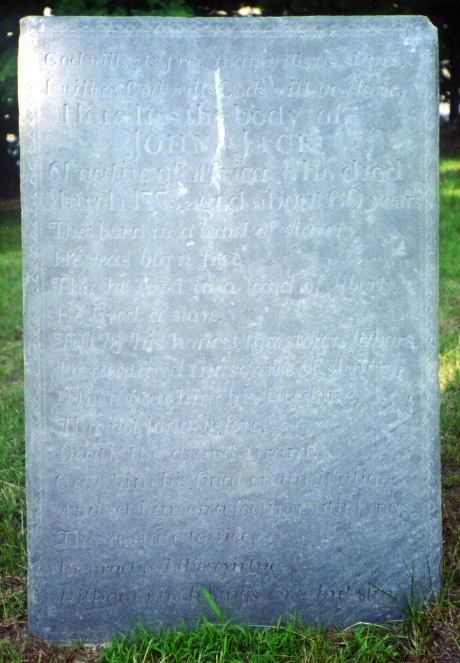
God wills us free; man wills us slaves.The epigraph above is on a Concord gravestone. Historian Michael Kammen (my graduate school advisor), notes in his 1972 book People of Paradox that "[i]n the nineteenth century this became the most famous epitaph in America, and was reprinted in English, French, German and Scandinavian newspapers." (p. 193)
I will as God wills; God's will be done.
Here lies the body of
JOHN JACK
a native of Africa who died
March 1773, aged about 60 years.
Tho' born in a land of slavery,
He was born free.
Tho' he lived in a land of liberty,
He lived a slave.
Till by his honest, tho' stolen labors,
He acquired the source of slavery,
Which gave him his freedom;
Tho' not long before
Death, the grand tyrant
Gave him his final emancipation,
And set him on a footing with kings.
Tho' a slave to vice,
He practised those virtues
Without which kings are but slaves.
The current gravestone is a facsimile of the original; the present copy was erected in 1830. Here's the picture of the grave from Alfred Sereno Hudson's 1904 book The History of Concord, Massachusetts, Volume 1: Colonial Concord:




There is a 1902 essay about John Jack, and about Daniel Bliss (the loyalist lawyer who wrote Jack's epigraph) here, online as a free google book. The grave is on find a grave here. H/T to Jonathan Holloway for putting me on this trail.
Thursday, April 04, 2013
Roger Ebert, 1942 - 2013
[On his impending death]: I know it is coming, and I do not fear it, because I believe there is nothing on the other side of death to fear. I hope to be spared as much pain as possible on the approach path. I was perfectly content before I was born, and I think of death as the same state. What I am grateful for is the gift of intelligence, and for life, love, wonder, and laughter. You can’t say it wasn’t interesting. My lifetime’s memories are what I have brought home from the trip. I will require them for eternity no more than that little souvenir of the Eiffel Tower I brought home from Paris.
-- Roger Ebert (2010)
...The elements in 'The Wizard of Oz'' powerfully fill a void that exists inside many children. For kids of a certain age, home is everything, the center of the world. But over the rainbow, dimly guessed at, is the wide earth, fascinating and terrifying. There is a deep fundamental fear that events might conspire to transport the child from the safety of home and strand him far away in a strange land. And what would he hope to find there? Why, new friends, to advise and protect him. And Toto, of course, because children have such a strong symbiotic relationship with their pets that they assume they would get lost together.R.I.P.
-- Roger Ebert (1996) (via)
Tuesday, January 15, 2013
Aaron Swartz (1986 - 2012)
I haven't posted on the untimely death of Aaron Swartz prior to now, because I didn't know him and didn't have anything particular to add, and because I can't imagine that anyone who reads this blog needs me to tell them about (or link them to) Aaron Swartz,
whom the entire internet, it seems, has been morning for nearly a
week. But in trying to type up a 'recent links' post, I found it swamped by Swartz-related links, so I decided to ignore the fact that this is all probably old news to all of you, and throw a few links together. It seemed wrong to mix this topic with random political stories, to say nothing of amusing tales about hats. Though I learned of him by reading his obituaries, I -- like many others -- have come to feel great grief for Swartz's heartbreakingly-young death, and great anger at those who drove him to it. So whether it's needed or not, yes, I'm giving him his own post.
Besides, the man deserves it.
So:
• First, in case I'm wrong, and someone reading this hasn't yet heard about Aaron Swartz, the two must-read obituaries, that will give you a well-rounded sense of the man, are this one by Cory Doctorow and this one by Rick Perlstein*.
• Also recommended: Henry Farrell, Larry Lessig. (Lessig was also the featured guest on Democracy Now when they spent the hour on Aaron Swartz's life yesterday; they also replayed his speech about SOPA in its entirety -- worth listening to if you haven't heard it.)
Besides, the man deserves it.
So:
• First, in case I'm wrong, and someone reading this hasn't yet heard about Aaron Swartz, the two must-read obituaries, that will give you a well-rounded sense of the man, are this one by Cory Doctorow and this one by Rick Perlstein*.
• Also recommended: Henry Farrell, Larry Lessig. (Lessig was also the featured guest on Democracy Now when they spent the hour on Aaron Swartz's life yesterday; they also replayed his speech about SOPA in its entirety -- worth listening to if you haven't heard it.)
• Swartz was a genuinely incredible guy, as a glance at those obituaries will tell you. I would have said that, prior to his heartbreaking death, I'd never heard of him, and this is in some sense strictly accurate. But I had read his work: I distinctly remember reading, and being extremely impressed by, his review of Chris Hayes's (marvelous, as the review says) book Twilight of the Elites. (At the time I thought Swartz had gotten one bit of his summary of Hayes's book wrong; rereading it now, I think so still; but I shan't say what, because I am by no means confident that I'm right and Swartz is wrong -- I'd want to go reread the book to confirm my judgment! Just, as with any article ever, caveat lector, and always check the original yourself.) I've also started browsing Swartz's other writings -- such as this essay on How To Be More Productive, which I liked -- and have been benefiting from them. I expect to read more in days to come.
• On the more specifically political aspects of Swartz's death, there are a lot of them, starting with petitions to fire the U.S. Attorneys Carmen Ortiz & Stephen Heymann, who seem to have the most direct culpably for Swartz's unjust persecution (sic). And I'm in favor of it -- any scrap of accountability for our hideous elites (see above re: Hayes) is welcome, and it may well serve as a (minor and insufficient) deterrent to others with similar power to abuse. That said, I think that emptywheel is right about this:
I didn’t know Aaron personally, but he doesn’t strike me as the kind of guy who would seek individualized solutions to systemic problems.... If we want to fix the injustice that was done to Aaron Swartz, we need to fix the aspects of the system that rewarded such behavior. We need to fix the law that empowered the prosecutors gunning for him. We need to put some breaks on DOJ’s power. And we should start by getting rid of the guy who has fostered this culture of abuse for the last four years.More on the political side of Swartz's death: Corey Robin on why Swartz should not be posthumously pardoned and Matt Stoller on Swartz's broader politics, and on the role of corruption in Swartz's death. (Still more from Glenn Greenwald.) Oh, and Swartz's family and partner see the prosecutors as central to, and culpable in, his death; they see him as someone who died in a political cause. The politics here is not imposed by outsiders to Swartz's life. (Update: Greenwald has a second piece -- talking about the connection between punishing prosecutorial overreach in this case and more generally, which is here.)
• If you're misguidedly inclined to a 'where there's smoke there's fire' take on the fact that Swartz was hounded to death by a prosecutor, you should read "The Truth About Aaron Swartz's 'Crime'", by an expert witness who was going to testify for the defense. And also Tim Wu in the New Yorker: "Basically, under American law, anyone interesting is a felon. The prosecutors, not the law, decide who deserves punishment."
• Finally, I will say that I thought the best line I saw about Swartz's death -- at least the one that moved me most, and had the most relevance to those of us who weren't his friends when he lived -- was this from Quinn Norton, Swartz's ex-lover -- who also wrote an incredibly moving eulogy for Swartz here -- who wrote on twitter:
Make the world that wouldn't have killed him, please.May we make it so.
— Quinn Norton (@quinnnorton) January 13, 2013
Swartz accomplished a stunning amount in his life; save for the fact that all of his accomplishments are too tied into recent developments, his resume could be mistaken for that of a man who died at 76, not 26. I do not take this fact
Swartz was, by all reports, an amazing (if also sometimes personally difficult, in the way some amazing guys are) guy. I wish I'd known him; I wish mostly, more strongly than I would normally feel for someone who died (even young), that I still had the chance to know him.
Rest in peace.
_________________
* On a tangential point: holy shit, Rick Perlstein is blogging again! Fabulous news. Adjust your bookmarks now.
Friday, December 14, 2012
The Latest Horror
It's stupid, I know: yet while I really, really have nothing to say, still I can't help feel that it is somehow wrong to let this blog stand empty, without at least some acknowledgement of the latest horrific violence in our country, this time in Newport. (This time: and yes, as so many are saying, how awful to feel such bleak certainty that it is only the latest in what has become a seemingly endless series of crimes we shriek about but do nothing to stop.) It is the combination of the need to acknowledge and the utter lack of anything to say that makes ritual and symbol so necessary at such times, I guess. But I don't even have those. So take this admission of inarticulate despair as a feeble equivalent for wearing black, flying the flag at half staff, covering the mirrors. Verbal dirt thrown onto the casket of a child.
Rest in peace.
Rest in peace.
Sunday, October 21, 2012
George McGovern (1922 - 2012)
RIP.
He thinks of those who have Spoken Evil of his Beloved
Half close your eyelids, loosen your hair,
And dream about the great and their pride;
They have spoken against you everywhere,
But weigh this song with the great and their pride;
I made it out of a mouthful of air,
Their children's children shall say they have lied.
-- W. B. Yeats
Monday, October 01, 2012
Eric Hobsbawm (1917 - 2012)
And then yet another great historian vanishes: Eric Hobsbawm died today at the age of 95. And the truth is that even among great historians, Hobsbawm stands out.
His four-volume history of modern times -- a trilogy on the "long nineteenth century", The Age of Revolution: 1789-1848 (1962), The Age of Capital: 1848-1875 (1975), The Age of Empire: 1874-1914 (1987) and a sequel, The Age of Extremes: A History of the World, 1914-1991 (1994) on the "short twentieth century" -- is really completely fabulous. My understanding is that it's out of date in a great many ways, but it's not only fabulously written, but is simply chock-full of historically interesting ideas. Sure, it has flaws and gaps, which means it needs to be supplemented. But then, no book is a good place to stop. These, however, are a good place to start (at least given basic high-school or college history: Hobsbawm tends to be writing about the meaning of events more than narrating them, although he does some of both). Among the more unmistakably brilliant of historians I've read.
Perhaps someone will come with proof-texts to disprove this (it's been a while), but one of my memories of those books is that -- unusually -- when Hobsbawm said something like "everyone" or "the world", he didn't meant Europe, or westerners, or anything like that -- he only said it when he meant, well, everyone, and that if he meant something less he said so.
Rest in peace.
Update: From the comments on this Crooked Timber thread on Hobsbawm (links added):
His four-volume history of modern times -- a trilogy on the "long nineteenth century", The Age of Revolution: 1789-1848 (1962), The Age of Capital: 1848-1875 (1975), The Age of Empire: 1874-1914 (1987) and a sequel, The Age of Extremes: A History of the World, 1914-1991 (1994) on the "short twentieth century" -- is really completely fabulous. My understanding is that it's out of date in a great many ways, but it's not only fabulously written, but is simply chock-full of historically interesting ideas. Sure, it has flaws and gaps, which means it needs to be supplemented. But then, no book is a good place to stop. These, however, are a good place to start (at least given basic high-school or college history: Hobsbawm tends to be writing about the meaning of events more than narrating them, although he does some of both). Among the more unmistakably brilliant of historians I've read.
Perhaps someone will come with proof-texts to disprove this (it's been a while), but one of my memories of those books is that -- unusually -- when Hobsbawm said something like "everyone" or "the world", he didn't meant Europe, or westerners, or anything like that -- he only said it when he meant, well, everyone, and that if he meant something less he said so.
Rest in peace.
Update: From the comments on this Crooked Timber thread on Hobsbawm (links added):
I notice that the obit in the Guardian is partly written by Dorothy Wedderburn (a sociologist of technology who sounds well worth knowing about), who herself died two weeks ago. Her obituary in the Guardian was by… Eric Hobsbawm. Of course these things are written far in advance, but it comes across quite oddly!I find that quite eerie, frankly. Also funny. But eerie.
Friday, September 28, 2012
Eugene Genovese 1930 - 2012
The great (albeit complex and controversial and problematic) historian of American slavery, Eugene Genovese, has died.
My favorite quote of Genovese's has nothing to do with history per se, but is an aside in his groundbreaking 1974 book Roll, Jordon, Roll: The World the Slaves Made. In my quote file, I pull my favorite two sentences --
Eugene Genovese, RIP.
My favorite quote of Genovese's has nothing to do with history per se, but is an aside in his groundbreaking 1974 book Roll, Jordon, Roll: The World the Slaves Made. In my quote file, I pull my favorite two sentences --
The truth of religion comes from its symbolic rendering of man's moral experience; it proceeds intuitively and imaginatively. Its falsehood comes from its attempt to substitute itself for science and to pretend that its poetic statements are information about reality.-- but to mark Genovese's passing, here's the full paragraph:
The philosophical problem of religion, its truth and falsehood, represents a domain only partially separate from that of politics. Since religion expresses the antagonisms between the life of the individual and that of society and between the life of civil society and that of political society, it cannot escape being profoundly political. The truth of religion comes from its symbolic rendering of man's moral experience; it proceeds intuitively and imaginatively. Its falsehood comes from its attempt to substitute itself for science and to pretend that its poetic statements are information about reality. In either case, religion makes statements about man in his world -- about his moral and social relationship -- even when it makes statements about his relationship to God. Even when a man's adherence to a religion is purely formal or ritualistic, essential elements of his politics are thereby exposed, for participation in rites normally means participation in social acts that precede, rather than follow, individual emotional response. He enters, usually as a child, into a pattern of socially directed behavior that conditions his subsequent emotional development and that, from the beginning, presupposes a community and a sense of common interest. For good reason the whites of the Old South tried to shape the religious life of their slaves, and the slaves overtly, covertly and even intuitively fought to shape it themselves. (p. 162)
Eugene Genovese, RIP.
Monday, August 27, 2012
Poem of the Day: the Moon's Mourning of Neil Armstrong
It was posted here, on Tor.com, and I hope that the author, Roz Kaveney, doesn't mind me reposting it.
This reminds me, slightly of Jonathan Coulton's lovely song, "I'm Your Moon", which was the love song that Charon sung to Pluto to reassure it after it was demoted from planethood.
Earlier thoughts about Neil Armstrong's passing here.
Endymion
(For Neil Armstrong)
In her white silent place, the hangings dust,
grey pebbles stretching to the edge of black
so far away. The goddess feels a lack
somewhere elsewhere, an ache deep as her crust
and weeps dry tears. The gentleman is gone
the first who ever called. His feet were light
as he danced on her. Went into the night
quite soon, his calling and his mission done
yet still his marks remain. Footfalls and flag.
The others she forgets. He was the first
to slake her ages long and lonely thirst
for suitors. Now she feels the years drag
as they did not before he came to call.
Our grief compared to hers weighs naught at all.
-- Roz Kaveney
This reminds me, slightly of Jonathan Coulton's lovely song, "I'm Your Moon", which was the love song that Charon sung to Pluto to reassure it after it was demoted from planethood.
Earlier thoughts about Neil Armstrong's passing here.
Sunday, August 26, 2012
One Small Grave For a Man, One Giant Diminishment for Mankind
My semester begins tomorrow, and I'm teaching two brand-new classes (more on this soon), so I've been spending full time getting ready for the past week -- so full, in fact, that I've barely opened a newspaper (or the modern equivalent, a browser window). I've just been working, preparing my classes. One of which will include a two-day unit on the moon landing of July 20, 1969. Finally, this evening, ready as I'll ever be, I went to Garry Canavan's web site for the first time in days and days... and see his links about the death of Neil Armstrong.
Having read quite a bit about Mr. Armstrong, his achievements and their cultural impact made the impact on me all the greater, I think, but it would have been pretty great anyway. But I can say with solid grounds that the sense diminishment -- how small we, as a species, have become since that moment forty-three years, one month and six days ago. As Pamela Sargent put it (in Tor.com's fun symposium of SF writers' memories of the moon landing (done for the fortieth anniversary)), "Humankind’s hopes these days are more limited and more desperate, confined to hoping that we can save our own planet from an ecological catastrophe."
I liked Esquire's obituary for Mr. Armstrong (via GC), and Charles Peirce's words at the same site too. Here's a bit of the obituary:
For one giant, leaping moment in 1969, because of what he did, humanity looked up and felt able to stride across worlds. But ever since that leap, we have all felt smaller in its shadow.
When we remember to.
Gerry Canavan headlined the news "A Thousand Years from Now They’ll Wonder If He Was Real", which put me in mind of the marvelous moment from Chapter Five of Gene Wolfe's Shadow of the Torturer, set millennia from now, in a wrecked and ruined future:
Neil Armstrong, rest in peace.
Having read quite a bit about Mr. Armstrong, his achievements and their cultural impact made the impact on me all the greater, I think, but it would have been pretty great anyway. But I can say with solid grounds that the sense diminishment -- how small we, as a species, have become since that moment forty-three years, one month and six days ago. As Pamela Sargent put it (in Tor.com's fun symposium of SF writers' memories of the moon landing (done for the fortieth anniversary)), "Humankind’s hopes these days are more limited and more desperate, confined to hoping that we can save our own planet from an ecological catastrophe."
I liked Esquire's obituary for Mr. Armstrong (via GC), and Charles Peirce's words at the same site too. Here's a bit of the obituary:
The idea still fills people with childlike disbelief and wonder. Once upon a time, a man walked on the moon. With Armstrong's death, we're mourning, not so much a man, as a conception of the world in which human beings believed themselves to be capable of anything....And here's a bit of Peirce:
...our technologies promise us so much less than they used to: "You can play Angry Birds any time you like" rather than "you can stand on different planets." But also, we've grown up, left behind our unrealistic optimism. The real question of our moment is whether the amazing power of engineers will destroy the planet we have rather than whether they will bring us to new ones. We have come to understand that human beings are bound to the earth. Forever. This terrestrial understanding isn't wrong. It's just smaller than the hope that motivated Armstrong.
What he thought when he looked at, night after night, is a perspective lost to all but eight old men. Sooner or later, there will be none of them left. On that day, like today, we should mourn for what we once thought we were. From that day forward, I fear, it is all going to sound like myth and magic, and the tales that the old men told around the ancient fires.Words of diminishment: thus words not really about Neil Armstrong at all, but about us. (But that is true of a lot of eulogies, a lot of obituaries, a lot of funerals.) About how little we have become. But, again, having read a lot on this topic very recently, this is only the most recent occasion for this sentiment, the last one being the fortieth anniversary three years ago. The next one will be at the fiftieth, perhaps, or maybe at the next death. And then, of course, we'll forget it again, until the next one. The moon landing, once a proud achievement of humankind, is now a depressing occasion for shivering in the shadow of the greatness of the past. Easier to think about other things. And there are, indeed, courses to prepare, children to raise, and blogs to write, to say nothing of apocalyptic crises to avert. So we'll wait, and not feel the diminishment again, until the calendar or the grave gives us reason to. (Or -- for my students and myself -- when the syllabus demands it.)
For one giant, leaping moment in 1969, because of what he did, humanity looked up and felt able to stride across worlds. But ever since that leap, we have all felt smaller in its shadow.
When we remember to.
Gerry Canavan headlined the news "A Thousand Years from Now They’ll Wonder If He Was Real", which put me in mind of the marvelous moment from Chapter Five of Gene Wolfe's Shadow of the Torturer, set millennia from now, in a wrecked and ruined future:
Many of these were so old and smoke-grimed that I could not discern their subjects, and there were others whose meaning I could not guess... I came upon an old man perched on a high ladder. I wanted to ask my way, but he seemed so absorbed in his work that I hesitated to disturb him.The man who took that picture died yesterday. Let us hope that we do not live to see his accomplishment hang as a forgotten painting in an old museum, in a painting used to train apprentices to clean because it isn't worth anything. (And even in the decaying world Wolfe portrays, the moon is green, because before we gave up it was irrigated.)
The picture he was cleaning showed an armored figure standing in a desolate landscape. It had no weapon, but held a staff bearing a strange, stiff banner. The visor of this figure's helmet was entirely of gold, without eye slits or ventilation; in its polished surface the deathly desert could be seen in reflection, and nothing more.
The warrior of a dead world affected me deeply, though I could not say why or even what emotion it was I felt....
Neil Armstrong, rest in peace.
Friday, July 20, 2012
Denver Massacre
Hard to find words for such horror. Here are some who managed to find good ones:
Adam Gopnik
Alyssa Rosenberg
...may add more if I see more. (Not really looking that hard. It's too horrible.)
RIP
Update: What Michael Grunwald said:
Adam Gopnik
Alyssa Rosenberg
...may add more if I see more. (Not really looking that hard. It's too horrible.)
RIP
Update: What Michael Grunwald said:
...there is nothing wrong with politicizing tragedy... politics is about life and death and human suffering. At least that’s what it should be about. If advocates or experts or even politicians think their policy ideas can prevent the next Aurora—by preventing potential killers from obtaining guns, by making sure potential victims can carry guns, or by some other method—then by all means, now is the time to spread the word.... It’s telling that the people who get paid to analyze politics recoil at the notion that its practitioners should connect it to real-life pain. They think they’re covering a sport, an entertainment. But politics matters, because policies matter. “Obamacare” and “gay marriage” are not just issues that might play badly with swing voters or turn the tide in Virginia; they’re issues that affect people’s lives. Gun control and the Second Amendment are issues, too, and now seems like a pretty good time to talk about them.Adam Serwer has some thoughts along the same lines. (Both via.)
Wednesday, June 06, 2012
More on Ray Bradbury
...who, as I noted in the last post, aujourd'hui est morte. (Note on updates: I'm adding to this after posting it. Deal with it.)
* The best mainstream media coverage I've seen of his death, and life, is from the LA times, which has a lot of great articles. (No surprise, perhaps, as it's his hometown paper.) The two photos here are from their photo round-up, for instance. I love this one of him as a child.

I also like this (oft-told) story of how he wrote (the novella that was expanded into) Fahrenheit 451 at a public library, on typewriters that cost a dime every half-hour to use. The novella took 49 hours to write, apparently.
• Appreciations: Junot Diaz in the New Yorker. Neil Gaiman 1; Neil Gaiman 1.5; Neil Gaiman 2. Melissa McEwan. John Scalzi.
• The New Yorker has also unlocked, on its site, the two pieces of writing that Bradbury published in that magazine: a mainstream short story from 1947, "I See You Never"; and an essay from its current issue, which just happens to be its (first-ever) science fiction issue.
• This site has (or claims to -- I haven't checked it) a complete list of Bradbury's stories, helpfully organized both by collection and alphabetically, with each listing including all the collections a story is in (Bradbury did a lot of reprinting in multiple places). It does leave out The Martian Chronicles -- presumably because it's a "novel", although it contains a lot of stories. But still, a useful list (and a good supplement to this.)
• I kind of love that Obama made a statement on Bradbury's death. (Oh, I'm cynical enough to know that he's doing it so people will forget about stuff like the fact that he is murdering people (including children) on his sole authority, ignoring one of the gravest crises in human history, and so on. But of course the reason politicians do stuff like this is because it works, so it shouldn't surprise us when it works.) And this is spot on: "For many Americans, the news of Ray Bradbury's death immediately brought to mind images from his work, imprinted in our minds, often from a young age. His gift for storytelling reshaped our culture and expanded our world..."
• I didn't know until reading the obituaries that Bradbury had written a sequel to Dandelion Wine (which I first read in school, yes, eighth grade, at the age of thirteen: although I loved it, and reread it many times myself. (The others -- Fahrenheit 451, The Martian Chronicles, The Illustrated Man, The Golden Apples of the Moon, and on and on -- I read on my own initiative.) There's an interesting review of the sequel, which was titled Farewell Summer, with some information about it's history, here.
* Ta-Nehisi Coates -- who is not only one of the best bloggers on the net but is a SF geek, and so I went to see what he had to say -- hadn't even read Bradbury, but he still managed an amazing post simply by coming up with this astonishing quote from Bradbury's Paris Review Interview:
• Bradbury once met Rachel Bloom. (Her tweet upon his death.) She wasn't the only musician inspired by Bradbury, but so far as I know, she was the only NSFW one. It's funny how her song has now worked itself indelibly into the Bradbury legend.
• All my Bradbury books, I think, are in storage right now -- a lot of my books are, and I read Bradbury mostly decades ago. But just browsing around, looking at titles and tables of contents, bring back so many amazing stories (and not just from The Martian Chronicles, which don't get me wrong is an amazing book, although in my memory other books of his stories, like The Illustrated Man, are even better): "A Sound of Thunder", "The Murderer", "The Wonderful Ice Cream Suit", "Hail and Farewell", "The Town Where No One Got Off", "All of Summer in a Day", "The Long Rain", "There Will Come Soft Rain", "Way in the Middle of the Air", "The Veldt", "Kaleidoscope", "Marionettes, Inc.", "Zero Hour"... there's a lot of amazing stories there. He was a wonderful, wonderful writer.
• He could also be a crank. Ah, well; as Auden noted:
• My sense is that the best Bradbury collection is the 1980 retrospective of 100 stories, The Stories of Ray Bradbury (not to be confused with the similarly-structured sequel, Bradbury Stories: 100 of His Most Celebrated Tales, which is actually non-overlapping, I believe.
• In addition to the three quotes on death I pulled from Bradbury's work for my first post (two I remembered, instantly, on hearing the news; the third I came across in finding one of the two, and only remembered then), the Washington Post offers this from Something Wicked This Way Comes:
• Jorge Luis Borges (!) wrote a preface to the Spanish translation of The Martian Chronicles; an English translation of it is here (h/t).

Once again: RIP.
* The best mainstream media coverage I've seen of his death, and life, is from the LA times, which has a lot of great articles. (No surprise, perhaps, as it's his hometown paper.) The two photos here are from their photo round-up, for instance. I love this one of him as a child.

• Appreciations: Junot Diaz in the New Yorker. Neil Gaiman 1; Neil Gaiman 1.5; Neil Gaiman 2. Melissa McEwan. John Scalzi.
• The New Yorker has also unlocked, on its site, the two pieces of writing that Bradbury published in that magazine: a mainstream short story from 1947, "I See You Never"; and an essay from its current issue, which just happens to be its (first-ever) science fiction issue.
• This site has (or claims to -- I haven't checked it) a complete list of Bradbury's stories, helpfully organized both by collection and alphabetically, with each listing including all the collections a story is in (Bradbury did a lot of reprinting in multiple places). It does leave out The Martian Chronicles -- presumably because it's a "novel", although it contains a lot of stories. But still, a useful list (and a good supplement to this.)
• I kind of love that Obama made a statement on Bradbury's death. (Oh, I'm cynical enough to know that he's doing it so people will forget about stuff like the fact that he is murdering people (including children) on his sole authority, ignoring one of the gravest crises in human history, and so on. But of course the reason politicians do stuff like this is because it works, so it shouldn't surprise us when it works.) And this is spot on: "For many Americans, the news of Ray Bradbury's death immediately brought to mind images from his work, imprinted in our minds, often from a young age. His gift for storytelling reshaped our culture and expanded our world..."
• I didn't know until reading the obituaries that Bradbury had written a sequel to Dandelion Wine (which I first read in school, yes, eighth grade, at the age of thirteen: although I loved it, and reread it many times myself. (The others -- Fahrenheit 451, The Martian Chronicles, The Illustrated Man, The Golden Apples of the Moon, and on and on -- I read on my own initiative.) There's an interesting review of the sequel, which was titled Farewell Summer, with some information about it's history, here.
* Ta-Nehisi Coates -- who is not only one of the best bloggers on the net but is a SF geek, and so I went to see what he had to say -- hadn't even read Bradbury, but he still managed an amazing post simply by coming up with this astonishing quote from Bradbury's Paris Review Interview:
INTERVIEWERDamn. On a related note, Stephen Andrew Hiltner has a terrific post about fact-checking Bradbury's Paris Review interview. (If you don't have the time and the patience for the whole interview, search for "Electrico" and read that little story (it runs the next few paragraphs, until the end -- it's fabulous.)
You seem to have been open to a variety of influences.
BRADBURY
A conglomerate heap of trash, that's what I am. But it burns with a high flame.
• Bradbury once met Rachel Bloom. (Her tweet upon his death.) She wasn't the only musician inspired by Bradbury, but so far as I know, she was the only NSFW one. It's funny how her song has now worked itself indelibly into the Bradbury legend.
• All my Bradbury books, I think, are in storage right now -- a lot of my books are, and I read Bradbury mostly decades ago. But just browsing around, looking at titles and tables of contents, bring back so many amazing stories (and not just from The Martian Chronicles, which don't get me wrong is an amazing book, although in my memory other books of his stories, like The Illustrated Man, are even better): "A Sound of Thunder", "The Murderer", "The Wonderful Ice Cream Suit", "Hail and Farewell", "The Town Where No One Got Off", "All of Summer in a Day", "The Long Rain", "There Will Come Soft Rain", "Way in the Middle of the Air", "The Veldt", "Kaleidoscope", "Marionettes, Inc.", "Zero Hour"... there's a lot of amazing stories there. He was a wonderful, wonderful writer.
• He could also be a crank. Ah, well; as Auden noted:
Time that is intolerant(Auden went on to prove the point that writers needed pardoning for silliness by deleting those stanzas from later editions of the poem.)
Of the brave and the innocent,
And indifferent in a week
To a beautiful physique,
Worships language and forgives
Everyone by whom it lives;
Pardons cowardice, conceit,
Lays its honours at their feet.
Time that with this strange excuse
Pardoned Kipling and his views,
And will pardon Paul Claudel,
Pardons him for writing well.
• My sense is that the best Bradbury collection is the 1980 retrospective of 100 stories, The Stories of Ray Bradbury (not to be confused with the similarly-structured sequel, Bradbury Stories: 100 of His Most Celebrated Tales, which is actually non-overlapping, I believe.
• In addition to the three quotes on death I pulled from Bradbury's work for my first post (two I remembered, instantly, on hearing the news; the third I came across in finding one of the two, and only remembered then), the Washington Post offers this from Something Wicked This Way Comes:
Death doesn’t exist. It never did, it never will. But we've drawn so many pictures of it, so many years, trying to pin it down, comprehend it, we've got to thinking of it as an entity, strangely alive and greedy. All it is, however, is a stopped watch, a loss, an end, a darkness. Nothing.(And now it's four in the other post, because I added another.)
• Jorge Luis Borges (!) wrote a preface to the Spanish translation of The Martian Chronicles; an English translation of it is here (h/t).

Once again: RIP.
Ray Bradbury (1920 - 2012)
Douglas was crying.
She roused herself again. "Now, why are you doing that?"
"Because," he said, "you won't be here tomorrow."
She turned a small hand mirror from herself to the boy. He looked at her face and himself in the mirror and then at her face again as she said, "Tomorrow morning I'll get up and seven, and wash behind my ears; I'll run to church with Charlie Woodman; I'll picnic at Electric Park; I'll swim, run barefoot, fall out of trees, chew spearmint gum.... Douglas, Douglas, for shame! You cut your fingernails, don't you?
"Yes'm."
"And you don't yell when your body makes itself over every seven years or so, old cells dead and new ones added to your fingers and your heart. You don't mind that, do you?"
"No'm."
"Well, consider then, boy. Any man saves fingernail clippings is a fool. You ever see a snake bother to keep his peeled skin? That's about all you got here today in this bed is fingernails and snake skin. One good breath would send me up in flakes. Important thing is not the me that's lying here, but the me that's sitting on the edge of the bed looking back at me, and the me that's downstairs now cooking supper, or out in the garage under the car, or in the library reading. All the new parts, they count. I'm not really dying today. No person ever died that had a family. I'll be around a long time. A thousand years from now a whole township of my offspring will be biting sour apples in the gumwood shade. That's my answer to anyone asks big questions! Quick now, send in the rest!"
-- Ray Bradbury, Dandelion Wine (1957)
Later on:
YOU CAN'T DEPEND ON THINGS BECAUSE...And:
...like machines, for instance, they fall apart or rust or rot, or maybe never get finished at all... or wind up in garages...
...like tennis shoes, you can only run so far, so fast, and then the earth's got you again...
...like trolleys. Trolleys, big as they are, always come to the end of the line...
YOU CAN'T DEPEND ON PEOPLE BECAUSE...
...they go away.
...strangers die.
...people you know fairly well die.
...friends die.
...peoplemurder people, like in books.
...your own folks can die.
So...!
He held onto a double fistful of breath, let it hiss out slow, grabbed more breath, and let it whisper through his tight-gritted teeth.
SO. He finished in huge heavily blocked capitals.
SO IF TROLLEYS AND RUNABOUTS AND FRIENDS AND NEAR FRIENDS CAN GO AWAY FOR A WHILE OR GO AWAY FOREVER, OR RUST, OR FALL APART OR DIE, AND IF PEOPLE CAN BE MURDERED, AND IF SOMEONE LIKE GREAT-GRANDMA, WHO WAS GOING TO LIVE FOREVER, CAN DIE... IF ALL OF THIS IS TRUE... THEN... I, DOUGLAS SPAULDING, SOME DAY... MUST...
But the fireflies, as if extinguished by his somber thoughts, had softly turned themselves off.
-- Ibid.
Granger stood looking back with Montag. "Everyone must leave something behind when he dies, my grandfather said. A child or a book or a painting or a house or a wall built or a pair of shoes made. Or a garden planted. Something your hand touched some way so your soul has somewhere to go when you die, and when people look at that tree or that flower you planted, you're there. It doesn't matter what you do, he said, so long as you change something from the way it was before you touched it into something that's like you after you take your hands away. The difference between the man who just cuts lawns and a real gardener is in the touching, he said. The lawn cutter might just as well not have been there at all; the gardener will be there a lifetime."And lastly (h/t):
-- Ray Bradbury, Fahrenheit 451 (1953)
When I was a boy my grandfather died, ad he was a sculptor. He was also a very kind man who had a lot of love to give the world, and he helped clean up the slum in our town; and he made toys for us and he did a million things in his lifetime; he was always busy with his hands. And when he died, I suddenly realized I wasn’t crying for him at all, but for the things he did. I cried because he would never do them again, he would never carve another piece of wood or help us raise doves and pigeons in the backyard or play the violin the way he did, or tell us jokes the way he did. He was part of us and when he died, all the actions stopped dead and there was no one to do them the way he did. He was individual. He was an important man. I’ve never gotten over his death. Often I think what wonderful carvings never came to birth because he died. How many jokes are missing from the world, and how many homing pigeons untouched by his hands? He shaped the world. He did things to the world. The world was bankrupted of ten million fine actions the night he passed on.
-- Ibid (a page or two before the previous one)
RIP.
Thursday, May 24, 2012
Paul Fussell (1924 - 2012)
I just saw that Paul Fussell died yesterday. It's probably inarguable that his masterpiece is The Great War and Modern Memory, one of the great books about World War One and a superb melding of literary criticism and history. A book to read if you have any interest in WW1 at all -- or even if you don't, perhaps.
But I've read a number of his other books too -- Class, The Boy Scout Handbook and Other Observations, Thank God for the Atom Bomb and Other Essays, and Poetic Meter and Poetic Form. (I feel like I at least read a bit in Abroad and BAD and maybe even one other, but those are the books of his I really remember.) Class is just descriptive, and is out of date, and would doubtless not impress me now as it did when I first read it as a teenager, when its accuracy and insight into my own life and social circle rather stunned me. The two essay collections are uneven, but have a lot of great material in them. Even his defense of the bombing of Hiroshima is extremely well done, given that it is (I think) arguing on the wrong side. (Rather to his credit Fussell reprints a reply from Michael Walzer in his collection, which does a good job making the basic case on the other side.) And his book on, well, poetic meter and poetic form is really good introduction to its subject.
A good writer over a wide range of material, who happened to write one truly brilliant book in addition to a number of simply good ones. We all should be so lucky.
Rest in peace.
But I've read a number of his other books too -- Class, The Boy Scout Handbook and Other Observations, Thank God for the Atom Bomb and Other Essays, and Poetic Meter and Poetic Form. (I feel like I at least read a bit in Abroad and BAD and maybe even one other, but those are the books of his I really remember.) Class is just descriptive, and is out of date, and would doubtless not impress me now as it did when I first read it as a teenager, when its accuracy and insight into my own life and social circle rather stunned me. The two essay collections are uneven, but have a lot of great material in them. Even his defense of the bombing of Hiroshima is extremely well done, given that it is (I think) arguing on the wrong side. (Rather to his credit Fussell reprints a reply from Michael Walzer in his collection, which does a good job making the basic case on the other side.) And his book on, well, poetic meter and poetic form is really good introduction to its subject.
A good writer over a wide range of material, who happened to write one truly brilliant book in addition to a number of simply good ones. We all should be so lucky.
Rest in peace.
Tuesday, May 08, 2012
Oh Please Don't Go -- We'll Eat You Up, We Love You So!
...And Max said "No".
Terribly sad news: Maurice Sendak has died. (h/t)
In addition to his masterpiece, Sendak wrote or illustrated a great many other wonderful children's books too. I mentioned one I dearly loved, The Bat Poet, last year.
Rest in peace.
Update: Via Gerry Canavan,the blogger I steal the most links from the bestest blogger in the whole wide internets, here's a New Yorker profile of Sendak from 2006, and here is a two-page Art Spiegleman cartoon depicting a conversation he had with Sendak. Even if you don't have time for the former, I highly recommend the latter. Update to the Update: The cartoon is apparently from a 1993 issue of The New Yorker; and it was co-drawn by Sendak and Spiegleman, rather than just Spiegelman reporting a conversation they'd had. (You can see both signatures at the bottom, Sendak on the left, Spiegleman on the right.) I learn both these facts from Neil Gaiman, by whose good efforts (well, Tweeting) the cartoon was apparently unlocked upon Sendak's death. Well done, NG.
Terribly sad news: Maurice Sendak has died. (h/t)
In addition to his masterpiece, Sendak wrote or illustrated a great many other wonderful children's books too. I mentioned one I dearly loved, The Bat Poet, last year.
Rest in peace.
Update: Via Gerry Canavan,
Tuesday, March 20, 2012
Peter Novick, 1934 - 2012
I missed the fact that the great historian Peter Novick died a week ago. His NYT obituary focuses on his (excellent, IMO) book on the changing place of the memory of the Holocaust in the U.S., but to my mind his magnum opus is his extraordinary book That Noble Dream: the "Objectivity Question" and the American Historical Profession. I have some serious disagreements with Novick's work, but it's extraordinary, and anyone interested in objectivity, in intellectual history, or, really, in history as a subject and discipline ought to read it.
Novick's obituary at the University of Chicago (where he taught) is here. Eric Rauchway, himself a marvelous historian, notes that he rereads Novick's masterpiece once a year (!).
It's an extraordinary loss to the profession. And personally there's something half-finished on my hard drive that I'd hope to send him. But mostly I'm sad that such a sharp (in both senses) voice is gone.
Rest in peace.
Novick's obituary at the University of Chicago (where he taught) is here. Eric Rauchway, himself a marvelous historian, notes that he rereads Novick's masterpiece once a year (!).
It's an extraordinary loss to the profession. And personally there's something half-finished on my hard drive that I'd hope to send him. But mostly I'm sad that such a sharp (in both senses) voice is gone.
Rest in peace.
Thursday, March 01, 2012
On Speaking Ill of the Ill-Spoken Dead
In response to the extraordinarily young and horrifically sudden death of Andrew Breitbart, some liberals have been saying nasty things (e.g.), and then justifying them (e.g.) by pointing out that Breitbart himself said quite nasty things about the recently departed.* In response to this, writer Paul Glastris suggests the rule "Don’t Speak Ill Of The Recently Departed, Unless The Recently Departed Spoke Ill Of The Recently Departed".
At first glance, this struck me as wise and correct.
At second thought, however, it raises a great many problems.
Most obviously, can one speak of the dead of those who have only spoken of the dead in accordance with the above rule?
If the answer to that is yes, then the rule creates two sub-populations: those who mutually agree (as it were) that it's fine to speak ill of the dead including themselves (it seems that Matt Yglesias, linked above, is imaging that sort of scenario.) This seems like it might work, although it does have the problem that speaking ill of the dead is not a problem primarily for the dead (i.e. the importance of it isn't limited to respect of the recently departed): it's also about their friends and families (who might not share their view, or even be old enough to have come to a view (I understand that Breitbart -- heartbreakingly -- had small children). In which case, speaking ill of the dead might not be justified even if the recently deceased themselves did so and/or thought it was generally appropriate. (Not the same thing -- I imagine that many people speak ill of the dead thinking only that certain people deserve it, and that they're not among them; others might have no problem with the practice without actually engaging in it.) Even more importantly, it's about our society and ourselves: what sort of people do we wish to be? We might have reasons to discourage speaking ill of the dead even if all involved agree it's right.
But I get the impression that Glastris is not thinking that those who follow his rule themselves are subject to it. (So that, for instance, he himself by writing his post is now fair game when the inevitable fate of mortals should befall him.) For instance, he writes:
But who is to judge what counts? Does ostentatiously saying nothing after quoting "speak no ill of the dead" and mentioning the death count? Are there degrees here, so that you can only speak as ill of the dead as they spoke of someone else? Wouldn't this just quickly degenerate to an utter removal of the "speak no ill of the dead" rule, since people would interpret what those they disliked said about others has having been ill, beginning a quick race to the bottom?
To be clear, I'm not necessarily endorsing the "speak no ill of the dead" rule. I think there are both real, deep and important reasons -- reasons of dignity and civility and respect and decency -- to hold it. And I think there are some real, deep and important counter-arguments too -- about the way that reputations are formed, about the problems of dealing with the deaths of those who did real ill in the world and not wanting them sanitized, about sanctimoniousness, and many other things. I just don't think that the fact that someone else did it is the right standard -- whatever one thinks.
Incidentally, for a very thoughtful meditation on the problems of not speaking ill of the dead who have done ill, in our contemporary culture, go read the article linked to in the first link in this post, namely, this obituary for Breitbart by (conservative journalist) David Frum, which, it seems to me, quite thoughtfully grapples with the problem of writing about someone like Breitbart immediately after their death. Recommended even if (like myself) you have essentially no interest in Breitbart himself. (via))
(Update: On the specificity of Breitbart, in addition to Frum, I recommend Ta-Nehisi Coates's take too.)
_____________________________
* Yglesias has a particularly funny retort to a piece counter-nastiness lobbed in response to the above examples here.
At first glance, this struck me as wise and correct.
At second thought, however, it raises a great many problems.
Most obviously, can one speak of the dead of those who have only spoken of the dead in accordance with the above rule?
If the answer to that is yes, then the rule creates two sub-populations: those who mutually agree (as it were) that it's fine to speak ill of the dead including themselves (it seems that Matt Yglesias, linked above, is imaging that sort of scenario.) This seems like it might work, although it does have the problem that speaking ill of the dead is not a problem primarily for the dead (i.e. the importance of it isn't limited to respect of the recently departed): it's also about their friends and families (who might not share their view, or even be old enough to have come to a view (I understand that Breitbart -- heartbreakingly -- had small children). In which case, speaking ill of the dead might not be justified even if the recently deceased themselves did so and/or thought it was generally appropriate. (Not the same thing -- I imagine that many people speak ill of the dead thinking only that certain people deserve it, and that they're not among them; others might have no problem with the practice without actually engaging in it.) Even more importantly, it's about our society and ourselves: what sort of people do we wish to be? We might have reasons to discourage speaking ill of the dead even if all involved agree it's right.
But I get the impression that Glastris is not thinking that those who follow his rule themselves are subject to it. (So that, for instance, he himself by writing his post is now fair game when the inevitable fate of mortals should befall him.) For instance, he writes:
Moral rules cannot long hold if there are no consequences for transgressing them. So I think that in the interest of protecting the rule about not badmouthing the recently departed, there should be a proviso that those who willfully and publicly break the rule do not deserve the protection of it when they die. By this standard, Yglesias gets a pass....which sounds like saying that this is a special sanction for those who do it, without the sense that it then makes those people themselves subject to it (which creates a free-for-all section rather than something that seems like punishment).
But who is to judge what counts? Does ostentatiously saying nothing after quoting "speak no ill of the dead" and mentioning the death count? Are there degrees here, so that you can only speak as ill of the dead as they spoke of someone else? Wouldn't this just quickly degenerate to an utter removal of the "speak no ill of the dead" rule, since people would interpret what those they disliked said about others has having been ill, beginning a quick race to the bottom?
To be clear, I'm not necessarily endorsing the "speak no ill of the dead" rule. I think there are both real, deep and important reasons -- reasons of dignity and civility and respect and decency -- to hold it. And I think there are some real, deep and important counter-arguments too -- about the way that reputations are formed, about the problems of dealing with the deaths of those who did real ill in the world and not wanting them sanitized, about sanctimoniousness, and many other things. I just don't think that the fact that someone else did it is the right standard -- whatever one thinks.
Incidentally, for a very thoughtful meditation on the problems of not speaking ill of the dead who have done ill, in our contemporary culture, go read the article linked to in the first link in this post, namely, this obituary for Breitbart by (conservative journalist) David Frum, which, it seems to me, quite thoughtfully grapples with the problem of writing about someone like Breitbart immediately after their death. Recommended even if (like myself) you have essentially no interest in Breitbart himself. (via))
(Update: On the specificity of Breitbart, in addition to Frum, I recommend Ta-Nehisi Coates's take too.)
_____________________________
* Yglesias has a particularly funny retort to a piece counter-nastiness lobbed in response to the above examples here.
Subscribe to:
Posts (Atom)