Showing posts with label Science. Show all posts
Showing posts with label Science. Show all posts
Monday, April 08, 2013

Friday, February 18, 2011
Nine Planets Again?
Despite Pluto's demotion, there may be nine planets after all. And no, I'm not talking about Eris (the larger-and-farther-out-than-Pluto object that never even briefly got to be a planet, but went straight into the "dwarf planet" kill-file). This one is bigger than that. Bigger than Jupiter.
If it exists. Right now, they're not quite sure:
And of course, those spoilsport scientists may find away to make this not a planet too:
Here's an image the Independent did (link to the original pdf) showing where Tyche would be (if it exists -- again, still not proven):

Wildly cool, says I.
If it exists. Right now, they're not quite sure:
The hunt is on for a gas giant up to four times the mass of Jupiter thought to be lurking in the outer Oort Cloud, the most remote region of the solar system. The orbit of Tyche (pronounced ty-kee), would be 15,000 times farther from the Sun than the Earth's, and 375 times farther than Pluto's, which is why it hasn't been seen so far.Stay tuned! Breaking!
But scientists now believe the proof of its existence has already been gathered by a Nasa space telescope, Wise, and is just waiting to be analysed.
The first tranche of data is to be released in April, and astrophysicists John Matese and Daniel Whitmire from the University of Louisiana at Lafayette think it will reveal Tyche within two years.
And of course, those spoilsport scientists may find away to make this not a planet too:
Whether it would become the new ninth planet would be decided by the International Astronomical Union (IAU). The main argument against is that Tyche probably formed around another star and was later captured by the Sun's gravitational field. The IAU may choose to create a whole new category for Tyche, Professor Matese said.Jeeze, waddya want? Pluto's too small, Tyche's an illegal immigrant...
Here's an image the Independent did (link to the original pdf) showing where Tyche would be (if it exists -- again, still not proven):

Wildly cool, says I.
Friday, January 28, 2011
Some People Are Really Just Overly Talented
Headline in the NY Times earlier this week: Nabokov Theory on Butterfly Evolution Is Vindicated. (via) Some details:
Someone needs to update this book.
Nabokov spent much of the 1940s dissecting a confusing group of species called Polyommatus blues. He developed forward-thinking ways to classify the butterflies based on differences in their genitalia. He argued that what were thought to be closely related species were actually only distantly related. At the end of a 1945 paper on the group, he mused on how they had evolved. He speculated that they originated in Asia, moved over the Bering Strait, and moved south all the way to Chile [...]This is just breathtakingly cool. Now, I've loved his fiction for years (I first read Pnin in high school, then took a course called "Nabokov" back in college), so I'm wildly biased. Still... breathtakingly cool.
Dr. [Naomi] Pierce, who became a Harvard biology professor and curator of lepidoptera in 1990, began looking closely at Nabokov’s work while preparing an exhibit to celebrate his 100th birthday in 1999. She was captivated by his idea of butterflies coming from Asia. “It was an amazing, bold hypothesis,” she said. “And I thought, ‘Oh, my God, we could test this.’" [...]
Dr. Pierce and her colleagues concluded that five waves of butterflies came from Asia to the New World — just as Nabokov had speculated. “By God, he got every one right,” Dr. Pierce said. “I couldn’t get over it — I was blown away.”
-- Carl Zimmer, The New York Times, January 25, 2011
Someone needs to update this book.
Sunday, November 07, 2010
Fair Results From a Biased Coin
This is brilliant:
To obtain a fair result from a biased coin, the mathematician John von Neumann devised the following trick. He advised the two parties involved to flip the coin twice. If it comes up heads both times or tails both times, they are to flip the coin two more times.The rest of the article is fun too -- it includes another way to get fair results from a biased coin, a method for attaining a 1/3 chance from a fair coin, and other fun coin tricks.
If it comes up H-T, the first party will be declared the winner, while if it comes up T-H, the second party is declared the winner. The probabilities of both these latter events (H-T and T-H) are the same because the coin flips are independent even if the coin is biased.
For example, if the coin lands heads 70 percent of the time and tails 30 percent of the time, an H-T sequence has probability .7 x .3 = .21 while a T-H sequence has probability .3 x .7 = .21. So 21 percent of the time the first party wins, 21 percent of the time the second party wins, and the other 58 percent of the time when H-H or T-T comes up, the coin is flipped two more times.
-- John Allen Poulos (via)
Tuesday, August 25, 2009
Quote of the Day
To return to the enlightened bishops and theologians, it would be nice if they’d put a bit more effort into combating the anti-scientific nonsense that they deplore. All too many preachers, while agreeing that evolution is true and Adam and Eve never existed, will then blithely go into the pulpit and make some moral or theological point about Adam and Eve in their sermons without once mentioning that, of course, Adam and Eve never actually existed! If challenged, they will protest that they intended a purely “symbolic” meaning, perhaps something to do with “original sin”, or the virtues of innocence. They may add witheringly that, obviously, nobody would be so foolish as to take their words literally. But do their congregations know that? How is the person in the pew, or on the prayer-mat, supposed to know which bits of scripture to take literally, which symbolically? Is it really so easy for an uneducated churchgoer to guess? In all too many cases the answer is clearly no, and anybody could be forgiven for feeling confused.
-- Richard Dawkins, published excerpt from The Greatest Show on Earth (via)
Sunday, August 02, 2009
Best. Headline. Ever.
"Surfer dude stuns physicists with theory of everything"
Via Gerry Canavan, who notes, "Not from The Onion..."
Alas, it turns out the theory doesn't work.
Too bad!
Via Gerry Canavan, who notes, "Not from The Onion..."
Alas, it turns out the theory doesn't work.
Too bad!
Sunday, February 22, 2009
Updike on Science
Quote from here (via Andrew Sullivan):
The non-scientist's relation to modern science is basically craven: we look to its discoveries and technology to save us from disease, to give us a faster ride and a softer life, and at the same time we shrink from what it has to tell us of our perilous and insignificant place in the cosmos. Not that threats to our safety and significance were absent from the pre-scientific world, or that arguments against a God-bestowed human grandeur were lacking before Darwin. But our century's revelations of unthinkable largeness and unimaginable smallness, of abysmal stretches of geological time when we were nothing, of supernumerary galaxies and indeterminate subatomic behavior, of a kind of mad mathematical violence at the heart of matter have scorched us deeper than we know.-- an oft-said sentiment, but, as is his wont, Updike just expresses it so bloody well.
-- John Updike (1985)
Wednesday, October 01, 2008
Thursday, September 18, 2008
Some Religious Ideas Are Subject to Scientific Investigation
Musings prompted by, but only tangentially related to, the Michael Reiss affair.
There's a longstanding notion that religious ideas are simply in another domain than those of science (whether in the narrowest sense of the physical sciences or the broadest sense of any evidence-and-reason based knowledge). One well-known popularization of this belief is Stephen Jay Gould's NOMA ("nonoverlapping magisteria"") argument, which holds that, in regards to the "supposed 'conflict' or 'warfare' between science and religion" that
This notion, and all the variants of it, is beloved by both science teachers (since it gives them a way out of the Reiss dilemma by simply responding to tricky questions with a swift "that's not my department") and by serious religious thinkers (since it gives their subject a safe haven from any possible challenges by the relentless advance of science). It is a very neat out to the challenges posed by religious faith in a secular society.*
The problem is that, as a description of the actual beliefs of many (I'd guess most) religious believers, it is simply false. Many religions** do, in fact, make claims that are well within the bounds of science -- certainly broadly construed, but even if narrowly construed. Worse, many of those claims are, so far as one can tell from the current state of human knowledge, simply false.
Thus the notion that the Earth is under 10,000 years old is both an idea integral to the religious beliefs of many Americans (in regards to which the state is ideally neutral), and a scientifically testable idea which has been conclusively demonstrated to be false.
This makes church/state issues -- both legally and socially -- far more complex than many people want to admit. A great many people -- more sophisticated religious thinkers and proponents of scientific education in particular -- cling to the NOMA idea as a liferaft: evolution is a scientific idea, and science has nothing to say about the existence of God.
The latter is true, however, only for some conceptions of God;*** or, more accurately, it may be true for the narrow question of God's existence, but it is decidedly not true for a great many other ideas and propositions which are as (or nearly as) integral to the beliefs of most believers as God's existence is. Both sides have a tendency in these debates to act as if whether or not God exists is the only important issue for religion; but it isn't, and the others are where the real trouble starts.
Thus a great many Americans believe that everything in the bible is entirely and literally true. If one is willing to interpret "entirely and literally" to include notions of metaphor, poetic language, phrasings appropriate to the time, and so forth, then this idea can probably be safely pulled onto the religious side of a NOMA divide. But for many (most?) of those who proclaim an adherence to biblical literalism, this is precisely what they don't mean. And biblical literalism in their sense is a testable idea: indeed, it has been tested, and found false.
Which is the end of the story -- for those for whom evidence (an overwhelming amount of it) and logic (as strong as any scientific logic we have) trump their preexisting ideological commitments. (This, incidentally, is what I was trying to get at when I proposed a distinction between reality-based and reality-defiant theists: the former are willing to let evidence and reason hold sway on any issue, while the latter will hold to their articles of faith regardless of what the progress of secular knowledge shows.****)
Now, most mainstream religions are willing to cede the matter of the age of the earth. But if we are willing to broaden out "science" to include "archeology" -- which basically means, if we are willing to take seriously the evidence and arguments of archeology rather than shut our ears to them while humming real loud -- then, for instance, whether the exodus from Egypt as described in the second book of the bible ever happened is also a question on the scientific side of NOMA. (An issue which some would claim is determinative for the existence of the Jewish religion.)
Of course, the historical facts about the exodus from Egypt are never likely to be settled as solidly as those about the age of the Earth -- the amount and nature of the evidence (as well as the nature of the question) simply doesn't lend itself to such solid settling. But the way that science works, and the way that a minimal adherence to the reality of evidence and argument works, isn't to hold a completely open mind on issues until they are definitively proven one way or another. So I think that the argument that archeology could be wrong here shouldn't be nearly as comforting for believers in the exodus as they assume it will be. In any event, the key point here is that the issue is one upon which empirical evidence comes to bear -- and thus one which doesn't fall neatly into the NOMA divide.
Now, some believers evade this by pointing out that old religious claims can always be reinterpreted in ways consistent with the science. And this is certainly true: one can imagine the exodus simply as a moral fable,§ and one can understand the opening of Genesis as implying something-or-other about the nature of existence that doesn't have to do with anything studied by science. In fact, millions of believers do precisely that.
But it seems worth noting that this doesn't solve so much as divide the problem. Instead of one religious claim -- e.g. that hundreds of thousands of Jews were slaves in Egypt, left, and then settled in present-day Israel -- we now have two: one, a moral claim that this is a useful story regardless of its historical truth, and two, a historical claim that this story is, in fact, historically accurate. And while the first may not be subject to scientific investigation, the latter remains so -- and this fact remains important since a lot of believers will not see the former as an adequate substitute for the latter.
(It is also somewhat disingenuous to note that there aren't two§§ different claims here -- as if the moral fable version is the only version, and thus the religious claim is entirely unaffected by science. It is particularly disingenuous to fall back on the moral fable version of the claim when considering the science, while, in most other contexts, to continue to talk about the issue as if the historical claim were true.)
I don't have any great solution to this problem. But it seems to me that a frank recognition that some religious claims are subject to investigation by secular science -- and that some have been flatly disproved by it -- is essential to any discussion of these issues.
Post Script: In addition to the issues which are clearly subject to scientific investigation, and those which are clearly not, there are a number of intermediate categories, of course. One important such category is the claim of a one-time departure from the laws of nature by God, of a sort that would (in the course of things) leave no remaining evidence one way or another. Both the claims of the virgin birth and the resurrection fall into this category: neither are thought to be anything other than a departure from the ordinary course of nature, and neither would (if true) leave evidence that could be examined by science at this point (in contrast to, say, Noah's flood, which would leave such evidence (and didn't, and thus clearly didn't happen.)) Some people will argue that our scientific understanding of the world shows that such events don't happen, but this seems to me to entirely beg the question, since the whole point is that they're supposed to be departures from observable reality. By my lights, therefore, these questions are safely exempted from scientific (or historical) investigation in a strict sense. However, any claimed evidence for them -- e.g. testimony -- can certainly be evaluated by historical standards (under which it doesn't stand up at all); so anyone who claims they have any historical basis for such beliefs is leaving the safe harbor of the religious magisterium and entering the historical one. As long as your claimed grounds are purely non-empirical, however (e.g. faith, or a burning in the bosom, or whatever), they fall on the safe side of NOMA.
_______________
* To be fair, Gould goes on to note that "two magisteria bump right up against each other, interdigitating in wondrously complex ways along their joint border." I think the situation is even worse for the principle than this implies, but Gould was not as naive as the quote above, out of context, may sound to some.
** Not all religions, since certainly some of the faithful restrict themselves to claims that are safely on the religious side of NOMA. But I suspect that most religions make such claims -- certainly as interpreted by most believers.
*** Richard Dawkins has argued that pretty much any concept of God is a claim upon which science has purchase; without wanting to hash it out right now, I think he's wrong; but I wanted to note that this line, too, is contested and arguable.
**** As I note in the original piece, the distinction is complex: where the line should be drawn will be a contested issue, and some theists might well be reality-based on most issues but reality-defiant on others.
§ With, for instance, the moral message that "if a stranger sojourn with thee in your land, ye shall not vex him. But the stranger that dwelleth with you shall be unto you as one born among you, and thou shalt love him as thyself; for ye were strangers in the land of Egypt".
§§ Well, there are a lot more than two, really. But certainly more than one.
There's a longstanding notion that religious ideas are simply in another domain than those of science (whether in the narrowest sense of the physical sciences or the broadest sense of any evidence-and-reason based knowledge). One well-known popularization of this belief is Stephen Jay Gould's NOMA ("nonoverlapping magisteria"") argument, which holds that, in regards to the "supposed 'conflict' or 'warfare' between science and religion" that
No such conflict should exist because each subject has a legitimate magisterium, or domain of teaching authority—and these magisteria do not overlap (the principle that I would like to designate as NOMA, or "nonoverlapping magisteria"). The net of science covers the empirical universe: what is it made of (fact) and why does it work this way (theory). The net of religion extends over questions of moral meaning and value. These two magisteria do not overlap, nor do they encompass all inquiry (consider, for starters, the magisterium of art and the meaning of beauty). To cite the arch clichés, we get the age of rocks, and religion retains the rock of ages; we study how the heavens go, and they determine how to go to heaven.
This notion, and all the variants of it, is beloved by both science teachers (since it gives them a way out of the Reiss dilemma by simply responding to tricky questions with a swift "that's not my department") and by serious religious thinkers (since it gives their subject a safe haven from any possible challenges by the relentless advance of science). It is a very neat out to the challenges posed by religious faith in a secular society.*
The problem is that, as a description of the actual beliefs of many (I'd guess most) religious believers, it is simply false. Many religions** do, in fact, make claims that are well within the bounds of science -- certainly broadly construed, but even if narrowly construed. Worse, many of those claims are, so far as one can tell from the current state of human knowledge, simply false.
Thus the notion that the Earth is under 10,000 years old is both an idea integral to the religious beliefs of many Americans (in regards to which the state is ideally neutral), and a scientifically testable idea which has been conclusively demonstrated to be false.
This makes church/state issues -- both legally and socially -- far more complex than many people want to admit. A great many people -- more sophisticated religious thinkers and proponents of scientific education in particular -- cling to the NOMA idea as a liferaft: evolution is a scientific idea, and science has nothing to say about the existence of God.
The latter is true, however, only for some conceptions of God;*** or, more accurately, it may be true for the narrow question of God's existence, but it is decidedly not true for a great many other ideas and propositions which are as (or nearly as) integral to the beliefs of most believers as God's existence is. Both sides have a tendency in these debates to act as if whether or not God exists is the only important issue for religion; but it isn't, and the others are where the real trouble starts.
Thus a great many Americans believe that everything in the bible is entirely and literally true. If one is willing to interpret "entirely and literally" to include notions of metaphor, poetic language, phrasings appropriate to the time, and so forth, then this idea can probably be safely pulled onto the religious side of a NOMA divide. But for many (most?) of those who proclaim an adherence to biblical literalism, this is precisely what they don't mean. And biblical literalism in their sense is a testable idea: indeed, it has been tested, and found false.
Which is the end of the story -- for those for whom evidence (an overwhelming amount of it) and logic (as strong as any scientific logic we have) trump their preexisting ideological commitments. (This, incidentally, is what I was trying to get at when I proposed a distinction between reality-based and reality-defiant theists: the former are willing to let evidence and reason hold sway on any issue, while the latter will hold to their articles of faith regardless of what the progress of secular knowledge shows.****)
Now, most mainstream religions are willing to cede the matter of the age of the earth. But if we are willing to broaden out "science" to include "archeology" -- which basically means, if we are willing to take seriously the evidence and arguments of archeology rather than shut our ears to them while humming real loud -- then, for instance, whether the exodus from Egypt as described in the second book of the bible ever happened is also a question on the scientific side of NOMA. (An issue which some would claim is determinative for the existence of the Jewish religion.)
Of course, the historical facts about the exodus from Egypt are never likely to be settled as solidly as those about the age of the Earth -- the amount and nature of the evidence (as well as the nature of the question) simply doesn't lend itself to such solid settling. But the way that science works, and the way that a minimal adherence to the reality of evidence and argument works, isn't to hold a completely open mind on issues until they are definitively proven one way or another. So I think that the argument that archeology could be wrong here shouldn't be nearly as comforting for believers in the exodus as they assume it will be. In any event, the key point here is that the issue is one upon which empirical evidence comes to bear -- and thus one which doesn't fall neatly into the NOMA divide.
Now, some believers evade this by pointing out that old religious claims can always be reinterpreted in ways consistent with the science. And this is certainly true: one can imagine the exodus simply as a moral fable,§ and one can understand the opening of Genesis as implying something-or-other about the nature of existence that doesn't have to do with anything studied by science. In fact, millions of believers do precisely that.
But it seems worth noting that this doesn't solve so much as divide the problem. Instead of one religious claim -- e.g. that hundreds of thousands of Jews were slaves in Egypt, left, and then settled in present-day Israel -- we now have two: one, a moral claim that this is a useful story regardless of its historical truth, and two, a historical claim that this story is, in fact, historically accurate. And while the first may not be subject to scientific investigation, the latter remains so -- and this fact remains important since a lot of believers will not see the former as an adequate substitute for the latter.
(It is also somewhat disingenuous to note that there aren't two§§ different claims here -- as if the moral fable version is the only version, and thus the religious claim is entirely unaffected by science. It is particularly disingenuous to fall back on the moral fable version of the claim when considering the science, while, in most other contexts, to continue to talk about the issue as if the historical claim were true.)
I don't have any great solution to this problem. But it seems to me that a frank recognition that some religious claims are subject to investigation by secular science -- and that some have been flatly disproved by it -- is essential to any discussion of these issues.
Post Script: In addition to the issues which are clearly subject to scientific investigation, and those which are clearly not, there are a number of intermediate categories, of course. One important such category is the claim of a one-time departure from the laws of nature by God, of a sort that would (in the course of things) leave no remaining evidence one way or another. Both the claims of the virgin birth and the resurrection fall into this category: neither are thought to be anything other than a departure from the ordinary course of nature, and neither would (if true) leave evidence that could be examined by science at this point (in contrast to, say, Noah's flood, which would leave such evidence (and didn't, and thus clearly didn't happen.)) Some people will argue that our scientific understanding of the world shows that such events don't happen, but this seems to me to entirely beg the question, since the whole point is that they're supposed to be departures from observable reality. By my lights, therefore, these questions are safely exempted from scientific (or historical) investigation in a strict sense. However, any claimed evidence for them -- e.g. testimony -- can certainly be evaluated by historical standards (under which it doesn't stand up at all); so anyone who claims they have any historical basis for such beliefs is leaving the safe harbor of the religious magisterium and entering the historical one. As long as your claimed grounds are purely non-empirical, however (e.g. faith, or a burning in the bosom, or whatever), they fall on the safe side of NOMA.
_______________
* To be fair, Gould goes on to note that "two magisteria bump right up against each other, interdigitating in wondrously complex ways along their joint border." I think the situation is even worse for the principle than this implies, but Gould was not as naive as the quote above, out of context, may sound to some.
** Not all religions, since certainly some of the faithful restrict themselves to claims that are safely on the religious side of NOMA. But I suspect that most religions make such claims -- certainly as interpreted by most believers.
*** Richard Dawkins has argued that pretty much any concept of God is a claim upon which science has purchase; without wanting to hash it out right now, I think he's wrong; but I wanted to note that this line, too, is contested and arguable.
**** As I note in the original piece, the distinction is complex: where the line should be drawn will be a contested issue, and some theists might well be reality-based on most issues but reality-defiant on others.
§ With, for instance, the moral message that "if a stranger sojourn with thee in your land, ye shall not vex him. But the stranger that dwelleth with you shall be unto you as one born among you, and thou shalt love him as thyself; for ye were strangers in the land of Egypt".
§§ Well, there are a lot more than two, really. But certainly more than one.
Monday, September 10, 2007
RIP Alex the Loquatious Parrot
I just found out that one of the most famous birds in the world died last week. Alex was an African Grey Parrot who had been taught by Brandeis professor Irene Pepperberg for years. He knew more words than any other known bird, I believe (more than a hundred); Dr. Pepperberg believed he understood all sorts of abstract concepts, including that of zero.

Dr. Pepperberg wrote a book based on her work with Alex called The Alex Studies: Cognitive and Communicative Abilities of Grey Parrots, published by Harvard University Press in 1999.
Alex died at the age of 31. He worked through the last week of his life -- "on compound words and hard-to-pronounce words" according to the NY Times obituary from today.
More Alex Links:
Alex's home page (with information about Dr. Pepperberg's research) is here.
Video of Alex (and Alan Alda) here. Really worth watching him in action (Alex, not Alda).
An older article about Alex from the Times can be found here.
Alex's Wikipedia page is here.
NPR Story about Alex's death is here.
An article by Dr. Pepperberg about her research with Alex is here.
(Update, 9/18) Alex's obituary in the L.A. Times is here. (via)
and the Boston Globe's article (not as obituary like as the NY or LA Times) about Alex's death & bird intelligence more broadly is here. (via)
Rest in peace, little guy.
Update: Just to be clear, I had not yet seen Grrlscientist's blogging about Alex when I chose the same picture that she did (I got it from here), and when I came up with the same final line as she did. Her posts are worth a visit, though (the former is her main post on the topic); Grrlscientist is a biologist, and even met Dr. Pepperberg, so actually, y'know, knows what she's talking about.

Alex died at the age of 31. He worked through the last week of his life -- "on compound words and hard-to-pronounce words" according to the NY Times obituary from today.
More Alex Links:
Alex's home page (with information about Dr. Pepperberg's research) is here.
Video of Alex (and Alan Alda) here. Really worth watching him in action (Alex, not Alda).
An older article about Alex from the Times can be found here.
Alex's Wikipedia page is here.
NPR Story about Alex's death is here.
An article by Dr. Pepperberg about her research with Alex is here.
(Update, 9/18) Alex's obituary in the L.A. Times is here. (via)
and the Boston Globe's article (not as obituary like as the NY or LA Times) about Alex's death & bird intelligence more broadly is here. (via)
Rest in peace, little guy.
Update: Just to be clear, I had not yet seen Grrlscientist's blogging about Alex when I chose the same picture that she did (I got it from here), and when I came up with the same final line as she did. Her posts are worth a visit, though (the former is her main post on the topic); Grrlscientist is a biologist, and even met Dr. Pepperberg, so actually, y'know, knows what she's talking about.
Thursday, July 26, 2007
How Widespread is the Scientific Support for Intelligent Design?
Someone I'm close to (SCT) recently forwarded me a letter from a friend of his (FH) whom I've never met. SCT and FH were having an email dialogue about their respective worldviews, and FH brought up the issue of intelligent design. Now, intelligent design/evolution isn't something that SCT spends much time thinking about; he accepts without much thought the scientific consensus, for the same reason that most of us accept without too much thought most scientific consensuses: if you don't care much about (say) other galaxies, and people who study the matter tell you that there are approximately 100,000,000,000 of them, you'll probably just believe them. But since FH brought it up, SCT sent me his letter and asked for comments. Having devoted some thought to a reply, and gathered a bunch of links, I thought I'd post them here rather than keep them private. (I am not going to name SCT or FH, though, nor quote FH directly, since FH wasn't writing for publication and it doesn't seem fair to make his words public without permission.)
I'm writing this up myself, rather than simply forwarding a link or two, because no one site said quite what I wanted to say in response. In particular, most of the links I found were either overly snarky for my purposes, or even openly contemptuous of people who hold the ID view. Of course there's nothing wrong with expressing one's opinion through humor, nor with expressing them strongly; but these seemed to me to be poor ways to convince a (presumptively) honest holder of the other view. Further, a lot of links were focused on the issue of whether or not to teach ID in schools (the political context in which it usually comes up), rather than on the issue of whether or not it's true. So I decided to gather what I'd found and put it forward. I strongly encourage additional links -- particularly to short articles accessible to non-scientists -- if anyone has 'em. And I also welcome correction on any factual errors I may have made (since I'm not a biologist there are bound to be some).
The centerpiece of FH's claim was the notion that an increasing number of scientists (and he implied, although he didn't say outright, that it was a large number of scientists) were retreating from the theory of evolution and increasingly open to the theory of intelligent design. This was the basis of his claim that this issue was an easy win for conservatives (by which he meant ID supporters), since the facts went his way. He added some further specifics, dropping the names Michael Behe and Philip Johnson, and talking a bit about gradualism versus punctuated equilibrium (although he didn't use the latter term), but the basic, central point was that more and more scientists were accepting ID.
I'm afraid that this simply isn't true. Think what you like about the issue, the fact of the matter is that ID is not gaining much ground at all; that the overwhelming -- overwhelming -- majority of all scientists, particularly biologists -- accept the theory of evolution. I would also claim that they do so on good grounds, but set that aside for now; first I simply want to focus on the claim that the scientific community, or any subset of it (e.g. microbiologists, who FH mentioned in his letter), is trending against evolution. Because the claim is false.
Here's some evidence.
Dozens of scientific and scholarly organizations have released statements emphasizing the centrality of evolution to contemporary science (usually in explicit reaction to ID claims). Many individual biology departments in states in which ID has become politically controversial have done the same. Of particular note in the previous link is the first item, that the biology department of Baylor University -- described by Wikipedia as "the largest Baptist university in the world by enrollment" -- has unanimously disavowed ID.
Another piece of evidence comes from the recent Kitzmiller v. Dover trial in Pennsylvania, which tested the constitutionality of teaching intelligent design in a public school. (The pro-ID side called as one of its witnesses Michael Behe.) The judge in the case was neither a liberal nor an atheist; he was appointed by the current President Bush, and is an avowed Lutheran. But he ruled against ID's constitutionality, on the grounds that it was religion, not science. In the course of his ruling, he had this to say about how widespread the support for ID is:
Project Steve is too snarky to really count here, but since it's so often mentioned in this context I'll say briefly what it is: in response to the Discovery Institute's lists of scientists (most of whom are not biologists -- indeed, many are only loosely describable as being scientists at all), a list of people affirming the truth of evolution as the foundation of modern biology, and disavowing ID (or other forms of creationism), has been drawn up, limiting itself to people named Steve (or Stephen, or Stephanie, etc.). The point -- again, snarkily made, but no less valid for that -- is that it's easy to get a far larger group of scientists who recognize evolution's truth than a parallel group of those who doubt it, even arbitrarily limiting the scientists to (they estimate) 1% of the whole.
But all of this really radically understates the case. Because it's not statements that are genuinely at issue; it's the ongoing, daily work of scientists. This Scientific American essay has a title that FH might find off-putting, but what they write on this topic is precisely on point:
evidence for, and understanding of, evolution.
The argument I'm making is not new; in fact, you can find it all over the place. For all that I felt like, in response to the specific nature of a specific set of claims (that I can't share with you for reasons already given), I wanted to sketch out my own reply, the underlying claim here has been answered many times before. Here are some of other people's refutations of the idea that scientists are increasingly doubting evolution: a brief version at the talk-origins archive; a version from the National Center for Science education; and a longer (and excellent) version by Marc Vuletic.
Actually, the claim that science is just on the cusp of abandoning evolution is not new either. As this survey shows, creationists have been making this claim for centuries (since before Darwin's theory, including arguments about the age of the earth and common descent). It's always been wrong before; it's wrong now -- the product of wishful thinking and not the facts. If someone says the contrary, they're misleading themselves, or you, or both.
If you want to disbelieve evolution, do so fully cognizant of the fact that the scientific community does not agree with you and is not coming to agree with you; and that it's findings all point the other way.
FH, as I said, went on to make some specific points in his letter; but those were basically framed as his explanation as to why science was moving away from evolution. As I have tried to show, the premise is incorrect. But I will also try to provide some links to deal with the specific claims (e.g. the work of Michael Behe) in a forthcoming post.
I'm writing this up myself, rather than simply forwarding a link or two, because no one site said quite what I wanted to say in response. In particular, most of the links I found were either overly snarky for my purposes, or even openly contemptuous of people who hold the ID view. Of course there's nothing wrong with expressing one's opinion through humor, nor with expressing them strongly; but these seemed to me to be poor ways to convince a (presumptively) honest holder of the other view. Further, a lot of links were focused on the issue of whether or not to teach ID in schools (the political context in which it usually comes up), rather than on the issue of whether or not it's true. So I decided to gather what I'd found and put it forward. I strongly encourage additional links -- particularly to short articles accessible to non-scientists -- if anyone has 'em. And I also welcome correction on any factual errors I may have made (since I'm not a biologist there are bound to be some).
The centerpiece of FH's claim was the notion that an increasing number of scientists (and he implied, although he didn't say outright, that it was a large number of scientists) were retreating from the theory of evolution and increasingly open to the theory of intelligent design. This was the basis of his claim that this issue was an easy win for conservatives (by which he meant ID supporters), since the facts went his way. He added some further specifics, dropping the names Michael Behe and Philip Johnson, and talking a bit about gradualism versus punctuated equilibrium (although he didn't use the latter term), but the basic, central point was that more and more scientists were accepting ID.
I'm afraid that this simply isn't true. Think what you like about the issue, the fact of the matter is that ID is not gaining much ground at all; that the overwhelming -- overwhelming -- majority of all scientists, particularly biologists -- accept the theory of evolution. I would also claim that they do so on good grounds, but set that aside for now; first I simply want to focus on the claim that the scientific community, or any subset of it (e.g. microbiologists, who FH mentioned in his letter), is trending against evolution. Because the claim is false.
Here's some evidence.
Dozens of scientific and scholarly organizations have released statements emphasizing the centrality of evolution to contemporary science (usually in explicit reaction to ID claims). Many individual biology departments in states in which ID has become politically controversial have done the same. Of particular note in the previous link is the first item, that the biology department of Baylor University -- described by Wikipedia as "the largest Baptist university in the world by enrollment" -- has unanimously disavowed ID.
Another piece of evidence comes from the recent Kitzmiller v. Dover trial in Pennsylvania, which tested the constitutionality of teaching intelligent design in a public school. (The pro-ID side called as one of its witnesses Michael Behe.) The judge in the case was neither a liberal nor an atheist; he was appointed by the current President Bush, and is an avowed Lutheran. But he ruled against ID's constitutionality, on the grounds that it was religion, not science. In the course of his ruling, he had this to say about how widespread the support for ID is:
Before discussing Defendants' claims about evolution, we initially note that an overwhelming number of scientists, as reflected by every scientific association that has spoken on the matter, have rejected the ID proponents' challenge to evolution. Moreover, Plaintiffs' expert in biology, Dr. Miller, a widely-recognized biology professor at Brown University who has written university-level and high- school biology textbooks used prominently throughout the nation, provided unrebutted testimony that evolution, including common descent and natural selection, is "overwhelmingly accepted" by the scientific community and that every major scientific association agrees. (1:94-100 (Miller)). As the court in Selman explained, "evolution is more than a theory of origin in the context of science. To the contrary, evolution is the dominant scientific theory of origin accepted by the majority of scientists."
Project Steve is too snarky to really count here, but since it's so often mentioned in this context I'll say briefly what it is: in response to the Discovery Institute's lists of scientists (most of whom are not biologists -- indeed, many are only loosely describable as being scientists at all), a list of people affirming the truth of evolution as the foundation of modern biology, and disavowing ID (or other forms of creationism), has been drawn up, limiting itself to people named Steve (or Stephen, or Stephanie, etc.). The point -- again, snarkily made, but no less valid for that -- is that it's easy to get a far larger group of scientists who recognize evolution's truth than a parallel group of those who doubt it, even arbitrarily limiting the scientists to (they estimate) 1% of the whole.
But all of this really radically understates the case. Because it's not statements that are genuinely at issue; it's the ongoing, daily work of scientists. This Scientific American essay has a title that FH might find off-putting, but what they write on this topic is precisely on point:
I just want to re-emphasize the key point here, which is in the first paragraph: actual science as it's actually done is exploring the world using an evolutionary framework on a daily basis; that science is achieving remarkable results; one by-product of those results is the ever-increasingNo evidence suggests that evolution is losing adherents. Pick up any issue of a peer-reviewed biological journal, and you will find articles that support and extend evolutionary studies or that embrace evolution as a fundamental concept.
Conversely, serious scientific publications disputing evolution are all but nonexistent. In the mid-1990s George W. Gilchrist of the University of Washington surveyed thousands of journals in the primary literature, seeking articles on intelligent design or creation science. Among those hundreds of thousands of scientific reports, he found none. In the past two years, surveys done independently by Barbara Forrest of Southeastern Louisiana University and Lawrence M. Krauss of Case Western Reserve University have been similarly fruitless.
Creationists retort that a closed-minded scientific community rejects their evidence. Yet according to the editors of Nature, Science and other leading journals, few antievolution manuscripts are even submitted. Some antievolution authors have published papers in serious journals. Those papers, however, rarely attack evolution directly or advance creationist arguments; at best, they identify certain evolutionary problems as unsolved and difficult (which no one disputes). In short, creationists are not giving the scientific world good reason to take them seriously.
evidence for, and understanding of, evolution.
The argument I'm making is not new; in fact, you can find it all over the place. For all that I felt like, in response to the specific nature of a specific set of claims (that I can't share with you for reasons already given), I wanted to sketch out my own reply, the underlying claim here has been answered many times before. Here are some of other people's refutations of the idea that scientists are increasingly doubting evolution: a brief version at the talk-origins archive; a version from the National Center for Science education; and a longer (and excellent) version by Marc Vuletic.
Actually, the claim that science is just on the cusp of abandoning evolution is not new either. As this survey shows, creationists have been making this claim for centuries (since before Darwin's theory, including arguments about the age of the earth and common descent). It's always been wrong before; it's wrong now -- the product of wishful thinking and not the facts. If someone says the contrary, they're misleading themselves, or you, or both.
If you want to disbelieve evolution, do so fully cognizant of the fact that the scientific community does not agree with you and is not coming to agree with you; and that it's findings all point the other way.
FH, as I said, went on to make some specific points in his letter; but those were basically framed as his explanation as to why science was moving away from evolution. As I have tried to show, the premise is incorrect. But I will also try to provide some links to deal with the specific claims (e.g. the work of Michael Behe) in a forthcoming post.
Wednesday, December 20, 2006
Carl Sagan's Ithaca Memorial
As part of today's Carl Sagan memorial blogswarm (via) marking the tenth anniversary of Sagan's death, I thought I'd write, not about Carl Sagan directly, but about a memorial to him -- one that happens to be my favorite piece of public art in my home town of Ithaca, New York. Sagan, of course, taught at Cornell (located in Ithaca) for many years, which is his connection to the town; hence the location for the memorial.
The sculpture in question is the Sagan Planet Walk, a scale model of the solar system on a 5,000,000,000:1 scale. The sun is represented as a window in a large black monolith:

It's about six feet tall (I'm afraid the photos are just what I happen to have, I have no time today to go get new ones, and I didn't think to get a photo of someone standing next to it.) It's in the middle of the Ithaca Commons, a pedestrian-only walkway at the center of downtown Ithaca. The next for monoliths (which are each a bit smaller) are all on the same block. In fact, in the background of the photo above, you can see the Earth and Mars megaliths:
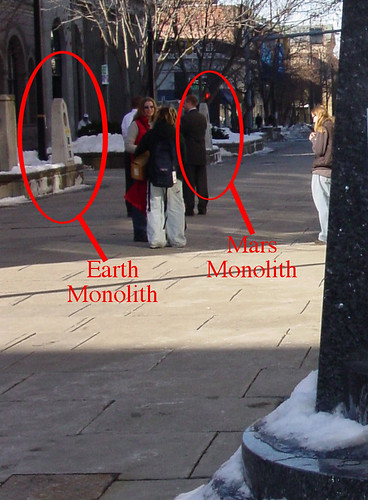
(The Venus monolith is directly behind the Sun monolith in this shot; Mercury is off to the left, beyond the edge of the photo.)
Each of the planets is represented by a slightly smaller grey monolith (except Pluto (yes, this was back before Pluto's demotion) which has a monolith matching that of the Sun, to anchor the other end of the Planet Walk). Here, for example, is the one for Mercury:

And here's the one for Jupiter:
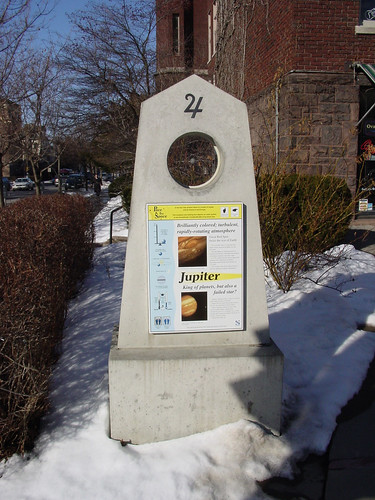
The window in the center of each Monolith is identical in size to the window which represents the sun, in order to give a sense of scale. The actual planet is represented by a to-scale size model of the planet embedded in the window. In most cases, you can only see it by going right up to the window and looking very closely; it's often hard to tell the planet from a speck of dirt (although the planet is in the center of each window, and of course you can tell if you look closely enough.) But the larger planets you can see even from a few feet away. For example, here is an enlargement of the Jupiter window above:

And here is an enlargement for the Saturn window:

For Jupiter, they also include several moons (the four big ones, I think) and the Saturn window includes Triton; but you can't see them with the level of detail in these pictures. Incidentally, in those two pictures, Jupiter looks smaller than Saturn, but that's a result of the framing and angle of the photos; in the actual monument, Jupiter is quite clearly bigger than Saturn (aside from the latter's rings, which even things out a bit.)
On the front of each monolith is a plaque giving information about the planet. There's also a podcast by Bill Nye which you can listen to as you do the walk (although I've never heard it -- it's fairly new -- even though I've done the walk more than a dozen times from end to end, not counting passing it just strolling around town (we live near Uranus, so I go by parts of the walk all the time.))
What's really cool about the memorial, however -- it's purpose, really -- is not possible to capture in photos, and that's the visceral sense of the sheer size of the space, and of the extraordinary emptiness of it. It takes about half an hour to walk from the Sun (at the heart of downtown) to Pluto, right in front of the Sciencenter, the local science museum. But walking it you imagine almost all of it as empty, save for these tiny little specks of nothing captured in the windows. Even the sun seems tiny. It's dizzying: our universe is basically extended void, a vast amount of nothing, with just a few insignificant specks of fire and dust. It is, in a powerful sense which gets lost in the common use of the phrase, awe-inspiring.
And of course the distances vary greatly. It's a matter of moments to walk from the Sun to Mars; each of the other distances gets progressively longer, save for the Neptune - Pluto distance which is shorter (although still long on the Sun - Mars scale). Here is the official map from the Sciencenter web site:

You can get a slight sense of the distances from this map -- but not as well as you can from an ordinary astronomy textbook. What really works is the sculpture itself: putting the entirety on a human scale, so you can feel it, get the variations under your shoes and in your legs.
It is a marvelous memorial for the late, lamented Carl Sagan, who spent his life trying to educate the public about astronomy and science: a beautiful piece of public art that also serves to convey, on a marrow-in-the-bones level, the feeling of awe that our universe can inspire when looked at through science's lens.
But my favorite thing about the planet walk I don't have a photograph of. It isn't on the map; it isn't in Ithaca -- it doesn't even exist yet, and it probably never will. But there has been talk apparently about building a matching, to-scale monolith for Alpha Centauri, the nearest star to the Sun.
It would be in Hawaii.
I love to imagine that it will be built: making the Sagan Planet Walk one of the largest public sculptures in the world (since, after all, the space between the monoliths is an integral part of the sculpture), and boggling the mind with the true vastness and emptiness of this extraordinary cosmos that we live in.
In any event, next time you are in Ithaca (which, to be sure, is in the middle of nowhere -- it's not even directly on a major interstate -- so it may be a while for most of you) take the time to walk the planet walk. It's a wonderful bit of public art, and worth taking the time to appreciate properly. And a wonderful tribute to an amazing man.
Update: Joel Schlosberg has now put up a post linking to the various entries of the blog memorial. Go there to check 'em out.
The sculpture in question is the Sagan Planet Walk, a scale model of the solar system on a 5,000,000,000:1 scale. The sun is represented as a window in a large black monolith:
Each of the planets is represented by a slightly smaller grey monolith (except Pluto (yes, this was back before Pluto's demotion) which has a monolith matching that of the Sun, to anchor the other end of the Planet Walk). Here, for example, is the one for Mercury:
On the front of each monolith is a plaque giving information about the planet. There's also a podcast by Bill Nye which you can listen to as you do the walk (although I've never heard it -- it's fairly new -- even though I've done the walk more than a dozen times from end to end, not counting passing it just strolling around town (we live near Uranus, so I go by parts of the walk all the time.))
What's really cool about the memorial, however -- it's purpose, really -- is not possible to capture in photos, and that's the visceral sense of the sheer size of the space, and of the extraordinary emptiness of it. It takes about half an hour to walk from the Sun (at the heart of downtown) to Pluto, right in front of the Sciencenter, the local science museum. But walking it you imagine almost all of it as empty, save for these tiny little specks of nothing captured in the windows. Even the sun seems tiny. It's dizzying: our universe is basically extended void, a vast amount of nothing, with just a few insignificant specks of fire and dust. It is, in a powerful sense which gets lost in the common use of the phrase, awe-inspiring.
And of course the distances vary greatly. It's a matter of moments to walk from the Sun to Mars; each of the other distances gets progressively longer, save for the Neptune - Pluto distance which is shorter (although still long on the Sun - Mars scale). Here is the official map from the Sciencenter web site:
It is a marvelous memorial for the late, lamented Carl Sagan, who spent his life trying to educate the public about astronomy and science: a beautiful piece of public art that also serves to convey, on a marrow-in-the-bones level, the feeling of awe that our universe can inspire when looked at through science's lens.
But my favorite thing about the planet walk I don't have a photograph of. It isn't on the map; it isn't in Ithaca -- it doesn't even exist yet, and it probably never will. But there has been talk apparently about building a matching, to-scale monolith for Alpha Centauri, the nearest star to the Sun.
It would be in Hawaii.
I love to imagine that it will be built: making the Sagan Planet Walk one of the largest public sculptures in the world (since, after all, the space between the monoliths is an integral part of the sculpture), and boggling the mind with the true vastness and emptiness of this extraordinary cosmos that we live in.
In any event, next time you are in Ithaca (which, to be sure, is in the middle of nowhere -- it's not even directly on a major interstate -- so it may be a while for most of you) take the time to walk the planet walk. It's a wonderful bit of public art, and worth taking the time to appreciate properly. And a wonderful tribute to an amazing man.
In Memoriam
Carl Sagan
1934 - 1996
Carl Sagan
1934 - 1996
Update: Joel Schlosberg has now put up a post linking to the various entries of the blog memorial. Go there to check 'em out.
Thursday, August 24, 2006
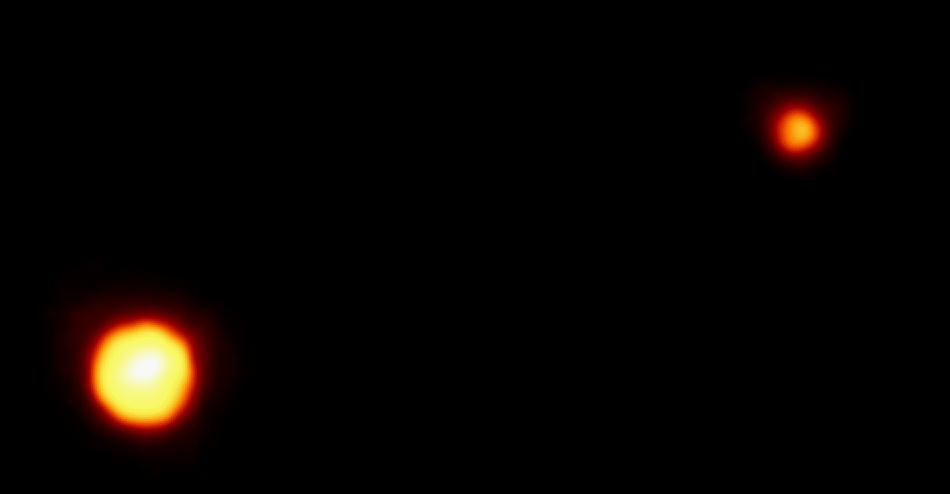
Pluto, We Still Love You!
Despite Christine Lavin's charming argument, Scott Westerfeld makes a depressingly good case that this was the right decision. (He'd better watch out for Cthulhu, though.) And Chris Clarke agrees with Scott. As do, now, Astronomers.
Alas, poor Pluto!
Pluto's reaction is here. (Update: And here.)
(Several links via this thread.)
Pluto Mourns (with Charon)
Saturday, July 01, 2006
Aliens Invade India!
Well, maybe. And the aliens (if they are such) are microbes -- they don't even have D.N.A. And "invasion" isn't quite the word -- dumped accidentally by a passing comet would be more like it, which is hardly the same as entering by force while looking for imaginary W.M.D.s.
Still, by my standards, even if qualified to "Microbes that Might Have Been Extraterrestrial Landed in India Five Years Ago!", it's still pretty exciting to think about.
Here's the story. It seems that in 2001, some mysterious red rain fell in India (specifically in the state of Kerala). No one is yet sure what caused it; there are a number of theories, apparently. (In the popular, slang use of "theory" to mean "hypothesis" rather than the scientific sense of "well-confirmed scientific explanation".) One theory, put forward by a scientist named Godfrey Louis, is that (in his words):
What can I say but: wow.

Disclaimer: Histrionic image of invading aliens
utterly unrelated to the otherwise factual, or at
least possible, aliens referred to in this blog post.
They're not even invading India.
(This little news tidbit via the blog of SF writer Nick Sagan, whose work, I must admit, I've never read -- but it seems from his blog that he's a local boy, so I suppose I should check out his (doubtless splendid, given his fine place of residence) work.)
Still, by my standards, even if qualified to "Microbes that Might Have Been Extraterrestrial Landed in India Five Years Ago!", it's still pretty exciting to think about.
Here's the story. It seems that in 2001, some mysterious red rain fell in India (specifically in the state of Kerala). No one is yet sure what caused it; there are a number of theories, apparently. (In the popular, slang use of "theory" to mean "hypothesis" rather than the scientific sense of "well-confirmed scientific explanation".) One theory, put forward by a scientist named Godfrey Louis, is that (in his words):
the red particles, which caused the red rain of Kerala, are possibly of extraterrestrial origin... the absence of DNA argues against the biological nature of these red rain cells. But I wish to consider the possibility of alternate biomolecules in these cells whose origin is now suspected as extraterrestrial. This way the cells may represent an alternate form of life from space...Dr. Louis has published one peer-reviewed article putting forward this idea; further are in process.
What can I say but: wow.

Disclaimer: Histrionic image of invading aliens
utterly unrelated to the otherwise factual, or at
least possible, aliens referred to in this blog post.
They're not even invading India.
(This little news tidbit via the blog of SF writer Nick Sagan, whose work, I must admit, I've never read -- but it seems from his blog that he's a local boy, so I suppose I should check out his (doubtless splendid, given his fine place of residence) work.)
Tuesday, December 20, 2005
Seeing Through the Lies
Some good news: Bush 43-appointed Judge John E. Jones III struck a blow for the separation of Church and State, and against the infestation of secular science with partisan religious advocacy, and ruled for the plaintiffs in the Dover Intelligent Design creationism case. Not only ruled for science and a religiously-neutral state, but did so in powerful terms which cut to the heart of the controversy. And he deliberately gave a through ruling, covering issues he might have by-passed (i.e. considering all the legal issues even after ones sufficient for a ruling had been decided) "in the hope that it may prevent the obvious waste of judicial and other resources which would be occasioned by a subsequent trial involving the precise question which is before us." (p. 64)
His ruling (in PDF format) is here (also here). It's long (139 pages) but it's a surprisingly good read -- if you're a geek who's into that sort of thing, I suppose is the inevitable rider, but I guess I would say that it had broader appeal than the average legal ruling or 100+ page discussion of the evolution/creationism issue; not saying much maybe. But (while I can't say I read every word of it, I read far more than I thought I would. It's engrossing. -- And encouraging in these dark times. (Update: Neil Gaiman (!) agrees, calling it "fascinating reading -- remarkably lucid and interesting". (via))
The go-to blogger on this issue is clearly PZ Myers -- he's got four posts up already, including lengthy excerpts, and I'm sure there are more to come. (His first post on today's ruling is here.) His site is clearly swamped; most of his posts seem to be mirrored at The Panda's Thumb (also swamped, but at least that's two longshots, not one). And, of course, other science & evolution bloggers are covering this too. (For pre-decision posting, see this post by a surprisingly perceptive and startlingly handsome blogger who will, for modesty's sake, go unnamed (but not unlinked -- modesty has its limits, after all.)) (Update: the Questionable Authority has a one-shot blog carnival with a huge number of links. And don't miss PZ Myers's day-after hangover.)
What strikes me above all is the level of mendacity by the creationist side. It's not surprising -- it's fundamental to their approach on every level. But it's just so ubiquitous, so blatant, so overwhelming by anyone who supports their position.
They have to lie about the evidence in order to try and rebut the overwhelmingly-supported theory of evolution ("Plaintiffs’ science experts, Drs. Miller and Padian, clearly explained how ID proponents generally and Pandas specifically, distort and misrepresent scientific knowledge in making their anti-evolution argument." -- Judge Jones, p. 84). Then, since the Supreme Court earlier decisively rejected creationism being taught in public school science classrooms, they have to lie and pretend that ID is not creationism; as part and parcel of this lie, they have to pretend that there is a real science of ID and real scientific controversy around its acceptance. ("The overwhelming evidence at trial established that ID is a religious view, a mere re-labeling of creationism, and not a scientific theory." -- p. 43) They have to lie about whether or not they believe the creator is Christ and whether or not they have religious motives. ("A significant aspect of the IDM is that despite Defendants’ protestations to the contrary, it describes ID as a religious argument. In that vein, the writings of leading ID proponents reveal that the designer postulated by their argument is the God of Christianity." -- p. 26)
Then there are the specific lies in this case. Since -- after openly stating that they wished creationism (under its true name) taught -- the leading school board members were informed that this was legally untenable, they had to lie about their earlier actions ("...the inescapable truth is that both Bonsell and Buckingham lied at their January 3, 2005 depositions about their knowledge of the source of the donation for Pandas... This mendacity was a clear and deliberate attempt to hide the source of the donations by the Board President and the Chair of the Curriculum Committee to further ensure that Dover students received a creationist alternative to Darwin's theory of evolution." -- p. 115) as well as about their motives. ("Although Defendants attempt to persuade this Court that each Board member who voted for the biology curriculum change did so for the secular purposed of improving science education and to exercise critical thinking skills, their contentions are simply irreconcilable with the record evidence. Their asserted purposes are a sham, and they are accordingly unavailing, for the reasons that follow." -- p. 130) Jones is openly and repeatedly scathing on the level of lying by the (mostly former I believe) pro-creationism members of the Dover School Board. ("Simply put, [former Dover school board president] Bonsell repeatedly failed to testify in a truthful manner about this and other subjects." -- p. 97) Nor does the irony of the 'religious' side being so dependent on lies escape the good Judge. ("It is ironic that several of these individuals, who so staunchly and proudly touted their religious convictions in public, would time and again lie to cover their tracks and disguise the real purpose behind the ID Policy." -- p. 137)
And then there are all the implicit lies -- Behe twisting his claims to try and ignore voluminous counter-evidence ("By defining irreducible complexity in the way that he has, Professor Behe attempts to exclude the phenomenon of exaptation by definitional fiat, ignoring as he does so abundant evidence which refutes his argument." -- p. 75); the implicit lie in the 'teach-the-controversy' meme ("ID, as noted, is grounded in theology, not science. Accepting for the sake of argument its proponents’, as well as Defendants’ argument that to introduce ID to students will encourage critical thinking, it still has utterly no place in a science curriculum. Moreover, ID’s backers have sought to avoid the scientific scrutiny which we have now determined that it cannot withstand by advocating that the controversy, but not ID itself, should be taught in science class. This tactic is at best disingenuous, and at worst a canard. The goal of the IDM is not to encourage critical thought, but to foment a revolution which would supplant evolutionary theory with ID." -- p. 89); and the astonishing mendacity revealed in the fact that the ID textbook simply replaced the words 'creationism' with 'intelligent design' after the court ruling on the former ("By comparing the pre and post Edwards drafts of Pandas, three astonishing points emerge: (1) the definition for creation science in early drafts is identical to the definition of ID; (2) cognates of the word creation (creationism and creationist), which appeared approximately 150 times were deliberately and systematically replaced with the phrase ID; and (3) the changes occurred shortly after the Supreme Court held that creation science is religious and cannot be taught in public school science classes in Edwards. This word substitution is telling, significant, and reveals that a purposeful change of words was effected without any corresponding change in content, which directly refutes FTE’s argument that by merely disregarding the words “creation” and “creationism,” FTE expressly rejected creationism in Pandas." -- p. 32)
And. frankly, I could keep going and going. Given all of that, it's not surprising that the proponents of Intelligent Design creationism are now issuing mendacious press releases about the verdict.
What was wonderful about Jones's ruling is that he saw through all these lies -- he called them on it, in the way that (for example) our pusillanimous press refuses to. I can't judge whether or not his ruling was solid on the law (although everything I've seen leads me to believe it was); but it was solid on the facts. And, these days, that is something to be grateful for.
His ruling (in PDF format) is here (also here). It's long (139 pages) but it's a surprisingly good read -- if you're a geek who's into that sort of thing, I suppose is the inevitable rider, but I guess I would say that it had broader appeal than the average legal ruling or 100+ page discussion of the evolution/creationism issue; not saying much maybe. But (while I can't say I read every word of it, I read far more than I thought I would. It's engrossing. -- And encouraging in these dark times. (Update: Neil Gaiman (!) agrees, calling it "fascinating reading -- remarkably lucid and interesting". (via))
The go-to blogger on this issue is clearly PZ Myers -- he's got four posts up already, including lengthy excerpts, and I'm sure there are more to come. (His first post on today's ruling is here.) His site is clearly swamped; most of his posts seem to be mirrored at The Panda's Thumb (also swamped, but at least that's two longshots, not one). And, of course, other science & evolution bloggers are covering this too. (For pre-decision posting, see this post by a surprisingly perceptive and startlingly handsome blogger who will, for modesty's sake, go unnamed (but not unlinked -- modesty has its limits, after all.)) (Update: the Questionable Authority has a one-shot blog carnival with a huge number of links. And don't miss PZ Myers's day-after hangover.)
What strikes me above all is the level of mendacity by the creationist side. It's not surprising -- it's fundamental to their approach on every level. But it's just so ubiquitous, so blatant, so overwhelming by anyone who supports their position.
They have to lie about the evidence in order to try and rebut the overwhelmingly-supported theory of evolution ("Plaintiffs’ science experts, Drs. Miller and Padian, clearly explained how ID proponents generally and Pandas specifically, distort and misrepresent scientific knowledge in making their anti-evolution argument." -- Judge Jones, p. 84). Then, since the Supreme Court earlier decisively rejected creationism being taught in public school science classrooms, they have to lie and pretend that ID is not creationism; as part and parcel of this lie, they have to pretend that there is a real science of ID and real scientific controversy around its acceptance. ("The overwhelming evidence at trial established that ID is a religious view, a mere re-labeling of creationism, and not a scientific theory." -- p. 43) They have to lie about whether or not they believe the creator is Christ and whether or not they have religious motives. ("A significant aspect of the IDM is that despite Defendants’ protestations to the contrary, it describes ID as a religious argument. In that vein, the writings of leading ID proponents reveal that the designer postulated by their argument is the God of Christianity." -- p. 26)
Then there are the specific lies in this case. Since -- after openly stating that they wished creationism (under its true name) taught -- the leading school board members were informed that this was legally untenable, they had to lie about their earlier actions ("...the inescapable truth is that both Bonsell and Buckingham lied at their January 3, 2005 depositions about their knowledge of the source of the donation for Pandas... This mendacity was a clear and deliberate attempt to hide the source of the donations by the Board President and the Chair of the Curriculum Committee to further ensure that Dover students received a creationist alternative to Darwin's theory of evolution." -- p. 115) as well as about their motives. ("Although Defendants attempt to persuade this Court that each Board member who voted for the biology curriculum change did so for the secular purposed of improving science education and to exercise critical thinking skills, their contentions are simply irreconcilable with the record evidence. Their asserted purposes are a sham, and they are accordingly unavailing, for the reasons that follow." -- p. 130) Jones is openly and repeatedly scathing on the level of lying by the (mostly former I believe) pro-creationism members of the Dover School Board. ("Simply put, [former Dover school board president] Bonsell repeatedly failed to testify in a truthful manner about this and other subjects." -- p. 97) Nor does the irony of the 'religious' side being so dependent on lies escape the good Judge. ("It is ironic that several of these individuals, who so staunchly and proudly touted their religious convictions in public, would time and again lie to cover their tracks and disguise the real purpose behind the ID Policy." -- p. 137)
And then there are all the implicit lies -- Behe twisting his claims to try and ignore voluminous counter-evidence ("By defining irreducible complexity in the way that he has, Professor Behe attempts to exclude the phenomenon of exaptation by definitional fiat, ignoring as he does so abundant evidence which refutes his argument." -- p. 75); the implicit lie in the 'teach-the-controversy' meme ("ID, as noted, is grounded in theology, not science. Accepting for the sake of argument its proponents’, as well as Defendants’ argument that to introduce ID to students will encourage critical thinking, it still has utterly no place in a science curriculum. Moreover, ID’s backers have sought to avoid the scientific scrutiny which we have now determined that it cannot withstand by advocating that the controversy, but not ID itself, should be taught in science class. This tactic is at best disingenuous, and at worst a canard. The goal of the IDM is not to encourage critical thought, but to foment a revolution which would supplant evolutionary theory with ID." -- p. 89); and the astonishing mendacity revealed in the fact that the ID textbook simply replaced the words 'creationism' with 'intelligent design' after the court ruling on the former ("By comparing the pre and post Edwards drafts of Pandas, three astonishing points emerge: (1) the definition for creation science in early drafts is identical to the definition of ID; (2) cognates of the word creation (creationism and creationist), which appeared approximately 150 times were deliberately and systematically replaced with the phrase ID; and (3) the changes occurred shortly after the Supreme Court held that creation science is religious and cannot be taught in public school science classes in Edwards. This word substitution is telling, significant, and reveals that a purposeful change of words was effected without any corresponding change in content, which directly refutes FTE’s argument that by merely disregarding the words “creation” and “creationism,” FTE expressly rejected creationism in Pandas." -- p. 32)
And. frankly, I could keep going and going. Given all of that, it's not surprising that the proponents of Intelligent Design creationism are now issuing mendacious press releases about the verdict.
What was wonderful about Jones's ruling is that he saw through all these lies -- he called them on it, in the way that (for example) our pusillanimous press refuses to. I can't judge whether or not his ruling was solid on the law (although everything I've seen leads me to believe it was); but it was solid on the facts. And, these days, that is something to be grateful for.
Thursday, August 18, 2005
Another Argument Against Intelligent Design
There's an argument against Intelligent Design creationism that I've not seen anyone make yet. (It's implicit here or there, but I've not seen it articulated as a separate argument.)
Most of the arguments against Intelligent Design have, rightly, focused on the fact that it's bogus -- that it's claims are either untestable and unfalsifiable (and hence not scientific at all) or are claims which have been tested and falsified already. This seems contradictory, incidentally, because Intelligent Design itself is nothing very coherent: it makes a grab-bag of bad claims of all sorts: unfalsifiable metaphysical claims, simple lies about science, presenting specific outstanding scientific questions (which there are of course, that's how science works) as if they somehow falsified evolutionary theory as a whole, deceptions based upon misunderstandings about the nature of science (i.e. what the word "theory" means in a scientific context), etc, ad nausuem. These are the main arguments made because it's the key point: ID's simply bogus (I prefer the word "bogus" because it covers both "wrong" and "unfalsifiable" and "deceptive" -- the various different ways various ID claims are, well, bogus.)
The other major argument -- about why the "teach the controversy" position (recently adopted by Bush) is wrong -- focuses on the fact that ID is a trojan horse. It's not science, but an attempt to teach religion in science class as if it were science. (No one opposes teaching religion in classes about religion, as long as it's not a single religion being promoted.) The key thing to understand here is that ID was engineered -- quite deliberately -- to work around the 1987 Supreme Court decision declaring the teaching of "Creation Science" to be a violation of the first amendment's disestablishment of religion: don't mention who the designer is (though everyone knows, nudge-nudge, wink-wink), hide your religions motivations (although they come out when ID's proponents let their hair down), and so forth. This is why ID shouldn't be taught in science classes: it's teaching a religious point of view in badly-fitting secular drag.
But I think there's another argument to be made as well. Assume for the sake of argument that ID is what its leading proponents say it is: a scientific challenge, made on scientific grounds, challenging evolution for purely scientific reasons and not ulterior motives. (Just to be clear: this is what philosophers call an assumption-contrary-to-fact, i.e. it isn't true; we're just assuming it is for the sake of this argument.) Even given this assumption, ID still shouldn't be taught in public high schools -- to say nothing of junior high schools, etc., nor in basic biology classes at the college level. (This particular argument doesn't hold for advanced classes (though of course the others do.))
Why not? Because the point of basic science education -- such as that of junior high, high school and introductory college classes -- is to teach basic science (and the scientific method, etc.) A fringe theory, one not yet accepted broadly in the scientific community, simply has no place there. Sure, this means that years after a student takes their classes, some of what they were taught will have been rendered obsolete -- but that's because of what makes science good, namely that it progresses. But since we can't know in advance where science is going, what basic science classes must teach are the best science of the day -- not fringe theories that have yet to gain acceptance.
This is obvious if we look at any other scientific controversy. I believe that there are still scientists who are promoting the idea of cold fusion -- but I'm sure that they themselves would agree that it shouldn't be taught in basic science classes until it gains wider acceptance. Certainly no one else would think so. Similarly with any other minority theory -- including ones that have come to be widely held, back when they were fringe theories: for a time the notion of continental drift was accepted only by a few -- and no one thought it should be taught in high schools; only when the evidence became overwhelming for it did it enter the basic curriculum.
Of course, in some cases a dispute is too live and too central to ignore. For instance, at least the last time I checked (if anyone has any more up to date info, email me) there was an ongoing question about human evolution, whether humans evolved into essentially their present-day state in Africa before spreading out into Asia, Europe and elsewhere, or whether earlier forms of primates spread out, and modern day humans evolved (as it were) all over, with enough interbreeding to keep us all one species. (I've never understood how the second makes sense, so perhaps I'm explaining it wrong. But of course it doesn't matter what I think; the vague understanding of laymen is not what matters in science, as is sort of the whole point here.) So if talking about human evolution, perhaps you'd have to mention both theories, at least until the evidence becomes clearer. But of course ID is not any such theory. The overwhelming majority of scientists reject it. It hasn't even published any real papers in peer-reviewed journals (except for one review essay shoved in against journal policy by a partisan editor.) So even if you (as per our contrary-to-fact assumption) take ID to be simply a scientific movement, there is absolutely no reason to teach it in high schools. It's just too fringe. Wait until it becomes a major movement, with serious scientific support, and then think about teaching it. If ID people were serious scientists, they'd agree -- no rush, wait until the evidence is in and more scientists become convinced. This, incidentally, is why ID proponents always talk about a growing controversy: to make it look like it's winning, not only for Rovian-people-join-the-winning-side reasons, but so as to make the idea of teaching it in schools look a little less ridiculous.
So why do people want it taught? Here, alas, is where our contrary-to-fact assumption breaks down (as they tend to do, since they are, well, contrary-to-fact). People want it taught for non scientific reasons -- specifically, for religious (or political and religious) reasons. Its major proponents -- Philip Johnson, Michael Behe, William Dembski and the like -- don't want to wait for more evidence to roll in because they're not waiting for evidence at all. Maybe it's because they're insincere, and know that what they're promoting is bunk and will never get more evidence. But even if they sincerely believe what they claim (and who knows, really), they are pushing it into schools for reasons other than those (supposedly) scientific reasons. If they simply wanted to get to the scientific truth, they'd wait: all sorts of developing science isn't taught in basic science classes, if it catches on it will be, until then what's the rush? But they want to undermine what they see as a tool of atheism -- evolutionary theory, and a materialist worldview more generally. (They've been explicit about this from time to time, although they try to hide it since it damages their strategy of appearing neutral for legal reasons.) Their goals, in other words, are religious, philosophical and political -- not scientific; and this is true even if they believe what they claim.
(Now, as I understand it, the current position of the Discovery (sic) Institute is that ID shouldn't be taught -- so to that extent they're honest, or at least trying to appear so -- but that the "problems" with evolution should be. But their supposed problems with evolution are as bunk as their notions on ID -- and the same argument applies: if they were serious about this as science and only as science, they wouldn't want these arguments taught until they'd gained wider acceptance. Pushing the teaching of so-called problems with evolution is simply one form of pushing the teaching of ID. For that matter, all that ID is is a bunch of bogus arguments against evolution -- there's no positive program there at all (as its proponents will also admit in unguarded moments.) So despite their attempt to appear fair, DI really is pushing for ID to be taught in the schools.)
That's the central proponents, most of whom are associated with the Discovery Institute. (Dear Lord, the very fact that a think-tank is the center of a purportedly scientific movement should be a dead giveaway!) But for the majority of proponents -- school board members, politicians, preachers and sundry other citizens who are pushing for ID to be taught on a local level -- it's even clearer. After all, most of them believe, frankly, in creationism. And therefore they're even less disciplined about hiding their religious motives than the central proponents are. (That's why the Discovery Institute is discomfited by the case in Dover, Pennsylvania: the Dover school board was too open about its religious motives, and thus are hurting the essentially deceptive legal strategy of ID.) Probably some of these other ID proponents don't understand the legal background and thus the necessity to hide their religious motives; probably others feel that they oughtn't to have to hide them and are frankly in favor of putting partisan religious views into public schools, the first amendment be damned (literally, I suppose). Whatever the reasons, though, they are far more open about it -- they will talk about teaching "divine design", for instance, which really messes up the ID/DI legal strategy, or openly say they are for ID because they believe in creationism, which does so even more. In other words, they see ID as essentially equivalent to creationism -- legally acceptable, but basically the same thing. (So at least on one issue, they're right.) Which is why they want it taught.
The very fact that people are pushing for ID to be taught in public schools shows that their motives are not scientific but religious (and/or political). The very fact that people are pushing for ID to be taught in public schools shows why it shouldn't be.
Most of the arguments against Intelligent Design have, rightly, focused on the fact that it's bogus -- that it's claims are either untestable and unfalsifiable (and hence not scientific at all) or are claims which have been tested and falsified already. This seems contradictory, incidentally, because Intelligent Design itself is nothing very coherent: it makes a grab-bag of bad claims of all sorts: unfalsifiable metaphysical claims, simple lies about science, presenting specific outstanding scientific questions (which there are of course, that's how science works) as if they somehow falsified evolutionary theory as a whole, deceptions based upon misunderstandings about the nature of science (i.e. what the word "theory" means in a scientific context), etc, ad nausuem. These are the main arguments made because it's the key point: ID's simply bogus (I prefer the word "bogus" because it covers both "wrong" and "unfalsifiable" and "deceptive" -- the various different ways various ID claims are, well, bogus.)
The other major argument -- about why the "teach the controversy" position (recently adopted by Bush) is wrong -- focuses on the fact that ID is a trojan horse. It's not science, but an attempt to teach religion in science class as if it were science. (No one opposes teaching religion in classes about religion, as long as it's not a single religion being promoted.) The key thing to understand here is that ID was engineered -- quite deliberately -- to work around the 1987 Supreme Court decision declaring the teaching of "Creation Science" to be a violation of the first amendment's disestablishment of religion: don't mention who the designer is (though everyone knows, nudge-nudge, wink-wink), hide your religions motivations (although they come out when ID's proponents let their hair down), and so forth. This is why ID shouldn't be taught in science classes: it's teaching a religious point of view in badly-fitting secular drag.
But I think there's another argument to be made as well. Assume for the sake of argument that ID is what its leading proponents say it is: a scientific challenge, made on scientific grounds, challenging evolution for purely scientific reasons and not ulterior motives. (Just to be clear: this is what philosophers call an assumption-contrary-to-fact, i.e. it isn't true; we're just assuming it is for the sake of this argument.) Even given this assumption, ID still shouldn't be taught in public high schools -- to say nothing of junior high schools, etc., nor in basic biology classes at the college level. (This particular argument doesn't hold for advanced classes (though of course the others do.))
Why not? Because the point of basic science education -- such as that of junior high, high school and introductory college classes -- is to teach basic science (and the scientific method, etc.) A fringe theory, one not yet accepted broadly in the scientific community, simply has no place there. Sure, this means that years after a student takes their classes, some of what they were taught will have been rendered obsolete -- but that's because of what makes science good, namely that it progresses. But since we can't know in advance where science is going, what basic science classes must teach are the best science of the day -- not fringe theories that have yet to gain acceptance.
This is obvious if we look at any other scientific controversy. I believe that there are still scientists who are promoting the idea of cold fusion -- but I'm sure that they themselves would agree that it shouldn't be taught in basic science classes until it gains wider acceptance. Certainly no one else would think so. Similarly with any other minority theory -- including ones that have come to be widely held, back when they were fringe theories: for a time the notion of continental drift was accepted only by a few -- and no one thought it should be taught in high schools; only when the evidence became overwhelming for it did it enter the basic curriculum.
Of course, in some cases a dispute is too live and too central to ignore. For instance, at least the last time I checked (if anyone has any more up to date info, email me) there was an ongoing question about human evolution, whether humans evolved into essentially their present-day state in Africa before spreading out into Asia, Europe and elsewhere, or whether earlier forms of primates spread out, and modern day humans evolved (as it were) all over, with enough interbreeding to keep us all one species. (I've never understood how the second makes sense, so perhaps I'm explaining it wrong. But of course it doesn't matter what I think; the vague understanding of laymen is not what matters in science, as is sort of the whole point here.) So if talking about human evolution, perhaps you'd have to mention both theories, at least until the evidence becomes clearer. But of course ID is not any such theory. The overwhelming majority of scientists reject it. It hasn't even published any real papers in peer-reviewed journals (except for one review essay shoved in against journal policy by a partisan editor.) So even if you (as per our contrary-to-fact assumption) take ID to be simply a scientific movement, there is absolutely no reason to teach it in high schools. It's just too fringe. Wait until it becomes a major movement, with serious scientific support, and then think about teaching it. If ID people were serious scientists, they'd agree -- no rush, wait until the evidence is in and more scientists become convinced. This, incidentally, is why ID proponents always talk about a growing controversy: to make it look like it's winning, not only for Rovian-people-join-the-winning-side reasons, but so as to make the idea of teaching it in schools look a little less ridiculous.
So why do people want it taught? Here, alas, is where our contrary-to-fact assumption breaks down (as they tend to do, since they are, well, contrary-to-fact). People want it taught for non scientific reasons -- specifically, for religious (or political and religious) reasons. Its major proponents -- Philip Johnson, Michael Behe, William Dembski and the like -- don't want to wait for more evidence to roll in because they're not waiting for evidence at all. Maybe it's because they're insincere, and know that what they're promoting is bunk and will never get more evidence. But even if they sincerely believe what they claim (and who knows, really), they are pushing it into schools for reasons other than those (supposedly) scientific reasons. If they simply wanted to get to the scientific truth, they'd wait: all sorts of developing science isn't taught in basic science classes, if it catches on it will be, until then what's the rush? But they want to undermine what they see as a tool of atheism -- evolutionary theory, and a materialist worldview more generally. (They've been explicit about this from time to time, although they try to hide it since it damages their strategy of appearing neutral for legal reasons.) Their goals, in other words, are religious, philosophical and political -- not scientific; and this is true even if they believe what they claim.
(Now, as I understand it, the current position of the Discovery (sic) Institute is that ID shouldn't be taught -- so to that extent they're honest, or at least trying to appear so -- but that the "problems" with evolution should be. But their supposed problems with evolution are as bunk as their notions on ID -- and the same argument applies: if they were serious about this as science and only as science, they wouldn't want these arguments taught until they'd gained wider acceptance. Pushing the teaching of so-called problems with evolution is simply one form of pushing the teaching of ID. For that matter, all that ID is is a bunch of bogus arguments against evolution -- there's no positive program there at all (as its proponents will also admit in unguarded moments.) So despite their attempt to appear fair, DI really is pushing for ID to be taught in the schools.)
That's the central proponents, most of whom are associated with the Discovery Institute. (Dear Lord, the very fact that a think-tank is the center of a purportedly scientific movement should be a dead giveaway!) But for the majority of proponents -- school board members, politicians, preachers and sundry other citizens who are pushing for ID to be taught on a local level -- it's even clearer. After all, most of them believe, frankly, in creationism. And therefore they're even less disciplined about hiding their religious motives than the central proponents are. (That's why the Discovery Institute is discomfited by the case in Dover, Pennsylvania: the Dover school board was too open about its religious motives, and thus are hurting the essentially deceptive legal strategy of ID.) Probably some of these other ID proponents don't understand the legal background and thus the necessity to hide their religious motives; probably others feel that they oughtn't to have to hide them and are frankly in favor of putting partisan religious views into public schools, the first amendment be damned (literally, I suppose). Whatever the reasons, though, they are far more open about it -- they will talk about teaching "divine design", for instance, which really messes up the ID/DI legal strategy, or openly say they are for ID because they believe in creationism, which does so even more. In other words, they see ID as essentially equivalent to creationism -- legally acceptable, but basically the same thing. (So at least on one issue, they're right.) Which is why they want it taught.
The very fact that people are pushing for ID to be taught in public schools shows that their motives are not scientific but religious (and/or political). The very fact that people are pushing for ID to be taught in public schools shows why it shouldn't be.
Saturday, July 30, 2005
When a New Planet Swims Into His Ken
"Then felt I like some watcher of the skies
When a new planet swims into his ken..."
-- Keats
Scientists (Mike Brown & colleagues at Caltech) have found a tenth planet! Bigger than Pluto!
How utterly cool is that!!
Detail seem sketchy so far. (This is apparently because the announcement was premature -- their hands were forced since someone had hacked their website and would, they feared, preempt the announcement.) They know that it's bigger than Pluto -- although they don't seem to know how much bigger. It's about three times as far out. They're describing it as a "typical member of the Kuiper belt" -- indeed, the New York Times rather grumpily suggests that the discovery of the new planet (so far simply called 2003UB313 while awaiting confirmation of its official, hopefully somewhat more euphonious, name) will simply hasten Pluto's demotion (which has been suggested in recent years). I hope not; I like Pluto as a planet, and the idea of their being a tenth planet is simply way cool.
(I found the NYT story is rather confusingly written, incidentally -- too tied up with other discoveries and not well done. (It's late at night; maybe by tomorrow they'll have cleaned it up.) Try the other links above, or here for another what-is-a-planet-anyway?-focused story.)
All I can say is that I sure hope that my favorite piece of public sculpture will be updated & expanded appropriately! (Actually, references to "nine planets" are all over the place -- I mentioned one just the other day, just for example. So a lot of things are going to need to be updated...)
When a new planet swims into his ken..."
-- Keats
Scientists (Mike Brown & colleagues at Caltech) have found a tenth planet! Bigger than Pluto!
How utterly cool is that!!
Detail seem sketchy so far. (This is apparently because the announcement was premature -- their hands were forced since someone had hacked their website and would, they feared, preempt the announcement.) They know that it's bigger than Pluto -- although they don't seem to know how much bigger. It's about three times as far out. They're describing it as a "typical member of the Kuiper belt" -- indeed, the New York Times rather grumpily suggests that the discovery of the new planet (so far simply called 2003UB313 while awaiting confirmation of its official, hopefully somewhat more euphonious, name) will simply hasten Pluto's demotion (which has been suggested in recent years). I hope not; I like Pluto as a planet, and the idea of their being a tenth planet is simply way cool.
(I found the NYT story is rather confusingly written, incidentally -- too tied up with other discoveries and not well done. (It's late at night; maybe by tomorrow they'll have cleaned it up.) Try the other links above, or here for another what-is-a-planet-anyway?-focused story.)
All I can say is that I sure hope that my favorite piece of public sculpture will be updated & expanded appropriately! (Actually, references to "nine planets" are all over the place -- I mentioned one just the other day, just for example. So a lot of things are going to need to be updated...)
Subscribe to:
Posts (Atom)