Showing posts with label Obsessive. Show all posts

Wednesday, September 29, 2021

The Aeneid, Book 1, Line 203

…forsan et haec olim meminisse iuvabit.

 — Virgil (19 BCE)

 An hour will come, with pleasure to relate
Your sorrows past, as benefits of Fate.

Trans. John Dryden (1697) 

  It well may be
some happier hour will find this memory fair.

Trans. Theodore C. Williams (1910)

Perhaps one day you will remember even
these our adversities with pleasure.

— Trans. Allen Mandelbaum (1971)

Some day, perhaps, remembering even this
Will be a pleasure.

— Trans. Robert Fitzgerald (1983) 

A joy it will be one day, perhaps, to remember even this. 

— Trans. Robert Fagels (2006)

Maybe the day’ll come when even this will be joy to remember.

— Trans. Frederick Ahl (2007) 

…perhaps one day you’ll even delight in remembering this.

Trans. A. S. Kline (2016) 

Friday, January 26, 2018

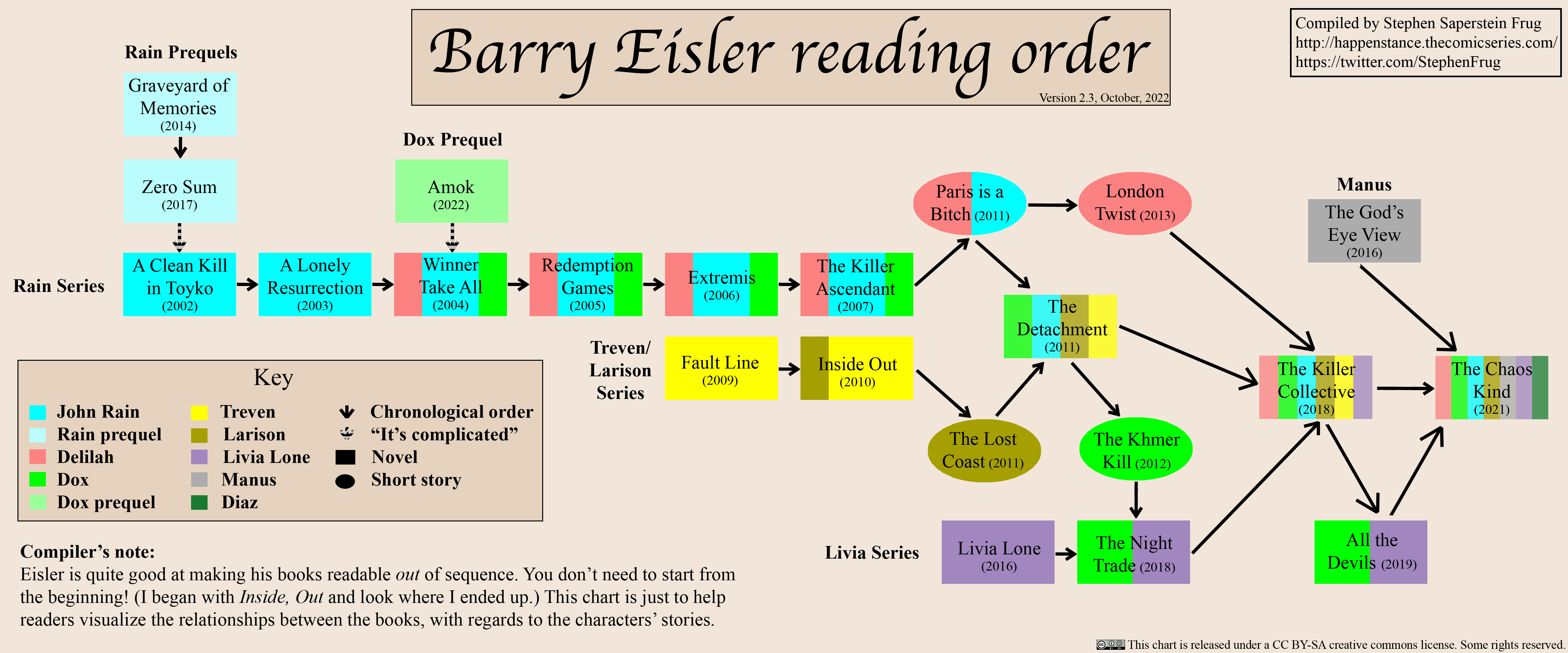
Barry Eisler Reading Order

Charted updated as of December, 2022.

Some of my favorite light reading are the thrillers of Barry Eisler. As he's gone along, the overlaps in his characters/series have become more complicated.  So, in a fit of OCD and with a nod to the Terry Pratchett Reading Order guide, I made this chart. I offer it here for the edification of all and sundry.  But do take the compiler's note about how you can start anywhere seriously.

(Click for a larger version.)

Incidentally, I got into this because I had just bought my aunt the second Livia Lone book as a present — she'd liked the first — and was trying to think of how to explain who Dox was and how he fits in.  It's tricky!

 (Now updated for his forthcoming novel The Chaos Kind (October, 2021). Also released under a Creative Commons BY-SA license, in case anyone feels inspired to improve upon it. (Email me for the photoshop file if you want it.)

Tuesday, March 26, 2013

Your Second Jazz Album

So we've established that the first jazz album you should listen to is, clearly and unmistakably, Kind of Blue.  What's the second?

....Here, things get complicated.  Rapidly, and Very.

If there is a really clear answer, and something approaching a consensus, to the number one slot, below that what we have is chaos.

(And, as a forthright warning, I should make it clear that I don't have an answer.  I'm not sure there is an answer, the way that there is for the question of one's first jazz album.  So if you're interested only in a single answer, you might as well bail now.)

Now, while it's chaos, it's not total chaos.  If you look at the dozen lists of introductory jazz albums I linked to last time (1 2 3 4 5 6 7 8 9 10 11 12), you'll see there's a great deal of overlap.  In particular, if you omit the last two (both of which are specifically trying to be different from the consensus), you'll see a lot of overlap.  Here -- I obsess, you benefit -- are the albums that appear on more than one of those ten lists*:
  • Davis, Miles, Kind of Blue (10)
  • Brubeck, Dave, Time Out (4)
  • Coleman, Ornette, The Shape of Jazz to Come (4)
  • Getz, Stan and Joao Gilberto, Getz/Gilberto (4)
  • Mingus, Charles, Mingus Ah Um (4)
  • Coltrane, John, Blue Train (3)
  • Coltrane, John, A Love Supreme (3)
  • Evans, Bill, Sunday at the Village Vanguard (3)
  • Adderly Cannonball, Somethin’ Else (2)
  • Armstrong, Louis, Best of the Hot Five and Hot Seven Recordings (2)
  • Davis, Miles , Bitches Brew (2)
  • Evans, Bill, Live at Town Hall (2)
  • Haden, Charlie & Pat Metheny, Beyond The Missouri Sky (2)
  • Jarrett, Keith, Köln Concert (2)
  • Parker, Charlie, Best of the Complete Savoy & Dial Studio Recordings (2)
  • Rollins Sonny, The Bridge (2)
The first thing to note is that Kind of Blue is on all ten lists; the next most frequently represented album is on four.  This is why it ought to be your first jazz album.

Apart from that, though, this is a list of fifteen other albums, and probably even makes a pretty decent starter list on its own.  It even has the "one recent album" feature that so many of the lists seem to include, since two of the lists chose the same recent album (Haden and Metheny's Beyond the Missouri Sky).

Oh, and remember how I was saying that 1959 was sort of an annus mirabilis in jazz, with no less than five albums selected for the Library of Congress's list of significant recordings?  Well, four of those albums are in the top five on the list -- Kind of Blue, Time Out, The Shape of Jazz to Come and Mingus Ah Um.  The only album mentioned on as many as four lists that is not from 1959 is Getz/GIlerto (from 1964)**; the only album from the 1959 set not on this list is Coltrane's Giant Steps -- which seems, on these ten lists, to have been overshadowed by his most famous earlier (Blue Train) and later (A Love Supreme) albums.  (Personally, I'd have gone for Giant Steps, not necessarily as the best of those three, but as the most accessible -- certainly more than A Love Supreme, good as the latter is.)

But of course this overemphasizes artists who made one very popular (or very accessible) album, and de-emphasizes those for whom there is no consensus about which album to recommend for beginners.  So here's a list, again drawn from those ten linked above, of just of the performers the lists agree on, giving the performers one point for each album (thus if a list gives two albums, they get two points for it).  Then you get:
  • Miles Davis (14)
  • John Coltrane (8)
  • Bill Evans (6)
  • Ornette Coleman (5)
  • Louis Armstrong (5†)
  • Dave Brubeck (4)
  • Stan Getz & Joao Gilbreto (4)
  • Charles Mingus (4)
  • Thelonious Monk (4)
  • Charlie Parker (4)
  • Duke Ellington (3) 
  • Herbie Hancock (3)
  • Sonny Rollins (3)
  • Cannnonball Adderly (2)
  • Art Blakey (2)
  • Ella Fitzgerald (2†)
  • Carlie Haden & Pat Metheny (2)
  • Keith Jarrett (2)
  • Wynton Marsailis (2) 
The ones in itallics are those where each of the lists mentioning them mention the same album.  (Miles Davis is a special case here: all mentioned Kind of Blue, four others added a second album.)  The daggers (†) are because I've credited both Fitzgerald and Armstrong separately for the listing of their joint album (Ella and Louis).  But I credited Haden & Metheny as a team, despite the fact that one list also mentioned a Metheny solo album (it was one of the two that listed the collaboration -- presumably a big Metheny fan).

Coltrane's place here is more clearly representative of his importance (and accessibility); there's just no agreement about which album to start with.  The same holds true in other cases.  More than half the lists think that you should try some live Bill Evans; they just can't agree on which (and whether to recommend Sunday at the Village Vanguard or the complete recordings that were released from that same set of performances).  Minugs and Monk get the same number of votes, but everyone plugs Mingus Ah Um, while the lists that mentioned Thelonious Monk mentioned four different albums (Brilliant Corners, Genius of Modern Music, Vol. 1, Misterioso, Monk's Dream).  Herbie Hancock too was represented by three different albums (Empyrean Isles, Gershwin's World, Head Hunters).  This is true too for Louis Armstrong, Charlie Parker and Duke Ellington, but it's less surprising in their cases because they had such long and storied carriers, and their work is usually considered by the song not the album (there was a switch at some point).

But if you put these two lists together, you get a sense of some of the places to go -- after, of course, Kind of Blue.  Now, obviously, these are just ten "start here" lists I pulled off a few Google searches.  (And I'm working with the short ones here -- there are a lot of longer lists I'm ignoring because obsession only goes so far.)  But it does show you some of the suggestions people make.

Have I followed these lists?  Somewhat.  I've been listening to a lot of things, including most (but not all) of the albums on the first list (and the artists on the second), but a bunch of other stuff too.  For me, however, the single most important consideration has been whether it's been available at my local public library***.  I'll try almost anything that I can get there; otherwise, my degree of selectivity goes way up.  I have bought a few things the library either didn't have or didn't have playable copies of (one example: Coltrane's A Love Supreme ****).  But my budget is limited, so albums I can listen to for free are prioritized.  -- And this is the way these things usually work, I presume: the lists are then integrated with other considerations, and a new list generated.

Still, those are some albums and artists some people have suggested you might like to listen to, if you'd like to listen to some jazz.  A list to consider with the rest.

...except that all this is assuming that albums are the right category to be looking for.  My next post (if and when I get to it) will consider another possibility entirely -- one that some people, at least, might find more to their liking.  Stay tuned.

_____________________
* Actually, these are also the albums that appear on all twelve lists more than once, since the last two have no overlaps with either each other or the other ten.  This doesn't hold when it comes to artists -- if I integrated the other two lists into the artist list, it'd change -- but, as we Jews say around this season, diyanu.

** The whole album Getz/GIlerto isn't on the L of C list, but its most famous track, "The Girl from Ipanema", is.

***  And whether the disk then works -- our library's CDs have a fail rate of about 10%, based on my not at all random sampling.  I'm not complaining, mind -- I love hearing the music for free, and kvetching that some of it doesn't work would be petty.  But I have found that just because something's listed in the catalog doesn't mean that it's actually available for hearing.  (There are also a fair number of disks which are, seemingly indefinitely, 'out for repair'.)

**** Yes, the library had it, but it was hopelessly scratched.

Wednesday, March 20, 2013

Your First Jazz Album

So I've been listening to a lot of jazz in the last few weeks.  It wasn't a totally new thing for me: I'd heard some before, and had almost a dozen jazz albums.  But I'd never listened to much, and I hadn't known that much about it; I had enough book learning to teach what I teach, but it was a weak area for me*.  I certainly hadn't listened to any (for non-work purposes) in quite a while.  (The mark of this was that when I decided I wanted to hear some, it wasn't on my computer, unlike most of my rock, folk and classical; it was all in CD format, so I had to go down to storage, dig through, get the cds, and add them to my itunes in order to hear them.)  But what began as the merest whim -- partly driven by the thought that my class on Holiday was approaching, and I ought to balance things out any more, partly by the fact that Barry Eisler recommended Junko Onishi, and I listened to a bit she's great -- rapidly snowballed into an obsession, and pretty much all my leisure time recently has been devoted to listening to, and reading about, jazz.

So I thought I'd tell you about it.  And I thought I'd begin at the beginning -- not the beginning of jazz (wherever you decide to draw that particular line), but the beginning of an individual person's engagement with Jazz.  Of course it won't be the absolute beginning -- who, growing up in our culture, hasn't heard snatches over loudspeakers. as background music in movies, and so forth.  But the beginning of listening to any in any sort of a serious sustained way -- even, one might say, the beginning of listening to any on purpose.  Sitting down to hear an album.

What should you listen to?

One might think it's a tricky question.  Jazz is, after all, a whole musical world, with a huge tradition, a wide variety of sounds and styles, and a lengthy back catalog.  It's not really that different from asking what rock album, or what classical music, should one listen to first.  There are a hundred different answers, right?

Wrong.

There's one.

You listen to Miles Davis's 1959 album Kind of Blue.

It's strange how obvious it is, but it is also completely, truly obvious.  Anyone who tries to deny it is either being willfully perverse, or simply trying to be different.

Now, I'd heard Kind of Blue before: it was one of the dozen albums I got out of storage.  I'd had it for decades -- ever since, probably when I was in college, I asked my father what one album I should listen to if I wanted to listen to a jazz album. and he walked me into a record store** and asked a rather gobsmacked clerk the same question.  Naturally, inevitably, I walked out with the obvious choice.

Why is it so obvious?  Because -- quite unusually, as far as art goes -- Kind of Blue combines four different, key things:
  • It is, undeniably, a masterpiece of the art;
  • It was an art-changing album, incredibly influential and innovative;
  • It was and is beloved by jazz fanatics;
  • It was and is beloved by people who don't otherwise like jazz at all;
  • It was and is incredibly popular, selling more (I believe) than any other jazz album, ever
  • It is something you can listen to over and over until you've played it so much that it's worn down the grooves in your record just from playing the mp3.  
Now, getting all of those things into one package is extremely rare -- in fact, I can't, at the moment, think of another example.  A piece of art that is both admired by the experts and widely popular even with people who don't otherwise don't know, or don't care for, the art at all?  A piece that is both a masterpiece, and a breakthrough innovation, and one of the most popular examples ever?  Seriously, does that ever happen?  Usually the great stuff is hard and inaccessible; usually the accessible stuff is scorned by the cognoscenti; usually the popular stuff isn't very good.  But Kind of Blue has it all.

It has other things going for it.  It's by Miles Davis -- he's the bandleader, and composed or co-composed all the tracks, in addition to playing trumpet -- who was unquestionably one of the handful of major musicians ever to play jazz.  But most of the sidemen are giants, too.  John Coltrane, an almost equally influential figure to Davis, played tenor sax on the album; Cannonball Adderley, yet another major figure, played alto sax.  Bill Evans, a fourth giant, played piano on four of the five tracks, and co-wrote two (and the original liner notes.)  If you're ever going to go beyond one album -- even to as many as five, and unquestionably if you go up to, say, twenty -- then you'll encounter those sidemen again as bandleaders in their own right (Coltrane definitely, Evans quite probably, Adderley probably).  So by listening to Kind of Blue first, you get to know (if you read the credits and listen carefully) not just one, but several of the major figures in Twentieth Century jazz.***

As a starting place, Kind of Blue is just bloody perfect.  People who don't usually like jazz like it, so it's a good place to start, since you'll probably like it.  But people who do like jazz not only think it's brilliant, but know that it's a landmark of the tradition.  It's not just an easy way in: it's the rich heart of it.


If you ask people what five or ten albums to start with, you'll get a lot of different answers.  (Here are ten: one, two three, four, five, six, seven, eight, nine, ten.)  But Kind of Blue is on every single list.  Some of the lists include comments along the lines of "Any list that doesn’t include Kind of Blue as essential listening is worthless and can be instantly disregarded. Hell, I could make this #1-10 and still have a good list."

Now it's possible to find lists of this sort without Kind of Blue on them.  (Here are two: one, two.)  Most of these seem to be deliberate attempts to be different -- not to list what everyone else is listing.  The first of those two begins by writing "It's too easy for someone to recommend John Coltrane, Miles Davis and Thelonious Monk.  This aught [sic] to get you off to a different start."  But of course the comment is self-refuting.  It's easy, if you know something about jazz, to list those.  But that's because you know something about jazz; the list is supposed to be for someone who doesn't.  Also, it's easy because everyone knows what ought to be on such lists.  Being different for its own sake has its place, but getting people into the basics of something isn't it.  (Those lists are useful... for moving on from the first top ten.  Not what they declare themselves to be, but what they, in fact, are.)

In fact, I must admit, while the whole album is clearly the first album to listen to, one track -- the first, "So What" --is clearly the most famous.  In my current obsession I've been listening to mostly albums, but I have also looked at (if only for guidance in selection) four different anthology albums, all multi-disk sets which aim to introduce listeners to jazz.  (I think they're frequently used for college courses; at least one was designed specifically for that.)  The four that I've looked at -- so far as I can tell, the four major ones (but, again, I'm new to this) -- are:
Unsurprisingly, there's fairly limited overlap between the four.  (It would be surprising if there was a lot; it would be equally surprising if there was none.)  But one song that all four contain is "So What" from Miles Davis's Kind of Blue.

Now, what should be the second album is much harder -- after one, we have a legitimate difference of opinion.  I hope to get into that in a later blog post.  And beyond that it gets really complicated: if the lists of top tens are different, the lists which contain 25 or 50 or 100 albums are increasingly so (about which too I hope to have more to say anon).  Increasingly you see different views of the matter; different tastes emerge.  And at some point, of course, the explorer will start to develop their own.  Yeah, high numbers are complicated.

But the first one?  It's not hard.  In fact, it's kind of simple.

Kind of obvious.

Kind of blue.

________________________________
* The way my course on the history of American culture is structured (if you click through you can see the syllabus), I focus on 21 examples, each touching on various different themes and issues.  One of those 21 is "Strange Fruit", written by Abel Meerpol and sung by Billie Holiday.  Now, I had a (single) Holiday album on my computer even before this recent obsession.  But in the classes I devoted to the song last semester, I spent much more time on the history of lynching, and the history of popular front culture (out of which cultural milieu Abel Meerpol sprang), than I did on the history of jazz (and most of that was about Holiday personally).

** I doubt they had many records by that point -- we bought it on CD.  But I don't seem to recall them ever being called cassette stores or CD stores.  Music stores, I guess.  But we also called them record stores.  Until we just started calling them "iTunes".

*** I don't know much about the other three players on the album -- remember, I'm just starting out.  My sense is that they weren't figures of the stature of Davis, Coltrane, Evans and Adderly.  Maybe I'll soon discover otherwise.  (They certainly were all sidemen on a lot of major projects.)  But, to complete the credits: Wynton Kelly played piano on the one track that Evans didn't play on.  Paul Chambers played double bass on the album (and played on a lot of major albums by both Davis and Coltrane).  And Jimmy Cobb played drums; as of right now, he is the last surviving musician to have played on Kind of Blue.

**** In addition to the 5-CD set, there was also a series of 22 albums, each serving as a "best of" of one of 22 jazz musicians.  (You certainly can't fault PBS for inadequate merchandising.)  And there was also a single CD called The Best of Ken Burns Jazz, which was a "greatest hits" of the 5-CD greatest hits selection -- a distillation of the distillation, all of jazz in 20 tracks.  One of those 20, naturally, is "So What" off of Kind of Blue.

Thursday, December 13, 2012

Fact to Make You Feel Old, Stolen In Its Entirety from Randall Munroe

Quoth Munroe:
The first Star Trek episode aired closer in time to the ratification of the 19th Amendment—guaranteeing women in the US the right to vote—than to today.
My flabber is officially gasted.

Now, to be fair, it isn't yet much closer.  The first Star Trek episode aired Thursday, September 8, 1966 -- 16,898 days ago, or 46 years, 3 months and 5 days ago.  The 19th Amendment was ratified Wednesday, August 18, 1920 -- 16,822 days (or 46 years and 21 days) prior to Star Trek's airing.  (Number of days calculated using this handy tool.)  In fact, given that Munroe posted this on September 29 of this year, he waited until it was true only by a day (or so, depending on the times all these things happened).  Now, that was a while ago, so now it's more comfortably -- or, rather, more uncomfortably -- true.

And, as these things tend to, it will only get worse as time goes on.

...It occurs to me that Munroe probably had that thought earlier, and was waiting until it was true to post it.  (The coincidence otherwise seems too great.)  Which leads to the further thought that someone should set up some sort of automated system to generate such depressing thoughts automatically (just feed a list of cultural milestones into a date calculator, and voila).  Which leads to the final thought that the person best suited to do this is, clearly, Randall Munroe himself.

We eagerly await his next masterpiece. 

Sunday, April 22, 2012

Henry Adams: Links to Works Online, Including His History of the United States

Sadly -- and slightly oddly -- it seems that the work which is arguably Henry Adams's masterpiece -- his History of the United States During the Administrations of Jefferson and Madison -- is not online at Gutenberg. It is, however, available on archive.org, so I thought I'd collect links to the nine volumes in one place (since, wonderful as Archive is in many ways, their search function is meh), just as a public service (and since I got obsessive (and had grading to procrastinate on (natch))). Here we are:
All the volumes are also available on google books.

Gutenberg does, however, have Adams's two novels:
as well as his two final works of nonfiction (the latter of which, The Education of Henry Adams, is the other contender for Adams's masterpiece (probably, in all honesty, the stronger contender (despite Wills's articulate plea on behalf of the lengthier book)):
Adams wrote a bunch of other things, but the only other things that the good people at the Library of America have seen fit to collect -- as the tag-end to their three-volume set of the history (in two volumes, one each for Jefferson and Madison) and the novels/nonfiction (the third volume) -- are two of Adams's poems. Taking the storied LoA as my canonical guide, here are links to the two poems to round out this post:
The two poems may be buried somewhere in Gutenberg or Archive -- or both -- but I have simply linked them from the web.

Tuesday, March 22, 2011

Sourcing a Superlative Cento (Accidental Poetry Month, Part 13)

Centos -- poems composed by quoting lines from previously existing poems -- have been mentioned on this blog before; in the latter case, I did what I propose to do here, and cited sources for all the lines from one of my favorite centos. (The word is pronounced with a soft c, incidentally -- 'sento'.) This cento is by R. S. Gwynn (what a marvelously voweless* name!); I found it on p. 68-69 of the anthology Rebel Angels: 25 Poets of the New Formalism. Oddly, despite that book's having an index of forms, and including this cento, they don't list "cento" among the forms the book uses.

Anyway, first just the cento, with no links, so you can just enjoy it as a poem (and personally I think it's a very good one).
Approaching a Significant Birthday, He
Peruses The Norton Anthology of Poetry


All human things are subject to decay.
Beauty is momentary in the mind.
The curfew tolls the knell of parting day.
If Winter comes, can Spring be far behind?

Forlorn! the very word is like a bell
And somewhat of a sad perplexity.
Here, take my picture, though I bid farewell,
In a dark time the eye begins to see

The woods decay, the woods decay and fall—
Bare ruined choirs where late the sweet birds sang.
What but design of darkness to appall?
An aged man is but a paltry thing.

If I should die, think only this of me:
Crass casualty obstructs the sun and rain
When I have fears that I may cease to be,
To cease upon the midnight with no pain

And hear the spectral singing of the moon
And strictly meditate the thankless muse.
The world is too much with us, late and soon.
It gathers to a greatness, like the ooze.

Do not go gentle into that good night.
Fame is no plant that grows on mortal soil.
Again he raised the jug up to the light:
Old age hath yet his honor and his toil.

Downward to darkness on extended wings,
Break, break, break, on thy cold gray stones, O sea,
And tell sad stories of the death of kings.
I do not think that they will sing to me.

-- R. S. Gwynn
Anyone who's read even a little English poetry will recognize some -- maybe even many -- of those lines. They are all -- as the title of course indicates -- extremely famous. Nevertheless, as a public (not-really-all-that-significant-a) service, here is the poem again, with each line linked to its original source:
Approaching a Significant Birthday, He
Peruses The Norton Anthology of Poetry


All human things are subject to decay.
Beauty is momentary in the mind.
The curfew tolls the knell of parting day.
If Winter comes, can Spring be far behind?

Forlorn! the very word is like a bell
And somewhat of a sad perplexity.
Here, take my picture, though I bid farewell,
In a dark time the eye begins to see

The woods decay, the woods decay and fall—
Bare ruined choirs where late the sweet birds sang.
What but design of darkness to appall?
An aged man is but a paltry thing.

If I should die, think only this of me:
Crass casualty obstructs the sun and rain
When I have fears that I may cease to be,
To cease upon the midnight with no pain
And hear the spectral singing of the moon
And strictly meditate the thankless muse.
The world is too much with us, late and soon.
It gathers to a greatness, like the ooze.

Do not go gentle into that good night.
Fame is no plant that grows on mortal soil.
Again he raised the jug up to the light:
Old age hath yet his honor and his toil.

Downward to darkness on extended wings,
Break, break, break, on thy cold gray stones, O sea,
And tell sad stories of the death of kings.
I do not think that they will sing to me.

-- R. S. Gwynn
And here's a list of the sources, in order:
John Dryden, "Mac Flecknoe"
Wallace Stevens, "Peter Quince at the Clavier"
Thomas Gray, "Elegy Written in a Country Churchyard"
Percy Bysshe Shelly, "Ode to the West Wind"

John Keats, "Ode to a Nightingale"
William Wordsworth, "Tintern Abbey"
John Donne, "Elegie: His Picture"
Theodore Roethke, "In a Dark Time"

Alfred Lord Tennyson, "Tithonus"
William Shakespeare, Sonnet 73
Robert Frost, "Design"
William Butler Yeats, "Sailing to Byzantium"

Robert Brooke, "The Soldier"
Thomas Hardy, "Hap"
John Keats, "When I have fears that I may cease to be"
John Keats, "Ode to a Nightingale"

John Crowe Ransom, "Piazza Piece"
John Milton, "Lycidas"
William Wordsworth, "The World is Too Much With Us"
Gerard Manley Hopkins, "God's Grandeur"

Dylan Thomas, "Do not go gentle into that good night"
John Milton, "Lycidas"
Edwin Arlington Robinson, "Mr. Flood's Party"
Alfred Lord Tennyson, "Ulysses"

Wallace Stevens, "Sunday Morning"
Alfred Lord Tennyson, "Break, Break, Break"
William Shakespeare, Richard II, 3:2.
T. S. Eliot, "The Love Song of J. Alfred Prufrock"
I suppose that just reading the 26 poems quoted in that one poem would be a pretty decent syllabus for an introduction to English poetry. (Not a perfect one, to be sure -- I note, just as a fer'instance, that there isn't a single female poet on the list). Most are very famous -- several are among the most famous poems in the language -- although in a number of cases (Donne, Roethke, Ransom, Hardy, Robinson) I hadn't heard of that particular poem previously, although I knew other poems by all of them (indeed, many poems fairly well in some cases). Rupert Brooke I don't think I'd ever heard of at all.

A couple of further notes:

• Gwynn twice uses two lines from a single poem: Lines 5 & 16 are both from Keats's "Ode to a Nightingale"; Lines 18 & 22 are both from Milton's Lycidas. (Thus, while there are 28 lines in Gwynn's poem, it has only 26 poems for sources.)

• Gwynn uses lines by 20 poets. He takes three lines each from Tennyson (from three separate poems) and Keats (two lines from one poem, one from another); he uses two lines each from Stevens, Wordsworth, Shakespeare and Milton (in the first three cases, from two separate poems; in the final case, two lines from one poem). That's half the poem. The other fourteen lines come from fourteen different writers.

• In Gwynn's use of Hopkins in line 20, he doesn't actually use the entire line, which in its original setting is "It gathers to a greatness, like the ooze of oil". For his antepenultimate line, Gwynn makes a single line out of what was a pair of lines in its original home in Tennyson's poem. These are the only times that Gwynn uses something other than a single, full line of poetry from another source. (Unlike Harry Mathews, I might add.)

• I'm curious about whether all these poems are really in the Norton Anthology of Poetry (do they include speeches from Shakespeare's plays, for instance?), but not curious enough to check.

Finally, a word about the poem overall. I said above that I thought that Gwynn's was a very good poem in its own right. A cynic might note that of course it was a good poem: he stole from 26 of the best poems in the language! And there's some truth in that, I suppose. But of course he didn't just pick lines higglety-pigglety. He put them in an order that made sense -- a new (and interesting and aesthetically powerful) sense that none of the original poems had. And he did so in a way that followed his own aesthetic form (alternating quatrains, quoth the back-matter of Rebel Angels). So while he may not have written any of the lines, he definitely wrote the poem -- which is to say, he created its structure and its meaning. All this is just to defend collage as a genuine artistic practice, which despite its obvious validity in power is somehow always needs redoing.** But as Montaigne said, there have been a great many centos, including "some very ingenious ones". And there have been many equally so since Montaigne wrote; among which I'd number this poem of R. S. Gwynn's creation.

___________________
* Yes, I know 'y' counts as a vowel.

** I grant this is an odd way to put it, since the cento is an ancient form, while collage was invented by Picasso. But for all cento's age, it remains an obscure practice; while collage is done, I'd guess, in every preschool in America.

Wednesday, October 13, 2010

BDFIJLRTU, or, One-Letter Book Titles

My unsolicited email (not quite "spam" I suppose since I did buy something from the company once) was uncannily on-point today. The web site ABE books sent me a link to this page of theirs celebrating one-letter book titles. Their occasion for this is that one of the works just shortlisted for the Booker prize is C by Tom McCarthy. So they list twenty others, plus some near-misses.

As it happens, I had some time ago stumbled upon John Burkardt's list of one-letter book titles, and quite enjoyed it -- I even suggested a few new ones, and Mr. Burkardt was kind enough to mention my name. I wonder if ABE's spam searchbots saw that? Or is it just coincidence? (I actually suspect the latter).


Not surprisingly, the 21-title list of ABE books and the 23-title list of John Burkardt are pretty similar. By my count, ABE caught only one book that Burkardt missed (the recent C) while Burkardt found three that ABE didn't (two earlier C's, plus Leacock's Q).

Merging these, I present for posterity (or spambots) the following list of 24 26 one-letter titles:
  • a, Andy Warhol
  • C, Maurice Baring
  • "C", Anthony Cave Brown
  • C, Tom McCarthy
  • c, Thomas Sowell
  • E, Matt Beaumont
  • F: Hu Feng's Prison Years,  Mei Zhi
  • F, Daniel Kehlmann
  • G, John Berger
  • H, Elizabeth Shepard
  • H., Lin Haire-Sargeant
  • J, Howard Jacobson
  • K, Mary Roberts Rinehart
  • K., Ronald Hayman
  • M, John Sack
  • N, Louis Edwards
  • O, Omari Grandberry
  • P, Andrew Lewis Conn
  • Q, Luther Blissett
  • Q, Stephen Leacock
  • S, Harry Mathews et. al.*
  • S., John Updike
  • V, Thomas Pynchon
  • W, or the Memory of Childhood, Georges Perec
  • X, Sue Coe
  • Y: the Last Man, Brian Vaughn et al.
  • Z, Vassily Vassilikos
Subtitles are included only for the Perec, the Zhi and the Vaughn, although more have them (often "a novel" if nothing else), but in each case the one-letter title is clear, at least to my mind (and, it seems, to others').

I'm not sure about that Sowell title, however... a quick google doesn't turn it up. Does anyone have a reference for that?


Where their pages differ, not surprisingly, is the category that Burkardt calls "Close but no cigar" and that ABE calls "Books that almost made the cut". There I definitely prefer Burkardt, where nearly all his near-miss books catch the spirit of the list, whereas ABE just lists a bunch of books with short words as titles. The two-book overlap between the near-miss lists are definitely the most relevant of the bunch, however:
  • N or M?, Agatha Christie
  • U and I, Nicholson Baker
-- but again, I think that Burkardt's near-miss list is mostly relevant -- unlike all the other entries on ABE's near-miss list-- so, if you're silly and obsessive enough to have enjoyed this list thus far, you should click on over for the rest of his titles. (On the other hand, you might say that of course I would consider his list better since I suggested several of the titles on it.)

In fact, one item that Burkardt lists in the "near miss" category is actually one I would argue belongs on the list proper is
  • ∈ by Jacques Roubaud
That's not an "E" however, although some references list the title that way: instead, it's "the mathematical symbol used to indicate that an object belongs to a set" (in Burkardt's phrasing) or -- as it's called in French, "Signe D'Appartenance" (that, in parentheses, is how it's listed sometimes in search engines). Still, even though not an E, it's a one-character title, so personally I'd count it, making 25 such titles in all.


Despite there being 25 such titles, however, overlap in usage (no less than four "C" books, assuming the Sowell is legit) means that a fair number of letters are still up for grabs. Writers of the world, take note! The following books remain to be written:
  • B
  • D
  • I
  • L
  • R
  • T
  • U
Abe books does note that "authors and publishers would be wise to move away from this trend as the influence of the Internet continues to affect book-buying. Single letter titles are not particularly friendly to Internet search engines that thrive more detailed data than just A or B." So perhaps those nine will remain un-penned. (Although if we're discounting subtitles, then that's always an option for making a title googleable.) I hope not, though. I'd like to complete my set.

(The other obvious extension here, I suppose, is to numbers. But so far as I can tell, there aren't any books titled 0, 1, 2, 3, 4, 5, 6, 7, 8 or 9. It seems if books wish to be a single-digit number, they spell it out (e.g. One). There are some films -- the one's I've seen in a brief search are 1, 3, 4, 8 and 9 (again, discounting films like Seven that spell it out). And album titles positively abound in single-digit numbers: there are multiple albums called by each of those eight titles, and for some there are a great many indeed. But it looks like these are, literarily, uncharted territory.)

Unrelated postscript: anyone who's read this far will probably also like John Burkardt's marvelously idiosyncratic list of Hapax Leomenon. (What would the plural be of that anyway?) And probably also his list of multiple homonyms (i.e. homonyms with three or more words in the set not just two).

Update, Years Later: Added two new titles, F and J, and removed those letters from the list of ones yet to be written.  Now, at the end of 2014, the title of this post should be BDILRTU.  But I'll leave it as is.

Update, More Years Later: I won't be updating this post any more, because others have it covered.  See, for instance:
One-letter titles at TV Tropes
Single-letter titles at goodreads
One-letter movie titles at IMDb
And one at the blog The Modern Novel

________
* This is the English translation of a book written partly in English and partly in French, by seven authors, with the French title Semaines de Suzanne.

Sunday, March 01, 2009

Eugene Onegin in English: Comparing Translations

One of my more neglected hobbies is comparing poetry translations. Because poetic translation is so over-constrained -- so that, in the words of Vladimir Nabokov, a rhymed translation that also "translate[s] the entire poem literally is mathematically impossible" -- any attempt to put it into a new tongue is going to involve contentious aesthetic choices. For that matter, the same is hardly less true of translation of unrhymed poetry: since poetry, practically by definition, involves playing with the specifics of its original language ("poetry is what's lost in translation" opines Robert Frost from off under his apple tree). So it's fun to see the different ways that people do it. Watching others attempt the impossible is always entertaining, which is why people go to circuses.

For me, it's fun in particular with canonical heavyweights -- if only because lots of translations of them tend to exist. In times past, I've collected translations of, in particular, Goethe's Faust, but also (to a lesser extent) of the Odyssey, the Bible, and Dante's Divine Comedy.

And Eugene Onegin.

Onegin is particularly fun for a number of reasons. Above all, it's form is so ridiculously confining that -- even knowing, as I do, not a word of the original language -- it look like it ought to be impossible to translate. And, indeed, Vladimir Nabokov -- one of my personal favorite authors, a giant of both 20th-century English and 20th-century Russian literature -- specifically declared that doing a rhymed translation was impossible (indeed, mathematically so; op. cit.). And his furious attacks on the attempts of Walter Arndt to prove him wrong created the biggest literary spat of the 1960's, including the rupture of his famous friendship with critic Edmund Wilson, who rose to Arndt's defense. Despite Nabokov's mathematics, a number of translators have attempted Onegin while preserving its rhymes.*

A word about the Onegin stanza. It's a cousin to a sonnet, although with some key differences. First of all, it's in tetrameter, not pentameter (four beats per line not five). Secondly, as opposed to either the traditional Petrarchian (ABBAABBACDECDE) or Shakespearean (ABABCDCDEFEFGG) rhyme schemes, the Onegin stanza uses one of its own (ABABCCDDEFFEGG) -- one which deliberately goes through the three possible variations on a rhymed quatrain (ABAB, CCDD, EFFE) with an additional couplet to close it off (GG). Finally, Pushkin alternates masculine and feminine rhymes (the former are rhymes which rhyme only one syllable -- head, dead -- and the latter are ones which rhyme more than one -- platter, clatter).

Some English-language poetry has been written directly in Onegin stanzas, so you can get an idea of what it's like. First and foremost, Vikram Seth's absolutely delightful verse novel, The Golden Gate, is written entirely in Onegin stanzas, in a direct homage to Eugene Onegin (actually, to its 1977 translation by Charles Johnston); you can read some sample stanzas from it here, but they only give a taste -- you really ought to go read the whole thing. Then there's Nabokov's two-stanza poem "On Translating Eugene Onegin", also written directly in English in Onegin stanzas.

Anyway, the point here is that it's a tight, tough little form. Hard to do.

I had heard of Onegin before -- I'd taken a whole college class on Nabokov back in the day -- but what really turned me on to the existing English translations was reading Douglas Hofstadter's delightful (if often infuriating) book Le Ton Beau de Marot: In Praise of the Music of Language. He devotes two chapters two Onegin. One he devotes to praising and comparing four rhymed translations -- those of Oliver Elton (1937, later rev. by A. D. P. Briggs), Walter Arendt (1963, rev. 1978), Charles Johnston (1977), and above all that of James Falen (1990); the other he devotes to attacking the "vile non-verse" of Nabokov's deliberately ugly translation. And, much to my surprise as a self-identified Nabokov fan, Hofstadter won me over.** I began collecting Onegin translations when I saw them.

One of those eventually included that of Douglas Hofstadter himself (1999), who taught himself enough Russian to go at the task, so enamoured was he of the poem after his two-chapter gear-up in his earlier book. In the introduction he talks about all of the above-cited translations as well as his own, and also about the translation of Babette Deutsch (1936, rev. 1964) which he had read since the completion of his earlier book. In the first book, he gives four stanzas in each of the five translations (counting Nabokov) that he highlights; in the introduction to his own translation, he gives an additional stanza in seven (counting his own).

Hofstadter, by the way, is still at it. If you scroll way down in this online talk of his (or simply search for the word "Deutsch") you'll find eight versions of Chapter 2, Stanza 38 (the original Russian and seven translations of it), which he quotes and discusses.

But yesterday, while I was procrastinating on grading the papers I need to grade engaged in deep intellectual questing, I discovered that there are two new rhymed translations since Hofstadter's discussions were published: that of Tom Beck (2004) who, like Hofstadter, taught himself Russian for the task (sample stanzas here), and that of Stanley Mitchell (2008), which seems to be the most recent (chapter two is online in its entirety here).

Since I happened to have on hand the first stanza of all of Hofstadter's seven translations -- plus a literal one Arndt did for a book called Pushkin Threefold, plus the Russian (of which I did not understand a word), I dug up the first stanzas of the Beck and Mitchell two, and thus had a complete set of ten versions to compare.

Rather than hide the fruits of my obsession, I decided to post all ten here. (I put them on a separate web page to hide them from all this blather, and generally for easier reference.) As I say in the sidebar, I may add more when I have another set of papers to get through the time. (I don't know if I should post the stanzas that Hofstdater reprints -- which might be nice to have online, and with the Beck and Mitchell added -- or if I should try to add others, whether my favorites or simply ones that have gotten some attention from other people (e.g. the one Boyd compares in his Nabokov biography, or perhaps "the great/Fourth stanza of... Canto Eight"). Any thoughts?)

Anyway, once again, here's a link to Nine different versions of a Eugene Onegin stanza in English (with a bonus couplet from another stanza tucked in at the end). I hope that at least some of you may find them half as fascinating as I do. I think that reading them can tell you a lot about translation, poetry, rich dying relatives, and other noteworthy things.

Now, if you'll excuse me, I think I might have some papers to grade. Or something.

Update: At the suggestion of several readers, I've added the 1881 translation of Henry Spalding (that link goes to the complete text on Project Gutenberg) -- not one of my favorites, but for completion's sake it's now there.

______________________
* Which doesn't by itself prove Nabokov wrong, since he only said it was impossible to translate Onegin faithfully with rhymes preserved.

** For a good argument on the Nabokov side of the debate, see Brian Boyd's comparison of the Deutsch, Arndt, Johnston and Nabokov translations in the Onegin chapter of his biography Vladimir Nabokov: the American Years.

Wednesday, July 16, 2008

W. H. Auden's Selected Poems: Differences Between Editions

W. H. Auden's Selected Poems -- edited by Edward Mendelson -- is an important book, more important than one might deduce even if one knew Auden's status as one of the great 20th Century English-language poets.

The reason for this is straightforward: among Auden's peculiarities was the habit of heavily revising, or even disowning, some of his best work. Thus, one of Auden's very best poems -- September 1, 1939 -- widely quoted in the wake of 9/11 -- is not, in fact, in his collected poems. Nor is "Spain"; nor Petition. Further, the explanations he gave for this disowning involved interpretations of them that would elicit C's from an undergraduate: clunky misinterpretations, nuance-less literalism, and the like. In other cases he simply eliminated great material, such as the three fabulous stanzas he eliminated from his poem In Memory of W. B. Yeats (the 2nd - 4th stanzas of section 3).

But Auden's Collected Poems reflects -- appropriately, I suppose -- the poet's final wishes.

So if you want some of the good stuff, you have to go look at the Selected Poems, in which it's included. (Although, of course, there's a lot of terrific stuff in Collected that's not in Selected: get both books, is my advice.)

Well, I recently discovered that there's a new, expanded edition of the Selected Poems. The version I have has 100 of Auden's works; the new one has 120. (You can find the table of contents of the new edition here). And I was curious about what new works were included.

So herewith, I give you the fruit of my obsessiveness: the poems added in the "expanded edition" of W. H. Auden's Selected Poems.

29. Underneath the abject willow
31. Fish in the unruffled lakes
33. Funeral Blues
38. Johnny
42. Dover
45. O Tell Me the Truth About Love
53. Calypso
57. Eyes look into the well
63. Leap Before You Look
75. A Household
80. Their Lonely Betters
81. Nocturne I
85. Epitaph for the Unknown Soldier
90. The Old Man’s Road
91. The Song
98. A Change of Air
104. Amor Loci
105. Profile
116. A Shock
118. Aubade

(This is assuming that the poem that comes between "The Willow-Wren and the Stare" and "Bucolics" -- called "Nocturne" in the first edition and "Nocturne II" in the second -- is, in fact, the same poem. (I'm working off a physical copy of the old edition, and the electronic contents of the new, so I can't tell myself.))

One of these -- "Funeral Blues" -- is the poem made famous by its inclusion in the film Four Weddings and a Funeral. Its fame postdated the first edition of the book, so it's completely unsurprising that it was incorporated into the new edition. (Before the film, it was one good Auden poem among many, and its omission was unsurprising; after, it rapidly became a glaring omission. Such is the power of cinema in our culture.)

As for the rest, one or two are ones that I was sort of surprised to realize hadn't been in the first edition; others I don't know. (O Tell Me the Truth About Love is the major one in the first category.) Nor do I know if any of them were excluded/altered in the collected poems.

But they're Auden, so they're probably worth reading. He's probably my favorite post-Yeats poet when all is said and done.