Friday, May 02, 2014

US History 1973 - 2014 Commonplace Book: Lecture 6: Lesbian & Gay Rights in the 1970s (Con't)

As to the epilogue, I could hardly be expected to stultify myself by implying that Joan's history in the world ended unhappily with her execution, instead of beginning there. It was necessary by hook or crook to shew the canonized Joan as well as the incinerated one; for many a woman has got herself burnt by carelessly whisking a muslin skirt into the drawing-room fireplace, but getting canonized is a different matter, and a more important one. So I am afraid the epilogue must stand.

— George Bernard Shaw, Preface to Saint Joan (1923)
A note of explanation for this one: I used it to introduce the final section of the Harvey Milk section of the lecture, talking about his reputation after the immediate post-assassination events (i.e. after the White Night Riots).

Introduction to (and explanation of) this quote series can be found here.  Read this tag to see all of them.

Thursday, May 01, 2014

US History 1973 - 2014 Commonplace Book: Lecture 6: Lesbian & Gay Rights in the 1970s (Con't)

If a bullet should enter my brain, let that bullet destroy every closet door.

— Harvey Milk, in a recording made November 18, 1977, "to be played only in the event of my death by assassination"
Introduction to (and explanation of) this quote series can be found here.  Read this tag to see all of them.

Wednesday, April 30, 2014

US History 1973 - 2014 Commonplace Book: Lecture 6: Lesbian & Gay Rights in the 1970s (Con't)

Somewhere in Des Moines or San Antonio there is a young gay person, who all the sudden realizes that she or he is gay; knows that if the parents find out, they will be tossed out of the house, the classmates will torture the child, and the Anita Bryants and John Briggs are doing their bit on TV. And that child has several options: staying in the closet; suicide... And then one day that child might open up the paper and it says “Homosexual elected in San Francisco” and there are two new options: [an] option is to go to California; or to stay in San Antonio and fight. Two days after I was elected I got a phone call, and the voice was quite young. It was from Altoona, Pennsylvania. And the person said “Thanks”. And you’ve got to elect gay people, so that that young child, and the thousands upon thousands like that child, know that there's hope for a better world, there's hope for a better tomorrow. Without hope, not only gays, but those blacks, the Asians, the disabled, seniors — the “us”-s; the “us”-s : without hope the “us”-s give up. I know that you can’t live on hope alone, but without it, life is not worth living. And you, and you, and you, you've got to give them hope.

— Harvey Milk, 1978 (from his famous “hope” speech)
Introduction to (and explanation of) this quote series can be found here.  Read this tag to see all of them.

Tuesday, April 29, 2014

US History 1973 - 2014 Commonplace Book: Lecture 6: Lesbian & Gay Rights in the 1970s (Con't)

Woman-identified lesbianism is, then, more than a sexual preference, it's a political choice.

— The Furies, 1972
Introduction to (and explanation of) this quote series can be found here.  Read this tag to see all of them.

Monday, April 28, 2014

US History 1973 - 2014 Commonplace Book: Lecture 6: Lesbian & Gay Rights in the 1970s

But lesbianism is also different from male homosexuality, and serves a different function in the society. "Dyke" is a different kind of put-down from "faggot", although both imply you are not playing your socially assigned sex role. . . are not therefore a "real woman" or a "real man. " The grudging admiration felt for the tomboy, and the queasiness felt around a sissy boy point to the same thing: the contempt in which women-or those who play a female role-are held.

— Radicalesbians, "The Woman Identified Woman" (1970)
Introduction to (and explanation of) this quote series can be found here.  Read this tag to see all of them.

Sunday, April 27, 2014

US History 1973 - 2014 Commonplace Book: Lecture 5: Gender, Sex and Family: Changes in the 1970s (Con't)

The shifting evangelical position on abortion: Three quotes
God does not regard the fetus as a soul, no matter how far gestation has progressed. The Law plainly exacts: “If a man kills any human life he will be put to death” (Lev. 24:17). But according to Exodus 21:22-24, the destruction of the fetus is not a capital offense. … Clearly, then, in contrast to the mother, the fetus is not reckoned as a soul.

— Christianity Today, 1968

And if men struggle with each other and strike a woman with child so that she has a miscarriage, yet there is not further injury, he shall surely be fined as the woman’s husband may demand of him; and he shall pay as the judges decide. But if there is any further injury, then you shall appoint as a penalty life for life, eye for eye, tooth for tooth, hand for hand, foot for foot, burn for burn, wound for wound, bruise for bruise.

— Exodus 21:22-25, New American Standard Bible, 1977 edition (emphasis added)

If men struggle with each other and strike a woman with child so that she gives birth prematurely, yet there is no injury, he shall surely be fined as the woman’s husband may demand of him, and he shall pay as the judges decide.

— Exodus 21:22, New American Standard Bible, 1995 edition (emphasis added)
Introduction to (and explanation of) this quote series can be found here.  Read this tag to see all of them.

Saturday, April 26, 2014

US History 1973 - 2014 Commonplace Book: Lecture 5: Gender, Sex and Family: Changes in the 1970s (Con't)

Pornography is the theory, rape is the practice.

— Robin Morgan (1974)
Introduction to (and explanation of) this quote series can be found here.  Read this tag to see all of them.

Friday, April 25, 2014

A Brief Note on the Right's New Piketty Panic

We're beginning to see a real right-wing pushback on Piketty.  (See, for instance, the links discussed here* and here.)

The reason is simple, I think: the 1% — or, if you prefer, the 0.01% — understand power better than the rest of us.

Really gut-level understand it.

That's why they're scared.

They get, in a way that we don't, that we could just retake their ill-gotten gains.

If we chose to.

____________________________
* Krugman is, of course, doing the columnist equivalent of sub-tweeting — sub-columning? — his colleague Ross Douthat, because of the Times' policy of not allowing their columnists to address each other.

US History 1973 - 2014 Commonplace Book: Lecture 5: Gender, Sex and Family: Changes in the 1970s (Con't)

Will the scientists and women's liberationists be able to unleash on the world a generation of kinless children to serves as the Red Guards of a totalitarian state?

— George Gilder, Sexual Suicide (1973)
Introduction to (and explanation of) this quote series can be found here.  Read this tag to see all of them.

Thursday, April 24, 2014

US History 1973 - 2014 Commonplace Book: Lecture 5: Gender, Sex and Family: Changes in the 1970s (Con't)

What about the rights of a woman who doesn't want to be treated like a man?

— Phyllis Schafly, "The Right to Be a Woman" (1972)
Introduction to (and explanation of) this quote series can be found here.  Read this tag to see all of them.

Wednesday, April 23, 2014

US History 1973 - 2014 Commonplace Book: Lecture 5: Gender, Sex and Family: Changes in the 1970s (Con't)

The more radical feminists today insist that mothers have exactly as much right as fathers do to work full time outside the home... babies and young children have needs and rights too.

— Benjamin Spock, 1970
Introduction to (and explanation of) this quote series can be found here.  Read this tag to see all of them.

Tuesday, April 22, 2014

US History 1973 - 2014 Commonplace Book: Lecture 5: Gender, Sex and Family: Changes in the 1970s (Con't)

The working mother has no 'wife' to care for her children.

—Myra Wolfgang, 1970
Introduction to (and explanation of) this quote series can be found here.  Read this tag to see all of them.

Monday, April 21, 2014

US History 1973 - 2014 Commonplace Book: Lecture 5: Gender, Sex and Family: Changes in the 1970s (Con't)

Feminists have to question, not just all of Western culture, but the organization of culture itself, and further, even the very organization of nature.

— Shulamith Firestone, The Dialectic of Sex (1970)
Introduction to (and explanation of) this quote series can be found here.  Read this tag to see all of them.

Sunday, April 20, 2014

US History 1973 - 2014 Commonplace Book: Lecture 5: Gender, Sex and Family: Changes in the 1970s

If the First Amendment means anything, it means that a State has no business telling a man, sitting alone in his own house, what books he may read or what films he may watch.

—Thurgood Marshall, Stanley v. Georgia (1969)
Introduction to (and explanation of) this quote series can be found here.  Read this tag to see all of them.

Saturday, April 19, 2014

US History 1973 - 2014 Commonplace Book: Lecture 4, Struggles Over Race & Gender in the 1970s

In the short run, it may seem to be the easier course to allow our great metropolitan areas to be divided up each into two cities—one white and one black—but it is a course, I predict, our people will ultimately regret.

— Thurgood Marshall, dissent in Milliken (1974)
Introduction to (and explanation of) this quote series can be found here.  Read this tag to see all of them.

Friday, April 18, 2014

US History 1973 - 2014 Commonplace Book: Lecture 3, The Economic Crisis of the 1970s (Con't)

We are aware, as never before, of distinct limits on our material resources. Abundance no longer seems to be our special defining characteristic as a nation.

— Lawrence Veysey (1979)
Introduction to (and explanation of) this quote series can be found here.  Read this tag to see all of them.

Thursday, April 17, 2014

US History 1973 - 2014 Commonplace Book: Lecture 3, The Economic Crisis of the 1970s

The continuous readjustment of expectations—downward: that was a key experience of the 1970s.

— Rick Perlstein
Introduction to (and explanation of) this quote series can be found here.  Read this tag to see all of them.

Wednesday, April 16, 2014

US History 1973 - 2014 Commonplace Book: Lecture 2, 1973 - 1974: "America's Nervous Breakdown" (Con't)

“This has been a good year.” Or, “This has been a bad year, right?” What sorts of statements are these? What consensus could there be on a year’s goodness? I think of early medieval annals. “721 AD–drought; 722 AD–(blank); 723 AD–(blank); 724 AD–(blank); 725 AD–bad harvest, frightening comet in the west.” Poor helpless humanity.... All years are terrible years; the predicament of being human tends towards the negative. We read the news and are left feeling nothing more noble than “only I have escaped to tell thee.” A given year can be pronounced good only in a solipsistic sense.

— Teju Cole, "Envoi" (2013)
Introduction to (and explanation of) this quote series can be found here.  Read this tag to see all of them.

Tuesday, April 15, 2014

US History 1973 - 2014 Commonplace Book: Lecture 2, 1973 - 1974: "America's Nervous Breakdown"

There is already some talk about what "the historians will say" — the historians, those unknown people who in the future will have the franchise to interpret what is going on now. We tend to assume that out of their years of accumulation of fact they will sift the truth—a truer truth than any we can hope to grasp. They will have many more facts. And they will have what is called "perspective" (which means they will not be trapped in the biases of our day and can freely write in the biases of their day—can find what they are looking for). But I wonder if they will really understand what it was like. Will they know how it felt to go through what we have gone through? Will they know how it felt to be stunned—again and again—as we learned what had been done by people in power? Will they know how it felt to be shocked, ashamed, amused by the revelations—will they understand the difficulty of sorting out the madcap from the macabre? (What, for example, was one really to think about someone in the pay of the White House putting on a red wig and traveling across the country to visit a sick, disgraced lobbyist?) Can they conceivably understand how it felt as we watched on our television screen, our President say, "I am not a crook"? Will they be able to understand why, almost two years ago, some very sensible people wondered whether it was the last election? Will they understand how it felt—as it did last fall at the time the President fired Special Prosecutor Cox, and on several later occasions—when it seemed that there were no checks on power? Will they understand how degrading it was to watch a President being run to ground? Will they know how it was to feel in the thrall of this strange man, who seemed to answer only to himself? Knowing the conclusion, as they will, will they understand how difficult, frightening, and fumbling the struggle really was?

— Elizabeth Drew, "A Reporter in Washington D.C. III-Summer Notes"
The New Yorker, October 28, 1974 (in an entry dated August 8, 1974)
Introduction to (and explanation of) this quote series can be found here.  Read this tag to see all of them.

Monday, April 14, 2014

US History 1973 - 2014 Commonplace Book: Lecture 1, Introduction (Con't)

There are few statements that can be made about America whose contradictions are not almost equally true.

—Godfrey Hodgson
Introduction to (and explanation of) this quote series can be found here.  Read this tag to see all of them.

Sunday, April 13, 2014

US History 1973 - 2014 Commonplace Book: Lecture 1, Introduction

The past is a foreign country; they do things differently there.

— L. P. Hartley

The past is never dead. It's not even past.

— William Faulkner
 Introduction to (and explanation of) this quote series can be found here.  Read this tag to see all of them.

Saturday, April 12, 2014

US History 1973 - 2014 Commonplace Book: Introduction

This semester I've been teaching an upper-level history course (called "Contemporary History") which covers the history of this country from 1973 through the present.  (If I decide to get all meta, I'll make the last fact I mention the fact that they are listening to the last fact I mention.)  The course is primarily a lecture course: I'm assigning eight books, and for each book we're having a class discussion, but otherwise I'm narrating a story.

To help them follow, I've been giving out outlines of my lectures, including key names, dates, etc: the idea is that way they aren't scrambling to get down those facts, but can listen to the ideas and narrative around them.  Who knows how much it helps.

At any rate, on the very first sheet (for the introductory lecture, laying out course themes, the problematics of contemporary history, and stuff like that) I put down a few quotes at the end of the outline and labeled them "commonplace book".  (This is the reference; see also here and here)  I didn't discuss them, but just threw them in.

Well, the practice quickly expanded. I started throwing in quotes I actually wanted to discuss, so they had them in front of them (for the same reasons that I was giving them the outline).  I also continued to throw in some quotes I didn't discuss (either ones that I didn't intend to discuss, or simply ones I didn't have time to discuss).  Most quotes were directly from or about the period or topic of the lecture, but some were thematic or associatal.

Anyway, I've decided, both because I think they're interesting and because this blog has been far too quiescent lately, to start posting them.  For the most part, I intend to post one per day, which mean that some lectures' quotes will go on for more than a week.  (The only case in which I intend to deviate from this is when I deliberately paired two quotes to work against each other, as I did sometimes; then I'll put up both in the same post.)

In the interest of both honesty and not going completely bugfuck insane, I'm going to strictly post only those I handed out to my students on the day of the lecture: I won't add or subtract to them.  No new finds or second thoughts.  The one exception to this: in some cases I would repeat quotes on the next handout, either if I hadn't gotten to it in the first lecture on whose handout it appeared,* or, more rarely, if I wanted to remind students of it.  In these cases, I won't repeat the quote, but will include it with the lecture where (to the best of my recollection) I actually discussed it — usually the second set, but occasionally the first.**

Finally, since these quotes will reflect the course's lectures, which are a key part, but only a part, of the class, I want to list the eight books I assigned here.  They include books on key topics I didn't lecture on (or didn't lecture sufficiently on).  I wouldn't choose the exact same books if I taught the course again, but I do think that most of them worked well, and that they, collectively, provided a very good introduction to the history of the period.  Anyway, enough apologetics: here they are:

  1. Jefferson Cowie, Stayin' Alive: the 1970s and the Last Days of the Working Class
  2. Sara M. Evans, Tidal Wave: How Women Changed America at Century's End
  3. Daniel T. Rodgers, The Age of Fracture
  4. Bethany Moreton, To Serve God and Wal-Mart: The Making of Christian Free Enterprise
  5. Thomas Streeter, The Net Effect: Romanticism, Capitalism, and the Internet
  6. Chalmers Johnson, The Sorrows of Empire: Militarism, Secrecy, and the End of the Republic
  7. Michelle Alexander, The New Jim Crow: Mass Incarceration in the Age of Colorblindness
  8. Christopher Hayes, Twilight of the Elites: America After Meritocracy
The first quote will go up tomorrow morning — or, actually, the first quotes, since the first are a pair meant to work against each other.

I hope you enjoy them.

Update: to see all quote thus far posted, read this tag.

__________________________
 * Sadly common: I always hoped to cover more than I actually could.

** Except that, even here, in a few cases I considered the beginning of the next lecture to be "really" part of the next one... I guess all I can say is: if I repeated a quote, I'll only post it once, in the lecture that makes the most sense to me.  There won't be any revisionism about what quotes I included, but there might be a tiny bit regarding when they got talked about.

Sunday, March 09, 2014

Forty-Three (How I'm Living Now)

Today, for no particular reason, I was moved to reread Harvey Pekar's classic short comics story, "I'll Be Forty-Three on Friday (How I'm Living Now)".

Since my copy is buried deep in a box, I'm fortunate that someone posted it online. As of now (no guarantee to these things, of course), you can read the entire thing here, albeit in an awkward format.

Thursday, February 27, 2014

Quote of the Day: "The Hammer Needs to Come Down"

Rather than letting the market work its magic… or addressing inequality solely through “bottom up” policies… America [] has to start looking at inequality from a different angle: from the top down. The hammer needs to come down on the corporations and the one percenters, hard. We need to crack down on their rent-seeking activities, eliminate the special protections they enjoy via unreasonable patent and intellectual property protections, wipe out their undeserved public subsidies and unfair tax breaks, dramatically increase marginal tax rates, and institute a tax on all forms of wealth. These people have too much money, which gives them too much power, and it is poisoning our society and our political process. The bulk of their money needs to be taken away.


— Kathleen Geier

Sunday, February 16, 2014

"You can't give evidence if you're stuck with concision"

In an interview in the 1992 film Manufacturing Consent: Noam Chomsky and the Media, Noam Chomsky says in an interview:
The U.S. media are alone in that you must meet the condition of "concision" -- you've got to say things between two commercials or in 600 words. And that's a very important fact, because the beauty of concision -- you know, saying a couple of sentences between 2 commercials -- the beauty of that is you can only repeat conventional thoughts. Suppose I get up on Nightline, I'm given whatever it is, two minutes, and I say Qaddafi is a terrorist and Khomeini is a murderer, the Russians invaded Afghanistan, all this sort of stuff -- I don't need any evidence, everybody just nods. On the other hand, suppose you say something that just isn't repeating conventional pieties. Suppose you say something that's the least bit unexpected or controversial. Suppose you say,
At this point the film cuts from one place to another, a series of different statements Chomsky made in different contexts:
  • "The biggest international terror operations that are known are the ones that are run out of Washington."
  • "What happened in the 1980s is the U.S. government was driven underground."
  • "The United States is invading South Vietnam".
  • "The best political leaders are the ones who are lazy and corrupt."
  • "If the Nuremberg laws were applied, then every post-war American President would have been hanged."
  • "The Bible is probably the most genocidal book in our total canon."
  • "Education is a system of imposed ignorance."
  • "There's no more morality in world affairs, fundamentally, than there was at the time of Ghengis Kahn, there are just different factors to be concerned with."
Then the cutting stops, and the interview goes on:
You know, people will quite reasonably expect to know what you mean. Why did you say that? I never heard that before. If you said that you better have a reason, you better have some evidence, and in fact you better have a lot of evidence, because that's a pretty startling comment. You can't give evidence if you're stuck with concision. That's the genius of this structural constraint.
(Film transcript from here.)

Similarly, you can't give reasoning if you're stuck with concision; you can't give nuance if you're stuck with concision.

I don't believe it's only the US media that does this — at least, not any more, if it ever was.  Importantly, today, it is true of most social media, certainly big ones like facebook and twitter.  Now, there's an important difference, that on facebook & twitter you get microclimates of conventional opinion, which means outrageous statements (to some people) are treated as banalities (to others).  But nevertheless I think the basic problem — "You can't give evidence if you're stuck with concision" — remains: and we are left either nodding our heads at what we agree with (perhaps a particularly nice formulation, perhaps a new instance of a familiar phenomenon or new instantiation of it — this isn't useless at all, but fleshing out what you believe is different from changing your beliefs), or dismissing something as rubbish without giving it a genuine hearing.  Often the same claim will produce both reactions, from different audiences.

It's something other than conversation.  Personally, I find it deeply frustrating.  And to the extent that we are, in fact, more divided than before (an issue I am not sure what I think about), I think this is one of the structural causes.

Tuesday, February 04, 2014

"I could hardly be expected to stultify myself by implying that Joan's history in the world ended unhappily with her execution, instead of beginning there"

Putting together a lecture on Gay Rights in the 1970s (for my class on the history of the US since 1973), I am, of course, including a substantial section on Harvey Milk.  But after talking about his life, his politics, his murder and the immediate aftermath, I go on to talk about how he is remembered.  And in doing so, I am going to explain why with the following quote, which I thought I'd share:
As to the epilogue, I could hardly be expected to stultify myself by implying that Joan's history in the world ended unhappily with her execution, instead of beginning there. It was necessary by hook or crook to shew the canonized Joan as well as the incinerated one; for many a woman has got herself burnt by carelessly whisking a muslin skirt into the drawing-room fireplace, but getting canonized is a different matter, and a more important one. So I am afraid the epilogue must stand.

— George Bernard Shaw, Preface to Saint Joan (1924)
Sometimes what comes after a life is just as important as the life.

And, for what it's worth, I think Harvey Milk might agree.
If a bullet should enter my brain, let that bullet destroy every closet door.

— Harvey Milk, in a recording "to be played only in the event of my death by assassination," made November 18, 1977, one year and nine days before his assassination.

Thursday, January 23, 2014

Far From the Only Reason, But A Key One, This Blog Has Been Slow of Late, Revealed In Humorous Fashion as a Parodic Request

Hey, y'all, quick favor: I need the entire world to stop for, oh, I dunno, not too long, maybe a week?, yeah, a week, that'll do it, so I can sorta catch up on some things. You're all willing to do that, right? I mean, no big. I'd appreciate it. You're the best! See y'all in a week. Which, for you, will be tomorrow. KTHXBY.

Tuesday, January 21, 2014

I Swear I Don't Know Why But Sometimes These Things Just Pop Into My Head

Rudolph, the red-eyed dragon,
Had a very flamey breath,
And if you ever saw him,
It would be a firey death.

All of Santa's reindeer
Used to scream and run away,
Because they knew that Rudolph
Ate about one per day.

Then one foggy Christmas eve
It was Santa's turn,
But when Rudolph ate him up
It gave him quite bad heartburn.

So now it's back to reindeer,
No more plump elvish men:
Rudolph, the red-eyed dragon
Won't be eating them again!

Wednesday, January 15, 2014

Claiming Victim Status

Unfortunately, claiming victim status does not itself bring sound ethical choices. Stalin and Hitler both claimed throughout their political careers to be victims. They persuaded millions of other people that they, too, were victims: of an international capitalist or Jewish conspiracy. During the German invasion of Poland, a German soldier believed that the death grimace of a Pole proved that Poles irrationally hated Germans. During the famine, a Ukrainian communist found himself beleaguered by the corpses of the starved at his doorstep. They both portrayed themselves as victims. No major war or act of mass killing in the twentieth century began without the aggressors or perpetrators first claiming innocence and victimhood. In the twenty-first century, we see a second wve of aggressive wars with victim claims, in which leaders not only present their peoples as victims but make explicit reference to the mass murders of the twentieth century. The human capacity for subjective victimhood is apparently limitless, and people who believe that they are victims can be motivated to perform acts of great violence. The Austrian policeman shooting babies at Mahileu imagined what the Soviets would do to his children.

— Timothy Snyder, Bloodlands: Europe Between Hitler and Stalin (2010), pp. 399 - 400

Friday, January 03, 2014

...But I'm SURE Our Elites Are Ready To Rise To The Challenge!

A surer formula for widening the gap between the haves and the have-nots—at least while still paying lip service to ideals like opportunity and meritocracy—would seem difficult to devise.

Saturday, December 21, 2013

5

Incredibly, my beloved son, Joseph, is five today.  Hard to believe.

Here are three photos from Thanksgiving (all by my uncle, John Henry Stassen):


And here's one from his school:


Happy birthday!

Wednesday, December 11, 2013

Link of the Day

One of the signs, for me, of a really great piece of internet writing (article, blog post, whatever) is that I find myself googling to try and dig it up again weeks or months or years after I first read it.  I just did this, not for the first time, with this article.  So I thought I'd share it with you.  It's by Adam Kotsko, who blogs here.  It's called "A Defense of the Lecture", which was not a title I was (prior to reading it) likely to be sympathetic with.  Now I keep rereading it.

Here's a small bit of it:
A lively discussion of a book by a small, engaged group is an ideal to be aspired to. At the same time, it seems to me that such discussions are pretty rare, even among professional academics (note how often people will express surprise that a conference session had good discussion). Such skills need to be cultivated, and of course you can only learn by doing. Yet there are some base-level confidence issues that need to be addressed as well, and unless we want to cultivate students who believe that their every utterance is intrinsically worthwhile due to their precious snowflake-hood, it would probably be good to get them to a point where their confidence is earned, where it’s based in actual knowledge....

I think that the assumption that students have baseline reading skills is behind the thinking of people who want more or less exclusively discussion-based classes — lectures, they suppose, are just trying to transmit information, which the books can do by themselves. If we assume that the students are reading attentively outside of class, we can use the class time to practice our critical reading with each other. I don’t think it’s at all clear, however, that students typically come to college with the skills necessary to make such a model work. Some will, but it’s much safer to assume that your students need help. And I believe that we should interpret students’ desire for more lectures precisely as a cry for help.

Monday, December 02, 2013

Michael Kammen (1936 - 2013)

I returned from a Thanksgiving trip to the news that my graduate advisor, Michael Kammen, died last Friday.  I hope to write something soon about him, in particular about what an amazing advisor he was.  For now, I don't have the heart.

For the moment, I thought I'd just post links to obituaries I've seen.  (I've seen precious few; I assume there will be more.  I'll add links when I see them.)  Here are some links:

Newspaper obituaries:

• The Cornell Chronicle
• Cornell Daily Sun (partially reprinted at HNN)
• The Washington Post
• Boston Globe
• The LA Times
• The New York Times 

Other comments & remembrances:

• US Intellectual History Blog• Organization of American Historians
• The Historical Society
• The Ithaca Journal
• Sara Polak

More will be added as I see them.  (If you have seen others, please leave links in the comments.)

Rest in peace, Michael.  You are sorely missed.

Thursday, November 28, 2013

The Same Thanksgiving Post I Have Put Up Every Year Since 1621

Serve the LORD with gladness: come before his presence with singing.... Enter into his gates with thanksgiving, and into his courts with praise: be thankful unto him, and bless his name.

-- Psalm 100:2, 4

ANYA: I love a ritual sacrifice.
BUFFY: It's not really a one of those.
ANYA: To commemorate a past event, you kill and eat an animal. It's a ritual sacrifice. With pie.

-- Buffy the Vampire Slayer, "Pangs" by Jane Espenson
Thanksgiving is a holiday, and holidays are rituals. And one of my holiday rituals is to give thanks to you, Noble Reader, for reading. Not all sentences said ritualistically are heartfelt -- it goes with the territory -- but this one always is.* I am thankful that you have dropped by; I hope you will come back again.

I wish everyone a joyful Thanksgiving, however (and whether) you celebrate it, and to whomever (and however) you give thanks.

But I must admit to you all that the title of this post is a lie. The first Thanksgiving feast was in 1621; so obviously I did not put up my first blog post commemorating the event until the following year, 1622. My apologies for the inaccuracy.

_________________________
* Yes, that sentence noting that the ritualistic sentence is said not just ritualistically but sincerely is now, itself, a part of my Thanksgiving ritual. I will note that it, too, is said sincerely and not just realistically, and shudder at the inevitable extrapolation of this trend. (As, for instance, the slightly odd shudder I get at copying & pasting the previous sentence from last year's post... (A parenthesis which, unlike this second-order parenthesis (which, along with this third-order one, is the only original text in this increasingly convoluted footnote (nay, post (this way madness lies!))), was itself cut & paste from last year's post...))

Friday, November 22, 2013

50 Years Ago Today

Here is a short editor's note from the December 7, 1963 issue of The New Yorker.  As was their custom at the time, it was unsigned; but it was written by John Updike (and was later republished in one of his many volumes of collected nonfiction—Assorted Prose (1965), I believe).  When I teach my seminar on the 1960s—as I am doing this fall—I use this to discuss Kennedy's death, since it captures (so far as I can tell, viewing the event through the lens of history) the experience of living through the assassination—the immediate, human experience of those days—as well as anything I've read.

For the fiftieth anniversary, I thought I'd share it here.
It was as if we slept from Friday to Monday and dreamed an oppressive, unsearchably significant dream, which, we discovered on awaking, millions of others had dreamed also. Furniture, family, the streets, and the sky dissolved; only the dream on television was real. The faces of the world's great mingled with the faces of landladies who had happened to house an unhappy ex-Marine; cathedrals alternated with warehouses, temples of government with suburban garages; anonymous men tugged at a casket in a glaring airport; a murder was committed before our eyes; a Dallas strip-tease artist drawled amiably of her employer's quick temper; the heads of state of the Western world strode down a sunlit street like a grim village rabble; and Jacqueline Kennedy became Persephone, the Queen of Hades and the beautiful bride of grief. All human possibilities, of magnificence and courage, of meanness and confusion, seemed to find an image in this long montage, and a stack of cardboard boxes in Dallas, a tawdry movie house, a tiny rented room where some shaving cream still clung to the underside of a washbasin, a row of parking meters that had witnessed panicked flight all acquired the opaque and dreadful importance that innocent objects acquire in nightmares.

What did it mean? Can we hope for a meaning? "It's the fashion to hate people in the United States." This quotation might be from one of a hundred admonitory sermons delivered after President Kennedy's death. In actuality, it occurs in an interview granted in 1959 to a United Press reporter, Aline Mosby, by a young American defector then living in Moscow, Lee Harvey Oswald. The presumed assassin did not seem to be a violent man. "He was too quiet, too reserved," his ex-landlord told reporters. "He certainly had the intelligence and he looked like he could be efficient at doing almost anything." In his room, the police found a map on which was marked the precise path that three bullets in fact took. The mind that might have unlocked this puzzle of perfectly aimed, perfectly aimless murder has been itself forever sealed by murder. The second assassination augmented the first, expanded our sense of potential violence. In these cruel events, democracy seemed caricatured; a gun voted, and a drab Dallas neighborhood was hoisted into history. None of our country's four slain Presidents were victims of any distinct idea of opposition or hope of gain; they were sacrificed, rather, to the blind tides of criminality and insanity that make civilization precarious. Between Friday and Monday, three men died: a President, a policeman, and a prisoner. May their deaths be symbols, clues to our deep unease, and omens we heed.

The dream began to lift at the sight, on television, of President Johnson giving his broad and friendly handshake, with exquisite modulations of political warmth, to the line of foreign dignitaries who had come to Washington as mourners. The sanity of daylight has returned, but the dissipated dream should not be forgotten; it must be memorized and analyzed. We pray we do not fall into such a sleep again.

-- John Updike
At some point, in my handing this out, I lost the last paragraph, and gave out only the first two to my classes.  It was an error—hence my adding it back here—but I think it was the sort of error that, in popular memory, sands the rough edges off of famous quotations.  Which is to say that I think that, in certain respects, the passage reads better truncated at the word "heed"—that it does not feel incomplete without the final paragraph, and indeed that it is in some ways diminished with it.  Hence, in reading it over, I did not notice the lack, since the lack improved it.

Tuesday, November 19, 2013

Seven Score and Ten Years Ago...

...on this date, Abraham Lincoln said this:
Four score and seven years ago our fathers brought forth on this continent, a new nation, conceived in Liberty, and dedicated to the proposition that all men are created equal.

Now we are engaged in a great civil war, testing whether that nation, or any nation so conceived and so dedicated, can long endure. We are met on a great battle-field of that war. We have come to dedicate a portion of that field, as a final resting place for those who here gave their lives that that nation might live. It is altogether fitting and proper that we should do this.

But, in a larger sense, we can not dedicate -- we can not consecrate -- we can not hallow -- this ground. The brave men, living and dead, who struggled here, have consecrated it, far above our poor power to add or detract. The world will little note, nor long remember what we say here, but it can never forget what they did here. It is for us the living, rather, to be dedicated here to the unfinished work which they who fought here have thus far so nobly advanced. It is rather for us to be here dedicated to the great task remaining before us -- that from these honored dead we take increased devotion to that cause for which they gave the last full measure of devotion -- that we here highly resolve that these dead shall not have died in vain -- that this nation, under God, shall have a new birth of freedom -- and that government of the people, by the people, for the people, shall not perish from the earth.
Amen.

Word.

This.

So say we all.

Saturday, November 16, 2013

Poem of the Day

Mirror in February

The day dawns with scent of must and rain,
Of opened soil, dark trees, dry bedroom air.
Under the fading lamp, half dressed - my brain
Idling on some compulsive fantasy-
I towel my shaven jaw and stop, and stare,
Riveted by a dark exhausted eye,
A dry downturning mouth.

It seems again that it is time to learn,
In this untiring, crumbling place of growth
To which, for the time being, I return.
Now plainly in the mirror of my soul
I read that I have looked my last on youth
And little more; for they are not made whole
That reach the age of Christ.

Below my window the awakening trees,
Hacked clean for better bearing, stand defaced
Suffering their brute necessities,
And how should the flesh not quail that span for span
Is mutilated more? In slow distaste
I fold my towel with what grace I can,
Not young and not renewable, but man.

—Thomas Kinsella, "Mirror in February"

Wednesday, November 13, 2013

Seven Songs Per Decade: 1970s (Part 1 of 4.5)

In the spring, I am teaching I brand-new class, on the history of the United States from 1974 - 2014.  I am currently in the process of preparing the course.  One thing I thought I'd do, mostly just for fun, is play a song as the students walk in every day as a processional.  I'm only going to do this on days I lecture (not on discussion days or exam days), so it won't be every day.

But I want to come up with a list of songs which are A), Good, B) Representative, and C) Iconic.  Some songs will be on the list primarily for one of those reasons, but ideally most will be a mix of all three.  In order to get a comparatively even chronological mix, I'm going to try to do 7 songs each from the 70s, 80s, 90s and 00s, plus 3 from the 10s.

And I'm soliciting suggestions!

To give you a sense of the sort of thing I'm thinking about, here is a preliminary, mostly off-the-top-of-my-head list of six songs (leaving one TBD):
  1. Sweet Home Alabama, Lynyrd Skynyrd (1974)
  2. Born to Run (or Thunder Road), Bruce Springsteen (1975)
  3. Stayin' Alive, Bee Gees (1977)
  4. Psycho Killer, Talking Heads (1978)
  5. Gotta Serve Somebody, Bob Dylan (1979)
  6. London Calling, The Clash (1979)
  7. ??
At the moment, all six are by white men. I'm not happy about that (it's not true for other decades).  That's one dimension I'd like suggestions on how to fix.

Note that as a general rule, I am limiting every single musician to one song on all five lists.  (I am making an exception for one, and only one, musician, to be revealed later.)  But bear that in mind: if you think someone's best or most representative or most iconic song is from a later decade, don't put them on this list!  Save them for later.

Note that while all suggestions are welcome, I'd prefer complete lists, either just a set of seven, or telling me what you'd add/subtract to my rough draft.

Update, November 15:

This query, cross-posted to facebook, generated a vigorous and (for me) very informative discussion, and far, far, far more suggestions than I could actually use.  After reading what everyone had to say, and painfully cutting it back down to seven, I came up with this revised list:
  1. After the Goldrush by Neil Young (1970)
  2. Search and Destroy, Iggy and the Stooges (1973)
  3. Sweet Home Alabama, Lynyrd Skynyrd (1973)
  4. The Payback, James Brown (1974)
  5. I Will Survive, Gloria Gaynor (1978)
  6. The Promised Land, Bruce Springsteen (1978)
  7. Rapper's Delight, Sugar Hill Gang (1979)
 ...with the idea that the Talking Heads will be on the 80s list instead.

So now I'm soliciting suggestions, comments and revisions on this second draft list.  I'd love to hear what you think — but please, only suggest an addition if you also suggest which it should replace.  Also, remember that we are going for a representative list of iconic songs; quality is important, but only within that larger constraint.

Myself, I am liking the list pretty well.  The one I am most tempted to cut is "After the Goldrush", not as any reflection on the song itself, but since the chronology of the course really starts a few years later, in 1973/1974.

Up next: the 1980s. Stay tuned.

Wednesday, October 23, 2013

Quote of the Day

Courage, I seemed to think, comes to us in finite quantities, like an inheritance, and by being frugal and stashing it away and letting it earn interest, we steadily increase our moral capital in preparation for that day when the account must be drawn down. It as a comforting theory. It dispensed with all those bothersome little acts of daily courage; it offered hope and grace to the repetitive coward; it justified the past while amortizing the future.

— Tim O'Brien, The Things They Carried, "On the Rainy River"
I'm teaching the first of three classes (in my seminar on the 1960s) on Tim O'Brien's amazing book The Things They Carried tomorrow.  It will be the fifth or sixth time, I think, I've taught it.  At least fifth, plus one time I taught the title story by itself.

Anyway, now, rereading it for class tomorrow, for the sixth or seventh or whateveritisth time, this quote struck me.  I've read those words before, of course, many times.  But each time through, of course, different quotes stand out; this one stood out tonight.

Monday, October 14, 2013

J. L. Austin's Philosophical Papers is Available Online

Awesome.  I was googling this book, hoping to use a 'search inside' function (either on google books or on Amazon or what-have-you) as an index (to then match it with my own, dead-trees copy), and I found that, lo and behold, the whole book is available online.

He's an obscure philosopher—at least these days—but, I think, an underrated one.  So now you can check him out, if you're so inclined.

Monday, October 07, 2013

Poem of the Day: Louis Macneice, "Charon"

Charon

The conductor’s hands were black with money:
Hold on to your ticket, he said, the inspector’s
Mind is black with suspicion, and hold on to
That dissolving map. We moved through London,
We could see the pigeons through the glass but failed
To hear their rumours of wars, we could see
The lost dog barking but never knew
That his bark was as shrill as a cock crowing,
We just jogged on, at each request
Stop there was a crowd of aggressively vacant
Faces, we just jogged on, eternity
Gave itself airs in revolving lights
And then we came to the Thames and all
The bridges were down, the further shore
Was lost in fog, so we asked the conductor
What we should do. He said: Take the ferry
Faute de mieux. We flicked the flashlight
And there was the ferryman just as Virgil
And Dante had seen him. He looked at us coldly
And his eyes were dead and his hands on the oar
Were black with obols and varicose veins
Marbled his calves and he said to us coldly:
If you want to die you will have to pay for it.

-- Louis Macneice

Thursday, October 03, 2013

3/10/2013

I have blogged about palindromic dates once before, and at the time discussed two of my very favorite* palindromes: Georges Perec's Grand Pallindrome, and J. A. Lindon's brilliant palindromic poem "Doppelgänger".  (The latter is posted in its entirety at the link.)

Once you pass out of 2012, palindromic dates become in short supply -- although, of course, it all depends on what date system you use (search for "palindrome", or just scroll down.)  And if you just write the necessary numbers -- thus, "3" for the day and not "03" -- and put them in the European rather than the usual American order (which, to be fair, makes more sense (although not as much as the Chinese manner, which styles today 2013-10-3)), then today, yes, is a palindromic date.

So to celebrate, I thought I'd post** one of my very favorite artistic uses of palindromes -- up there with Perec and the Lindon -- Weird Al Yankovic's marvelous song/video parody, "Bob".

Incidentally, while the lyrics to this stand on their own (after all, they're perfectly balanced), the video itself is a parody of a famous video (avant la lettre) by Bob Dylan of his song Subterranean Homesick Blues.  If you don't know the latter, you might want to watch it first, not only 'cause it's great, but in order to properly enjoy the parody.

And now, ladies and gentlemen, I give you Weird Al:


Happy palindrome day!

____________
* Yes, I'm claiming the Perec as a favorite without ever having read it (see post for details); I like the idea of it, the fact of it, enough for it to qualify.

** Actually repost, but the earlier post was buried in a link dump and you probably missed it (close attention that I know you pay notwithstanding).

Friday, September 20, 2013

Quote of the Day

To portray a lengthy ideological change or transition as an endogenous process is of course more complex than to depict it as the rise of an independently conceived, insurgent ideology concurrent with the decline of a hitherto dominant ethic. A portrayal of this sort involves the identification of a sequence of concatenated ideas and propositions whose final outcome is necessarily hidden from the proponents of the individual links, at least in the early stages of the process; for they would have shuddered—and revised their thinking—had they realized where their ideas would ultimately lead.

— Albert O. Hirschman, The Passions and the Interests: Political Arguments for Capitalism before its Triumph (1977), pp. 4-5

Friday, September 06, 2013

Four Phrases to Keep With You

Tamar Gendler (an old friend who is currently chair of the Yale philosophy department) just gave the welcoming speech to the first-year students.  I really liked this bit:
There’s an ancient Jewish teaching that says that every human being should carry in their pockets two pieces of paper: on one of them you should write the words “For my sake was the world created” On the other you should write: “I am but dust and ashes.”

The teaching continues telling you to reach for each these papers at the moment that you are feeling the opposite. So when you are feeling lowly or depressed, discouraged or overwhelmed, you should pull from your pocket the paper that says “the world was created for my sake.” And when you are feeling high and mighty, superior and arrogant, you should pull from your pocket the paper that says “dust and ashes are all that I am.”...

But there’s another pair — hinted at by the pair that I’ve already mentioned — that I’d also advise you to have on hand.

So here’s another version of the parable. Every human being should carry in their pockets two pieces of paper: on one of them you should write the words “All others experience the world as I do.” On the other you should write: “My perspective is mine alone.”

There are moments that you will need to pull each of these from your pockets: there are times when you will assume too much commonality with those around you, and times when you will assume too little....

So keep those contradictions in your pockets:
“For my sake was the world created”
“I am but dust and ashes”
“My perspective is mine alone”
“All others experience the world as I do”
And when circumstances require, pull them from your pockets and read them aloud to yourself.
The rest of the speech includes some interpretations of her four texts, including a bunch from cool psychology experiments, so click through for more.  (And, yeah, a rather cringe-worthy amount about how fabulous Yale is, how fabulous the Yale class is, how the old the buildings are -- precisely what you'd expect from a welcoming speech to a fancy college, I suppose (though I went to an equally fancy college and I don't recall ever getting anything of the sort) and perfectly reasonable under the circumstances and flat-out hard to take, so don't click through unless you have a strong stomach for this sort of thing.)  But ultimately what is fabulous about those pairs of sentences is that they are richer than pretty much any midrash that will be done about them.  Tamar's is, as befits the author of two of them, fabulous; but there's a lot more two.  It's what good koans are for, I suppose.

Monday, September 02, 2013

A Marvelous Jazz Visualization

Via, here's a fabulous animation visualizing (part of) the title track to John Coltrane's classic 1959 album Giant Steps, by Israeli artist Michal Levy*.  Take a look:

Sadly, she seems to have done only two such animations -- the other, "One", animates music by contemporary jazz musician Jason Lindner (about whom I otherwise know nothing, although I liked what she used in her video).  You can see that video at the artist's web site.


Some canny jazz educator should hire her to make more of these.  The Coltrane one does such a good job of helping you hear what's going on in the music, while also being a beautiful work in its own right.

_____________________________
* Note the youtube page from which I took the embedded video misspells her name; as shown in the video credits, it's Michal, not Michael.

Sunday, September 01, 2013

Quote of the Day

Stephen M. Walt, from a 2011 article (occasioned by the Libiya intervention) about why America fights so many wars:
[L]urking underneath the Establishment consensus on foreign-policy activism is the most successful Jedi mind trick that the American right ever pulled. Since the mid-1960s, American conservatism has waged a relentless and successful campaign to convince U.S. voters that it is wasteful, foolish, and stupid to pay taxes to support domestic programs here at home, but it is our patriotic duty to pay taxes to support a military establishment that costs more than all other militaries put together and that is used not to defend American soil but to fight wars mostly on behalf of other people. In other words, Americans became convinced that it was wrong to spend tax revenues on things that would help their fellow citizens (like good schools, health care, roads, and bridges, high-speed rail, etc.), but it was perfectly OK to tax Americans (though of course not the richest Americans) and spend the money on foreign wars. And we bought it.
I would suggest amending "mostly on behalf of other people" with "putatively on behalf of other people", but otherwise this is right-on.

I will say that I was pleasantly surprised that Obama is seeking Congressional approval for his next little act of war in Syria.  What I haven't quite seen anyone mention yet is that, among other things, it creates both time and a vehicle for the American public (overwhelmingly against this war) to make its voice heard.  This strikes me as a textbook case for classic activism, where calling your representatives might really make a difference.  So let's get to it.

Saturday, August 31, 2013

A. Philip Randolph at the 1963 March on Washington

I missed this in my earlier post rounding up commentary on the 50th anniversary of the March for Jobs and Freedom, but that's fine, because it's good enough that it deserves a post all its own.

For those of you who don't know, it was Randolph who first proposed a march on Washington, in 1941, which he called off when FDR, in a concession, integrated workers in war-related industries.  He was the titular head of the 1963 march (although the real organization was done by his right-hand man, Bayard Rustin, also an amazing and marvelous figure).  Here's a bit of what Randolph said about the meaning of the March for Jobs and Freedom:
And we know that we have no future in a society in which 6 million black and white people are unemployed and millions more live in poverty. Nor is the goal of our civil rights revolution merely the passage of civil rights legislation. Yes, we want all public accommodations open to all citizens, but those accommodations will mean little to those who cannot afford to use them. Yes, we want a Fair Employment Practice Act, but what good will it do if profit-geared automation destroys the jobs of millions of workers black and white? And so we have taken our struggle into the streets as the labor movement took its struggle into the streets, as Jesus Christ led the multitude through the streets of Judaea. The plain and simple fact is that until we went into the streets the federal government was indifferent to our demands. It was not until the streets and jails of Birmingham were filled that Congress began to think about civil rights legislation. It was not until thousands demonstrated in the South that lunch counters and other public accommodations were integrated.

We want integrated public schools, but that means we also want federal aid to education, all forms of education. We want a free, democratic society dedicated to the political, economic and social advancement of man along moral lines. Now we know that real freedom will require many changes in the nation’s political and social philosophies and institutions. For one thing we must destroy the notion that Mrs. Murphy’s property rights include the right to humiliate me because of the color of my skin.

The sanctity of private property takes second place to the sanctity of the human personality. It falls to the Negro to reassert this proper priority of values, because our ancestors were transformed from human personalities into private property. It falls to us to demand new forms of social planning, to create full employment, and to put automation at the service of human needs, not at the service of profits—for we are the worst victims of unemployment. Negroes are in the forefront of today’s movement for social and racial justice, because we know we cannot expect the realization of our aspirations through the same old anti-democratic social institutions and philosophies that have all along frustrated our aspirations.
Note that Randolph emphasises (as did the majority of the contemporary commentary which I saw) the connection between the civil rights and economic rights demanded in the very title of the March.  And provides, if one were needed, yet another refutation of conservative attempts to embrace the March as a narrow and fulfilled struggle.  (But then, "we cannot expect the realization of our aspirations through the same old anti-democratic social institutions and philosophies that have all along frustrated our aspirations".)

The entire speech can be found here.  It's via Digby, who adds her own commentary here.

Friday, August 30, 2013

Seamus Heaney (1939 - 2013)

As anyone who has been online today has probably already heard, the Irish poet (and Nobel laureate) Seamus Heaney died today.

It would be an exaggeration to say that I knew Heaney, but he was to more more than simply a name signed to incredible verse (although he was that too).  His daughter spent a year at my high school -- she was a year or two below me -- and during that year he came to speak at my school.  I remember asking him a question during the Q&A; what he answered wasn't quite what I meant to ask, but it was sort of thrilling anyway.

Then, in college, I went to Harvard, where he was teaching, and I took his course on Modern British and Irish poetry.  It was a great class, and I remember a great deal of the poetry we read in it.  (We did a day on Heaney himself of course -- we couldn't not; a guest lecturer, professor Helen Vendler, came in and gave the lecture on that day.)  I also remember bits and pieces of things he said in class.  (From the first day, winding up talking about the class: "Tough grading -- nothing for nothing.")  He wasn't a perfect teacher -- he had the bad habit of quoting poems he almost, but didn't quite, know from memory, when we all had the texts open in front of us: the mistakes grated.  But he was a good one, and I learned a lot.

A number of years later I saw him on Mass Ave, across from Harvard yard.  I introduced myself as a former student.  In memory, he pretended to recognize me, but I quite doubt he did (I certainly wouldn't have, in his place.  Maybe he was better with faces than I.)  He had won the Nobel prize, and I asked if he was still teaching.  Some, he said; but he limited things so that he didn't have to grade papers any more.  (He hadn't graded them in the class I had with him; like nearly every Harvard lecture class, they were graded by TAs.)

And then we said goodbye.

The poem of his that I didn't know, that I've seen most quoted today which I like best, is actually from his translation/adaptation of Sophocles’ Philoctetes (quoted variously here and here).  Here are the lines being quoted:
Human beings suffer,
they torture one another,
they get hurt and get hard.
No poem or play or song
can fully right a wrong
inflicted or endured.

The innocent in gaols
beat on their bars together.
A hunger-striker's father
stands in the graveyard dumb.
The police widow in veils
faints at the funeral home.

History says, Don't hope
on this side of the grave.
But then, once in a lifetime
the longed for tidal wave
of justice can rise up,
and hope and history rhyme.

So hope for a great sea-change
on the far side of revenge.
Believe that a further shore
is reachable from here.
Believe in miracles
and cures and healing wells.

Call the miracle self-healing:
The utter self-revealing
double-take of feeling.
If there's fire on the mountain
Or lightning and storm
And a god speaks from the sky

That means someone is hearing
the outcry and the birth-cry
of new life at its term.
This passage seems to have been separately published under the title "Doubletake", but I'm not quite sure about that; it's definitely from The Cure of Troy (pp. 77-78, spoken by the Chorus).

Now I guess I need to track down the whole thing.

RIP, Professor Heaney.

Wednesday, August 28, 2013

50th Anniversary of March on Washington Link Round-Up

I'm teaching my seminar on "America in the Sixties" again this semester -- but, sadly, we just began and won't get to the March this week.  Pity  (I did skip ahead and talk about it a bit yesterday -- I couldn't resist -- although I don't know if it was useful or just confusing.)

Some reading about today's anniversary:

• In my seminar, we read the speech of John Lewis as delivered -- it was considered too radical by other March organizers and, with a personal appeal from A. Philip Randolph narrowly avoiding a walkout by SNCC (the Student Nonviolent Coordinating Committee, pronounced "snick"), Lewis rewrote it to tone it down.  It's on the web, though; you can read it here.  (Lewis, by the way, just published the first volume of a graphic-novel autobiography; I haven't had a chance to read it yet, but flipping through it it looks fabulous.  (They got a great artist, it seems -- thankfully, and crucially.))

Some recent media-provided historical context on the March:

• Rick Perlstein, "The March on Washington in Historical Context"  Perlstein talks mostly about the fears people -- not just conservatives, but mainstream liberals (and whites generally) had about the march beforehand.

• Harold Meyerson, "The Socialists Who Made the March on Washington"  Meyerson reviews some background about the march too often forgotten today

•, William P. Jones, "How Black Unionists Organized the 1963 March for Jobs and Freedom"  Similar in theme to the previous link; an excerpt from a just-released book on the topic.

• Speaking of whom, both Jones and another historian with a timely book out about the March (in the latter case, I believe, specifically on King's speech) were guests on the amazing radio show Democracy Now! last week.  (Link to a transcript.)

• Relatedly, Democracy Now! has a good round-up of march-relevant interviews and materials from their show.

• Garance Franke-Ruta at The Atlantic has some good photographs of the March by Leonard Freed (which I'd never seen before).

• Dave Zirin notes some differences between the original 1963 March and this past weekend's commemorative anniversary march.

• An interview with one of the co-authors of a new book on the Freedom Budget, an ambitious policy plan (never seriously considered) which arose out of the March coalition.  The connecting hook:
Martin Luther King's "I Have a Dream" speech cannot be comprehended unless we understand it as the culmination of a March for Jobs and Freedom, linking economic justice with racial justice. From his college days in the late 1940s until his death in 1968, King was deeply committed to overcoming poverty and economic exploitation no less than to overcoming racism. He came to see the struggles to overcome economic and racial oppression as inseparable.
Read the rest.

• And Digby puts up some really stunningly good clips from MSNBC (!) about King's legacy and its depoliticization in American memory.  Is Up with Chris Hayes always this good?  I may need to actually watch it.

• I hadn't realized, until Angus Johnston pointed it out this morning, that William Zantzinger (op. cit.) was sentenced on the day of the March.  (Nor that his sentence was deferred until after the tobacco harvest.)  Bury the rag deep in your face.

• The official program from the March is online here.

• Did you know that the "dream"section of MLK's famous speech was improvised?  If not, the story's retold in the Times today.

• Joseph Stiglitz on a common theme, touched in many of these links, about the forgotten "jobs" part of the March for Jobs and Freedom:
Like so many looking back over the past 50 years, I cannot but be struck by the gap between our aspirations then and what we have accomplished. True, one “glass ceiling” has been shattered: we have an African-American president. But Dr. King realized that the struggle for social justice had to be conceived broadly: it was a battle not just against racial segregation and discrimination, but for greater economic equality and justice for all Americans. It was not for nothing that the march’s organizers, Bayard Rustin and A. Philip Randolph, had called it the March on Washington for Jobs and Freedom. In so many respects, progress in race relations has been eroded, and even reversed, by the growing economic divides afflicting the entire country.
Read the rest.

...and that's what I've seen so far.  I'll add more later if I see more.  (Update: Yup.)

Friday, August 16, 2013

Poem of the Day: Langston Hughes, Song for Billie Holiday

Song for Billie Holiday

What can purge my heart
        Of the song
        And the sadness?
What can purge my heart
        But the song
        Of the sadness?
What can purge my heart
        Of the sadness
        Of the song?

Do not speak of sorrow
With dust in her hair,
Or bits of dust in eyes
A chance wind blows there.
The sorrow that I speak of
Is dusted with despair.

Voice of muted trumpet,
 Cold brass in warm air.
Bitter television blurred
By sound that shimmers–
        Where?

-- Langston Hughes

Tuesday, July 23, 2013

Summer and Spring and Fall: Recent Silences, and a Poem

Been quiet 'round here this summer.  No particular reason: all my thoughts have either been briefer than blog length, or longer (i.e. the real work I'm actually working on this summer).  Or at least all the thoughts I've taken the time and energy to write down.

But hey, I can still post poetry.  Here's one of my favorite poems from one of my favorite poets (previously featured on Attempts here, here and here), which I've never posted before.  Enjoy.  And I'll be back soon.  Or perhaps in the fall.

Spring and Fall
to a young child

Márgarét, áre you gríeving
Over Goldengrove unleaving?
Leáves, líke the things of man, you
With your fresh thoughts care for, can you?
Áh! ás the heart grows older
It will come to such sights colder
By and by, nor spare a sigh
Though worlds of wanwood leafmeal lie;
And yet you wíll weep and know why.
Now no matter, child, the name:
Sórrow’s spríngs áre the same.
Nor mouth had, no nor mind, expressed
What heart heard of, ghost guessed:
It ís the blight man was born for,
It is Margaret you mourn for.

-- Gerard Manley Hopkins

Thursday, July 04, 2013

Words Hard to Take Seriously Enough, However Seriously You Take Them (Repost)

We hold these truths to be self-evident, that all men are created equal, that they are endowed by their Creator with certain unalienable Rights, that among these are Life, Liberty and the pursuit of Happiness. — That to secure these rights, Governments are instituted among Men, deriving their just powers from the consent of the governed, — That whenever any Form of Government becomes destructive of these ends, it is the Right of the People to alter or to abolish it, and to institute new Government, laying its foundation on such principles and organizing its powers in such form, as to them shall seem most likely to effect their Safety and Happiness. Prudence, indeed, will dictate that Governments long established should not be changed for light and transient causes; and accordingly all experience hath shewn that mankind are more disposed to suffer, while evils are sufferable than to right themselves by abolishing the forms to which they are accustomed. But when a long train of abuses and usurpations, pursuing invariably the same Object evinces a design to reduce them under absolute Despotism, it is their right, it is their duty, to throw off such Government, and to provide new Guards for their future security.

--The unanimous Declaration of the thirteen united States of America

They're hard words to live by. Jefferson, who wrote them (with some later editing by committee), had trouble living by them, seeing his role in personally denying hundreds of people their inalienable right to liberty. Indeed, many of those who signed the declaration, people who took them very seriously indeed (the pledge of their lives, fortunes and sacred honors was not simply a rhetorical flourish, since they could have been hung if they'd lost the war), had trouble taking them seriously enough.

But it was hardly the only time. When Elizabeth Cady Stanton repeated those words, adding only a few self-evident edits ("all men and women are created equal"), it took decades for her to be taken seriously enough. When Ho Chi Min said those words (in Vietnamese) in saying that his colonized people also wanted to "dissolve the political bands which have connected them with another and to assume among the powers of the earth, the separate and equal station to which the Laws of Nature and of Nature's God entitle them", we did not take him seriously enough, and sent troops to aid his colonizers (who had, ironically, themselves aided us when we were the colonized).

And today, our government is threatening the life and liberty and pursuits of happiness of its citizens (not to mention its non-citizens: and after all those inalienable rights are due to all men and all women, not simply to American citizens), but somehow, we don't take those rights seriously, or the idea that governments derive just powers only from consent of the governed, and only to protect those rights, seriously enough.

Yet those words, written in haste by a slaveowner, derived from commonplaces of enlightened thought of his day, edited by a committee and passed hurriedly so they could return to the managing of a war, those words remain worthy of being taken seriously. The words were larger and better than he or they meant; larger and better than he or they knew; and larger and better than we have yet fully and truly grasped. Indeed, the question we should continually ask our government -- and ourselves -- is whether we are acting worthy of them.

Happy July 4, everyone.

(Reposted from 2010.)

Tuesday, June 11, 2013

Some Commentary on the Matter of Edward Snowden, from an American Writer

Must the citizen ever for a moment, or in the least degree, resign his conscience to the legislator? Why has every man a conscience, then? I think that we should be men first, and subjects afterward. It is not desirable to cultivate a respect for the law, so much as for the right. The only obligation which I have a right to assume, is to do at any time what I think right. It is truly enough said, that a corporation has no conscience; but a corporation of conscientious men is a corporation with a conscience. Law never made men a whit more just; and, by means of their respect for it, even the well-disposed are daily made the agents of injustice. A common and natural result of an undue respect for law is, that you may see a file of soldiers, colonel, captain, corporal, privates, powder-monkeys and all, marching in admirable order over hill and dale to the wars, against their wills, aye, against their common sense and consciences, which makes it very steep marching indeed, and produces a palpitation of the heart. They have no doubt that it is a damnable business in which they are concerned; they are all peaceably inclined. Now, what are they? Men at all? or small moveable forts and magazines, at the service of some unscrupulous man in power? Visit the Navy Yard, and behold a marine, such a man as an American government can make, or such as it can make a man with its black arts, a mere shadow and reminiscence of humanity, a man laid out alive and standing, and already, as one may say, buried under arms with funeral accompaniments, though it may be
"Not a drum was heard, nor a funeral note,
  As his corse to the ramparts we hurried;
Not a soldier discharged his farewell shot
  O'er the grave where our hero we buried."


The mass of men serve the State thus, not as men mainly, but as machines, with their bodies. They are the standing army, and the militia, jailers, constables, posse comitatus, &c. In most cases there is no free exercise whatever of the judgment or of the moral sense; but they put themselves on a level with wood and earth and stones; and wooden men can perhaps be manufactured that will serve the purpose as well. Such command no more respect than men of straw, or a lump of dirt. They have the same sort of worth only as horses and dogs. Yet such as these even are commonly esteemed good citizens. Others, as most legislators, politicians, lawyers, ministers, and office-holders, serve the State chiefly with their heads; and, as they rarely make any moral distinctions, they are as likely to serve the devil, without intending it, as God. A very few, as heroes, patriots, martyrs, reformers in the great sense, and men, serve the State with their consciences also, and so necessarily resist it for the most part; and they are commonly treated by it as enemies.

-- Henry David Thoreau, Resistance to Civil Government

Monday, June 03, 2013

At the Ithaca Festival

I took my son, Joseph, to the Ithaca Festival last weekend. The good folks at the Family Reading Partnership Tent took our picture, and were kind enough to send it to me:


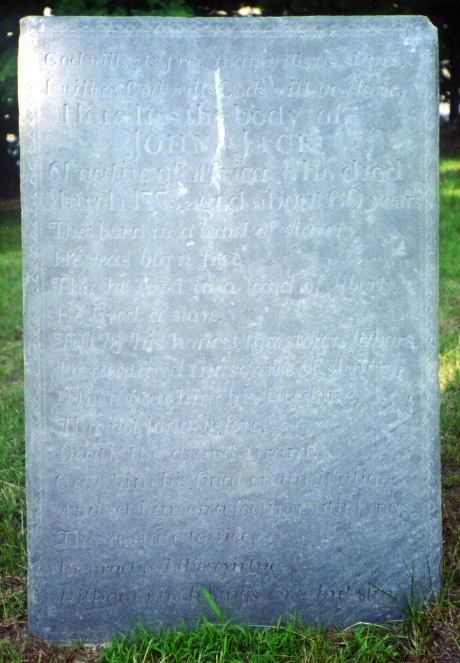
Epigraph to a Grave in Concord, Massachusetts

God wills us free; man wills us slaves.
I will as God wills; God's will be done.

Here lies the body of
JOHN JACK
a native of Africa who died
March 1773, aged about 60 years.

Tho' born in a land of slavery,
He was born free.
Tho' he lived in a land of liberty,
He lived a slave.
Till by his honest, tho' stolen labors,
He acquired the source of slavery,
Which gave him his freedom;
Tho' not long before
Death, the grand tyrant
Gave him his final emancipation,
And set him on a footing with kings.
Tho' a slave to vice,
He practised those virtues
Without which kings are but slaves.
The epigraph above is on a Concord gravestone.  Historian Michael Kammen (my graduate school advisor), notes in his 1972 book People of Paradox that "[i]n the nineteenth century this became the most famous epitaph in America, and was reprinted in English, French, German and Scandinavian newspapers." (p. 193)

The current gravestone is a facsimile of the original; the present copy was erected in 1830.  Here's the picture of the grave from Alfred Sereno Hudson's 1904 book The History of Concord, Massachusetts, Volume 1: Colonial Concord:

And here's the best contemporary picture I could find of the gravestone:
Image source here (click the above photo for a larger, almost-legible version).  Alternate images here, here, here, here and here.

There is a 1902 essay about John Jack, and about Daniel Bliss (the loyalist lawyer who wrote Jack's epigraph) here, online as a free google book.  The grave is on find a grave here.  H/T to Jonathan Holloway for putting me on this trail.