Friday, August 30, 2013

Seamus Heaney (1939 - 2013)

As anyone who has been online today has probably already heard, the Irish poet (and Nobel laureate) Seamus Heaney died today.

It would be an exaggeration to say that I knew Heaney, but he was to more more than simply a name signed to incredible verse (although he was that too).  His daughter spent a year at my high school -- she was a year or two below me -- and during that year he came to speak at my school.  I remember asking him a question during the Q&A; what he answered wasn't quite what I meant to ask, but it was sort of thrilling anyway.

Then, in college, I went to Harvard, where he was teaching, and I took his course on Modern British and Irish poetry.  It was a great class, and I remember a great deal of the poetry we read in it.  (We did a day on Heaney himself of course -- we couldn't not; a guest lecturer, professor Helen Vendler, came in and gave the lecture on that day.)  I also remember bits and pieces of things he said in class.  (From the first day, winding up talking about the class: "Tough grading -- nothing for nothing.")  He wasn't a perfect teacher -- he had the bad habit of quoting poems he almost, but didn't quite, know from memory, when we all had the texts open in front of us: the mistakes grated.  But he was a good one, and I learned a lot.

A number of years later I saw him on Mass Ave, across from Harvard yard.  I introduced myself as a former student.  In memory, he pretended to recognize me, but I quite doubt he did (I certainly wouldn't have, in his place.  Maybe he was better with faces than I.)  He had won the Nobel prize, and I asked if he was still teaching.  Some, he said; but he limited things so that he didn't have to grade papers any more.  (He hadn't graded them in the class I had with him; like nearly every Harvard lecture class, they were graded by TAs.)

And then we said goodbye.

The poem of his that I didn't know, that I've seen most quoted today which I like best, is actually from his translation/adaptation of Sophocles’ Philoctetes (quoted variously here and here).  Here are the lines being quoted:
Human beings suffer,
they torture one another,
they get hurt and get hard.
No poem or play or song
can fully right a wrong
inflicted or endured.

The innocent in gaols
beat on their bars together.
A hunger-striker's father
stands in the graveyard dumb.
The police widow in veils
faints at the funeral home.

History says, Don't hope
on this side of the grave.
But then, once in a lifetime
the longed for tidal wave
of justice can rise up,
and hope and history rhyme.

So hope for a great sea-change
on the far side of revenge.
Believe that a further shore
is reachable from here.
Believe in miracles
and cures and healing wells.

Call the miracle self-healing:
The utter self-revealing
double-take of feeling.
If there's fire on the mountain
Or lightning and storm
And a god speaks from the sky

That means someone is hearing
the outcry and the birth-cry
of new life at its term.
This passage seems to have been separately published under the title "Doubletake", but I'm not quite sure about that; it's definitely from The Cure of Troy (pp. 77-78, spoken by the Chorus).

Now I guess I need to track down the whole thing.

RIP, Professor Heaney.

Wednesday, August 28, 2013

50th Anniversary of March on Washington Link Round-Up

I'm teaching my seminar on "America in the Sixties" again this semester -- but, sadly, we just began and won't get to the March this week.  Pity  (I did skip ahead and talk about it a bit yesterday -- I couldn't resist -- although I don't know if it was useful or just confusing.)

Some reading about today's anniversary:

• In my seminar, we read the speech of John Lewis as delivered -- it was considered too radical by other March organizers and, with a personal appeal from A. Philip Randolph narrowly avoiding a walkout by SNCC (the Student Nonviolent Coordinating Committee, pronounced "snick"), Lewis rewrote it to tone it down.  It's on the web, though; you can read it here.  (Lewis, by the way, just published the first volume of a graphic-novel autobiography; I haven't had a chance to read it yet, but flipping through it it looks fabulous.  (They got a great artist, it seems -- thankfully, and crucially.))

Some recent media-provided historical context on the March:

• Rick Perlstein, "The March on Washington in Historical Context"  Perlstein talks mostly about the fears people -- not just conservatives, but mainstream liberals (and whites generally) had about the march beforehand.

• Harold Meyerson, "The Socialists Who Made the March on Washington"  Meyerson reviews some background about the march too often forgotten today

•, William P. Jones, "How Black Unionists Organized the 1963 March for Jobs and Freedom"  Similar in theme to the previous link; an excerpt from a just-released book on the topic.

• Speaking of whom, both Jones and another historian with a timely book out about the March (in the latter case, I believe, specifically on King's speech) were guests on the amazing radio show Democracy Now! last week.  (Link to a transcript.)

• Relatedly, Democracy Now! has a good round-up of march-relevant interviews and materials from their show.

• Garance Franke-Ruta at The Atlantic has some good photographs of the March by Leonard Freed (which I'd never seen before).

• Dave Zirin notes some differences between the original 1963 March and this past weekend's commemorative anniversary march.

• An interview with one of the co-authors of a new book on the Freedom Budget, an ambitious policy plan (never seriously considered) which arose out of the March coalition.  The connecting hook:
Martin Luther King's "I Have a Dream" speech cannot be comprehended unless we understand it as the culmination of a March for Jobs and Freedom, linking economic justice with racial justice. From his college days in the late 1940s until his death in 1968, King was deeply committed to overcoming poverty and economic exploitation no less than to overcoming racism. He came to see the struggles to overcome economic and racial oppression as inseparable.
Read the rest.

• And Digby puts up some really stunningly good clips from MSNBC (!) about King's legacy and its depoliticization in American memory.  Is Up with Chris Hayes always this good?  I may need to actually watch it.

• I hadn't realized, until Angus Johnston pointed it out this morning, that William Zantzinger (op. cit.) was sentenced on the day of the March.  (Nor that his sentence was deferred until after the tobacco harvest.)  Bury the rag deep in your face.

• The official program from the March is online here.

• Did you know that the "dream"section of MLK's famous speech was improvised?  If not, the story's retold in the Times today.

• Joseph Stiglitz on a common theme, touched in many of these links, about the forgotten "jobs" part of the March for Jobs and Freedom:
Like so many looking back over the past 50 years, I cannot but be struck by the gap between our aspirations then and what we have accomplished. True, one “glass ceiling” has been shattered: we have an African-American president. But Dr. King realized that the struggle for social justice had to be conceived broadly: it was a battle not just against racial segregation and discrimination, but for greater economic equality and justice for all Americans. It was not for nothing that the march’s organizers, Bayard Rustin and A. Philip Randolph, had called it the March on Washington for Jobs and Freedom. In so many respects, progress in race relations has been eroded, and even reversed, by the growing economic divides afflicting the entire country.
Read the rest.

...and that's what I've seen so far.  I'll add more later if I see more.  (Update: Yup.)

Friday, August 16, 2013

Poem of the Day: Langston Hughes, Song for Billie Holiday

Song for Billie Holiday

What can purge my heart
        Of the song
        And the sadness?
What can purge my heart
        But the song
        Of the sadness?
What can purge my heart
        Of the sadness
        Of the song?

Do not speak of sorrow
With dust in her hair,
Or bits of dust in eyes
A chance wind blows there.
The sorrow that I speak of
Is dusted with despair.

Voice of muted trumpet,
 Cold brass in warm air.
Bitter television blurred
By sound that shimmers–
        Where?

-- Langston Hughes

Tuesday, July 23, 2013

Summer and Spring and Fall: Recent Silences, and a Poem

Been quiet 'round here this summer.  No particular reason: all my thoughts have either been briefer than blog length, or longer (i.e. the real work I'm actually working on this summer).  Or at least all the thoughts I've taken the time and energy to write down.

But hey, I can still post poetry.  Here's one of my favorite poems from one of my favorite poets (previously featured on Attempts here, here and here), which I've never posted before.  Enjoy.  And I'll be back soon.  Or perhaps in the fall.

Spring and Fall
to a young child

Márgarét, áre you gríeving
Over Goldengrove unleaving?
Leáves, líke the things of man, you
With your fresh thoughts care for, can you?
Áh! ás the heart grows older
It will come to such sights colder
By and by, nor spare a sigh
Though worlds of wanwood leafmeal lie;
And yet you wíll weep and know why.
Now no matter, child, the name:
Sórrow’s spríngs áre the same.
Nor mouth had, no nor mind, expressed
What heart heard of, ghost guessed:
It ís the blight man was born for,
It is Margaret you mourn for.

-- Gerard Manley Hopkins

Thursday, July 04, 2013

Words Hard to Take Seriously Enough, However Seriously You Take Them (Repost)

We hold these truths to be self-evident, that all men are created equal, that they are endowed by their Creator with certain unalienable Rights, that among these are Life, Liberty and the pursuit of Happiness. — That to secure these rights, Governments are instituted among Men, deriving their just powers from the consent of the governed, — That whenever any Form of Government becomes destructive of these ends, it is the Right of the People to alter or to abolish it, and to institute new Government, laying its foundation on such principles and organizing its powers in such form, as to them shall seem most likely to effect their Safety and Happiness. Prudence, indeed, will dictate that Governments long established should not be changed for light and transient causes; and accordingly all experience hath shewn that mankind are more disposed to suffer, while evils are sufferable than to right themselves by abolishing the forms to which they are accustomed. But when a long train of abuses and usurpations, pursuing invariably the same Object evinces a design to reduce them under absolute Despotism, it is their right, it is their duty, to throw off such Government, and to provide new Guards for their future security.

--The unanimous Declaration of the thirteen united States of America

They're hard words to live by. Jefferson, who wrote them (with some later editing by committee), had trouble living by them, seeing his role in personally denying hundreds of people their inalienable right to liberty. Indeed, many of those who signed the declaration, people who took them very seriously indeed (the pledge of their lives, fortunes and sacred honors was not simply a rhetorical flourish, since they could have been hung if they'd lost the war), had trouble taking them seriously enough.

But it was hardly the only time. When Elizabeth Cady Stanton repeated those words, adding only a few self-evident edits ("all men and women are created equal"), it took decades for her to be taken seriously enough. When Ho Chi Min said those words (in Vietnamese) in saying that his colonized people also wanted to "dissolve the political bands which have connected them with another and to assume among the powers of the earth, the separate and equal station to which the Laws of Nature and of Nature's God entitle them", we did not take him seriously enough, and sent troops to aid his colonizers (who had, ironically, themselves aided us when we were the colonized).

And today, our government is threatening the life and liberty and pursuits of happiness of its citizens (not to mention its non-citizens: and after all those inalienable rights are due to all men and all women, not simply to American citizens), but somehow, we don't take those rights seriously, or the idea that governments derive just powers only from consent of the governed, and only to protect those rights, seriously enough.

Yet those words, written in haste by a slaveowner, derived from commonplaces of enlightened thought of his day, edited by a committee and passed hurriedly so they could return to the managing of a war, those words remain worthy of being taken seriously. The words were larger and better than he or they meant; larger and better than he or they knew; and larger and better than we have yet fully and truly grasped. Indeed, the question we should continually ask our government -- and ourselves -- is whether we are acting worthy of them.

Happy July 4, everyone.

(Reposted from 2010.)

Tuesday, June 11, 2013

Some Commentary on the Matter of Edward Snowden, from an American Writer

Must the citizen ever for a moment, or in the least degree, resign his conscience to the legislator? Why has every man a conscience, then? I think that we should be men first, and subjects afterward. It is not desirable to cultivate a respect for the law, so much as for the right. The only obligation which I have a right to assume, is to do at any time what I think right. It is truly enough said, that a corporation has no conscience; but a corporation of conscientious men is a corporation with a conscience. Law never made men a whit more just; and, by means of their respect for it, even the well-disposed are daily made the agents of injustice. A common and natural result of an undue respect for law is, that you may see a file of soldiers, colonel, captain, corporal, privates, powder-monkeys and all, marching in admirable order over hill and dale to the wars, against their wills, aye, against their common sense and consciences, which makes it very steep marching indeed, and produces a palpitation of the heart. They have no doubt that it is a damnable business in which they are concerned; they are all peaceably inclined. Now, what are they? Men at all? or small moveable forts and magazines, at the service of some unscrupulous man in power? Visit the Navy Yard, and behold a marine, such a man as an American government can make, or such as it can make a man with its black arts, a mere shadow and reminiscence of humanity, a man laid out alive and standing, and already, as one may say, buried under arms with funeral accompaniments, though it may be
"Not a drum was heard, nor a funeral note,
  As his corse to the ramparts we hurried;
Not a soldier discharged his farewell shot
  O'er the grave where our hero we buried."


The mass of men serve the State thus, not as men mainly, but as machines, with their bodies. They are the standing army, and the militia, jailers, constables, posse comitatus, &c. In most cases there is no free exercise whatever of the judgment or of the moral sense; but they put themselves on a level with wood and earth and stones; and wooden men can perhaps be manufactured that will serve the purpose as well. Such command no more respect than men of straw, or a lump of dirt. They have the same sort of worth only as horses and dogs. Yet such as these even are commonly esteemed good citizens. Others, as most legislators, politicians, lawyers, ministers, and office-holders, serve the State chiefly with their heads; and, as they rarely make any moral distinctions, they are as likely to serve the devil, without intending it, as God. A very few, as heroes, patriots, martyrs, reformers in the great sense, and men, serve the State with their consciences also, and so necessarily resist it for the most part; and they are commonly treated by it as enemies.

-- Henry David Thoreau, Resistance to Civil Government

Monday, June 03, 2013

At the Ithaca Festival

I took my son, Joseph, to the Ithaca Festival last weekend. The good folks at the Family Reading Partnership Tent took our picture, and were kind enough to send it to me:


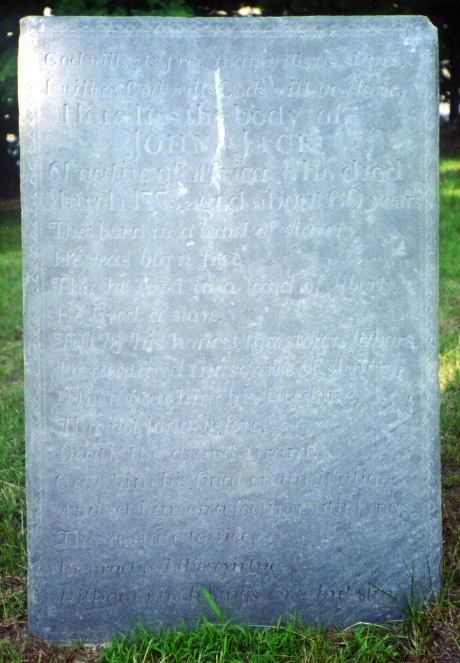
Epigraph to a Grave in Concord, Massachusetts

God wills us free; man wills us slaves.
I will as God wills; God's will be done.

Here lies the body of
JOHN JACK
a native of Africa who died
March 1773, aged about 60 years.

Tho' born in a land of slavery,
He was born free.
Tho' he lived in a land of liberty,
He lived a slave.
Till by his honest, tho' stolen labors,
He acquired the source of slavery,
Which gave him his freedom;
Tho' not long before
Death, the grand tyrant
Gave him his final emancipation,
And set him on a footing with kings.
Tho' a slave to vice,
He practised those virtues
Without which kings are but slaves.
The epigraph above is on a Concord gravestone.  Historian Michael Kammen (my graduate school advisor), notes in his 1972 book People of Paradox that "[i]n the nineteenth century this became the most famous epitaph in America, and was reprinted in English, French, German and Scandinavian newspapers." (p. 193)

The current gravestone is a facsimile of the original; the present copy was erected in 1830.  Here's the picture of the grave from Alfred Sereno Hudson's 1904 book The History of Concord, Massachusetts, Volume 1: Colonial Concord:

And here's the best contemporary picture I could find of the gravestone:
Image source here (click the above photo for a larger, almost-legible version).  Alternate images here, here, here, here and here.

There is a 1902 essay about John Jack, and about Daniel Bliss (the loyalist lawyer who wrote Jack's epigraph) here, online as a free google book.  The grave is on find a grave here.  H/T to Jonathan Holloway for putting me on this trail.

Monday, May 27, 2013

Poem of the Day

Dulce et Decorum Est

Bent double, like old beggars under sacks,
Knock-kneed, coughing like hags, we cursed through sludge,
Till on the haunting flares we turned our backs
And towards our distant rest began to trudge.
Men marched asleep. Many had lost their boots,
But limped on, blood-shod. All went lame; all blind;
Drunk with fatigue; deaf even to the hoots
Of tired, outstripped Five-Nines that dropped behind.

Gas! GAS! Quick, boys! – An ecstasy of fumbling,
Fitting the clumsy helmets just in time;
But someone still was yelling out and stumbling
And flound'ring like a man in fire or lime . . .
Dim through the misty panes and thick green light,
As under a green sea, I saw him drowning.

In all my dreams before my helpless sight,
He plunges at me, guttering, choking, drowning.

If in some smothering dreams, you too could pace
Behind the wagon that we flung him in,
And watch the white eyes writhing in his face,
His hanging face, like a devil's sick of sin;
If you could hear, at every jolt, the blood
Come gargling from the froth-corrupted lungs,
Obscene as cancer, bitter as the cud
Of vile, incurable sores on innocent tongues, –
My friend, you would not tell with such high zest
To children ardent for some desperate glory,
The old Lie: Dulce et decorum est
Pro patria mori
.

-- Wilfred Owen

Tuesday, May 21, 2013

Quote of the Day: the Murders We Romanticize and the Murders We Don't

The city of Deadwood, they stage the murder of [Wild Bill] Hickok fourteen times a day. People have the security of knowing that that story is going to go on, and they'll be able to see Hickok killed 365 days a year.  Which might be an alternative argument in terms of continuing stories past the point of their utility. ...

All of Chinatown [in the Deadwood series] was intended as a venue for storytelling, to show the people who were invisible to what history takes to be the main story of a place.  And the process of servicing the illusions of those who are telling history what history will take to be the main story of a place -- the process of servicing that is never very pretty.  They used to bring in whores for the people too poor to pay for the white prostitutes.  The only way to make that economically feasible was not to feed the Chinese whores.  So they would just let them get fucked to death, until they starved.

They don't stage that fourteen times a day in Deadwood.

-- David Milch, "The Meaning of Endings: David Milch on the Conclusion of Deadwood" (
The heart of this fabulous little DVD extra -- available, I believe, only in the DVD set containing the complete series (which has a disk above and beyond the extras disks contained in each of the three season sets) -- is excerpted here.  A summary of the whole is here.  (Via Canavan, who comments at the link.)  It's just Milch rambling -- but "just" is very much not le mot juste here.  It's Milch, rambling -- and doing so with grace and insight.  The bit above isn't the best bit, but it's good, and I hadn't seen it quoted or transcribed anywhere, so I thought I'd quote it.

Here's one more sentence, more in tune with the main theme of Milch's rambling:
The biggest lie is the idea that we are entitled to a meaningful and coherent summarizing, a conclusion, of something which never concludes.

-- Ibid.

Tuesday, May 07, 2013

American Studies 100: Cover Image Version 2.0

Since today is the last day of my second run-through of my class American Studies 100: A History of American Culture in 21 Examples, I thought I'd post the (slightly) revised cover image.  The syllabus (pdf) is pretty much what it was when I taught it in the fall -- the order switched a little bit (often for practical rather than pedagogical considerations), tweaked a few of the readings, but mostly it was the same.  (I didn't change any of my examples.)  But here's the cover image (without accompanying text):


And, just to correlate with the picture, here are the 21 examples which I used to outline the history of American culture:
  1. Minstrel Shows
  2. Central Park
  3. A Sears & Roebuck Catalog, 1898
  4. Hull House
  5. Coney Island
  6. The Five Foot Shelf (a.k.a. The Harvard Classics)
  7. D. W. Griffith, The Birth of a Nation (1915)
  8. Billy Sunday Sermons
  9. Louis vs. Schmeling (New York City, June 22, 1938)
  10. The Lone Ranger (radio and TV show)
  11. Billie Holiday, "Strange Fruit" (words & music by Abel Meeropol)
  12. Jackson Pollock, Number 1, 1950 (Lavender Mist) 
  13. Drive-in Movie Theaters
  14. Bob Dylan at the Newport Folk Festival, 1965
  15. Charles Schultz, Peanuts
  16. The Moon Landing, 1969
  17. Roman Polanski, Chinatown (1974)
  18. The Vietnam Veterans Memorial (Maya Lin, 1982)
  19. Fast Food 
  20. Buffy the Vampire Slayer (Joss Whedon, 1997 - 2003)
  21. Steroids in Baseball
For more details on the ideas & reasoning behind the class, see this post, or the whole syllabus (pdf).

It was a fun class to teach.  Next year I'm teaching in the history department, rather than American studies, again; but I'd like to teach it again sometime, if I ever get the chance.

Monday, May 06, 2013

Poem of the Day: Merwin's For the Anniversary of My Death

For the Anniversary of My Death

Every year without knowing it I have passed the day
When the last fires will wave to me
And the silence will set out
Tireless traveler
Like the beam of a lightless star

Then I will no longer
Find myself in life as in a strange garment
Surprised at the earth
And the love of one woman
And the shamelessness of men
As today writing after three days of rain
Hearing the wren sing and the falling cease
And bowing not knowing to what

-- W. S. Merwin

Sunday, May 05, 2013

Poem of the Day: Hopkins's Carrion Comfort

Not, I’ll not, carrion comfort, Despair, not feast on thee;
Not untwist -- slack they may be -- these last strands of man
In me or, most weary, cry I can no more. I can;
Can something, hope, wish day come, not choose not to be.
But ah, but O thou terrible, why wouldst thou rude on me
Thy wring-world right foot rock? lay a lionlimb against me? scan
With darksome devouring eyes my bruised bones? and fan,
O in turns of tempest, me heaped there; me frantic to avoid thee and flee?

Why? That my chaff might fly; my grain lie, sheer and clear.
Nay in all that toil, that coil, since (seems) I kissed the rod,
Hand rather, my heart lo! lapped strength, stole joy, would laugh, cheer.
Cheer whom though? the hero whose heaven-handling flung me, fóot tród
Me? or me that fought him? O which one? is it each one? That night, that year
Of now done darkness I wretch lay wrestling with (my God!) my God.

-- Gerard Manley Hopkins

Saturday, May 04, 2013

Poem of the Day: Yeats's The Second Coming

The Second Coming

Turning and turning in the widening gyre
The falcon cannot hear the falconer;
Things fall apart; the centre cannot hold;
Mere anarchy is loosed upon the world,
The blood-dimmed tide is loosed, and everywhere
The ceremony of innocence is drowned;
The best lack all conviction, while the worst
Are full of passionate intensity.

Surely some revelation is at hand;
Surely the Second Coming is at hand.
The Second Coming! Hardly are those words out
When a vast image out of Spiritus Mundi
Troubles my sight: somewhere in sands of the desert
A shape with lion body and the head of a man,
A gaze blank and pitiless as the sun,
Is moving its slow thighs, while all about it
Reel shadows of the indignant desert birds.
The darkness drops again; but now I know
That twenty centuries of stony sleep
Were vexed to nightmare by a rocking cradle,
And what rough beast, its hour come round at last,
Slouches towards Bethlehem to be born?

-- W. B. Yeats

Friday, May 03, 2013

Quote of the Day

Of course it should not be too surprising to find out that your life story has included an event, something important, that you have known nothing about -- your life story is in and of itself something that you know very little about.

-- Philip Roth, I Married a Communist, p. 15
I'm rereading this to teach next week.  Quite, quite fabulous.  (Then again, I assigned it: of course I'd think that...)

Poem of the Day: Ryan's A Certain Kind of Eden

A Certain Kind of Eden

It seems like you could, but
you can’t go back and pull
the roots and runners and replant.
It’s all too deep for that.
You’ve overprized intention,
have mistaken any bent you’re given
for control. You thought you chose
the bean and chose the soil.
You even thought you abandoned
one or two gardens. But those things
keep growing where we put them—
if we put them at all.
A certain kind of Eden holds us thrall.
Even the one vine that tendrils out alone
in time turns on its own impulse,
twisting back down its upward course
a strong and then a stronger rope,
the greenest saddest strongest
kind of hope.

-- Kay Ryan
I went on a binge of posting Kay Ryan poems a bit over a year ago; you can read them all here if you'd like to read more of this fabulous poet. And, although it's not accurate -- the week being long over -- I've tagged this post too with the Kay Ryan Week tag, to group it with the others.

Thursday, May 02, 2013

David Graeber Link Round-Up

David Graeber has a new book out, and as a consequence, we get some interesting articles and interviews both by and about him.
I'll probably add more links if and when I see 'em.

Poem of the Day: Frost's Acquainted with the Night

Acquainted With the Night

I have been one acquainted with the night.
I have walked out in rain --and back in rain.
I have outwalked the furthest city light.

I have looked down the saddest city lane.
I have passed by the watchman on his beat
And dropped my eyes, unwilling to explain.

I have stood still and stopped the sound of feet
When far away an interrupted cry
Came over houses from another street,

But not to call me back or say good-bye;
And further still at an unearthly height
One luminary clock against the sky

Proclaimed the time was neither wrong nor right.
I have been one acquainted with the night.

Wednesday, May 01, 2013

Quote of the Day: A Real-Life Lord of the Flies

For there actually has been a real-life Lord of the Flies incident, and the result was the opposite of what is portrayed in the novel. One day, in 1977, six boys set out from Tonga on a fishing trip. They left safe harbor, and fate befell them. Badly. Caught in a huge storm, the boys were shipwrecked on a deserted island. What do they do, this little tribe?

They made a pact never to quarrel, because they could see that arguing could lead to mutually assured destruction. They promised each other that wherever they went on the island, they would go in twos, in case they got lost or had an accident. They agreed to have a rotation of being on guard, night and day, to watch out for anything that might harm them or anything that might help. And they kept their promises—for a day that became a week, a month, a year. After fifteen months, two boys, on watch as they had agreed, saw a speck of a boat on the horizon. The boys were found and rescued, all of them, grace intact and promises held.

-- Jay Griffiths
Sadly, he doesn't cite a source.  Wish I knew where he got the information.

Poem of the Day: cummings's i thank You God for this most amazing

i thank You God for this most amazing
day:for the leaping greenly spirits of trees
and a blue true dream of sky;and for everything
which is natural which is infinite which is yes

(i who have died am alive again today,
and this is the sun's birthday;this is the birth
day of life and love and wings:and of the gay
great happening illimitably earth)

how should tasting touching hearing seeing
breathing any-lifted from the no
of all nothing-human merely being
doubt unimaginable You?

(now the ears of my ears awake and
now the eyes of my eyes are opened)

-- e e cummings