Tuesday, November 07, 2006

From the Annals of Self-Parodying Overhype

We have:

"Classic"


"Essential"


(Just a little it's-election-day-I-thought-I'd-try-to-relieve-the-tension humor... If you haven't yet, remember to vote!!)

Sunday, November 05, 2006

Election Eve Reading Round-Up

Once more around the blogs:

• Scott Horton puts on his medium hat, and Kant Critiques Bush:
Kant welcomes the political moralist, but he warns us ardently of the moralizing politician... How can we identify the wolf in sheep's clothing who presents himself on the public stage as a man of morals but in fact is morally corrupt? There is, writes Kant, a three-part test that gives us an unfailing peek at the political scoundrel. First, does he seek every opportunity to assert the right of the state he controls over its own people and over other peoples?... Second, does he accept the principle of accountability for his own misdeeds – or does he in fact try to pass off to others every mistake that occurs?... Third, does he rule through the sowing of discord and division? After coming to power, does he identify other potential rivals to power and attack them or set them to battle, one against the other? ... But in its entire history, America has had only one leader who clearly passes Kant's three-point test to detect the political scoundrel. His name is George W Bush. Is it even necessary to rehearse the test?

• And from the same blog, Jack Balkin talks about Ted Haggard:
Many progressives have never quite understood why the most vehement religious opponents of homosexuality view it as such a threat. I myself have always assumed that it is because religious opponents are devoted to the preservation of traditional gender roles, which sustain a male/female hierarchy. But the Ted Haggard story suggests a different reason-- at least for that segment of religious opponents who, like a significant proportion of the population generally, share same-sex or bisexual orientations and desires. Viewed from Ted Haggard's perspective-- a man who, despite his shame and guilt, is attracted to other men-- gay marriage and the gay lifestyle really are a threat to heterosexual relationships and heterosexual marriage. That is because they are a threat to his heterosexual identity and his heterosexual marriage. He knows the Devil is always tracking him, waiting for him to slip up. That is because he conceptualizes his sexual desires as sin and as alienation from God, and not as the expressions of something that might actually become valuable to him if accepted them as part of himself.

Jim Henley reacts to the Saddam verdict:
When I say the Dujail case is “bullshit” I’m not saying that the crime itself was no crime. It was a mass reprisal based on evidence collected under torture with little in the way of a fair chance for the accused to exonerate themselves, a punishment designed as much to terrify onlookers as bring justice to the guilty. All bad stuff. No matter who does it. We are already doing some of the kind of thing ourselves. Too many people in this country want us to do more of it.

• A lot of people are talking about this just-released government study from 1999 estimating that 400,000 troops would be necessary to secure Iraq -- approximately three times as many as we've ever had there. The key fact is simply in that headline, but a good overview of the rest is this one by Jim Macdonald at Making Light, although he leaves out what Matt Yglesias reasonably calls the most interesting conclusion of the study, that "we would have ended up with a failed state even with 400,000 troops on the ground" (emphasis added).

This was always a disaster in the making -- and they either knew, or damn well should have known.

• ...but since, along with the administration, the neocons ignored this fact, they are now trying desperately to salvage something of their justifiably-ruined reputations. Everyone's blogging this one too, but a good basic take is Kevin Drum's suggestion that "This is one rehabilitation project that needs to be stopped dead in its tracks." Meanwhile Glenn Greenwald focuses on Michael Leden's lies in reaction to the piece; Shakespeare's Sister offers snark; and Scott Lemieux notices the misogyny.

Too much outrage to talk about! A mini-round-up within the round-up:
* Army recruiters are telling kids that the Iraq war is over and they won't be sent there.
* Being tortured by America disqualifies you from having a trial, because the torture methods used are state secrets & in a trial you might mention 'em.
* Government permission will soon be needed for any overseas travel. (More here.)

And finally, because I imagine that we could all use some humor today, two funny and totally apolitical items:

Rabbi Jack Moline watches Abbot and Costello Learn Hebrew (via):

ABBOTT: Fine. Let’s start with mee.
COSTELLO: You.
ABBOTT: No, mee.
COSTELLO: Fine, we’ll start with you.
ABBOTT: No, we’ll start with mee.
COSTELLO: Okay, have it your way.
ABBOTT: Now, mee is who.
COSTELLO: You is Abbott.
ABBOTT: No, no, no. Mee is who.
COSTELLO: You is Abbott.
ABBOTT: You don’t understand.
COSTELLO: I don’t understand? Did you just say me is who?
ABBOTT: Yes I did. Mee is who.
COSTELLO: You is Abbott.
Whether or not you do for any of the others (which I recommend in each and every case), you'll definitely want to read the whole thing this time, eh?

• And a scientific study with statistical evidence on the non-existence of vampires:
In short, the authors conclude, it would take surprisingly little time for vampires to rule the earth:
[chart showing complete vampirization of the Earth in c. 30 months omitted]
Relying on the anthropic principle -- which declares that any condition essential for human existence must indeed be true -- the authors conclude that because the non-existence of vampires is necessary for human survival, vampires cannot in fact be real.
I grant you that the assumptions of the study omit the well-known fact that, rather than turn humans into vampires, "mostly, they're just going to kill you"; but nevertheless, this is a study worth careful consideration.

I'll probably add more quotes & links as the day goes on. (Update: Yep.)

Saturday, November 04, 2006

Grim Thoughts at a Time of Hope

A glance at the categories in the sidebar of this blog will demonstrate that I am interested in politics: that category is twice the size of the next largest one. Yet in the past two weeks, I have posted about inconsistencies in literature and religion, Walt Whitman, musician Jonathan Coulton, Battlestar Galactica -- and only posted once about politics, and then briefly. Is it that I don't care that we have a monumentally important election in just a few days?

No, not at all. I care deeply; it is preoccupying my thoughts to a probably unhealthy degree. Nor is it quite that I have nothing to say, although I am more a fan than a perpetrator of political wonkery. But I am not sure I have anything positive to say. I have spoken before about optimism as a moral position -- something I believe strongly on rational grounds, although as a fallible being in a fallen world, I have trouble putting into practice within my own heart. So part of me feels reluctant to speak grim thoughts at a time when morale and energy is so important to securing for ourselves a better future. Those who have hope and fight in them are right, and heaven forefend I should do anything to dampen their spirits.

And yet --

It's not that I don't think will win next Tuesday -- at least the House, and hopefully the Senate too. The polls indicate this, and while certain long-scheduled last-minute "surprises", or the Republicans' built-in advantages, or simple happenstance (or all three) might always change matters at the last minute, I will admit that I not only think we will win, but I have my heart set on it -- emotionally, I've banked on it, and if things should turn out unexpectedly -- or, even, if we garner a weak rather than the strong victory that our country (and world) so desperately needs -- I will unquestionably be crushed. So yes: I strive always to be reality-based, the polls look good -- and my hopes are if anything beyond the polls, my attempts to restrain them notwithstanding.

Why then so grim?

It's not that I don't think it will matter if we win. Even apart from the horror that our loosing would imply -- that American democracy is truly broken beyond any ability to register the public will -- a Democratic congress will be able to do some extremely important things. Just the often-cited investigations would be an extraordinary step forward: one of the central problems with our government now is an unaccountable and unhindered executive branch, and holding Bush and his henchmen to account for their crimes, their lies and their blunders -- and exposing those crimes, lies and blunders which they have heretofore kept secret -- is of the utmost importance. If we win and get nothing else out of it, it will have been a huge step forward. And beyond that, the Democrats positive program, modest as it is, is nevertheless important and valuable. So yes, it will matter. It will matter a lot.

I'm just not sure it will matter enough.

In large measure this is simply because the extraordinary damage -- to our country and to the world -- done by the Bush regime will not be easily undone, and cannot be undone completely whatever political victories we shall secure. As Publius put it,
...the 2000-through-2004 elections were the really important ones. The consequences of those elections simply can’t be undone. I think there’s a Billmon post on this somewhere, but even if the Dems win, Iraq will still have been invaded, torture will still have been approved, and, well, I could go on. It’s the whole “you can remove the nail but not the nailhole” point.
Bush's evil "cannot be wholly cured nor made as if it had not been," no more than the evil to which this phrase was first applied. And even that evil which can be cured will not be cured without enormous -- nearly impossible -- effort. ("...But to such days are we doomed": yes, I understand that too.) So that's part of it: even if, as I dearly hope and fully expect, we win Tuesday, it will be too little, too late. If nothing else, then for the dead.

But I have more practical -- which, I think, is to say, more future-oriented -- foreboding as well.

To begin with, there is the powerful fact that the Republicans work best in opposition. The pent-up force of the right wing's anger and paranoia and hatred and contempt, the sheer motivating power of its urge to destroy, will be upon our throats within seconds -- seconds -- of a victory. Their extraordinary willingness to use any means, however foul, to hold on to power will, I fear, seem as nothing next to their willingness to use foul means to attack those to whom they lost it.

The dishonesty of the attacks will not stay them. Let us take the single most pressing issue: Iraq. America's choices, now, are between the horrible and the even-worse-than-horrible: not only are there no longer any good outcomes, there are no longer even any merely bad outcomes. As of now -- November 4, 2006, before the election -- there are no options remaining which will not mean terrible things for the United States, and far, far worse for the Iraqis. And this is because of the Republicans. The entire time of the war they have had unquestioned dominance of the United States government: they began the war, the prosecuted the war, and the have lost the war. Whether such outcomes were inevitable from the moment the war began, or merely became inevitable due to the extraordinary incompetence and venality with which the war has been fought, is at this point academic: it's lost. And they lost it.

But this will not stop them -- it will not hinder them for as long as a nanosecond -- from blaming the end of the war on the media, the Democrats, the left. We know this for a fact because they are already doing so: the venerable stab-in-the-back theories long beloved of authoritarians everywhere have already been trotted out repeatedly. The Democrats will have come to office with a mandate to end the war -- indeed, with the public expectation that they will end the war: "A substantial majority of Americans expect Democrats to reduce or end American military involvement in Iraq if they win control of Congress" as the New York Times put it a few days ago. But if they do, terrible things will happen -- because at this point, terrible things will happen whatever we do -- and the right, without the least shame or historical honesty, will blame us. (And it goes without saying that our lapdog media will largely let them get away with it.)

The same applies, mutatis mutandis, to the economy; to the budget; to the degradation of our political institutions; to the damage done to our civil rights and liberties; the slow, ongoing catastrophe of global warming; and on and on.

Then there is the question of whether the Democrats even will stop the bloodshed -- or, at least, the American role in the bloodshed -- in Iraq. That they will have (assuming they win) a mandate to do so won't mean that they will. Fools and cowards and idiots and David Broder (but I repeat myself, as the old joke goes) are already saying that the Democrats should walk softly if they win. They would be themselves fools and cowards and idiots if they did so; but that is hardly reassuring, given that the Democrats have long demonstrated a positive genius for political foolishness, idiocy and, above all, cowardice. They have been better of late; they are many orders of magnitudes better than the deliberate, positive evil that is the opposition; but all that that means is that the Democrats too are better in opposition. And I fear a return of their weak-kneed and spineless tendencies should they actually win. -- All of which will just be made worse by the fact that the issue will come to the fore simultaneously with the vicious and dishonest Republican attacks I have already predicted.

And finally there is Bush -- or perhaps I should say, Bush and Cheney. They have already made it perfectly, crystal clear that any victory will not change their minds about their policies. Cheney said just the other day (h/t) that its not their job to change their minds just because, y'know, the voters want them to. And they won't.

But -- and this is my last, deepest, and greatest fear -- that this applies not only to what they have done and what they are currently doing, but to what they intend to do.

Put simply: Is Bush planning to wage an aggressive war -- possibly even a nuclear war -- against Iran? There is ample evidence that they have been making preparations for the possibility -- indeed, some feared they might do so before this current election. That, it seems, is now not going to happen (surely even they aren't fool enough to do it in the last day or two before...). But what about right after? Will Bush simply push forward with his attack even if the country votes for the Democrats -- even if the country votes overwhelmingly for the Democrats?

The only honest answer to this is that I haven't the slightest idea. But I do know that the theories of executive power, particularly in matters of war, that this administration have relentlessly championed means that they will feel no need whatsoever to get authorization from congress. It is certainly rumored that Bush feels he must "deal with" -- i.e. wage aggressive war against -- Iran before his term ends. And it may well seem to them that an attack on Iran would not only do well in reclaiming the agenda, but would be simplest if begun before they loose control of congress -- if only to avoid annoyances from those whose readings of the constitution are different from theirs.

I trust that I don't need to add that such an attack, in addition to being grossly immoral, would be catastrophic in its consequences.

Of course none of this means that I don't want -- desperately, desperately want -- the Democrats to win. Partly this is because, if Bush intends to wage aggressive war against Iran, a Democratic victory will simply change its timing, not its likelihood. And partly this is because 'vote-for-me-or-I-will-kill-many-people' is simply not an appeal that a free people should listen to, under any circumstances. And partly this is because, however cowardly or inept they might be in their response, the response of a Democratic congress to such an attack would at the least be clearly better than that of a Republican one.

But it means that, for this reason and all the others, while I am utterly wrapt with hope, I am at the same time filled with fear and foreboding and worry.

So then what?

Why, we keep on fighting. What else? This is part of why optimism is a moral position. Whatever the odds or possibilities, despair will not improve them. "There is naught that you can do, other than to resist, with hope or without it," to quote again from that same literary work. It is precisely the same as our choices in Iraq: if we must choose between the horrible and the even-worse, let us choose the horrible. If there is no hope, let us go down struggling to improve the world anyway. In the words of the old song:
I know the one thing we did right
Was the day we started to fight:
Keep your eyes on the prize,
Hold on.
Which is why, at the end of the day, all these grim thoughts should not deter us from doing what we need to do. Anything you can do, Noble Reader, to ensure that we win Tuesday -- that we win in as big a manner as possible -- will only be for the good. Even if I am right -- especially if I am right -- in my worries and fears, we need as large and strong a party on our side as possible. And perhaps -- fortune willing -- I will be proved wrong. I dearly hope so.

So vote. Vote with your eyes open: vote with an understanding that it will be but the first, small step on the road to the recovery of our country. But vote.

And then we'll see.

Update: John Holbo has some grim thoughts of his own on the forthcoming election:
Assuming the Dems win there will be a Constitutional crisis when the President claims privilege and refuses to cough up documents for investigations into corruption and cronyism in Iraq reconstruction, bad intelligence, etc, in response to congressional subpoenas. Does that seem likely? But I don’t know enough to guess what form it is likely to take – the legal wrangling, that is. What is likely to happen? (I can’t say I’m depressed at the thought of the investigations. Far from it. But I don’t relish the prospect of the wrenching legal struggles that will be necessary...
As I said in comments there (echoing what several others had already said), a Constitutional crisis and “wrenching legal struggles” is very much a best case scenario; far more likely is that the Dems simply roll over and play dead when Bush refuses to comply with perfectly legal subpoenas. So I am put in the odd position of hoping for a Constitutional crisis… since the alternatives are no meaningful investigations into the crimes of this administration at all. (Since Bush obeying the law is clearly not a possibility.) And this is what flows out of the most likely positive outcome of a victory in this election!

But, of course, far better a Constitutional crisis than simple acquiescence in Bush's ongoing evisceration of the Constitution. So go, do what you can, keep your eyes on the prize... and vote.

Wacky Tolkieny Goodness

While searching for an appropriate link to footnote a casual literary reference in the above post (and yeah, contrary to blogospheric tradition I'm fiddling with the time-stamp on this post so as to leave the older (by a few minutes) post above the brief footnote to it... sue me), I stumbled across two wonderfully wacky Tolkien links.

First, we have Tolkien Geek: some wonderful fellow who blogged the entire !@#$% The Lord of the Rings. I haven't delved too deeply into the site yet, but it looks splendid and wonderful -- yet another example of what I love about the blogosphere.

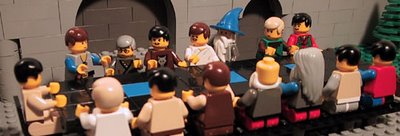
And second, we have The Lord of the Rings in Legos. Yes, some enterprising chap is in the process of illustrating the entire novel in Legos. How wonderful is that! Best use of Legos since The Brick Testament (which, in case you don't know, is some other enterprising chap who is illustrating the entire Bible in Legos... which, with all due respect to the LOTR in Legos site, is even more wonderful, and if you haven't seen it before you should go enjoy it immediately.) But the LOTR Lego site is charming enough. Here is a picture from the flight to the ford:

And here is Frodo at the Council of Elrond accepting the burden of the ring:

...And, lastly, the LOTR Lego site has an entire page of links to other LOTR Lego sites. Yes, it turns out, there are a lot of people, not only who have gone so far as illustrate this (extraordinary and wonderful) novel, but a lot of people who have gone so far as to illustrate it in Lego.

What can I say? It's a strange and wonderful world.

Monday, October 30, 2006

Fruitful Inconsistencies

This is half on literature, half on religion; if you're here for the latter, stick around: I do get to it.

I think that one of the mistakes that amateurs authors tend to make -- and I very much include myself here -- is to work too hard on world building. This is probably a particular occupational hazard for SF (broadly understood) writers, since of course (much but not all) SF takes place in worlds which are partially or fully imaginary; but I think it actually probably applies to all authors, even the most strictly of realist ones, who tend to do the equivalent in, for example, doing research to build (that is, in this context, accurately represent) the world they are writing in. What we should do, of course -- what the best writers do -- is simply work on the story, the text, and let the rest fall into place as it may.

That this is a mistake can be seen first and most clearly in the fact that the best writers' work is filled with all sorts of contradictions, and few people seem to care. Shakespeare can include anachronisms, and have the age and timing of Hamlet be seriously difficult to unravel; and really it matters not a wit. One ready but (I think) clearly mistaken answer to this is to say, "Oh well Shakespeare was a genius, he can get away with this sort of thing, but others cannot." And it's mistaken because good authors at all levels do this. To take a very different example, Arthur Conan Doyle was notoriously careless in writing the Sherlock Holmes stories: was Watson's wound in his arm or leg? Who cares? It hasn't prevented Holmes from becoming probably the single most powerful iconic figure from popular literature in the last two centuries.

And the entire spectrum from Shakespeare to Doyle to anyone you like -- high literary, the best of pure popular pulp, anything -- does the same. Read about books and you'll see comments about these little mistakes and errors -- errors that indicate that the world is somehow not fully imagined, not consistently created; and you'll see that they don't really matter. Even Homer nods.

But if anything I am actually understating the case, I think. Because far from not mattering, often such inconsistencies become positive assets. Inconsistencies that originate in speed and carelessness -- or, more accurately, care being taken in matters other than world-building -- once recognized become sources of energy and complexity that drive a work to a higher level.

Here the examples that occur to me are mostly from popular culture, although I feel fairly sure that any decent literary scholar (a category which does not include me) could come up with some high culture ones off the top of their head. Nevertheless, since I am simply trying to sketch a point here, I will use the popular culture examples. In fact, let me use one of the richest and best examples of recent popular culture there is: Buffy the Vampire Slayer.

The point is that Buffy came with a lot of givens -- large parts of traditional vampire mythology that were simply adopted whole -- and that other parts were added fairly quickly in a show that looked like it might well not last longer than its initial half-length season. For example, the question of what a soul is and does in the Buffyverse is essentially unanswerable, largely because the writers clearly made it up as they went along. Angel is cursed with a soul, and therefore regrets his crimes -- but were they really his crimes if the soul was not there when they were committed? Normally the soul is taken to be the "he"; but Angel is a brooding regretful character so he regrets them anyway. How much free will is there without a soul? Various contradictory answers are given. Can a being without a soul love? It is said many times that they cannot; and it is just as clearly demonstrated that Spike does, genuinely, love Buffy, however much she (and he) might deny it.

I'm not trying to rag on Buffy or its writers for this inconsistency here -- far from it: I think that this inconsistency is actually one of the show's strengths. A world of fairly simple bad-and-good sides is set up by the Vampire-Slayer mythology -- and then the complexities of character and storytelling lead them to make it complicated, complex, grey -- the end result being even more grey and complex than a show which started out to be grey and complex could be, because it is a moral complexity overlaid on a universe painted first in stark black-and-white terms. Giles's speech in "Lie To Me" about how the villains are easy to identify by their black hats is very different than it would be in (to take a very good show in a different mode) The Wire, because in the latter no one would ever suspect such a thing, it's silly -- but in Buffy many of the villains are easy to identify, by their crinkled brows and pointed teeth: which makes it all the more complex and interesting when, in the end, some aren't -- whether through evil humans, good vampires or (most of all) intermediate, undecidable cases. Spike is perhaps the most complex character in Buffy -- certainly the most morally complex character -- because he started out as a simple villain, and then was so compelling that the writers wanted to keep him around, so they made him progressively better, backslid for a story point here and there, had him go over the line, and then gave him a soul, describing the latter in terms that were clearly falsified by some of his earlier portrayals. In the hands of poor writers, the result might simply be an unbearable mish-mash: in the hands of writers of the Buffy caliber, it's extraordinary and complex fiction.

This is just one example, but I think it could be endlessly multiplied. Tom Shippey, in The Road to Middle Earth, talks about how much of the power of Tolkien's work comes from the contradiction in the conception of the ring -- how it embodies two fundamentally contradictory ideas of what evil is -- the result of which is an end far richer than a more philosophically consistent view would be. Tolkien was a world-maker par excellence -- but his method of composition was not: he wrote the Hobbit without thinking through completely how it tied into his mythology, and then was left with contradictions that he had to think through; he launched into The Lord of the Rings without a clear sense of where he was going, which meant that contrary ideas were built in from the get-go.

Quick contradictions lead to further stories, stories which try to deal with (thematic, philosophical, historical, factual) contradictions in the earlier ones -- and lead to a complex and rich fiction. Perhaps this is simply a common way by which fictional worlds (and in this I include the "worlds" that are meant to be ours) can portray the complexity of the real world: no fictional author can possibly design a world as complex as the real one, by more orders of magnitude than one can think; but inserting contradictions creates the appearance of complexity that leads to a variety of mimesis. The world is complex, not contradictory, but to any given viewpoint it looks contradictory, because we can't comprehend its complexity.

This may not apply to all fiction, but it applies to a lot of it. And I think it applies to the greatest fiction of all time: religion. Religion gets its power from its early-adopted inconsistencies. A few very different ideas were merged, and the result is far richer than any single one of them could be alone.

I'm brought around to this thought by a long and fascinating post by Sean Carroll at Cosmic Variance, which is, essentially, a review of Terry Eagleton's review of Richard Dawkins's recent book The God Delusion. (Link via Pharyngula.) After making an important distinction between three topics in Dawkins's book -- topics which Carroll correctly notes are confused by reviewers, thus allowing them to attack Dawkins's weaker points in the guise of attacking his stronger ones -- Carroll goes on to talk about the contradictions at the heart of (Jewish and Christian) monotheism -- contradictions which he says undermine the notion of God (and which P. Z. Myers, correctly in my view, says that theologians use to dodge awkward questions from different in audiences). All of this may be true, but as irritating as this intellectual slipperiness may be to atheists such as Dawkins, Carroll, Myers or myself, it is also the source of religion's strength -- and not just because it allows the avoidance of awkward questions.

Carroll tells a story about the history of monotheism -- a story that accords with what I know, although I can't vouch for his details, and I also don't know how widely accepted this story is among those knowledgeable in the field -- in which one notion is shaped in such a way as to be contradictory, after which the resulting contradiction is itself melded with another contradictory idea -- leading to a truly rich and complex (as well as, well, contradictory) result. The beginning of the story (as Carroll tells it) is the evolution of the tribal god of the Jews -- imagined as simply our god, but not the only one -- eventually came to be conceived not simply as one of, or the most powerful of, many gods whose reality was recognized, but as the only real God, whereas the others were simply imaginary. This itself was a fruitful contradiction -- God was both the creator of and God for the whole world, and the special, personal God of the Jews. But then this "personal/tribal God of Biblical Judaism" was further merged with "the Unmoved Mover of ancient Greek philosophy." And the result is a Being which can be described in one breath as an ineffable essence which underlies the nature of existence and in another as a being with actual emotions like jealousy and love.

Carroll (and Myers) point out that using part of this notion to weasel out of the silliness of other parts of it is, intellectually, unfair -- changing the terms in the middle of the debate, or depending on who the audience is: Bush can reassure many by claiming God speaks to him while theologians Clintonize about what the meaning of God "speaking" is. And they have a point. But it is also precisely this contradiction that gives religion -- which is, I agree, a fiction, although I agree with Carroll (and against Dawkins) that the question of whether it is a fiction which is, in sum, beneficial or detrimental to society is a very complex one* -- its enduring power.

This is true in all sorts of ways. The richness of theology -- which, contrary to Dawkins's dismissal, is indeed a rich field of intellectual endeavor -- comes from its basic remit being the discussion of a fundamentally flatly contradictory notion. The rich Jewish literary tradition of Midrash -- which could be humorously but accurately described as fan-fiction based on the bible -- arises out of the need to explain contradictions in a supposedly divine and perfect text. The richness of Christian spirituality arises out of all sorts of contradictions -- that the trinity is nevertheless a unity, that Christ was both God and man, and so forth.

Now, Dawkins would probably say that it is one thing to acknowledge the power of all this as a fiction -- which, to be clear, is all I am doing -- and quite another to assert it as metaphysical truth and guide one's life (to say nothing of others' lives) by it. And I quite agree, which is why in the Dawkins/Eagleton debate I am finally more sympathetic with Dawkins.

But here's the thing. Eagleton falsely claims in his review that
Such is Dawkins’s unruffled scientific impartiality that in a book of almost four hundred pages, he can scarcely bring himself to concede that a single human benefit has flowed from religious faith, a view which is as a priori improbable as it is empirically false.
I say "falsely" because Dawkins spends several pages discussing the literary importance of the Bible, and bemoaning the biblical illiteracy of contemporary culture. And Dawkins is right to do so: say what you will about the Bible, it is an amazing and (at least in parts) extraordinary work of literature that everyone should read. But what I think really is bothering Eagleton, although he doesn't say so and (I am guessing) isn't aware that this is what is really getting his goat, is that Dawkins doesn't give this credit to any religious movements or texts that occur after the bible. (Or if he does, it is in passing and very much against the overall spirit of his book.) Eagleton would want to say that, at the very least, theology and religious writing has the same sort of literary value that the Bible does -- maybe not as much and maybe not as consistently, but it still has it and is important for that reason. And on this account I agree with Eagleton.

And here's the point I am making. The very inconsistencies in the notion of God that make Dawkins dismiss it -- the very inconsistencies that give Eagleton the room to try and weasel out of the metaphysical points that Dawkins effectively drives home -- are precisely what gives religion, in the Bible and later, its genuine power. It is, I think, no more than a fiction (and I think that this is actually fairly clear): but it is a rich and powerful fiction, one that has sustained many in distress and moved many to acts of selflessness and heroism that they would not otherwise have done. Dawkins (and others such as P. Z. Myers and Sam Harris) wants us to be able to say, clearly, that the metaphysics is clearly bunk -- and I agree and would like more people to say so as well. But I think (in contrast to Dawkins and Harris) that, if religion is a fiction, it is an astonishing fiction, and one that can't be dismissed on the grounds that there weren't clocks in Julius Caesar's day and that we don't even know which limb Watson was wounded in. And I think that those of us who hold Dawkins-like positions on the metaphysics -- and who worry greatly about the political extensions of religion in the world, and find in them the most powerful single source of evil today, whether we are talking Islamists, Christian fundamentalists, or others -- would be more persuasive if we were to acknowledge that beauty that others see in religion, and, rather than insist that it is in fact ugly, simply insist that, beautiful as it may be, it is no more real than Frodo's inspiring, heroic, utterly imaginary journey up Mount Doom.

___________________________________________
* This is one of the points that Carroll notes is confused by reviewers of Dawkins's book: the question of whether God exists (easy, says Carroll, agreeing with Dawkins: He doesn't) and the question of whether religion is a positive force in the world (hard, says Carroll, disagreeing with Dawkins) are separable, but Dawkins's (and, I would add, Sam Harris's) tendency to conflate them allows reviewers to attack the weaker (latter) arguments while ignoring the stronger (former) ones. On this point I agree with Carroll and disagree with Dawkins and Harris. I will also note that, while Daniel Dennett is often lumped in with Dawkins and Harris in his defense of atheism, Dennett's recent book Breaking the Spell is quite resolutely agnostic on the question of religion's overall effects, saying its a complex question and we simply don't know the answer, however strongly atheist it is on the metaphysical question of God's existence. This is a key distinction between Dennett and Dawkins/Harris that has been (to my knowledge) completely overlooked -- and an important one, to my mind, since I think Dennett's skepticism about the social effects of religion is right, and that Dawkins and Harris cherry-pick their way to simplicity on this issue. (Another good critique of Dawkins on this issue, in the context of Eagleton's review, is here (h/t to Carroll's post), although this critique doesn't mention Dennett at all.)

Postscript to the footnote: And, picking up from the end of the essay above, I think that Dennett goes further than Dawkins in recognizing the beauty of religious fictions. Dawkins might reply, fairly, that Dennett has been no more persuasive than he, thereby giving a counter-example to my argument that a Dennettian approach will be more readily accepted; and I cede the point. But either way this will be a long argument; and while so far results from any approach have been few, I claim that Dennett's position will in the end be more effective than Dawkins's -- and that it also has the additional advantage (to use the Kissingerism) of being true.

Sunday, October 29, 2006

Stop This Day and Night with Me and You Shall Possess the Origin of All Poems

I just stumbled upon a wonderful recording: Orson Welles reading out selections from Walt Whitman's poem "Song of Myself" (or reading out some poems from the poem-cycle "Song of Myself" -- depends on how you look at it ("listen to all sides and filter them from your self."))

It's a marvelous recording, at least to my ears. Welles, of course, was a famous radio producer and actor before he turned filmmaker, and so his voice and aural presence is astonishing. He really puts a lot of life into the poems. Needless to say, it's just one interpretation -- not always how I hear it my head, and I'm sure not how you hear it in yours -- but it's a wonderful one. His selection is about 50 minutes long; I highly recommend listening to it.

The recording can be found here (link via); this is a direct link to the real audio file.

The numbers from "Song of Myself" that Welles performs are: 1, 2, 3, 6, 7, 10, 14, 15, 21, 24, 26, 27, 28, 31, 33/46*, 48, 51, 52.

I put an asterisk next to 33/46 to signify that, in that instance, Welles (for some reason) attaches the first four lines of 33 to 46 (which is complete). Apart from that oddity, there are two lines which are skipped on the recording -- I think it's taken off a record. One is the sixth-to-last line of 14, which should read "I can eat and sleep with them week in and week out," but which skips and so sounds just like "week in". The other is, damn it, the very last line of 52 -- the end of the cycle ("I stop somewhere waiting for you.") -- which seems to have been cut off in the process of putting it online. Apart from that, the above-listed numbers are complete.

I don't know anything about the site that the recording is hosted on, but it looks like they have a bunch of other stuff. They have a brief 1890 recording of Whitman reading one of his own poems, "America" -- but one that is so scratchy as to be all-but inaudible. And, on a different page, along with some speeches by Malcolm X and Martin Luther King, they have what purports to be Orson Welles's famous radio version of The War of the Worlds; but I haven't listened to that one to check.

One great American artist performs another. Check it out.

Have you reckon'd a thousand acres much? have you reckon'd the earth much?
Have you practis'd so long to learn to read?
Have you felt so proud to get at the meaning of poems?

Stop this day and night with me and you shall possess the origin of all poems,
You shall possess the good of the earth and sun, (there are millions of suns left,)
You shall no longer take things at second or third hand, nor look through the eyes of the dead, nor feed on the spectres in books,
You shall not look through my eyes either, nor take things from me,
You shall listen to all sides and filter them from your self.

-- Walt Whitman, "Song of Myself", 2

Saturday, October 28, 2006

Even My Henchmen Think I’m Crazy I’m Not Surprised That You Agree

One of the wonderful things about Teresa & Patrick Nielsen Hayden's blog Making Light (which I recently mentioned in another context) are the little links they have in the upper left-hand corner. Called "Particles" and "Sidelights", they are links selected respectively by Teresa & Patrick, and linked to with a single line. Often funny, sometimes moving or important or bizarre, they're one of the touches that turns Making Light from one among many good blogs to a must-visit site.

Well, a bit less than two weeks ago Teresa linked to a site with the cryptic but unquestionably intriguing words "All We Want to Do Is Eat Your Brains." Naturally I had to click through.

If you feel similarly, go ahead. I won't mind. You can come back here later. Or even just stay and explore that site. That's what I'm going to end up recommending, anyway. (Damn. Gave away my punch line.)

You're back? Funny, wasn't it? What, you just read the lyrics? No, you have to actually click the button and listen to the song. Right, that one; the one that says "play song". Okay, go try again.

Ah, now you get it, right?

Well, if the answer is no you might never do so. But I bet for a lot of you it'll be yes. Which is, as previously mentioned, the point of this post: to try and introduce a few of you into the wacky and wonderful world of the music of Jonathan Coulton.

I must admit I probably heard "Re: Your Brains" (the official title of the song whose chorus is "All We Want to Do is Eat Your Brains") at least a dozen times before it occurred to me that if I liked it so much I might like some of his other songs as well. Partly it's just that, in these internet days, I'm more used to finding one good song and just iPoding it, rather than using one song as a start to digging around a whole new artist's work. And partly it was simply that I was enjoying that song so much (in the slightly obsessive-compulsive way I have whenever I find a great new song, namely over and over) that I didn't get around to it.

But finally I clicked through to Jonathan Coulton's song page.

Man, but that guy is great.

I'm still getting into his music -- I've heard a couple of dozen songs, but have only listened to a dozen or so often enough that I feel that I really know them (I tend to like to hear a song a lot before I really feel like I fully know it) -- but here are some notes based on what I've heard thus far.

He's very much a humorous musician. I haven't heard one song yet that isn't deliberately comic or, at the very least, distinctly quirky. But I think that if he was merely funny I would have just laughed and kept going. He's also a very appealing songwriter; his songs are catchy and fun and just plain good to listen to, in addition to being funny.

Which also means that, while I'm going to be quoting his lyrics here, you should really click through and go hear his songs. (While he asks you to pay $1 for most -- although not all (some are free) -- of his songs if you actually download them, you can actually listen to them all for free on line.) So listen: they sound better than they read (and I think they actually often read well), and you might well go on listening to them just for their quality as songs, beyond the point where they are (as it were) active jokes for you.

(It's sort of like the music of Weird Al Yankovic: one of the things that Yankovic's lyrics did, I think, is allow people to enjoy genuinely enjoyable pop melodies without feeling too silly about the usually ridiculous lyrics; by making a joke of them, they were not only funny, but they released the fun in the melodies. Coulton writes his own music, but you enjoy them as good songs just as one does Yankovic's work, i.e. beyond the joke.)

Jonathan Coulton's sense of humor is very much in the wacky style -- a delighted celebration of absurdity, sometimes absurdity borrowed from areas such as SF, such as in the Zombies song (yeah, in case you didn't go listen to it, the "Re Your Brains" song is about a bunch of zombies). Another type of absurdity he likes is the bizarre juxtaposition -- to again stick with "Re: Your Brains", it's talking about Zombies in business (or office) jargon. As part of the latter, his songs vary a lot in style -- some are folksy, some are rock, some are Christmas carols, etc; often the absurd juxtaposition is between the lyrics and the song's genre.

One song which I like a lot which falls into both of those categories is "Chiron Beta Prime", a song which presents itself as a Christmas carol, in fact as one of those mass Christmas letters that some people send out saying what happened to their family in the year. But this is a set-up for absurdity, as you get from his opening lyrics:
This year has been a little crazy for the Andersons. You may recall we had some trouble last year. The robot council had us banished to an asteroid. That hasn’t undermined our holiday cheer. And we know it’s almost Christmas from the marks we make on the wall. And that’s our favorite time of year. Merry Christmas...
Again: either this is your sense of humor or it's not. It's definitely mine -- and if it's yours, then go and listen, because the tune is also incredibly catchy, and he has follow-up jokes in the latter verses: it's not one of those cases where after one joke the person writes the song and then has nothing else to offer.

A second example of the absurdity-through-genre style that Coulton has is "Stroller Town" which sounds (to me, anyway) like a Beach Boys song, one of those that are about cars and how good it is to be out on the town in a car... but here it's an infant in his stroller:
Early in the morning full belly clean bum
I got my cup of cheerios in case I want some
Jacket, hat, diaper bag, carried out the door
And I know where we’re going cause we’ve been there before
There’s a warm breeze blowing and it tickles my hair...
A third example, which in this case is mostly wacky just through its use of genre elements, is the song "Skullcrusher Mountain", which is clearly sung by some very James Bond-esque villain, although I don't believe it's any specific one: it's just a genre piece, funny and catchy. (The title of this post comes from the lyrics to that song.)

Another thing he clearly likes to do is formal experimentation. It was through one of those, in fact, that I realized that I had in fact heard one of his songs before: one of his songs -- or, rather, the video version of it, because (as he says on its page) this is really a song which needs to be seen as a video rather than simply listened to -- had made the email or blog rounds at some point and I'd watched it, liked it but (unlike in the case of "Re Your Brains") hadn't pressed the matter. The song I'm referring to here is "Flickr", where Coulton writes a set of lyrics describing various photos he found on Flickr. The sound is sweet and nostalgic, as if he were describing a photo album -- but he very much isn't, hence the humor.

Other examples of his formal experimentation include "W's Duty", where the lyrics are all sound clips from our Boy King's speeches in which he invokes duty, edited into new meanings -- surprisingly effective and catchy. There are others in this category too -- mash-ups (such as this mash-up of "When I'm 64" and "25 or 6 to 5"; or a song with lyrics which were, in Coulton's words, "taken verbatim from a text message that a friend of mine received from their boss, and spoken by my Mac." There are a lot of strange little songs like that. Another example of his experimental tendency was the fact that, fairly recently, he spent a year producing one song a week -- 52 songs in 52 weeks -- as sort of an endurance test, finishing just about a month ago. (Many of my favorites come from that year, by the way.)

And then there are a lot of his songs which are plain and simple funny fun, which I can't categorize -- but they include some of my favorites. So here are some of my other favorite Coulton songs so far:

• "Mandelbrot Set": a marvelous, catchy song which not only includes the formula:
Take a point called Z in the complex plane
Let Z1 be Z squared plus C
And Z2 is Z1 squared plus C
And Z3 is Z2 squared plus C and so on
If the series of Z’s should always stay
Close to Z and never trend away
That point is in the Mandelbrot Set...
but which also includes these incredibly wonderful lines:
Mandelbrot’s in heaven, at least he will be when he’s dead
Right now he’s still alive and teaching math at Yale...
I can't help but wonder what Mandelbrot thought of those lines when he heard them (or would think if he did, although I presume that he did at some point). (Coulton himself went to Yale, incidentally.) "Mandelbrot Set" is one of about half a dozen of his songs (along with "Re Your Brains", "The Presidents", "Code Monkey" and "Chiron Beta Prime"... maybe one or two others, maybe not) which has, at some point in the past two weeks, been my absolute favorite Coulton song, as opposed to the others here, which have only been among my favorites.

• "The Presidents" -- one line per president, rather randomly selected although mostly accurate facts (although there's one historical mistake (about Garfield), as Coulton notes on his lyrics page). For some reason LBJ's line always makes me feel sorry for him, although of course it really should make me feel sorry for its other subjects. It's just that he wasn't that much worse compared to other presidents -- and was very good on (some) other issues. Great song.

• "Code Monkey" -- this was, I believe, Coulton's first big "hit", a song which was slashdotted at some point -- not surprisingly, given that 'Code Monkey' is slang for a computer programmer doing dull work. This one I heard a few times before I really listened to the lyrics... which, let me just say, you should not do for the first time behind the wheel of a moving car.

• "Ikea" -- yeah, about the store. Incredibly catchy. Bonus points for referencing Thor.

• "Podsafe Christmas song" -- Another Christmas carol, this one sung by a group of characters who sound like the Chipmunks, but with a rather pugnacious attitude. And I just gotta love any song which includes these lyrics:
We want a podsafe Christmas song
We want a song that’s safe to play
Don’t think us rude
We don’t want to get sued
By the thugs at the RIAA...
Unlike the others, this one took a few hearings to grow on me. But it's really great.

• "Kenesaw Mountain Landis" -- This is a really weird one, a sort of tall tale about Shoeless Joe Jackson that has only a tenuous connection to the historical facts, and includes as well the (wholly fictional, I believe historically real (if rather different than Coulton's version)) eponymous character.

• "First of May", which is a "Poisoning Pigeons in the Park" for the 21st century (and whose lyrics are NSFW, by the way).

Those are the dozen or so that I've gotten most into so far -- as you'll note if you click through, I've heavily favored the free ones for the obvious reason. But Coulton's song page has more than fifty songs on it, and I expect I'll be finding new favorites for a while now.

But one new favorite -- Jonathan Coulton -- is clearly here to stay for me. I hope you'll give him a try.

And watch out for Zombies. Reasonable as they may be.

Tuesday, October 24, 2006

Biting My Nails

Some in the Bush administration wanted North Korea to get the bomb (via) They thought it would be "clarifying". What's it clarify -- that we should wage an aggressive war on them too? Is that in addition to Iran or instead? (Clearly it's in addition to the two, count 'em, two wars we're fighting now.)

The U.S. is now a model for other countries... who want to torture their citizens too, just like we do.

Of course, even if the Democrats win both houses on November 7, some idiots are saying they should make nice with the pro-torture, anti-habeas corpus, pro-war crimes, incompetant-to-tie-their-own-shoes-let-alone-govern-a-country-or-win-a-war party. But good lord, it would be something.

I know the signs are positive, but the stakes are so damn high. (Although even there: at this point all the Dems could do would be to mitigate, and to expose, the damage. So much has already been done. I personally am of the opinion that the U.S. might well never recover from this administration. But in any event it would take a long time.)

Did I mention global warming?

Too little; maybe too late. But if we can win, it'll be something.

If.

If if if if if....

Two more weeks. Do what you can. We need this one, folks.

Update: Publius is more elegant than I on a similar point, with an added good point about what a defeat might actually mean if (Heaven forefend) it might mean. Check out his post.

Monday, October 23, 2006

Scattered Thoughts on Battlestar Galactica: Exodus Part 2

This post contains total and complete spoilers for the first four episodes of Battlestar Galactica, Season Three (through "Exodus, Part 2")
Skip on down to the next post if you don't want to be spoiled.

Battlestar Galactica is not, to my mind, quite as good as Veronica Mars or The Wire (the latter of which I see only on DVD, so only through Season Three at this point) -- which are far and away my favorite still-ongoing shows at the moment. But BSG is a very good show, which I am quite glad to be watching and wouldn't want to miss. As I just caught up on the most recent (i.e. as of last Friday) episode of BSG. Herewith a few random thoughts.

* I was sort of surprised that they didn't milk the occupation situation for longer. I had thought that, after going to all the trouble of setting the new status quo up, they would actually run with it for, oh, half a season or so -- really tell some individual, free-standing stories set on occupied Caprica, and use that to reboot the show a bit. They're not back to precisely the pre-settlement status quo -- they lost the Pegasus, of course, and a lot of individual characters are in rather different situations -- but it's fairly close. Given that BSG was definitely drifting in the latter half of its second season, I'm surprised they didn't use the change of pace -- which I, like almost everyone else, found to be a reinvigoration of the show -- to more effect. I'm only slightly worried about the upcoming episodes -- they've clearly got a pretty good grasp on what works and what doesn't -- but I was surprised.

* Anyway, the title for the next episode (don't click unless you're willing to have the title, at least, spoiled) is very promising. So is the fact that Jane Espenson is writing an upcoming episode.

* Baltar's claim that if he didn't stop the nuke from going off no one would get off made no sense at all, given that people had already left. I was rather confused on this point. I think the analysis of the BSG Wiki -- that Baltar simply didn't know the situation (and presumably Gaeta didn't either, since he seemed to buy Baltar's claim (unless he was simply willing to fall for any excuse not to have to kill him)) -- seems like the most straightforward explanation. But it was a bit untidy.

* Several really strong parts of the episode: Tigh's murder of Ellen; the jump of the Galactica right into the atmosphere; the unveiling of Kacey's parentage. (Unlike this blogger, I didn't find the latter to be obvious at all: I thought they might go with the difficulties of having a half-cylon child actually aboard, and use that as a character arc for Starbuck. Though yeah, given the terrible damage that cute kids can do to SF shows, probably a good move.)

* On the other hand, the Pegasus's changed-our-minds-we'll-be-the-cavalry maneuver was not only so obvious that I almost though they were making it a red herring, but it was also a rather silly cliché, frankly. (Shows do that sort of thing constantly.) And the scene that set it up with all the subtlety of a 2x4 to the head -- the opening dialogue between Lee and Dee (Lord, what an awful rhyme -- just noticed that) -- was incredibly flat, by far the weakest scene in the show, probably in the season to date. I think they would have done better just having both ships go in -- or, possibly, have them fake out the viewers (also sort of a cliché (for example, used in the first-season episode "The Hand of God"), but not quite as bad a one) with Lee's ship held in reserve as a deliberate tactical maneuver. (Although then they would have had, as Robert Farley notes, the problem of why they didn't sacrifice the older, clunkier ship -- Galactica -- whereas this plot did explain that. (Apart from the its-the-title-of-the-frackings-show bit, of course.)) But it would have seemed less, well, silly -- having the earnest commander change his mind, make the emotional decision and come just in the nick of time... bah. Humbug. (By the way, that LGM post has an interesting comment thread, too, if you want more BSG blogging.)

* The best story developments they got out of the four-and-a-bit episode stay on New Caprica, of course, are the character changes -- most of the major characters are in very different places than they were. I wonder to what degree this was done deliberately -- i.e. they set up the occupation so as to set up arcs they wanted to do, but couldn't get to in the earlier compressed-timeframe that held up through the end of season two -- and to what degree they simply thought the occupation would be a good story, and then used it to spin the various characters off in different directions.

Overall, a good start to the third season -- a distinct return to the strength of the first season and a half (counting the miniseries as part of season one) after the comparative unevenness of the season 2.5. Let's hope they know what they're doing and can keep it up.

Friday, October 20, 2006

Superjew!

If this doesn't make you laugh early on, just bail. Because either you'll get why this is the greatest thing ever, or you won't. If not, stop as soon as you figure that out. It won't get any better for you.

The rest of you will love it.

Actually, I have two rather more serious posts a bit down-blog, which I was fairly tempted to deliberately leave at the top, since I think they're closer to the spirit of what I hope to do here than, well, this. So if this doesn't make you laugh, read this and this, and you can weep for our country instead. I don't often post multiple times in a day, and the others are better pieces of writing -- I sort of hate to see them get buried beneath this frivolity.

But the following trail of links made me laugh to beat the band, and sometimes one needs that. Besides, alongside a strong reality-based worldview, we here at Attempts also have a strong commitment to whimsy, strangeness and all-around quirkiness. So why not. It all starts with a single dinner party...

Part the First:

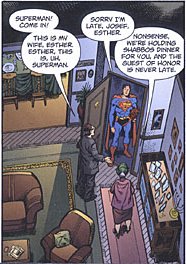
Superman went to a Shabbos dinner. (link via)

Let me say that one more time, just so we're all clear: Superman went to a Shabbos dinner.


And not just in a brief panel. No, he eats there over the course of, like, three pages (reportedly -- I haven't read it, although obviously I have to go get a copy immediately). This was in Action Comics #835, written by Gail Simone and drawn by John Byrne. Most of this issue is apparently devoted to other matters, a fight against someone named Livewire, but at the end of the comic he goes to Shabbos Dinner with some couple.


Part the Second:

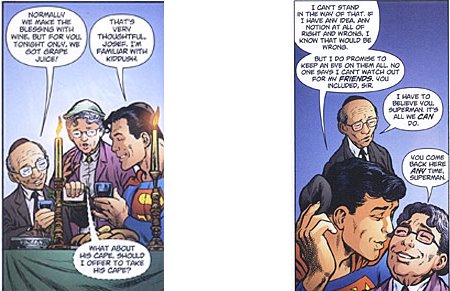
An Orthodox Jewish comics fan goes and nitpicks the entire scene. (This is at a blog called Suspension of Disbelief, although the blogger in question is not the usual blogger there, but rather a guy named Mordechai who usually blogs elsewhere.) We're talking things like this --
Also, if those are rolls to Superman’s left? They should be covered. During Kiddush and until the blessing on the bread is made, any bread products on the table are covered.
-- and like this --
Superman, you mean to tell me you’re "familiar with Kiddush" but you don’t know rule one of Orthodox male/female interactions? That’d be look, don’t touch. You don’t kiss a Jewish woman on the cheek. Ever. Unless you’re family. This is a major error here.
That bit about "familiar with Kiddush", by the way, comes from earlier in the scene: it's a direct quote from Superman. Yes, Noble Readers, Superman is familiar with Kiddush. We can all die happy. (Although knowing about Kiddush but not negiah isn't actually that surprising -- they make Kiddush in Reform & Conservative congregations, but negiah is not at all widely observed (at least to the no-kissing-on-cheek level.))
But stick around (if you've come this far), 'cause we're just getting going.


Part the Third:

Then we have the comments thread. This is absolutely filled with gems. First, we have the nitpicking of the nitpicking:
Superman is NOT A HUMAN. I am not a Talmudic Scholar, but wouldn't his behavior be covered under the rules for animals rather than persons? it is well established that nonhumans are NOT responsbile for obeying Jewish law. He can even kiss Orthodox women- he cannot break ritual purity any more than a dog, cat, or helper monkey can.

I'm not sure that Superman is actually kissing Esther in that panel, he may just be doing the California air-kiss thing, which would be fine. Although given the errors he made with the flowers and the doorbell I wouldn't expect Esther to trust him not to get it wrong.

Could it be that the couple Superman is visiting simply isn't as observant as everyone is assuming? And why blame Superman for making mistakes? Why should he know better?

Now, regarding the debate about Superman's (and other heroes) human status, would Josef and his wife know that he's alien? I'm not up on whether Superman's origin is common knowledge in the modern DCU.

The problem is how do you define “humanity”? I myself would not make the attempt. Superman and J’onn seem to act as though they have souls though.

Faith and Doubt by Rabbi Norman Lamm contains an essay called 'Religious Implications of Extraterrestrial Life'. In it he says... If we should discover other free and rational species we shall of course include them in the community of uniquely bio-spiritual creatures.'

Among most of my orthodox older relatives the women certainly touch men - it seems that the younger generation is more stringent. So it would not surprise me at all for a woman of Mrs. Josef's age to allow heself to be kissed on the cheek.

This all leads into lots of other discussion, including a lengthy consideration of the whether the fact that Wonder Woman was sculpted in clay by the Greek Gods makes her an idol, or is she just more like a golem?

The writer of the issue herself shows up in the comment thread to mention that she loves the thread, that she did do a lot of research, that not everyone is strict about the things the writer is mentioning (true), but also to defend the right of readers' criticism.

And at one point we get the Best. Comment. Ever.:
Being Jewish sure looks complicated.
'Nuff said, as they used to say in the comics world. Except...


(Image from Heeb Magazine #3, via Dave's
Long Box
(which rules, by the way.))

Part the Fourth:

One commentator shows up to link to his (I think his) own treatment of Superman Halachka, as well as his discussion of whether the Kryptonians are Jewish. This was apparently "originally conceived as a way to teach halachot", and includes facts such as the following:
Many versions of Superman keep the Kent clothes hidden in a pouch inside the cape. While flying on Shabbat, this is no problem - the air is a makom ptur. But once grounded, he'd better be in an eruv or he's got problems.
And yes, the section on brit milah contains the obligatory Larry Niven reference.

...And that, alas, is the end.

At least with Superman.

The Road Goes Ever On and On...

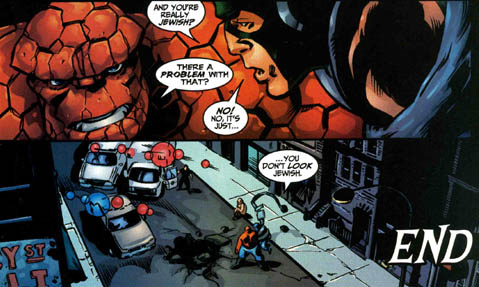
But if you want to know more about the religious affiliations of comic book characters, there's a web site that will tell you everything that you could possibly need to know. Superman is a Methodist, for example. There are lots of Jews -- but just the usual suspects, either. The most surprising, perhaps, is the (rather late-breaking) revelation that The Thing -- yes, Ben Grimm, ol' blue eyes himself, is Jewish:


There are lots of other Jewish superheroes, too. But never fear! There are lots of superheroes of every religion, including Jewish Catholics, Mormons, Buddhists, Objectivists, Wiccans, followers of traditional Greek and Roman Gods and even (horrors!) some atheists. Don't miss the pictures of superheroes grouped into teams by religion -- if you've made it this far, you'll love it.

Irony is Not Only Dead, It has Turned Into a Zombie and is Eating our Brains

It's not so much that ChurchReport.com has labeled David Kuo -- Christian, conservative, former member of the Bush Administration (as second in command of the faith-based initiative) David Kuo -- a member of the Axis of Evil for daring to publish a book critical of Bush, putting him in the same league as North Korea, as Adele M. Stan notes (to whom also a hat tip for the link). That's just par for the course for the "Bush is Jesus" Christians that we have around these days.

No, it's that at the end of this essay labeled "David Kuo: An Additiion (sic) to the Axis of Evil", an essay which says, among other things, that Kuo is "only move[d]... to author a masterpiece when he feels like an unimportant, disgruntled former employee and needs to make a few dollars," that claims that he has "penchant for penning thrillers as a disgruntled former employee," that says that he " has been described as a 'wolf in sheep’s clothing'" and that responds to Kuo's claim that the White House describes its Evangelical supporters as "nuts, goofy and boorish" by suggesting that "Kuo should take a closer look in the mirror" -- it's that at the end of all this, the essayist, one Jason T. Christy (I kid you not, that's his name) -- says this:
David Kuo forgot one important lesson: Judge not lest ye be judged.

Irony has now officially turned into a Zombie and is eating our brains. (Link via)

That is all.

Update: On (the non-ironic side of) the larger David Kuo issue, I think Tristero hits the essential point:
...no one seems to have asked what I think is the only interesting question: Does David Kuo believe that the US government actually should have an Office of Faith Based Initiatives?...

To make it clear, there should be no office of faith-based initiatives. The very idea is digustingly offensive. To say so does not make me a "secularist" as many of the devout understand how important such a wall is to their faith. I am merely being an American. A wall of separation between church and state was clearly established by the Founders and over the years, that wall has been determined, quite rightly, to mean that no religion can be privileged by the US government. And that means giving 'em money or other special breaks.

Kuo's basic point appears to be that faith-based initiatives would be great, provided he was in control of it, or some other incorruptible evangelical. No, it wouldn't. It is simply un-American, a direct violation of the Constitution and American traditions.
Amen.

Truth in Fact and Tone

We have handed a blank check drawn against our freedom to a man who may now, if he so decides, declare not merely any non-American citizens "Unlawful Enemy Combatants" and ship them somewhere — anywhere — but may now, if he so decides, declare you an "Unlawful Enemy Combatant" and ship you somewhere - anywhere....

This President now has his blank check.

He lied to get it.

He lied as he received it.

Is there any reason to even hope, he has not lied about how he intends to use it, nor who he intends to use it against?...

"One of the terrorists believed to have planned the 9/11 attacks," you told us yesterday, "said he hoped the attacks would be the beginning of the end of America."

That terrorist, sir, could only hope.

Not his actions, nor the actions of a ceaseless line of terrorists (real or imagined), could measure up to what you have wrought.

Habeas Corpus? Gone.

The Geneva Conventions? Optional.

The Moral Force we shined outwards to the world as an eternal beacon, and inwards at ourselves as an eternal protection? Snuffed out.

These things you have done, Mr. Bush… they would be "the beginning of the end of America."

-- Keith Olbermann, October 18, 2006 (via)

Only shrillness can save America.

-- Atrios
We in the reality-based community all love Jon Stewart and Stephen Colbert not just because they are funny, but because they speak, not truth to power, but merely truth -- at a time when to approach anything that deserves the name requires a "shrillness" of speech that most of the pusillanimous opinions-on-the-shape-of-the-Earth-differ reporters of the so-called liberal media shrink from like vampires from the light. But, of course, as they themselves remind us, neither Stewart nor Colbert are journalists; they're comedians.*

That fact has allowed them to tell a deeper, a bigger, a more important truth that has eluded those who speak truth in the dry tones of "factual" reporting: the truth about the genuine nature of this administration, and the harms it has done, is doing and, unless we manage to stop it, will do to our country. They can do it because comedy has always allowed jesters to speak truths to kings. Because people will listen to a joke who would not listen to an anguished cry.

Because today, it is not facts we are lacking. The facts are all there: the lies, the crimes, the attacks on everything that is good and decent and free about his, our once-noble country. Bush and his henchmen's true uniqueness is not what they have done, but the brazenness with which they have done it. Bush breaks the law and boasts; he guts our freedoms and smiles.

So what to do, when truth is easily found, but is drowned out -- by lies, by gossip, by boredom? What to do, when putting facts down in plain order kills them, and allows us the understanding of dissection but not of a living ecological study? What to do when plain reporting itself becomes a lie, when the only way to tell the truth is to scream it, for anything less is a lie, not in fact, but in tone?

All we can do, then, is scream. And hope we are not drowned out by the wind.

And honor those who scream louder than we can.

How few actual journalists have spoken, not simply words, but in a tone that truthfully conveys the state of our nation? Paul Krugman, of course, has done so for years; but this is the age of digital media, not of dead-tree print; and who listens to Krugman?

Well, Keith Olbermann is speaking truth: truth in his words, truth in his tone. In recent weeks, he has being doing so again and again and again and again and again and again and again.

And he's been doing it on television.

Oh, I wish he would speak more about, say, Iraq; but then, there are so many issues to be shrill about these days. And the full-scale attacks on our civil liberties, and on truth, by this administration is as worthy as any. And Olbermann is telling the truth about them, to his eternal honor and credit.

We should - we must -- honor him for it. While there's still time. Before someone decides that he is an enemy combatant and we no longer can.

And if you think that that last sentence is too shrill go read -- or, better yet, watch and listen to (because it is not so much the words as the voice that is so special) -- all of those links above.

And remember that, if you think that Olbermann's safe, it is no longer because there is a law protecting him. It is simply because you -- yes, you -- are trusting George Bush's honor and honesty and respect for the truth.

And then honor Olbermann's words. While we can.

While he is still here.

While we are.

While what is left of our country is.

_______
* I just read that phase on a blog today; but danged if I can remember where. If I can find it I'll link; otherwise, apologies....

Thursday, October 19, 2006

Crimes and Blunders

Not every crime is done out of evil motives.

Some people would go so far as to say that nothing, really, is done out of evil motives: that people always act out of an idea of the good, and sometimes they're simply wrong about what that entails. I myself wouldn't go so far as to say this, but it was a view held by, among many others, Plato, so if you think this you're in good company.

Nevertheless, I do think it's pretty indisputable that not every crime is done out of malevolence. Indeed, some crimes are pretty straightforwardly benevolent in motive; far more are of mixed motive, and/or a case in which the criminal is fooling themself as to the likely effects of their actions.

(I should perhaps interject that I am not a lawyer; that my use of the word "crime" here is meant to have more moral than legal force. It may be the case that some crimes -- some genuinely wicked acts -- are not punishable under any applicable law; but I think that the word crime is nevertheless not only still justified but is, in fact, still important. In any event, it is that sense -- a moral crime, with the associated implication that such actions should be prosecuted if possible (but that it won't always be) -- that I am using the word here.)

Perhaps some examples are in order.

I think it's quite possible, for example, that the police officers who shot Amadou Diallo didn't have any particular malevolent intent: that, in fact, they sincerely believed that they were under attack, that they thought they saw a gun, and that they fired -- yes, even 41 times -- under a genuine fear for their safety. But the point is that a genuine fear is not necessarily a legitimate fear. Theirs was a fear that was, presumably, born out of racist beliefs -- again, possibly not explicitly racist beliefs: they did not set out to lynch someone -- but the sort of beliefs that can color ones perceptions and make one see a gun where there is only a wallet. Beliefs per se are not criminal of course: but when acted upon, they can become so. Some fears are illegitimate. And even apart from the fear's source, while fear for one's safety is a legitimate motive for action, it's not a legitimate motive for any possible action. Act upon genuine fear wrongly, and you've committed a crime.

And the same goes for a desire to improve the world. The person who decides to kill a mafia don may have completely laudable motives: the don is running a criminal enterprise, and has certainly murdered people in the past; the neighborhood will be much better out from under their spell. But to shoot the don in the back is still murder. Perhaps, in some circumstances, it's justifiable homicide: but those circumstances are exceptional, not normal. And if one misses the don, and hits the don's child -- or if one hits them both -- then one has murdered a child: and no amount of I-went-in-this-with-the-best-of-intentions talk will alter that one iota, because one oughtn't to have been shooting in the first place. Well meaning or not, it was not a legitimate act.

And in addition to fear and desire to improve the world, many other good motives can lead to crimes to. And that's not even to get into the large number of motives which aren't quite good or evil, but are mixed. Or the large number of cases where crimes are committed by carelessness: if you get drunk and drive home, you may have committed only a minor crime, one that will never be discovered and will have no lasting consequences -- but you also might be the person responsible for the deaths of many innocent people. It's not entirely up to you, in the sense that you can do little to avoid it -- save not to drink and drive in the first place: which is where the real responsibility lies. (This example -- indeed, many of these examples -- are instances of the phenomenon of "moral luck": that our actions can become moral or immoral -- and genuinely moral or immoral, in the sense that we will have sinned -- depending on how our luck runs. But that's a whole topic in and of itself.)

The point of all this is that these are not simply mistakes. It's not enough to say that you meant well, that you had good intentions, that it seemed like the right thing to do at the time, that it really looked liked a gun not a wallet, that you really thought that the Don was alone and that he was unquestionably a wicked man, that you just had a lot of beer it's not like you aimed a riffle for chrissakes. It won't do because these weren't mistakes, or weren't just mistakes: these are crimes. People are dead. And we are responsible.

I bring this up, of course, because people are dead -- approximately 655,000 people, although it is one small part of the circumstances of our crimes that we will never know precisely how many -- indeed, our knowledge is so poor that even the best available studies have an error range of hundreds of thousands of people.

But it doesn't matter. Because people are dead. And we are responsible.

And it was a crime.

Not a mistake; not a poor policy decision; not a bad idea in retrospect but how could we have known really. A crime.

To reverse the famous saying of Talleyrand: it was worse than a blunder; it was a crime.

A crime.

Because we didn't have to do it.

We were not under attack, or under any imminent threat -- and if not all of us knew it, than all of us should have known it: our perceptions were distorted by anger and fear and misplaced trust and all sorts of things that, while not crimes in and of themselves, become crimes when you act on them in a certain way. If we had been attacked, really attacked by the Iraqis, it would be different. (Which is why Afghanistan, however smegged-up things are becoming there too, is different.) But we weren't. Nor were armies looming on our boarders, shouting that they would throw us into the sea, as in Israel in 1967. What we had were grainy photos of trailers and lies about Africa. So it was a crime.

A crime, because it doesn't matter that we, or some of us, thought that we would make the world a better place, thought that the person we were after was a horrid criminal who had killed many people in the past (and Saddam unquestionably was that), thought that it would spread democracy like a rosy-fingered dawn: it doesn't matter. Because we attacked someone without being attacked, and so can't make the excuse that our aim was poor. If a massacre or genocide had been ongoing, it would have been different. Intervention in a specific, ongoing massacre may be justified -- and may simply turn out to have been a blunder if it goes badly, because we would have been acting in a legitimate, moral way. But that wasn't the case here. Saddam had killed many people; Saddam was a vicious tyrant; but there was not ongoing killings we intervening to stop. We were simply out to make the world a better place (or some people thought so, and others have adopted this as the ex post facto justification). And we missed, and we hit 655,000 other people.

For which there are no excuses.

And all of this is apart from any of the less laudable motives that may have been involved -- as some surely were, since there were many players and many actors and many calculations and many motives, and if one person's motives are so often impure, how impure will the motives of an entire government -- an entire ruling class -- an entire country -- be? We may not know all those motives until after the archives are opened, the documents examined and the causation carefully charted out; even then it is sure to be a horribly complex story; but in many ways it doesn't matter. The car has crashed; the people are dead; what drove us to drink is neither here nor there.

That we blundered in what we did is all the worse, since it made it worse; but it was not simply a blunder. It was not simply a mistake. It was not that we all thought so and who could have known.

It was a crime.

It was our crime. All of us. As Billmon so eloquently wrote yesterday (in response to Riverbend's anguished re-entry into blogging), none of us -- even those who opposed the war -- did enough. Because it happened. And people are dead. Responsibility is not a zero-sum game; it is our country that has done this deed. So we are guilty. All of us.

But -- as much as it may depart from Billmon's wisdom* -- I can't help but say that we are not all equally guilty.

Those who supported the war are more guilty than those who opposed it.

Those who wrote or marched to support the war are more guilty than those who supported it silently.

Those who created a climate of opinion where this scheme took hold are more guilty than those who spoke in its favor.

Those who abetted the action, by voting for war resolutions or attacking those who did not, are more guilty than those who simply made the idea seem good.

And those who decided on the war are the guiltiest of all.

This should not make us feel better. The blood of hundreds of thousands of dead will stain enough hands that none of us can feel entirely clean. But it should make each of us feel worse, according to the measure that they supported, or failed to hinder, this crime.

And perhaps -- maybe, maybe, maybe, maybe, maybe -- we can learn from our mistakes. I don't really think so: this after all was precisely the war that we should have avoided by learning from the mistakes from Vietnam, the previous crime. Of course there are differences: this is not a game, where we will see precisely the same patterns again. But it should have been clear enough. To many of us, it was clear enough.

But we didn't stop it. Maybe we couldn't have. I don't know. All I know is that, whether we could or not, we needed to.

Because people are dead. And we are responsible.

For that crime.

__________________________
* (Peripheral) Update: As long as I'm linking to Billmon's piece, I should link to this very interesting reply by Amanda Marcotte which I just came across.