Easter, 1916
I have met them at close of day
Coming with vivid faces
From counter or desk among grey
Eighteenth-century houses.
I have passed with a nod of the head
Or polite meaningless words,
Or have lingered awhile and said
Polite meaningless words,
And thought before I had done
Of a mocking tale or a gibe
To please a companion
Around the fire at the club,
Being certain that they and I
But lived where motley is worn:
All changed, changed utterly:
A terrible beauty is born.
That woman's days were spent
In ignorant good-will,
Her nights in argument
Until her voice grew shrill.
What voice more sweet than hers
When, young and beautiful,
She rode to harriers?
This man had kept a school
And rode our winged horse;
This other his helper and friend
Was coming into his force;
He might have won fame in the end,
So sensitive his nature seemed,
So daring and sweet his thought.
This other man I had dreamed
A drunken, vainglorious lout.
He had done most bitter wrong
To some who are near my heart,
Yet I number him in the song;
He, too, has resigned his part
In the casual comedy;
He, too, has been changed in his turn,
Transformed utterly:
A terrible beauty is born.
Hearts with one purpose alone
Through summer and winter seem
Enchanted to a stone
To trouble the living stream.
The horse that comes from the road.
The rider, the birds that range
From cloud to tumbling cloud,
Minute by minute they change;
A shadow of cloud on the stream
Changes minute by minute;
A horse-hoof slides on the brim,
And a horse plashes within it;
The long-legged moor-hens dive,
And hens to moor-cocks call;
Minute by minute they live:
The stone's in the midst of all.
Too long a sacrifice
Can make a stone of the heart.
O when may it suffice?
That is Heaven's part, our part
To murmur name upon name,
As a mother names her child
When sleep at last has come
On limbs that had run wild.
What is it but nightfall?
No, no, not night but death;
Was it needless death after all?
For England may keep faith
For all that is done and said.
We know their dream; enough
To know they dreamed and are dead;
And what if excess of love
Bewildered them till they died?
I write it out in a verse -
MacDonagh and MacBride
And Connolly and Pearse
Now and in time to be,
Wherever green is worn,
Are changed, changed utterly:
A terrible beauty is born.
— W. B. Yeats
Sunday, March 27, 2016

Thursday, January 28, 2016
A Musical Cultural Query, With Lots of Backstory & A Few Asides
(Cross-posted from Facebook.)
So people regularly use (in casual conversation, in fiction, etc) music as markers of personality and character — the sort of music that sort of person would listen to, listening to that sort of music carries *these* connotations. Music, basically, as cultural signifiers, as cultural coloring.
So people regularly use (in casual conversation, in fiction, etc) music as markers of personality and character — the sort of music that sort of person would listen to, listening to that sort of music carries *these* connotations. Music, basically, as cultural signifiers, as cultural coloring.
ASIDE: Personally, I happen to think a lot of this is bullshit (which is perhaps affected by the somewhat separate fact that I think it would be a better world if everyone recognized it as bullshit); I happen to think that a lot of what degree it isn't bullshit is actually about tribe/class/etc rather than personality (and sometimes rather damagingly conflates the latter with the former).
But set those personal beliefs aside: the fact is people do it, and do it a lot. My problem is that I simply don't know these associations. I was just listening to a podcast where someone said "I couldn't put U2 on that playlist" and another person said "thank you", and they clearly had the same association with U2 and I don't have the slightest fucking clue what it is. (My only association with U2, beyond knowing a few of their songs, is that when I was in Ireland several decades ago there was a huge amount of basically nationalistic love for them. That wasn't what these podcast people meant, though.) What did U2 mean in that sentence (aside from the specific band, which is only a fraction of what it really meant)? I genuinely don't know; I can guess a bit from context, but not very specifically, not very richly, not very accurately. (I know a tiny bit of it for classical and jazz. But only a bit. And that's not what gets most used, by a very long shot.)
ASIDE: Actually, these things are so vague that I rather suspect that people themselves have very different understandings of them: that one person will say, "U2, damn" and another will reply "I know" and that they'll never work out that they are actually meaning almost entirely different things.
It seems to me, however, that this is precisely the sort of thing that the web ought to help with. To tell us not only who U2 is (members names, song names, release dates) but what they mean — or, more accurately, what they are taken to mean, including any big disagreements in that. I'm thinking of something vaguely like "urban dictionary", except for bands/singers/songs. Except I don't know of anything like that. It's certainly not on wikipedia (probably too opinionated, although it's the sort of thing I wish wikipedia had more of, frankly).
So: does this exist? And if not, can someone build it? (And please don't say 'you do it!'; obviously, I am the *last* person who should try this, or I wouldn't be asking.)
Wednesday, January 20, 2016
David Hartwell
(This is a combination of two things I posted on Facebook today.)
As anyone with anyone in the SF field in their social media feed knows by now, the extraordinary editor, David G. Hartwell, is dying. (Contrary to various reports, it seems he is not actually dead; but his wife has reported that he "is not expected to recover", and that he is being tested for brain death.) As best as I can tell, a fall down a flight of stairs triggered brain bleeding which has become fatal to his self if not actually his heartbeat.
There will be a lot more to say, mostly by people better qualified to say it than I. But, like so many in (or on the fringes of) the SF field, I knew him. I was his student in a summer class in 1988. It was a good class; and only years later, having myself been a teacher, can I recognize how extraordinarily above & beyond he went in teaching that class, meeting with us for hours before and after nearly every time. After that I saw him from time to time at SF conventions, once or twice elsewhere. He was a kind and generous man, and it is a shock to imagine him gone from the world.
As anyone with anyone in the SF field in their social media feed knows by now, the extraordinary editor, David G. Hartwell, is dying. (Contrary to various reports, it seems he is not actually dead; but his wife has reported that he "is not expected to recover", and that he is being tested for brain death.) As best as I can tell, a fall down a flight of stairs triggered brain bleeding which has become fatal to his self if not actually his heartbeat.
There will be a lot more to say, mostly by people better qualified to say it than I. But, like so many in (or on the fringes of) the SF field, I knew him. I was his student in a summer class in 1988. It was a good class; and only years later, having myself been a teacher, can I recognize how extraordinarily above & beyond he went in teaching that class, meeting with us for hours before and after nearly every time. After that I saw him from time to time at SF conventions, once or twice elsewhere. He was a kind and generous man, and it is a shock to imagine him gone from the world.
A shock: it was so sudden, so unexpected. That a man who yesterday was
(I believe) seeming in full health can today be on the brink of death
is terrifying, and magnifies what is already an incalculable loss.
A note to anyone not acquainted with the SF field (should anyone in that position have read this far): I strongly suspect that David affected your life, too: simply because his affect on the SF field was *so* vast (he was the most influential SF editor in my lifetime), and because SF has had such a prominent role in the culture beyond the field proper (movies, TV, etc), it seems inescapable. I am not myself capable of articulating what that influence is, but it's there, and I hope others will do a better job of tracing it than I.
Finally, I can help noting that David and his wife Kathryn had children who are — I believe — teenagers. As overwhelming a loss as this is to so many in his field, as utterly overwhelming as it must be for Kathryn and his two kids from his first marriage, I can't help but think of them in particular. I know a bit of what it's like to have a parent die suddenly around that age; my heart goes out to them.
Not yet gone, you are already missed, David.
***
Can't stop thinking about David Hartwell. Most people (rightly) will be talking about his impact on SF, so here are a few links on another subject: his clothes.
Lee Whiteside's photo of David showing his ties at a SF convention (below, with another of his photos further down):

David as Fashion Theorist: his three laws, with corollaries (scroll down a bit).
Mary Robinette Kowal on some of the thinking behind his outfits.
And more ties.
And still more ties.
And yet more:

Seeing all this made me quite nostalgic for David all over again. Which is the point, I guess.
A note to anyone not acquainted with the SF field (should anyone in that position have read this far): I strongly suspect that David affected your life, too: simply because his affect on the SF field was *so* vast (he was the most influential SF editor in my lifetime), and because SF has had such a prominent role in the culture beyond the field proper (movies, TV, etc), it seems inescapable. I am not myself capable of articulating what that influence is, but it's there, and I hope others will do a better job of tracing it than I.
Finally, I can help noting that David and his wife Kathryn had children who are — I believe — teenagers. As overwhelming a loss as this is to so many in his field, as utterly overwhelming as it must be for Kathryn and his two kids from his first marriage, I can't help but think of them in particular. I know a bit of what it's like to have a parent die suddenly around that age; my heart goes out to them.
Not yet gone, you are already missed, David.
***
Can't stop thinking about David Hartwell. Most people (rightly) will be talking about his impact on SF, so here are a few links on another subject: his clothes.
Lee Whiteside's photo of David showing his ties at a SF convention (below, with another of his photos further down):

David as Fashion Theorist: his three laws, with corollaries (scroll down a bit).
Mary Robinette Kowal on some of the thinking behind his outfits.
And more ties.

And still more ties.
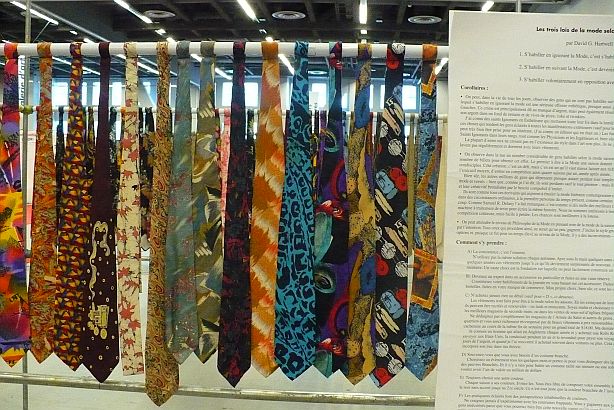
And yet more:

Seeing all this made me quite nostalgic for David all over again. Which is the point, I guess.
Tuesday, September 22, 2015
Quote of the Day: Erev Yom Kippur, 5776
She wept and wept, and the gods drank up her tears, as they have always drunk up our tears, yours and mine and everyone’s, and by their sweetness were sustained for another day.
—John Crowley, Daemonomania (2000)
To those observing Yom Kippur, g'mar chatimah tova.
Friday, January 30, 2015
Quote of the Day
These days, if you have something to say and it won't fit in a single tweet (or a tweetstorm), you have so many more compelling options than blogging. You can post on Facebook if it's just for friends, or Tumblr if it's image-based, or on Medium if you want a think piece shared more widely, or LinkedIn, or any one of a hundred other sites and services that are thirsty for content.
About the last thing you'd do is willingly maintain your own site, especially not in an age where your readers are as likely to be on phones or tablets as desktop browsers. Who still does that kind of one-man operation?
— Chris Taylor
Readers, should any still wander by, will not have failed to notice that this blog has been silent a good long while. Save for quotes and salutations, the last time I put up any actual content was (quickly checks)... July. Six months ago.
I'm not saying that I, like my polar opposite in the blogging world (as far as, say, "having readers" or "actually putting up content" goes) am quitting, or have already quit. I am saying that these days when I have something brief to say, I tend to post it on Facebook, where I know at least some people will read it; and when I have something to link to, I tend to link to it on Twitter, where there is a better chance that someone might see it. And that when I sit down to write long pieces these days (not as often as I'd like, but for reasons of time & energy rather than anything else) I tend to imagine them going places other than here.
Where does this leave me? I don't know. Maybe I (like so many quitting bloggers — including Andrew Sullivan! — in the past) will recant quickly. Maybe this is the last post this blog will receive. Who knows. All I'm saying is: when I write these days, it tends to be elsewhere; and when I imagine writing more, as I hope and plan to do, it tends to be imagined towards elsewhere.
I'm not quitting; but I'm not not quitting either. I am staying silent for now, without any specific promises, one way or the other, about the future.
The most I can promise is that, if this blog resumes regular posting, I will announce that fact on those other mediums. And that I have every intention of writing attempts in times to come, wherever those end up.
Til later, then, whether or not "later" is also "elsewhere".
Sunday, December 21, 2014
Now We Are Six
Happy Birthday to my beloved son, Joseph Saperstein Frug, who is six today.
.jpeg)
Disclaimer: the picture above is actually from Thanksgiving, back when Joseph was still "just alive" and not yet "as clever as clever".
When I was One,
I had just begun.
When I was Two,
I was nearly new.
When I was Three,
I was hardly Me.
When I was Four,
I was not much more.
When I was Five,
I was just alive.
But now I am Six, I'm as clever as clever,
So I think I'll be six now for ever and ever.
— A. A. Milne
Disclaimer: the picture above is actually from Thanksgiving, back when Joseph was still "just alive" and not yet "as clever as clever".
Sunday, November 23, 2014
US History 1973 - 2014 Commonplace Book: Lecture 32, America in 2014: Inequality (Con't)
Little piece of cornbread sitting on the shelf:Introduction to (and explanation of) this quote series can be found here. Read this tag to see all of them.
If you want any more, you can sing it yourself.
—Traditional children's song
Saturday, November 22, 2014
US History 1973 - 2014 Commonplace Book: Lecture 32, America in 2014: Inequality (Con't)
Let me give you a word of the philosophy of reform. The whole history of the progress of human liberty shows that all concessions yet made to her august claims, have been born of earnest struggle.... If there is no struggle there is no progress. Those who profess to favor freedom and yet depreciate agitation, are men who want crops without plowing up the ground, they want rain without thunder and lightening. They want the ocean without the awful roar of its many waters. This struggle may be a moral one, or it may be a physical one, and it may be both moral and physical, but it must be a struggle. Power concedes nothing without a demand. It never did and it never will.Introduction to (and explanation of) this quote series can be found here. Read this tag to see all of them.
— Frederick Douglass, 1857
Friday, November 21, 2014
US History 1973 - 2014 Commonplace Book: Lecture 32, America in 2014: Inequality (Con't)
In the United States, our findings indicate, the majority does not rule -- at least not in the causal sense of actually determining policy outcomes. When a majority of citizens disagrees with economic elites and/or with organized interests, they generally lose. Moreover, because of the strong status quo bias built into the U.S. political system, even when fairly large majorities of Americans favor policy change, they generally do not get it.... [O]ur analyses suggest that majorities of the American public actually have little influence over the policies our government adopts. Americans do enjoy many features central to democratic governance, such as regular elections, freedom of speech and association, and a widespread (if still contested) franchise. But we believe that if policymaking is dominated by powerful business organizations and a small number of affluent Americans, then America’s claims to being a democratic society are seriously threatened.Introduction to (and explanation of) this quote series can be found here. Read this tag to see all of them.
— Martin Gillens & Benjamin I. Page, "Testing Theories of American Politics: Elites, Interest Groups, and Average Citizens" (forthcoming, Fall, 2014)
Thursday, November 20, 2014
US History 1973 - 2014 Commonplace Book: Lecture 32, America in 2014: Inequality (Con't)
Since coming back to the United States after three years away in China, I have been asking experts around the country whether America is finally going to hell.... [T]he question wasn’t simply a joke.... I spoke with historians and politicians, soldiers and ministers, civil engineers and broadcast executives and high-tech researchers. Overall, the news they gave was heartening—and alarming, too. Most of the things that worry Americans aren’t really that serious, especially those that involve “falling behind” anyone else. But there is a deeper problem almost too alarming to worry about, since it is so hard to see a solution.... We could correct all these problems—and that is the heart of the problem. America still has the means to address nearly any of its structural weaknesses.... We know that such an investment could happen here—but we also know that it won’t. That is the American tragedy of the early 21st century: a vital and self-renewing culture that attracts the world’s talent, and a governing system that increasingly looks like a joke.... America the society is in fine shape! America the polity most certainly is not.... Our government is old and broken and dysfunctional, and may even be beyond repair.Introduction to (and explanation of) this quote series can be found here. Read this tag to see all of them.
—James Fallows (2010)
Wednesday, November 19, 2014
US History 1973 - 2014 Commonplace Book: Lecture 32, America in 2014: Inequality (Con't)
The real fear today is that the world we now live in was intended by those who profit from it.Introduction to (and explanation of) this quote series can be found here. Read this tag to see all of them.
—John Clute
Tuesday, November 18, 2014
US History 1973 - 2014 Commonplace Book: Lecture 32, America in 2014: Inequality (Con't)
...And the truth cannot be hid;Introduction to (and explanation of) this quote series can be found here. Read this tag to see all of them.
Somebody chose their pain,
What needn't have happened did.
—W. H. Auden
Monday, November 17, 2014
US History 1973 - 2014 Commonplace Book: Lecture 32, America in 2014: Inequality (Con't)
Inequality kills. Between 1990 and 2008, life expectancy for White American men without a college degree fell by three years, and White low-educated women had their lives shortened by more than five years. Only AIDS in southern Africa and the restoration of capitalism in Russia have had a more lethal impact than the US social polarization in the boom years of Clinton and Bush.Introduction to (and explanation of) this quote series can be found here. Read this tag to see all of them.
— Göran Therborn, The Killing Fields of Inequality
Sunday, November 16, 2014
US History 1973 - 2014 Commonplace Book: Lecture 32, America in 2014: Inequality (Con't)
The inescapable reality is this: wealth is so concentrated that a large segment of society is virtually unaware of its existence, so that some people imagine that it belongs to surreal or mysterious entities.Introduction to (and explanation of) this quote series can be found here. Read this tag to see all of them.
—Thomas Piketty, Capital in the Twenty-First Century
Saturday, November 15, 2014
US History 1973 - 2014 Commonplace Book: Lecture 32, America in 2014: Inequality (Con't)
But we know that people’s frustrations run deeper than these most recent political battles.... They experience in a very personal way the relentless, decades-long trend that I want to spend some time talking about today. And that is a dangerous and growing inequality and lack of upward mobility that has jeopardized middle-class America’s basic bargain -- that if you work hard, you have a chance to get ahead. I believe this is the defining challenge of our time... [T]he basic bargain at the heart of our economy has frayed. In fact, this trend towards growing inequality is not unique to America’s market economy... But this increasing inequality is most pronounced in our country, and it challenges the very essence of who we are as a people.... The combined trends of increased inequality and decreasing mobility pose a fundamental threat to the American Dream, our way of life, and what we stand for around the globe.Introduction to (and explanation of) this quote series can be found here. Read this tag to see all of them.
—Barack Obama, December, 2013
Friday, November 14, 2014
US History 1973 - 2014 Commonplace Book: Lecture 32, America in 2014: Inequality (Con't)
It's called the American Dream because you have to be asleep to believe it.Introduction to (and explanation of) this quote series can be found here. Read this tag to see all of them.
—George Carlin, Life is Worth Loosing (2005)
Thursday, November 13, 2014
US History 1973 - 2014 Commonplace Book: Lecture 32, America in 2014: Inequality (Con't)
We are the 99%.Introduction to (and explanation of) this quote series can be found here. Read this tag to see all of them.
—Slogan of Occupy Wall Street
Wednesday, November 12, 2014
US History 1973 - 2014 Commonplace Book: Lecture 32, America in 2014: Inequality
Good historians, I suspect, whether they think about it or not, have the future in their bones. Besides the question: Why? the historian also asks the question: Whither?Introduction to (and explanation of) this quote series can be found here. Read this tag to see all of them.
— E. H. Carr
Tuesday, November 11, 2014
US History 1973 - 2014 Commonplace Book: Lecture 31, Occupy Wall Street & Other Politics of the Obama Years (Con't)
NYC authorities clearly feel #OWS eviction is just and reasonable. That's why they are doing it at 2am and barring all press.Introduction to (and explanation of) this quote series can be found here. Read this tag to see all of them.
—George Zornick
Monday, November 10, 2014
US History 1973 - 2014 Commonplace Book: Lecture 31, Occupy Wall Street & Other Politics of the Obama Years (Con't)
To all those across the world currently occupying parks, squares and other spaces, your comrades in Cairo are watching you in solidarity... [W]e are now in many ways involved in the same struggle.... An entire generation across the globe has grown up realising, rationally and emotionally, that we have no future in the current order of things. Living under structural adjustment policies and the supposed expertise of international organisations like the World Bank and IMF, we watched as our resources, industries and public services were sold off and dismantled as the "free market" pushed an addiction to foreign goods, to foreign food even.... The current crisis in America and western Europe has begun to bring this reality home to you as well: that as things stand we will all work ourselves raw, our backs broken by personal debt and public austerity.... Spaces for gathering, leisure, meeting and interacting – these spaces should be the reason we live in cities. Where the state and the interests of owners have made them inaccessible, exclusive or dangerous, it is up to us to make sure that they are safe, inclusive and just....We are all watching one another now, and from Cairo we want to say that we are in solidarity with you, and we love you all for what you are doing.Introduction to (and explanation of) this quote series can be found here. Read this tag to see all of them.
—Message from Tahir Square occupiers to Occupy Wall Street & other occupations, October 25, 2011
Subscribe to:
Posts (Atom)