Sunday, October 30, 2005

Fall Back

In just under two hours, we're all supposed to set our clocks back one hour, so that it will suddenly and mysteriously be just under one hour from now. Time travel is as easy as the flick of a dial, eh?

If you're wondering why we do this, the go-to person seems to be one Michael Downing, who about sixth months ago (just in time for the previous clock change) published a book called Spring Forward: The Annual Madness of Daylight Saving Time. I haven't read his book yet (it's the middle of the night and for some reason all the bookstores and libraries in Ithaca are closed... maybe we can do something about that, eh?) but reviews of his book which summarize his findings can be found here, here and here. The answer turns out to be rather more of a mess than one would think or than commonly-held theories have it (there's no hard proof it saves energy, the Government did mandate it during WW1 (and WW2) but rescinded those laws once the wars ended, and farmers were the practice's strongest foes). Based on what he says in this radio interview, it sounds like it was tied in with the establishment of standard time (time zones rather than each locale setting time by the sun), which was motivated by the railroads in the late Nineteenth Century but only mandated by the Government during WW1. Somehow daylight savings time got slipped in there. Despite opposition from farmers and others, it had its constituencies (e.g. major league baseball, who liked the extra time for games).

It still seems to be a point of some contention, incidentally. There is an advocacy site here against instituting daylight saving time in Queensland, Australia; and there is a petition here to end it altogether in the U.S. -- or, rather, to end it in half the country and make it permanent in the other half, thereby creating a two-time zone U.S. rather than a four-time zone one. Not quite the same thing I suppose.

Interestingly, Googling around about this I found out that, starting in 2007, Daylight Saving Time has been extended so that it will start on the second Sunday in March and not end until the first Sunday in November. All part of Dick Chaney's glorious energy bill. It was earlier extended (from the last Sunday in April to the first) by Ronald Reagan. Guess those Republicans just love daylight.

And if you follow all those links you, like I, can spend the 'extra' hour from this fall learning about why you have it in the first place.

This idea [standardized time zones] was first advanced and fought for by Sandford Fleming of Canada and Charles F. Dowd of the United States. I mention them chiefly because like so many benefactors of mankind they have been rewarded by total obscurity.

--Isaac Asimov, “The Times of Our Lives” (in Science, Numbers and I)

Monday, October 24, 2005

Rosa Parks, 1913 - 2005

A great American hero died today. Rest in peace.


(image source)

Update (Weds 10/26): Via Facing South, Paul Loeb captures the important way in which Rosa Parks' achievement is misremembered in this country:

[The] familiar rendition of [Rosa Parks'] story... stripped the Montgomery, Ala., boycott of its most important context. Before refusing to give up her bus seat, Parks had spent 12 years helping lead the local NAACP chapter. The summer before, Parks had attended a 10-day training session at Tennessee's labor and civil rights organizing school, the Highlander Center, where she'd met an older generation of civil rights activists and discussed the recent U.S. Supreme Court decision banning ''separate but equal'' schools.
In other words, Parks didn't come out of nowhere. She didn't single- handedly give birth to the civil rights efforts. Instead, she was part of an existing movement for change at a time when success was far from certain. This in no way diminishes the power and historical importance of her refusal to give up her seat. But it does remind us that this tremendously consequential act might never have taken place without the humble and frustrating work that she and others did earlier on. It reminds us that her initial step of getting involved was just as courageous and critical as the fabled moment when she refused to move to the back of the bus.

This is a crucial point, ill-remembered today. The Civil Rights Movement was, above all, the work of local people (to borrow the title of John Dittmer's wonderful book on the subject), not simply famous heroes. Heroism requires preparation, organization, and work. If we remember only the myth of a single act of defiance, we loose the key to what made change possible in the first place. Rosa Parks was a great American hero. But she never would have become that if she hadn't, first, been a dedicated activist working in the trenches; nor would her heroism have had the effects it did without the subsequent mobilization of the entire African American community of Montgomery. We should remember that. (Read Loeb's entire piece. There is also more on this subject in this Daily Kos diary.)

(The myth is important too, of course. Via Pandagon, Sarah Vowell has these thoughts on the misuses of the myth. She read a later version of the piece on the radio show This American Life; you can listen to that here (it's the last ten minutes or so of the show.))

Thursday, October 20, 2005

Article Recommendation

Matt Yglesias hardly needs linkage from me; not only is he one of the stars of the left-leaning blogosphere, but Atrios already linked to this article for Pete's sake (and had some good things to add to it, too, though you should read Matt's piece first). But Matt Ygelsias's latest article in collaboration with Sam Rosenfeld, about the current argument of liberal hawks that the problem with the Iraq war was that it was incompetently executed, is simply superb, and gets at why many of us opposed this !@#$% war in the first place, even knowing full well that Saddam Hussein was a monster.

After slicing & dicing the liberal hawks, Yglesias has George Will for desert here. But eat the main meal first: it's the important bit.

Update: Not that I agree with everything they say; in particular, I'm sure their criteria for when interventions will and won't work can be debated and improved on. Still a must-read though.

Wednesday, October 12, 2005

New (Sports) Blog

My cousin, David Stassen, has started a sports-commentary blog. David's the second member of the family to blog, after me (so far as I know, anyway). You can find his blog here: http://sportsjerk.blogspot.com/. I don't really know anything about sports (save for a bit or two that goes along with studying American history, and isn't really what people talk about when they talk about sports (to paraphrase Raymond Carver)), but if you're interested in that sort of thing I urge you to check it out.

I should have known that there was a sports side to the blogosphere -- it's a huge area of interest for an enormous number of people. But I just never thought about it (despite noticing the occasional sports-related post on other blogs I frequent). It's sort of mind-boggling to think that, for any area of human interest, there's probably a blog or two (if not many more) devoted to it.

(On other matters, light posting is likely to continue for at least another few weeks, alas. Other areas of life are trumping this one at the moment.)

Quote of the Day (A November Guest Arrives Early)

One of my favorite poems has taken on early relevance today, at least here in Cloudy Ithaca. Here it is in full:

My November Guest

My Sorrow, when she’s here with me,
Thinks these dark days of autumn rain
Are beautiful as days can be;
She loves the bare, the withered tree;
She walks the sodden pasture lane.

Her pleasure will not let me stay.
She talks and I am fain to list:
She’s glad the birds are gone away,
She’s glad her simple worsted gray
Is silver now with clinging mist.

The desolate, deserted trees,
The faded earth, the heavy sky,
The beauties she so truly sees,
She thinks I have no eye for these,
And vexes me for reason why.

Not yesterday I learned to know
The love of bare November days
Before the coming of the snow,
But it were vain to tell her so,
And they are better for her praise.

-- Robert Frost, 1915

Friday, September 30, 2005

Indictments and Politics

In today's LA Times, Jonathan Chait starts his column with a point that is three-quarters correct. He writes:

WHEN A POLITICIAN is enmeshed in scandal, it usually has little to do with the regular way he conducts himself in office. Despite all the heroic attempts by President Clinton's critics to make promiscuity or lying a metaphor for his presidency, most of what he did had little to do with bedding interns.
The same goes for Senate Majority Leader Bill Frist's alleged insider trading or Karl Rove's alleged uncovering of a clandestine CIA officer. Frist or Rove may be bad people, but these alleged crimes are not an outgrowth of their everyday behavior.
The indictment of House Majority Leader Tom DeLay (R-Texas) is another matter entirely. It's hard to imagine how DeLay could function without at least coming very close to breaking the law. His indictment is an indictment of the whole way the Republican Party operates. The central theme of DeLay's tenure has been to break down barriers to greater corporate influence in American politics.

This final point -- that DeLay's illegal acts are not essential, not accidental to his political style and success -- is the main one that Chait is making, and he is, of course, correct: DeLay is part of a nexus of corruption that has turned the Republicans into little more than a vehicle for corporate welfare and political corruption -- one of its central remaining tenets (unlike, say, reducing the size of Government, which their recent record has turned into a joke, and which DeLay recently declared a finished project). Chait is also right that Clinton and Frist's scandals have little to do with their political records.

But he's wrong about Rove. Rove's crime is precisely "an outgrowth of [his] everyday behavior." Rove's stock-in-trade has been reprehensible, irrelevant character assassination, an attempt to distract from policies and stir up his base (can you say "Swift Boat"?). Of course, he usually doesn't do something illegal (as opposed to merely immoral) while doing this -- so far as we know. He almost certainly doesn't usually destroy key assets in America's defense against terrorism while making (irrelevant) attacks on his clients' critics' character. But the basic act -- sleazy character assassination -- is a direct outgrowth of what Rove has done, the essential ingredient of his success. Further, as others have argued, his so-called genius is, in large measure, a willingness to ignore ethical boundaries -- which can lead to practical success, albeit of a noxious sort.

DeLay's indictment reveals a corruption at the heart of the Republican congress (and since I haven't had a chance to say it yet, can I just say: Hurrah!); and it is essential that Democrats make this connection. But Rove's actions -- which, now that Judy has decided to sing will hopefully lead to his imminent indictment -- are essential to Bush's political success: sleaziness employed to distract from disastrous policies that would otherwise be unpopular. If and when that indictment comes, we need to make that connection as well.

Sunday, September 25, 2005

Other Reasons I Love Firefly (Part One)

Other reasons, you say? Was there a previous post in the series? No. It's just that if I were to list the main reasons I love the show, they'd be some version of the obvious ones, the reasons why I'd recommend the series to anyone (or, really, any fiction to anyone): it's superbly written, wonderfully acted, with nine characters who grab you and won't let you go -- subtle and insightful, graceful and humorous, exciting and fun. It jumps from humor to horror to action to drama and back, often in a sentence. In other words, it's just great fiction, in the form of great television. That's why you should watch it, if you haven't.

But there are other reasons I love it too -- idiosyncratic reasons. These aren't the reasons I'd push it on anyone. They're just small things or particular twists that add to my particular love for it. Without the wonderful writing, acting, characters and stories, they wouldn't mean anything. But on top of a great show, they're a marvelous garnish.

Some of them are more substantial, some less. I'd hoped to start with some of the more substantial ones -- but I think I won't get around to it before Serenity opens. So instead I'll start with a minor, but extremely delicious, reason I life Firefly: the Chinese.

The future history of Firefly imagines that the U.S. and China formed an alliance and colonized space. Thus the future is bilingual -- including all nine of the main characters, no matter how little education they have ("If I wanted schooling, I'd have gone to school.") Chinese writing is all over -- signs, the name of the ship, art in the captain's cabin. A danger message the ship broadcasts in one episode is given in both English and Chinese. It's not that a big deal is made of it; the world created by this alliance is simply bilingual -- being bilingual is just standard in the culture (which is historically quite reasonable, actually: many cultures have had a wide degree of bilingual; America's monolingual nature is arguably the exception rather than the rule).

And the characters speak Chinese -- regularly, in the show. This Chinese tends to be phrases that the viewer can not understand without any interruption of understanding (it's not subtitled) -- thus the most frequent uses are curses, ranging from the simple (哎呀, "damn") to the absurd (大象爆炸式的拉肚子, "the explosive diarrhea of an elephant"). Besides these, the Chinese phrases are things like "thank you" (谢谢) or "little sister" (妹妹) -- stuff you can easily 明白 from context, even if you don't know a single word of Chinese. (Though if you're curious, all the Chinese used in Firefly, visual and oral, is translated here.)

Now, since none of the actors really spoke Chinese, they speak it pretty badly -- even I can hear that sometimes, and I don't speak a word of Chinese! (Well, one word: 谢谢.) It's possible that anyone who actually knew Chinese would be driven crazy by this -- possibly even to the point of finding the show unwatchable. Though certainly some fans of the show on the net know Chinese; but then, those who hated it and turned it off are unlikely to hang out on Firefly sites! (Strangely enough, though, in the Serenity comics (a three-part series comprising a single story which takes place in the six-month gap between the final episode of Firefly and the start of the film Serenity) the characters appear to speak it perfectly. The benefits of having letterers do it rather than actors, I suppose!)

The show also, to its credit, tries to mix a Chinese aesthetic with a western one ("western" in two senses: broadly in the sense of Western Civilization, but specifically in the sense of the old U.S. West, as the show is envisioned as a space western (a notion which, before I'd watched it, turned me off -- it seemed utterly silly, the sort of thing mocked decades ago in print SF -- but which Whedon makes work very well.)) This is noticeable in the visuals of the show -- costumes and sets -- as well as the show's music, for example. The show tries to be deeply bicultural, albeit extrapolated into the future and mixed with other things as well. And it does pretty well, I think.

But what I love is the use of the language. It's spread to Firefly fandom, unsurprisingly, so that (e.g.) the Firefly podcast, The Signal, has a regular feature "How to Speak Chinese" translating bits of Chinese used on the show. The advertisements for Serenity all have Chinese in them, so I'm hopeful that this will not get discarded in the film (although none of the snipets of dialogue from the trailer have any Chinese in them -- but I'm betting that they thought this would scare off audiences and omitted these deliberately.)

Why do I like this? Well, I'm a language geek, who -- despite an utter lack of any aptitude for them -- loves languages. And in particular I've for some time been fascinated and enticed by Chinese. I think the script is beautiful, the language fascinating and wonderful -- and likely to be increasingly important. So while, as a language geek, I'd probably think it was neat to have any language routinely used in the show (for instance, I always liked that Red Dwarf takes place on a bilingual ship which uses English and Esperanto -- although that's all in background signs; the characters don't generally speak it, although in one episode one tries to learn some, with hilarious results), the fact that Firefly uses Chinese in particular just warms my heart. I just love it. I like when the characters use it; I like seeing it in the background. I like having an excuse to learn little scraps of the language. I like the idea of a bilingual future, and that it's an English/Chinese one. I like seeing Chinese on Firefly websites, using it on message boards and in emails to Firefly fans without an additional excuse. I've loved having an excuse to include some Chinese in one of my posts on this website. It's just cool -- and one of the other reasons that I love Firefly.

serenityimage

Haven't been attempting much recently...

...and I don't know when that'll change: I'm in for sort of a hard fall, for various reasons.

I still hope to complete some of my posts about Other Things I Like About Firefly before Serenity comes out on Friday. But it looks like I may not. (Update: Except that, of course, writing this little non-post inspired me to do at least one. Funny how that works.)

In the meantime, though, following the lead of Lance Mannion, I've decided to meme myself. Here's the meme:

1. Go into your archive.
2. Find your 23rd post (or closest to).
3. Find the fifth sentence (or closest to).
4. Post the text of the sentence in your blog along with these instructions.

Well, if I've counted properly, my 23rd post was When A New Planet Swims Into His Ken, and it's fifth sentence (not counting the epigraph) was "This is apparently because the announcement was premature -- their hands were forced since someone had hacked their website and would, they feared, preempt the announcement." Just for clarity's sake, the post was about the discovery of the tenth planet, and the fourth sentence was "Details seem sketchy so far."

And that's all I have for now.

Sunday, September 11, 2005

One Thing I (Already) Dislike About Serenity

As I said in my previous post, I haven't written too much here about Katrina because I have been, for the most part, too heartsick to do so. Still am.

So instead I will turn to a happier topic: a movie I'm looking forward to. The movie in question is Serenity; it is the movie which is based upon -- continues the story of -- the wonderful, sadly-aborted TV series created by Joss Whedon, Firefly. So to celebrate the forthcoming resurrection of this tale in a new medium, I will start a series of posts about what I liked about Firefly.

(In case anyone out there hasn't heard of it, Firefly was a TV series produced by Joss Whedon, executive producer of those other wonderful series Buffy the Vampire Slayer and Angel. Only 14 episodes were made before the show was canceled -- and they were run out of order, so the show was never really given a chance. But it sold very well as a set of DVDs, so now a movie of the show, called Serenity, is coming out on September 30 -- watch for it! And if you haven't seen the show, check it out.)

But before I begin that series, let me list something I don't like about Serenity.

Now, I should make clear that I haven't actually seen the movie yet -- primarily because it isn't being released in the U.S. until September 30. That isn't quite decisive, actually -- there have been an unusual number of pre-screenings of the film, so I know people who've seen it; but none of those pre-screenings, for some reason, were held in the teeming metropolis of Ithaca, New York. So I haven't seen the film.

But yes, I already have a complaint:

It's too short.

Don't get me wrong. I'm delighted that Universal gave Whedon a chance to make a film of Firefly -- that that story, those characters, that universe will continue. I'll list some of the reasons why I am glad in forthcoming posts on this topic. And I'm fairly sure, given the reactions I've heard about to the pre-screenings of the film, both from friends and on the web, that I'll love the film. It sounds terrific.

But damnit, I don't want to see a film of Firefly. I want to see the next season of Firefly -- better yet, six more seasons. This is not simply irritation that I'll get two hours of entertainment rather than twenty-two, or a hundred and thirty-two. It's also that, frankly, I think the basic story involved would be a lot better as a TV show. Joss Whedon has said that what gets sacrificed in a film is character moments; in many ways, this is obvious. TV does slow development of character very well, just by the nature of its structure. A lot of facts about these characters, a lot of dangling plot threads and outstanding questions, would be wonderful answered slowly, over the course of many episodes. Whereas in a film -- or even a series of films -- they will be answered with a bang, if at all. The universe is so complex, the characters so rich, that it really ought to have been a TV show -- no surprise, since after all it was designed as one.

One example -- not even one example, since it is the basic structural fact that gets to the heart of the matter. In the 'making-of' feature that's in the DVD set, Joss Whedon talks about expanding the number of characters from five to nine, because a deeper and more complex ensemble would be better for TV. And so it would; but if he'd started out to make a film, I'd bet he'd have stuck with five. Again, don't get me wrong: I wouldn't want to sacrifice any of the nine. (For that matter, my vague impression is that Book has a small roll in the movie -- which I for one will be sorry about if I'm right.) But nine characters are simply too many for a movie to handle well. The only way you'd do it is if the movie was based on a pre-existing source -- such as Lord of the Rings (which never would have been made in anything like its actual form if it were an original movie: apart from the number of characters, which would have unquestionably been cut, can you imagine them bothering with the sizes of the hobbits? Or creating a CGI character with such a big role (given the technology of the time)? And so forth.) Or Firefly. Oh, it's not impossible: original film scripts (i.e. not based on anything else) with that many characters have been made. Gosford Park comes to mind, which had a lot more. But it's difficult, especially in an action movie, which is what Serenity appears to be. (Whedon originally intended Firefly to be mostly a drama.) So while I'm glad the pre-existing show forced his hand on the number of characters, it doesn't quite fit the medium.

I expect that I'll have to eat these words in a few weeks, at least to some extent, since I expect, as I said, to love the film. And I have sky-high hopes that Whedon will, in fact, manage to deal well with so many characters, such a complex place. But I suspect that on some level, no matter how great the film is, I think I'll always be sorry that it didn't stay on the air as a TV show.

Enough griping: the next installment will list some of the other reasons I like Firefly. (Huh? Other reasons? You haven't listed any yet! -- Stay tuned, Noble Readers: the answers to that question will come soon.)

Four Years Ago

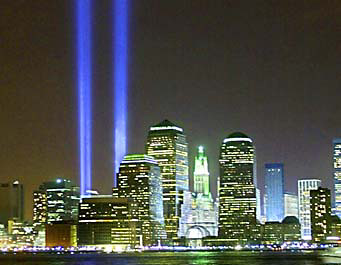
Four years ago our country was attacked.

At this juncture, I find it hard to separate out my feelings about that monstrous crime from my feelings about the hideous uses to which our so-called government has put it, rhetorically, since it occurred -- waving it around like a bloody shirt to justify unrelated wars, attack political opponents and all manner of other things. The horror of the murdered innocents is primary, of course, but I also feel a horror at what my country has become since -- a country which tortures as a matter of policy, a country ever-less free, a country which even today is hosting a revolting spectacle that Matt Yglesias properly described by invoking Milan Kundera's notion of "totalitarian kitsch".

One of the standard complaints about Bush is that he passed up a tremendous opportunity to unite the country: if instead of exploiting the murders for cheap partisan gain he had endeavored to unite the country -- had asked for shared sacrifices, put aside crude partisanship, and so forth -- what good he could have done! If he had finished the war against Al-Queada rather than draining resources from it to fight an unrelated, long-desired war against Iraq, how much safer we might be! If he had, in short, reacted with greatness -- truly acted as if 9/11 had changed everything instead of simply saying it did while acting as if it had changed nothing... But, of course, he did none of those things: merely one of a thousand sins each in itself sufficient to confine him to hell, should such a place exist.

But I must admit that I put forward that criticism (unlike all the others) only half-heartedly: for I never believed it. Most liberal bloggers will tell of how, in the days following 9/11, they put aside their disdain for George Bush, put their trust in him, hoped for his success. Well, I didn't. Oh, I hoped for America's success: in the war against Afghanistan, in tracking down those who sought to do us harm, in limited the proliferation of weapons that they might do it with, in securing the homeland, as we quickly learned to call it. But not Bush. I already felt that he was utterly untrustworthy: viciously and pettily partisan, utterly incompetent, mixing cronyism and ideology in noxious combination. Rather than wish him well, I mostly feared for us that we were stuck with such a man at such a time.

Well, I have since been borne out: alas that I was! If the disaster that was Bush was clear on 9/11, it was utterly evident by November 2004 to anyone who bothered to look -- and may have become outright inarguable given Bush's criminally negligent handling of Katrina, and what it has revealed about our readiness to safeguard our citizens in the event of another terrorist attack (a readiness that was, let us never forget, the key element in Bush's reelection pitch). I have not written much about Katrina since the early days because -- frankly -- I am too heartsickened by the dead, too infuriated by the appalling response at every level. A thousand fine pieces have been written, but I will not bother to link to them here; I can't bear it. Most of you will have seen most of them anyway, I suspect.

In the first day or two after Katrina hit, there were a few calls, even from some normally level-headed leftists, not to "politicize" the situation. These calls were quickly discarded by all except Bush mouthpieces, as it quickly became evident that the situation was entirely political: the lack of preparation, the lack of response -- these are political matters. (Only those who see the political as petty -- only those, ultimately, who do not see it for what it is -- could fail to see that this life or death situation, like most, was and is political. Politics is about the most serious stuff imaginable: life and death, hope and despair, right and wrong, freedom and fear. Nothing is ever too important for politics: politics is about human life, which is as important as things get on this earth.) The calls to be non-political, now, are simply the Bush administrations weaselly way of trying to avoid responsibility for the nightmare they abetted -- indeed, for the nightmare abetted by twenty-five years of a poisonous rhetoric and philosophy which spoke ill of all government. And the left saw this, this time -- very quickly. Because, I think, of how Bush had handled 9/11 in the previous just-shy-of four years.

But in truth I wish that the left had reacted with as much furry and skepticism after 9/11. Uplifting it would not have been: but the country would have been better for it. Politics, ultimately, is not about inspiration but about policy: about what governments do. (To which inspiration may be key, of course. But it's instrumental.) If we had reacted with skepticism and not blind-faith, perhaps the patriot act would have been read by the congress before it was voted on; perhaps the tortures in the American gulag would have been met with fiercer resistance; perhaps the struggle against nuclear proliferation would have counted for more than scoring half-assed political points; perhaps the battle against Al-Queada would not have been shelved in pursuit of another. (In this last regard, let me recommend today's NYT magazine cover article by Mark Danner, who points out -- not in these words -- that while some have said we needed to invade Iraq when we did so that we fought Saddam on our terms and not his, what we ended up doing was fighting Osama on his terms -- terms that have led us to be loosing in the fight that most matters.) Most of all, if we had not had not abandoned skepticism for blind-faith in a faithless fool, perhaps we would have monitored matters, to ensure that our homeland defenses -- against any terror, man-made or natural -- were adequate and not neglected. Perhaps the people of New Orleans and elsewhere would have been treated as they deserved to be. Perhaps more of them would now be alive.

It is hard to properly commemorate the dead of four years ago when the bodies are still being drawn from the rubble of a newly ruined city -- rushing to find them before they can be devoured by wild animals. But ultimately, if they are utterly disconnected in their root cause, they are alike in the utter disaster of the government's response -- albeit a disaster that in one case took four years to see, and in another was evident within hours. Perhaps if we remember this -- and act on it -- we can struggle to make sure that when the next disaster comes (for disasters are unavoidable; only our responses to them are within our control), we are readier to meet it.

The dead of 9/11; the dead of Katrina. Rest in peace.

TowersOfLight

Friday, September 02, 2005

Great Minds Think Alike

A new meme is born. It has what Henry Kissinger once reportedly called the "additional advantage" of being true.

Jeffry Dubner:

These are the things, if nothing else, that government is here for. Liberals, who believe that good government can improve the our lot in life -- as Noam said, that "a robust, efficient government can mitigate, if not completely eliminate, much of the chaos and nastiness in the world" -- recognize that nothing but a powerful, central, active, federal government can do these things. Liberals identify the things that government needs to do and then find ways to fund them. Conservatives, on the other hand, think the government should be shrunk and stripped of power at all opportunities, and that taxes shouldn't be raised for all but the most obvious of social goods (if those). Even at a time when our nation is supposed to be at the highest level of disaster preparedness in history (and has the resources to), the governing conservatives didn't take steps essential to being ready for any massive disaster. If one good thing comes out of this tragedy, it will be the repudiation for decades of the idea that people who don't believe in government have any place running the government.

Kevin Drum:

FEMA was downsized and partially privatized because modern Republican leaders think that's the right thing to do with federal agencies. Budgets were limited for levee construction and first responder training because Republicans have other priorities. The federal government was slow to respond to Katrina because conservatives believe states should take the lead in looking out for their own needs. George Bush talks endlessly to the cameras about the private sector helping to rebuild the Gulf Coast because that's the kind thing conservatives believe in.
Liberals, by contrast, believe in a robust role for the federal government. We believe in sharing risk nationwide for local disasters. We believe that only the federal government is big enough to coordinate relief on the scale needed by an event like Katrina, and that strong, well managed agencies like FEMA should take the lead role in making this happen.
Both of these governing philosophies are defensible, but too often they seem like nothing more than opposing sides in an intellectual game. Katrina demonstrates otherwise. It's what happens when a drowning city runs smack into a conservative
movement that believes in drowning the federal government in a bathtub.

Tom Tomorrow:

I guess this is what you get when you elect leaders ideologically committed to the notion that government isn't good for anything.

Kos:

We have two competing world views in American politics. The first says that government cannot help people. That government must be as small as possible, and exists only to provide security from external enemies. The other says that government can be a force for good and can help make people's lives better.
This week, we are seeing the effects of the lack of government. The American people are seeing what happens when the worldview is dominant. We've talked about the two disasters -- the hurrican itself, which was unavoidable, and the response to the hurricane and lack of leadership, which was.
We are seeing a third disaster -- the conservative world view itself, crashing and burning as reality meets ideology. Where government programs are slashed in the name of Norquist's drownable government, only to see an entire major city wiped off the face of the map as a result.

Matt Yglesias:

Liberals think there should be taxes, and that the revenue thereby raised should be spent on projects that will be useful. The GOP thinks there should be no taxes, programs should be funded if powerful interest groups want them to be funded, and the American military should mainly be used to conquer medium-sized countries that aren't threatening the United States. The result, naturally, is that useful programs wind up underfunded -- and that has consequences.

(and earlier:)

They say there are no atheists in foxholes. Similarly, there are no libertarians in the aftermath of a giant, city-wide flood. Private charities have a huge role to play in these situations, but so does the government, not least to provide coordination.
Ezra Klein:

Government is failing. They're doing it obviously. And reporters and citizens alike are smart enough to extrapolate that if they failed here, they could do it again during a crisis that their hometown. Bush is discrediting small government conservatism by not mobilizing the private sector and he's highlighting the need for an effective big government to pick up the slack.
Rob Salkowitz:

It’s moments like this when you need a party in power that actually believes in the affirmative power of government to help its citizens, rather than the party that sees government’s role as protecting the property of the well-off from the predations of the underclass. It’s when the true ugly soul of American conservatism is borne out for what it is: a rationalization of selfishness and the hysterical denial of community. America is about to see what happens when the government is staffed by people appointed to their jobs precisely for their disdain for the whole notion of policy in the public interest. It’s won’t be pretty.

Thursday, September 01, 2005

Lamentations

Alas!
Lonely sits the city
Once great with people!
She that was great among nations
Is become like a widow;
The princess among states
Is become a thrall.
Bitterly she weeps in the night,
Her cheek wet with tears.
There is none to comfort her
Of all her friends...

All her inhabitants sigh
As they search for bread;
They have bartered their treasures for food,
To keep themselves alive. --
See, O Lord, and behold,
How abject I have become! ...

Her gates have sunk into the ground,
He has smashed her bars to bits...

My eyes are spent with tears,
My heart is in tumult,
My being melts away
Over the ruin of my poor people,
As babes and sucklings languish
In the squares of the city.
They keep asking their mothers,
"Where is bread and wine?"
As they languish like battle-wounded
In the squares of the town,
As their life runs out
In their mothers' bosoms....

My eyes shall flow without cease,
Without respite.

(1:1-2, 12; 2:9, 11-12; 3:49)

Sunday, August 28, 2005

Terrifying Image

From the U. S. Army Corps of Engineers, via Wikipedia:


Update: Another good blog following Katrina here. The latest information is that it may only be a strong Category 4 by the time it hits New Orleans; but they're still predicting that the damage will be catastrophic.

Update (Monday, 11:30 a.m.): From Dr. Jeff Marsters' Wunderblog: "The storm's passage to the east of the city means that New Orleans has escaped the catastrophic blow a direct hit would have delivered, and heavy loss of life is not expected in New Orleans.... Katrina is not hitting at maximum intensity and is sparing New Orleans a direct hit, and although the damage will be incredible, it could have been much, much worse." Thank God!! Although what has happened looks terrible enough.

More Katrina Links

It's like that moment on the 9/11 video when the plane is just about to smash into the tower, but paused; or like one of those nightmares where something is coming but you can't run, you're stuck for no discernable reason. Horror beyond imagining is about to erupt, but not quite yet: a slow-motion descent into hell. God help us.

Here is a complete transcript of the 2002 NPR story about the possibility of a hurricane hitting New Orleans which I linked to earlier (via). Here's a picture accompanying the story, showing how high they think the water might go:


The Hurricane Katrina Wikipedia page is surprisingly detailed.

Wunder blog is keeping track of things closely. Another useful dedicated news blog (mostly repostings, it looks like, but seems like a good selection) on Katrina is here.

The New York Times has a beginning of an answer to my question earlier about the Louisiana National Guard:

Many of Louisiana's national guard forces are currently deployed to Iraq, but the general in charge of the Louisiana troops "has 1,500 troops ready to be deployed, with another couple of thousand that they can tap into pretty quickly," Mr. Nagin said in the CNN interview.

CNN is reporting that Katrina has shut down (not may -- has already) 1/3 of U.S. domestic oil production. Prices are likely to soar, at least temporarily.

Maps of the storm's forecast path.

There's an almost apocalyptic warning from the National Weather Service here. Here's the heart of it:

MOST OF THE AREA WILL BE UNINHABITABLE FOR WEEKS...PERHAPS LONGER. AT LEAST ONE HALF OF WELL CONSTRUCTED HOMES WILL HAVE ROOF AND WALL FAILURE. ALL GABLED ROOFS WILL FAIL...LEAVING THOSE HOMES SEVERELY DAMAGED OR DESTROYED.

THE MAJORITY OF INDUSTRIAL BUILDINGS WILL BECOME NON FUNCTIONAL. PARTIAL TO COMPLETE WALL AND ROOF FAILURE IS EXPECTED. ALL WOOD FRAMED LOW RISING APARTMENT BUILDINGS WILL BE DESTROYED. CONCRETE BLOCK LOW RISE APARTMENTS WILL SUSTAIN MAJOR DAMAGE...INCLUDING SOME WALL AND ROOF FAILURE.

HIGH RISE OFFICE AND APARTMENT BUILDINGS WILL SWAY DANGEROUSLY...A FEW TO THE POINT OF TOTAL COLLAPSE. ALL WINDOWS WILL BLOW OUT.

AIRBORNE DEBRIS WILL BE WIDESPREAD...AND MAY INCLUDE HEAVY ITEMS SUCH AS HOUSEHOLD APPLIANCES AND EVEN LIGHT VEHICLES. SPORT UTILITY VEHICLES AND LIGHT TRUCKS WILL BE MOVED. THE BLOWN DEBRIS WILL CREATE ADDITIONAL DESTRUCTION. PERSONS...PETS...AND LIVESTOCK EXPOSED TO THE WINDS WILL FACE CERTAIN DEATH IF STRUCK.

POWER OUTAGES WILL LAST FOR WEEKS...AS MOST POWER POLES WILL BE DOWN AND TRANSFORMERS DESTROYED. WATER SHORTAGES WILL MAKE HUMAN SUFFERING INCREDIBLE BY MODERN STANDARDS.

(Update: Links added.)

Impending Disaster

There are a lot of things that the U.S. doesn't do very well. One of them is prepare for large but distant threats -- particularly those from natural causes (of course, Bush is doing a disastrous job at treating human-made threats such as terrorism as well, but that's another story). One looming disaster is an avian flu pandemic -- a possibility for which the U.S. is grossly unprepared, and which some experts now estimate as having a 100% possibility of occurring. I don't know why we're so bad at this -- I think that the U.S.'s increasing disdain for science is one reason; I think that simplistic free-market ideologies which attack the very notion of government planning is another.

But I'm horrified to note that another concern that has been long foreseen -- a hurricane making a direct hit on New Orleans -- may be about to occur. Hurricane Katrina is now a category 4 storm, and is heading straight for the city. People are evacuating, but of course not everyone can afford to. (The AP is reporting that at least 100,000 people lack transportation out of town.) I'm terrified to think what could happen.

(Less immediate, but also worrying, is the possibility of major oil disruptions from the storm, and economic havoc that would result. And yes, peak oil is yet another large and distant threat we are horrifically unprepared for.)

Weather is unpredictable; perhaps recent efforts to make preparations will have been adequate. But I'm very worried.

If you're the praying type, now's the time.

Update (Sun 11 a.m.): Katrina is now a Category 5 hurricane -- as high as they go. (Only three category 5 hurricanes have hit the U.S. since they began keeping track.) The Mayor of New Orleans has issued a mandatory evacuation order.

Chris Mooney published a good article warning of this possibility a few months ago in the American Prospect for anyone looking for a little background.

Update (2:15 p.m.): "So basically the part of New Orleans that most Americans, and most of the world, think of as the city could disappear, under the water." "Some scientists think that 40,000 people killed is a conservative estimate." Those are quotes from an 2002 NPR story on the possibility of a disaster should a hurricane hit New Orleans. It's well worth a listen. (I'm just assuming that anyone reading this is safely out of the way...) Part one is here, part two is here. (Via a comment on Daily Kos.) Daily Kos also has a thread of people offering help and shelter. It is heartening to see people reach out, horrible though the necessity is...

A thought occurs. I wonder how much of the Louisiana national guard won't be able to help with the emergency because they're in Iraq?

Wednesday, August 24, 2005

Further Selections from the 1811 Dictionary of the Vulgar Tongue

Picking up more or less where I left off last time, here are some further selections from the 1811 Dictionary of the Vulgar Tongue. Notes in parentheses and italics are mine.

***

DUKE OF LIMBS. A tall, awkward, ill-made fellow.

DUMB-FOUNDED. Silenced, also soundly beaten.

EARTH BATH. A Grave.

ELBOW GREASE. Labour. Elbow grease will make an oak table shine.
(Also included with definitions essentially identical to the modern meaning: elbow-room; eves dropper; eye sore; fat headed; to feather one's nest; feint; to fence (in the sense of to sell stolen goods); fidgets; flabby; freshman; gang; gift of gab (as gift of the gab); gingerly; and many others. In some cases, it feels surprising that the slang goes back so far; in some, that it was listed as simply slang (and not regular English) then.)

ELF. A fairy or hobgoblin, a little man or woman.

EMPEROR. Drunk as an emperor, i.e. ten times as drunk as a lord.

FAGGOT. A man hired at a muster to appear as a soldier.

FALLEN AWAY FROM A HORSE LOAD TO A CART LOAD. A saying on one grown fat.

FAM LAY. Going into a goldsmith's shop, under pretence of buying a wedding ring, and palming one or two, by daubing the hand with some viscous matter.

FAULKNER. A tumbler, juggler, or shewer of tricks; perhaps because they lure the people, as a faulconer does his hawks. CANT.

FICE, or FOYSE. A small windy escape backwards, more obvious to the nose than ears; frequently by old ladies charged on their lap-dogs. See FIZZLE.

FINGER POST. A parson: so called, because he points out a way to others which he never goes himself. Like the finger post, he points out a way he has never been, and probably will never go, i.e. the way to heaven.

FIRING A GUN. Introducing a story by head and shoulders. A man wanting to tell a particular story, said to the company, Hark! did you not hear a gun?--but now we are talking of a gun, I will tell you the story of one.

FLABAGASTED. Confounded. (Note it's not "flabbergasted".)

FLY-BY-NIGHT. You old fly-by-night; an ancient term of reproach to an old woman, signifying that she was a witch, and alluding to the nocturnal excursions attributed to witches, who were supposed to fly abroad to their meetings, mounted on brooms.

FORTUNE TELLER, or CUNNING MAN. A judge, who tells every prisoner his fortune, lot or doom. To go before the fortune teller, lambskin men, or conjuror; to be tried at an assize. See LAMBSKIN MEN.

FRUITFUL VINE. A woman's private parts, i.e. that has FLOWERS every month, and bears fruit in nine months.

GAG. An instrument used chiefly by housebreakers and thieves, for propping open the mouth of a person robbed, thereby to prevent his calling out for assistance.

GALIMAUFREY. A hodgepodge made up of the remnants and scraps of the larder.

GAMON AND PATTER. Common place talk of any profession; as the gamon and patter of a horse-dealer, sailor, &c.

GARRET ELECTION. A ludicrous ceremony, practised every new parliament: it consists of a mock election of two members to represent the borough of Garret (a few straggling cottages near Wandsworth in Surry); the qualification of a voter is, having enjoyed a woman in the open air within that district: the candidates are commonly fellows of low humour, who dress themselves up in a ridiculous manner. As this brings a prodigious concourse of people to Wandsworth, the publicans of that place jointly contribute to the expence, which is sometimes considerable.

GENTLEMAN OF THREE OUTS. That is, without money, without wit, and without manners: some add another out, i.e. without credit.

To GIGGLE. To suppress a laugh. Gigglers; wanton women.

GODFATHER. He who pays the reckoning, or answers for the rest of thecompany: as, Will you stand godfather, and we will take care of the brat; i.e. repay you another time. Jurymen are also called godfathers, because they name the crime the prisoner before them has been guilty of, whether felony, petit larceny, &c.

GOOD MAN. A word of various imports, according to the place where it is spoken: in the city it means a rich man; at Hockley in the Hole, or St. Giles's, an expert boxer; at a bagnio in Covent Garden, a vigorous fornicator; at an alehouse or tavern, one who loves his pot or bottle; and sometimes, though but rarely, a virtuous man

GORMAGON. A monster with six eyes, three mouths, four arms, eight legs, live on one side and three on the other, three arses, two tarses, and a *** upon its back; a man on horseback, with a woman behind him.

TO GOUGE. To squeeze out a man's eye with the thumb: a cruel practice used by the Bostonians in America.

GRANNY. An abbreviation of grandmother; also the name of an idiot, famous for licking, her eye, who died Nov. 14, 1719. Go teach your granny to suck eggs; said to such as would instruct any one in a matter he knows better than themselves.

Shorter David Brooks (Now in Three Flavors!)

I managed to find two people who don't think that Iraq's constitutional situation is totally FUBAR.

Alternative paraphrase:

Bush's most insightful critics are those who actually don't criticize him at all.

Yet another paraphrase:

Notwithstanding its being written in English by US Embassy staff members, the new constitution is deeply Iraqi.

Choices, choices...

Tuesday, August 23, 2005

Quote of the Day

SNYDER: One day the campus is completely bare. Empty. The next, there are children everywhere. Like locusts. Crawling around, mindlessly bent on feeding and mating. Destroying everything in sight in their relentless, pointless desire to exist.
GILES: I do enjoy these pep talks. Have you ever considered, given your abhorrence of children, school's principal was not, perhaps, your true vocation?
SNYDER: Somebody's got to keep an eye on them.

-- Joss Whedon, "When She Was Bad", Buffy the Vampire Slayer

Monday, August 22, 2005

Why Does It Still Matter?

Liberal hawks are saying that we need to debate what to do in Iraq now -- and that the issue of whether support for the war was justified (or even justifiable) in March 2003, and the issue of who-supported-what-when, is now moot. Those of us on the left side of the spectrum -- those who were always against the war, or who turned against it early and seriously (i.e. not with a quick, defensive, dismissive mea culpa but with genuine regret) -- tend, not monolithically but in general, to say that no, it still matters. (Though of course we also need to discuss what to do now.) So the question is why? Why does it still matter?

This is important in part because the desire (or even demand) for extended expressions of self-recrimination are at best unseemly, and at their worst have an air of communist-style "self-criticism" about them. Further, those on the pro-war left seem to think that some of the attitude of the left is akin to gloating -- we-were-right-and-you-were-wrong. And while I would emphatically deny the implications of "gloating" -- no one with the slightest bit of sense is in the least bit happy about the horrendous situation we have gotten ourselves into -- I do think that, at least in some cases, the desire for extended mea culpas is driven by a not-very-admirable desire to have them admit that they were wrong -- a desire that is not due to gloating but to helpless, heartbroken rage: damnit, if you had just seen this back in the day, maybe -- not likely but maybe -- we could have stopped this thing. I know this is true because it's true of me: it is frustrating and depressing that everything that has gone wrong was so clear, the size of the blunder so utterly evident, and yet that even people supposedly on our side aided and abetted it.

But there are other reasons -- good reasons -- that this still matters. Let me list some of them.

First of all, there is historical truth. I know, I know: that sounds quaint. Yet as a historian, an academic, a person who spends much of his life engaged with ideas, I find it important. Call me silly, but I do.

Second, there is the political issue. This war is, at this point, desperately unpopular. And, as much as any war has ever been, this is a war due to a single, particular individual: George W. Bush. This is an issue that should hang around the Republicans' neck like a loadstone for a generation. Yet this can't happen, won't happen, so long as many of the most prominent democrats still support the decision to go war -- even in retrospect. Insofar as this is a political issue, it is not an issue of having-to-have-been-right: but you need to be right now. Whether they say they were lied to or say that given the administration's now-evident incompetence they now think--, or whatever, democrats need to be united on the idea that this war was wrong. It seems crass to treat a horror of this magnitude as a political issue. But to prevent future horrors -- and ongoing policy disasters -- we need to do so. Certainly the other side has done so, and is doing so, a thousandfold more than we have (Bush evoked 9-11 as an excuse for Iraq most recently today.) So all the prominent democrats -- DLCers, Biden, Clinton, Kerry, the lot -- need to say, strongly and clear, that we should not have done this.

Third, there is the issue of avoiding future mistakes. This is really one we should have learned from Vietnam. While there are, of course, numerous differences -- there always are, in any two historical situations -- the similarities are so strong that we really should have seen this coming. If we can't now see that this was a mistake we'll just make it again in twenty years -- or whenever Bush decides to invade Iran -- which, I think, will be right after the next terrorist attack in this country (attacks that his Iraq policy have, of course, made more not less likely, and which his other policies have done little (certainly far, far less than they ought to have) to prevent). The mainstream, centrist, liberal establishment supported the Vietnam war for years; they were wrong, and should have known it at the beginning (certainly from the point of major escalation in 1965; and they should have asked questions that they did not of the Gulf of Tonkin resolution in 1964). The mainstream, centrist, liberal establishment supported the Iraq war, and they were wrong again: if we are to avoid another go-around of this, we need to make this very clear -- in the culture, in the Democratic party, and in leftist circles generally. This is all the more crucial because even those liberal hawks who have admitted that they were wrong seem, generally, to have not come to grips with why they were wrong (about which more in a moment), tending instead to focus on the safe ground of 'we should have known that the Administration would mess it up' -- true, but not the whole story.

Finally, and most crucially, there is the fact that they are still making the same mistakes today. Whether this is true of the various intellectuals, think-tanks and consultants who continue to support the war or not I'm not certain, although I suspect it is. But it seems unquestionably clear of the actual, front-line politicians, including most of the people who -- alas, alas -- are currently in the front of the running for the 2008 Democratic nomination. They are currently supporting policies for the same reason that they, disastrously, supported the war.

What do I mean by that? (Since obviously they are not now saying that Iraq has/had WMD and is/was a threat!) To answer that, we need to get at the root of why they supported the Iraq war in the first place. I can't bring myself to believe that, at root, it was about WMDs, or any of the other myriad reasons that were given for supporting the war. I can't believe that because it was so clearly wrong at the time, as was evident by the fact that damn-near 40% of the country (and most of the civilized world outside of it) opposed the war, stating clearly that it was wrong: that, fundamentally, Iraq was no threat to us. (We may have thought Iraq had some minor WMDs (i.e. not nukes, not smallpox) lying around, but we thought that Iraq was not a threat -- particularly given the genuine threat that other countries, to say nothing of Al Queada, presented.) If a large group of people are saying something, and it turns out to be true, then it is hard to credit those who say that they could not have known it at the time. We are entitled, I think, to look elsewhere for an explanation.

And I think the explanation is, in a nutshell, to look tough. They were afraid, post-9/11, of looking weak -- to the public, to other policymakers, pundits, establishment intellectuals, and so forth -- and thus supported this war without thinking it through. They ignored the reasons to think it would be a mistake -- probably less in the sense of deliberately and consciously turning away from them, but more in the manner of never looking at them with unjaundiced eyes in the first place. They dismissed those who made the arguments that have turned out to be right as peaceniks, or weak, or even anti-American -- and thus did not see the truth of what we were saying.

A big part of this is what Publius insightfully called "the other Vietnam syndrome", which he described as follows:

The original “Vietnam syndrome” referred to the reluctance of Americans to send troops to war after the fall of Saigon. The critique that many conservatives and hawkish liberals made was that this reluctance morphed into irrational knee-jerk hostility to the use of any and all military force. What I call the “other Vietnam syndrome” is precisely the opposite. It refers to the mindset of those who are so anxious to distance themselves from the anti-war movement of the 60s that they have developed an irrational and knee-jerk acceptance of any and all exercises of military force.

What is crazy about this, as Publius goes on to note, is that this "other Vietnam syndrome" persists in spite of the fact that -- as most Americans as well as most historians and policymakers (or at least centrist and liberal policymakers) now believe -- the anti-war movement was right about Vietnam: we should have gotten out long before we did; it was a mistake to be there in the first place. This is mirrored in the fact that, in Timothy Noah's words (quoted by Publius in his post), mainstream Democrats continue to make "support for a mistaken policy [invading Iraq] a litmus test" because "it shows that the person in question is willing to project U.S. force abroad" -- which Noah calls the D.C. consensus and "completely insane". (Indeed, some people are still arguing for reading people out of the party on essentially this basis!)

In other words, people, even those who now admit it was a mistake, are still only listening to those who supported the invasion of Iraq because it makes them look tough.

But I fear that this is the main motivation behind the centrist Democratic support for Bush's non-policy policy of "staying the course" -- certainly for the (essentially cowardly) politicians of the DLC-persuasion who support the war out of a pathological fear of looking weak, despite the fact that majorities of Americans now think it was a mistake (to say nothing of the fact that it has clearly made the U.S. far less secure in numerous ways), but probably also for the pundit/consultant/intellectual class as well.

Now, people are right that we need to have a debate about what to do now. (This seems like a good opening salvo to me.) I'm not saying that people have to support a withdraw-now position to be taken seriously. I am saying that people have to recognize that a concern for American security sometimes leads to not using force to be taken seriously. Even aside from the historical, political and future-policy necessity of seeing and openly saying that this war was wrong which I outline above, I -- and many on the left -- find it almost impossible to take seriously anything that establishment, centrist, pro-war liberals have to say on the 'what-should-we-do-now' issue without some sense that they have gotten over this "other Vietnam syndrome". Until liberal hawks see not only that they were wrong but why they were wrong, they will continue to distort their policy recommendations out of a misguided desire to look tough. Until they make it clear that they see why they were wrong, those of us who were right about this war are, I think, justified in distrusting their judgment on the what-to-do-now issue -- since they are still looking at this war with jaundiced eyes.

The country should never again blindly support a war out of a desire to be tough. But I would hope that, above all, liberal hawks would see that they in particular should never again dismiss those who question the use of military force as unconcerned with American security, as knee-jerk pacifist or weak or antiwar or anti-American, given that they have themselves shown themselves to be knee-jerk prowar, blindly in favor of a policy which has made America less safe. Let their mistake in supporting this disastrous war teach them that at least, lest we continue making the same mistakes over and over again.