Thursday, December 03, 2020

The Inscription Over a Modern Gate to Hell

Philip Terry is a writer who works in the oulipian tradition.  He is the author of a novel, The Book of Bachelors (1995) (which was published in its entirety in an issue of The Review of Contemporary Fiction), which consists of nine chapters, each a lipogram on a different letter of the alphabet. He wrote a book of versions of Shakespeare's Sonnets, each modified by a different oulipian constraint (the results are predictably mixed).  And he did a... you can't really call it a translation... adaptation of Dante's Inferno.

For comparison, here are the opening five stanzas of Alan Mandlebaum's translation of the Inferno, Canto III:

THROUGH ME THE WAY INTO THE SUFFERING CITY,
THROUGH ME THE WAY TO THE ETERNAL PAIN,
THROUGH ME THE WAY THAT RUNS AMONG THE LOST.

JUSTICE URGED ON MY HIGH ARTIFICER;
MY MAKER WAS DIVINE AUTHORITY,
THE HIGHEST WISDOM, AND THE PRIMAL LOVE.

BEFORE ME NOTHING BUT ETERNAL THINGS
WERE MADE, AND I ENDURE ETERNALLY.
ABANDON EVERY HOPE, WHO ENTER HERE.

These words—their aspect was obscure—I read
inscribed above a gateway, and I said:
“Master, their meaning is difficult for me.”

And he to me, as one who comprehends:
“Here one must leave behind all hesitation;
here every cowardice must meet its death.

And now, here are the opening lines of Philip Terry's Canto III:

THROUGH ME THE WAY TO THE DOLEFUL CAMPUS,

THROUGH ME THE WAY TO ETERNAL DEBT,

THROUGH ME THE WAY TO THE FORSAKEN GENERATION.


FREEDOM OF THOUGHT INSPIRED MY FOUNDERS;

POLITICAL EXPEDIENCY RUINED ME,

COUPLED BY BETRAYAL OF PRINCIPLE AND PLEDGE.


BEFORE ME NOTHING BUT ETERNAL THINGS WERE MADE,

NOW I SHALL MARK YOU ETERNALLY.

ABANDON ALL HOPE, YOU WHO ENTER HERE.


I saw these words spelled out on a digital display

Above the entrance to the Knowledge Gateway.

‘Master,’ I said, ‘this is scary.’


He answered me, speaking with a drawl:

‘Now you need to grit your teeth,

This isn’t the moment to shit yourself.

It's quite funny— the first nine lines are, I think, a very good joke.

But I am rather uncertain, having read (thanks to Amazon's "see inside" feature) the opening two and a half cantos, whether it's a joke that can be sustained over an entire book.  So I am hesitant to plunk down $16 to get a copy.

Anyone know if the whole thing works at all?

Thursday, November 26, 2020

The Same Thanksgiving Post I Have Put Up Every Year Since 1621

Serve the LORD with gladness: come before his presence with singing.... Enter into his gates with thanksgiving, and into his courts with praise: be thankful unto him, and bless his name.

-- Psalm 100: 2, 4

ANYA: I love a ritual sacrifice.
BUFFY: It's not really a one of those.
ANYA: To commemorate a past event, you kill and eat an animal. It's a ritual sacrifice. With pie.

-- Buffy the Vampire Slayer, "Pangs" by Jane Espenson

The title of this post is false, of course: after an unbroken streak from 1621-2013, I have not posted it in seven years. But a friend of mine said he looked forward to it, so, in honor of the day, I am resuming, at least for this year, the ritual. There are so many rituals we will lack this year; this is one I can reclaim.

If you are reading this, I am thankful that you have (to borrow from another tradition) been granted life, been sustained, and been enabled to reach this occasion.  Too few of us have.  I hope you are being safe today; for even fewer will have by next year, or even by New Year's.

The Buffy the Vampire Slayer quote above comes from the Thanksgiving episode Pangs; you can watch the clip of it here:


And another, bonus quote from the same episode is here:


It's a fun episode; but for those of you reading this who aren't familiar with the show (hi Jon), not really the best place to start. Hit me up if you want more advice along these lines.

Happy Thanksgiving, everyone.

Tuesday, September 15, 2020

A Longer-Term Problem


I know we're all (rightly) paralyzed with fear and anxiety about the next few months, but allow me a moment for a longer-term worry.

I heard some of Biden's speech on climate change this morning. And I had two thoughts. First, it was (as far as a Democratic candidate goes) superb: a level of alarm and seriousness which is very welcome (and, yes, long over due). I doubt that Bernie could have done better.

But I fear he fell into a trap not specific to him, but broadly arising out of liberal politics. He said that if we reelect a "climate arsonist" (great term), more of America will burn, more will flood. But he seemed to imply that if we elect him instead, this won't happen. The horrible truth, of course, is that at this point 20-30 years of ever-increasing climate misery are already baked in. We're going to spend the next three decades paying for the last three decades of emissions (you know, the 50% of all emissions throughout history which were produced after we were thoroughly warned & had supposed begun to react).

This doesn't mean that reducing our emissions rapidly is not a priority; it has to be. But that's because if we don't act now things will be unimaginable—perhaps literally unendurable—in the second half of the century. We need to ensure a future for later generations. But the near-term present will be increasingly worse regardless. — Of course, there are things we can and should do to help the next few decades, adaptation and social strengthening of all sorts. But those are to live through the climate misery, not avert it.

Again: nothing Biden said was wrong, precisely. Certainly a vote for the climate arsonist is as immoral as it is possible to imagine—solely on these grounds, even aside from everything else. But he hasn't done anything to prepare people for the longer-term struggles ahead. I don't think that's a failure of Biden's; I think it's a problem with liberal democracy, which must sell people the idea that they will have a better life if they vote for us. Whereas now we have reduced ourselves to choosing between bad and worse for the rest of our natural lives.

Not now, not in the next two months, but soon, we're going to have to learn, as a political movement, as a society, to talk about these things. We don't want Joshua Hawley or Tucker Carson or Don Jr to get up and say in 2024, "you said you'd fix this!". We need to communicate to people the urgency, but also the length of the storm. This won't be fixed in four years, nor even in forty, although in forty we will make some serious strides (or else have dug our own graves). We need to learn to speak of care; of struggling together to survive the damage already done; of preparing for the long term. Because that's what we need to do, now.
 
Housekeeping: this is reposted from FB. Preparing it for blog publication, it occurs to me I've been nattering about this long enough that the tag is "global warming" and not the more up-to-date "climate change" — or the currently trending "climate emergency". What will we call it in a decade?  Just ordinary life, I suppose.  Or perhaps our long twilight struggle.

Sunday, March 08, 2020

A Pesitlence Isn't a Thing Made to Man's Measure

"Everybody knows that pestilences have a way of recurring in the world; yet somehow we find it hard to believe in ones that crash down on our heads from a blue sky. There have been as many plagues as wars in history; yet always plagues and wars take people equally by surprise.… When a war breaks out, people say: 'It's too stupid; it can't last long.' But though a war may well be 'too stupid', that doesn't prevent its lasting.…

"In this respect our townfolk were like everybody else, wrapped up in themselves; in other words they were humanists; they disbelieved in pestilences. A pestilence isn't a thing made to man's measure; therefore we tell ourselves that pestilence is a mere bogy of the mind, a bad dream that will pass away. But it doesn't always pass away and, from one dream to another, ti is men who pass away...

"They went on doing business, arranged for journeys, and formed views. How should they have given a thought to anything like plague, which rules out any future, cancels journeys, silences the exchange of views. They fancied themselves free, and no one will ever be free, so long as there are pestilences."

— Albert Camus, The Plague

Tuesday, September 24, 2019

TWO IMPORTANT LANGUAGE NOTES

1) The proper English term for the Jewish celebrations in early adolescence is hereby termed "b'mitzvah" (both singular and plural). This allows easy sentences like, "when are your kids' b'mitzvahs?" or "we've been going to a lot of b'mitvahs lately", to say nothing of gender-noncomforming kids.

2) The word ducking is now an intensifier, as in "I can't ducking believe Pelosi actually had the guts to start impeachment hearings", and "I hope that the GOP is willing to do its ducking job and convict". Easier on kids & Apple ducking lets you type it.

Signed,

The English Language Academy

Saturday, June 22, 2019

Happenstance: the Print Edition

I assume most visitors to this blog know that I spent many years creating a graphic novel, and that over the past two years I have been serializing it online (you can read it here.)  Now I am trying to fund a print edition by running a kickstarter campaign.  You can learn more, donate and pre-order the book here:

https://www.kickstarter.com/projects/happenstanceprint/happenstance-the-print-edition

Go have a look!

Wednesday, June 05, 2019

"But What Can I Do?"

A friend on facebook (who will be anonymous unless they say they'd like to be named) asked. re climate change: "But what can we do? I have yet to come up with anything we can do as individuals that could possibly help. Have anything?"

My reply:

"As individuals"? No. Nothing we can do as individuals is remotely equal to the scale of the problem. I mean, sure, drive less, fly never, get solar panels — all good things. But if everyone who cared did this it won't help. Only a radical restructuring of society and the economy can save us.

So what can we do? What we need to do is to elect politicians committed to a restructuring of the economy and society to a degree consonant with the problem. Not just Democrats; AOC Democrats, not Biden Democrats. (Along those lines: go to marches. Sign petitions. Give money. Make sure Jay Inslee is in the debates, at least.)

How do we do this? The only thing I know of, broadly, is to change the way people think. The best thing to do, I suppose, would be to find conservatives you know and convert them. That's tough, though. Second best? Try to convince liberals you know to treat the problem with the seriousness that is its due.

That's why I post on it all the time. If enough of us get that this is an emergency, one that will need to be solved by greater-than-WW2 style mobilization starting yesterday, then maybe, *maybe*, we can overcome this.

So talk about it, as often as you can stand or more. Be that annoying person who always points out that the house is on fire. And get everyone you know to talk about it.

If enough of us talk, if enough of us listen, then we won't be individuals any more, but a collective. And then maybe we can do something that can help.

Thursday, May 02, 2019

HAPPENSTANCE, pages 402-403

My graphic novel Happenstance — which I have mentioned & linked before on this (admittedly all-but-dormant) blog — continues to be published, two pages twice a week, here.  If you haven't read it, check it out!

Today's pages, however, are highly unusual: an attempt to (in Abel & Madden's marvelous phrase) draw words without the usual addition of written pictures.  It's part of a sequence that is interspersed throughout chapter 11, in which one of the characters sits with another in the hospital.  Intercutting between that and a conversation, I use different techniques to try to capture this experience.  Most of those techniques are visual.  This is linguistic — or, rather, linguistic-as-visual.  It's an old technique, of course: the first of the page owes much to the work of William Gaddis and similar writers; the one on the left is an example of concrete poetry, which is a whole form with its own traditions, etc.

But the result of this is that I am using more words in smaller fonts than elsewhere in the book. And the way the site that hosts the work works, I have to use smaller file sizes than the book was created in... and thus the words aren't always easy to read.  So I am reposting these pages here, full-size:
Click through to see it more clearly!

And if you haven't read Happenstance before, I hope you will check it out.  Just go here and click through!


(And don't overlook the helpful little "save my place" button on the bottom of each page!)

Tuesday, April 16, 2019

Poem of the Day: Notre-Dame de Paris de Gérard de Nerval

NOTRE-DAME DE PARIS

Notre-Dame est bien vieille : on la verra peut-être
Enterrer cependant Paris qu'elle a vu naître ;
Mais, dans quelque mille ans, le Temps fera broncher
Comme un loup fait un boeuf, cette carcasse lourde,
Tordra ses nerfs de fer, et puis d'une dent sourde
Rongera tristement ses vieux os de rocher!


Bien des hommes, de tous les pays de la terre
Viendront, pour contempler cette ruine austère,
Rêveurs, et relisant le livre de Victor :
- Alors ils croiront voir la vieille basilique,
Toute ainsi qu'elle était, puissante et magnifique,
Se lever devant eux comme l'ombre d'un mort!

— Gérard de Nerval (1808 - 1855)

And here is a translation by Guy Lionel Slingsby (from Facebook):

Notre Dame is quite old: one will see it perhaps
Still bury that Paris it saw at its birth;
But in a few thousand years Time will cause to collapse
(As wolves do to cattle) this carcass to earth,
Twist its tendons of iron, then with a deaf tooth
Chew its bones made of rock, which fills us with ruth.

From all over the world, many people will go
To gaze at and brood on this ruin thus purged,
But these dreamers, rereading the work of Hugo:
Will imagine they see standing there the old church,
Just as it was in its glory and power:
Like the shadow of death, the cathedral will tower!

Friday, March 15, 2019

Poem of Some Day That Turns Out to Be the Poem of Today

W. S. Merwin died today. (NY Times obituary.)

Here's a poem he wrote for the occasion.
For the Anniversary of My Death

Every year without knowing it I have passed the day
When the last fires will wave to me
And the silence will set out
Tireless traveler
Like the beam of a lightless star

Then I will no longer
Find myself in life as in a strange garment
Surprised at the earth
And the love of one woman
And the shamelessness of men
As today writing after three days of rain
Hearing the wren sing and the falling cease
And bowing not knowing to what

—W. S. Merwin

RIP. Baruch dayan ha-emet.

Friday, January 04, 2019

My Photographic Novel, Happenstance, Is Nearly 3/4 Posted! Start Reading Now!

A graphic novel I wrote & illustrated (using photographs and photoshop) has been serializing online for about a year and a half, now.  It's about two friends who change their religious views in opposite ways, but in dialogue with each other; and about the fallout from those changes in each of their lives.  I thought I'd pop up here and say it's still posting! You can go read it!  Two new pages go up twice a week, on Mondays & Thursdays.  It's nearly 3/4 up — I just put up pp. 332-333 out of an eventual 444 yesterday, and we're nearing the end of chapter 9 (of 12).  So click here and check it out:


The graphic novel to date can be read here: http://happenstance.thecomicseries.com/

If you haven't read it, give it a try; and if you like it, share it with your friends!

Tuesday, February 27, 2018

Poem of the Day: Four Strategic Lines

Four Strategic Lines

There, four strategic lines are anagrams.
I'm rearranging letters. A chaos features
in the rule, frames reason, grates a tragic,
rare formula. A strange aesthetic reigns.

Anthony Etherin

Friday, January 26, 2018

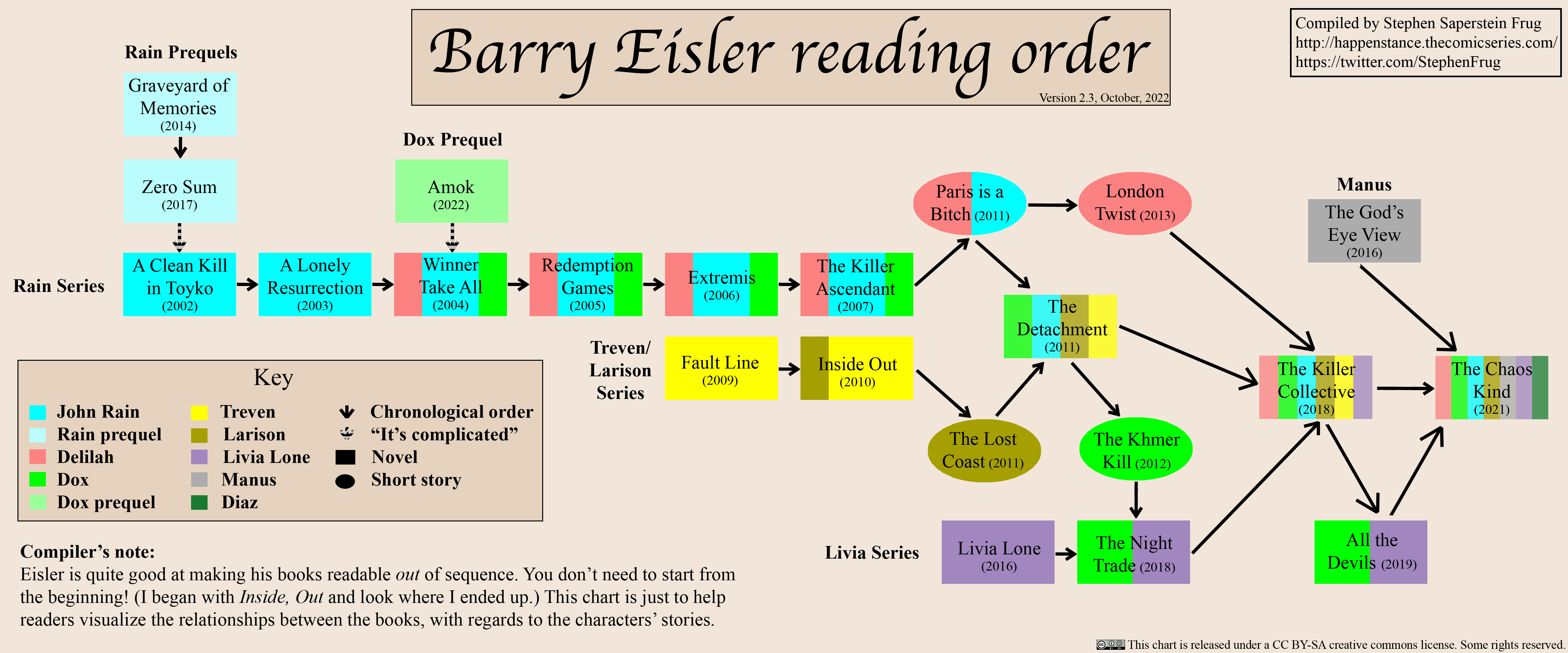
Barry Eisler Reading Order

Charted updated as of December, 2022.

Some of my favorite light reading are the thrillers of Barry Eisler. As he's gone along, the overlaps in his characters/series have become more complicated.  So, in a fit of OCD and with a nod to the Terry Pratchett Reading Order guide, I made this chart. I offer it here for the edification of all and sundry.  But do take the compiler's note about how you can start anywhere seriously.

(Click for a larger version.)

Incidentally, I got into this because I had just bought my aunt the second Livia Lone book as a present — she'd liked the first — and was trying to think of how to explain who Dox was and how he fits in.  It's tricky!

 (Now updated for his forthcoming novel The Chaos Kind (October, 2021). Also released under a Creative Commons BY-SA license, in case anyone feels inspired to improve upon it. (Email me for the photoshop file if you want it.)

Sunday, December 17, 2017

Alias Grace: A Brief Review

So I just binge-watched the Netflix series Alias Grace, on Netflix (based on the Margaret Atwood novel, which I haven't read). I recommend it. It's a historical drama, focused on women's experiences (even the parts about men are about how they think about, and use, women), and a lot about power and the lack of it. It's also a marvelous narrative contraption, with some real subtle possible interpretations lurking just under the surface of the ending, leaving us with a marvelous ambiguity. Also very well acted & shot. (One other advantage: it's a good length, six 45-minute episodes, and it's a closed story, not an open-ended thing.)

If you don't know, it's based on a true story, a mid-nineteenth century murder case (this is not a spoiler, it's shown in the first few minutes, and then circled back to, repeatedly).

The only negative comment I have, really, is that the actors are required to play a very wide range of ages. The lead actress is superb as the main age she's asked to do, but a scene where she gets her first period was jarring because I'd assumed (just from appearance, not having adequately thought through the timing) that she was supposed to be about 20 at that point. Similarly, one actor at the end (shan't say who, it's a spoiler) is made up to be old & it's quite unconvincing. Not sure how this could have been avoided, though.

One particular thing I really liked is a spoiler, so I'll ROT13 it: Va gur svany rcvfbqr, jura Tenpr fcrnxf va Znel'f ibvpr, vg ernyyl fbhaqrq yvxr gur npgerff jub cynlrq Znel gb zr. Ohg ernqvat hc n ovg, vg'f npghnyyl zhpu pbbyre guna gung: nccneragyl gur npgerff jub cynlrq Znel qvq gur fprar, fb gur npgerff jub cynlrq Tenpr pbhyq zvzvp vg, naq gura gur npgerff jub cynlrq Tenpr npghnyyl qvq jung jr urneq. Vg'f dhvgr n fcyraqvq ovg bs npgvat juvpu uvgf dhvgr gur evtug abgr.

Don't let that stop you, though. It's quality television. (And now I want to read the book!)

Saturday, December 02, 2017

From a Commonplace Book

[Responding to the question why he was not a member of any specific religion:]
Because they all appear to have prohibitions, admonitions and proffered truths which cannot be established as a matter of intellect or natural law, which is reason -- simple reason -- unattended by revelation of faith. Most of them insist that you believe in certain things not because you can prove absolutely that they are so, but because you want to believe in them. Give me a church or a religion that has one principle: Love one another as you love yourself, and I will belong to that church.

-- Abraham Lincoln

Friday, December 01, 2017

From a Commonplace Book

There are, of course, more important things than art: life itself, what actually happens to you. This may sound silly, but I have to say it, given what I’ve heard art-silly people say all my life: I say that if you have to choose between life and happiness or art, remember always to choose life and happiness.

-- Clement Greenberg

Thursday, November 30, 2017

From a Commonplace Book

When I gave food to the poor, they called me a saint; but when I asked why people are poor, they called me a communist.

-- Bishop Don Helder Camara

Wednesday, November 29, 2017

Secondary Sources On Gene Wolfe's Book of the New Sun

A friend of mine, seeing my previous post (on FB), asked whether there were "annotations" of Gene Wolfe's SF masterpiece, The Book of the New Sun.  Since I wrote a lengthy reply, I thought I'd repost it here, with links.  (In the following, the "you" is my friend, natch.)

I don't think there's quite what you're looking for. The closest that there is—and in any event the first secondary work devoted to The Book of the New Sun that one should lay hands on—is Lexicon Urthus: A Dictionary for the Urth Cycle, by Michael Andre-Druisi. It defines many of the obscure words, and also has a certain amount of commentary/exposition, although hardly a complete reading. Beyond that I can think of three other books, none quite perfect for your needs: there is Attending Daedalus by Peter Wright, which is about Wolfe's work in general but which focuses on The Book of the New Sun; there is Marc Aramini's Between Light and Shadow, volume one of a projected three-volume work discussing all of Wolfe's fiction, but its entry on The Book of the New Sun, while good, is brief (c. 40 pages) and is more thematic than annotational. And then there's Solar Labyrinth by Robert Borski, which has a number of essays on specific puzzles in the Urth cycle. All three are worthwhile; none are quite what you're looking for.

That's mostly it for books. There are a few essays scattered around — in review collections by John Clute, for instance — but nothing systematic. Three web resources might have some more of what you're looking for. First, there's the Wolfe Wiki, which is variable (some works get only a skeleton treatment, some a very detailed reading), but it looks like there's some good stuff there. There are the archives of the Urth List, which is the mailing list/forum for discussion of Wolfe's work, which has a lot of stuff in it, but so far as I know it's not indexed & you'd have to do a tremendous amount of searching. And then there's Reddit, about which I don't know much, but it looks like there's a fairly active Gene Wolfe section there. Again, while I imagine there's some good stuff in all three, none are quite what you're looking for.

One more set of resources to discuss. There are now two podcasts devoted to close readings of GW's work. One, The Gene Wolfe Literary Podcast, seems good, but it's just starting (and I've heard only one episode), and is doing a lot of short stories & many novels before they get to the The Book of the New Sun. So they probably won't get to it for years. The other, Alzabo Soup, is actually doing The Book of the New Sun now. But at this point I can't quite recommend it. I find many of their readings simply careless: some strike me as flatly disprovable, others as wholly wrongheaded even if not flatly contradicted by clear textual evidence. I'm getting a lot out of it — even with its problems, they pick out details & things I missed on my several times through the books — but I think their overall interpretation is questionable, and I think that, unless you feel you have a good grasp on the text, they will mislead as much as provide insight. I wish this wasn't so; after the first ep or two I had great hopes for it, but I have been disappointed as I've kept listening. I haven't stopped listening yet, but I may; at this point it's more frustrating than enlightening, although it is that, too, at least in certain local observations if not more broadly considered. Alas! I really wanted it to be great. (It's gotten a fair amount of positive attention, so I may simply be an outlier here, but for what it's worth a Wolfean whom I respect a great deal — whom I can't name, because it was a private communication — said they dislike it too, for some of the same reasons.)

Beyond that, I would suggest that a large number of the mysteries—not all, by any means, but more than you'd think—can be cleared up by simply reading the entire work (i.e. both The Book of the New Sun and The Urth of the New Sun, the sequel) closely & carefully, and then doing so a second time, while the first is still fresh in your mind. That's a huge time commitment, of course — five books, each twice — but it's the best route I know of.

I do wish someone would put out a proper annotated edition. (No one will, and if they did they wouldn't hire me to do it, but I would love to if both of these counterfactuals were miraculously overcome.) Or that there was a "rereader's companion", online annotations that went chapter-by-chapter.

will say, in conclusion (after far more than you wanted to read, I'm sure!), that the best route is to get Lexicon Urthus, do a careful reading with it to hand, and then either do a careful rereading, or read the Wright, the Aramini & the Borski volumes, the WolfeWiki pages, and possibly explore other online stuff as well, and then do a careful rereading. Wolfe is work. Personally I think it's well worth it. But many others, doubtless, won't find it so. (Of course the books can also be enjoyed on a surface level, as a sword & sorcery romp, although that's obviously, A) not what they are when read closely, and B) not what you were asking about.)  

Tuesday, November 28, 2017

In Which, as a Throwaway Notion in a Letter, the Origin of the Autarch's Social Role In THE BOOK OF THE NEW SUN Can Perhaps Be Found

And—though I pale to admit it—I have my vice. It is writing, and in everyday circles that is viewed a good deal more seriously than, say, pot probably is in yours. In short, your business is my besetting weakness; your business letters are my pornography; your shop talk my dissipation.

Which gives me a story idea. A nobleman, a pillar of the Jockey Club, who (on alternate Thursdays) creeps away from the Fabourg St. Germain to become (heh, heh!) a Montmarte used-lace merchant. Can't you just see him gloating fierce gloats as he speculates on Society's reaction to the news that he is secretly a petit commerçant? That's me except that I reverse it—I steal way to become a nobleman.

And you know what the petite bourgeoisie think of that.

— Letter from Gene Wolfe to Damon Knight, December 3, 1969
Reprinted in The Best From Orbit (1976), p. 337

From a Commonplace Book

My first concern is not for the reader. That would be pandering. My first concern is not for myself. That would be self-indulgent. The writer's first concern should be for the verbal object that's trying to get itself said.

-- William Gass