Sunday, January 28, 2007

Reading The Sociopath Next Door as a Mystery

I just read Martha Stout's 2005 book The Sociopath Next Door (SND). It's a very quick read -- I went through it in a couple of hours, although I admit that I was exercising my right to skim, particularly since it was not a book that I was reading for work or anything like that. It's not a good book in a conventional literary sense -- it's written in a breezy style that is common to pop books about psychiatric conditions and to books in which the author's name is followed by "Ph.D." on the title page. But it is a very interesting book, and one which seems (so far as I can tell) to be fairly careful in its description of the academic field it describes and which usually modulates its judgments with the sort of qualifiers one would want to keep it from getting overblown and silly.

SND is about sociopaths, people without conscience -- described as a condition affecting 1 in 25 people, or about 4% of the population. (The figure is given rather relentlessly and I wonder about its confidence -- its strikes me as a hard thing to measure accurately.) The sense one gets is that some people are born without conscience the way some people are born deaf or blind -- they lack the "seventh sense", as Stout terms conscience.* Of course, Stout talks about sociopathology as deriving from both nature and nurture -- but she does so entirely from analogy to other traits, admitting quite frankly that while all sorts of psychological problems are due to external factors such as abuse, no such links have been found with sociopathology. What links there are are to genetics, and to culture (as distinguished from individually varying nurture) -- Stout notes that sociopaths, while a universal phenomenon, are more common in some cultures than others: they are apparently rare in China and Japan, for example, while they are distressingly and increasingly common in the U.S. (and Stout talks about some of the ways in which U.S. culture might reward sociopathic traits in its emphasis on individuality, competition, cutthroat capitalism, etc.)

Obviously to write a book about something one must be a bit obsessed with it, and Stout does come across as someone who jumps at sociopaths in corners. This makes it all the more gratifying that she is careful not to attribute more to sociopathology than she ought, talking about other reasons for immoral acts such as obedience to immoral authority, desperation, momentary failings of existent consciences, and so forth. But she is trying to warn us about sociopaths; a key purpose of her book is to try and convince us that such people really do exist, that they are common enough that we'll all meet them, and that we have to be careful. (She does not, alas, deal with the social and psychological implications that would result from that idea being more widespread; it seems that the idea that 1 in 25 people were fundamentally untrustworthy, unable to love, without remorse, etc., while presumably perfectly true, would nevertheless be quite destructive if widely believed -- and for at least some individuals if they think upon it too deeply. Blindness to sociopaths may hurt us, but seeing them everywhere might, too.)

She paints the portraits of a number of sociopaths**, describing their varied courses of life -- of course sociopaths vary in every other way: some are smart, some aren't; some are energetic, some lazy; and so forth, so they take many different paths. (Very few turn out to be the Hannibal Lecterian-murderers that we associate with sociopaths; more are what we think of as garden-variety nasty people.)

At any rate, it's a fascinating book, and I recommend it to anyone interested in the subject. (There's another good review here.)

But concurrently with my normal 'what's-this-all-about-then' read, I read it in an entirely different way as well: as a mystery. All the way through, I kept wondering: Is George W. Bush a sociopath?

I should be very clear: Stout never raises the possibility. She does talk about sociopathic leaders, but always referring to people like Hitler or Mussolini -- uncontroversial examples. She says things which tantalizingly hint at her awareness of the issue -- always vague enough to give her full plausible deniability. Still, when she writes things like:
Do sociopaths understand what they are?... Sociopaths are infamous for their refusal to acknowledge responsibility for the decisions they make, or for the outcomes of their decisions. In fact, a refusal to see the results of one's bad behavior as having anything to do with oneself -- "consistent irresponsibility" in the language of the American Psychiatric Association -- is a cornerstone of the antisocial personality diagnosis. (SND, pp. 49 - 50)
or, to pick one of the most blatant examples, brought up in the context of the intimidation that sociopaths use as part of their manipulation of others:
The resolve to keep respect separate from fear is even more crucial for groups and nations. The politician, small or lofty, who menaces the people with frequent reminders of the possibility of crime, violence or terrorism, and who then uses their magnified fear to gain allegiance, is more likely to be a successful con artist than a legitimate leader. This too has been true throughout human history. (SND p. 159)
-- it's impossible to think that she's not making a coy reference to Bush. She is a Harvard-associated clinician; and while universities are not the swamps of liberal oppression that conservatives imply they are, they are certainly liberal in their culture to the extent that what she wrote must have screamed "Bush" to her and to all her readers. Indeed, I suspect that most conservatives would see this as a dig at Bush too -- although maybe not, since to do so would be to admit that Bush was illegitimately magnifying fear, whereas conservatives would probably believe he was simply confronting evil (not practicing it). -- And, of course, her last sentence gives her coy deniability -- nor is it simply deniability, since of course it is true that tyrants throughout history have used fear to gain allegiance.

Still, these passages (both as blatant as the latter and as merely slightly suggestive as the former) are common in the book, and I couldn't help but wonder what Stout thought of it. She might be a conservative who would bristle at the idea -- although, reading the book, I doubt it. I suspect that it was a coy acknowledgement of what many of her readers would think, which still allowed her to avoid the professionally irresponsible notion of diagnosing at a distance. -- Although she does seem willing enough to diagnose someone as a sociopath based on what one of her patients tells her; many of her examples are presented** as people in the lives of her patients. Inaccurate as psychiatry based on (manipulated, manufactured, partial and inevitably misleading) news depictions might be, I can't see why it's that much less reliable than a diagnosis based on patient interviews, particularly since the latter has a great many sources, which must mitigate their individual inaccuracies somewhat.

Anyway, even if one treats Bush's presentation in the media as an essentially fictional character, and discusses it as such, I was struck by how much the DSM-IV diagnosis list fits it. Stout writes:
According to the current bible of psychiatric labels, the Diagnostic and Statistical Manual of Mental Disorders IV of the American Psychiatric Association, the clinical diagnosis of “antisocial personality disorder” should be considered when an individual possesses at least three of the following seven characteristics: (1) failure to conform to social norms; (2) deceitfulness, manipulativeness; (3) impulsivity, failure to plan ahead; (4) irritability, aggressiveness; (5) reckless disregard for the safety of self or others; (6) consistent irresponsibility; (7) lack of remorse after having hurt, mistreated, or stolen from another person. The presence in an individual of any three of these “symptoms,” taken together, is enough to make many psychiatrists suspect the disorder. (SND, p.6)
By my personal count, Bush falls pretty clearly into six of those categories (the exception being #1). In some cases (e.g. #3) this is true for his policies, but not necessarily for his personal relations with people. But even in his personal life, #4, 6 and 7 are frequently documented. And in some cases (e.g. #5) the personal and the political are impossible to disentangle.

Again, this is Bush's media image. Who knows. But his protestations of his own certainty and lack of doubt about his leading the country into war on false premises is striking (compare the stories of Lyndon Johnson, having lead us into an equally unnecessary war, torturing himself with guilt about American deaths); indeed, he recently said that he slept better than most people would think.

Further, most -- not all, but most, probably around the 6/7 that he scores here -- of the other things that Stout says about sociopaths seem to fit Bush as well -- their frequent reliance on drugs and alcohol, for example. Reading the book, one is hit by it over and over and over. I find it impossible to think that Stout thought it, too, and repressed it as much as she needed to for professional integrity, while giving ample material for readers to draw their own conclusions. Since it seems so clear.

Or does it?

In her antepenultimate chapter, Stout considers people at the opposite end of the spectrum -- those who have stronger consciences than the rest of us. And she writes:
In a book that documents their findings entitled Some Do Care: Contemporary Lives of Moral Commitment, [Anne Colby and William Damon] report three striking commonalities among individuals of extreme conscience. The authors label these shared characteristics as (1) "certainty, (2) "positivity," and (3) "unity of self and moral goals." "Certainty" refers to an exceptional clarity concerning what the exemplars believe to be right, and also their sense of an unequivocal personal responsibility to act on those beliefs. "Positivity" expresses the exemplars' affirmative approach to life, their extraordinary enjoyment of their work, and their marked optimism, often despite hardship or even danger. And "unity of self and moral goals" describes the integration of the subjects' moral stance with their conception of their own identity, and the perceived sameness of their moral and personal goals. (SND, p. 194)
Just before I hit this passage, I had just about convinced myself that Stout was playing a coy game. But this gave me pause. I realized at once that it sounded a lot like the descriptions that conservatives tended to give to Bush. Where I, a liberal, saw Bush as having the features of those lacking conscience, conservatives see him as having the features of those with "extreme conscience"! To be sure, not everything here fits (does anyone really think that Bush shows "extraordinary enjoyment of [his] work"?), but a lot -- moral clarity, marked optimism despite danger -- seems to match conservative rhetoric quite powerfully.

So perhaps what I'm seeing is just a reflection of my own beliefs.

Now, I don't in fact believe that. I'm not a relativist. I think that one can distinguish the powerful fit of the sociopath description with the extremely shallow, only apparent fit of the extreme conscience description -- point out that despite Bush's purported moral clarity, there is hardly a principle he hasn't broken, for example, or the fact that his willingness to deal in Rovian dirty tricks to achieve his ends demolishes any notion of "a perceived sameness of their moral and personal goals."

I'm not even sure that Stout would see this; a few of the (few) other things she says about Colby and Damon's categories markedly don't fit, just as many of the other things she says about sociopaths do. For instance, she writes that "Colby and Damon report that most of their moral exemplars are insistent realists regarding the circumstances of human life and their own limited potential to alter those conditions" (SND p. 215). I would guess that while Stout saw the relevance of sociopathology to Bush and decided not to make it explicit (while fairly clearly teasing the idea), she never guessed that anyone would see Bush as a man of extreme conscience. (But of course I don't really know.)

Still, for all that I believe what I believe, and believe that my view is in fact defensible on the available evidence, it did give me pause -- an appropriate twist at the end of the mystery. I had been so sure. Perhaps that was not the conclusion after all.

Finally, I think I should note that, even if it turns out that Bush is, in fact, one of the 4% of the population to lack any sort of conscience, in a lot of ways it doesn't much matter. What's destructive about Bush isn't the fact that he's a sociopath. Sociopaths often do well, since they aren't inhibited from tactics that principled people would shun (such as bald-faced lying, say, or using racist appeals to demonize their opponent in a South Carolina primary. Or whatever.) Ruthlessness can serve people well -- particularly, as Stout points out, in our culture. (She is in fact rather optimistic on this point, suggesting that while sociopaths tend to get ahead, they also tend eventually to self-destruct; her examples fit this, but I wonder if this isn't wishful thinking.) So sociopaths will always be there, to try to charm us, manipulate us and lie to us to get ahead. The problem is if we let them.

The problem isn't Bush. It's the conservative movement that picked this incompetent failure and put him at its head; that wrote disastrous policies for him to implement; that served up incompetent hacks for him to appoint; and that designed an authoritarian cult around this natural-born used-car salesman,*** treating him as an infallible Leader instead of the proudly ignorant bully that he is. It is this last point -- the power of authorities, and the tendency of people to follow them -- that is the real crux of the matter. Indeed, Dr. Stout discusses it at the end of her third chapter, in one of her discussions other things that cause moral harm. Referring to the famous Milgram experiments, she combines Milgram's findings with the statistics on sociopathology and writes:
To illustrate, I propose an imaginary society of exactly one hundred adults, in a group that conforms precisely to known statistics. This means that of the one hundred people in my hypothetical society, four are sociopathic -- they have no conscience. Of the remaining ninety-six decent citizens, all of whom do have consciences, 62.5 percent will obey authority more or less without question, quite possibly the authority of one of the more aggressive and controlling sociopaths in the crowd. This leaves thirty-six people who have both conscience and the strength to bear the burdens of their actions, a little more than a third of the group. These are not impossible odds, but they are not easy ones, either. (SND pp. 68 - 69)
The problem is not Bush; it is those who blindly followed, and follow, him.

But I don't think the odds are as bad as Stout suggests. The Milgram experiments were a particular set-up, with a powerful and unitary authority. Other social structures can be created -- competing authorities to block an single evil from imposing its will. One attempt to do this was the constitution, with its checks and balances (which in turn is perhaps one reason why the Bush administration, and Cheney in particular, are so dedicated to the so-called unitary theory of executive power, which allows them to override those checks and balances). If we can offer competing authorities, then all people of good conscience -- which, according to Dr. Stout's book, is about 96% of us -- will at least have other options than following whichever sociopath' charm allows him to lie his way into a place where he can ply his love of risk and lack of concern for other's lives into disaster for us all.

≈≈≈≈

I was going to leave matters there; but thinking it over, I wanted to return to this issue of the percentage of sociopaths in the population.

As I said, Stout gives the 4% figure rather relentlessly. The first time she mentions it, her notes cite it to four sources -- three journal articles and a book. I have neither the time nor, almost certainly, the technical ability to look these up and evaluate them. But I must admit to deep skepticism. There are all sorts of questions one might ask -- methodology, definitions, representativeness of samples, control for other variables, and so forth; and they should be asked. In particular one might ask about the applicability of the models: one needn't question either the interest of the results of the Milgram experiments, nor their applicability in certain historical and social circumstances, to doubt that the claim that, in ordinary circumstances, "62.5 percent will obey authority more or less without question" is a reasonable conclusion to draw from them. I wonder if a similar extrapolation is going on with the data used to support the 4% figure for sociopaths.

But I think the fundamental reason for my skepticism is that it just doesn't seem to match my experience. I don't feel like 1 in 25 people I know lack conscience; it doesn't sound right. It doesn't fit with the people I know (although as I lay in bed last night, after writing a draft of this entry, I ran through many of them, seeing who might fit -- a tiny example of the corrosive effect that the dissemination of this information might have which I mentioned above.)

Of course, it wouldn't sound right. One of the things that Dr. Stout talks about at length is our blindness to sociopathy -- our unwillingness to see it, the way that sociopaths prey on our consciences and compassion to hide their lack of them, the way that there is no marker or badge to see: that sociopaths often appear normal, even good, to many who know them. So my gut-level rejection of the idea is itself explained in the book.

But it still doesn't feel right. And of course gut-level skepticism is an important check on accepting data -- particularly data from only one source; given legitimate questions about the reliability of the data's determination, it seems odd to say that we should set it aside. (Besides, the second of Dr. Stout's 13 rules for dealing with sociopaths in everyday life is: "In a contest between your instincts and what is implied by the role a person has taken on -- educator, doctor, leader, animal lover, humanist, parent -- go with your instincts." (SND, p. 156.) She meant it about individuals, of course. Still.)

And it's hard to underestimate the importance of the figure for SND's impact -- one of the reason that Stout mentions it so frequently. It's not that what she says would be invalidated or less interesting if the percentage of sociopaths were only .4%, or .04%, of the population -- which is close to what the percentage has been found to be in Taiwan, incidentally. The book would still say a lot of interesting things about morality, psychology and many other things.

But it wouldn't have the same visceral impact -- the same gut-level, emotional punch. It would still be good advice for individual people. But what makes the intellectual content pack a punch above its weight would be gone. The book is so gripping because of its recurring suggestion not only that there are people like this -- in contrast to what Dr. Stout seems to think, I don't find that particularly hard to accept -- but that you know people like this, and more than you think. And it's precisely that that I find myself most skeptical about.

The book is worth reading in any event; it clearly describes a possible dimension of the human condition. But whether that is a dominant feature of our life, or a feature that is just an intellectual curiosity to most of us, is something I am still unconvinced about. Though perhaps, given the tendency of sociopaths to rise to power, even if the percentage is small it is still a phenomenon we should all know more about.

________________________________________
* The sixth sense is the colloquial "sixth sense" or intuition. I get the impulse behind the name -- if she called it the "sixth sense" it would be confusing given the colloquial usage -- but it's awkward in that it somehow takes the idea of the sixth sense too seriously (although I don't think Stout means to).

One might object that conscience isn't a sense, and of course strictly speaking that's true. But it can operate uncannily like a sense -- allow us the empathy that in turn gives us genuine information about the world. It's a sort of a priori sense, whose workings depend upon the reliability of the models we impose upon the world (as opposed to the data we draw from it, as in the other senses). That reliability is not bad, since our sense of other's minds is, after all, honed by evolution; but part of the oddity of dealing with sociopaths is that for them our sense of other's minds fail: they really don't think the way we do, and it's hard to get that through our heads. That's one of Stout's key points.

** Stout's case examples are composites, as well as altered in their details, in order to preserve the privacy of her patients. This is a typical move for popular psychiatry books, but a fascinating one; I may write more about this soon if I find the time.

*** My sincere apologies to any and all used-car salesmen for perpetuating this stereotype.

Saturday, January 27, 2007

In Which the Terrifying but True Story of Recent Events

-- Whose Results Appear to the General Public To Be the Outcome of a Simple, Ordinary Haircut Performed Upon Your Humble Author -- Are At Last Revealed to the World, a Circumstance Which Only the Inevitable Disbelief of a Skeptical Audience Allows; a Tale Told Somewhat More Tersely Than the Present Title Might Indicate.

Haunted lawnmower.

Saturday Systematic X: Flower Edition

Welcome to the first Saturday Systematic X of 2007. Both "new" and "year" produced excessive numbers of songs, so instead, I present you these "flower" songs for the new year:

1. (Forgive Me) My Little Flower Princess, John Lennon
2. (Nothing But) Flowers, Talking Heads
3. Chad Gadya, Chava Alberstein
4. Flower Lady, Phil Ochs
5. Flowers Never Bend With the Rainfall, Simon & Garfunkel
6. Flowers on the Wall, the Statler Brothers
7. San Francisco (Be Sure To Wear Flowers In Your Hair), Scott McKenzie
8. Wallflower, Bob Dylan

Explanation of the non-obvious entry: Chava Alberstein's "Chad Gadya" is from the album Crazy Flower. Oh, and the "open-parenthesis-is-before-a-in-the-alphabet-thing" is iTune's idea; I just copied it.

And before you ask, yeah, I've been told before that the Wallflowers (headlined by the son of the author of "Wallflower") are a good band, but I've never heard them. Any suggestions for a good album/song to start with? (Or any good "flower" songs I'm missing?)

As always, this is a meme: do it yourself (on "flower" or anything else), and leave a link in the comments.

***

In other news, I'm hoping that blog posting will now resume its more ordinary schedule. But I have a heavier-than-I've-ever-had-although-not-heavy-in-absolute-terms-I-suppose teaching schedule this term, so no promises.

Thursday, January 11, 2007

Weather Forecast

Light posting will continue over the next week or two, as the semester starts. I hope to be back after that (FSM willing).

Thursday, January 04, 2007

Perec on the Lipogram

Before publishing what will probably go down in literary history as the greatest lipogram ever written -- his e-less novel La Disparition (translated into e-less English by Gilbert Adair as A Void), Georges Perec wrote an essay called "History of the Lipogram"; you can find a translation of it in Warren F. Motte's edited volume Oulipo: A Primer of Potential Literature. I don't recall if Perec's essay was written just before he set out to write La Disparition or in the process of writing it, but it was clearly preparation for that task. A propos of a discussion some of us were having on Geoff Klock's blog, I thought I would excerpt a bit of Perec's defense of the lipogram here. (The whole essay is not online; if you want to read it, you should get a copy of Motte's book (or, if you read French, you can get the first Oulipo anthology, La Littérature potentielle, and read it in the original.))
Littré defines the lipogram as "a work in which one affects to exclude a particular letter of the alphabet"; Larousse says, more precisely: "literary work in which one compels oneself strictly to exclude one or several letters of the alphabet". An appreciation of the nuance between "one affects" and "one compels oneself" might have constituted one of the purposes of this article....

Exclusively preoccupied with its great capitals (Work, Style, Inspiration, World-Vision, Fundamental Options, Genius, Creation, etc.), literary history seems deliberately to ignore writing as practice, as work, as play. Systematic artifices, formal mannerisms (that which, in the final analysis, constitutes Rabelais, Sterne, Roussel...) are relegated to the registers of asylums for literary madmen, the "Curiosities": "Amusing Library," "Treasury of Singularities," "Philological Entertainments," "Literary Frivolities," compilations of a maniacal erudition where rhetorical "exploits" are described with suspect complaisance, useless exaggeration, and cretinous ignorance. Constraints are treated therein as aberrations, as pathological monstrosities of language and of writing; the works resulting from them are not even worthy to be called "works": locked away, once and for all and without appeal, and often by their authors themselves, these works, in their prowess and their skillfulness, remain paraliterary monsters justiciable only to a symptomology whose enumeration and classification order a dictionary of literary madness.

Without wishing to distinguish between that which, in writing, is madness, and that which is not (is platitude a form of wisdom?), one might at least recall that formal mannerisms have existed since time immemorial and not only, as some feign to believe, during so-called "decadent periods": they have traversed all of Western literature (we shall not speak of the others here) and have left their trace on every genre....

We do not pretend that systematic artifices are identical to writing, but only that they constitute a dimension of writing which must not be ignored. Rather than harrying the ineffable to who knows where, shouldn't we first examine the reasons for the persistence of the sonnet? And why should we forget that the most beautiful line of poetry in the French language is composed of monosyllables?...

...the suppression of the letter, of the typographical sign, of the basic prop, is a purer, more objective, more decisive operation [than suppressing a given word], something like constraint degree zero, after which everything becomes possible.

-- Georges Perec, "History of the Lipogram"
Translated by Warren F. Motte, Jr.

If anyone's curious, Motte says in a footnote that the "most beautiful line of poetry in the French language" that Perec had in mind (confirmed by a personal letter Perec wrote) is from Racine's Phèdre, line 1112: "Le jour n'est pas plus pur que le fond de mon coeur", which Motte translates as "the day is no more pure than my own heart".

If you are interested in this topic, seek out the entire essay -- although of course Perec's definitive defense of the lipogram is not his history of it, but his wonderful novel exemplifying its power and possibility.

Friday, December 29, 2006

Ten Years

I don't normally post much purely personal stuff on this blog, but I can't help noting that ten years ago today I married the most wonderful woman in the entire world, and that not an hour has gone by that I wouldn't have gladly married her all over again.

I love you, Sara. Happy anniversary.

Monday, December 25, 2006

Recommended Reading

There's a very interesting discussion of the relation of bloggers to the mainstream media going on at Orcinus, the blog run by (professional journalist) David Niewert and recently joined by Sara Robinson. David starts the discussion here; Sara adds her contribution here; and then Sara brings a recent E. J. Dionne article into the discussion here (the full essay can be read here). (Update: to help get you in the mood, the AP printed a long-discredited lie this past weekend.)

On the other hand, if you're in the mood for something more seasonal, or more humorous, may I recommend the Evil Santa generator (via); the story of Jesus's birth, re-told in Legos (at the Brick Testament, natch); or either of these two wonderful Christmas Songs by Jonathan Coulton: "Chiron Beta Prime" and "Podsafe Christmas Song".

And as those in my tribe say, Gut Yontiff.

Saturday, December 23, 2006

Saturday Systematic X: Wait Edition

"If you want start a meme and stuff, you need to do it regularly."

-- apologies to Arlo Guthrie

With this whole Saturday Systematic X thing, not all words work equally well, of course. Typing "love" into my iTunes search box gets me -- unsurprisingly -- a huge number of results -- 128, in fact. No problem with that, I suppose, except that I don't feel like typing in 128 !@#$% entries. Similarly, typing in "night" got me 67 entries -- including every single song from the album A Hard Day's Night. (The iTunes search function searches not only title and but artist, album, and various other things too, I think.) Again, just too gorram many.

I suppose that, given the season, I should have made this a "Christmas" edition... but I only had three songs with "Christmas" in the title, and it didn't seem fun enough. (Yeah, only three: whadya want, I'm Jewish.)

So a certain selectivity is required. If the first one produces too many results (or too few), try again -- and wait until you get a manageable one, and blog that.

Like, for example, "wait", which produced a list of 15 songs -- a reasonable size. So, in alphabetical order by title, we have:

1. Awaiting On You All, George Harrison
2. Can't Wait, Bob Dylan
3. Crying, Waiting, Hoping, The Beatles
4. Groom's Still Waiting at the Alter, Bob Dylan
5. Jersey Girl, Bruce Springsteen
6. Just You Wait, Lerner & Lowe
7. Memories Can't Wait, Talking Heads
8. She's Waiting, Eric Clapton
9. Someone is Waiting, Stephen Sondheim
10. Wait, The Beatles
11. Waitin' on a Sunny Day, Bruce Springsteen
12. Waiting for a Girl Like You, Foreigner*
13. Waiting for the Big One, Peter Gabriel
14. Waiting for the End of the World, Elvis Costello
15. Waiting for the Sun, The Doors

A few notes: the Beatles rendition of "Crying, Waiting, Hoping" is from the Live at the BBC set that came out some years ago. (I actually once had the Buddy Holly version... but that was on cassette, and who listens to cassettes any more? I should get that again sometime.) And if you're wondering why "Jersey Girl" by Bruce Springsteen is on that list... it was actually written by Tom Waits.

As always, this is a meme: if you have an iPod and a blog (or the equivalents), do it for yourself, whether or not it's Saturday, either on the word "wait" or any other; report the results; and leave a link in the comments.

Also, what great "wait" songs am I missing? Anything I simply can't wait to get?**

_____________________
* I am so not going to apologize for this.
** I'm not going to apologize for that, either.

Friday, December 22, 2006

Chappy Chanukkah (Redux)

Tonight is the eighth and final night of Chanukkah. I have made an animation based on the picture I posted earlier:


Happy Hanukkah to you all!

(Posting may be light for the next week or two.)

Thursday, December 21, 2006

Pass It On

I kept wondering about this, didn't see anything on most of the big blogs... but Glenn Greenwald comes through with this info: Atrios's blog is down, so he is (temporarily?) blogging here. Update: Atrios's main site is back. Hooray!

Wednesday, December 20, 2006

Carl Sagan's Ithaca Memorial

As part of today's Carl Sagan memorial blogswarm (via) marking the tenth anniversary of Sagan's death, I thought I'd write, not about Carl Sagan directly, but about a memorial to him -- one that happens to be my favorite piece of public art in my home town of Ithaca, New York. Sagan, of course, taught at Cornell (located in Ithaca) for many years, which is his connection to the town; hence the location for the memorial.

The sculpture in question is the Sagan Planet Walk, a scale model of the solar system on a 5,000,000,000:1 scale. The sun is represented as a window in a large black monolith:
SaganWalk.Sun 2b
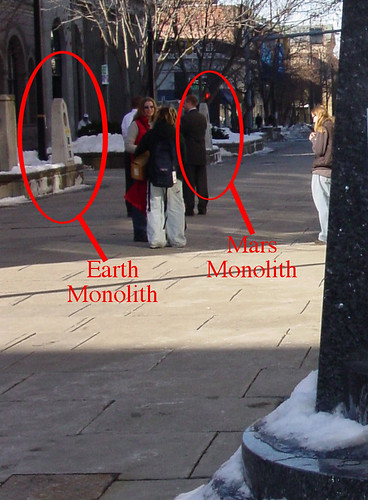
It's about six feet tall (I'm afraid the photos are just what I happen to have, I have no time today to go get new ones, and I didn't think to get a photo of someone standing next to it.) It's in the middle of the Ithaca Commons, a pedestrian-only walkway at the center of downtown Ithaca. The next for monoliths (which are each a bit smaller) are all on the same block. In fact, in the background of the photo above, you can see the Earth and Mars megaliths:

SaganWalk_Sun_Detail
(The Venus monolith is directly behind the Sun monolith in this shot; Mercury is off to the left, beyond the edge of the photo.)

Each of the planets is represented by a slightly smaller grey monolith (except Pluto (yes, this was back before Pluto's demotion) which has a monolith matching that of the Sun, to anchor the other end of the Planet Walk). Here, for example, is the one for Mercury:

SaganWalk.Mercury
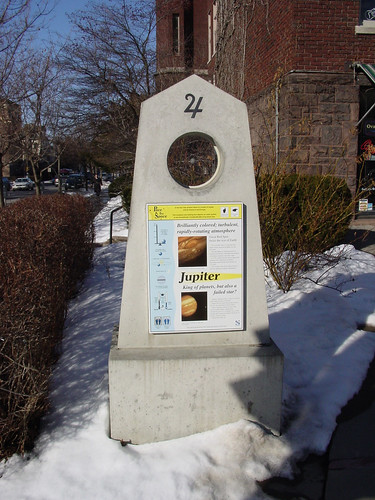
And here's the one for Jupiter:

SaganWalk.Jupiter
The window in the center of each Monolith is identical in size to the window which represents the sun, in order to give a sense of scale. The actual planet is represented by a to-scale size model of the planet embedded in the window. In most cases, you can only see it by going right up to the window and looking very closely; it's often hard to tell the planet from a speck of dirt (although the planet is in the center of each window, and of course you can tell if you look closely enough.) But the larger planets you can see even from a few feet away. For example, here is an enlargement of the Jupiter window above:
SaganWalk_Jupiter_detail
And here is an enlargement for the Saturn window:
SaganWalk_Saturn_detail
For Jupiter, they also include several moons (the four big ones, I think) and the Saturn window includes Triton; but you can't see them with the level of detail in these pictures. Incidentally, in those two pictures, Jupiter looks smaller than Saturn, but that's a result of the framing and angle of the photos; in the actual monument, Jupiter is quite clearly bigger than Saturn (aside from the latter's rings, which even things out a bit.)

On the front of each monolith is a plaque giving information about the planet. There's also a podcast by Bill Nye which you can listen to as you do the walk (although I've never heard it -- it's fairly new -- even though I've done the walk more than a dozen times from end to end, not counting passing it just strolling around town (we live near Uranus, so I go by parts of the walk all the time.))

What's really cool about the memorial, however -- it's purpose, really -- is not possible to capture in photos, and that's the visceral sense of the sheer size of the space, and of the extraordinary emptiness of it. It takes about half an hour to walk from the Sun (at the heart of downtown) to Pluto, right in front of the Sciencenter, the local science museum. But walking it you imagine almost all of it as empty, save for these tiny little specks of nothing captured in the windows. Even the sun seems tiny. It's dizzying: our universe is basically extended void, a vast amount of nothing, with just a few insignificant specks of fire and dust. It is, in a powerful sense which gets lost in the common use of the phrase, awe-inspiring.

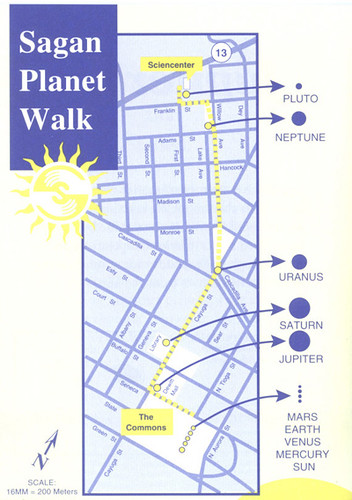
And of course the distances vary greatly. It's a matter of moments to walk from the Sun to Mars; each of the other distances gets progressively longer, save for the Neptune - Pluto distance which is shorter (although still long on the Sun - Mars scale). Here is the official map from the Sciencenter web site:
Sagan Walk map
You can get a slight sense of the distances from this map -- but not as well as you can from an ordinary astronomy textbook. What really works is the sculpture itself: putting the entirety on a human scale, so you can feel it, get the variations under your shoes and in your legs.

It is a marvelous memorial for the late, lamented Carl Sagan, who spent his life trying to educate the public about astronomy and science: a beautiful piece of public art that also serves to convey, on a marrow-in-the-bones level, the feeling of awe that our universe can inspire when looked at through science's lens.

But my favorite thing about the planet walk I don't have a photograph of. It isn't on the map; it isn't in Ithaca -- it doesn't even exist yet, and it probably never will. But there has been talk apparently about building a matching, to-scale monolith for Alpha Centauri, the nearest star to the Sun.

It would be in Hawaii.

I love to imagine that it will be built: making the Sagan Planet Walk one of the largest public sculptures in the world (since, after all, the space between the monoliths is an integral part of the sculpture), and boggling the mind with the true vastness and emptiness of this extraordinary cosmos that we live in.

In any event, next time you are in Ithaca (which, to be sure, is in the middle of nowhere -- it's not even directly on a major interstate -- so it may be a while for most of you) take the time to walk the planet walk. It's a wonderful bit of public art, and worth taking the time to appreciate properly. And a wonderful tribute to an amazing man.

In Memoriam
Carl Sagan
1934 - 1996


Update: Joel Schlosberg has now put up a post linking to the various entries of the blog memorial. Go there to check 'em out.

Monday, December 18, 2006

Civil Unions Are Not Equivalent to Marriage

Over at the Lippard Blog, Jim Lippard quotes a recent Economist article on the global state of equal marriage rights for gays and lesbians as follows:
Gays have the same rights as married heterosexuals, but only in civil unions or partnerships rather than marriage in Britain, Denmark, Finland, Iceland, New Zealand, Norway, Sweden, and the U.S. (California, Connecticut, New Jersey, and Vermont).

Gays have civil unions or partnerships with lesser rights than heterosexual marriage in Argentina (1 state), Czech Republic, France, Germany (3 states), Hong Kong, Ireland, Luxembourg, and the United States (Hawaii, Maine).
I don't read the Economist, so I have only this summary to go by. But as far as the U.S. goes, this summary is simply wrong. It's not just in Hawaii and Maine that civil unions have lesser rights than heterosexual marriage; it's in every state of the U.S. In fact, even full-fledged marriage rights in Massachusetts are not equivalent to heterosexual marriage: even in Massachusetts, gay and lesbian citizens are denied equal rights.

This isn't a new point; it's been talked about a lot (one recent example is here). But if the Economist can get this wrong, it's a point that bears repeating.

For the purposes of this post, I'm going to set aside the whole separate-but-equal issue. Nevertheless, it is of course true that even denying the name marriage is a form of discrimination -- a linguistic marker that does nothing but set aside a disfavored group as lesser; it is "a badge of servitude wholly inconsistent with the civil freedom and the equality before the law established by the Constitution." (source) So even if there were no legal ramifications at all, civil marriage as a matter of justice must be made available to gays and lesbians on an equal basis with straight couples.

But again, let's set that aside for now. Let's just talk about specific legal rights.

I don't know the details of state law in California, Connecticut, New Jersey, or Vermont, so I will take the Economist at its word (possibly a mistake) that within state law civil unions have all the legal rights of full marriage. But even if this is the case, it doesn't make civil unions equal to marriage, because in the U.S., federal law also gives rights to married couples. For a couple to be treated as married (or the equivalent) in federal law, the federal government has to recognize them as married (or the equivalent).

But the federal government doesn't. One of the provisions of the so-called "Defense of Marriage Act" which President Clinton, to his eternal shame, signed into law is that the federal government is not required to recognize marriages (let alone civil unions) between gays and lesbians which a state might recognize. That is, DOMA doesn't only permit states not to recognize gay and lesbian marriages performed in other states; it also forbids the federal government from doing so.

This means that, for federal purposes, married couples from Massachusetts are treated as single by the U.S. government -- if they happen to be a gay or lesbian couple. And "civil unions" from California, Connecticut, New Jersey, or Vermont are not granted the rights of marriage under federal law either.

What are those rights? Well, a specific example just came up fairly recently when Gerry Studds's spouse was denied pension benefits on precisely these grounds. From the Nashua Telegraph:
For the first time, the federal government is denying death benefits to the spouse of a congressman because he is gay. Former Rep. Gerry Studds, D-Mass., who became the first openly gay member of Congress when his homosexuality was exposed during a teenage page sex scandal, died early Saturday. He was 69. In 2004 Studds married Dean Hara, 48, after gay marriage was legalized in Massachusetts. Hara, unlike the spouses of other members of Congress who have died, won’t be receiving any portion of Studds’ estimated annual $114,337 pension. The 1996 federal Defense of Marriage Act blocks the federal government from recognizing the 2004 marriage between Studds and Hara.
That's just one example; there are, in total, more than 1100 others.

Until that section of DOMA is overturned by the courts, or revoked by Congress, gay and lesbian couples will be legally discriminated against even in Massachusetts, the one state thus far to treat its gay and lesbian citizens equally. And, of course, even if that section of DOMA is overturned, "civil unions" in the states that have them won't have to be recognized by the federal government.

So don't let anyone say that civil unions are equivalent to marriage. It's not true. In fact, for gay and lesbian citizens, even marriage won't be equivalent to marriage until that section of DOMA is overturned.

There is only one solution to this issue: full equality, without any badge of servitude or other maker of second-class status. And contrary to those who proclaim the role of the states in this matter, this is also something that will have to be granted by the federal government.

Which leads to a speculative postscript: it seems that there is a case to be made against that section of DOMA without overturning the entire thing -- at least this site quotes an ACLU lawyer as saying that
if DOMA were to be challenged, lawyers would solely focus on the part of DOMA that denies gay citizens federal benefits. Left unchallenged would be the portion of DOMA that allows states to refuse recognition to a same-sex marriage performed in another state, out of fear that the legal claim would be rejected, and even if successful might encourage passage of a federal amendment banning gay marriage.
Obviously I would be in favor of overturning the entire thing -- indeed, I think it will happen, sooner or later. But so far as "sooner" goes I can definitely see it being politically easier (and maybe legally easier, although I don't know either way) to eliminate just that section of DOMA. It would preserve for discriminatory states their "right" to discriminate, which might mollify the bigot vote; and that way at least those states that intend to grant their gay and lesbian citizens the full and equal rights to which the laws of nature and of nature's God entitle them -- so far just Massachusetts, but hopefully to be soon joined by others (even maybe my home state of New York) -- will at least be legally able to do so. It would be of great help to gays and lesbians in those non-discriminating states; it would allow those who are able to vote with their feet and move somewhere that treats them as full citizens; and it would be clarifying. And, maybe, more politically possible in the short run.

Powerpoint on Vampire Biology

This is making the rounds -- I saw the link last night on Whatever before I saw it this morning on Pharyngula -- so I suspect that anyone who's interested has already had this dangled before them. But since a crucial part of my doing this blog is at least pretending that I have some readers who will see stuff for the first time if I link to it, I thought I'd link to this too.

SF author Peter Watts has done a very amusing, half-hour-long powerpoint presentation on the biology and evolution of vampires. It's filled with a lot of very convincing psuedo-science -- not surprisingly, given that Watts is in fact a marine biologist; in fact, P. Z. Myers says that there is "some surprisingly accurate general information about the principles of evolution embedded in all the silliness". Basically, if you think that a power-point presentation about the biology and evolution of vampires sounds fun or funny, you'll love this -- it's very well done. If you don't see the point -- both the humor and the actual (if whimsical) interest -- then don't bother.

I actually met Peter Watts at Readercon last summer, and he's a very nice guy. The powerpoint is an outtake (promotion? spin-off? not sure what the noun is supposed to be) of his fourth and latest SF novel, Blindsight (warning: large file.) -- I think he actually did his vampire powerpoint at Readercon, but I missed it. The vampires described in the powerpoint are featured in Blindsight, and this powerpoint gives (I think) more detail on their underlying biology than is to be found in the novel.

About Blindsight: it's now out in hardcover but, due to some publishing glitches there may or may not be a second printing, and so the thing is actually in short supply. (Publishing makes no sense to me -- I think this is because it more or less makes no sense, but maybe I just don't understand it. (To vampires, no doubt, it would make perfect sense (that's a joke for those who've seen the powerpoint.))) Because of this, Peter Watts just released the entire novel under a Creative Commons licence for free on the web -- so that people can read it even if they can't buy it. Hopefully this will create enough buzz to actually get that second printing to happen. (The CC release has gotten some big-scale blog attention, which hopefully will lead to increased sales & orders.) I haven't read the novel yet -- I'm waiting to get my hands on a physical copy, since it's too irritating for me to read lengthy fiction on a screen -- but I've read the opening, and I'm really looking forward to it. If you're more screen-tolerant than I, you can go read it now; otherwise, some bookstores still have it -- Amazon seems to -- even if big chains like Borders aren't carrying it. (See above re: publishing makes no sense to me.)

In any event, whether or not you read and/or buy the novel, do check out the powerpoint. It's fun and funny and interesting and just what you might need to cheer you up in a world where Bush is going to stay in Iraq regardless what the commissions, congress or citizens have to say about it.

Saturday, December 16, 2006

Chappy Chanukkah!

The Festival of Lights began last night; tonight is the second night.


Happy Hanukkah everyone!

Saturday Systematic X: Wish Edition

To (rather loosely) paraphrase Arlo Guthrie, if you want start a meme and stuff, you need to do it regularly.

Last week I introduced the Saturday Systematic X, a variant on the blogosphere tradition of the Friday Random Ten. The basic idea, again, is this: instead hitting "random" on your iPod or equivalent, and blogging the first ten items, you type a word into the search box, and blog howevermany songs come up.

This week, the word is "wish". Rather to my surprise, I got a far shorter list than I did last week with "God"; instead of 17 songs, I only got 5:

1. I Wish You Would, The Yardbirds
2. I Wish You Wouldn't Say That, Talking Heads
3. More I Cannot Wish You, Frank Loesser
4. Wish I Could Stay, Joss Whedon
5. Wish You Were Here, Pink Floyd

Given the tradition of the "wish song" in the musical, I suppose it's fitting that two of the five should be from musicals -- "More I Cannot Wish You" from Guys and Dolls, and "Wish I Could Stay" from the Bufy the Vampire Slayer musical episode... except that neither of those are traditional wish songs. Go figure.

Again, a fun list -- and a fun mix (not the same thing).

And, as before, this is a meme: if you have an iPod and a blog (or the equivalents), consider yourself tagged: do it for yourself -- either on the word "wish" or any other (and it doesn't have to be on Saturday) -- report the results... and don't forget to leave a link in the comments!

Friday, December 15, 2006

Quote of the Day

He came out into the entrance court and contemplated his bonsai.

Early sun gold-frosted the horizontal upper foliage of the old tree and brought its gnarled limbs into sharp relief, tough brown-gray and crevices of velvet. Only the companion of a bonsai (there are owners of bonsai, but they are of a lesser breed) fully understands the relationship. There is an exclusive and individual treeness to the tree because it is a living thing, and living things change, and there are definite ways in which the tree desires to change. A man sees the tree and in his mind makes certain extensions and extrapolations of what he sees, and sets about making them happen. The tree in turn will do only what a tree can do, will resist to the death any attempt to do what it cannot do, or to do it in less time than it needs. The shaping of a bonsai is therefore always a compromise and always a cooperation. A man cannot create a bonsai, nor can a tree; it takes both and they must understand each other. It takes a long time to do that. One memorizes one’s bonsai, every twig, the angle of every crevice and needle, and, lying awake at night or in a pause a thousand miles away, one recalls this or that line or mass, one makes one’s plans. With wire and water and light, with tilting and with the planting of water-robbing weeds or heavy root-shading ground cover, one explains to the tree what one wants, and if the explanation is well enough made, and there is great enough understanding, the tree will respond and obey—almost. Always there will be its own self-respecting, highly individual variation: Very well, I shall do what you want, but I will do it my own way. And for those variations, the tree is always willing to present a clear and logical explanation, and more often than not (almost smiling) it will make clear to the man that he could have avoided it if his understanding had been better.

It is the slowest sculpture in the world, and there is, at times, doubt as to which is being sculpted, man or tree.

-- Theodore Sturgeon, "Slow Sculpture" (1970)

Wednesday, December 13, 2006

McCain versus Free Speech

I've got a whole new pile of exams to grade, so this will be quick, but John McCain is introducing legislation that will hamper the ability of blogs to function, in particular blog "communities" like Daily Kos. I trust that I don't need to explain to anyone who's reading this why this is so !@#$% evil.

I'd say "so much for those who think that McCain is some sort of Goldwater-style libertarian", except that anyone who still thinks that John "sign off on torture" McCain is a libertarian just isn't paying attention. McCain is someone who wants to be president, and has shown himself willing to do anything, say anything and pander to anybody he needs to to make that happen.

The real question is what will the right-wing blogosphere think of this? They're bloggers too. (Not as many of them have big comment sections or diaries the way DailyKos does... but some do.)

More if/when I see it. If anyone knows of any good actions to take to oppose this, please leave them in comments.

Update: Here's commentary from Digby, who also links to this news story on the issue. And Patrick Nielsen Hayden's not happy.

Saturday, December 09, 2006

Friday Saturday Random Systematic Ten X: God Edition

Variation on a theme.

There's a long-standing blogosphere tradition of a "Friday Random Ten" -- set your iPod to "random", read off the first ten items, and blog them. (I even participated once myself.) Then there are variations -- Fred Clark on Slacktivist has been doing systematic Friday tens for some time now, reading off an alphabetical selection of his iPod with titles like "Racing to Rapture", "Not Nothing" and "Mr. & Mrs.".

Well, here's a variation: the Saturday Systematic X. It's Saturday, not Friday*; it's systematic, not random, as I'll explain in a minute; and since the system determines the outcome, the number is a variable -- X -- rather than a set number like 10.

Here's how it goes. You pick a word, type that into the search box of iTunes or the equivalent, and read off the list of pieces that are included.

So for the first week -- for no particular reason -- I typed "god" into my search box, and got 17 items, which I here present in alphabetical order by title:

1. Chorus: Glory to God in the Highest, Handel
2. God, John Lennon
3. God Bless My S.U.V., The Capital Steps
4. God Give Me Strength, Elvis Costello
5. God is Love, Marvin Gaye
6. God Only Knows, The Beach Boys
7. God Part II, U2
8. God Save the Internet, The Broadband
9. Hand Of The Almighty! (God Will Fuck You Up), John R. Butler
10. Little Tin God, Don Henley
11. Part 2: Chorus: Behold the L, Handel
12. Ravel:Ma mère l'Oye (4hands)/3: Laideronnette, imperatrice des pagodes, Ravel
13. The Messiah, Part 28. Chorus: He Trusted in God, Handel
14. The Messiah, Part 35. Chorus: Let all the Angels of God Worship Him, Handel
15. The Messiah, Part 51. Chorus: But Thanks Be to God, Handel
16. The Messiah, Part 52. Air(Contralt): If God be for us, Handel
17. With God On Our Side, Bob Dylan

It's systematic, since it depends on entering a word... but it's also random in lots of ways, of course. Not the least is that which items come up are a bit random, since they depend on how the titles were entered -- which in my case was frequently done by that automatic function in iTunes that looks at a CD and figures out the title -- often differently for different disks in a set (e.g. Handel's Messiah above), which I never bother to correct; I have copied them as is above, with all the variations intact). So, for example, Joan Osborne's "One of Us" was entered just as that and not as Joan Osborne, "(What if God Was) One of Us" -- which is how it's listed on the album cover, I think -- and thus doesn't show up. And I love that Ravel shows up for "des pagodes" -- the pagodas -- where, if only alphabetically speaking, God dwells.

Still, a fun list. At least I thought so. A lot of Handel.

It does make a damn strange mix to play (I've been playing it, in random order, as I write this), what with the leaps from song-structured music to snippets of classical music. But I sort of like it.

I may even do this again.

And now this is a meme: if you have an iPod (or the equivalent) and a blog (ditto), consider yourself tagged: do it yourself -- either on the word "god" or any other -- and report the results. (It doesn't have to be on Saturday -- whenever you read this, you're tagged!) And leave a link in the comments!

____________________________
* Not for any interesting reason, or even for the alliteration, but because I just thought of it today.

What Do You Do If the Future is Against You?

This is a follow-up post to my earlier thoughts about the recent decision by the Committee on Jewish Law and Standards of the Conservative Jewish Movement regarding the place of gay and lesbian Jews in their movement. But where, in my earlier post, I had a point to make, in this one I don't. Rather, I have a question to ask -- a question which will manifest itself as a constellation of questions but which is, I think, a single question at bottom.

The question arises from the comments of Rabbi Joel Roth -- author of the one of the status-quo-upholding teshuvot accepted in the recent CJLS meeting, who nevertheless resigned from the CJLS to protest the acceptance of the (rather moderate) pro-gay teshuva which they accepted simultaneously. His comments were made during a public discussion from before the meeting, but it was already fairly clear (indeed, it was widely reported) what the outcome was likely to be. The discussion was between Rabbi Roth and Rabbi Elliot Dorff, co-author of the liberal teshuva, and were reported in the Jewish Week's news story on the recent decision as follows:
“The effect of having multiple positions passed will be a sign of the strength of the movement,” [Rabbi Dorff] argued. “We have learned to live and let live.”

Rabbi Dorff said this would mean that some Conservative rabbis will now perform commitment ceremonies that permit the union of same-sex couples and others will not... “Some [Conservative seminaries] may decide to ordain gays and lesbians and others may not,” he explained, adding that they would continue to “live with each other.”

Rabbi Roth strongly disagreed, however.

“It’s simply not true that it will be live and let live,” he argued. “That implies that both positions are equal.”

He suggested that “most young people” are intolerant of the current ban on gay and lesbian leadership and believe their inclusion to be a “moral imperative.”

He noted that after the Conservative movement’s Law Committee voted to ordain women in 1983, its rabbinical school in Manhattan set up an egalitarian minyan in addition to the one it had maintained since the seminary was established in 1886. The non-egalitarian minyan “survived 10 years until the upstairs egalitarian minyan claimed that any Conservative Jew who was not egalitarian was immoral and [therefore] delegitimate. The student body to this day virtually reviles students who go to the non-egalitarian minyan, and if it was up to most of them, it would not exist because it is [considered] immoral.”

“It will only take two years on this issue,” Rabbi Roth predicted, before critics of the permissive position on gays lose out.

There is something strange -- even, in an odd way, affecting -- about these comments. Rabbi Roth not only knows that the demographics are against him, but that "most young people" -- and it seems clear that he actual meant the young people in his own movement -- are not only against him, but feel so strongly on the other side that he fears that within two years the social pressure against his view will make it de facto illegitimate.

Given that he believes that, what does he think he is likely to accomplish on the other side?

Even if his legal reasoning and persuasive power had managed to keep the more inclusive teshuva from being accepted this year, what then? If most young people in his own movement -- even, he seems to suggest, in his own seminary -- find his position not only mistaken but are "intolerant" of it, and believe that including gays and lesbians is a "moral imperative" -- what would his convincing another half-dozen or so influential Rabbis currently on the CJLS do? Surely Roth can't think that upholding the ban on gay and lesbian Rabbis would bring young people around to his position, since the ban is currently in place and they're against it.

So what was he hoping to accomplish? At the best, he would have delayed the full inclusion of gays and lesbians until a time when the current "most young people" became, well, "most people" -- including, presumably, a majority on the CJLS. At worst he would had convinced those who thought that the Conservative Movement was failing in a moral imperative to leave it, and join another, more moral, movement.

Or is that latter option in fact what he wanted -- a sort of Jewish version of what is said to be the current Pope's strategy, purging the institution of insidious liberals to make a smaller but "purer" movement?

Or is he simply upholding what he sees as God's will, in the face of seemingly-inevitable defeat -- hoping, perhaps, for a miracle?

I must admit that generally in such cases I would tend to think that yet another explanation was in play: namely, animus and bigotry so strong that it overrode any tactical considerations or thoughts for the future in a mindless drive to suppress. But one of the co-authors of the more inclusive teshuva, Rabbi Daniel Nevins, has said in a statement that
... none of the committee members uttered anything like animus to gay or lesbian Jews in the entire four years of proceedings. On the contrary, even those most opposed to halakhic change framed their arguments with respect and sympathy for the predicament that gay and lesbian Jews face.
-- and I will take Rabbi Nevins at his word: this was not about animus. But quite honestly, it makes the question all the more puzzling.

I suppose that Rabbi Roth thinks he is simply sticking up for legal standards for their own sake. It is in a way a noble thing to do -- even if the practical ends he seeks are discriminatory and unjust. And I suppose going down with the ship has a certain nobility even an unjust cause.

But what does he think is going to happen?

His comments on the decision about admitting women Rabbis are in some ways even more puzzling. I presume that he doesn't wish that the egalitarian minyan had never been established. (He apparently supported the ordination of women.) But what then? Presumably he simply wishes that both were accorded equal legitimacy.

But then, that's the problem, isn't it? A statement of equality between two options -- one inclusive, one discriminatory -- is inherently unstable. If not discriminating is at all viable, then discrimination becomes unjustifiable. The non-egalitarian minyan has to claim that the egalitarian minyan is against Jewish law; otherwise they're simply a bunch of sexist bastards.

This isn't necessarily intellectually true. A person might say: 'I personally disagree with your evaluation of the legal question on the merits, but I think it is important for you to uphold your own intellectual position and not feel social pressure to change your mind -- even though I will continue to try to convince you that intellectually you should change your mind.' It's a possible intellectual position -- but it's one that's hard to maintain socially. Could such a person justify going to a non-egalitarian minyan -- i.e. a minyan that they thought was discriminating for no good legal reason -- just to help someone else maintain a social function that the second person believed necessary to fulfill their intellectual position (a position which is, again, mistaken in the eyes of the first person)? Well, again, maybe -- but that's even a moral stretch. (If you think they're wrong, is your duty really to help them persist in their error, even against the claims of justice?)

Practically speaking, once both minyanim are seen as an option then, really, only one is: the one with justice on its side.

Which is precisely Rabbi Roth's point. If both tolerance and intolerance are options then, really, only tolerance is an option. So he has to hold his fight against letting gays and lesbians get their foot in the door, since once they do, all of a sudden he is illegitimate.

But as arguments for maintaining the status quo go, it's a pretty piss-poor one. Of course, it's also a common one these days: this is the same argument that (largely Christian) conservatives make in the U.S., when they say that accepting gays discriminates against them. It's false in any rational, just sense of "discriminate". But intolerance can't maintain itself on a level playing field. It has to squash the opposition.

Which is what Rabbi Roth tried to do. He tried to get the committee of older Rabbis, Rabbis who he knew does not represent the movement that they were legislating for -- namely, the one that will exist in the future -- to hold it back. For a time.

It's comparable to a theory that Andrew Sullivan has floated about the amendment that Christian conservatives wish to add to the constitution: that they know that they will soon lose on a state-by-state level (for demographic reasons: in terms of percentages, young people are less bigoted against gays than older ones), and so they are trying to lock their desired outcome into the U.S. constitution where it will be hard to change. I don't think this suggestion of Sullivan's is right; I suspect that the Christian conservatives who support such an amendment genuinely believe it will be part of (or will precipitate) a revival of conservative Christianity which will eventually change the demographics -- or perhaps they are simply counting on a miracle. At any rate, Christian conservatives are hardly the most reality-based bunch around, so it's likely they don't give much credence to the demographics.

But Rabbi Roth does: he said so himself. And nothing he's said seems to indicate that he thinks that maintaining the ban will produce a swing in its favor. (The only such scenario that seems at all plausible -- that the demographics switch because upholding the ban leads to a mass exodus of the pro-gay faction from the Conservative Movement -- was entirely my speculation; I have no reason to think that Rabbi Roth expects or hopes such a thing will happen.)

It's hard to maintain a position of intolerance when tolerance is an option. Of course Rabbi Roth doubtless feels that he is right on the intellectual merits -- that halakah, and through it God, forbids the sanctioning of any non-celibate gay or lesbian life. But what do you do when you've so signally failed to convince the next generation of your intellectual point of view?

It's one thing to fight from a minority intellectual position; I do it all the time. You hope to convince others, in time, of the rightness of your view. But when the intellectual divide matches onto a generational one, the fight seems basically hopeless. Your opponents will win, in the end.

Is there really a point in making them wait until you're dead?

As I said, I oppose Rabbi Roth on this issue; I am glad that gay and lesbian Jews will now be allowed to be (nearly) full participants in the Conservative Jewish Movement, even though I no longer attend services with any regularity. But reading his comments made me spare a moment to think of Rabbi Roth and the loosing side -- for I think he's probably right and that his side was not equally accepted this week, but took the first step to a larger loss, even if he's wrong about how swiftly it will happen -- and wonder what I would do in his shoes. Would I go down fighting for a cause which is not only most likely doomed, but which is increasingly seen (correctly, of course, in my actual view) as a fundamentally unjust stance?

What do you do if the future is against you?

Friday, December 08, 2006

Conservative Judaism and "What Gay Men Do": Clearing Up A Misconception

This week, the Committee on Jewish Law and Standards of the Conservative Jewish Movement accepted three teshuvot (legal opinions about Jewish law, singular teshuva) about the status of gays and lesbians in Jewish law and in the Conservative movement. (More information here and here.) Because of the rules of the Conservative movement, all three opinions are now acceptable options for individual rabbis and institutions (such as Conservative Jewish seminaries). Two of those opinions simply re-stated the status quo -- i.e., gays and lesbians are tref (although we shouldn't go out of our way to be mean about it) -- and hence aren't particularly newsworthy. The third opinion, however, accepted (with a caveat) gays and lesbians, welcoming them (almost-but-not-quite) fully into the Conservative movement, and saying that they should be allowed to become Conservative rabbis, and that their permanent relationships should be celebrated (while side-stepping the issue of whether they are "marriages" under Jewish law).

There's a lot to say about this -- about which the most basic thing to say is simply that this is a serious and important step towards justice and equality for gay and lesbian Jews. The side of good and right won this week; justice was pursued.

But here are some other points to make about it. This post will begin by addressing one of them; if I feel inspired/up to it, I'll do some follow-up posts on other aspects of the issue. (Update: I now have a second post on the topic here.)

It begins with the "caveat" I mentioned above. Because even aside from the question of marriages -- which the liberal teshuva simply punts on -- the "caveat" is that the liberal teshuva still holds anal sex between men to be prohibited. This is (basically, simplifying greatly) so they can still uphold the biblical verses Leviticus 18:22 and 20:13. Their opinion (online in a pdf file (via Jspot)) argues -- credibly, so far as I can tell, but I'm not a rabbi and am hardly expert in these matters -- that the biblical prohibition originally was interpreted to apply only to anal sex between men, and that the extension of the prohibition to all gay sex, and to lesbian sex, was a rabbinical extension of the basic biblical law. Since (still simplifying) it's easier to overrule rabbis than God, they hold that our current knowledge about homosexuality justifies overruling the rabbinical extensions but not the underlying law.

(Incidentally, this is an argument also made by Steven Greenberg, the first (and, I believe, to date the only) openly gay Orthodox Jewish rabbi in his wonderful book Wrestling with God and Men.)

Now, aside from the question of the rulings legal reasoning (about which I'm not competent to judge although, based on a quick reading of it, they present a serious argument), and aside from the question of whether such a ruling really does full justice to gays and lesbians (as we must strive to do), a lot of people -- primarily, I suspect, straight people -- are fundamentally confused about it. To quote the questions asked one blogger:
One person asked me why the rabbis picked on what gay men do, but had nothing to say about lesbians?
A few wondered how gay men can be considered equals if they are not allowed to have gay sex?
Again, the questions of the differing treatment of lesbians, and the ongoing question of the status of gay men, are good ones. But there is another point here, something which both questions assume, but which simply isn't true: that anal sex is "what gay men do"; that if men can't have anal sex, they can't have gay sex; or, as the above-linked blogger titled his post, "Gay Men are OK, But Not Gay Sex"

Now, I will admit that as a straight man in a monogamous straight marriage, I'm probably the last person on earth to talk about this. But since I haven't seen anyone else make this point, I'll weigh in on it. (Update: After I wrote this, I saw at least one other blogger had made this point, although more briefly than I do.)

Anal sex between men is not all gay male sex; it is not (all of) "what gay men do".

This is, I think, a misconception that results from applying the cultural model of straight sex to gay sex. (Please add caveats about how different cultures vary, none of these models are inevitable, what I am saying applies only to our culture, that there are exceptions even within our culture, etc., to taste.) In straight sex, intercourse -- vaginal intercourse -- is the end-point, the main event, the real thing. Other sex -- petting, oral sex, whatever else that "straight couples do" -- is foreplay: it's not "real". That's why you get straight couples who "do everything but" -- it's because intercourse is the real thing, and everything else is leading-up.

But this isn't true for gay sex. Gay sex -- and I am relying on the reports of friends, books I've read, and so forth here -- has a much less defined model. Some gay men focus their sexual energies on anal sex. But many don't. To take just one example, SF writer Samuel R. Delany, who has written a lot of non-fiction which is explicit about his own sexual practices and desires. Delany -- despite a life that most people would describe as very active, even promiscuous -- never has anal sex: his sex life is based around oral sex.

This is a point that a lot of straights -- particularly homophobes, who often seem oddly obsessed with anal sex, but I think a lot of sympathetic straights too -- get wrong. Thus to them the idea that a ruling might exclude anal sex sounds equivalent to saying that gay sex isn't okay. But it isn't.

Here's another way to think about it -- a bit exaggerated in the other direction, but probably a useful corrective. Imagine a ruling that straight couples couldn't have anal sex. Now, a lot of straight couples do have anal sex, so this wouldn't be meaningless. But it wouldn't prohibit straight sex, even if it would affect the sex life of many straight couples (if observed).

Or, another way to think about it: imagine a ruling that straight couples couldn't have sex while the woman is menstruating, nor for a week after. This would make a lot of straight couples -- probably a large majority (although who the hell knows) -- technically in violation of the law. But you couldn't tell, simply by the fact that you knew a couple, whether or not they were following this rule. Certainly straight sex is possible within the rule.

In fact, you don't have imagine this ruling: it exists. This is a basic notion of Jewish law, known as the laws of nidah. The polite thing to do in observant Jewish circles is to assume that Jews are in compliance with them -- not to quiz them before giving them a Torah honor, for example. But many of them might not be. The point is that you can't deduce from the fact that someone is in a straight couple whether or not they are violating a basic law of Jewish sexuality.

The same is true for gay Jewish couples. You can't tell from the fact that they're in a gay relationship that they're violating Leviticus 18:22 (on the anal-sex prohibition only interpretation of it), even if they are having sex. You'd actually have to quiz them about their sex life. Nor is it ridiculous and unthinkable to think that a married gay couple might not have anal sex, because there are a lot of gay men who express their sexuality in other ways. Indeed, some are almost certainly already following this rule anyway.

A lot of gay men at this point will be sniggering, because I am going on and on about the obvious. But this seems to be something that a lot of straights -- even sympathetic straights -- don't know. So ideas such as the one just put forward by the Committee on Jewish Law and Standards sound like they are asking gay men to behave like teenagers saving their technical virginity forever. But that's simply an inapplicable model.

I'm not saying the rule is meaningless, nor defending it on moral grounds, nor saying that it does sufficient justice to gay men. But it is worth noting that it does not say that (all) gay sex isn't okay, just that some gay sex isn't; that there really are gay couples whose sex life doesn't involve anal sex. As long as straights get this wrong, these arguments will sound a lot sillier than, in fact, they are.

If you want to criticize this ruling on legal grounds, or religious grounds, or moral grounds, or gay-rights grounds, go ahead. But on its own terms it does make sense, and straights should understand that.

Monday, December 04, 2006

Gone Gradin'

Sort of like gone fishin', except not as much fun. And I don't even like fishing.

Blogging will resume when grades are in. (Or just possibly before if the need to procrastinate becomes overwhelming.)

In the meantime, here is some Monday random Flickr blogging (via) on the number 3352:


(Photo by Aster Chang)


(Photo by Peter and Julie)

Back in a bit...

Tuesday, November 28, 2006

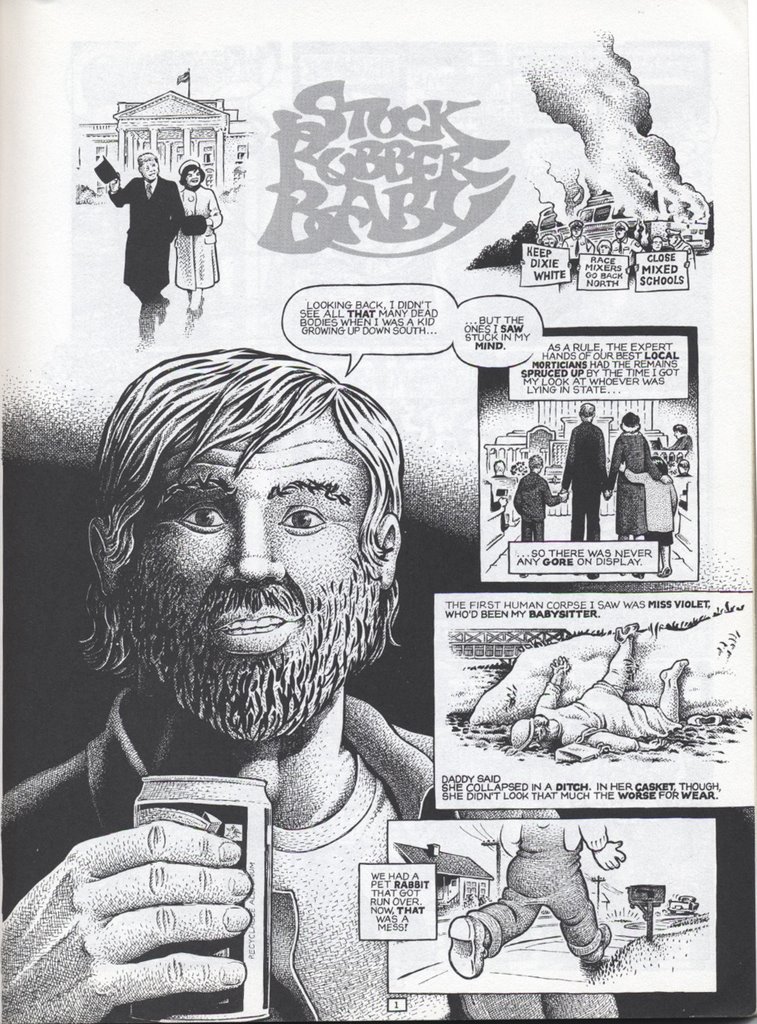
Teaching Graphic Novels: Stuck Rubber Baby

At Cornell, where I am currently an ABD struggling to finish a dissertation, there is a program known as the First-Year Writing Seminars program. These are roughly the equivalent of the various Freshman English and Expository Writing classes you get at most (all?) colleges. But there are serious differences too, and -- so far as I can tell from my limited perspective as a three-time teacher of one -- the Cornell program is a significant improvement over the usual fare.

The major improvement is that the courses are designed around (in their phrase) "writing in the disciplines". That is, rather than simply trying to teach "expository writing" in a sort of general way, or making everyone do English Lit as their writing focus, the courses are taught in areas throughout the curriculum; and the focus is supposed to be how to write in the discipline you're teaching. This recognizes that writing a physics paper, an anthropology essay and a linguistics analysis are very different things. The courses also are each designed around a topic: in theory the class spends half its time analyzing the subject matter and half its time on writing. This means that the students actually have something to write about, also an obvious improvement.

As a grad student in history, I've so far offered three of the seminars. Most grad students offer seminars on topics which more-or-less closely match their dissertation research, for obvious reasons. But I sort of felt that I should offer classes which would appeal to First Year Students, many of whom will never take another history class. (A lot of the dissertation topics strike me as too narrow and esoteric.) So the first time around I offered a seminar called "The Sixties", a topic which I felt (correctly) would have a natural audience; and it seemed to go well enough. A few years later, I was able to offer two more seminars in the course of a year, one in the fall and one in the spring. Rather than simply repeat my earlier seminar, I decided I'd like to try a new one, so I offered a class in....

Historical fiction.

Yeah, I know. A program where the specific benefit is teaching in the disciplines, and teaching writing in the disciplines, I, a historian-in-training, offered what was essentially a literature class -- an area in which I have no post-undergraduate training. Of course, we talked about history as well as fiction; but the class was centered around historical novels, and that was the basis of the essays the class wrote.

It seemed like a good idea at the time.

And, actually, I think it went pretty well -- about as well as my earlier seminar on a bona fide historical topic. (I should say that (not wanting to create two new courses if I didn't have to) I offered it twice, once in the fall of 2005 and once in the spring of 2006; my impression is that both went equally well, although of course mine is a particular and peculiar perspective on the matter.)

Now, one of the limitations of the First Year Seminar program is that you're only supposed to assign 75 pages of reading per week, to keep the workload manageable (given that they're also supposed to be writing on a weekly (or nearly weekly) basis too). My highly unscientific and rather undersourced impression is that a lot of the seminars don't obey this rule too strictly -- along with the other rules, like how much time is supposed to be spent on writing and how much rewriting is supposed to go on: talking to my students, it seems that a fair number of the seminars break these rules. FWS offered by professors (as opposed to grad students) are particularly bad on this score, and my impression is that a lot of professors just treat them like, well, any other seminar. It's in the way of things that professors are less monitored in this regard, I suppose. Fortunately, 2/3 of the FWS are offered by grad students, so most first-years (who take one each semester of their first year) will take at least one that, y'know, focuses on writing. At any rate, I felt compelled to follow the guidelines fairly closely, and did so.

Of course this meant that I could only assign a fairly small number of novels -- four, in the end, chosen for comparative brevity among other factors. (The students also each read an additional book for their long final essay, which doesn't count in the 75-page tally.) Now, keeping a discussion going about a single novel for three weeks -- which is what this turned out to mean -- was a bit tricky. I had to pick novels that could bear it. (In my experience literature courses usually spend only a week or at most two on a single novel, unless it's something both huge and complex such as Ulysses or In Search of Lost Time.) I think I did pretty well on that score if I do say so myself, but it was definitely one of the challenges I faced.

So I picked four novels. My understanding of "historical novel", incidentally, was a novel which focused strongly on historical events, even if the author had been alive at the time. Many people make it definitional that historical novels are about events the author did not live through. But I was less interested in historical novels as a genre than what it meant to learn history by reading fiction (which a great many people do -- to say nothing of the fact that, in my experience, a surprising number of history classes assign historical novels), and for those purposes novels based on personal experience worked just find.

One of the books I picked was a graphic novel.

I did this for a number of reasons. The first, and frankly in the end the most naive, was an attempt to appeal to the students -- I figured that kids liked comics, these youngsters had been kids fairly recently (like, six months before) and so that it might appeal to them. Mostly, however, my students hadn't read comics as kids -- in each of my two classes more than half the students had never read a comic before (I took a show of hands and don't recall the exact number, but it was slightly more than half.) Certainly the "appeal to kids" angle was fairly unimportant -- although in each class I also had one or three students who did really like comics, although generally not the sort of comics I was teaching, and were glad to read one, so I suppose it did work for a small subset of each class.

A second reason was that graphic novels are a up-and-coming medium, growing in cultural and aesthetic importance almost weekly, and I thought that kids should be exposed to them. A related third reason was that we live in a visual culture, and I thought some visual analysis would be good to throw into the mix. I think these two reasons worked out much better than the first reason.

A fourth reason is that it was fun for me. Self-indulgent, yes, but I might offer the defense that if I'm having fun they're more likely to too.

But the most important reason by far -- the reason without which I would never have considered it -- is that the graphic novel I chose was and is a genuinely wonderful book, a superb novel (in the sense of being a sustained narrative with well-developed characters and themes), a superb graphic novel and a superb portrait of a historical era.

The book I am talking about is one of my favorite graphic novels, Howard Cruse's Stuck Rubber Baby.

Howard Cruse grew up in Birmingham, Alabama in the early 60's, at a time when it was one of the centers of the then-at-its-peak Civil Rights Movement. Cruse was white, so saw the events from a different perspective than many histories of the Civil Rights Movement are (though there are exceptions; a splendid recent one is Jason Sokol's There Goes My Everything -- highly recommended.) Cruse was also gay, at a time when the Gay Rights Movement may have started (contrary to popular belief, it didn't begin with the Stonewall Bar riot), but clearly hadn't spread beyond a small handful of still-quite-closeted people -- there certainly is no indication in his semi-autobiographical novel that Cruse had heard of the Mattachine society or anything like it. So Cruse's semi-autobiographical graphic novel (try saying that three times fast) has an interesting and rich perspective on several key aspects of that era of American history.

(Yes, I said history, damnit. I taught these classes in 2005 - 2006; my students were first-years in college, which meant that most of them were about eighteen -- born, therefore, in the vicinity of 1987, more than two decades after the events Cruse depicts. Hell, I, their teacher, was born in 1971. These events were carbon dated to these kids. Martin Luther King was as dead and gone to them as Martin Luther.)

Stuck Rubber Baby takes place in a city called Clayfield, a thinly-fictionalized version of Birmingham, in what Cruse calls "Kennedytime" -- basically, as he admits in his fascinating and detailed web site about the book, between the October Missile Crisis and Kennedy's assassination.* It's lead character is a young, white gay man, sympathetic to the Civil Rights Movement but somewhat clueless about it, as well as a distinct outsider, a man slowly coming to terms with his sexuality at a difficult time for it. But there are lots of very rich characters in the book, black and white, straight and gay -- one of the things that make it such a wonderful novel.

It's not a perfect book. Various structural criticisms my students made -- in particular, parts of the story left tantalizingly untold -- seemed fair to me. And I think that Cruse's distinctive but decidedly odd way of drawing people -- what is up with those chins? -- takes some getting used to. But it's a superb graphic novel, a wonderful book, which I recommend quite highly. If you've never read a graphic novel before, it's a pretty good place to start -- which was precisely the situation a lot of my students were in.

Here's some things I did in teaching it.

The first thing I did was to show my students episode four of the astonishing television documentary Eyes on the Prize -- a superb series, one of the best things ever to air on television, and a very good introduction to the Civil Rights Movement. Even better for my purposes, the history covered in Cruse's graphic novel fit very precisely with the events covered in episode four of the series -- the movement in Birmingham, the 1963 March on Washington, and the bombing of the 16th Street Baptist Church shortly thereafter. This gave my students some historical context to put Cruse's book in, and another version of the events which we could discuss.

Then I set about teaching them how to read a graphic novel.

A bit of this was really basic, as in, what-order-do-you-read-the-balloons-in basic. For this, I used the (two-page black-and-white educational version of) Jessica Abel's marvelous brief introduction "What is a Graphic Novel?" which introduces students to some of these basics. This was surprisingly necessary: while I, and other comics readers, tend to think of these things as as natural as reading prose, they turn out to be, well, as natural as reading prose, i.e. highly artificial, not natural at all, and a skill which one needs to be taught -- and not a skill that was included in the standard how-to-read-prose educational package. Now, it wasn't a hard skill to acquire -- most of them were familiar with comics if only from the funny pages, and a few minutes in class did the trick I think -- but it did need a little attention.

The harder part was teaching them how to read graphic novels in the literary sense of "read" as "analyze". This I did in two parts.

The first part was a class in which we discussed some pages in Cruse's comic as pages, focusing on their visual elements, his visual choices, and the way the visuals constructed the pages' meaning. We started, for obvious reasons, with page one, which looks like this:


And we talked about it. Why were the upper two images without panel boarders? What did they do as opening images? When were they set, anyway? What effect did it have to draw the narrator so large? Or shown at his present-day age? Holding a beer? Why did none of the three images on the left show a human face? What was the effect of this truncation? How would they describe the layout of the page as a whole? Why was the background of the lower half of the page black and the upper half white? And so forth.

We then had similar conversations about several other pages in the graphic novel, until they began to get the point that they had to read the images as well as read the words -- indeed, that the images and the words were a single thing -- a comic -- and not two separate, separable things which stood on their own.

That was our first full class on Cruse's graphic novel (we'd done a few minutes on how to read a comic the week before they even began reading it.) In our second class on the book I did the second part of my how-to-think-about-comics lesson, which nicely coincided with the FWS mandate of using lots of writing, including in-class writing. This was as follows. I gave them a list of possible pages -- focusing on slightly difficult ones, and ones from the first third of the book, which was all they had read -- and asked them to "translate" that page into what they imagined it would sound like if it had been from a prose novel.

The point of this exercise was how hard it was to do it. Not only did they have to pick a style, decide whether it was in the first person (an older version of the narrator does narrate the graphic novel) or third (looking at things happen in a graphic novel creates a decidedly third-person feel for a lot of people), but they had to translate many very specifically visual effects into purely linguistic ones. They quality of their versions varied, of course, but that wasn't really the point: the point was that they had another chance to notice how much was going on visually -- in the pictures, in the lettering, in the layout, etc, etc. Simply copying out the dialogue got them nowhere, or nowhere very good.

And after that, we could just talk about the book as a piece of historical fiction: how it portrayed the Civil Rights Movement, how it portrayed the lives of gays (and to a lesser extent lesbians) at a time before the Gay Rights Movement was widespread, how we dealt theoretically with the fact that, while this novel was based on real events, it was also set in a fictional city, and so on. I had them look at Cruse's web page, to see the ways in which the book was and was not based on real events, as well as the research that had gone into the book -- both its events and its visual construction. (He did a lot of research even though he'd lived through the events (or ought one to say very similar events?)) And finally they wrote essays (as they did about each of the novels we read) about the relationship between the personal stories and the larger historical forces as portrayed in the book -- how each affected the other, how historical choices and events were shaped by individual circumstances, and vice-versa.

It was fun -- certainly for me, and I think for them. I believe they learned a lot -- about gay life in the 1960's, about the Civil Rights Movement, and about how to read graphic novels. I certainly learned a lot about how to teach graphic novels. As someone who primarily teaches history, I have (alas!) limited opportunities to work fiction of any sort into my classes, let alone specifically graphic novels. But I think I learned a fair bit about how to do it. And, more-or-less out of nowhere, it occurred to me today that I might try and share some of what I learned with you.

I hope I have.

And if anyone out there hasn't read Stuck Rubber Baby, let me say, once again, that it is a simply splendid book, one I recommend very highly to one and all.

A comics-oriented-but-otherwise-unrelated bulletin: Scott McCloud's promised online supplement to his most recent book (which I previously wrote about here and here), "chapter five-and-a-half", is now online.

Later Update: I was cheeky enough to send a link to this entry to Howard Cruse himself; he not only read it, but in fact discussed it on his own blog! Click through to read what he has to say.

Still Later Update: I have written another lengthy post about Stuck Rubber Baby; if you liked this one, check it out -- I think there's fairly little overlap, considering.

_____________
* This is true for an interesting reason so far as narrative construction goes, actually; as Cruse says on his web site:
One challenge in constructing my chronology was to dodge the two big events of 1962-63: the Cuban Missile Crisis and the assassination of President John Kennedy. Neither of these national traumas had any relevance to the themes of my novel, but by virtue of their historic importance they would have required strong responses from my characters, which means that precious pages would have been drained from my story. So I constructed the pivotal incidents in Stuck Rubber Baby so that they could all occur between the Cuban crisis and the assassination (except for the final scene, which leapfrogged over Kennedy's death by several months).
This is, I think, probably a common problem in creating narratives with any sort of real-life connection at all; I recall a character in Nabokov's novel The Defense wrestling with a similar problem vis-à-vis the Russian Revolution, for example.

Wednesday, November 22, 2006

Giving Thanks

From Daniel Dennett, writing on his recent brush with death, come these words on giving thanks:
Yes, I did have an epiphany. I saw with greater clarity than ever before in my life that when I say "Thank goodness!" this is not merely a euphemism for "Thank God!" (We atheists don't believe that there is any God to thank.) I really do mean thank goodness! There is a lot of goodness in this world, and more goodness every day, and this fantastic human-made fabric of excellence is genuinely responsible for the fact that I am alive today. It is a worthy recipient of the gratitude I feel today, and I want to celebrate that fact here and now.

... The best thing about saying thank goodness in place of thank God is that there really are lots of ways of repaying your debt to goodness—by setting out to create more of it, for the benefit of those to come. Goodness comes in many forms, not just medicine and science. Thank goodness for the music of, say, Randy Newman, which could not exist without all those wonderful pianos and recording studios, to say nothing of the musical contributions of every great composer from Bach through Wagner to Scott Joplin and the Beatles. Thank goodness for fresh drinking water in the tap, and food on our table. Thank goodness for fair elections and truthful journalism. If you want to express your gratitude to goodness, you can plant a tree, feed an orphan, buy books for schoolgirls in the Islamic world, or contribute in thousands of other ways to the manifest improvement of life on this planet now and in the near future.
It's a good little essay; read the whole thing here. (But be forewarned: it is confusingly laid out: not only the italicized part at the top, but the next few paragraphs as well, are actually just selections from the essay; the essay proper begins with the second printing of the title -- just scroll down to there you won't miss anything (except Dennett's bio, I suppose.))

***


***

ANYA: I love a ritual sacrifice.
BUFFY: It's not really a one of those.
ANYA: To commemorate a past event, you kill and eat an animal. It's a ritual sacrifice. With pie.

-- Buffy the Vampire Slayer, "Pangs" by Jane Espenson

***


***


(credits: image; lettering by Spell with Flickr.)

***

Happy Thanksgiving to one and all, however you celebrate it, and to whomever and in whatever way you give thanks.

Among many, many other things, I thank you, my Nobel Readers, for reading.