Showing posts with label My Writing Elsewhere. Show all posts

Sunday, July 09, 2023

I'm Now Writing Elsewhere, Come Read Me There

To put this all in one post for the top of this page: I've moved.

If you want to read my essays and link round-ups—the sort of thing I used to put here, but now delivered to your inbox, and at a steady once-a-week rate—you should go and subscribe to Attempts 2.0 over on Substack:

https://stephenfrug.substack.com/

And I am also publishing a series of short stories, which you should go read! Learn more about them here:

https://stephenfrug.com/retcon-a-mosaic-narrative-in-three-movements/

I will of course leave this up for its archives, but if you want to see anything new, go to those places. I hope to see you there!

Friday, March 10, 2023

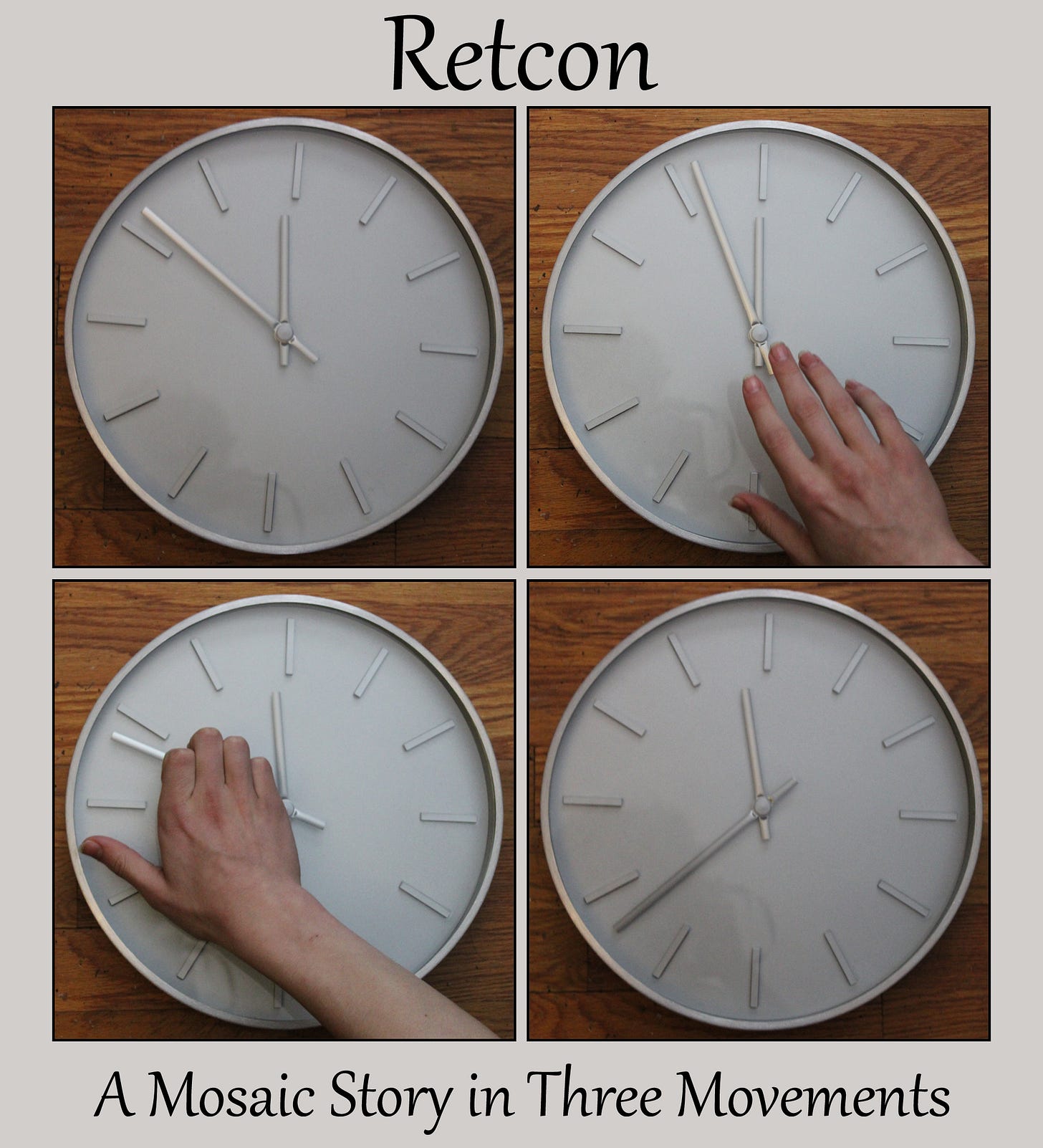
Introducing Retcon: A Mosaic Story in Three Movements

This is cross-posted from Attempts's new home on substack. If you are reading this, you should go subscribe to the substack!  New updates will be mostly there, and new essays & other substantive material will be exclusively there.  We now return you to your regular post, already in progress:

I am debuting a new project—a big project—one I've been working on for a few years and which I have been gathering ideas for for longer than that. And I am hoping that you will  give the first installment a try.

What is this project? you ask. Why, say I, I am glad you asked that.1

Well, you remember that last week I put forward the term "mosaic stories" to refer to the general form of stories where small, to-some-degree self-contained stories make up a larger one? It so so happens, in an astonishing coincidence, that that's precisely the form of the story I've been working on.

The story's name is Retcon.

It will be a large story composed of twenty-seven smaller ones, divided into three sections, or "movements" as I've decided to call them.2 The smaller stories are (prose) short stories, averaging about 15,000 words each. 3 The stories are going to be released as ebooks (to begin with), although I have plans for print collections too. I am planning to release them on a monthly schedule, with a break between movements, so there will be one a month for nine months, and then a break, and then another movement will begin. 4

And the first one is available now. It's called "Zero Second"

So how can I read this story?

You can buy the ebook! It’s only $0.99.5

As for where to buy it, there are lots of options.

• If you want to buy it at Amazon (for Kindle), which is where the majority of ebooks are sold, you can do so at this link.

Or, if you’d prefer, you can buy it directly from me at my web site.

• Or you could buy it from another ebook vendor; it is available at Smashwords, Barnes & Noble, and Kobo. (So far Apple is being difficult, but I hope to get it up there too before too long).

• Or, if you are willing to commit to the whole narrative (and/or are interested in supporting the series, and this substack in the bargin), you can pre-order the entire series in advance, and I will send them to you as they are released. Note that this offer is exclusive to my web site.6

As I mentioned a few weeks ago, a number of people have offered to support my Substack, for which I was very grateful. Well, if you are interested in supporting this Substack, the best way to do it would be to support me, and the best way to do that would be to support my series. So please: go buy it, and read it!

And, just as important: if you like it, please tell people! Reviews (on Amazon or elsewehere) are really helpful. Even better: tell a friend that you think might like it, and get them to read it.7 Word of mouth is how this series will find its audience, if it does.

So… go! Now! Read! Enjoy!

But what's this story actually about?

A fair question!

I wrote a blurb for the series, which I will share in a moment. But while it fairly represents the whole series, it is something of a spoiler for parts of the first story. So before you read any further, you should go buy or listen to “Zero Second”!

All right, everyone back? Or at least not too spoiler-phobic?

Here’s what the story is about:

In 1951, a pair of scientists at Cornell discovered time-travel. With the specter of the atomic bomb in the immediate background, they decide not to replicate Einstein's mistake of drawing the attention of the political authorities to what might be a weapon. Instead, they decide to set up a clandestine research program to investigate the phenomenon, swearing all those who work on it to keep the secret.

Then, in 1991, a time traveler returns from 2031 with a disturbing message: no traveler and no message has ever come farther back from the moment in time when he left; beyond that instant—dubbed "zero second"—is unreachable. No one knows why. All people know is that something happens on April 4, 2031, to prevent any news of the future.

This is the story of what happens next... if "next" is the right word for a narrative which, in the way of things, is necessarily non-linear.

A Final Repeat of the Basic Point

I hope you will all go read the story; and then go and tell a friend, or three. This is the work of my heart, which I have been pouring myself into, “the heart’s reflections, writ in tears”, as the poet said.8 I hope you’ll give it a try.

1 It's easier when you're playing both parts.
 
2 I was going to call them three "series", as British TV does its sub-sections, but given that the entirety is also a series, I thought that would be confusing.
 
3 Actually, given their length, those more plugged into the terminology of the writing business they are "novelettes" or, in one or two cases, "novellas", but I don't think these are distinctions that need detain ordinary readers.
 
4 Yes, yes, just like a television show with its seasons (although closer together in time). Pity the poor fiction writer, always scuttling about in the shadow of those larger beasts, like tiny mammals dodging dinosaurs.
 
5 If that honestly, no kidding represents a financial difficulty to anyone, then drop me an email at stephenfrug - that little symbol for at - gmail.
 
6 Read: I don’t know how to set it up elsewhere or if it’s even possible.
 
7 And if you want to support this substack qua substack, do the same for it: tell people about it! Forward the link to essays they might like! Share!
 
8 Actually, Pushkin’s entire description of his own work resonates with me in contemplating mine:
Half humorous, half pessimistic,
Blending the plain and idealistic—
Amusement's yield, the careless fruit
Of sleepless nights, light inspirations,
Born of my green and withered years...
The intellect's cold observations,
The heart's reflections, writ in tears.
     — Pushkin, Eugene Onegin, trans. James Fallen

…although I should say “l’havdil”, the Talmudic term for saying that a comparison made on one front is not a comparison in other ways (so that to compare God to a king is not to say that kings are like gods, nor that God is like a king in living with bread, feeling want,
tasting grief, and needing friends): I am not comparing myself to Pushkin! Save that my work, howevermuch lesser than his, is also half humorous, half pessimistic, and also mixes “the intellect’s cold observations/the heart’s reflections, writ in tears”.

Thursday, February 02, 2023

Re-Launching Attempts on Substack

I have decided to re-launch Attempts on Substack. You can read (and subscribe for free) here:

https://stephenfrug.substack.com/

The inaugural post in which I say "I have decided to re-launch Attempts on Substack" at far greater length is here:

https://stephenfrug.substack.com/p/essaying-again

I hope that, if you happen to be here, you will hop over there and subscribe—which means that instead of you having to come to the blog, the blog will come to you(r inbox)!

Saturday, June 22, 2019

Happenstance: the Print Edition

I assume most visitors to this blog know that I spent many years creating a graphic novel, and that over the past two years I have been serializing it online (you can read it here.)  Now I am trying to fund a print edition by running a kickstarter campaign.  You can learn more, donate and pre-order the book here:

https://www.kickstarter.com/projects/happenstanceprint/happenstance-the-print-edition

Go have a look!

Friday, January 04, 2019

My Photographic Novel, Happenstance, Is Nearly 3/4 Posted! Start Reading Now!

A graphic novel I wrote & illustrated (using photographs and photoshop) has been serializing online for about a year and a half, now.  It's about two friends who change their religious views in opposite ways, but in dialogue with each other; and about the fallout from those changes in each of their lives.  I thought I'd pop up here and say it's still posting! You can go read it!  Two new pages go up twice a week, on Mondays & Thursdays.  It's nearly 3/4 up — I just put up pp. 332-333 out of an eventual 444 yesterday, and we're nearing the end of chapter 9 (of 12).  So click here and check it out:


The graphic novel to date can be read here: http://happenstance.thecomicseries.com/

If you haven't read it, give it a try; and if you like it, share it with your friends!

Tuesday, June 13, 2017

My Photographic Novel, Happenstance, Is Now Being Serialized Online

So some of you know that I spent much of the past decade working on a (photo-based) graphic novel titled Happenstance. I'm pleased to announce I've begun serializing it online. My plan (kenina hara) is to post new images twice a week, Monday and Thursday (where each image is a two-page spread: the contrast between the pages becomes important down the line).


The graphic novel to date can be read here: http://happenstance.thecomicseries.com/

So please check it out, like & share with your friends!

Wednesday, January 16, 2013

Two Weeks Ago I Had Jury Duty

...and I live-tweeted it.  Since (rather to my surprise) a number of people mentioned that they liked the tweets I decided to wildly overreact to what was doubtless mere politeness collect them all in one place for the pathetic gratification of my swollen ego anyone who might be interested. Think of it as a performance piece about boredom.

So here they are. I hope they are at least as a tenth as pleasant as jury duty itself w...  Nah, I can't wish that on my Noble Readers.  But click through if you're curious.

(PS: For more exciting experiences in sheer dullness, you can follow me on twitter here.)

Monday, February 21, 2011

Yoram Hoazony, Israel and the Conflict of Paradigms

I met Yoram Hazony -- an American-born Israeli conservative, as well as a writer, think-tank founder and soon to be college founder -- back in the early 90's, and attended one of his summer programs (a sort of trial run for the currently-in-formation Shalem College) for a while. I still consider him a friend, although I haven't actually seen him in well over a decade.This means that I am even more interested in his work than I would be normally -- and I think that normally I would be quite interested, since he is one of the more intelligent writers and thinkers working on Israel-related questions around. (Lest you chalk that up entirely to friend-related bias, I should perhaps add that I also disagree with him on a great many points, that our politics are wildly far about, and that I think a fair number of his claims are flatly wrongheaded. (The fact that this coexists quite comfortably with my admiration for his work is a small example of a well-known set of facts which are of deep interest to anyone studying epistemology.))

Recently he's started putting up a series of essays -- blog posts, really, although they're longer than what a lot of people think of when they think of blog posts (although not me, as a quick browse through the "some favorite attempts so far" links over in the right-hand column will confirm) -- under the title "Jerusalem Letters". I've been reading them avidly, and went so far as to write him a lengthy email replying to one of them. He never responded directly (no hurt feelings there: he's busy, I get it), but when he mentioned (in a recent bulletin) that he'd posted some of the replies he'd received to his letters on his new web site, I looked and, yep, he'd posted mine too. I had thought myself that I might rewrite it and put it up as a blog post, but had never gotten around to it; but since it's now in the public sphere, I'll go ahead and post it here, with only minor emendations.

The letter is a reply to two of Hazony's Jerusalem Letters specifically (and while they're all interesting, I think these are clearly the ones to read if you're only going to read two (and if only one, read the first of these). The first of the letters is titled Israel Through European Eyes (from last July), the second is a follow-up titled More on Kuhn, Kant, and the Nation-State (from August). (Hazony has since put up another follow-up post titled EU Council President Van Rompuy: The Time of the Nation-State is Over.) You really ought to go read the original letters, but the on-one-foot version is that Hazony argues that Kuhn's paradigm theory is an important tool to understand current conflicts about Israel, and that Israelis and Europeans are using fundamentally different paradigms to understand the Israeli situation. In my letter, I comment first on two secondary issues, and then on his central point.

And I think it's fair to say that the third paradigm I outline in this letter is the one that I myself hold; and that it is the crucial theoretical critique (as opposed to more practical critiques about the occupation, say) I'd make of the Zionist project.

(What follows is the letter I wrote Yoram, as posted on his web site (no permalink -- but you'll see it if you go to the second of the essays & scroll down). I've cleaned it up slightly -- added a few links and two footnotes, changed a few misspellings, reformatted the quotes and fixed the emphases from *asterisks* to italics -- but it's substantially unchanged.)


I have a very long response to your two essays -- which I think are extremely perceptive, and do a lot to explain differing political views, even though I disagree with you in some key respects -- in my head, percolating, waiting to be written. But I have two books to write, courses to teach, a son to raise: I'm sort of doubtful I'll get around to it. So herewith are three brief responses to three specific points. If they're somewhat weaker, as thinking & writing, than I'd like, I hope you'll try to see beyond them to the hazy fuller text which I may or may not ever get around to pulling out of the Library of Babel (in one of its myriad versions).

So:

Most recent letter:
Münkler blames the fall of the nation-state system on the misbehavior of the United States, which he sees as abandoning its status as a nation-state and becoming an empire. I can’t make any sense of this claim. The principal hallmark of empire—the possession of a rationale for permanently ruling over an ever-expanding roster of nations—is entirely absent in the United States. No American I’ve ever met is interested in taking over Canada, although the United States could easily do it. No American I’ve ever met is interested in maintaining long-term control over Iraq or Afghanistan.
This only makes no sense if you think of "empire" purely in terms of a military empire, a la Rome. Now, we've had a little bit of that -- e.g. the Philippines, and of course the southwest was won in a war of conquest (which some, including Lincoln in his sole congressional term, decried as a war of aggression) -- but it's not been our main thing. But there are other models of empire, in which economic empire, dominating and economically exploiting areas without directly governing them -- economics backed up with military force which is more threatened than used -- is one. IMS, the Athenian Empire was basically of this sort. And so is the American Empire. Some of our wars can be seen as attempts to keep economically pliable client states in place (e.g. Vietnam). And of course we've knocked over a fair number of unfriendly governments more easily than that (Iran in '53, Guatemala in '54, Chile in '73, etc.) And while no one wants America to directly rule Iraq, Afghanistan, etc, I think some influential people (largely conservatives but also some neoliberals) want to establish friendly regimes, regimes friendly enough to keep bases on indefinitely -- as we are doing in Germany and Japan, say -- for the future projection of military force. So that fits too.

Now, you may not buy this as a description of America's last sixty-five years of foreign policy -- I wouldn't buy it in quite this form myself, although I would buy it in a rather more nuanced & carefully articulated version -- but it's a perfectly coherent notion of empire, and one with an ancient lineage as a usage.

Earlier letter
: "...we have to begin talking about what it takes to establish a new paradigm, or to rebuild an old one that has collapsed."

I read Kuhn a decade ago, early in grad school -- so not in college, but not recently either.* Still, my memory is that he never discusses or describes any notion of rebuilding a paradigm. Once a paradigm is gone, it's gone. Part of this is related to Kuhn's repeated (and complicated to interpret) insistence that his theory includes, indeed accounts for, scientific progress and not just change in world views (so perhaps this is simply not part of the analogy between scientific and non-scientific paradigms which would hold). But in considering what you want to do, it's worth thinking about.

Incidentally, if you think (and based on my memory of Kuhn it sounds correct to me) that paradigms collapse in the face of anomalous facts, what do you think are the anomalous facts which the current European paradigm can't explain or account for? (This is a genuine, not a rhetorical, question -- perhaps a good one for a future letter.)**

Finally, point three, generally on both letters: your description of the European paradigm may or may not be accurate -- I don't feel qualified to say. But I don't think it's accurate for America -- and, for liberal America at least, the other paradigm you present (of the nation state) doesn't fit either. There's a third paradigm that most of liberal America holds in some view or another, which you don't discuss -- but which is, I would claim, a driving force behind much of the criticism of Israel in the U.S. these days.

Very briefly, this paradigm holds that nation states are fine, but that any ethnic distinctions made by those states (or, really, anyone else) are abhorrent. Thus the U.S. acting as a nation state is fine, because it's an ideological, not an ethnic-based, nation state. (At least that's how liberals who hold by this paradigm would define it.) Similarly France, to the degree that it accords itself as an ideological nation state (Liberté, égalité, fraternité) and not simply as an ethnic state of the French, fits too. In this instance what makes Israel a particular offender is not that it is a nation state, but that it is a nation state built on and by an ethnicity. (Think of your colleagues Daniel Gordis's column upon Obama's victory, about how a Palestinian prime minister of Israel would violate its purpose: from the point of view of this paradigm, that purpose is illegitimate because (although not only because) it rules out such a change in Israeli society).

In this view, what distinguished the Nazis was not that they were a nation state, nor that they were an empire, but rather that they were a nation-state built upon an ethnic definition (Aryans good, Slavs bad, Jews the worst of all). Auschwitz occurred not because Jews couldn't defend themselves, nor because Germans were trying to create an empire, bur because the Germans distinguished between Germans and Jews rather than treating all of its citizens equally. - But all this is also rather separate: in the American view the reigning example of national wrongdoing (of which Nazism is considered an even more extreme example, but not the classic example, if you follow me) is Jim Crow: a nation (or a region of a nation) discriminating on the basis of ethnicity (in this case color). South Africa lost the U.S. when we looked and said not, "this is Auschwitz", but rather "this is Mississippi circa 1950". In the U.S., we're not post-WW2, we're post-Civil Rights Movement, at least in what our focus is in these areas.

And it's obvious, I trust, why Israel does not qualify as good under this paradigm.

People operating under this paradigm tend to focus -- too much, in my view, but legitimately -- on racism and other forms of discrimination as the worst types of evil. (I think that liberals would do good to take other evils more seriously -- I personally would make violence, particularly state violence, more central. But that's me.) So since North Korea oppresses all of its population, while Israel (arguendo) oppresses only part of it, that makes Israel more noteworthy. (Although in fairness, nearly everyone who operates under this paradigm (and here I include myself) would point out another, far more salient reason for people in the U.S. to treat them differently: the U.S. is complicit in any crimes Israel commits, through financial, diplomatic and other aid, but not in the crimes of North Korea; it is also correspondingly easier for us to help end them if we should so choose.)

This paradigm also explains why there is a divide among liberal Jews on Israel. Some think that Israel could withdraw from the territories and thereby rejoin the family of non-discriminatory nations (i.e. don't see what happens in Israel proper as Mississippi circa 1960, but only in the occupied territories), and thus support a two-state solution -- but find Israel, until then, to be an extreme offender on the "distinguish-by-ethnicity" count. Others think that the very definition of Israel as a Jewish state is the equivalent to South Africa (or Mississippi) defining themselves as a white state, and that the in-practice quality of life for Palestinian-Israelis isn't as important as the very act of defining and treating differently citizens by ethnicity -- and thereby the only real solution is a single-state solution in all of Israel/Palestine. (Still others would be in camp 1, but think it's now impossible, so are edging into camp 2).

-- I think that this paradigm more accurately captures American -- at least liberal American -- problems with Israel. I think it's a very different beast than the EU paradigm. And if you want to defend Israel, you're going to have to tackle it as well as the EU one.

...Yeah, that was the short version. Long version can be found c/o J. L. Borges, the Library of Babel.

I get a lot out of your letters. I look forward to the next.

__________________
* I hadn't figured this out yet when I wrote this, but obviously this is going to change soon since I'm assigning Kuhn in my Intellectual History course, so will reread it in a couple of weeks.

** Sadly, Hazony has not yet responded to this particular point. I still hope he will, though: it really was a genuine question!

Friday, July 13, 2007

Rutu Modan's Exit Wounds

My second review column is up at Broken Frontier; this week I review Israeli cartoonist Rutu Modan's marvelous debut graphic novel Exit Wounds. Take a look.

(In blog news, posting may be light for the next week or two.)

Friday, July 06, 2007

Graphic Novel Review Column at Broken Frontier

I was approached recently by the editor of a comics news site, Broken Frontier, and asked if I would do a weekly review column for them -- picking up "Crossing Borders", a column which the previous writer described as "reports from the world of comics from off the beaten path, those with an “alternative” sensibility or told from an international perspective". I must admit I was a little hesitant at first, for a few reasons: first, the writings I've done on comics here have tended to take a somewhat more skewed perspective on things rather than being straight reviews, and I wasn't sure reviewing as such was the best mode for me; second, I know far too little about manga to write from a truly international perspective; and finally, I have a lot of other projects on my plate. But it sounded like fun, so I decided to give it a try. (I was also comforted by the fact that the previous columnist took a rather broad view of his mandate, which suggested I could do the same (as in fact I will.))

And, lo and behold, my first column -- a review of Matt Madden's wonderful book 99 Ways to Tell a Story, is now up at Broken Frontier. I invite you all, Noble Readers, to go take a look at it.

Those who have been reading Attempts for a while may recall that I've actually written about Madden's book before -- although that, too, was not quite a straight review, so I was happy to take another crack at it. And I'll admit that there was a comfort zone in writing about a book I'd discussed once before (in another context) for my first column.

Anyway, my reviews will -- FSM willing -- generally be up on Fridays. I'll try to post links to them here, but of course you can go read them at Broken Frontier yourself.

As a small additional treat for my readers here, I'll mention one thing I didn't put in the review. My only negative comment on Madden's extraordinary work (which you can sample online here, by the way) is that the cover and general sales presentation of the book was terribly off-putting. So what would a good cover for Madden's book be? Actually, most of the foreign editions had quite good covers. I thought that the UK cover was clearly the best, and the nearly-identical Italian cover is (obviously) really good too. But the Japanese, French and Spanish covers are good too (they're all variations on this page). Only the US version was bad.

Anyway, take a look at the column, and look for it on future Fridays!

Monday, February 27, 2006

Continuity #1: A Creative Commons Comics Script

Continuity1_Script.html
Continuity1_Script.pdf
Continuity1_Script.doc

Above, in a few different formats, are links to a script I've written for a 24-page comic book -- Continuity #1. It's intended as a one-shot, i.e. a single issue without follow-up. I am releasing the script under a creative commons license (Attribution-NonCommercial-ShareAlike 2.5), as described here (human-readable summary) and here (legal text).

This is (to the best of my knowledge) the first time a comics script has been released under a creative commons license. (Lots of complete comics, but no scripts that I've seen.)

The license I've released it under allows anyone (without getting any special permission from me) to read and distribute the strip, so long as they don't release it commercially or attempt to make any money from it. It also allows anyone (again, without getting any special permission from me) to make derivative artworks, so long as 1) I am give adequate credit; 2) those artworks are non-commercial and are 3) released under the same creative commons license that I am releasing this script under. I don't know of any way of writing this into the legal license, but I am in addition asking people who make a derivative work to send me a copy (link to your web site, a scan or jpeg of the artwork, etc.) unless it is wholly for your private practice and not distributed at all. Basically, if anyone draws any of this (or paints or whatever), I'd really like to see it. My email address is sfrug [symbol for at] post.harvard.edu.

The point of the "derivative works" is not to allow people to go write endless stories about these characters (although of course that is allowed, presuming they follow the given restrictions) but to allow any artists who want to to illustrate it. This could be for anything. It could simply be good practice for someone, a way to test out skills and stretch artistic muscles. Perhaps someone who wants to draw a 24 hour comic but doesn't want to write it at the same time could use this script (it might not, therefore, be strictly according to the rules, but what the hey). Or whatever.

I should note, incidentally, that it is possible to release this work commercially and not under a creative commons license if you get my permission. The point of mentioning this is that if anyone wants to illustrate it and try to publish it as an independent, for-sale comic (whether self-published or through some established comic publisher), then I'm certainly open to the idea. We just need to talk terms (which I would imagine as share-and-share-alike). Anyway, if you're interested, do contact me.

For anyone else who is interested, I hope you enjoy reading my script. And please forward it (or a link to it) to anyone else who might be interested!

(A hopefully-permanent version of this post will be found on its own page here.)