Showing posts with label Links. Show all posts

Sunday, July 09, 2023

I'm Now Writing Elsewhere, Come Read Me There

To put this all in one post for the top of this page: I've moved.

If you want to read my essays and link round-ups—the sort of thing I used to put here, but now delivered to your inbox, and at a steady once-a-week rate—you should go and subscribe to Attempts 2.0 over on Substack:

https://stephenfrug.substack.com/

And I am also publishing a series of short stories, which you should go read! Learn more about them here:

https://stephenfrug.com/retcon-a-mosaic-narrative-in-three-movements/

I will of course leave this up for its archives, but if you want to see anything new, go to those places. I hope to see you there!

Friday, March 10, 2023

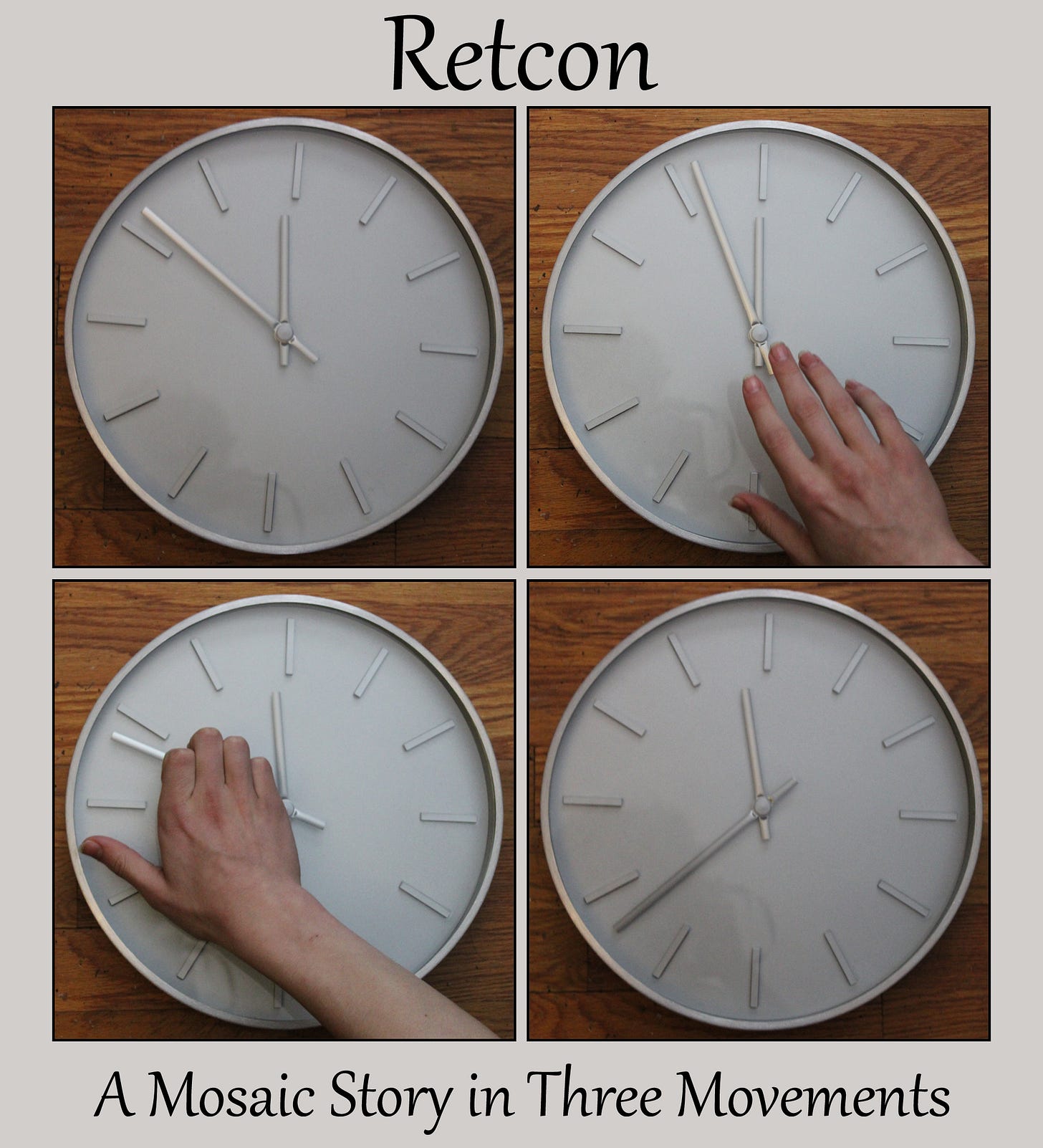
Introducing Retcon: A Mosaic Story in Three Movements

This is cross-posted from Attempts's new home on substack. If you are reading this, you should go subscribe to the substack!  New updates will be mostly there, and new essays & other substantive material will be exclusively there.  We now return you to your regular post, already in progress:

I am debuting a new project—a big project—one I've been working on for a few years and which I have been gathering ideas for for longer than that. And I am hoping that you will  give the first installment a try.

What is this project? you ask. Why, say I, I am glad you asked that.1

Well, you remember that last week I put forward the term "mosaic stories" to refer to the general form of stories where small, to-some-degree self-contained stories make up a larger one? It so so happens, in an astonishing coincidence, that that's precisely the form of the story I've been working on.

The story's name is Retcon.

It will be a large story composed of twenty-seven smaller ones, divided into three sections, or "movements" as I've decided to call them.2 The smaller stories are (prose) short stories, averaging about 15,000 words each. 3 The stories are going to be released as ebooks (to begin with), although I have plans for print collections too. I am planning to release them on a monthly schedule, with a break between movements, so there will be one a month for nine months, and then a break, and then another movement will begin. 4

And the first one is available now. It's called "Zero Second"

So how can I read this story?

You can buy the ebook! It’s only $0.99.5

As for where to buy it, there are lots of options.

• If you want to buy it at Amazon (for Kindle), which is where the majority of ebooks are sold, you can do so at this link.

Or, if you’d prefer, you can buy it directly from me at my web site.

• Or you could buy it from another ebook vendor; it is available at Smashwords, Barnes & Noble, and Kobo. (So far Apple is being difficult, but I hope to get it up there too before too long).

• Or, if you are willing to commit to the whole narrative (and/or are interested in supporting the series, and this substack in the bargin), you can pre-order the entire series in advance, and I will send them to you as they are released. Note that this offer is exclusive to my web site.6

As I mentioned a few weeks ago, a number of people have offered to support my Substack, for which I was very grateful. Well, if you are interested in supporting this Substack, the best way to do it would be to support me, and the best way to do that would be to support my series. So please: go buy it, and read it!

And, just as important: if you like it, please tell people! Reviews (on Amazon or elsewehere) are really helpful. Even better: tell a friend that you think might like it, and get them to read it.7 Word of mouth is how this series will find its audience, if it does.

So… go! Now! Read! Enjoy!

But what's this story actually about?

A fair question!

I wrote a blurb for the series, which I will share in a moment. But while it fairly represents the whole series, it is something of a spoiler for parts of the first story. So before you read any further, you should go buy or listen to “Zero Second”!

All right, everyone back? Or at least not too spoiler-phobic?

Here’s what the story is about:

In 1951, a pair of scientists at Cornell discovered time-travel. With the specter of the atomic bomb in the immediate background, they decide not to replicate Einstein's mistake of drawing the attention of the political authorities to what might be a weapon. Instead, they decide to set up a clandestine research program to investigate the phenomenon, swearing all those who work on it to keep the secret.

Then, in 1991, a time traveler returns from 2031 with a disturbing message: no traveler and no message has ever come farther back from the moment in time when he left; beyond that instant—dubbed "zero second"—is unreachable. No one knows why. All people know is that something happens on April 4, 2031, to prevent any news of the future.

This is the story of what happens next... if "next" is the right word for a narrative which, in the way of things, is necessarily non-linear.

A Final Repeat of the Basic Point

I hope you will all go read the story; and then go and tell a friend, or three. This is the work of my heart, which I have been pouring myself into, “the heart’s reflections, writ in tears”, as the poet said.8 I hope you’ll give it a try.

1 It's easier when you're playing both parts.
 
2 I was going to call them three "series", as British TV does its sub-sections, but given that the entirety is also a series, I thought that would be confusing.
 
3 Actually, given their length, those more plugged into the terminology of the writing business they are "novelettes" or, in one or two cases, "novellas", but I don't think these are distinctions that need detain ordinary readers.
 
4 Yes, yes, just like a television show with its seasons (although closer together in time). Pity the poor fiction writer, always scuttling about in the shadow of those larger beasts, like tiny mammals dodging dinosaurs.
 
5 If that honestly, no kidding represents a financial difficulty to anyone, then drop me an email at stephenfrug - that little symbol for at - gmail.
 
6 Read: I don’t know how to set it up elsewhere or if it’s even possible.
 
7 And if you want to support this substack qua substack, do the same for it: tell people about it! Forward the link to essays they might like! Share!
 
8 Actually, Pushkin’s entire description of his own work resonates with me in contemplating mine:
Half humorous, half pessimistic,
Blending the plain and idealistic—
Amusement's yield, the careless fruit
Of sleepless nights, light inspirations,
Born of my green and withered years...
The intellect's cold observations,
The heart's reflections, writ in tears.
     — Pushkin, Eugene Onegin, trans. James Fallen

…although I should say “l’havdil”, the Talmudic term for saying that a comparison made on one front is not a comparison in other ways (so that to compare God to a king is not to say that kings are like gods, nor that God is like a king in living with bread, feeling want,
tasting grief, and needing friends): I am not comparing myself to Pushkin! Save that my work, howevermuch lesser than his, is also half humorous, half pessimistic, and also mixes “the intellect’s cold observations/the heart’s reflections, writ in tears”.

Wednesday, May 19, 2021

Nine Years Ago Today

This happened nine years ago today; adjusting for time zones, this post should go up at the moment (6pm Spanish time, 12pm Eastern US). It's one of the happiest things to ever be on the internet. Go ahead and watch it. Even if you've seen it before, it's worth enjoying again.

Sunday, April 25, 2021

On the Afterlife of Photographic Subjects: A Strange Sub-Sub Genre on the Border of History and Journalism

I just read the remarkable piece of journalism about the woman who was the subject of this famous photograph:

It was written by Patricia McKormick, whose work I was previously unfamiliar with, but who (judging by this piece) is superb; it was first published in the Washington Post (h/t LGM), but if that link hits a paywall for you, you can also find it in the Anchorage Daily News.

But it occurred to me that it is, in fact, an example of a small little niche genre: stories about the lives of not-particularly famous people who appeared in famous photographs. A few more examples occur to me.

First, there are stories about this other famous photograph from the Vietnam War, in which American napalm, dropped on children, has burned off the clothes of a little girl:

Well, the story (which I've had occasion to mention before) of the girl—how the photographer rushed her to the hospital, how she eventually ended up in Canada, how she and the photographer became friends—has been told, briefly, here: http://digitaljournalist.org/issue0008/ng5.htm and at greater length in a book (which I haven't yet read) called The Girl in the Picture by Denise Chong.

Another example, about a different iconic photograph* from a different iconic midcentury event, this one the 1957 integration of Little Rock, Arkansas's high school:

The story (which I have also had occasion to mention before) of the relationship between the two women (girls, at the time) in the photograph has been told by David Margolick, briefly, here: https://www.vanityfair.com/news/2007/09/littlerock200709 and in longer form in his book Elizabeth and Hazel.

But the more I think about it, the more examples come to mind.

There have been many stories told about this famous photograph from V-E day:

 About which there are, apparently, both questions concerning the identity of the people in the photograph and (conditional on who it actually is!) the fact that the kiss was non-consensual and more of a sexual assault than a celebration (see, e.g., here: https://www.artsy.net/article/artsy-editorial-controversy-surrounding-alfred-eisenstaedts-iconic-photo-v-j-day-kiss, but this has gotten a lot of coverage.)  And yes, that too has been a book, The Kissing Sailor (another I haven't read), which appears to focus on the who-are-they mystery angle.

Then there's this photograph, less historic than the others here, perhaps, but very widely known in the art world, of the artist Marcel Duchamp playing chess (the activity he abandoned art to persue) while at the first retrospective of his work, with a young woman named Eve Babitz who would go on to be a novelist of some note:

This story (less shocking than any of the above, but still quite interesting) was told first by Eve Babitz herself, and then in greater detail by writer Lili Anolick in this engaging & worthwhile essay: https://www.vanityfair.com/culture/2015/10/eve-babitz-marcel-duchamp-chess-nude. Anolick has also written a biography of Babitz, Hollywood's Eve, which also tells the story, of course.

And those are just the ones that come readily to mind. I'm sure there are a lot more. Please leave any that occur to you in the footnotes.  It would be nice to curate a list!

_____________________________

* Actually, this one wasn't a single photographs; there were two or three images taken at almost the exact same moment, from different angles, two (at least) of which are widely reprinted; see Margolick for details.

Saturday, June 22, 2019

Happenstance: the Print Edition

I assume most visitors to this blog know that I spent many years creating a graphic novel, and that over the past two years I have been serializing it online (you can read it here.)  Now I am trying to fund a print edition by running a kickstarter campaign.  You can learn more, donate and pre-order the book here:

https://www.kickstarter.com/projects/happenstanceprint/happenstance-the-print-edition

Go have a look!

Wednesday, November 29, 2017

Secondary Sources On Gene Wolfe's Book of the New Sun

A friend of mine, seeing my previous post (on FB), asked whether there were "annotations" of Gene Wolfe's SF masterpiece, The Book of the New Sun.  Since I wrote a lengthy reply, I thought I'd repost it here, with links.  (In the following, the "you" is my friend, natch.)

I don't think there's quite what you're looking for. The closest that there is—and in any event the first secondary work devoted to The Book of the New Sun that one should lay hands on—is Lexicon Urthus: A Dictionary for the Urth Cycle, by Michael Andre-Druisi. It defines many of the obscure words, and also has a certain amount of commentary/exposition, although hardly a complete reading. Beyond that I can think of three other books, none quite perfect for your needs: there is Attending Daedalus by Peter Wright, which is about Wolfe's work in general but which focuses on The Book of the New Sun; there is Marc Aramini's Between Light and Shadow, volume one of a projected three-volume work discussing all of Wolfe's fiction, but its entry on The Book of the New Sun, while good, is brief (c. 40 pages) and is more thematic than annotational. And then there's Solar Labyrinth by Robert Borski, which has a number of essays on specific puzzles in the Urth cycle. All three are worthwhile; none are quite what you're looking for.

That's mostly it for books. There are a few essays scattered around — in review collections by John Clute, for instance — but nothing systematic. Three web resources might have some more of what you're looking for. First, there's the Wolfe Wiki, which is variable (some works get only a skeleton treatment, some a very detailed reading), but it looks like there's some good stuff there. There are the archives of the Urth List, which is the mailing list/forum for discussion of Wolfe's work, which has a lot of stuff in it, but so far as I know it's not indexed & you'd have to do a tremendous amount of searching. And then there's Reddit, about which I don't know much, but it looks like there's a fairly active Gene Wolfe section there. Again, while I imagine there's some good stuff in all three, none are quite what you're looking for.

One more set of resources to discuss. There are now two podcasts devoted to close readings of GW's work. One, The Gene Wolfe Literary Podcast, seems good, but it's just starting (and I've heard only one episode), and is doing a lot of short stories & many novels before they get to the The Book of the New Sun. So they probably won't get to it for years. The other, Alzabo Soup, is actually doing The Book of the New Sun now. But at this point I can't quite recommend it. I find many of their readings simply careless: some strike me as flatly disprovable, others as wholly wrongheaded even if not flatly contradicted by clear textual evidence. I'm getting a lot out of it — even with its problems, they pick out details & things I missed on my several times through the books — but I think their overall interpretation is questionable, and I think that, unless you feel you have a good grasp on the text, they will mislead as much as provide insight. I wish this wasn't so; after the first ep or two I had great hopes for it, but I have been disappointed as I've kept listening. I haven't stopped listening yet, but I may; at this point it's more frustrating than enlightening, although it is that, too, at least in certain local observations if not more broadly considered. Alas! I really wanted it to be great. (It's gotten a fair amount of positive attention, so I may simply be an outlier here, but for what it's worth a Wolfean whom I respect a great deal — whom I can't name, because it was a private communication — said they dislike it too, for some of the same reasons.)

Beyond that, I would suggest that a large number of the mysteries—not all, by any means, but more than you'd think—can be cleared up by simply reading the entire work (i.e. both The Book of the New Sun and The Urth of the New Sun, the sequel) closely & carefully, and then doing so a second time, while the first is still fresh in your mind. That's a huge time commitment, of course — five books, each twice — but it's the best route I know of.

I do wish someone would put out a proper annotated edition. (No one will, and if they did they wouldn't hire me to do it, but I would love to if both of these counterfactuals were miraculously overcome.) Or that there was a "rereader's companion", online annotations that went chapter-by-chapter.

will say, in conclusion (after far more than you wanted to read, I'm sure!), that the best route is to get Lexicon Urthus, do a careful reading with it to hand, and then either do a careful rereading, or read the Wright, the Aramini & the Borski volumes, the WolfeWiki pages, and possibly explore other online stuff as well, and then do a careful rereading. Wolfe is work. Personally I think it's well worth it. But many others, doubtless, won't find it so. (Of course the books can also be enjoyed on a surface level, as a sword & sorcery romp, although that's obviously, A) not what they are when read closely, and B) not what you were asking about.)  

Wednesday, December 11, 2013

Link of the Day

One of the signs, for me, of a really great piece of internet writing (article, blog post, whatever) is that I find myself googling to try and dig it up again weeks or months or years after I first read it.  I just did this, not for the first time, with this article.  So I thought I'd share it with you.  It's by Adam Kotsko, who blogs here.  It's called "A Defense of the Lecture", which was not a title I was (prior to reading it) likely to be sympathetic with.  Now I keep rereading it.

Here's a small bit of it:
A lively discussion of a book by a small, engaged group is an ideal to be aspired to. At the same time, it seems to me that such discussions are pretty rare, even among professional academics (note how often people will express surprise that a conference session had good discussion). Such skills need to be cultivated, and of course you can only learn by doing. Yet there are some base-level confidence issues that need to be addressed as well, and unless we want to cultivate students who believe that their every utterance is intrinsically worthwhile due to their precious snowflake-hood, it would probably be good to get them to a point where their confidence is earned, where it’s based in actual knowledge....

I think that the assumption that students have baseline reading skills is behind the thinking of people who want more or less exclusively discussion-based classes — lectures, they suppose, are just trying to transmit information, which the books can do by themselves. If we assume that the students are reading attentively outside of class, we can use the class time to practice our critical reading with each other. I don’t think it’s at all clear, however, that students typically come to college with the skills necessary to make such a model work. Some will, but it’s much safer to assume that your students need help. And I believe that we should interpret students’ desire for more lectures precisely as a cry for help.

Monday, October 14, 2013

J. L. Austin's Philosophical Papers is Available Online

Awesome.  I was googling this book, hoping to use a 'search inside' function (either on google books or on Amazon or what-have-you) as an index (to then match it with my own, dead-trees copy), and I found that, lo and behold, the whole book is available online.

He's an obscure philosopher—at least these days—but, I think, an underrated one.  So now you can check him out, if you're so inclined.

Wednesday, August 28, 2013

50th Anniversary of March on Washington Link Round-Up

I'm teaching my seminar on "America in the Sixties" again this semester -- but, sadly, we just began and won't get to the March this week.  Pity  (I did skip ahead and talk about it a bit yesterday -- I couldn't resist -- although I don't know if it was useful or just confusing.)

Some reading about today's anniversary:

• In my seminar, we read the speech of John Lewis as delivered -- it was considered too radical by other March organizers and, with a personal appeal from A. Philip Randolph narrowly avoiding a walkout by SNCC (the Student Nonviolent Coordinating Committee, pronounced "snick"), Lewis rewrote it to tone it down.  It's on the web, though; you can read it here.  (Lewis, by the way, just published the first volume of a graphic-novel autobiography; I haven't had a chance to read it yet, but flipping through it it looks fabulous.  (They got a great artist, it seems -- thankfully, and crucially.))

Some recent media-provided historical context on the March:

Rick Perlstein, "The March on Washington in Historical Context"  Perlstein talks mostly about the fears people -- not just conservatives, but mainstream liberals (and whites generally) had about the march beforehand.

Harold Meyerson, "The Socialists Who Made the March on Washington"  Meyerson reviews some background about the march too often forgotten today

•, William P. Jones, "How Black Unionists Organized the 1963 March for Jobs and Freedom"  Similar in theme to the previous link; an excerpt from a just-released book on the topic.

• Speaking of whom, both Jones and another historian with a timely book out about the March (in the latter case, I believe, specifically on King's speech) were guests on the amazing radio show Democracy Now! last week.  (Link to a transcript.)

• Relatedly, Democracy Now! has a good round-up of march-relevant interviews and materials from their show.

Garance Franke-Ruta at The Atlantic has some good photographs of the March by Leonard Freed (which I'd never seen before).

Dave Zirin notes some differences between the original 1963 March and this past weekend's commemorative anniversary march.

An interview with one of the co-authors of a new book on the Freedom Budget, an ambitious policy plan (never seriously considered) which arose out of the March coalition.  The connecting hook:
Martin Luther King's "I Have a Dream" speech cannot be comprehended unless we understand it as the culmination of a March for Jobs and Freedom, linking economic justice with racial justice. From his college days in the late 1940s until his death in 1968, King was deeply committed to overcoming poverty and economic exploitation no less than to overcoming racism. He came to see the struggles to overcome economic and racial oppression as inseparable.
Read the rest.

• And Digby puts up some really stunningly good clips from MSNBC (!) about King's legacy and its depoliticization in American memory.  Is Up with Chris Hayes always this good?  I may need to actually watch it.

• I hadn't realized, until Angus Johnston pointed it out this morning, that William Zantzinger (op. cit.) was sentenced on the day of the March.  (Nor that his sentence was deferred until after the tobacco harvest.)  Bury the rag deep in your face.

The official program from the March is online here.

• Did you know that the "dream"section of MLK's famous speech was improvised?  If not, the story's retold in the Times today.

Joseph Stiglitz on a common theme, touched in many of these links, about the forgotten "jobs" part of the March for Jobs and Freedom:
Like so many looking back over the past 50 years, I cannot but be struck by the gap between our aspirations then and what we have accomplished. True, one “glass ceiling” has been shattered: we have an African-American president. But Dr. King realized that the struggle for social justice had to be conceived broadly: it was a battle not just against racial segregation and discrimination, but for greater economic equality and justice for all Americans. It was not for nothing that the march’s organizers, Bayard Rustin and A. Philip Randolph, had called it the March on Washington for Jobs and Freedom. In so many respects, progress in race relations has been eroded, and even reversed, by the growing economic divides afflicting the entire country.
Read the rest.

...and that's what I've seen so far.  I'll add more later if I see more.  (Update: Yup.)

Thursday, May 02, 2013

David Graeber Link Round-Up

David Graeber has a new book out, and as a consequence, we get some interesting articles and interviews both by and about him.
I'll probably add more links if and when I see 'em.

Friday, April 26, 2013

What We Cannot Speak About We Must Link To In Silence

Lotsa links, some old but all still fresh.  Mostly humorous or diverting.  A few otherwise. Random order.

Teju Cole, "Seven Short Stories About Drones" (viaMore here.

100 Things Your Kids May Never Know About

Philip Roth v. Wikipedia

Flowchart: Are You Good at Following Flowcharts?

The Spider-man frog.

The greatest 404 page ever. (Warning: music starts on opening.)  Another good one.

• Possibly the greatest Venn diagram ever (via):


• If you read the Narnia books as a kid, you might remember the problem of Susan.  I'd always thought that Neil Gaiman had the last word on that.  But it turns out there were other brilliant things to say too.

• I’ve done my work for the day,
I’ve twittered random shit.
I’ve whined about immigration;
And I’m sure I displayed my wit.
I’ve drunk my supper, watched some porn,
And even fed the dog.
Now it’s time to be an idiot on John Scalzi’s blog.

(continues at the link)

•  Plot holes (and similar flaws) in World War Two.  Sample:
Apparently we're supposed to believe that in the middle of the war the Germans attacked their allies the Russians, starting an unwinnable conflict on two fronts, just to show how sneaky and untrustworthy they could be? And that they diverted all their resources to use in making ever bigger and scarier death camps, even in the middle of a huge war? Real people just aren't that evil. And that's not even counting the part where as soon as the plot requires it, they instantly forget about all the racism nonsense and become best buddies with the definitely non-Aryan Japanese.
Similarly (or is it 'conversely?), If Series Set In the Modern Day Were Written Like Sci-Fi Series.

• Rest easy: University of Chicago's Indiana Jones mystery solvedAlso here.

The Avengers vs. God. 'nuff said.

God's blog: the comments.  Sample:
Going carbon-based for the life-forms seems a tad obvious, no?

The creeping things that creepeth over the earth are gross.

The dodo should just have a sign on him that says, “Please kill me.” Ridiculous.

Amoebas are too small to see. They should be at least the size of a plum.
• The inspiring and uplifting -- at least in personal terms; it's a bit depressing & infuriating considered politically -- story of Richard the piano tuner:


Here's his web site, for more on his lifestyle -- or to hire him to tune his pianos. if you live in the London area.

•  11 More Weird & Wonderful Wikipedia Lists. The problem with pages like this is that highlighting good stuff on Wikipedia always sets it up for deletion.  But it's fun.

Brief but fascinating (and quite persuasive) speculation about how fictional characters work from Cory Doctorow.

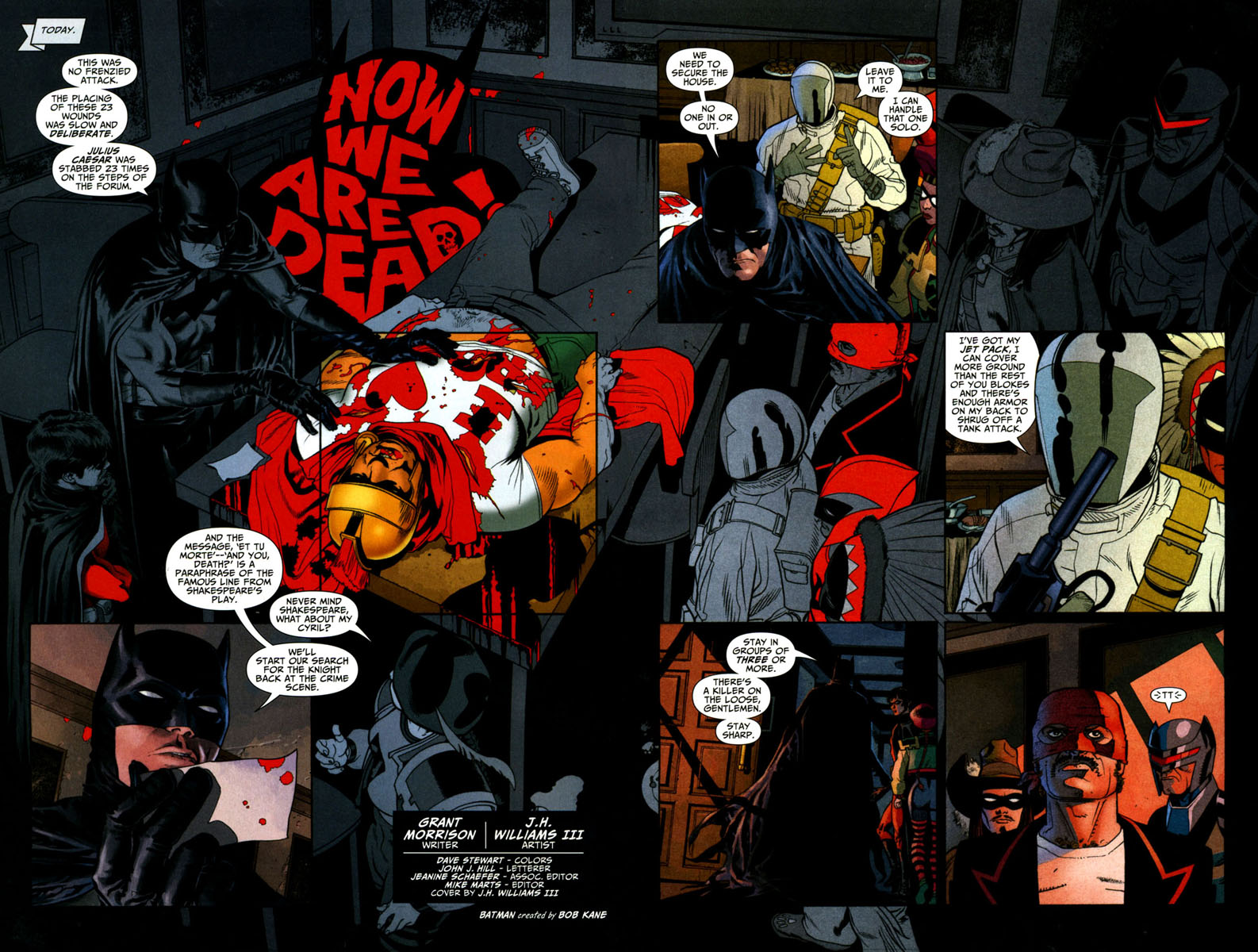
• Old news, but I missed it before: Neil Gaiman's writing a new Sandman series!  Huzzah!  And with the person who is probably the best artist working in mainstream comics today, too.  (JHW3's books are pretty much the only ones I'll buy just for the art, even with little interest in the story.)  So double huzzah!!

The Battle of Hoth (from The Empire Strikes Back) in military terms.  Includes links to rebuttals, further discussion, etc.

Zombies as an image of survivalism.

A defense of academic hesitations and verbiage.  Preach it!

Compilation of Calvin & Hobbes snowmen cartoons.

• And speaking of which, “Hobbes and Bacon” is a “Calvin and Hobbes” tribute that takes place 26 years later

• I don't know how to describe this incredible, amazing series of photographs called simply "The Basement".  It's brilliant.  Go see.

• The Saga of the Hat:


An extraordinary blog post about addiction, from the fabulous Natalie Reed who, sadly, recently stopped blogging.

Sayings of the Jewish Buddha.

27 Science Fictions That Became Science Facts In 2012

• Truth hurts:  Novelists strike fails to affect nation whatsoeverDying Lion Sure Doesn't Feel As Though He's Completing Some Great Cosmic CircleNew Cheney Memoir Reveals He's Going To Live Full, Satisfied Life Without Ever Feeling Remorse And There's Nothing We Can Do About It.

• Ever since Ambrose Bierce's classic Devil's Dictionary (1881 - 1906), there have been a lot of sequels, updates, etc.  Most aren't nearly in its class.  But this one comes pretty close.

Henri Matisse’s Rare 1935 Etchings for James Joyce’s Ulysses

Texts from Superheroes (via).
 Link to tumblr; link to best-of-2012.

How many people are in space right now?

• "supercalifragilisticexpialidocious": not invented in Mary Poppins. In fact, it predates it by decades.

• Quiz: 18th-Century Connecticutian or Muppet?  Don't miss the answers (especially the final answer).

Wild dolphins will greet one another by exchanging names.

Six things rich people need to stop saying.

• Two on (SF writer) Robert A. Heinlein: Friday as a trans novel, and Robert Heinlein: One Sane Man?  By John Kessel.

The unabomber's entry for his Harvard alumni reunion book.  And the unabomber's pen pal.

Wovon man nicht sprechen kann, darüber muss man schweigen.

Thursday, February 21, 2013

Recursive Conspiracy Theories

From Justin Gills at the New York Times (via):
Dr. Lewandowsky’s survey results suggested that people who rejected climate science were more likely than other respondents to reject other scientific or official findings and buy into assorted fringe theories: that NASA faked the moon landing, that the Central Intelligence Agency killed Martin Luther King Jr., that the AIDS virus was unleashed by the government, and so forth.

This piece of research appeared in a specialized journal in psychological science, but it did not take long to find its way onto climate skeptics’ blogs, setting off howls of derision.

A theory quickly emerged: that believers in climate science had been the main people taking Dr. Lewandowsky’s survey, but instead of answering honestly, had decided en masse to impersonate climate contrarians, giving the craziest possible answers so as to make the contrarians look like whack jobs.

So, a paper about a tendency among this group to believe in conspiracy theories was met by … a conspiracy theory.
Words fail me.

But one further wrinkle occurs to me.  This is all a secondary finding of the initial study.  The primary finding was "that ideological belief in an unregulated free market tended to be a predictor of someone’s willingness to reject the findings of mainstream climate research." As Gills says, "no surprises there"; after all, that's a straightforward ideological pairing in a country where beliefs are more and more partisan (and the right has an echo-chamber devoted to spreading falsehoods).

But how do other conspiracy theories fit in?  Are they part of the right-wing nonsense machine somehow?  Does getting one's news from that machine simply predispose one to believing other conspiracy theories?  Are they somehow in sync with right wing beliefs?  Or are these two different groups -- a big group that deny climate science because of right wing beliefs, and another group that denies them because they believe other conspiracy theories?

Damn. Now maybe I'll need to read the #$%^& papers.  (Oh, and by the way: here's a link to the first paper, which spawned the conspiracy theories, and here's a link to (a preliminary draft of) a second paper, written about the response to the first one.)

Monday, February 11, 2013

Good Reading on College Pedagogy (and a few other matters)

I came across these two essays by Adam Kotsko, and wanted to commend them to anyone working as a teacher in a college-or-later setting as rich food for pedagogical thought.  They repeat themselves somewhat -- he reuses some paragraphs -- but they both add something to his overall picture.  And while they start in a direction I would have said I disagree with, he makes some pretty compelling points.  Anyway, check them out:
Kotsko, by the way, is an interesting guy all around.  Until now I've known him mostly from his blogging, but poking around after reading these essays his main work looks pretty interesting too.  (Indeed, a few pieces of it I'd already read and liked -- e.g. his review of Red Plenty -- without remembering who wrote them.)  Here's an excerpt from one of his books, on Zizek and theology; here's an excerpt from another one, on sociopaths in contemporary TV shows.    I found both more interesting than I thought I would based on their announced subjects.  Kotsko was also kind enough to point out that Orson Welles's The Trial is available for free online. (He teaches at a pretty interesting looking college too -- an interesting variant on the St. John's College model.)

__________________
* If there was ever a follow-up 'Immersion Method II' essay, I couldn't find it.

Thursday, January 17, 2013

January 20 is Inauguration Day

...so why is this year's inauguration on Monday the 21st (the Martin Luther King holiday), and not the day before?

It's for the same reason that Sally tells Harry they don't make Sunday underpants: because of God.

Which is to say, because it's Sunday.

I had thought that this was constitutional, but it's not: it's just a tradition.  You can read the brief version here.  This happens -- roughly -- once every 28 years (there are disruptions for various reasons).  It happened with Reagan in January of 1985, Ike in January of 1955, and Wilson in March of 1915 (remember what I said about disruptions?).  The current tradition (which was done with all three of those earlier gentlemen) is to have a private swearing-in on the actual, uh, inauguration day, and then a big public hoopla on the following day, including a do-over of the swearing-in ceremony.  (Which happens: they had to do it last time too, after all, albeit for different reasons.)

It would be awkward if there was actually a new President, and not a second term, but coincidentally that's only happened twice, and not for well over a century: the two times were Hayes in 1877 and Taylor in 1849.  (The first of these lead to the fanciful notion that David Rice Atchison was actually acting President for a day.)  The other four times -- the three Twentieth Century ones, plus the first occurrence, with Monroe in 1821 -- all happened to be, as this one is, a reinauguration.  It certainly hasn't come up since the Presidency became what it is now, i.e. the sort of office where you need to know at every moment who is in it.  (In 1848, a day here or there wasn't that big a deal.)

Perhaps that will happen next time, which will be (unless unforeseen disruptions occur) on Sunday, January 20, 2041.  (If not then, then next up is Sunday, January 20, 2069, and then Sunday, January 20, 2097.)

(To say it's ridiculous to speculate about parties and presidents 28 years into the future is to wildly understate the matter.  (Will there even be the same two parties?  Will our constitutional structure have changed?  Who knows.)  Nevertheless, I can't help but pointing out that since WW2, with one exception, the parties have alternated eight-year stints.  (The exception is that under this scheme Carter should have won the 1980 election, so that that particular sixteen year stint was divided 4/12 instead of 8/8; change that outcome, and no other, and the pattern holds precisely.)  I consider it extremely unlikely that this pattern will hold for twenty-eight more years.  (Indeed, I hope it doesn't: a Republican administration in 2016 would be a disaster for the Republic.)  But if it happened to, then January 20, 2041 would indeed see the inauguration of a new President, and not a reinauguration.)

Normally I would natter on about this -- intersecting, as it does, various of my obsessions -- but I don't have to, because this marvelous post I found in looking into it says everything I'd want to say about it and more, including remarkably complete histories of each of the previous incidents, explanations of both disruptions of the 28-year-cycle, etc.  If you've read this far, and you're still interested, click on over.

Tuesday, January 15, 2013

Aaron Swartz (1986 - 2012)

I haven't posted on the untimely death of Aaron Swartz prior to now, because I didn't know him and didn't have anything particular to add, and because I can't imagine that anyone who reads this blog needs me to tell them about (or link them to) Aaron Swartz, whom the entire internet, it seems, has been morning for nearly a week.  But in trying to type up a 'recent links' post, I found it swamped by Swartz-related links, so I decided to ignore the fact that this is all probably old news to all of you, and throw a few links together.  It seemed wrong to mix this topic with random political stories, to say nothing of amusing tales about hats.  Though I learned of him by reading his obituaries, I -- like many others -- have come to feel great grief for Swartz's heartbreakingly-young death, and great anger at those who drove him to it.  So whether it's needed or not, yes, I'm giving him his own post.

Besides, the man deserves it.

So:

• First, in case I'm wrong, and someone reading this hasn't yet heard about Aaron Swartz, the two must-read obituaries, that will give you a well-rounded sense of the man, are this one by Cory Doctorow and this one by Rick Perlstein*.

• Also recommended: Henry Farrell, Larry Lessig.  (Lessig was also the featured guest on Democracy Now when they spent the hour on Aaron Swartz's life yesterday; they also replayed his speech about SOPA in its entirety -- worth listening to if you haven't heard it.)

• Swartz was a genuinely incredible guy, as a glance at those obituaries will tell you.  I would have said that, prior to his heartbreaking death, I'd never heard of him, and this is in some sense strictly accurate.  But I had read his work: I distinctly remember reading, and being extremely impressed by, his review of Chris Hayes's (marvelous, as the review says) book Twilight of the Elites.  (At the time I thought Swartz had gotten one bit of his summary of Hayes's book wrong; rereading it now, I think so still; but I shan't say what, because I am by no means confident that I'm right and Swartz is wrong -- I'd want to go reread the book to confirm my judgment!  Just, as with any article ever, caveat lector, and always check the original yourself.)  I've also started browsing Swartz's other writings -- such as this essay on How To Be More Productive, which I liked -- and have been benefiting from them.  I expect to read more in days to come.

• On the more specifically political aspects of Swartz's death, there are a lot of them, starting with petitions to fire the U.S. Attorneys Carmen Ortiz & Stephen Heymann, who seem to have the most direct culpably for Swartz's unjust persecution (sic).  And I'm in favor of it -- any scrap of accountability for our hideous elites (see above re: Hayes) is welcome, and it may well serve as a (minor and insufficient) deterrent to others with similar power to abuse.  That said, I think that emptywheel is right about this:
I didn’t know Aaron personally, but he doesn’t strike me as the kind of guy who would seek individualized solutions to systemic problems.... If we want to fix the injustice that was done to Aaron Swartz, we need to fix the aspects of the system that rewarded such behavior. We need to fix the law that empowered the prosecutors gunning for him. We need to put some breaks on DOJ’s power. And we should start by getting rid of the guy who has fostered this culture of abuse for the last four years.
More on the political side of Swartz's death: Corey Robin on why Swartz should not be posthumously pardoned and Matt Stoller on Swartz's broader politics, and on the role of corruption in Swartz's death.  (Still more from Glenn Greenwald.)  Oh, and Swartz's family and partner see the prosecutors as central to, and culpable in, his death; they see him as someone who died in a political cause.  The politics here is not imposed by outsiders to Swartz's life.  (Update: Greenwald has a second piece -- talking about the connection between punishing prosecutorial overreach in this case and more generally, which is here.)

• If you're misguidedly inclined to a 'where there's smoke there's fire' take on the fact that Swartz was hounded to death by a prosecutor, you should read "The Truth About Aaron Swartz's 'Crime'", by an expert witness who was going to testify for the defense.  And also Tim Wu in the New Yorker: "Basically, under American law, anyone interesting is a felon. The prosecutors, not the law, decide who deserves punishment."

• Finally, I will say that I thought the best line I saw about Swartz's death -- at least the one that moved me most, and had the most relevance to those of us who weren't his friends when he lived -- was this from Quinn Norton, Swartz's ex-lover -- who also wrote an incredibly moving eulogy for Swartz here -- who wrote on twitter:
May we make it so.

Swartz accomplished a stunning amount in his life; save for the fact that all of his accomplishments are too tied into recent developments, his resume could be mistaken for that of a man who died at 76, not 26.  I do not take this fact

Swartz was, by all reports, an amazing (if also sometimes personally difficult, in the way some amazing guys are) guy.  I wish I'd known him; I wish mostly, more strongly than I would normally feel for someone who died (even young), that I still had the chance to know him.

Rest in peace.

_________________
* On a tangential point: holy shit, Rick Perlstein is blogging again!  Fabulous news.  Adjust your bookmarks now.

Monday, December 31, 2012

Tom Tomorrow Has Some Questions

All pointed, all good.  The funniest:
Can someone PLEASE tell the President if he doesn't stop negotiating with himself, he'll go blind?
The rest.  Go, read.

Wednesday, December 19, 2012

Theologies of Moloch

Quotes and links on Newtown, and guns more generally (mostly via Twitter).
Few crimes are more harshly forbidden in the Old Testament than sacrifice to the god Moloch (for which see Leviticus 18.21, 20.1-5). The sacrifice referred to was of living children consumed in the fires of offering to Moloch. Ever since then, worship of Moloch has been the sign of a deeply degraded culture. Ancient Romans justified the destruction of Carthage by noting that children were sacrificed to Moloch there. Milton represented Moloch as the first pagan god who joined Satan’s war on humankind:
First Moloch, horrid king, besmear’d with blood
Of human sacrifice, and parents’ tears,
Though for the noise of Drums and Timbrels loud
Their children’s cries unheard, that pass’d through fire
To his grim idol. (Paradise Lost 1.392-96)
Read again those lines, with recent images seared into our brains—“besmeared with blood” and “parents’ tears.” They give the real meaning of what happened at Sandy Hook Elementary School Friday morning. That horror cannot be blamed just on one unhinged person. It was the sacrifice we as a culture made, and continually make, to our demonic god. We guarantee that crazed man after crazed man will have a flood of killing power readily supplied him. We have to make that offering, out of devotion to our Moloch, our god. The gun is our Moloch. We sacrifice children to him daily—sometimes, as at Sandy Hook, by directly throwing them into the fire-hose of bullets from our protected private killing machines, sometimes by blighting our children’s lives by the death of a parent, a schoolmate, a teacher, a protector. Sometimes this is done by mass killings (eight this year), sometimes by private offerings to the god (thousands this year).

-- Garry Wills, "Our Moloch"

**


Dangerous jobs in today's America (via)

**

Gun rights advocates also argue that guns provide the ultimate insurance of our freedom, in so far as they are the final deterrent against encroaching centralized government, and an executive branch run amok with power. Any suggestion of limiting guns rights is greeted by ominous warnings that this is a move of expansive, would-be despotic government. It has been the means by which gun rights advocates withstand even the most seemingly rational gun control measures. An assault weapons ban, smaller ammunition clips for guns, longer background checks on gun purchases — these are all measures centralized government wants, they claim, in order to exert control over us, and ultimately impose its arbitrary will. I have often suspected, however, that contrary to holding centralized authority in check, broad individual gun ownership gives the powers-that-be exactly what they want.

After all, a population of privately armed citizens is one that is increasingly fragmented, and vulnerable as a result. Private gun ownership invites retreat into extreme individualism — I heard numerous calls for homeschooling in the wake of the Newtown shootings — and nourishes the illusion that I can be my own police, or military, as the case may be. The N.R.A. would have each of us steeled for impending government aggression, but it goes without saying that individually armed citizens are no match for government force. The N.R.A. argues against that interpretation of the Second Amendment that privileges armed militias over individuals, and yet it seems clear that armed militias, at least in theory, would provide a superior check on autocratic government.

As Michel Foucault pointed out in his detailed study of the mechanisms of power, nothing suits power so well as extreme individualism. In fact, he explains, political and corporate interests aim at nothing less than “individualization,” since it is far easier to manipulate a collection of discrete and increasingly independent individuals than a community. Guns undermine just that — community. Their pervasive, open presence would sow apprehension, suspicion, mistrust and fear, all emotions that are corrosive of community and civic cooperation. To that extent, then, guns give license to autocratic government.

Our gun culture promotes a fatal slide into extreme individualism. It fosters a society of atomistic individuals, isolated before power — and one another — and in the aftermath of shootings such as at Newtown, paralyzed with fear. That is not freedom, but quite its opposite. And as the Occupy movement makes clear, also the demonstrators that precipitated regime change in Egypt and Myanmar last year, assembled masses don’t require guns to exercise and secure their freedom, and wield world-changing political force. Arendt and Foucault reveal that power does not lie in armed individuals, but in assembly — and everything conducive to that.

-- Firmin DeBrabander, "The Freedom of an Armed Society"
Or, as Teresa Nielsen Hayden put it, "Americans love owning guns because it lets them pretend their safety isn't a function of our shared society. They should grow up."

**


**

Quick facts and links from diverse sources:

People in possession of a gun were 4.5 times more likely to be shot during an assault than those who didn’t have a firearm.
Although medical advances ensure that fewer lives are being lost to violence, incidences of such violence are actually increasing.
Sales are booming for kids' body armor.
Fully 87% of children killed in this way [by guns], in the industrialized world, are killed in the United States.
20 Disturbing Gun Ads
Tunisia had the lowest gun ownership rate in the world when they overthrew their dictator of 24 years.
How Japan has virtually eliminated shooting deaths.
German police fired just 85 bullets total in 2011.
The answer is not more guns.

**

The people who fight and lobby and legislate to make guns regularly available are complicit in the murder of those children. They have made a clear moral choice: that the comfort and emotional reassurance they take from the possession of guns, placed in the balance even against the routine murder of innocent children, is of supreme value. Whatever satisfaction gun owners take from their guns—we know for certain that there is no prudential value in them—is more important than children’s lives. Give them credit: life is making moral choices, and that’s a moral choice, clearly made.

-- Adam Gopnik, "Newton and the Madness of Guns"

** 

Twitter-length commentary from diverse sources:

• Conn. priest: "I just told a little boy that his sister died. And he said, 'Who am I going to play with?'"-- Audrey Cooper

• "Kant famously claimed it wrong to lie to a deranged murderer to save someone, which is what Victoria Soto is rightly praised for doing" -- Chris Bertram

• "I support the right to keep and bear children." -- Tom Tomorrow

• "If you believe you live in a country where you need a gun for personal protection at all times you’re implying you live in a failed state. "  -- Tobias Buckell

• "If only the first victim, Adam Lanza's mother, had been a gun owner, she could have stopped this before it started." -- Michael Moore (he also posted a link to a free, online copy of his Oscar-winning film Bowling for Columbine)

• "The Tree of Liberty must be refreshed from time to time with the blood of teachers and kindergarteners. -- " - Billmon

• "Guns don't attack children; psychopaths and sadists do. But guns uniquely allow a psychopath to wreak death and devastation on such a large scale so quickly and easily. America is the only country in which this happens again -- and again and again." -- James Fallows, "American Exceptionaslims: The Shootings Will Go On"

• "Here's a mind-boggling sentence: 'Tonight's speech was very different from any other he's given as president after a mass shooting.' "-- Angus Johnston

• "We have no reason to assume that this will be the last such incident in 2012." -- Teresa Nielsen Hayden

• The bottom line: "Gun regulation isn't about reducing violence, it's about reducing the lethality of violence. International evidence shows that works." -- Richard Yeselson

**

Sociologists study the links between small-towns and school shootings:
[I]n her 2004 book, Rampage: The Social Roots of School Shootings, Newman concluded that many of these small-town massacres followed a few striking patterns.

One thing they discovered was that it was often boys at the margins of society who carried out these shootings. They weren’t loners. But they were often socially awkward and struggling to fit in. And the atmosphere of small towns could exacerbate those feelings. ”In a small town,” Newman says, “there often aren’t that many options, it’s hard to find a place where you can feel socially comfortable. These smaller towns are extremely stable — that’s what makes them such wonderful places to raise a family. But that very stability can often feel like a death sentence to those at the margins.”

So why attack schools? “Think about what the shooter wants to accomplish — trying to get the attention of their peers, trying to change how people around them think about them,” Newman says. “If you’re looking to attack a community and change the way people think about you, the school is the place where you’ll have the most devastating impact.”
**

Digby pairs the story of Dr. John Snow, in 1854, trying to convince a town to shut down the pump that was (although this was not yet understood, save by Dr. Snow) the cause of a cholera epidemic, with Australia's successful gun control laws, instituted in reaction to a massacre:
It took many more years before it was widely accepted that cholera came from the water. (In fact, it took a priest trying to prove that it was God's will to finally do it!)

But here's the relevant takeaway: they didn't need to cure the disease to end the epidemic. What ended it was shutting down the pump....

[Australia's gun control] did not solve the problem of mental illness or end the primitive capacity of human beings to commit murder and mayhem. Those are huge problems that their society, like all societies, is still grappling with every day. But it did end the epidemic of mass shootings. They have not had even one since then.

The lesson is this: End the epidemic and then we can --- and must --- talk about root causes and mental health facilities and our violent culture. But first things first --- shut down the damned pump.
**

From the front page of The New York Times, December 16, 2012:


**
The gun culture that we have today in the U.S. is not the gun culture, so to speak, that I remember from my youth. It’s too simple to say that it’s “sick;” it’s more accurately an absurd fetishization....

The guns that I grew up with (in the late-1970’s and 1980’s) were bolt-action rifles: non-automatic weapons, with organic fixtures - i.e., stocks - and limited magazine capacities....

I can’t remember seeing a semi-automatic weapon of any kind at a shooting range until the mid-1980’s. Even through the early-1990’s, I don’t remember the idea of “personal defense” being a decisive factor in gun ownership. The reverse is true today...

The “tactical” turn is what I want to flag here. It has what I take to be a very specific use-case, but it’s used - liberally - by gun owners outside of the military, outside of law enforcement, outside (if you’ll indulge me) of any conceivable reality-based community: these folks talk in terms of “tactical” weapons, “tactical” scenarios, “tactical applications,” and so on. It’s the lingua franca of gun shops, gun ranges, gun forums, and gun-oriented Youtube videos. (My god, you should see what’s out there on You Tube!) Which begs my question: in precisely which “tactical” scenarios do all of these lunatics imagine that they’re going to use their matte-black, suppressor-fitted, flashlight-ready tactical weapons? They tend to speak of the “tactical” as if it were a fait accompli; as a kind of apodeictic fact: as something that everyone - their customers, interlocutors, fellow forum members, or YouTube viewers - experiences on a regular basis, in everyday life. They tend to speak of the tactical as reality.

And I think there’s a sense in which they’ve constructured their own (batshit insane) reality.

One in which we have to live.

-- "Tactical Reality" (Letter to the Editor at Talking Points Memo)
 **
There are a lot of folks who believe we’re free in the US because of guns.

It’s worth stepping back for a moment and thinking about what that means.

It is a bizarre, weirdly narcissistic notion that is totally unhinged from any of our history.... [T]he Jacksonian drive for universal manhood suffrage, the fight against the bank of the United States, abolitionism, the women’s rights movement, progressivism, the various religious awakenings, westward expansion, industrialization, the New Deal, the Civil Rights Era. Obviously you could come up with a very different list. But we’ve been a country now for well over two centuries and we have the longest period of unbroken republican, constitutional rule of any country in the world.

We’ve expanded our freedoms, sometimes let it recede. We’ve had major blots on in our history like the post-Reconstruction era in the South or the internment of Japanese-Americans in World War II. It’s a rich and complex, sometimes tragic, but generally incredibly powerful and inspiring story. And yet in really not a single one of these cases has any government — state or federal — been pushed back in some moment of overreach by armed citizens or even affected in its decision-making by the knowledge of an armed citizenry.

You could imagine a very different history in which various strong men had taken power and been deposed by violent uprisings. That just hasn’t been our history.

-- Josh Marshall, "In Search of the Guns & Freedom Unicorn"
**
It’s telling that the people who get paid to analyze politics recoil at the notion that its practitioners should connect it to real-life pain. They think they’re covering a sport, an entertainment. But politics matters, because policies matter. “Obamacare” and “gay marriage” are not just issues that might play badly with swing voters or turn the tide in Virginia; they’re issues that affect people’s lives. Gun control and the Second Amendment are issues, too, and now seems like a pretty good time to talk about them.


This was written in response to an earlier massacre.  I guess for a writer, publishing a piece about a gun massacre in America is a perennial.

**
Therefore we do not lose heart. Though outwardly we are wasting away, yet inwardly we are being renewed day by day. For our light and momentary troubles are achieving for us an eternal glory that far outweighs them all. So we fix our eyes not on what is seen, but on what is unseen, since what is seen is temporary, but what is unseen is eternal. For we know that if the earthly tent we live in is destroyed, we have a building from God, an eternal house in heaven, not built by human hands.
-- 2 Corinthians 4:16-5:1, quoted by President Barack Obama on December 16, 2012, in Newtown, Connecticut