Showing posts with label history. Show all posts

Sunday, April 25, 2021

On the Afterlife of Photographic Subjects: A Strange Sub-Sub Genre on the Border of History and Journalism

I just read the remarkable piece of journalism about the woman who was the subject of this famous photograph:

It was written by Patricia McKormick, whose work I was previously unfamiliar with, but who (judging by this piece) is superb; it was first published in the Washington Post (h/t LGM), but if that link hits a paywall for you, you can also find it in the Anchorage Daily News.

But it occurred to me that it is, in fact, an example of a small little niche genre: stories about the lives of not-particularly famous people who appeared in famous photographs. A few more examples occur to me.

First, there are stories about this other famous photograph from the Vietnam War, in which American napalm, dropped on children, has burned off the clothes of a little girl:

Well, the story (which I've had occasion to mention before) of the girl—how the photographer rushed her to the hospital, how she eventually ended up in Canada, how she and the photographer became friends—has been told, briefly, here: http://digitaljournalist.org/issue0008/ng5.htm and at greater length in a book (which I haven't yet read) called The Girl in the Picture by Denise Chong.

Another example, about a different iconic photograph* from a different iconic midcentury event, this one the 1957 integration of Little Rock, Arkansas's high school:

The story (which I have also had occasion to mention before) of the relationship between the two women (girls, at the time) in the photograph has been told by David Margolick, briefly, here: https://www.vanityfair.com/news/2007/09/littlerock200709 and in longer form in his book Elizabeth and Hazel.

But the more I think about it, the more examples come to mind.

There have been many stories told about this famous photograph from V-E day:

 About which there are, apparently, both questions concerning the identity of the people in the photograph and (conditional on who it actually is!) the fact that the kiss was non-consensual and more of a sexual assault than a celebration (see, e.g., here: https://www.artsy.net/article/artsy-editorial-controversy-surrounding-alfred-eisenstaedts-iconic-photo-v-j-day-kiss, but this has gotten a lot of coverage.)  And yes, that too has been a book, The Kissing Sailor (another I haven't read), which appears to focus on the who-are-they mystery angle.

Then there's this photograph, less historic than the others here, perhaps, but very widely known in the art world, of the artist Marcel Duchamp playing chess (the activity he abandoned art to persue) while at the first retrospective of his work, with a young woman named Eve Babitz who would go on to be a novelist of some note:

This story (less shocking than any of the above, but still quite interesting) was told first by Eve Babitz herself, and then in greater detail by writer Lili Anolick in this engaging & worthwhile essay: https://www.vanityfair.com/culture/2015/10/eve-babitz-marcel-duchamp-chess-nude. Anolick has also written a biography of Babitz, Hollywood's Eve, which also tells the story, of course.

And those are just the ones that come readily to mind. I'm sure there are a lot more. Please leave any that occur to you in the footnotes.  It would be nice to curate a list!

_____________________________

* Actually, this one wasn't a single photographs; there were two or three images taken at almost the exact same moment, from different angles, two (at least) of which are widely reprinted; see Margolick for details.

Wednesday, January 20, 2021

Thursday, July 31, 2014

Some Historical Echoes Really Undermine Your Own Case

Segregation now, segregation tomorrow, segregation forever.
— George Wallace, 1963

Israel today, Israel tomorrow, Israel forever.
— Rep. Hakeem Jeffries (D-NY), Yesterday
Yes, apparently he really said that. They have video and everything.

The echo is so strong that I have to admit to wondering whether he was trying to subtly signal that he thinks he's on the wrong side here. (Although if so, he ought to remember that "Hell's just a place for kiss-ass politicians who pander to assholes.") Or maybe his unconscious is working overtime?

'cause really, if this is an honest attempt at pro-Israel hasbara, I kinda got rate this a big 'ol FAIL.

Wallace didn't recant as much as quickly as he was given credit for (there's a whole chapter of my dissertation on this), but he did start shifting positions to some degree within a decade. I wonder how long Rep. Jeffries will take?

Sunday, July 06, 2014

How to Survive

Every time I rewatch the trailer for How to Survive a Plague (2012) — and I find it compulsively rewatchable; I keep playing it in the background as I prepare for my lecture on AIDS on Tuesday morning — I tear up when I get to the part where Peter Staley, speaking in 1990 at the Sixth International Conference on AIDS in San Francisco, says "Some day, there will be a people alive on this earth who will hear the story that once there was a terrible disease, and that a brave group of people stood up an fought, and in some cases died, so that others might live and be free."


Well, one small slice of those people will be the students in the course I'm teaching, on Tuesday afternoon. All of them are younger than the drug cocktail that produced the so-called Lazarus effect in 1996; that has shaped their world. But they should hear the story behind.

And if you haven't seen the movie yourself, see it. If you have seen it, see it again. Not only because it is an amazing story. But we have a lot of terrible evils that plague this world. This is how we'll survive them: by acting up. And fighting back.

Friday, May 30, 2014

US History 1973 - 2014 Commonplace Book: Lecture 10, Reaganomics & Domestic Policy in Reagan's First Term (Con't)

Paint Reagan as the personification of all that is right with or heroized by America. Leave Mondale in a position where an attack on Reagan is tantamount to an attack on America's idealized image of itself.

—Republican Campaign Memo, 1984
Introduction to (and explanation of) this quote series can be found here.  Read this tag to see all of them.

Tuesday, February 04, 2014

"I could hardly be expected to stultify myself by implying that Joan's history in the world ended unhappily with her execution, instead of beginning there"

Putting together a lecture on Gay Rights in the 1970s (for my class on the history of the US since 1973), I am, of course, including a substantial section on Harvey Milk.  But after talking about his life, his politics, his murder and the immediate aftermath, I go on to talk about how he is remembered.  And in doing so, I am going to explain why with the following quote, which I thought I'd share:
As to the epilogue, I could hardly be expected to stultify myself by implying that Joan's history in the world ended unhappily with her execution, instead of beginning there. It was necessary by hook or crook to shew the canonized Joan as well as the incinerated one; for many a woman has got herself burnt by carelessly whisking a muslin skirt into the drawing-room fireplace, but getting canonized is a different matter, and a more important one. So I am afraid the epilogue must stand.

— George Bernard Shaw, Preface to Saint Joan (1924)
Sometimes what comes after a life is just as important as the life.

And, for what it's worth, I think Harvey Milk might agree.
If a bullet should enter my brain, let that bullet destroy every closet door.

— Harvey Milk, in a recording "to be played only in the event of my death by assassination," made November 18, 1977, one year and nine days before his assassination.

Wednesday, January 15, 2014

Claiming Victim Status

Unfortunately, claiming victim status does not itself bring sound ethical choices. Stalin and Hitler both claimed throughout their political careers to be victims. They persuaded millions of other people that they, too, were victims: of an international capitalist or Jewish conspiracy. During the German invasion of Poland, a German soldier believed that the death grimace of a Pole proved that Poles irrationally hated Germans. During the famine, a Ukrainian communist found himself beleaguered by the corpses of the starved at his doorstep. They both portrayed themselves as victims. No major war or act of mass killing in the twentieth century began without the aggressors or perpetrators first claiming innocence and victimhood. In the twenty-first century, we see a second wve of aggressive wars with victim claims, in which leaders not only present their peoples as victims but make explicit reference to the mass murders of the twentieth century. The human capacity for subjective victimhood is apparently limitless, and people who believe that they are victims can be motivated to perform acts of great violence. The Austrian policeman shooting babies at Mahileu imagined what the Soviets would do to his children.

— Timothy Snyder, Bloodlands: Europe Between Hitler and Stalin (2010), pp. 399 - 400

Monday, December 02, 2013

Michael Kammen (1936 - 2013)

I returned from a Thanksgiving trip to the news that my graduate advisor, Michael Kammen, died last Friday.  I hope to write something soon about him, in particular about what an amazing advisor he was.  For now, I don't have the heart.

For the moment, I thought I'd just post links to obituaries I've seen.  (I've seen precious few; I assume there will be more.  I'll add links when I see them.)  Here are some links:

Newspaper obituaries:

The Cornell Chronicle
Cornell Daily Sun (partially reprinted at HNN)
The Washington Post
Boston Globe
The LA Times
The New York Times 

Other comments & remembrances:

US Intellectual History BlogOrganization of American Historians
The Historical Society
The Ithaca Journal
Sara Polak

More will be added as I see them.  (If you have seen others, please leave links in the comments.)

Rest in peace, Michael.  You are sorely missed.

Friday, November 22, 2013

50 Years Ago Today

Here is a short editor's note from the December 7, 1963 issue of The New Yorker.  As was their custom at the time, it was unsigned; but it was written by John Updike (and was later republished in one of his many volumes of collected nonfiction—Assorted Prose (1965), I believe).  When I teach my seminar on the 1960s—as I am doing this fall—I use this to discuss Kennedy's death, since it captures (so far as I can tell, viewing the event through the lens of history) the experience of living through the assassination—the immediate, human experience of those days—as well as anything I've read.

For the fiftieth anniversary, I thought I'd share it here.
It was as if we slept from Friday to Monday and dreamed an oppressive, unsearchably significant dream, which, we discovered on awaking, millions of others had dreamed also. Furniture, family, the streets, and the sky dissolved; only the dream on television was real. The faces of the world's great mingled with the faces of landladies who had happened to house an unhappy ex-Marine; cathedrals alternated with warehouses, temples of government with suburban garages; anonymous men tugged at a casket in a glaring airport; a murder was committed before our eyes; a Dallas strip-tease artist drawled amiably of her employer's quick temper; the heads of state of the Western world strode down a sunlit street like a grim village rabble; and Jacqueline Kennedy became Persephone, the Queen of Hades and the beautiful bride of grief. All human possibilities, of magnificence and courage, of meanness and confusion, seemed to find an image in this long montage, and a stack of cardboard boxes in Dallas, a tawdry movie house, a tiny rented room where some shaving cream still clung to the underside of a washbasin, a row of parking meters that had witnessed panicked flight all acquired the opaque and dreadful importance that innocent objects acquire in nightmares.

What did it mean? Can we hope for a meaning? "It's the fashion to hate people in the United States." This quotation might be from one of a hundred admonitory sermons delivered after President Kennedy's death. In actuality, it occurs in an interview granted in 1959 to a United Press reporter, Aline Mosby, by a young American defector then living in Moscow, Lee Harvey Oswald. The presumed assassin did not seem to be a violent man. "He was too quiet, too reserved," his ex-landlord told reporters. "He certainly had the intelligence and he looked like he could be efficient at doing almost anything." In his room, the police found a map on which was marked the precise path that three bullets in fact took. The mind that might have unlocked this puzzle of perfectly aimed, perfectly aimless murder has been itself forever sealed by murder. The second assassination augmented the first, expanded our sense of potential violence. In these cruel events, democracy seemed caricatured; a gun voted, and a drab Dallas neighborhood was hoisted into history. None of our country's four slain Presidents were victims of any distinct idea of opposition or hope of gain; they were sacrificed, rather, to the blind tides of criminality and insanity that make civilization precarious. Between Friday and Monday, three men died: a President, a policeman, and a prisoner. May their deaths be symbols, clues to our deep unease, and omens we heed.

The dream began to lift at the sight, on television, of President Johnson giving his broad and friendly handshake, with exquisite modulations of political warmth, to the line of foreign dignitaries who had come to Washington as mourners. The sanity of daylight has returned, but the dissipated dream should not be forgotten; it must be memorized and analyzed. We pray we do not fall into such a sleep again.

-- John Updike
At some point, in my handing this out, I lost the last paragraph, and gave out only the first two to my classes.  It was an error—hence my adding it back here—but I think it was the sort of error that, in popular memory, sands the rough edges off of famous quotations.  Which is to say that I think that, in certain respects, the passage reads better truncated at the word "heed"—that it does not feel incomplete without the final paragraph, and indeed that it is in some ways diminished with it.  Hence, in reading it over, I did not notice the lack, since the lack improved it.

Tuesday, November 19, 2013

Seven Score and Ten Years Ago...

...on this date, Abraham Lincoln said this:
Four score and seven years ago our fathers brought forth on this continent, a new nation, conceived in Liberty, and dedicated to the proposition that all men are created equal.

Now we are engaged in a great civil war, testing whether that nation, or any nation so conceived and so dedicated, can long endure. We are met on a great battle-field of that war. We have come to dedicate a portion of that field, as a final resting place for those who here gave their lives that that nation might live. It is altogether fitting and proper that we should do this.

But, in a larger sense, we can not dedicate -- we can not consecrate -- we can not hallow -- this ground. The brave men, living and dead, who struggled here, have consecrated it, far above our poor power to add or detract. The world will little note, nor long remember what we say here, but it can never forget what they did here. It is for us the living, rather, to be dedicated here to the unfinished work which they who fought here have thus far so nobly advanced. It is rather for us to be here dedicated to the great task remaining before us -- that from these honored dead we take increased devotion to that cause for which they gave the last full measure of devotion -- that we here highly resolve that these dead shall not have died in vain -- that this nation, under God, shall have a new birth of freedom -- and that government of the people, by the people, for the people, shall not perish from the earth.
Amen.

Word.

This.

So say we all.

Wednesday, November 13, 2013

Seven Songs Per Decade: 1970s (Part 1 of 4.5)

In the spring, I am teaching I brand-new class, on the history of the United States from 1974 - 2014.  I am currently in the process of preparing the course.  One thing I thought I'd do, mostly just for fun, is play a song as the students walk in every day as a processional.  I'm only going to do this on days I lecture (not on discussion days or exam days), so it won't be every day.

But I want to come up with a list of songs which are A), Good, B) Representative, and C) Iconic.  Some songs will be on the list primarily for one of those reasons, but ideally most will be a mix of all three.  In order to get a comparatively even chronological mix, I'm going to try to do 7 songs each from the 70s, 80s, 90s and 00s, plus 3 from the 10s.

And I'm soliciting suggestions!

To give you a sense of the sort of thing I'm thinking about, here is a preliminary, mostly off-the-top-of-my-head list of six songs (leaving one TBD):
  1. Sweet Home Alabama, Lynyrd Skynyrd (1974)
  2. Born to Run (or Thunder Road), Bruce Springsteen (1975)
  3. Stayin' Alive, Bee Gees (1977)
  4. Psycho Killer, Talking Heads (1978)
  5. Gotta Serve Somebody, Bob Dylan (1979)
  6. London Calling, The Clash (1979)
  7. ??
At the moment, all six are by white men. I'm not happy about that (it's not true for other decades).  That's one dimension I'd like suggestions on how to fix.

Note that as a general rule, I am limiting every single musician to one song on all five lists.  (I am making an exception for one, and only one, musician, to be revealed later.)  But bear that in mind: if you think someone's best or most representative or most iconic song is from a later decade, don't put them on this list!  Save them for later.

Note that while all suggestions are welcome, I'd prefer complete lists, either just a set of seven, or telling me what you'd add/subtract to my rough draft.

Update, November 15:

This query, cross-posted to facebook, generated a vigorous and (for me) very informative discussion, and far, far, far more suggestions than I could actually use.  After reading what everyone had to say, and painfully cutting it back down to seven, I came up with this revised list:
  1. After the Goldrush by Neil Young (1970)
  2. Search and Destroy, Iggy and the Stooges (1973)
  3. Sweet Home Alabama, Lynyrd Skynyrd (1973)
  4. The Payback, James Brown (1974)
  5. I Will Survive, Gloria Gaynor (1978)
  6. The Promised Land, Bruce Springsteen (1978)
  7. Rapper's Delight, Sugar Hill Gang (1979)
 ...with the idea that the Talking Heads will be on the 80s list instead.

So now I'm soliciting suggestions, comments and revisions on this second draft list.  I'd love to hear what you think — but please, only suggest an addition if you also suggest which it should replace.  Also, remember that we are going for a representative list of iconic songs; quality is important, but only within that larger constraint.

Myself, I am liking the list pretty well.  The one I am most tempted to cut is "After the Goldrush", not as any reflection on the song itself, but since the chronology of the course really starts a few years later, in 1973/1974.

Up next: the 1980s. Stay tuned.

Friday, September 20, 2013

Quote of the Day

To portray a lengthy ideological change or transition as an endogenous process is of course more complex than to depict it as the rise of an independently conceived, insurgent ideology concurrent with the decline of a hitherto dominant ethic. A portrayal of this sort involves the identification of a sequence of concatenated ideas and propositions whose final outcome is necessarily hidden from the proponents of the individual links, at least in the early stages of the process; for they would have shuddered—and revised their thinking—had they realized where their ideas would ultimately lead.

— Albert O. Hirschman, The Passions and the Interests: Political Arguments for Capitalism before its Triumph (1977), pp. 4-5

Saturday, August 31, 2013

A. Philip Randolph at the 1963 March on Washington

I missed this in my earlier post rounding up commentary on the 50th anniversary of the March for Jobs and Freedom, but that's fine, because it's good enough that it deserves a post all its own.

For those of you who don't know, it was Randolph who first proposed a march on Washington, in 1941, which he called off when FDR, in a concession, integrated workers in war-related industries.  He was the titular head of the 1963 march (although the real organization was done by his right-hand man, Bayard Rustin, also an amazing and marvelous figure).  Here's a bit of what Randolph said about the meaning of the March for Jobs and Freedom:
And we know that we have no future in a society in which 6 million black and white people are unemployed and millions more live in poverty. Nor is the goal of our civil rights revolution merely the passage of civil rights legislation. Yes, we want all public accommodations open to all citizens, but those accommodations will mean little to those who cannot afford to use them. Yes, we want a Fair Employment Practice Act, but what good will it do if profit-geared automation destroys the jobs of millions of workers black and white? And so we have taken our struggle into the streets as the labor movement took its struggle into the streets, as Jesus Christ led the multitude through the streets of Judaea. The plain and simple fact is that until we went into the streets the federal government was indifferent to our demands. It was not until the streets and jails of Birmingham were filled that Congress began to think about civil rights legislation. It was not until thousands demonstrated in the South that lunch counters and other public accommodations were integrated.

We want integrated public schools, but that means we also want federal aid to education, all forms of education. We want a free, democratic society dedicated to the political, economic and social advancement of man along moral lines. Now we know that real freedom will require many changes in the nation’s political and social philosophies and institutions. For one thing we must destroy the notion that Mrs. Murphy’s property rights include the right to humiliate me because of the color of my skin.

The sanctity of private property takes second place to the sanctity of the human personality. It falls to the Negro to reassert this proper priority of values, because our ancestors were transformed from human personalities into private property. It falls to us to demand new forms of social planning, to create full employment, and to put automation at the service of human needs, not at the service of profits—for we are the worst victims of unemployment. Negroes are in the forefront of today’s movement for social and racial justice, because we know we cannot expect the realization of our aspirations through the same old anti-democratic social institutions and philosophies that have all along frustrated our aspirations.
Note that Randolph emphasises (as did the majority of the contemporary commentary which I saw) the connection between the civil rights and economic rights demanded in the very title of the March.  And provides, if one were needed, yet another refutation of conservative attempts to embrace the March as a narrow and fulfilled struggle.  (But then, "we cannot expect the realization of our aspirations through the same old anti-democratic social institutions and philosophies that have all along frustrated our aspirations".)

The entire speech can be found here.  It's via Digby, who adds her own commentary here.

Wednesday, August 28, 2013

50th Anniversary of March on Washington Link Round-Up

I'm teaching my seminar on "America in the Sixties" again this semester -- but, sadly, we just began and won't get to the March this week.  Pity  (I did skip ahead and talk about it a bit yesterday -- I couldn't resist -- although I don't know if it was useful or just confusing.)

Some reading about today's anniversary:

• In my seminar, we read the speech of John Lewis as delivered -- it was considered too radical by other March organizers and, with a personal appeal from A. Philip Randolph narrowly avoiding a walkout by SNCC (the Student Nonviolent Coordinating Committee, pronounced "snick"), Lewis rewrote it to tone it down.  It's on the web, though; you can read it here.  (Lewis, by the way, just published the first volume of a graphic-novel autobiography; I haven't had a chance to read it yet, but flipping through it it looks fabulous.  (They got a great artist, it seems -- thankfully, and crucially.))

Some recent media-provided historical context on the March:

Rick Perlstein, "The March on Washington in Historical Context"  Perlstein talks mostly about the fears people -- not just conservatives, but mainstream liberals (and whites generally) had about the march beforehand.

Harold Meyerson, "The Socialists Who Made the March on Washington"  Meyerson reviews some background about the march too often forgotten today

•, William P. Jones, "How Black Unionists Organized the 1963 March for Jobs and Freedom"  Similar in theme to the previous link; an excerpt from a just-released book on the topic.

• Speaking of whom, both Jones and another historian with a timely book out about the March (in the latter case, I believe, specifically on King's speech) were guests on the amazing radio show Democracy Now! last week.  (Link to a transcript.)

• Relatedly, Democracy Now! has a good round-up of march-relevant interviews and materials from their show.

Garance Franke-Ruta at The Atlantic has some good photographs of the March by Leonard Freed (which I'd never seen before).

Dave Zirin notes some differences between the original 1963 March and this past weekend's commemorative anniversary march.

An interview with one of the co-authors of a new book on the Freedom Budget, an ambitious policy plan (never seriously considered) which arose out of the March coalition.  The connecting hook:
Martin Luther King's "I Have a Dream" speech cannot be comprehended unless we understand it as the culmination of a March for Jobs and Freedom, linking economic justice with racial justice. From his college days in the late 1940s until his death in 1968, King was deeply committed to overcoming poverty and economic exploitation no less than to overcoming racism. He came to see the struggles to overcome economic and racial oppression as inseparable.
Read the rest.

• And Digby puts up some really stunningly good clips from MSNBC (!) about King's legacy and its depoliticization in American memory.  Is Up with Chris Hayes always this good?  I may need to actually watch it.

• I hadn't realized, until Angus Johnston pointed it out this morning, that William Zantzinger (op. cit.) was sentenced on the day of the March.  (Nor that his sentence was deferred until after the tobacco harvest.)  Bury the rag deep in your face.

The official program from the March is online here.

• Did you know that the "dream"section of MLK's famous speech was improvised?  If not, the story's retold in the Times today.

Joseph Stiglitz on a common theme, touched in many of these links, about the forgotten "jobs" part of the March for Jobs and Freedom:
Like so many looking back over the past 50 years, I cannot but be struck by the gap between our aspirations then and what we have accomplished. True, one “glass ceiling” has been shattered: we have an African-American president. But Dr. King realized that the struggle for social justice had to be conceived broadly: it was a battle not just against racial segregation and discrimination, but for greater economic equality and justice for all Americans. It was not for nothing that the march’s organizers, Bayard Rustin and A. Philip Randolph, had called it the March on Washington for Jobs and Freedom. In so many respects, progress in race relations has been eroded, and even reversed, by the growing economic divides afflicting the entire country.
Read the rest.

...and that's what I've seen so far.  I'll add more later if I see more.  (Update: Yup.)

Monday, June 03, 2013

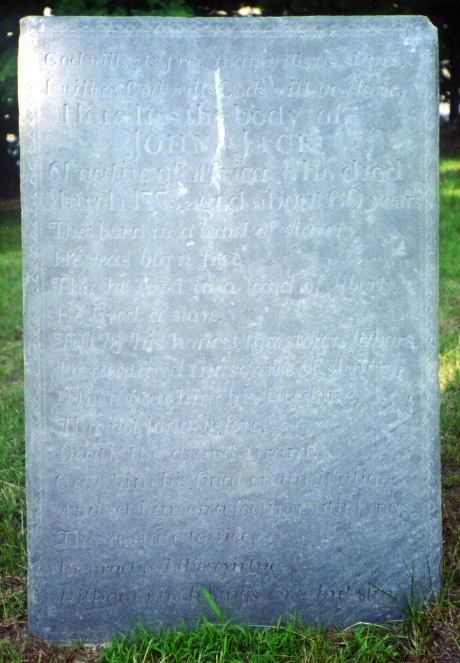
Epigraph to a Grave in Concord, Massachusetts

God wills us free; man wills us slaves.
I will as God wills; God's will be done.

Here lies the body of
JOHN JACK
a native of Africa who died
March 1773, aged about 60 years.

Tho' born in a land of slavery,
He was born free.
Tho' he lived in a land of liberty,
He lived a slave.
Till by his honest, tho' stolen labors,
He acquired the source of slavery,
Which gave him his freedom;
Tho' not long before
Death, the grand tyrant
Gave him his final emancipation,
And set him on a footing with kings.
Tho' a slave to vice,
He practised those virtues
Without which kings are but slaves.
The epigraph above is on a Concord gravestone.  Historian Michael Kammen (my graduate school advisor), notes in his 1972 book People of Paradox that "[i]n the nineteenth century this became the most famous epitaph in America, and was reprinted in English, French, German and Scandinavian newspapers." (p. 193)

The current gravestone is a facsimile of the original; the present copy was erected in 1830.  Here's the picture of the grave from Alfred Sereno Hudson's 1904 book The History of Concord, Massachusetts, Volume 1: Colonial Concord:

And here's the best contemporary picture I could find of the gravestone:
Image source here (click the above photo for a larger, almost-legible version).  Alternate images here, here, here, here and here.

There is a 1902 essay about John Jack, and about Daniel Bliss (the loyalist lawyer who wrote Jack's epigraph) here, online as a free google book.  The grave is on find a grave hereH/T to Jonathan Holloway for putting me on this trail.

Saturday, April 13, 2013

Obama and Lincoln Analogies

Obama came into office wanting to be Lincoln but ended up being McClellan instead.

Tuesday, February 19, 2013

Sentences One Finds Oneself Saying During Class

Federalist 10 is about dealing with threats from the left; Federalist 51 is about dealing with threats from the right.

(PS: Yes, I know that this terminology is anachronistic.  Don't hock me a chonic.)

Thursday, January 17, 2013

January 20 is Inauguration Day

...so why is this year's inauguration on Monday the 21st (the Martin Luther King holiday), and not the day before?

It's for the same reason that Sally tells Harry they don't make Sunday underpants: because of God.

Which is to say, because it's Sunday.

I had thought that this was constitutional, but it's not: it's just a tradition.  You can read the brief version here.  This happens -- roughly -- once every 28 years (there are disruptions for various reasons).  It happened with Reagan in January of 1985, Ike in January of 1955, and Wilson in March of 1915 (remember what I said about disruptions?).  The current tradition (which was done with all three of those earlier gentlemen) is to have a private swearing-in on the actual, uh, inauguration day, and then a big public hoopla on the following day, including a do-over of the swearing-in ceremony.  (Which happens: they had to do it last time too, after all, albeit for different reasons.)

It would be awkward if there was actually a new President, and not a second term, but coincidentally that's only happened twice, and not for well over a century: the two times were Hayes in 1877 and Taylor in 1849.  (The first of these lead to the fanciful notion that David Rice Atchison was actually acting President for a day.)  The other four times -- the three Twentieth Century ones, plus the first occurrence, with Monroe in 1821 -- all happened to be, as this one is, a reinauguration.  It certainly hasn't come up since the Presidency became what it is now, i.e. the sort of office where you need to know at every moment who is in it.  (In 1848, a day here or there wasn't that big a deal.)

Perhaps that will happen next time, which will be (unless unforeseen disruptions occur) on Sunday, January 20, 2041.  (If not then, then next up is Sunday, January 20, 2069, and then Sunday, January 20, 2097.)

(To say it's ridiculous to speculate about parties and presidents 28 years into the future is to wildly understate the matter.  (Will there even be the same two parties?  Will our constitutional structure have changed?  Who knows.)  Nevertheless, I can't help but pointing out that since WW2, with one exception, the parties have alternated eight-year stints.  (The exception is that under this scheme Carter should have won the 1980 election, so that that particular sixteen year stint was divided 4/12 instead of 8/8; change that outcome, and no other, and the pattern holds precisely.)  I consider it extremely unlikely that this pattern will hold for twenty-eight more years.  (Indeed, I hope it doesn't: a Republican administration in 2016 would be a disaster for the Republic.)  But if it happened to, then January 20, 2041 would indeed see the inauguration of a new President, and not a reinauguration.)

Normally I would natter on about this -- intersecting, as it does, various of my obsessions -- but I don't have to, because this marvelous post I found in looking into it says everything I'd want to say about it and more, including remarkably complete histories of each of the previous incidents, explanations of both disruptions of the 28-year-cycle, etc.  If you've read this far, and you're still interested, click on over.

Tuesday, January 01, 2013

"Forever Free": 150 Years Ago Today

Lincoln wrote (and thus did*) this:
Now, therefore I, Abraham Lincoln, President of the United States, by virtue of the power in me vested as Commander-in-Chief, of the Army and Navy of the United States in time of actual armed rebellion against the authority and government of the United States, and as a fit and necessary war measure for suppressing said rebellion, do, on this first day of January, in the year of our Lord one thousand eight hundred and sixty-three, and in accordance with my purpose so to do publicly proclaimed for the full period of one hundred days, from the day first above mentioned, order and designate as the States and parts of States wherein the people thereof respectively, are this day in rebellion against the United States...

And by virtue of the power, and for the purpose aforesaid, I do order and declare that all persons held as slaves within said designated States, and parts of States, are, and henceforward shall be free.
Some important context from James M. McPherson, probably the greatest living historian of the Civil War:
The final proclamation exempted from emancipation the border states and some parts of Confederate states controlled by Union forces. They were deemed not to be at war with the United States; therefore the president’s power as commander in chief to seize enemy property could not apply to them. These exemptions gave rise to the accusation that Lincoln “freed” the slaves in areas where he had no power, and left them in slavery where he did have power.

Nothing could be more wrong. For one thing, tens of thousands of ex-slaves lived in parts of the Confederacy that were occupied by Union forces but were not exempted from the proclamation. They celebrated it as their charter of freedom. For that matter, so did many slaves in exempted areas, which included the four slave-holding states that never left the Union (Missouri, Kentucky, Delaware, and Maryland) as well as Confederate areas that had been returned to Union control, such as New Orleans and the forty-eight Virginia counties that would soon become West Virginia. They recognized that if emancipation took hold in the Confederate states, slavery could scarcely survive in the upper South.

The proclamation officially turned the Union army into an army of liberation—if it could win the war. And by authorizing the enlistment of freed slaves in the army, the final proclamation went a long step toward creating that army of liberation. If the Emancipation Proclamation was merely a piece of paper that did not actually free anyone, as skeptics then and later charged, the Declaration of Independence was likewise a mere piece of paper that did not in itself create a new nation. Both outcomes depended on victory in a war to which these documents gave new purpose.
A great step forward for the history of freedom and justice.  Worthy of taking a moment to remember, and reflect upon, today.

________________________
* Generalized nod towards J. L. Austin.

Thursday, December 13, 2012

Fact to Make You Feel Old, Stolen In Its Entirety from Randall Munroe

Quoth Munroe:
The first Star Trek episode aired closer in time to the ratification of the 19th Amendment—guaranteeing women in the US the right to vote—than to today.
My flabber is officially gasted.

Now, to be fair, it isn't yet much closer.  The first Star Trek episode aired Thursday, September 8, 1966 -- 16,898 days ago, or 46 years, 3 months and 5 days ago.  The 19th Amendment was ratified Wednesday, August 18, 1920 -- 16,822 days (or 46 years and 21 days) prior to Star Trek's airing.  (Number of days calculated using this handy tool.)  In fact, given that Munroe posted this on September 29 of this year, he waited until it was true only by a day (or so, depending on the times all these things happened).  Now, that was a while ago, so now it's more comfortably -- or, rather, more uncomfortably -- true.

And, as these things tend to, it will only get worse as time goes on.

...It occurs to me that Munroe probably had that thought earlier, and was waiting until it was true to post it.  (The coincidence otherwise seems too great.)  Which leads to the further thought that someone should set up some sort of automated system to generate such depressing thoughts automatically (just feed a list of cultural milestones into a date calculator, and voila).  Which leads to the final thought that the person best suited to do this is, clearly, Randall Munroe himself.

We eagerly await his next masterpiece.