“‘You may seek it with thimbles—and seek it with care;
You may hunt it with forks and hope;
You may threaten its life with a railway-share;
You may charm it with smiles and soap—’”
I am pleased to say that Snark and Boojum Press now has a web page.

“‘You may seek it with thimbles—and seek it with care;
You may hunt it with forks and hope;
You may threaten its life with a railway-share;
You may charm it with smiles and soap—’”
I am pleased to say that Snark and Boojum Press now has a web page.
This happened nine years ago today; adjusting for time zones, this post should go up at the moment (6pm Spanish time, 12pm Eastern US). It's one of the happiest things to ever be on the internet. Go ahead and watch it. Even if you've seen it before, it's worth enjoying again.
I just read the remarkable piece of journalism about the woman who was the subject of this famous photograph:

But it occurred to me that it is, in fact, an example of a small little niche genre: stories about the lives of not-particularly famous people who appeared in famous photographs. A few more examples occur to me.
First, there are stories about this other famous photograph from the Vietnam War, in which American napalm, dropped on children, has burned off the clothes of a little girl:

Another example, about a different iconic photograph* from a different iconic midcentury event, this one the 1957 integration of Little Rock, Arkansas's high school:

The story (which I have also had occasion to mention before) of the relationship between the two women (girls, at the time) in the photograph has been told by David Margolick, briefly, here: https://www.vanityfair.com/news/2007/09/littlerock200709 and in longer form in his book Elizabeth and Hazel.
But the more I think about it, the more examples come to mind.
There have been many stories told about this famous photograph from V-E day:

Then there's this photograph, less historic than the others here, perhaps, but very widely known in the art world, of the artist Marcel Duchamp playing chess (the activity he abandoned art to persue) while at the first retrospective of his work, with a young woman named Eve Babitz who would go on to be a novelist of some note:

And those are just the ones that come readily to mind. I'm sure there are a lot more. Please leave any that occur to you in the footnotes. It would be nice to curate a list!
_____________________________
* Actually, this one wasn't a single photographs; there were two or three images taken at almost the exact same moment, from different angles, two (at least) of which are widely reprinted; see Margolick for details.
When people say, “we have made it through worse before”
all I hear is the wind slapping against the gravestones
of those who did not make it, those who did not
survive to see the confetti fall from the sky, those who
did not live to watch the parade roll down the street.
I have grown accustomed to a lifetime of aphorisms
meant to assuage my fears, pithy sayings meant to
convey that everything ends up fine in the end. There is no
solace in rearranging language to make a different word
tell the same lie. Sometimes the moral arc of the universe
does not bend in a direction that will comfort us.
Sometimes it bends in ways we don’t expect & there are
people who fall off in the process. Please, dear reader,
do not say I am hopeless, I believe there is a better future
to fight for, I simply accept the possibility that I may not
live to see it. I have grown weary of telling myself lies
that I might one day begin to believe. We are not all left
standing after the war has ended. Some of us have
become ghosts by the time the dust has settled.
A sneak preview of Biden's inaugural address in just over an hour:
I just finished reading Susana Clarke's second novel, Piranesi (2020) and it is just as wonderful as her first novel, Jonathan Strange and Mr. Norrell (2004) while being so utterly unlike it that you would never guess that they were by the same author. Their only commonality is that both are distinctly British fantasy novels. Basically, if you like good fantasy novels, pick it up & read it.
That's the long and the short of it, except that I should add that I think it's a particularly good book to go into blind. After I finished reading it, I glanced at a few reviews, and I was very glad I hadn't done so first. Of course, for many of you, "by the author of Jonathan Strange and Mr. Norrell" is sale enough. The rest of you should go read Jonathan Strange and Mr. Norrell.—Ok, I kid: I know that that latter book was not for everyone, although for a large number of people it was utterly superb. But I will say that if you generally like fantasy but were put off by Jonathan Strange and Mr. Norrell, then probably the parts that put you off are absent from Piranesi.


Beyond that? Try to learn nothing. The first page or two of Piranesi can be confusing, but the immediate mysteries are cleared up within another few pages. You'll be quite comfortable with them before the new mysteries, the ones you don't want spoiled, start piling up.
There's more to say about this book — a lot more — but for now, that's where I'll stop. It's great, go read it, avoid reviews.
Philip Terry is a writer who works in the oulipian tradition. He is the author of a novel, The Book of Bachelors (1995) (which was published in its entirety in an issue of The Review of Contemporary Fiction), which consists of nine chapters, each a lipogram on a different letter of the alphabet. He wrote a book of versions of Shakespeare's Sonnets, each modified by a different oulipian constraint (the results are predictably mixed). And he did a... you can't really call it a translation... adaptation of Dante's Inferno.
For comparison, here are the opening five stanzas of Alan Mandlebaum's translation of the Inferno, Canto III:
THROUGH ME THE WAY INTO THE SUFFERING CITY,
THROUGH ME THE WAY TO THE ETERNAL PAIN,
THROUGH ME THE WAY THAT RUNS AMONG THE LOST.JUSTICE URGED ON MY HIGH ARTIFICER;
MY MAKER WAS DIVINE AUTHORITY,
THE HIGHEST WISDOM, AND THE PRIMAL LOVE.BEFORE ME NOTHING BUT ETERNAL THINGS
WERE MADE, AND I ENDURE ETERNALLY.
ABANDON EVERY HOPE, WHO ENTER HERE.These words—their aspect was obscure—I read
inscribed above a gateway, and I said:
“Master, their meaning is difficult for me.”And he to me, as one who comprehends:
“Here one must leave behind all hesitation;
here every cowardice must meet its death.
And now, here are the opening lines of Philip Terry's Canto III:
THROUGH ME THE WAY TO THE DOLEFUL CAMPUS,
THROUGH ME THE WAY TO ETERNAL DEBT,
THROUGH ME THE WAY TO THE FORSAKEN GENERATION.
FREEDOM OF THOUGHT INSPIRED MY FOUNDERS;
POLITICAL EXPEDIENCY RUINED ME,
COUPLED BY BETRAYAL OF PRINCIPLE AND PLEDGE.
BEFORE ME NOTHING BUT ETERNAL THINGS WERE MADE,
NOW I SHALL MARK YOU ETERNALLY.
ABANDON ALL HOPE, YOU WHO ENTER HERE.
I saw these words spelled out on a digital display
Above the entrance to the Knowledge Gateway.
‘Master,’ I said, ‘this is scary.’
He answered me, speaking with a drawl:
‘Now you need to grit your teeth,
This isn’t the moment to shit yourself.
It's quite funny— the first nine lines are, I think, a very good joke.
But I am rather uncertain, having read (thanks to Amazon's "see inside" feature) the opening two and a half cantos, whether it's a joke that can be sustained over an entire book. So I am hesitant to plunk down $16 to get a copy.
Anyone know if the whole thing works at all?
Serve the LORD with gladness: come before his presence with singing.... Enter into his gates with thanksgiving, and into his courts with praise: be thankful unto him, and bless his name.
-- Psalm 100: 2, 4
ANYA: I love a ritual sacrifice.
BUFFY: It's not really a one of those.
ANYA: To commemorate a past event, you kill and eat an animal. It's a ritual sacrifice. With pie.
-- Buffy the Vampire Slayer, "Pangs" by Jane Espenson
The title of this post is false, of course: after an unbroken streak from 1621-2013, I have not posted it in seven years. But a friend of mine said he looked forward to it, so, in honor of the day, I am resuming, at least for this year, the ritual. There are so many rituals we will lack this year; this is one I can reclaim.
If you are reading this, I am thankful that you have (to borrow from another tradition) been granted life, been sustained, and been enabled to reach this occasion. Too few of us have. I hope you are being safe today; for even fewer will have by next year, or even by New Year's.
The Buffy the Vampire Slayer quote above comes from the Thanksgiving episode Pangs; you can watch the clip of it here:
And another, bonus quote from the same episode is here:
It's a fun episode; but for those of you reading this who aren't familiar with the show (hi Jon), not really the best place to start. Hit me up if you want more advice along these lines.
Happy Thanksgiving, everyone.
"Everybody knows that pestilences have a way of recurring in the world; yet somehow we find it hard to believe in ones that crash down on our heads from a blue sky. There have been as many plagues as wars in history; yet always plagues and wars take people equally by surprise.… When a war breaks out, people say: 'It's too stupid; it can't last long.' But though a war may well be 'too stupid', that doesn't prevent its lasting.…
"In this respect our townfolk were like everybody else, wrapped up in themselves; in other words they were humanists; they disbelieved in pestilences. A pestilence isn't a thing made to man's measure; therefore we tell ourselves that pestilence is a mere bogy of the mind, a bad dream that will pass away. But it doesn't always pass away and, from one dream to another, ti is men who pass away...
"They went on doing business, arranged for journeys, and formed views. How should they have given a thought to anything like plague, which rules out any future, cancels journeys, silences the exchange of views. They fancied themselves free, and no one will ever be free, so long as there are pestilences."
— Albert Camus, The Plague


For the Anniversary of My Death
Every year without knowing it I have passed the day
When the last fires will wave to me
And the silence will set out
Tireless traveler
Like the beam of a lightless star
Then I will no longer
Find myself in life as in a strange garment
Surprised at the earth
And the love of one woman
And the shamelessness of men
As today writing after three days of rain
Hearing the wren sing and the falling cease
And bowing not knowing to what
—W. S. Merwin


Four Strategic Lines
There, four strategic lines are anagrams.
I'm rearranging letters. A chaos features
in the rule, frames reason, grates a tragic,
rare formula. A strange aesthetic reigns.
— Anthony Etherin
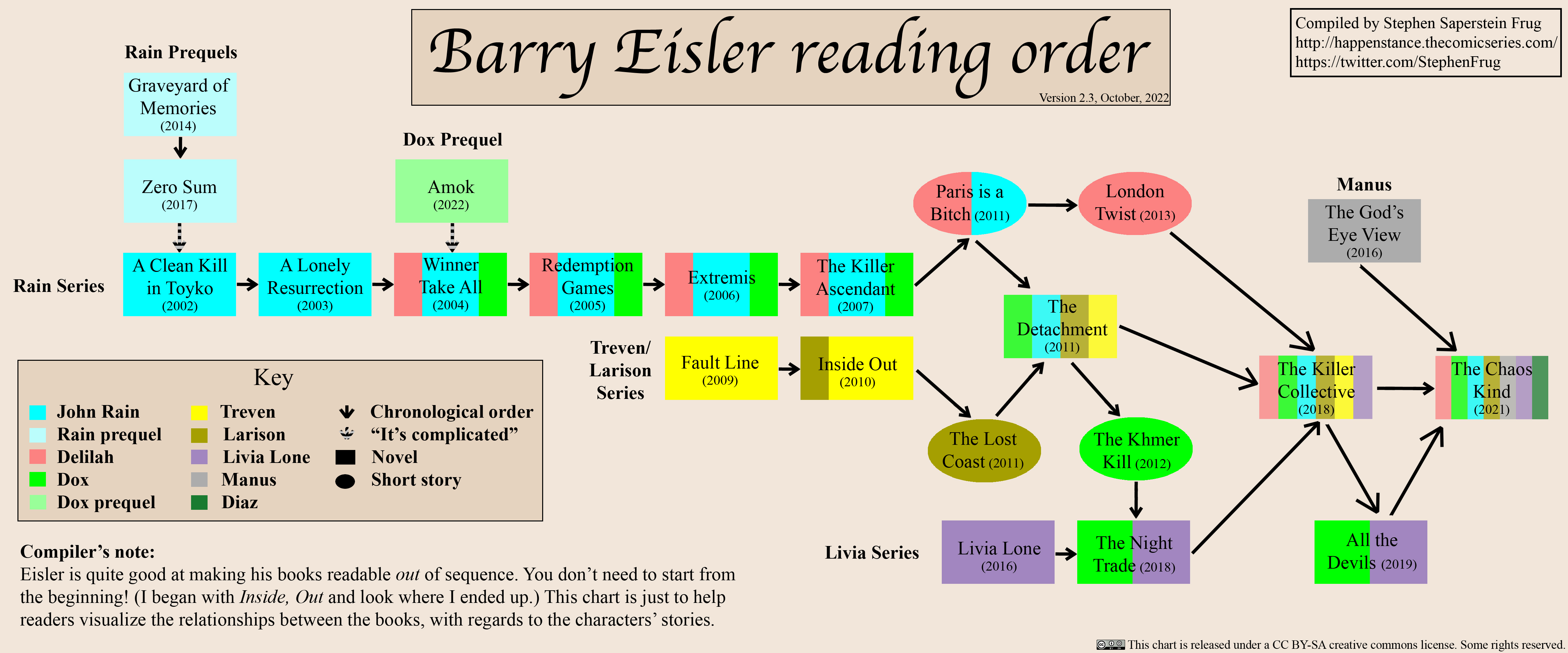
(Click for a larger version.)
Incidentally, I got into this because I had just bought my aunt the second Livia Lone book as a present — she'd liked the first — and was trying to think of how to explain who Dox was and how he fits in. It's tricky!
(Now updated for his forthcoming novel The Chaos Kind (October, 2021). Also released under a Creative Commons BY-SA license, in case anyone feels inspired to improve upon it. (Email me for the photoshop file if you want it.)


