Thursday, July 13, 2006

All I Can Think to Say on the Horrors in the Middle East

G’Kar: The Centauri started it!
G’Quon/Kosh*: And will you continue? Until there are no more Narns, and no more Centauri? If both sides are dead, no one will care which side deserves the blame. It no longer matters who started it, GKar. It only matters who is suffering.

-- J. Michael Straczynski, "Dust to Dust" (Babylon 5)

Lots of people are asking why left bloggers aren't saying anything on this. For myself, I have nothing to say except sorrow and horror. "What we cannot speak about, we must pass over in silence."

------------------
* Don't ask.

Tuesday, July 11, 2006

A Few (Fairly Random) Thoughts on the Unaired Buffy Pilot

So the 26 minute-long unaired pilot for Buffy the Vampire Slayer is available on Youtube here (via Pharyngula). As I am a huge fan of the show, I'd heard of the unaired pilot before, but I'd never seen it until a few minutes ago. So here are some thoughts on it.

The very first thought is that while it is interesting for a fan of Buffy to see -- and, just possibly, for someone who isn't a fan of the show but who has seen the (aired version of the) pilot episode and is interested in the techniques of screenwriting -- it holds no interest for anyone else: it's a clearly inferior rough draft, and is interesting for basically the same reasons, and in basically the same ways (insight into the finished work and/or creative process) that reading earlier drafts of good fiction are interesting. But no one should go see it who hasn't already seen the aired pilot -- hence, spoilers for the pilot (and the unaired pilot, since it's not of interest for plot reasons) will be forthcoming.

It's like an earlier draft, but, as I understand matters, it isn't, quite, an earlier draft, since it was never intended to air. Nor, for that matter, is it in the normal format of a TV show: at 26 minutes long, it's too long for a half-hour show (which would have commercials) and too short for the hour-long show it would become.

If there's something it's an earlier draft of, it's mostly the first half of the double-length aired pilot: there are scenes from it more-or-less intact in the first twenty or so minutes of the unaired pilot, which then ends with a fight in a school auditorium and a final discussion the next day at school which are clearly the ancestors for the final fight and coda of the second part of the unaired pilot. But it's mostly the first half.

Many of the changes seem -- from the point of view of having seen the finished version first, which is, presumably, the reverse of the order of composition -- like inferior versions whose changes are largely due to cutting for time. The connections between the scenes in the finished version are clearly better (e.g. Buffy recognizing a vampire because she sees his outfit is dated is both funnier and more plausible than her asking Xander to describe it and getting it from that) -- but the versions in the unaired pilot are briefer and allow the cutting of various extraneous material and many extras. Buffy's first meetings with Willow and Cordelia are more awkward; her rapport with Xander and Willow more forced. The scenes aren't as sharp as the final versions, even when they are more or less the same -- little changes can make a big difference.

While the finished version was, as I said, clearly superior, the unaired version had a few things I liked:
* The line "hold that thought" -- a very characteristic Joss line (in context), one which worked fairly well, but which he never used that I recall.
* The set for the library seemed larger, colder and (therefore) somewhat more realistic -- I like the final set, of course, but I'm not sure how much of that is familiarity plus a love of the material filmed there -- it's possible the unaired version was better, or maybe simply just as good.
* Stephen Tobolowsky -- you might remember him for his roles in such movies as Groundhog Day (where he played Ned Ryerson, the annoying insurance salesman) and Memento (where he played the seen-in-flashback character of Sammy Jankis) was really good as the high school's principal -- possibly even better than Principal Flutie, the (early) season one principal. I liked his performance and found his character (somewhat different than the character in the final pilot) funny.

With the obvious exception of the actor playing Willow who wasn't in the final version, everyone's performances -- the way they said certain lines, their affect, and so forth -- seemed remarkably similar to the performances in the aired version, despite differences in the script, context, and so forth. (There is a moment in the "homework" of the Lord of the Rings DVDs where they show multiple takes of a line of Aragorn's; those varied far more than most lines from this to the final pilot.) The most changed character seemed to be Giles -- he was written to be both less humorously awkward and somewhat harsher, and Anthony Head played him accordingly.

It was fun to see how Darla, Harmony and Jonathan were in the show from the very beginning.

I'm not sure if the unaired pilot would have sold me had I seen it fresh -- whether as a TV executive deciding whether to make the show or as a viewer deciding whether to see another episode; then again, the final pilot didn't totally sell me either: I thought it was fun but didn't see the greatness in it that people said (correctly, of course) was in the show -- I wasn't sold on the show as a whole until late in the first season (and other people have taken into season two). But the final version is clearly better.

And, as we learn from the aforelinked Wikipedia entry, Joss knows this:
IGNFF: Is the presentation ever going to make it to DVD?
WHEDON: Not while there is strength in these bones.
IGNFF: Well, I mean, it's one of the most heavily bootlegged things on the Internet.
WHEDON: Yeah. It sucks on ass.
IGNFF: Yeah, it does, but it's sort of that archival, historical perspective...
WHEDON: Yeah, I've got your historical perspective
IGNFF: It would take it off the bootleg market...
WHEDON: Ah, I don't – what are you going to do?
IGNFF: Put it on the DVD.
WHEDON: Not me
Writers can hardly be blamed for the unreleased drafts that historians -- or rabid internet fans -- insist upon digging up and making public. So see it as a curio if you're interested. Just don't expect it to be any good.

Update: While I'm mentioning interesting bits miscellaneous Whedonania, here's two more pieces:

• This article on Whedon and race is an interesting, complex look at a (to me) rather troubling question. I don't know if I agree with the whole analysis, but it's definitely quite interesting and worth reading. (Via)

• This fictional trailer for a sadly-probably-always-to-remain-hypothetical sequel to Serenity is well done -- really, extraordinarily well done, if you consider the fact that the creator had no new footage to work with: not only did they manage to put together a credible and interesting looking trailer (not the most compelling trailer ever, but a very compelling one), but they even managed to imply a story that is a quite reasonable direction to go in, if there were going to be a sequel (probably not the direction that Joss would go in -- but one that would be (one of the many) quite reasonable directions to go in). The imaginary film is titled Return to Serenity; I'd go see it in a hot second. Too bad it almost certainly will never find its way out of Lucien's library (the film annex). A marvelous fan remix. (Via)

Thursday, July 06, 2006

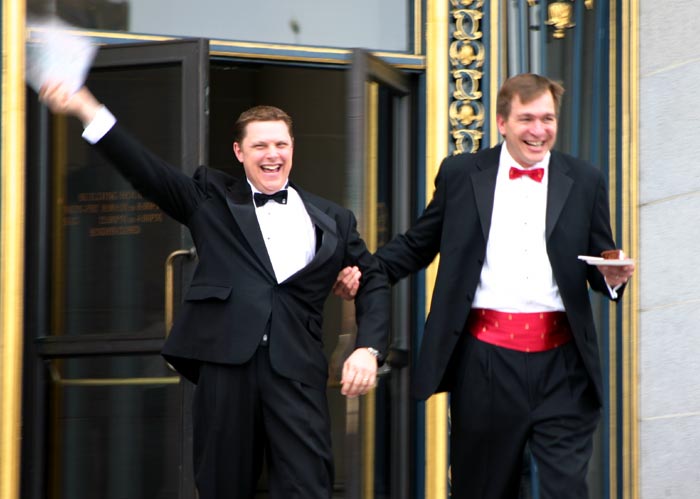
New York is Officially a Discriminatory State

I don't have the time or the health or the heart for a full post on this topic right now, but since it is my home state, I feel a compulsion to express my total opposition to the bigotry sanctioned by our highest court. I don't have an opinion on the decision -- I haven't read it, I'm not a lawyer -- but the outcome is wrong. Right now we have one state in fifty that treats gay and lesbian citizens with basic equality and dignity. As a former resident of Massachusetts, I am proud that my former home is doing the morally right thing; as a current resident of New York, I am ashamed that my current home is not. The court had a chance to decide between right and wrong today, and it chose wrong. Perhaps the law compelled them to*; that does not make wrong into right.

Protests are occurring tonight; go if you can. News articles on this topic can be found here and here. The New York Times article is here.

I suppose the silver lining here is that the court said that equal, non-discriminatory marriage laws are not required by our state's constitution -- but certainly that they are not forbidden either. Now it goes to the legislature. And if, ultimately, the legislature upholds the demands of equality and justice, that will be a far more politically powerful act than if the court did. One of the main calumnies that the forces of bigotry have put on the fight for equal marriage rights is that it is an action solely of courts and a few mayors. It will be a powerful statement if a legislature, the political voice of the people, are the ones who establish equality in marriage. (Update: Reading the Republic of T reminds me that a state legislature - California's - has passed an equal marriage-rights bill before; but its !@#$% governor vetoed it, so it didn't become law. With luck, however, New York will soon have a Governor who will support equal marriage rights, so we could still become the first state in the union in which a legislature-passed equal marriage bill becomes law.)

So if that happens, perhaps I'll have something to be proud of my home for.

-----------------------------
* Though I doubt it, given that the "rational basis" test has failed in many states before -- Massachusetts certainly and (if memory serves) Hawaii and Vermont too; and all purported rational bases have been shredded over and over. (The real reason people don't want gays and lesbians to marry is that they think it wrong, usually for religious reasons -- but if they say this, then they will definitely loose, so they have to make reasons up (which, naturally, tend to be flimsy.) They want to write their own moral prejudices (which they are entitled to believe, of course) into law, so struggle to justify it rationally.) So -- again, not having read the case -- it seems probable that this is simply a case of bigotry -- or perhaps cowardice -- overruling legal judgment. And of course there were two dissenters, so another legal reading was available. But, again: even if the law allows no other choice, the law is immoral, and should be changed. [Footnote added as an update.]

Tuesday, July 04, 2006

Words to Live By


(Click for a larger version; easier-to-read text version found here.)

Happy July Fourth, everyone!

Saturday, July 01, 2006

Aliens Invade India!

Well, maybe. And the aliens (if they are such) are microbes -- they don't even have D.N.A. And "invasion" isn't quite the word -- dumped accidentally by a passing comet would be more like it, which is hardly the same as entering by force while looking for imaginary W.M.D.s.

Still, by my standards, even if qualified to "Microbes that Might Have Been Extraterrestrial Landed in India Five Years Ago!", it's still pretty exciting to think about.

Here's the story. It seems that in 2001, some mysterious red rain fell in India (specifically in the state of Kerala). No one is yet sure what caused it; there are a number of theories, apparently. (In the popular, slang use of "theory" to mean "hypothesis" rather than the scientific sense of "well-confirmed scientific explanation".) One theory, put forward by a scientist named Godfrey Louis, is that (in his words):
the red particles, which caused the red rain of Kerala, are possibly of extraterrestrial origin... the absence of DNA argues against the biological nature of these red rain cells. But I wish to consider the possibility of alternate biomolecules in these cells whose origin is now suspected as extraterrestrial. This way the cells may represent an alternate form of life from space...
Dr. Louis has published one peer-reviewed article putting forward this idea; further are in process.

What can I say but: wow.


Disclaimer: Histrionic image of invading aliens
utterly unrelated to the otherwise factual, or at
least possible, aliens referred to in this blog post.
They're not even invading India.

(This little news tidbit via the blog of SF writer Nick Sagan, whose work, I must admit, I've never read -- but it seems from his blog that he's a local boy, so I suppose I should check out his (doubtless splendid, given his fine place of residence) work.)

Wednesday, June 28, 2006

Fascism, Pseudo-Fascism, and the Real Danger

Some of those of us on the left have been teetering on the edge of Godwin's law for some time now, as we attempt to describe the current politics without saying that the current party is, well, like the Nazis. For, as Wittgenstein once wrote in another context, "the kinship is just as undeniable as the difference". And, I would add, just as important. (No one has been more careful and informative about this than journalist David Neiwart, whose powerful, multi-part essay about this topic is one of the crucial documents of the Bush years.)

What we need here is a powerful English synonym for a wonderful Talmudic term: "l'havdil", which I believe literally means "to make a distinction", but which is used to emphasize that a comparison is being made only along a single axis, and that the two objects are not otherwise similar. (Thus, God rules like a King, l'havdil -- they are alike only in the attribute of rulership, not that Kings -- a rather debased crowd, after all -- are any other way like the Holy One, blessed be He.)

After all, Bush is not rounding up citizens and putting them in camps and murdering them. Although, it's worth noting, that only that last phrase is false: Bush had imprisoned at least one citizen for more than three years without trial, access to council or any of the other rights that theoretically distinguish us from dictatorships. And the Bush administration defends its right to do this to this day. And, of course, non-citizens -- many absolutely innocent (and if you deny that, answer this: how do you know, given that there have been no trials, no hearings, nothing that could determine their guilt?) -- have been detained in camps in Guantanamo for years now.

You see how difficult it is? Any distinction -- and the distinctions are real, and important -- has to be drawn very carefully. Bush was elected rather than seizing control... well, he was elected in 2004, unless you think that very-easily-hacked voting machines, run with no supervision by a Republican-operative-owned company, might have been altered, as their differences from historically-reliable exit polling might well indicate. And in 2000, he was only elected due to judges shutting down a recount that would have given the election to the man who -- indisputably -- got more votes than Bush did.

But that's not what I came here to talk about, as Arlo Guthrie once said ten minutes or so into a song. I came to talk about the draft.

What draft? We don't have a draft.

No, we don't. Although the military is badly, badly hurting for soldiers -- and, indeed, is essentially conducting a draft, just one confined to people who had at some point volunteered for the armed forces. A back-door draft, as John Kerry called it.

So why aren't we drafting anyone, if we need soldiers so badly?

It wouldn't fly politically. They couldn't get away with it. The war's too unpopular.

Which, of course, implies that they will do it when they can get away with it -- or think that they can.

As far as a draft goes, that wouldn't be so utterly dire: the U.S. has had a draft before, and survived it. I think it would be a truly terrible idea, for reasons ranging from the principled (for my own quirky reasons, I'm actually against "involuntary servitude" -- of any sort -- unless in a genuinely existential crisis, e.g. I think that the Soviet Union was probably justified in drafting soldiers after the Nazi invasion of 1941) to the practical (I believe it would allow the current gang of fools and criminals to start even more wars (which they fairly clearly want to do), contrary to widely-held liberal theories that it would restrain them by pulling in a broader class of people).

It's what else they will do, when they can get away with it (or think they can) that worries me.

Bush has already claimed well-neigh dictatorial powers -- locking up citizens indefinitely without trial, doing anything contrary to explicit U.S. law as long as he claims it is necessary for our security, etc. What keeps this from being a dictatorship is that he is -- so far -- using them in a comparatively restrained way.

A large segment of the right has been calling this week for the prosecution of newspapers for publishing articles that are claimed to be "harmful to our security" (even though they are really only harmful to Bush's political image).

A similar segment of the right has openly called for political violence: Ann Coulter, to name one figure indulged by the mainstream, has called for the murder of supreme court justices, newspaper staffs and many others (including, by implication, all liberals).

A small but influential segment of the religious right wants -- quite explicitly -- to turn the country into a theocracy.

None of this means we are a fascist state -- we clearly are not -- nor that the Republican party is a fascist part -- it clearly isn't. What it means, though, is that fascist ideas -- and the murder of your political enemies is about as fascist as you can get -- are circulating openly and widely on the right. They aren't accepted yet. But they're there, they're considered. They are thinkable. Fascism has become an important part of the mixture of ideas on the right, swirled in with the vast, contradictory stew that includes such flavors as libertarianism, religious nationalism, neoconservatism and rank corruption, among others. It's not dominant.

What I worry about is after the next terrorist attack.

For -- horrible as it is to think -- there almost certainly will be another one. The Bush administration has been pursuing policies which, while probably no actively designed to create another one, have been far more efficient at achieving that end than most of their policies are at achieving their stated goals.

Think about how far this country went after 9/11. Think about what people were willing to tolerate -- even supposed "liberals" -- in the months and years after. Think about what they've gotten away with -- including, basically, all of the horrors they have unleashed upon our country in the years since.

What worries me is that we have a political culture on the right (and in most of the center) which would be primed to implement and accept a genuinely fascist state (probably with a larger-than-historically-found-in-earlier-fascist-states element of theocracy) were another terrorist attack to occur.

Particularly if it were worse than 9/11.

As David Neiwart (who is -- to repeat -- the most careful and insightful analyst of the pseudo-fascism of the contemporary right) has emphasized, the fact that the current trends are something less than full fascism is not a recipe for complacency. Once a movement is a full-fledged fascist movement, it is (likely) too late to stop it. That Bush's supporters -- those willing to applaud our use of torture, to praise our gutting of the bill of rights, to call for prosecution as treason the reporting of secret and unchecked government programs, those who wish to write their religious beliefs into law -- are not yet an openly fascist movement simply means that it is not too late to stop them.

The most powerful and important genuinely conservative insight has been a suspicion of unchecked government power. To the degree that conservatives have been a vital part of our best historical tradition, it is because they have insisted upon this insight.

It is an insight that most followers of Bush have now simply abandoned -- that what is known as "conservatism" in this country only occasionally even pays lip service to any more. Now they are all about power -- their power. That, all factions of the contemporary right seem to agree on.

We must fight them while we can. After the next attack will likely be too late.

Update (07/03): Yesterday Michelle Goldberg made a variation of my argument in this post, talking about the rise of fascism-like thought in the U.S. She quotes Roger Griffin's The Nature of Fascism thus:
In its chrysalis stage fascism is but a publicistic and activistic (or 'agit-prop') phenomenon on the fringe of mainstream political culture and developments, condemned to lead a marginal existence in articles, pamphlets and books, often with negligible readerships and in the radicalism of ineffectual political factions... Even the progression to the columns of large-circulation newspapers and well-attended public meetings represents a quantum leap for the diffusion of fascism which is still far removed from nation-wide mass rallies, extensive paramilitary violence and the 'seizure' of state power.
Goldberg then says that "American fascism has made this quantum leap", citing evidence similar to that which I cited above. She ends by saying that "while America remains long way from real fascism, fascism has come a long way in America".

Link via this post of David Neiwert, who has further thoughts on the recent escalation of eliminationist rhetoric from the right which are, as usual, well worth reading.

Update (07/05): The good news is that this topic seems to be spreading. In addition to the recent Michelle Goldberg essay which I linked to in the previous update, we have (via the ever-invaluable David Neiwert) the latest Gene Lyons column, where he says:
Reasonable people never want to believe that extremists believe their own rhetoric. But quit kidding yourselves. This is mass psychosis. The next terrorist strike, should it happen, will be blamed on the enemy within: treasonous “liberals” who dissent from the glorious reign of George W. Bush. Unless confronted, it’s through such strategems that democracies fail and constitutional republics become dictatorships.

The full essay can be found here. Note to trolls: if you want to reply, please note that Lyons is not saying that we live in a fascist state, or that the Republican party is a fascist party (nor is Goldberg, nor I). We are talking about spreading, and dangerous, ideas. If you want to disagree, at least disagree with what people are saying and not some barely-recognizable distortion thereof.

Sunday, June 25, 2006

For Want of a Nail a World was Lost

"Our children, grandchildren, and many more generations will bear the consequences of choices that we make in the next few years."

That's a quote from an essay on global warming in the New York Review of Books by Jim Hansen. What occurred to me as I read it is what a strange, small thing our world -- no, let's not exaggerate: the world will survive. Life upon it will too. For that matter, human beings probably will as well. Our global civilization is another matter -- to say nothing of millions upon millions of human beings -- precisely who is, of course, not yet clear -- who will be harmed if global warming proceeds apace: if (in Hansen's phrase) "human beings follow a business-as-usual course." So: what occurred to me is what a strange, small set of things the fate of millions of lives -- and a civilization -- hangs upon.

Let me explain.

What will determine their fate? Our fate, I might well say, since the life of every person on this planet will be altered in the business-as-usual scenario: What will determine our fate?

Well -- provincial as it may seem -- I would say that, first of all, our fate depends on the actions of the United States.

This isn't entirely true, of course. China and India, as is frequently noted, are racing to catch up with us in pollutants. Europe does its share. And so forth. But it is true to a terrifying extent. True, because we currently emit 25% of all global warming agents. But that's really not the rub: its true largely because of the influence we wield (for better or -- far too often -- for worse) in the world. Kyoto stumbled in its central goal -- to establish momentum -- because the U.S., the most powerful nation, the only superpower, the biggest polluter -- did not join. And now, if we pushed, many others would fall in line. If it were a real priority, we could negotiate with China and India. (They already use, in some contexts, less-polluting technology than we.) We could support the best instincts of Europe -- already stronger than ours. The U.S. could make it a global priority, change the global focus and the global language, as only the sole superpower can. As we did with the "war on terror" on September 11.

So: will we or won't we?

At the moment, it doesn't look very hopeful.

There are two possibilities, and I honestly don't know which is correct. (Some mix of the two, doubtlessly: this is a simplification, natch. Go along with me here for a second.) One is that the political system in the U.S. is too controlled by those opposed to dealing with the looming catastrophe -- current business interests and their ideological allies -- to change course at this juncture. In that case, we are simply helpless.

So, to the extent that there is any hope at all, the hope lies in the second possibility: that a political coalition in favor of the significant action that is required can be assembled. Can it?

It is an open question. Consciousness may be changing on this issue. There are hopeful signs -- the rising effort by some in the religious right to make this a priority; the success of Al Gore's movie. But I fear they are very little, this late.

We will need all the allies that we can get. Moderate Republicans (who often list the environment as one of the issues they are supposedly moderate on); Republicans who might be pushed by a rising consciousness among their own base; and any Republicans who are tied enough to the reality-based community to admit to the weight of the evidence, and tied enough to moral principles to put aside electoral consequences. All will help; all might well be -- in the end -- decisive.

I fear, however, that it will ultimately come down to the question of whether Democrats can regain power or not. (As a small stone in the mosaic of evidence for this, Tristero -- to whom I am indebted for the original link to Hansen's essay -- reminds us of Hansen's history with the Bush administration.)

But what controls that? What has controlled it?

A million things: causality is rarely simple. Yet in so close a political divide, that means many little things could have changed it.

If we had organized better. If the venality of the ideologies on the right had not blocked concern with false balance and bought-and-paid for doubts. Ideological battles of all sorts are crucial here: through the odd linking of American politics, the pro-life movement may have doomed far more lives than it claims have been lost.

But then there are things that have nothing to do with ideological battles at all. The odd balance of the Senate, which gives the Republicans a 55-45 majority despite the fact that more votes have gone to Democrats than Republicans in Senate races in recent years (due to the overwhelming power of small, rural states in the Senate, and the tendency of those to swing right). And how much of it comes down to far smaller things! A butterfly ballot in Miami might -- maybe, maybe, maybe -- have held the world in its ill-designed structure.

All is not yet lost. But when I look at the battle that would be needed to better matters, all I can see is the power of the right -- largely science-denying, largely willing to sell out generations untold for the wealth of a few -- buttressed by so many small things -- so many things which have nothing to do with this issue, this most crucial of issues. And I think how strange it is, that so much depends upon the strange, contingent politics of this country.

And I remember the old poem.

Robert Sobel, a historian, used it to title his work of alternate history, For Want of a Nail, which gave me half of my title for this post. The work of Peter Laslett, another historian, gave me the other half: The World We Have Lost, as evocative a phrase for the vanishing wake of history as ever I have heard.

Will that be how it unfolds? Will the triumph of forces bent largely on other goals, victorious for other reasons, really block progress on this?

And I imagine historians of the future. How could they recapture it? How they will blame us, for letting it occur. How they will struggle to impart to their students the power of other forces that swept -- or, moving back to now, are sweeping -- us off the cliff. How could they make them see?

I wish I knew. For if they can see, then so can we, now: and perhaps it might not be too late, after all.

Update: Today in the Los Angeles Times (via) there is a report on how the Greenland ice sheet is melting faster than predicted; it's an interesting explanation of the science, and why forces are destabilizing it in ways not expected even very recently. It notes that "should all of the ice sheet ever thaw, the meltwater could raise sea level 21 feet and swamp the world's coastal cities, home to a billion people."

In Which the Author Distracts Himself from Impending Global Disaster with Minor Literary Research

While I was seeking for a link for my previous post (which I have, contrary to blogging custom, left higher on the blog than this one since it is more important (the topic, not the post)) I found that what I thought was an old nursery rhyme has a history somewhat more complex than that.

Though it is often cited to "anonymous", and other times to Ben Franklin (see below), its earliest recorded author seems to have been poet George Herbert (1593 - 1633). In a work called Jacula Prudentum (dated 1651 in several places, so a posthumous work unless that date's wrong (also, see here for a note on the title.)) Jacula Prudentum was a collection of proverbs -- proverbs he may have gotten from contemporary folklore -- meaning that this phrase may not have been originally his; but he seems to be the earliest person whose name we know associated with it. At any rate, Herbert wrote:
For want of a naile the shoe is lost, for want of a shoe the horse is lost, for want of a horse the rider is lost.
And that's where he ended it. (The work as such is not online, but you can see the relevant page via google book search here (p. 160 -- try searching for "for want of a nail".))

Then, a century or so later, Benjamin Franklin took the quote and modified it, using it as one of the maxims which preface the 1757 version of Poor Richard's Almanac (at least according to Bartlett's Familiar quotations). Franklin wrote:
And again, he adviseth to circumspection and care, even in the smallest matters, because sometimes a little neglect may breed great mischief; adding, for want of a nail the shoe was lost; for want of a shoe the horse was lost, and for want of a horse the rider was lost, being overtaken and slain by the enemy, all for want of care about a horse-shoe nail.
Note that the second cite (pun intended) linked above gives the quote's context in Benjamin Franklin's "The Way to Wealth" -- singed by 'Richard', so presumably it's from the almanac, although I don't know for sure. Notably, the more complete version's use of italics distinguishes (somewhat) what was original with Franklin with the rest, although he doesn't cite Herbert as such.

It's also worth noting that Franklin's opening phrase -- "a little neglect may breed mischief" -- puts a very particular spin on the notion. It turns it into one of Franklin's little maxims of instruction -- a very characteristic keeping-working-harder sentiment. By contrast, the more familiar version is more about sensitive dependence on initial conditions. An interesting twist for some cultural historian to trace out, perhaps.

The most familiar version, I believe, is the nursery rhyme variation. It's all over the place (e.g.), variously credited, but usually written the same way that I remembered it:
For want of a nail, the shoe was lost,
For want of the shoe, the horse was lost,
For want of the horse, the rider was lost,
For want of the rider, the battle was lost,
For want of the battle, the kingdom was lost,
And all for the want of a nail!
The longer version is usually cited to "anonymous" -- certainly I haven't seen any author claimed for the final half. The two significant variations seem to be in the articles -- some people say, in the second half of each phrase, "a shoe", "a horse", etc, rather than using the definite article -- and in the final line, where some versions add the word "horseshoe" before the word "nail". I don't know about the articles, but I think that the word "horseshoe" detracts rather than adds to it (it's unnecessary, it breaks the symmetry, etc.)

One nice rendition of that version can be found here (the link's at the bottom of the page, or here's a direct link), in a pro-library advertisement (a good cause if ever there was one). They add "one book can change a life; imagine what a library could do." Just as Franklin turned it into a moral maxim for self-improvement, they turn it into a pro-charity story -- in, admittedly, a rather sentimental way. I wonder if that sort of sentimentalism-for-charity is typical of our time the way that Franklin's discipline-for-success was of his (narrowly speaking)?

Interestingly, that's not quite the end of it: there is another version that is even longer -- and arguably better. In the article on "Causation" in the Blackwell Guide to Metaphysics, Wesley C. Salmon wrote:
An old nursery rhyme (which I'm extending a bit)... "For want of a nail, the shoe was lost; for want of the shoe, the horse was lost; for want of the horse, the rider was lost; for want of a rider, the message was lost; for want of the message, the battle was lost; for want of the battle, the war was lost; for want of a victory, a Kingdom was lost. All for want of a nail."
The benefit of this version is that (as befits a philosopher's revision) the causality chain is stronger. The line about the loss of a single rider determining the outcome of a battle has always struck me as the least convincing in the causal chain (and, notably, was not in the versions given by either Franklin or Herbert). Here it is spelled out in a convincing fashion. But the final link -- battle-war -> victory-Kingdom -- is badly marred by the word switch ("war" in the first, "victory" in the second); even if the idea is clear, the aesthetics are thrown off. (This isn't online either, but it comes up in a Google book search here; it's from p. 27, or search for 'for want of a nail' in that book.)

So that's the nail that -- running down the causal chain -- caused this particular rhyme to stick in my head. It does seem that Herbert (and Franklin, maybe, although he's more widely credited even though Herbert wrote it (or wrote it down) first) should get more credit than he does for starting the poem off.

(Sources: I didn't find any single web site that presented this story quite as I just did (or I would have just linked to it!), but the bits and pieces come from here, here and here in addition to the web sources cited above.)

Saturday, June 17, 2006

Rant (On Comics, Reviewers and the NYT)

I am delighted that Alison Bechdel's marvelous new graphic novel, Fun Home, is getting a rave review in the NY Times tomorrow: it's a superb book, and it deserves all the plaudits and attention that it can get. And much in the review is good -- the reviewer captures much of what is wonderful in the book, and his report on his trip to Beech Creek, Pennsylvania is a treat.

But could the New York !@#$% Times possibly have managed to get a reviewer who wasn't a complete !@#$% ignoramus about graphic novels?

Actually, they didn't even need to do that. How about: if they were going to get a reviewer who is an ignoramus about graphic novels, could they at least get him to stick to the book at hand and not make ignorant comments about the medium as a whole?

Where do I start?

It is a pioneering work, pushing two genres (comics and memoir) in multiple new directions, with panels that combine the detail and technical proficiency of R. Crumb with a seriousness, emotional complexity and innovation completely its own.

At least he knows who Crumb is -- probably from promotional material where Bechdel said (as she's said often in interviews) that he's one of her biggest influences and models. But we'll be charitable and assume he knew on his own (from the movie, maybe).

But comics is not a genre! A genre involves a work's content or style -- memoir is a plausible genre, as is historical fiction, science fiction, mysteries, westerns, and so forth. Comics is a medium -- the equivalent of film or prose or live theater. Just as you can have a memoir in prose, or as a live theatrical performance, you can have one in comics. Fun Home doesn't mix two genres. I mean, seriously: people said this sort of smeg back when Maus first came out. Aren't we beyond that now, twenty years later?

Apparently not. At least not in the New York !@#$% Times.

Then there are the actual words. Generally this is where graphic narratives stumble. Very few cartoonists can also write — or, if they can, they manage only to hit a few familiar notes. But "Fun Home" quietly succeeds in telling a story, not only through well-crafted images but through words that are equally revealing and well chosen... A comic book for lovers of words!

I like the praise for Bechdel's words, which is well deserved. But to write as if she's the only one! Has this bozo never read Alan Moore or Neil Gaiman? Apparently not.

So if he doesn't know jack about comics, why can't he just praise Bechdel's work rather than ignorantly talk about the medium?

It's odd that this memoir, a work of meticulous personal reportage, is referred to as a "graphic novel" in the accompanying letter from its publisher — though I was relieved to discover that I'm not the only one in need of a trip to the dictionary.

And here's where he really goes off the rails. Of course "novel" (as I am continually having to remind my students -- a sign that the meaning of the word is in transition, I suspect) means only a fictional work, so that if a publisher referred to a memoir as a novel it would be an error requiring a dictionary. But (as I also have to tell my students -- but then, they're not writing for the New York !@#$%ing Times!!!!) "graphic novel" is an odd term that is not simply a type of novel.

Now I admit this can be a bit confusing. I admit that, say, a college Freshman -- even at an elite college such as Cornell -- can understandably trip over this. But I would suspect that a reviewer for an elite newspaper could grasp the notion that a compound term doesn't always have the meaning which is implied by its constituent parts. (I'm sure there's a linguistic term for this, and probably six different categories that I am mixing up here, so -- since, unlike the reviewer for our nation's "paper of record", I don't wish to talk too long about things I don't know anything about -- I will stop here, and suggest that the good people of Language Log might help out.)

The point is, the term "graphic novel" has been used since its introduction -- literally, since the first widely-publicized work to be called a "graphic novel" (Will Eisner's A Contract With God) was what our reviewer would probably have preferred to call "graphic short stories" -- to mean book-length, sophisticated* comics of any variety, whether a single work or a collection, and whether fiction or non-fiction.

I mean, picking on a publisher for calling a memoir a graphic novel? Where the !@#$% have you been, Sean Wilsey? Memoirs are practically the heart of the new renaissance in graphic novels -- from Maus to Persepolis to -- well, Fun Home. In my recent beginner's guide to graphic novels, I had a whole subsection on memoir and autobiography. And I didn't even mention Eddie Campbell or Joe Matt or Phoebe Glockner or any other of a large number of fine comics artists who've written (often multiple) memoirs. If you broaden out the issue at hand to other nonfiction, you've got superb reporting (Joe Sacco), aesthetic analysis (Scott McCloud), popular history (Larry Gonick) and lots of other stuff too. Hell, R. Crumb who our reviewer so blithely mentioned earlier in his own !@#$%ing review has done a lot of autobiography -- and when it's collected, you can bet dimes to dollars it will be called a "graphic novel"; indeed, I suspect (what with the Complete Crumb and other reprintings) that it already has been many times over.

It's an odd and imperfect term, I admit, since it sounds -- to those utterly unfamiliar with the medium -- like it refers to a type of novel. But it's the term we have -- the "wrong and only name for it" (to borrow a phrase from David Hartwell in referring to another publishing category (really a genre, this time) ill-served by reviewers). It's now an official category in many bookstores. There are magazines and web sites and college classes on the form. It's what these things are called.

It's perfectly reasonable to lament this situation -- or even to suggest another term. But to talk as if this was a simple mistake and not the normal usage among people who know anything about the topic at hand is ridiculous. Hell, just look at the wikipedia page for "graphic novel", which defines the term as "a long-form work in the comics form, usually with lengthy and complex storylines, and often aimed at more mature audiences" and then notes that

In the publishing trade, the term is sometimes extended to material that would not be considered a novel if produced in another medium. Collections of comic books that do not form a continuous story, anthologies or collections of loosely related pieces, and even non-fiction are stocked by libraries and bookstores as "graphic novels" (similar to the manner in which dramatic stories are included in "comic" books).

(Parenthetically, I should note that "comic books" is a wonderful example of the type of term-not-reducible-to-its-constituent-parts that I mentioned earlier. Bechdel subtitles her work "a family tragicomic", playing with the multiple meanings of the word "comic" ("funny" and "sequential art"). But I suppose our reviewer missed that little pun, literal-minded as he seems to be.)

Now, again, I don't actually insist that a reviewer should know all this to review Bechdel's book. Getting a memoirist to review a memoir is a reasonable thing to do. And the reviewer did just fine when he stuck to the work at hand. But why oh why did he push at this issue, about which he clearly knows little or nothing, with snarky comments that simply misled any readers unfortunate enough to pay any attention to them? Why doesn't the NYT have anyone on its staff who knew enough to at least edit these sentences out? Why can't we just get over it and understand that graphic novels are a full-fledged (if still young) medium, and discuss works for what they are and not take potshots at some stereotype that exists largely in a reviewer's head?

Hell, I probably should be glad that he didn't work in a "gee, comics don't have to be about superheroes or funny animals?" line in there somewhere.

Update (6/27): A bit more than a week later, the NYT published another review of Fun Home, this time in the daily paper rather than the book review. This one was equally laudtory (I think -- I'm not going to go back to reread the one that pissed me off just to check!), but this time the reviewer didn't come across as ignorantly snarky about graphic novels. Indeed, the first sentence of the new review is "Alison Bechdel's "Fun Home: A Family Tragicomic" is an engrossing memoir that does the graphic novel format proud.". Now that's more like it! (Link via Bechdel's own blog.)

(Incidentally, while the NYT book reviews stay accessible indefinitely, I think the daily paper goes behind the firewall after two weeks or so; so that link above may rot soon. If you want to read it, read it now!)
________
* "Sophisticated" is probably pushing it. But I'd argue that even in cases where the lack of sophistication ought to be obvious, a push for sophistication -- or, at least, respectability -- is inherent in the term's use.

Friday, June 16, 2006

One Year of Attempts

It was a year ago today that I began this blog; in blogospeak, it's my one-year blogoversery. To celebrate, I'll do what I did six months ago, and collect links to what I consider my best posts so far.

I think my single favorite post -- the one that really captures what, ideally, I want to do on this blog -- is On Being a Cracked Pot. I wish I had time for more posts like that (other writing projects take up the majority of my time.)

Apart from that, I'll go by categories.

Creative Work
Continuity #1: A Creative Commons Comics Script

Political
Winning for the Wrong ReasonsHistory Might be Kind to Bush
There Are No Excuses
More on the Cartoon War
Seeing Through the Lies
Another Argument Against Intelligent Design
Four Years Ago
Why Does It Still Matter?
Sixty Years Ago Today

Literary
Winter Journeys
Oulipo Compendium Round-up
Frost + 7 = Fruit
James Fenimore Cooper Prize for Best Historical Fiction: A Google Tale
Stanislaw Lem, 1921 - 2006
The Question of Hu

Graphic Novels/Comics
Where to Start with Graphic Novels
Books & Cartoons to Watch Out For
99 Ways to Tell a Story
Friday Five and Sunday Ten: Good Comics Covers

Film and TV
X-Men: The Last Stand: A Review
TV for Buffy Fans
Other Reasons I Love Firefly
One Thing I (Already) Dislike About Serenity

Attempts Best of the Blogosphere™ Series
Part Two
Part One
Part Zero (Precursor Post)

Those That From a Long Way Off Look Like Flies
Buying Books Online: Links and Notes
Music of Pain, Music of Anger
Kirk Poland and Bulwer-Lytton

As a nice little blogoversery present from fate, earlier today, for the first time, I randomly came across a link to one of my posts on a blog (i.e. not in a case where I solicited the link, know the blogger, or anything like that); it was here. A nice grace note for the day.

And oh, yes: it is also Bloomsday. A fine day to pick for my blogoversery, says I.

You were going to do wonders, what? Missionary to Europe after fiery Columbanus.... Rich booty you brought back...

-- Stephen in Ulysses

Tuesday, June 13, 2006

Best of the Blogosphere, Part 2: the Medium Lobster on the Power of the Glow

(Second in an occasional and entirely whimsical series. Other entries here.)

Fafblog has been, for years, one of the funniest sites on the web -- one of the funniest political sites, sure, but also just one of the funniest, period. The political undercurrent just gives it a nice bite, like food spicy enough to get your mouth tingling.

Recently, alas, they have been on hiatus -- and many people across the web have been suffering serious Fafblog withdrawal. But, hip-hip-hurray, they're back. To celebrate, I thought I'd mention one of their old posts, a personal favorite from the deep well of Fafbloggy goodness. So the second official Attempts Best of the Blogosphere™ post is The Power of the Glow.

When I gave the first of these awards, I was able to give a general sense of the post by saying what it was about -- a blogger reading and interpreting, humorously, a political book. Fafblog is not so easily summarized. Suffice to say that this post gets at -- really, really gets at, in the way that sometimes only brilliant satire can get at something -- the essential Republican reason that they think that Bush (particularly) and other Republicans (generally) are better on terrorism than Democrats. Oh, it's not what they'd say if you asked them. Rather, if you boil down their argument, taking all the calorie-less water out of it, it's what you'd be left with.

It's not that they make us safer in any practical way -- they manifestly don't: aggressive wars, torture, the basic failure to secure ports and chemical plants, and so on and so forth, make it abundantly clear that actual, tangible security is not the standard here -- or, rather, that actual tangible changes that might improve security aren't. Rather, they think security comes not from, y'know, looking carefully for bombs or not making people hate you, but from... the Power of the Glow.

And for that, you'll have to go read the Medium Lobster at the now-happily-back-on-line Fafblog. Or reread it, if you read it then. For, like the best humor, it's not only funny: it's right, telling you something true and important about the world.

Wednesday, June 07, 2006

Winning for the Wrong Reasons

So the Whip Up the Bigots Amendment -- er, I mean, the Marriage Protection Amendment -- has gone down to its expected defeat today, with the vote on whether or not they should vote (doncha just love Senate rules?) failing 49-48 (a failure because a closure vote requires a 60 vote majority).

I should be delighted. I mean, the forces of equality and justice have won a victory over the forces of bigotry and intolerance. The result is unquestionably good. So why don't I feel cheerier about it?

Part of it, I suppose, is that all we have to hold on to is this sort of beating-back-the-dark victory when the situation of our country is so grim. But mostly it's because while the forces of good won, they won for the wrong reasons. Or at least the wrong reasons were spoken.

This was brought home to me last night when I happened to be driving around 5 p.m., and heard the top-of-the-hour NPR news summary. They mentioned the amendment's defeat, and then said, "opponents say that the amendment will violate states' rights", and quoted John McCain.* And then it quoted people for the amendment.

That's it. State's rights.

And it's not just that NPR decided to balance the proponents of the socially conservative Republican's amendment with comments by a socially conservative Republican. Even democrats, for the most part, were harping on the fact that this was a blatant pander to the base, an attempt to change the topic from the dismal situation that the current ruling party has brought our country to. And this is all true. But it's hardly a ringing endorsement of the merits of equality and the humanity of our gay and lesbian citizens. Particularly since a lot of the more "centrist" Democrats (where "centrist" seems to have its usual meaning of "invertebrate") also made the argument that this was unnecessary because the (so-called) Defense of Marriage Act was still in force.

It's just bloody depressing.

I mean, sure, it's sort of amusing in an "irony's kind of ironic" sort of way to hear "state's rights", that old segregationists' argument, turned around and used to defeat a measure designed to put a new type of segregation in the constitution -- to be used by the Senator now holding the seat that then-presidential candidate Senator Barry Goldwater held when he invoked it to vote against the 1964 Civil Rights Act. And of course it would have been a disaster if the biases of the current day were written into the constitution, where it would have taken that much longer -- and that much more effort -- to erase them.

Because, of course, they would have been erased. Unless this country falls into a full-fledged theocracy -- not, alas, impossible -- this is the one issue on which I feel quite confident that the side of justice will win. We may engage in unprovoked nuclear war against Iran, we may cook the globe to the point where our costal cities drown, we may throw away the constitution and install, at last, a new King George. But gay marriage is coming.

It's demographics, you see. The younger generation -- roughly, people younger than I -- simply don't have a problem with this. Oh, not uniformly -- there are bigots aplenty that wish to write their own religious views into the law of the land, even among the younger folk -- but the overwhelming majority think it's obvious that marriage should be equal to gays and straights on an equal basis. Growing up seeing gays and lesbians presented as people in the media, growing up far more likely to know out gays and lesbians themselves -- it simply comes to seem obvious. (As, in the end, it is.) So that, in time, this view simply will become a majority view. It might even be sooner, since public views on this are shifting so quickly -- hell, even George Bush has come out for civil unions, which a decade ago were a forlorn hope of the radical left. So yes, in the end, we'll win.

So why can't Democrats stand up and make the real argument here? It's not that hard. Last night John Stewart got it in a sentence: "it's a debate about whether you think gay people are part of the human condition or just a random fetish". Why do Democrats -- liberals -- have to defend this on the true-but-really-not-the-point grounds of there are more pressing issues, or the true-but-it-ought-not-to-be grounds that DOMA still stands? Why can't they come out and say that gay and lesbian citizens must have equality under the law -- period? That gay marriage is, in fact, something that we ought to have in all fifty states, just as interracial marriage is now legal in all fifty?

(And while I'm at it: will someone please ask Bush, and all the other politicians who are decrying "activist judges", whether or not they think that Loving v. Virginia was correctly decided in 1967 -- when, it should be noted, interracial marriage was far less approved of than gay marriage is now. Whatever the state of the debate on this issue, no one should be able to hide behind the fig leaf of blaming judges unless they are prepared to come out for anti-miscegenation laws.)

I know the answer that Democrats would give: they'd lose votes. But frankly I doubt it. This simply isn't a priority for most people -- people are concerned about other things: Iraq, say. Since the Democrats have resolutely embraced the position of the majority of the American people that we should withdraw from Iraq, then people will see that they support their... oh, wait. Right.

As I said, depressing.

Although in all seriousness, I don't think that Democrats would loose a lot of votes on this. Those who really care won't vote for Democrats anyway (unless they really care on the other side, in which case a principled stance would help, not hurt); most people will simply not focus on it. Nor do I think anyone is fooled by legalisms. If we're going to be tagged as the party of gay marriage, we might as well make the (ultimately unanswerable) moral case for it, rather than pussyfoot around.

In truth, there are, I think, two moral cases for it. The best one is simply that, as John Stewart said last night, "gay people are part of the human condition" and there is nothing even remotely immoral about that: it is simply a condition like left or right handedness, nothing that should have the slightest meaning about anyone you're not trying to date. But even if Democrats aren't ready to say that -- and much as I might wish it, they aren't -- there is a simple moral case that should be clear, even to those whose religious views are against homosexuality: this is simply not something about which the state should discriminate. Objections to gay marriage are, ultimately, rooted in religion; religious views should not be public policy. (All other supposed arguments have been repeatedly eviscerated: they simply don't hold up in the slightest. That's why gay marriage keeps winning in the courts, where arguments are taken more seriously than they are in legislatures. (Which is not to say that the current Supreme Court is likely to do anything other than ratify their own religious and political biases. But it's been stacked for just that purpose. You can always find people to say what you want, however ridiculous, if you look long enough.))

My iTunes mix just threw up the song "Wallace" by the Drive-By Truckers, in which the Devil celebrates (segregationist Alabama Governor) George Wallace's arrival in hell:

Throw another log on the fire, boys,
George Wallace is coming to stay.
When he met St. Peter at the pearly gates,
I'd like to think that a black man stood in the way.
I know "All should be forgiven",
But he did what he done so well
So throw another log on the fire boys,
George Wallace is a coming…


We will win on this once all the Rick Santorums of the world have gone up to the pearly gates and found that God has ratified a Heaven Protection Amendment and that they are therefore barred from entry. But it would be nice if, in the meantime, those who are actually fighting on the side of right on this issue would speak as if they were fighting on the side of right, and not make legalistic arguments along the lines of segregationists thirty years ago -- arguments that people make when they are afraid to stand up for what they believe in because they think that the real argument won't fly.

Its nice to win. But if we want to keep winning, we need to argue as if we deserve to. Since we do, it shouldn't be that hard. We're on the side of right, here: we should say so. Get used to it.

-----------------------
*Yet further evidence of the pernicious, and potentially disastrous, crush that the media has on that unrepentant, power-seeking panderer. But that's another post.

Saturday, June 03, 2006

On the (so-called) Marriage Protection Amendment

The freedom to marry has long been recognized as one of the vital personal rights essential to the orderly pursuit of happiness by free men. Marriage is one of the "basic civil rights of man," fundamental to our very existence and survival.

-- Earl Warren, Loving v. Virginia


Liberty protects the person from unwarranted government intrusions into a dwelling or other private places. In our tradition the State is not omnipresent in the home. And there are other spheres of our lives and existence, outside the home, where the State should not be a dominant presence. Freedom extends beyond spatial bounds. Liberty presumes an autonomy of self that includes freedom of thought, belief, expression, and certain intimate conduct. The instant case involves liberty of the person both in its spatial and more transcendent dimensions....
“ These matters, involving the most intimate and personal choices a person may make in a lifetime, choices central to personal dignity and autonomy, are central to the liberty protected by the Fourteenth Amendment. At the heart of liberty is the right to define one’s own concept of existence, of meaning, of the universe, and of the mystery of human life. Beliefs about these matters could not define the attributes of personhood were they formed under compulsion of the State.”... Persons in a homosexual relationship may seek autonomy for these purposes, just as heterosexual persons do....

-- Anthony Kennedy, Majority Opinion, Lawrence v. Texas


Today’s opinion dismantles the structure of constitutional law that has permitted a distinction to be made between heterosexual and homosexual unions, insofar as formal recognition in marriage is concerned.

-- Anton Scalia Dissenting Opinion, Lawrence v. Texas


In God's intention, a meet and happy conversation is the chiefest and noblest end of marriage.

-- John Milton


And it came to pass, when he had made an end of speaking unto Saul, that the soul of Jonathan was knit with the soul of David, and Jonathan loved him as his own soul. And Saul took him that day, and would let him go no more home to his father's house. Then Jonathan made a covenant with David, because he loved him as his own soul....

-- 1 Samuel 18:1-3


Let me not to the marriage of true minds
Admit impediments. Love is not love
Which alters when it alteration finds,
Or bends with the remover to remove:
O, no! it is an ever-fixed mark,
That looks on tempests and is never shaken;
It is the star to every wandering bark,
Whose worth's unknown, although his height be taken.
Love's not Time's fool, though rosy lips and cheeks
Within his bending sickle's compass come;
Love alters not with his brief hours and weeks,
But bears it out even to the edge of doom.
If this be error and upon me proved,
I never writ, nor no man ever loved.

-- William Shakespeare, Sonnet 116 [previously quted in this context here]


...the arc of the moral universe is long but it bends toward justice.

-- Martin Luther King, Jr.
[photo source (via)]

Monday, May 29, 2006

Where to Start with Graphic Novels

In a recent email exchange, one of my cousins expressed an interest in reading more graphic novels. I offered to make suggestions, and he responded with the following:

Let me know which comics or graphic novels I should check out. I've only read the obvious(Watchmen, Dark Night, Sin City). I occasionally stumble into a comic book store, but get sort of overwhelmed with my ignorance and run out empty handed... I'd love to hear what you recommend.
Since this is an inquiry of general interest, I thought I'd post my musings on this topic here, where they can last forever to the enlightenment of future ages. Or at least the two or three people who might happen to stumble upon them while desperately googling "graphic".

By far the most important thing to say in this context, I think, is that there no longer is a general answer to this question: and that that is a good thing. You see, two decades ago, there were a few obvious answers -- because there simply wasn't a lot more that was both good and readily available. The medium was still arising out of its ancestors (comic books both mainstream and underground; comic strips; manga and bande dessiné; and other influences) and while one could point to older stuff, it wasn't generally graphic novels as such (by which I mean longer comics of serious intent), was usually hard to find, and wasn't very accessible, or simply not very good. So you pointed to the obvious stuff.

That isn't true any more. Thanks to the explosion of graphic novels -- new, reprinted and translated from other countries where these things have always been taken more seriously -- there now is simply a lot out there. At this point, asking 'what graphic novels should I read?' has become a question equivalent to 'what movies should I watch?'. There is no general answer to the latter question, not only because there is simply too much good stuff out there, but also because it depends on your taste. Where do you start with movies? 8 ½, Citizen Kane or Casablanca? Or with the latest blockbusters, the latest Oscar winners, the latest art films? Depends who you are and what you want.

So that's the most important thing to bear in mind. Graphic novels are a medium, and as such, there's stuff to anyone's taste -- and good stuff that is not to your taste, whoever you are. And, therefore, anyone can be at best only an imperfect guide for you.

Now, everything I've said before is true -- indeed, increasingly true. But it's only recently true, which means that there are still, to a greater extent, 'classics' that everyone should read -- simply because of the youth of the medium. So there are three books I'd recommend unreservedly to anybody. My cousin mentioned one above, Watchmen, which is not only one of the greatest graphic novels written, but is -- I'd say inarguably, save that so many people have tried to argue it -- the single greatest superhero story ever written, and a work which can be enjoyed even by those with no particular interest in or taste for the odder aspects of the superhero genre. So that's a good place to start. I'm assuming that we're all beyond the gosh-gee-graphic-novels-don't-have-to- be-about-superheroes-any-more stage, but since that association is still strong, we may as well point to Watchmen -- particularly since it is good enough for anyone to like.

Two other classics of the same stature should be mentioned here. The first, Maus (which is published both in two volumes, as Maus I and Maus II, and in a volume entitled The Complete Maus) came out (or at least the first half of it did) around the same time that Watchmen and The Dark Knight Returns did, and were one of the first wave of graphic novels to get and deserve wide and serious attention. And, like Watchmen, Maus is one of those works which deserves it. Because it too is so good that even if you have no particular interest in its subject area, you should read it and will like it. It is -- as I assume most people know -- a holocaust memoir, the story of the father of its creator, Art Spiegelman, and tells both the story itself and of the relationship of Art with his father. There can be a tendency to over-praise works on the Holocaust because of the importance of the subject rather than the quality of the work itself -- but this is very much not the case with Maus. It's an amazing book and everyone should read it.

The other classic to mention is Scott McCloud's book Understanding Comics. It's a book of, essentially, art theory, talking about how comics works (which will tell you, among many, many other things, why the phrase preceding this parenthesis is, in fact, grammatically correct.) Art theory, but also itself comics -- sequential art with both words and pictures (to combine the two most famous definitions of comics.) And I always hate to describe it this way, because it sounds academic and dry and dull, but good lord is it anything but -- it's absolutely captivating and witty and engrossing and really wonderful, and, like Watchmen and Maus, I recommend it unequivocally to everyone, whether or not you have an interest in its subject matter -- which just happens, in this case, to be comics itself.

Okay, those three are foundational -- and, among other things, a very good sample of the diversity of the graphic novel medium: a superhero story, a realistic historical memoir, and a non-narrative nonfiction work. But where do we go from here? (The battle's done, and we've kind of won... sorry, wrong topic.)

Well, here all the stuff I said above about how it depends on your taste comes into play. Because there is such a diversity of material. So from here on, I'll try to describe things by genre or feel or type, and point you towards a few good things in each category.

Realistic fiction. The gold standard here is probably Chris Ware's Jimmy Corrigan. It's an extraordinary work, complex and rich and wonderful. The problem is that it's also an extraordinarily bleak, depressing book: Chris Ware makes Beckett look like a cheerful guy given to action tales. So while it's really, really good, it will not be to everyone's liking.

Fortunately there's a lot of other great stuff too. One of my personal favorites is Howard Cruse's autobiographical novel Stuck Rubber Baby, which I actually taught in my historical fiction seminar at Cornell this past year (twice, once each semester). It's the story of a white, gay man growing up in a southern city (a fictionalized Birmingham, Alabama) at the height of the Civil Rights Movement (and, therefore, before the Gay Rights Movement began in any but the most rudimentary fashion). It's absolutely terrific, although Cruse's drawing style take some getting used to.

Other stuff. If you like comedy, read Kyle Baker's Why I Hate Saturn. Will Eisner did a wonderful novel about life on the lower-east side back in the 1930's known as A Life Force. Craig Thompson's Blankets is a coming-of-age graphic novel. Alan Moore did a long historical novel about Jack the Ripper which is wonderful and sophisticated and every bit as violent and sex-filled as you'd expect a novel about a prostitute-killing serial killer to be (fair warning), called From Hell. There's a postmodern mystery novel (okay, I'm pushing the boundaries of "realistic fiction" here, but it's good) adapted from a prose novel by Paul Auster (and which I actually think is (gasp!) better than the novel, although the latter is quite good), called Paul Auster's City of Glass, by David Mazzuchelli. There's a early twenties, down-and-out-and-don't-know-what-to-do book by Alex Robinson called Box Office Poison that I liked a lot. Neil Gaiman, better known for his fantasy comics (see below), did some great more-or-less-realistic graphic novels with artist Dave McKean, Mr. Punch and Signal to Noise. I haven't read as much Love and Rockets as I should have (I'm working on it!) but most people who have read it think it's among the best there is; the two big collections are Locas by Jamie Hernandez and Palomar by Gilbert Hernandez.

Memoir and autobiography. Here I'm tempted to recommend Alison Bechdel's Fun Home on the strength of her ongoing comic strip Dykes to Watch Out For (for more, see here), but since I haven't read it yet, I suppose that would be irresponsible of me. (My copy's on order; ask me again in a week.)

Okay, other stuff which I've actually, y'know, read. Marjane Satrapi's memoir of growing up in Iran, Persepolis, is wonderful. Samuel R. Delany (best known as an SF writer) did a marvelous, very brief memoir of how he met his (still-current, I believe) lover, Dennis -- who was homeless at the time -- called Bread and Wine. Katherine Arnoldi's The Amazing True Story of a Teenaged Single Mom has very simple art, but is a great story. Harvey Pekar has done very brief, slice-of-life pieces for many years in a comic known as American Splendor. Start either with the collection of works he did with cartoonist Robert Crumb, American Splendor Presents Bob & Harv's Comics, or his book-length work about the year he had cancer (co-written with his wife, Joyce Brabner), called Our Cancer Year. And there's a book by Chester Brown about his teenaged obsession with pornography called The Playboy which is quite good too.

Science-fiction and fantasy. Here the place to start -- one that is almost as central as the works that my cousin mentioned -- is with Neil Gaiman's Sandman. The problem with Sandman, though, is that the first volume is distinctly inferior to the others (ten in the main series, plus four auxiliary volumes by Gaiman and various spin-offs by others). And while it's easy to say, yeah, yeah, I'm interested enough to get through that, you may end up doing what I did and reading the first and thinking 'ehh' and putting it down (in my case, for at least a year). So I recommend starting with volume two, The Doll's House. All you really need to know to do so is this: that there are seven beings, older than the gods and not worshiped by humans, named Destiny, Death, Dream, Desire, Despair and Delirium (and one other whose name is revealed later); and that Dream, the hero of the series, was recently held captive for seventy years, and has just returned to begin repairing his domain, the realm of dreams.

Grant Morrison has also written a bunch of wild SF; here I'd recommend starting with The Filth, since it's one volume and will be a good indication of whether you like his particular brand of lunacy. If so, you can go on to The Invisibles (seven volumes, the first is Say You Want a Revolution). Further good SF/Fantasy includes Brian K. Vaughn's thriller Y: the Last Man (seven volumes and still ongoing; the first is Unmanned). Alan Moore's Swamp Thing is a mix of horror and fantasy and some superhero elements, and is terrific; the first of six volumes is Saga of the Swamp Thing.

Superhero comics. My cousin mentioned The Dark Knight Returns, which is good, but which I wouldn't recommend to anyone without some prior interest in superhero comics and a bit of knowledge of Batman in particular. But if you are interested in this sort of thing, there's lots of good, recent stuff.

The first place to start is probably with Alan Moore's other superhero work, particularly the comics he published in his own line, America's Best Comics (and no other writer could get away with doing, under that name, an entire line of comics by one person. But Moore can, and did.) The League of Extraordinary Gentlemen (2 volumes, plus one forthcoming) is probably the most broadly popular; it's a series which explores the roots of the superhero genre in nineteenth century pulp fiction, teaming up Mr. Hyde, the Invisible Man, Captain Nemo and others. Then there's Promethea (5 volumes), which is my favorite: it starts off as a fairly standard superhero story but quickly turns into a lesson in Moore's own strange occult metaphysics.; Tom Strong (6 volumes, first is the best) is a deliberately retro exploration of the nature of superheroes; and Top Ten (2 volumes plus 2 auxiliary tales) is a police procedural set in a city in which everyone is a superhero.

Also noteworthy in the superhero category are many of the works of Grant Morrison -- start with Animal Man (three volumes, I've only read the last) and Doom Patrol (three volumes, more being reprinted), although he also did a run on X-Men if the movie has inspired you (more below). Further good stuff includes Kurt Busiek's Astro City (five volumes, still ongoing); Warren Ellis's Planetary (four volumes, one forthcoming) and -- less serious but lots of fun -- Warren Ellis's Authority (two volumes); and Brian Michael Bendis's Powers (I've only read the first few, but it's fun; a lot of his other stuff looks less interesting, though). There's a lot more where those came from, too, because while graphic novels have grown way beyond being just superheroes, it's still the dominant genre -- and while it probably passes the canonical Sturgeon's Law minimum of 90% crud (Sturgeon's law: "90% of SF is crud, but 90% of everything is crud"), there's still a lot of enjoyable stuff.

(Actually, my cousin mentioned comics he enjoyed as a kid -- Spiderman, Daredevil and X-Men -- so let me make some recommendations about those. First, as should be obvious, I don't think that those are the best stuff out there, even within the superhero genre. But I did enjoy Grant Morrison's run on X-Men, called New-X-Men and now collected in seven volumes (the first is called E for Extinction); it was followed by the almost-as-good run by Joss Whedon (of Buffy the Vampire Slayer fame), re-titled Astonishing X-Men, which is two volumes to date and is still ongoing; if you want to read X-Men, those are the places to start. Those also should be very accessible to those who enjoyed the movies and haven't read any other X-Men comics. Also good are the various volumes of Ultimate X-Men -- the first six by Mark Miller, the next two by Brian Michael Bendis, and then a bunch by Brian K. Vaughn. The classic Daredevil, of course, is by Frank Miller -- the best volume is probably Born Again -- I haven't read more recent stuff, although a lot of people like Brian Michael Bendis's recently-concluded run. Spiderman isn't as good, at least I don't think so, but if you want to read it the best thing to seek out is probably Brian Michael Bendis (yeah, the guy writes everything), Ultimate Spiderman.)

For kids. Wait, do kids still read comics? Do kids still read? Never mind. The following stuff is good for adults, too. (Phew!) The best that I know of, bar none, is Jeff Smith's Bone. This was originally nine volumes, was briefly available as the one-volume Complete Bone, and is now being reprinted as nine volumes again, this time in color (it was originally black and white); the first volume is Out From Boneville. Bone is a fantasy story -- think Lord of the Rings with a lot more comedy and humor. It's wonderful. If kids want to read about superheroes, a good teenage series is Brian Vaughn's Runaways, five volumes to date, the first is Pride and Joy.

Summing up. This post may have made you feel like my cousin: overwhelmed by choices. So let me sum up what I've said. Everyone should read:

Art Spiegelman's Maus


Alan Moore's Watchmen


Scott McCloud's Understanding Comics.


Then, by genre, I'd recommend:

Mainstream Fiction: Howard Cruse, Stuck Rubber Baby


Memoir/Autobiography: Marjane Satrapi's Persepolis


Fantasy & SF: Neil Gaiman, Sandman -- start with volume two, The Doll's House


Superheroes: Alan Moore, The League of Extraordinary Gentlemen


For Kids & Those Who Were Once Kids: Jeff Smith, Bone: Out From Boneville


-- and I'll leave it at that lest I overwhelm you again. But remember that just because you don't like one, it doesn't mean you won't like others: it's becoming a whole world, and there's stuff for every taste.

In fact, what's really sort of amazing, I think, is that I haven't even begun to scratch the surface here -- there's more great stuff in every category, along with lots of categories I haven't even mentioned. Some people are going to say that I've omitted the very best work -- and they might be right (there's a lot I haven't read; in many ways the biggest entry barrier to graphic novels is money, since they cost a lot and read comparatively quickly (although the best can be reread many times with increasing pleasure, as Gene Wolfe said of great literature) -- but that's another post.) I haven't gotten into much non-fiction, or mysteries or any of the many other genres that are out there. There's a whole universe of stuff translated from the Japanese (where comics, known as Manga, have long been far more popular and respectable then they are here) about which I know very little, not to mention stuff from the French (where similarly comics are more respectable, known as bande dessiné) and other languages. There are collections of daily comics strips, which aren't quite graphic novels but can be wonderful. And on and on and on.

Other people's viewpoints. So seek out other people's views, too. For review sites, you could start here or here or here or here or here. Or, for best-of lists, you could start here or here or here or here or here. I don't fully agree with any of those viewpoints, of course -- that's the point! There are a lot of good review sites out there, with different views than mine.

Enjoy!