Who is the "fifth Beatle" of pragmatism?
What does that question even mean?
Ok, it goes like this. Everyone decided (for some inexplicable reason) that the four-person musical group "The Beatles" actually had a fifth member; that person was the "fifth Beatle". But no one seems to agree who that is.* Wikipedia has (at least until some bozo decides to delete it) a fairly good list of candidates -- ten serious candidates, plus some minor candidates, and a large number of additional joke and fictional candidates.
So I decided (for some inexplicable reason) that "fifth Beatle" was a good generalized term for the following situation: pretty much everyone agrees that a particular group has X members, and pretty much everyone agrees on the identities of X-1 of them, whereas the remaining position has many plausible candidates. In these cases, the final person can be referred to as "the fifth Beatle of _____", where the blank is the name of the group.**
So: who is the fifth Beatle of the pragmatists?
The major classical pragmatists were, by broad consensus, a four-man band. And three of them everyone agrees on: the three central, core, canonical pragmatists are Charles Sanders Peirce, William James and John Dewey. Everyone who makes such a list agrees on that. Even people like Rorty, who wants to read Peirce out, wouldn't deny his historical place on the list.
But who else?
I'm not going to answer that question; I'm just going to list some plausible candidates. In most cases, I've actually seen someone actually use that person as the fifth Beatle of the pragmatists.
1. Oliver Wendell Holmes, Jr.
Holmes's big promoter as pragmatism's fifth Beatle is Louis Menand, who, in his Pulitzer-prize winning history of pragmatism, made Holmes his fourth main subject along with Peirce, James and Dewey. And there are some good arguments for him: above all, he was a member of the Metaphysical Club, the discussion group at which pragmatism was born.*** And his ideas are arguably pragmatist in spirit. On the other hand, many people have denied that Holmes was a pragmatist at all (let alone a key one), most notably Oliver Wendell Holmes himself. ("I think pragmatism an amusing humbug" Holmes wrote in a letter.)
2. George Herbert Mead
A very popular choice: I think I've seen more four-person lists with Mead as #4 than any other single candidate. Thus Israel Scheffler's introduction to the pragmatists is called Four Pragmatists: A Critical Introduction to Peirce, James, Mead and Dewey. And a fair number of people slip him onto lists of the 'great pragmatists' without any hint that he's not a unanimous pick. One argument for him is that he helps beef up the "Chicago" school of pragmatism (Dewey, more socially oriented) and keeps pragmatism less focused on the "Cambridge" school (of Peirce and James, and for that matter Holmes).
3. F. C. S. Schiller
The Englishman: good to stick on if you want to emphasize that pragmatism wasn't just an American movement; easy to leave off nonjudgmentally if you simply declare you're only talking about American pragmatists. Another good argument for him is that James cites him a lot in Pragmatism, along with Dewey (and more than Peirce). An argument against him is that he isn't read as much these days as Perice, James or Dewey -- or Holmes or Mead, for that matter. An early favorite, he's in decline these days.
4. Richard Rorty
Not really a good candidate -- he's simply a much later figure. (He is credited for pragmatism's recent revival, but that's another story.) Calling him the fourth pragmatist is like calling Julian Lennon the fifth Beatle of the Beatles. But I've seen him used on such lists.
5. A few other possibilities
Not as convincing as the above possibilities, but you might argue for: Chauncey Wright (a key influence, but not really a pragmatist per se); Josiah Royce (arguably pragmatist, but hardly on the classic track); Jane Addams (influenced Dewey), Ralph Waldo Emerson (not a pragmatist, but some argue for him as a precursor).
***
Strangely, while there seems to be no consensus on who the fifth Beatle of the pragmatists (that is, the fourth major pragmatist) is, there is a surprising level of consensus on who the fifth person (the sixth Beatle?) is, on lists which happen to include five. Even more surprisingly, he isn't one of the main candidates for the position of fifth Beatle! In lists of three, people stick to Peirce, James and Dewey; in lists of four, they add one of the candidates listed above. But in lists of five, people tend to include Peirce, James, Dewey, their choice of fifth Beatle, and C. I. Lewis, who was a later figure than Peirce, James, Dewey or any of the various fifth Beatle candidates. Lewis, in fact, was considered for a while the last pragmatist; now that there has been a major pragmatism revival in the last thirty-odd years, he's the last of the old school, or perhaps a transitional figure between the old school and the new school. (He taught some of the analytic philosophers who, while not pragmatists, were arguably pragmatic in spirit -- Quine and Wilfred Sellars -- who in turn were influences on the major promoter of the pragmatist revival, Richard Rorty.) So all the world can know: C. I. Lewis is the fifth member of the four-man band, the pragmatists.
Finally, let me close with a question about this whole notion of "fifth Beatles" as a general category. Can anyone think of any other groups which seem to have a "fifth Beatle" role? Remember, to count there have to be a (largely) agreed upon number, with all but one slot (largely) agreed upon, and that one spot fairly wide open. I think it's a fun little category, and I'd love to get more examples of it; but I don't know if there are any.**** To put the question in a pragmatist spirit: how useful an analytical category is this notion of the "fifth Beatle"?
______________________
* Personally I think the best answer is clearly George Martin: the most important thing about the Beatles was their music, and Martin clearly had an influence on the music comparable to that of the four (other) members of the group, which can be said of none of the other candidates. But lots of people -- including people like George Harrison and Paul McCartney, who one might plausibly think are in a better position to judge than I¶ -- disagree.
** If this ever catches on, of course, it will lead to the traditional question of "who is the fifth Beatle?" being rephrased as "who is the fifth Beatle of the Beatles?" This is a feature, not a bug.
*** The Cavern Club of pragmatism, perhaps? Or should that be the Liverpool College of Art of pragmatism?
**** The closest thing I can think of is the fact that, in a lot of college catalogs, there are courses on three modernist writers, and that they always seem to be courses in "Joyce, Proust and _____", with a variety of candidates for the third slot. I believe I've heard of classes on "Joyce, Proust and Faulkner", "Joyce, Proust and Mann" and "Joyce, Proust and Kafka", and of course there are other very plausible candidates too (Virginia Woolf and Robert Musil come to mind). But I'm not quite sure that that counts, or should count -- if nothing else because there isn't a name for this category, which the fifth Beatle could be the fifth Beatle of.
¶ Although you might, at least plausibly, think they are in a worse position to judge: too biased, no historical distance, etc.
Tuesday, February 15, 2011

Monday, February 14, 2011
Poem of the Day: To You
To You
Whoever you are, I fear you are walking the walks of dreams,
I fear these supposed realities are to melt from under your feet and hands;
Even now, your features, joys, speech, house, trade, manners, troubles, follies, costume, crimes, dissipate away from you,
Your true Soul and Body appear before me,
They stand forth out of affairs—out of commerce, shops, law, science, work, forms, clothes, the house, medicine, print, buying, selling, eating, drinking, suffering, dying.
Whoever you are, now I place my hand upon you, that you be my poem;
I whisper with my lips close to your ear,
I have loved many women and men, but I love none better than you.
O I have been dilatory and dumb;
I should have made my way straight to you long ago;
I should have blabb’d nothing but you, I should have chanted nothing but you.
I will leave all, and come and make the hymns of you;
None have understood you, but I understand you;
None have done justice to you—you have not done justice to yourself;
None but have found you imperfect—I only find no imperfection in you;
None but would subordinate you—I only am he who will never consent to subordinate you;
I only am he who places over you no master, owner, better, God, beyond what waits intrinsically in yourself.
Painters have painted their swarming groups, and the centre figure of all;
From the head of the centre figure spreading a nimbus of gold-color’d light;
But I paint myriads of heads, but paint no head without its nimbus of gold-color’d light; 20
From my hand, from the brain of every man and woman it streams, effulgently flowing forever.
O I could sing such grandeurs and glories about you!
You have not known what you are—you have slumber’d upon yourself all your life;
Your eye-lids have been the same as closed most of the time;
What you have done returns already in mockeries;
(Your thrift, knowledge, prayers, if they do not return in mockeries, what is their return?)
The mockeries are not you;
Underneath them, and within them, I see you lurk;
I pursue you where none else has pursued you;
Silence, the desk, the flippant expression, the night, the accustom’d routine, if these conceal you from others, or from yourself, they do not conceal you from me;
The shaved face, the unsteady eye, the impure complexion, if these balk others, they do not balk me,
The pert apparel, the deform’d attitude, drunkenness, greed, premature death, all these I part aside.
There is no endowment in man or woman that is not tallied in you;
There is no virtue, no beauty, in man or woman, but as good is in you;
No pluck, no endurance in others, but as good is in you;
No pleasure waiting for others, but an equal pleasure waits for you.
As for me, I give nothing to any one, except I give the like carefully to you;
I sing the songs of the glory of none, not God, sooner than I sing the songs of the glory of you.
Whoever you are! claim your own at any hazard!
These shows of the east and west are tame, compared to you;
These immense meadows—these interminable rivers—you are immense and interminable as they;
These furies, elements, storms, motions of Nature, throes of apparent dissolution—you are he or she who is master or mistress over them,
Master or mistress in your own right over Nature, elements, pain, passion, dissolution.
The hopples fall from your ankles—you find an unfailing sufficiency;
Old or young, male or female, rude, low, rejected by the rest, whatever you are promulges itself;
Through birth, life, death, burial, the means are provided, nothing is scanted;
Through angers, losses, ambition, ignorance, ennui, what you are picks its way.
-- Walt Whitman (via)
Sunday, February 13, 2011
Quote of the Day: The Problem with Simple Philosophies
Whatever universe a professor believes in must at any rate be a universe that lends itself to lengthy discourse. A universe definable in two sentences is something for which the professorial intellect has no use. No faith in anything of that cheap kind!
-- William James, Pragmatism, Lecture 1
Saturday, February 12, 2011
Poem of the Day: L. A. Lindon's Dopplegänger
As a follow-up to yesterday's date-driven discussion of Perec's Palindrome, here is a palindrome of a very different sort: a poem by J. A. Lindon (who was apparently a master of palindromes at all levels) which is a palindrome by lines rather than by letters, that is, the first line and the last line are identical, and so are the second and the penultimate, and so forth. (A form with extremely different problems than the letter-by-letter, or the intermediate word-by-word, palindrome.)
Update: Text corrected from that at the link, based on pp. 118-119 of Howard W. Bergerson, Palindromes and Anagrams (Dover, 1978).
DOPPELGÄNGER
Entering the lonely house with my wife
I saw him for the first time
Peering furtively from behind a bush--
Blackness that moved,
A shape amid the shadows,
A momentary glimpse of gleaming eyes
Revealed in the ragged moon.
A closer look (he seemed to turn) might have
Put him to flight forever--
I dared not
(For reasons that I failed to understand)
Though I knew I should act at once.
I puzzled over it, hiding alone,
Watching the woman as she neared the gate.
He came, and I saw him crouching,
Night after night,
Night after night
He came, and I saw him crouching,
Watching the woman as she neared the gate.
I puzzled over it, hiding alone--
Though I knew I should act at once,
For reasons that I failed to understand
I dared not
Put him to flight forever.
A closer look (he seemed to turn) might have
Revealed in the ragged moon
A momentary glimpse of gleaming eyes,
A shape amid the shadows,
Blackness that moved.
Peering furtively from behind a bush,
I saw him for the first time,
Entering the lonely house with my wife.
-- J. A. Lindon
Update: Text corrected from that at the link, based on pp. 118-119 of Howard W. Bergerson, Palindromes and Anagrams (Dover, 1978).
Friday, February 11, 2011
11/02/2011; or, Two Translations of Two Paragraphs of Le Grand Palindrome de Georges Perec
What dates count as Palindromic dates depends on the dating system you use: in American usage, today is not a Palindrome, but in European usage (which puts the day first) it is: 11 February 2011, aka 11/02/2011.* (I think the European system makes more sense than the American, but not as much sense as the Chinese, which apparently puts the year first: 2011-02-11.)
But since today is a palindromic date in European countries (one of only 60 they get this millennium (we Americans get a more paltry 36 in the same period)), I thought I'd mark the occasion by briefly mentioning a work which has often been called the greatest Palindrome ever written, by the French novelist (and member of the literary group the Oulipo) Georges Perec, "Le Grand Palindrome".
Perec's "Grand Palindrome" is 5,566 letters, and about 1000 words, long. In it, Perec -- a man given to word games in his literary works, as fans of his novel La disparition will know -- attempted to write a Palindrome that was not simply a series of words that read the same in both directions, but one which was, in some sense, a literary work.
I will admit I haven't read it. My French is too weak to be called shaky, and this is hardly very clear. As Perec's (generally admiring) biographer noted:
Here is Perec's opening paragraph:
...comparing those translations, and imagining each of them as palindromes of their mates is, I suspect, as close as non-French readers can get to experiencing Perec's "Grand Palindrome". Probably not the biggest loss ever, I'll admit. But one that I will also admit saddens me just a little.
Happy 11/02/2011!
_________________
* There are still other results if you use only the two-number abbreviation for the year, of course. See the above links for all the obsessive details you could wish.
But since today is a palindromic date in European countries (one of only 60 they get this millennium (we Americans get a more paltry 36 in the same period)), I thought I'd mark the occasion by briefly mentioning a work which has often been called the greatest Palindrome ever written, by the French novelist (and member of the literary group the Oulipo) Georges Perec, "Le Grand Palindrome".
Perec's "Grand Palindrome" is 5,566 letters, and about 1000 words, long. In it, Perec -- a man given to word games in his literary works, as fans of his novel La disparition will know -- attempted to write a Palindrome that was not simply a series of words that read the same in both directions, but one which was, in some sense, a literary work.
I will admit I haven't read it. My French is too weak to be called shaky, and this is hardly very clear. As Perec's (generally admiring) biographer noted:
...it is undeniably difficult to read. Knowledge of the constraint disarms critical faculties; when you know that it is a monster palindrome, you tend to see nothing but its palindromic design. At Manchester, in 1989, doctored photocopies and unsigned handwritten versions were given to students and teachers of French who were asked, respectively, to use it for the exercise of explication de texte and to mark it as an essay. Perec's palindrome barely made sense to the readers. Some teachers took it for the work of an incompetent student, while others suspected that they had been treated to a surrealist text produced by "automatic writing". Those with psychiatric interests identified the author as an adolescent in a dangerously paranoid state; those who had not forgotten the swinging sixties wondered whether it was LSD or marijuana that had generated the disconnected images of the text. Readers seem to project their won positive and negative fantasies onto Perec's palindrome, as they do onto other difficult, obscure and unattributed works.But the first and last sentences have been translated (not as palindromes, just for their plain sense (such as it is)) -- not once, but twice. So I thought I'd share them with you here.
-- David Bellos, Georges Perec: a Life in Words, p. 429
Here is Perec's opening paragraph:
Trace l’inégal palindrome. Neige. Bagatelle, dira Hercule. Le brut repentir, cet écrit né Perec. L’arc lu pèse trop, lis à vice-versa.Here's how Bellos translates it in his aforecited biography (p. 430):
Perte. Cerise d'...
Trace the uneven palindrome. Snow. A trifle, says Hercules. Unadorned repentance, this piece born [of] Perec. [If] the bow of reading is too heavy, read back-to-front.And here's how the same words (save for the two at the end) are translated by Perec's friend and fellow Oulipian Harry Mathews (as given by Martin Gardner in his book Penrose Tiles to Trapdoor Ciphers... and the Return of Dr. Matrix (p. 83)):
Loss. Cherry...
Trace the unequal palindrome. Snow. A trifle, Hercules would say. Rough penitence, this writing born as Perec. The read arch is too heavy: read vice-versa....And, of course, reading backwards in the French (and respacing and repunctuating the words, to be sure) gives us:
.... Désire ce trépas rêvé : Ci va ! S’il porte, sépulcral, ce repentir, cet écrit ne perturbe le lucre : Haridelle, ta gabegie ne mord ni la plage ni l’écart.Which Bellows translates:
Desire this dreamt-of death: Here goes! If it bears, entombed, this repentance, this writing bears not on lucre. Strumpet, your trickery has no bite on range or space!Whereas Mathews translates it:
Desire this dreamed-of decease: Here goes! If he carries, entombed, this penitence, this writing will disturb no lucre: Old witch, your treachery will bite into neither the shore nor the space between,
...comparing those translations, and imagining each of them as palindromes of their mates is, I suspect, as close as non-French readers can get to experiencing Perec's "Grand Palindrome". Probably not the biggest loss ever, I'll admit. But one that I will also admit saddens me just a little.
Happy 11/02/2011!
_________________
* There are still other results if you use only the two-number abbreviation for the year, of course. See the above links for all the obsessive details you could wish.
Thursday, February 10, 2011
Characterizing Pragmatism
Pragmatism is an incredibly important philosophical and intellectual movement -- "widely described as America's distinctive philosophy", or "America's one original contribution to the world of philosophy".*
Great. So what is it?
In order to clarify this for my students -- or, at least, in order to leave them confused in a much richer, more educated way -- I passed out (on the day I first began talking about pragmatism) four characterizations of pragmatism, three of which attempt to summarize its core contribution in a few words. Here they are, with a few stray comments interlaced:
Pragmatism... could be characterized as the doctrine that all problems are at bottom problems of conduct, that all judgments are, implicitly, judgments of value, and that, as there can be ultimately no valid distinction of theoretical from practical, so there can be no final separation of questions of truth of any kind from questions of the justifiable ends of action. -- C. I. Lewis, "Logical Positivsm and Pragmatism" (1941)That one is a twofer as far as characterizations go, since not only is Lewis a prominent pragmatist in his own right** (yet a later one, and thus writing after Peirce and James and after most of the work of Dewey), but it's also been endorsed by one of the more prominent figures in the pragmatist revival, Cornel West, who has cited it as "the best characterization of pragmatism ever formulated".
If we strain out the differences, personal and philosophical, they had with one another, we can say that what these four thinkers had in common was not a group of ideas, but a single idea -- an idea about ideas. They all believed that ideas are not 'out there' waiting to be discovered, but are tools -- like forks and knives and microchips -- that people devise to cope with the world in which they find themselves. They believed that ideas are produced not by individuals, but by groups of individuals -- that ideas are social. They believed that ideas do not develop according to some inner logic of their own, but are entirely dependent, like germs, on their human carriers and the environment. And they believed that since ideas are provisional responses to particular and unreproducible circumstances, their survival depends not on their immutability but on their adaptability. -- Louis Menand, The Metaphysical Club (2001)I like that one in part because, right after saying that "what these four thinkers had in common was not a group of ideas, but a single idea", Menand goes on to list four different ideas. Now, it's clearly fair to say that those ideas are connected (probably logically, and certainly historically insofar as they were held by the key pragmatists***). But that's just to say that they're "a group of ideas". To avoid inconsistency here, Menand is committed to the claim that they are a single idea as opposed to a group of ideas -- which is, I think, hard to maintain. So if the Lewis is a twofer in one sense, this is a twofer -- or, more accurately, a fourfer -- in a different sense: four characterizations of the key pragmatist idea(s) for the price of one.
Indeed, from the earliest of Peirce's Pragmatist writings, Pragmatism has been characterized by antiscepticism: Pragmatists hold that doubt requires justification just as much as belief (Peirce drew a famous distinction between "real" and "philosophical" doubt); and by fallibilism: Pragmatists hold that there are not metaphysical guarantees to be had that even our most firmly-held beliefs will never need revision. That one can be both fallibilisitc and antisceptical is perhaps the basic insight of American Pragmatism. -- Hilary Putnam, Pragmatism: An Open Question (1995)
So between the characterizations of Lewis and Putnam, and the four from Menand, we have a list of six ideas where are said by quite distinguished authorities to be central to pragmatism. Now, I don't think that all six of these (or even all four of Menand's) are "a single idea" -- I think they are quite clearly a group of ideas. In fact, I think that they are (at least on their face) "separate not merely in the sense of being discriminable, but in the sense of being logically independent, so that you may without inconsistency accept any one and reject all the others, or refute one and leave the philosophical standing of the others unimpugned." (You could make an argument against that, but I don't think it's obviously false.) Nor do I think that they are all variations on a theme; I don't think that (say) they all bear a "family resemblance" to each other. But they are clearly linked -- historically, obviously, in their adaptation by the pragmatists, but also in making up the core of a worldview -- the philosophy of pragmatism. And I think that, put altogether, they make a decent beginning at characterizing what this thing called "pragmatism" is.
Incidentally, the quote in the above paragraph is from the fourth of the quotes I handed out to my students -- a quote from a 1908 essay, meant to show, basically, that this confusion is (at least) not new. Here it is in its full glory:
In the present year of grace 1908 the term "pragmatism"--if not the doctrine--celebrates its tenth birthday. Before the controversy over the mode of philosophy designated by it enters upon a second decade, it is perhaps not too much to ask that contemporary philosophers should agree to attach some single and stable meaning to the term. ...[E]ven after we leave out of the count certain casual expressions of pragmatist writers which they probably would not wish taken too seriously, and also certain mere commonplaces from which scarcely any contemporary philosopher would dissent, there remain at least thirteen pragmatisms: a baker's dozen of contentions which are separate not merely in the sense of being discriminable, but in the sense of being logically independent, so that you may without inconsistency accept any one and reject all the others, or refute one and leave the philosophical standing of the others unimpugned. All of these have generally or frequently been labeled with the one name, and defended or attacked as if they constituted a single system of thought-sometimes even as if they were severally interchangeable. -- A. O. Lovejoy, "The Thirteen Pragmatisms" (1908)
Plus ça change, plus c'est la même chose.
______________________
* The latter quote is from John Patrick Diggins, The Promise of Pragmatism: Modernism and the Crisis of Knowledge and Authority (U Chicago, 1994), p2; the former is from a book called Four Pragmatists: A Critical Introduction to Peirce, James, Mead and Dewey (Routledge, 1974), p. 1, written by a man named Israel Scheffler, who also happened to teach a seminar I took way back in the fall of 1990 called "Philosophy 136: The Pragmatists", which was my introduction to this particular school of thought, and which has (clearly) stood me in very good stead for lo these many years. Thanks, Professor Scheffler!
** According to most people; there isn't (in an appropriate irony) consensus on this issue. I don't think there's anyone who everyone would agree is a pragmatist, except maybe William James.
*** Who the "key pragmatists" are is, as mentioned in the previous note, a contested question. Menand's list of four thinkers are Oliver Wendell Holmes, Jr., Charles Sanders Peirce, William James and John Dewey.
Wednesday, February 09, 2011
Super Duck vs. Rabbitman!
Stealing this unbelievably fabulous image directly from Gerry:

Gerry also managed to score the gimme goal by comparing this to Wittgenstein's famous duck-rabbit image:

So what was left for me to do except invoke Super Duck to tie it all together in one great big circle?

Gerry also managed to score the gimme goal by comparing this to Wittgenstein's famous duck-rabbit image:

So what was left for me to do except invoke Super Duck to tie it all together in one great big circle?
Stray Thoughts on William Graham Sumner's What Social Classes Owe Each Other
A week or two ago, preparing for class, I reread William Graham Sumner's What Social Classes Owe Each Other (1883). After doing so, I jotted down some of the stray thoughts that occurred to me while rereading it -- nothing fully thought through, just my first impressions -- a set of reader reactions of the sort that I asked my students to do and hand in. But I thought it might make for a nice blog post. Then I forgot to post it.
Coming across the saved post, I had the sad thought that its time had passed, and that it was now too late to post it. I then further reflected that every human being on earth, save a paltry 21 of them, is not in my class; and by no measure aside from the fact that my syllabus has passed it by is this post on a 128-year-old book any more or less relevant now than it was a week and a half ago. So here it is.
In case you've never read Sumner -- and I wouldn't particularly recommend it to anyone who isn't studying intellectual history; unlike many of the books I'm assigning, I don't think it's a Valuable Book That Ought To Be Widely Read (even if it was an influential one, a usefully representative one, and one that made for a good assignment) -- his basic answer to the question of "well, what do social classes owe each other?" is "nothing". (In fact, when I asked my class that very question early on, one student piped up with that entirely apt one-word answer (much to my relief: it showed they got the basic point.))
As a book, I'd have to say that it was both rhetorically masterful and intellectually shoddy.
Rhetorically masterful: even if you don't agree with his viewpoint (and while a lot of contemporary right-wingers say things which are along the same lines, I imagine that fairly few of them would actually support the repeal of, say, child-labor laws), he sweeps you along, until you are filled with emotion over the visceral injustice of taxing one person to help another. How dare you! It is an argument that has a lot of easy, intuitive persuasiveness (as Sumner made it but also -- importantly -- even divorced from his particular articulation of it (hence its insidiousness.)) It sounds right at first blush as long as you don't think about it too hard.
To be sure, Sumner rhetoric isn't particularly subtle. (But then, to be effective, it doesn't have to be.) One aspect that struck me was the language he chose to describe what it is that those pushing social programs (which Sumner mostly defines as not only any economic assistance but even most economic regulation, as well as such things as public schools (I say "mostly" because, as I'll get to in a moment, he isn't always consistent about it)) seek to do for others. Sumner says that the desire was to make the worse off "as comfortable" as others, to fulfill their "desires", give them "everything of which they feel the need", grant them "satisfaction": terms that make you think of an evening out of luxuries. Only once does he let slip and admit that one of the realities that the programs he decries seek to prevent is that of people literally starving to death. (To say nothing of children neglected by their parents, children being denied schooling, people being forced by market conditions to work twelve hour days, working under unsafe conditions, and so forth.) His talk of comfort, desire and satisfaction are, at the least, shockingly misleading, if not downright dishonest.
And considered just as a rational argument the book is a mess. This is true in far too many ways for me to enumerate, so I'll just touch on a few.
Sumner is woefully inconsistent in how he uses terms and in his reasoning. For example: one of Sumner's key ideas is that of the "Forgotten Man". But he doesn't use this notion at all consistently. Here's how he defines it early on:
Now already we're in a conceptual muddle, since Sumner never even notices the possibility that A, B, C and D might be different people in the case of different programs -- that looking at an entire government everyone might variously play the roles of C and D. Perhaps he means that, overall, the sheer dollar-value one gets from or contributes to the programs can be added up. But he doesn't say that; that's me trying to clear up a mess he leaves.
And of course it gets worse if you consider that, over time, the roles of C and D might switch. A child who goes to public school and gains benefit thereby (playing D) then grows up to be a productive taxpayer (playing C).* This complexity -- hardly a particularly obscure possibility -- is never mentioned, and makes utter hash out of a great many of Sumner's arguments.
Instead of following his own rigorous definition (while not abandoning it either, but always returning to it whenever convenient for his purposes) Sumner clearly has an image of who he takes the "forgotten man" to be, just as he has an image of those he takes to be the beneficiaries of government largess too. Here's how he describes the "forgotten man" latter on:
What's going on, clearly, is that Sumner is working with an imaged representative example of what he takes the "forgotten man" to be. (The same is true with those who get help, who propose that the government do it, and other roles in his little medieval morality play.) And either through deliberate distortion or through simply sloppiness he varies between his strict, "scientific" definition and his fictional, platonic character. It's an understandable slippage -- people typically think about concepts by comparing cases to core examples, even if we try to formally define them -- but it doesn't make it any less sloppy.
And of course that's just one example. Vague claims, poorly defined terms, inconsistent arguments, key points asserted with neither argument nor evidence to back them up, unnoticed assumptions -- and on and on, ad nauseum -- all abound.
Another example that struck me, for instance, was that Sumner was inconsistent about why a strict laissez-faire system was desirable. Often he seemed to be making a moral claim, saying that it is simply unjust to tax any one person to benefit another; at other times, however, he seemed to be making a practical argument, that such schemes always leave people worse off (everyone? or on average? in how long a term? -- he's not clear.) Again, which one he's saying matters -- some of his claims fail one test, some fail another, but he conveniently slips back and forth depending on what he needs to establish at the time.
He's inconsistent about what he thinks the state should do -- in some places he seems to be a minarchist, supporting only police, soldiers and the enforcement of contracts; in other cases he implies that there are genuine things the state should do for the public interest besides that, "public interests and common necessities" -- transportation infrastructure, I suppose. Maybe parks. But he not only fails to establish what divides those things which are genuinely good state interests from those that are immoral/unwise attempts to coerce charity (why do bridges and police pass the test while public schools and food safety inspectors do not?), he doesn't even seem to notice that this is an issue he needs to address. But a strict minarchist could apply lightly edited arguments from Sumner against the idea (which, again, he inconsistently supports) of any public works; and an anarchist could apply them against the minarchist. (If D needs police or contract enforcement and C doesn't, isn't it robbery to tax C to hire police to protect D? Let D hire private security and private-sector contract enforcers; if they don't, then they deserve whatever they get.) I'm not saying that such lines can't be drawn, but they clearly need to be drawn, not taken as obvious.
And so forth. Anyone looking for evidence that conservative ideas are nothing more than "irritable mental gestures which seek to resemble ideas" will find plenty to go on here. Dressed up as science, it's all an emotional screed based on some romanticized image of the hardworking forgotten man.
The book is a mess. A philosophy class in basic argumentative errors could profitably use this as a text -- but, then again, so could a class in rhetoric. Because it's persuasive. Which is the really horrifying thing.
A few odds and ends. I think that Robert Bannister is clearly right (in his book Social Darwinism: Science and Myth in Anglo-American Social Thought (1989)) that "social Darwinism" isn't playing much of a role here. (Contradicting the earlier, influential argument by Richard Hofstadter in Social Darwinism in American Thought (1944, 2nd ed. 1955) which made Sumner the poster boy for Social Darwinism.) Sumner is arguing a classic laissez-faire position based on economics and some poorly thought-through political philosophy.
In his final chapter, Sumner compares the sociologist (which is what he called himself -- and, indeed, he is one of the founders of American sociology) to a physicist, and says that he has simply described the workings of the world without moral judgments, and that anyone who complains that he is ignoring moral judgments doesn't understand how science works. If you take it as humor, it's kind of funny.
Sumner said that, given government assistance, it's better to be poor than to be rich, since the latter have to support the former. It's an argument that was made again.
Finally, I kept thinking while reading the book that you could probably run for office as a Republican in this country using only quotes from Sumner for your speeches and soundbites. It feels quite contemporary -- or, perhaps, late 90's: the Republican party since 2001 has had such a large strain of fear-mongering about terrorism (and, after that, about undocumented immigrants and then Obama) that that part seems wildly missing. But as far as the attitude towards social policy goes, it's quite current. I kept thinking of Phil Gramm (my least favorite politician until the advent of W.) Oddly enough, though -- here and there, in the corners -- Sumner comes across as quite Victorian in some of his moral assumptions, beliefs in progress, and so forth. Not much -- you could edit them out pretty easily and still have plenty left for a Congressional campaign. But they integrate far more naturally than I might have guessed beforehand.
__________________
*This particular example is complicated by the fact that, here and there, Sumner seems to argue that the person who would be playing C in this example are the parents, who are getting someone else to pay for their kids' education, and not the children themselves. But he seems perfectly content to let the children suffer for the sins of their parents, which means they are either going to be "D" (i.e. helped by the state) or the victims of Sumner's hoped-for neglect.
Coming across the saved post, I had the sad thought that its time had passed, and that it was now too late to post it. I then further reflected that every human being on earth, save a paltry 21 of them, is not in my class; and by no measure aside from the fact that my syllabus has passed it by is this post on a 128-year-old book any more or less relevant now than it was a week and a half ago. So here it is.
In case you've never read Sumner -- and I wouldn't particularly recommend it to anyone who isn't studying intellectual history; unlike many of the books I'm assigning, I don't think it's a Valuable Book That Ought To Be Widely Read (even if it was an influential one, a usefully representative one, and one that made for a good assignment) -- his basic answer to the question of "well, what do social classes owe each other?" is "nothing". (In fact, when I asked my class that very question early on, one student piped up with that entirely apt one-word answer (much to my relief: it showed they got the basic point.))
As a book, I'd have to say that it was both rhetorically masterful and intellectually shoddy.
Rhetorically masterful: even if you don't agree with his viewpoint (and while a lot of contemporary right-wingers say things which are along the same lines, I imagine that fairly few of them would actually support the repeal of, say, child-labor laws), he sweeps you along, until you are filled with emotion over the visceral injustice of taxing one person to help another. How dare you! It is an argument that has a lot of easy, intuitive persuasiveness (as Sumner made it but also -- importantly -- even divorced from his particular articulation of it (hence its insidiousness.)) It sounds right at first blush as long as you don't think about it too hard.
To be sure, Sumner rhetoric isn't particularly subtle. (But then, to be effective, it doesn't have to be.) One aspect that struck me was the language he chose to describe what it is that those pushing social programs (which Sumner mostly defines as not only any economic assistance but even most economic regulation, as well as such things as public schools (I say "mostly" because, as I'll get to in a moment, he isn't always consistent about it)) seek to do for others. Sumner says that the desire was to make the worse off "as comfortable" as others, to fulfill their "desires", give them "everything of which they feel the need", grant them "satisfaction": terms that make you think of an evening out of luxuries. Only once does he let slip and admit that one of the realities that the programs he decries seek to prevent is that of people literally starving to death. (To say nothing of children neglected by their parents, children being denied schooling, people being forced by market conditions to work twelve hour days, working under unsafe conditions, and so forth.) His talk of comfort, desire and satisfaction are, at the least, shockingly misleading, if not downright dishonest.
And considered just as a rational argument the book is a mess. This is true in far too many ways for me to enumerate, so I'll just touch on a few.
Sumner is woefully inconsistent in how he uses terms and in his reasoning. For example: one of Sumner's key ideas is that of the "Forgotten Man". But he doesn't use this notion at all consistently. Here's how he defines it early on:
In all these schemes and projects the organized intervention of society through the State is either planned or hoped for, and the State is thus made to become the protector and guardian of certain classes. The agents who are to direct the State action are, of course, the reformers and philanthropists. Their schemes, therefore, may always be reduced to this type--that A and B decide what C shall do for D. It will be interesting to inquire, at a later period of our discussion, who C is, and what the effect is upon him of all these arrangements. In all the discussions attention is concentrated on A and B, the noble social reformers, and on D, the "poor man." I call C the Forgotten Man, because I have never seen that any notice was taken of him in any of the discussions.Under this definition -- and it's not a throwaway, it's one he returns to multiple times -- the "Forgotten Man" is anyone who pays taxes for a social program while not benefiting from it.
Now already we're in a conceptual muddle, since Sumner never even notices the possibility that A, B, C and D might be different people in the case of different programs -- that looking at an entire government everyone might variously play the roles of C and D. Perhaps he means that, overall, the sheer dollar-value one gets from or contributes to the programs can be added up. But he doesn't say that; that's me trying to clear up a mess he leaves.
And of course it gets worse if you consider that, over time, the roles of C and D might switch. A child who goes to public school and gains benefit thereby (playing D) then grows up to be a productive taxpayer (playing C).* This complexity -- hardly a particularly obscure possibility -- is never mentioned, and makes utter hash out of a great many of Sumner's arguments.
Instead of following his own rigorous definition (while not abandoning it either, but always returning to it whenever convenient for his purposes) Sumner clearly has an image of who he takes the "forgotten man" to be, just as he has an image of those he takes to be the beneficiaries of government largess too. Here's how he describes the "forgotten man" latter on:
He is the Forgotten Man. If we go to find him, we shall find him hard at work tilling the soil to get out of it the fund for all the jobbery, the object of all the plunder, the cost of all the economic quackery, and the pay of all the politicians and statesmen who have sacrificed his interests to his enemies. We shall find him an honest, sober, industrious citizen, unknown outside his little circle, paying his debts and his taxes, supporting the church and the school, reading his party newspaper, and cheering for his pet politician.Needless to say, this is wildly more specific than his actual definition -- unless you assume (as Sumner at times, but not always, seems to) that everyone who does not benefit from Government help will be honest, sober, industrious, unknown, and so forth -- a fairly far-fetched notion.
What's going on, clearly, is that Sumner is working with an imaged representative example of what he takes the "forgotten man" to be. (The same is true with those who get help, who propose that the government do it, and other roles in his little medieval morality play.) And either through deliberate distortion or through simply sloppiness he varies between his strict, "scientific" definition and his fictional, platonic character. It's an understandable slippage -- people typically think about concepts by comparing cases to core examples, even if we try to formally define them -- but it doesn't make it any less sloppy.
And of course that's just one example. Vague claims, poorly defined terms, inconsistent arguments, key points asserted with neither argument nor evidence to back them up, unnoticed assumptions -- and on and on, ad nauseum -- all abound.
Another example that struck me, for instance, was that Sumner was inconsistent about why a strict laissez-faire system was desirable. Often he seemed to be making a moral claim, saying that it is simply unjust to tax any one person to benefit another; at other times, however, he seemed to be making a practical argument, that such schemes always leave people worse off (everyone? or on average? in how long a term? -- he's not clear.) Again, which one he's saying matters -- some of his claims fail one test, some fail another, but he conveniently slips back and forth depending on what he needs to establish at the time.
He's inconsistent about what he thinks the state should do -- in some places he seems to be a minarchist, supporting only police, soldiers and the enforcement of contracts; in other cases he implies that there are genuine things the state should do for the public interest besides that, "public interests and common necessities" -- transportation infrastructure, I suppose. Maybe parks. But he not only fails to establish what divides those things which are genuinely good state interests from those that are immoral/unwise attempts to coerce charity (why do bridges and police pass the test while public schools and food safety inspectors do not?), he doesn't even seem to notice that this is an issue he needs to address. But a strict minarchist could apply lightly edited arguments from Sumner against the idea (which, again, he inconsistently supports) of any public works; and an anarchist could apply them against the minarchist. (If D needs police or contract enforcement and C doesn't, isn't it robbery to tax C to hire police to protect D? Let D hire private security and private-sector contract enforcers; if they don't, then they deserve whatever they get.) I'm not saying that such lines can't be drawn, but they clearly need to be drawn, not taken as obvious.
And so forth. Anyone looking for evidence that conservative ideas are nothing more than "irritable mental gestures which seek to resemble ideas" will find plenty to go on here. Dressed up as science, it's all an emotional screed based on some romanticized image of the hardworking forgotten man.
The book is a mess. A philosophy class in basic argumentative errors could profitably use this as a text -- but, then again, so could a class in rhetoric. Because it's persuasive. Which is the really horrifying thing.
A few odds and ends. I think that Robert Bannister is clearly right (in his book Social Darwinism: Science and Myth in Anglo-American Social Thought (1989)) that "social Darwinism" isn't playing much of a role here. (Contradicting the earlier, influential argument by Richard Hofstadter in Social Darwinism in American Thought (1944, 2nd ed. 1955) which made Sumner the poster boy for Social Darwinism.) Sumner is arguing a classic laissez-faire position based on economics and some poorly thought-through political philosophy.
In his final chapter, Sumner compares the sociologist (which is what he called himself -- and, indeed, he is one of the founders of American sociology) to a physicist, and says that he has simply described the workings of the world without moral judgments, and that anyone who complains that he is ignoring moral judgments doesn't understand how science works. If you take it as humor, it's kind of funny.
Sumner said that, given government assistance, it's better to be poor than to be rich, since the latter have to support the former. It's an argument that was made again.
Finally, I kept thinking while reading the book that you could probably run for office as a Republican in this country using only quotes from Sumner for your speeches and soundbites. It feels quite contemporary -- or, perhaps, late 90's: the Republican party since 2001 has had such a large strain of fear-mongering about terrorism (and, after that, about undocumented immigrants and then Obama) that that part seems wildly missing. But as far as the attitude towards social policy goes, it's quite current. I kept thinking of Phil Gramm (my least favorite politician until the advent of W.) Oddly enough, though -- here and there, in the corners -- Sumner comes across as quite Victorian in some of his moral assumptions, beliefs in progress, and so forth. Not much -- you could edit them out pretty easily and still have plenty left for a Congressional campaign. But they integrate far more naturally than I might have guessed beforehand.
__________________
*This particular example is complicated by the fact that, here and there, Sumner seems to argue that the person who would be playing C in this example are the parents, who are getting someone else to pay for their kids' education, and not the children themselves. But he seems perfectly content to let the children suffer for the sins of their parents, which means they are either going to be "D" (i.e. helped by the state) or the victims of Sumner's hoped-for neglect.
Tuesday, February 08, 2011
REPOST: Is This Man Worth Two Presidents?
So I just figured out how to use title text (put your mouse over those words to see it)! And following in the footsteps of Alas, I thought it'd be a good idea to put the text of footnotes in the title text as well as at the bottom of the page. I tried it, and it worked! Hooray. So in celebration I'm reposting an old post, from November, 2006, which I really always liked but which no one else seemed to care for much. The humor in the piece, however, depended a lot on its footnotes... which people might have missed. So now you can read them just by hovering over them with your mouse.
What you can't read that way, however, are the footnotes on the footnotes... of which there are four. To read those, you'll have to bop down to the actual footnotes, and read the footnotes on the footnotes in the title text *there* (or just scroll still further). Unless anyone has a solution for this?
Original post follows:
The first interesting thing I learned from this article was why the Sacagawea dollars didn't go over. Everyone** knows that the Susan B. Anthony dollars didn't work because they were too much like quarters: people would get confused, and be shortchanged by a factor of 75%. Apt to make anyone cranky. But they learned from this experience, and the Sacagawea dollars are quite distinct in size, feel and color. So what went wrong that time?
Well, there's the fact that the U.S. population seems to be plain old resistant to using dollar coins. (For what it's worth, I'm for it: the dollar has dropped to coin-level worth some time since. England, for instance, uses a pound coin even though a pound is worth almost $2. But it's hardly one of my major concerns.) But the other factor apparently was that "limited Sacagawea quantities led to too many being stashed away by collectors, reducing circulation and thus familiarity." That's a pretty silly mistake: if you're going to roll out a new coin, do it right.
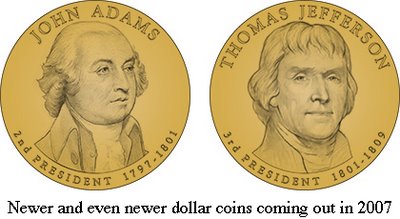
Anyway, we're up to take three here... except it's sort of like take three, four.... up to at least thirty-nine, and probably beyond. Borrowing an idea from their (apparently successful) "50-state" quarters, they are going to start releasing a coin for every U.S. President, in order, at four a year.

Or almost every President, I should say: U.S. law (quite properly and wisely) forbids the putting of any living person on currency. So, as of now, Ford, Carter, Bush 41, Clinton and Bush 43 are off-limits. Which is presumably why, if you examine the schedule, you see that the last currently announced coin is the 37th President, Richard Nixon, scheduled for roll-out in 2016. This is what drove boingboing batty: that "Richard 'Lying Scumbag' Nixon" is getting his face on a coin.
And while I certainly appreciate the accurate historical memory of Nixon as a lying scumbag, the truth is that far too many Presidents have been liars; and not a few have been scumbags. After all, when the current President finally goes to his eternal reward -- and if there is any justice in the universe *** he'll go from a jail cell to a far worse place -- he'll also presumably be stamped on a shiny new dollar, and then someone who (astonishing as it is) outdoes Nixon in both the "lying" and the "scumbag" department will be on a coin.
No, what gets me is another thing. You see one President is going to have two different coins in the series with his shinny face on them.
I'm speaking, of course, about Grover Cleveland.
I wouldn't really be surprised if some non-trivial proportion of my Noble Readers said Who?
Grover Cleveland comes from the list of Presidents between Lincoln and Roosevelt 26 (as opposed to Roosevelt 32, natch) -- in other words, the Presidents no one ever remembers -- largely deservedly so, really: they're a fairly undistinguished bunch all around, although you can make cases for the odd one here and there. ****
But what distinguishes Grover Cleveland, in a one-of-these-things-is-not-like-the-others sort of way, from all the other Presidents, is that he served two nonconsecutive terms, 1885 - 1889 and 1893 - 1897.
Parenthetically, the reason he served two non-consecutive terms is the same reason that the current lying scumbag had the opportunity to toss our country down the toilet: the Electoral College. Cleveland actually won the popular vote in the 1888 election, just as he did in the 1884 and 1892 elections (thereby being one of only three men ever to win a plurality of the popular vote more than twice.*****) So to the Electoral College -- which has so many other negatives to its credit -- this minor irritation can also be ascribed.
In any event, once this occurred, the inevitable question occurred: how do we number Cleveland among the Presidents?
The first 23 are easy, Washington to Harrison (and how's that for a diminution?) But should Cleveland be simply the 22nd President, Harrison the 23rd -- with the quick-step to the 24th, William McKinley, interrupted by a brief return to the 22nd... or was Cleveland actually not only the 22nd, but also the 24th, President, with McKinley therefore actually the 25th?
Congress, leaping into action on important matters, officially declared****** that Grover Cleveland was both the 22nd and the 24th President.
Well, I think they blew it.
Obviously there is a good case to be made that Grover Cleveland was the perpetrator of both the 22nd and the 24th Presidencies. But honestly, when do we think about that?******* If you're going to think about that, you might as well talk about Presidential terms, which admittedly gets you instantly tangled up in fractions given the nine Presidential terms that were divided between two people,******** but still, they're more important.
Usually, when we're not talking about Presidential terms, we're talking about Presidents. As in the people. As in the ugly ass white men who get their faces on legal motherfucking tender.
And Grover Cleveland, say what you will about him, was one guy.
So I think Congress made the wrong call.*********
Here's the best argument against their position, though. If you say that Cleveland was just the 22nd (individual to hold the office of) President, you get the odd situation that the 22nd President was after as well as before the 23rd. But that is a localized oddity: it will only come up when you're thinking about the Presidents between Lincoln and Roosevelt 26. Which, let's face it, people hardly ever do, since they were an undistinguished bunch, as mentioned previously. But if you hold to the Official Position Of The United States Government and say that Cleveland was both the 22nd and the 24th President, then it comes up every time you think about any post-Harrison Presidential ranking, and you need to constantly include footnotes********** to the effect that Bush 43 might be the 43rd President, but there were still only 42 people to hold the office. It's a choice that instead of localizing the oddity -- an oddity that is, after all, real and odd but also local -- distributes from now until the end of time, the end of the Presidency as an institution, or the next time the Electoral College decides to fuck us in our collective ass, depending. In other words, given the choice they made, you get more oddities than you would otherwise.
Including not one but two dollar coins for Grover Cleveland.
And not because he deserves his own coin, like Lincoln on the penny, Jefferson on the nickel, Roosevelt 32 on the dime, Washington on the quarter or JFK on the half-dollar. But because... well. Because.
It's silly.

I readily admit that this is an issue on which intelligent people can disagree. In fact, it is pretty much a good candidate for the archetypal issue on which there is no "correct" decision. For instance, my beloved wife, who is usually right about everything,is wrong about disagrees with me about this.
But I think the localized-versus-distributed-oddity argument is a clincher, personally.
But Congress disagrees, so in 2012 we'll get two separate Grover Cleveland dollars. (Kevin Drum points out that 2012 will be a banner year all around for dollar coins, what with Chester Arthur and Benjamin Harrison joining Cleveland 22 and Cleveland 24 as their poster boys for the year.)
Otherwise, I have to say, the dollars look pretty well designed. They will be designed like Sacagawea dollars, so that the millions... er, thousands... well, all the machines that were re-designed to accept those will accept the new ones. And they will have three of the traditional inscriptions for coins -- the date, "E Pluribus Unum" and "In Ba'al We Trust"*********** -- on the coins' edges, which is frankly pretty cool. Anyway, I, for one, am looking forward to them.
But a lot of Presidents -- possibly a majority of those who weren't firmly in the lying scumbag category (and some who were in the "lying but not a scumbag" category) -- already have their faces on coins. It might be fun to put out a series of forty coins with other notable Americans on them, joining Alexander Hamilton, Benjamin Franklin, Susan B. Anthony and Sacagawea with non-Presidential currency portraits. Martin Luther King might be a good place to start, since today everyone either admires his work or has to pretend they do. ************ At any rate, it would be more fun than all forty-three of the forty-two men who have served as President of the United States.
But I suppose that ain't no ugly ass white man get his face on no legal motherfucking tender, 'cept he president.
And people other than white men -- particularly after the failure of the Anthony & Sacagawea dollars -- need not apply at all.
Update: Matthew Yglesias says that the mining lobby was the force behind the new coins.
______________________________
* I really hope I don't need to point out that Wallace, not D'Angelo, is correct here -- Alexander Hamilton never was President? (He was Secretary of the Treasury, and an important pre-Constitutional figure too.) For that matter, Benjamin Franklin, on the $100 bill, wasn't a President either (he died in 1791, during the first term of the first President, (who is currently gracing the $1 bill and the quarter.)) And it somehow seems typical of The Wire that they let the character who is wrong get the last word...
** Defined tautologically as those who actually know the information in question.
*** There isn't.§
**** You can make a case for almost anything, really.
***** Andrew Jackson, who was cheated of the Presidency by a combination of the Electoral College and the odd constitutional procedures for when there isn't a majority within it in 1824 (and then went on to win outright in 1828 and 1832), and Roosevelt 32, who of course did so not thrice but in quadruplicate.§§
****** I've known this for years, but a brief Google doesn't turn up the actual date of Congress's important decision on this matter. And I don't care enough to do a prolonged Googling.
******* I mean, even those of us who think about these things.
******** Sigh. 1841-1845, 1849-1853, 1865-1869, 1881-1885, 1901-1905, 1921-1925, 1945-1949, 1961-1965 and 1973-1977. Four natural deaths, four assassinations, and one lying scumbag. And no, I didn't need to look anything up to type all that out; I do this for a living.§§§
********* Shocking, I know. Try to control yourself. (As Orson Scott Card might say.)
********** And footnotes, as everyone knows, are an incredible nuisance.§§§§
*********** What? Why would that bother you? It's just ceremonial Ba'alism, which, as everyone§§§§§ knows, is not any sort of violation of the first amendment. Really. The Supreme Court has said so. Would they ever get anything wrong?
************ Otherwise, they might end up demoted from Majority Leader of the U.S. Senate to Minority Whip -- a shocking fall from being the most powerful Republican in the Senate to the second-most powerful Republican in the Senate.
_________________________________
§ Except what we put there. We could do the jail cell part, if we want. I, for one, am for it.
§§ There really isn't another in the sequence "once, twice, thrice..." is there? Or am I just not thinking of it?
§§§ Which means that I probably made a mistake somewhere. So you'd better look it up yourself if you care. You're always safer looking things up. Well, depending where you look.
§§§§ Don't you think?
§§§§§ Yes, tautologically defined. Wasn't this where we came in?
_________________________________
Postscript, 2011: So the program proceeds apace. The latest release is Lincoln, although you can see designs now up through Garfield -- Johnson, Grant, Hayes & Garfield being the four luminaries to be honored this year. And doesn't it just warm your heart to know that all four of those worthies are going to get their face on a coin? (Grant might actually deserve it (Lincoln deserves it, but already had it.))
And, it turns out, there is a First Ladies Coin program - each of the wives is going to get her face on a $10 gold coin, released in tandem with their husbands' $1 coin. (At least Abigail Adams might actually deserve it.) From the schedule it looks like both Mrs. Wilsons, Ellen and Edith, will be getting their own coins. And what about Jefferson, Jackson, Van Buren & Buchanan, who were either widowers or bachelors for their entire presidencies? They get a coin with a picture of liberty on it. How sweet. Personally, I think that for Jefferson they should have made a Sally Hemmings coin: would have been historically accurate, and would have served the cause of racial diversity on American currency. (Have they ever put any African Americans on money? Or do we have to wait until a few years after Obama kicks?)
Actually the most interesting thing about the $10 coin program is that it's actually called the First Spouse Program and not the First Ladies Program -- despite the fact that all the people scheduled to be on it were, in fact, women and have traditionally been called "First Ladies" in their day. It looks like they're laying the linguistic groundwork for their Bill or Todd coins.
What you can't read that way, however, are the footnotes on the footnotes... of which there are four. To read those, you'll have to bop down to the actual footnotes, and read the footnotes on the footnotes in the title text *there* (or just scroll still further). Unless anyone has a solution for this?
Original post follows:
Wallace: Hamilton? He ain't no president.Via boingboing, I learn that the U.S. Mint is planning on releasing a new series of dollar coins -- a third attempt after the earlier unsuccessful Susan B. Anthony dollars and Sacagawea dollars.
D'Angelo: ...Ain't no ugly ass white man get his face on no legal motherfucking tender, 'cept he president.
-- The Wire, Episode 1, "The Target" *
The first interesting thing I learned from this article was why the Sacagawea dollars didn't go over. Everyone** knows that the Susan B. Anthony dollars didn't work because they were too much like quarters: people would get confused, and be shortchanged by a factor of 75%. Apt to make anyone cranky. But they learned from this experience, and the Sacagawea dollars are quite distinct in size, feel and color. So what went wrong that time?
Well, there's the fact that the U.S. population seems to be plain old resistant to using dollar coins. (For what it's worth, I'm for it: the dollar has dropped to coin-level worth some time since. England, for instance, uses a pound coin even though a pound is worth almost $2. But it's hardly one of my major concerns.) But the other factor apparently was that "limited Sacagawea quantities led to too many being stashed away by collectors, reducing circulation and thus familiarity." That's a pretty silly mistake: if you're going to roll out a new coin, do it right.
Anyway, we're up to take three here... except it's sort of like take three, four.... up to at least thirty-nine, and probably beyond. Borrowing an idea from their (apparently successful) "50-state" quarters, they are going to start releasing a coin for every U.S. President, in order, at four a year.

Or almost every President, I should say: U.S. law (quite properly and wisely) forbids the putting of any living person on currency. So, as of now, Ford, Carter, Bush 41, Clinton and Bush 43 are off-limits. Which is presumably why, if you examine the schedule, you see that the last currently announced coin is the 37th President, Richard Nixon, scheduled for roll-out in 2016. This is what drove boingboing batty: that "Richard 'Lying Scumbag' Nixon" is getting his face on a coin.
And while I certainly appreciate the accurate historical memory of Nixon as a lying scumbag, the truth is that far too many Presidents have been liars; and not a few have been scumbags. After all, when the current President finally goes to his eternal reward -- and if there is any justice in the universe *** he'll go from a jail cell to a far worse place -- he'll also presumably be stamped on a shiny new dollar, and then someone who (astonishing as it is) outdoes Nixon in both the "lying" and the "scumbag" department will be on a coin.
No, what gets me is another thing. You see one President is going to have two different coins in the series with his shinny face on them.
I'm speaking, of course, about Grover Cleveland.
I wouldn't really be surprised if some non-trivial proportion of my Noble Readers said Who?
Grover Cleveland comes from the list of Presidents between Lincoln and Roosevelt 26 (as opposed to Roosevelt 32, natch) -- in other words, the Presidents no one ever remembers -- largely deservedly so, really: they're a fairly undistinguished bunch all around, although you can make cases for the odd one here and there. ****
But what distinguishes Grover Cleveland, in a one-of-these-things-is-not-like-the-others sort of way, from all the other Presidents, is that he served two nonconsecutive terms, 1885 - 1889 and 1893 - 1897.
Parenthetically, the reason he served two non-consecutive terms is the same reason that the current lying scumbag had the opportunity to toss our country down the toilet: the Electoral College. Cleveland actually won the popular vote in the 1888 election, just as he did in the 1884 and 1892 elections (thereby being one of only three men ever to win a plurality of the popular vote more than twice.*****) So to the Electoral College -- which has so many other negatives to its credit -- this minor irritation can also be ascribed.
In any event, once this occurred, the inevitable question occurred: how do we number Cleveland among the Presidents?

The first 23 are easy, Washington to Harrison (and how's that for a diminution?) But should Cleveland be simply the 22nd President, Harrison the 23rd -- with the quick-step to the 24th, William McKinley, interrupted by a brief return to the 22nd... or was Cleveland actually not only the 22nd, but also the 24th, President, with McKinley therefore actually the 25th?
Congress, leaping into action on important matters, officially declared****** that Grover Cleveland was both the 22nd and the 24th President.
Well, I think they blew it.
Obviously there is a good case to be made that Grover Cleveland was the perpetrator of both the 22nd and the 24th Presidencies. But honestly, when do we think about that?******* If you're going to think about that, you might as well talk about Presidential terms, which admittedly gets you instantly tangled up in fractions given the nine Presidential terms that were divided between two people,******** but still, they're more important.
Usually, when we're not talking about Presidential terms, we're talking about Presidents. As in the people. As in the ugly ass white men who get their faces on legal motherfucking tender.
And Grover Cleveland, say what you will about him, was one guy.
So I think Congress made the wrong call.*********
Here's the best argument against their position, though. If you say that Cleveland was just the 22nd (individual to hold the office of) President, you get the odd situation that the 22nd President was after as well as before the 23rd. But that is a localized oddity: it will only come up when you're thinking about the Presidents between Lincoln and Roosevelt 26. Which, let's face it, people hardly ever do, since they were an undistinguished bunch, as mentioned previously. But if you hold to the Official Position Of The United States Government and say that Cleveland was both the 22nd and the 24th President, then it comes up every time you think about any post-Harrison Presidential ranking, and you need to constantly include footnotes********** to the effect that Bush 43 might be the 43rd President, but there were still only 42 people to hold the office. It's a choice that instead of localizing the oddity -- an oddity that is, after all, real and odd but also local -- distributes from now until the end of time, the end of the Presidency as an institution, or the next time the Electoral College decides to fuck us in our collective ass, depending. In other words, given the choice they made, you get more oddities than you would otherwise.
Including not one but two dollar coins for Grover Cleveland.
And not because he deserves his own coin, like Lincoln on the penny, Jefferson on the nickel, Roosevelt 32 on the dime, Washington on the quarter or JFK on the half-dollar. But because... well. Because.
It's silly.

I readily admit that this is an issue on which intelligent people can disagree. In fact, it is pretty much a good candidate for the archetypal issue on which there is no "correct" decision. For instance, my beloved wife, who is usually right about everything,
But I think the localized-versus-distributed-oddity argument is a clincher, personally.
But Congress disagrees, so in 2012 we'll get two separate Grover Cleveland dollars. (Kevin Drum points out that 2012 will be a banner year all around for dollar coins, what with Chester Arthur and Benjamin Harrison joining Cleveland 22 and Cleveland 24 as their poster boys for the year.)
Otherwise, I have to say, the dollars look pretty well designed. They will be designed like Sacagawea dollars, so that the millions... er, thousands... well, all the machines that were re-designed to accept those will accept the new ones. And they will have three of the traditional inscriptions for coins -- the date, "E Pluribus Unum" and "In Ba'al We Trust"*********** -- on the coins' edges, which is frankly pretty cool. Anyway, I, for one, am looking forward to them.
But a lot of Presidents -- possibly a majority of those who weren't firmly in the lying scumbag category (and some who were in the "lying but not a scumbag" category) -- already have their faces on coins. It might be fun to put out a series of forty coins with other notable Americans on them, joining Alexander Hamilton, Benjamin Franklin, Susan B. Anthony and Sacagawea with non-Presidential currency portraits. Martin Luther King might be a good place to start, since today everyone either admires his work or has to pretend they do. ************ At any rate, it would be more fun than all forty-three of the forty-two men who have served as President of the United States.
But I suppose that ain't no ugly ass white man get his face on no legal motherfucking tender, 'cept he president.
And people other than white men -- particularly after the failure of the Anthony & Sacagawea dollars -- need not apply at all.
Update: Matthew Yglesias says that the mining lobby was the force behind the new coins.
______________________________
* I really hope I don't need to point out that Wallace, not D'Angelo, is correct here -- Alexander Hamilton never was President? (He was Secretary of the Treasury, and an important pre-Constitutional figure too.) For that matter, Benjamin Franklin, on the $100 bill, wasn't a President either (he died in 1791, during the first term of the first President, (who is currently gracing the $1 bill and the quarter.)) And it somehow seems typical of The Wire that they let the character who is wrong get the last word...
** Defined tautologically as those who actually know the information in question.
*** There isn't.§
**** You can make a case for almost anything, really.
***** Andrew Jackson, who was cheated of the Presidency by a combination of the Electoral College and the odd constitutional procedures for when there isn't a majority within it in 1824 (and then went on to win outright in 1828 and 1832), and Roosevelt 32, who of course did so not thrice but in quadruplicate.§§
****** I've known this for years, but a brief Google doesn't turn up the actual date of Congress's important decision on this matter. And I don't care enough to do a prolonged Googling.
******* I mean, even those of us who think about these things.
******** Sigh. 1841-1845, 1849-1853, 1865-1869, 1881-1885, 1901-1905, 1921-1925, 1945-1949, 1961-1965 and 1973-1977. Four natural deaths, four assassinations, and one lying scumbag. And no, I didn't need to look anything up to type all that out; I do this for a living.§§§
********* Shocking, I know. Try to control yourself. (As Orson Scott Card might say.)
********** And footnotes, as everyone knows, are an incredible nuisance.§§§§
*********** What? Why would that bother you? It's just ceremonial Ba'alism, which, as everyone§§§§§ knows, is not any sort of violation of the first amendment. Really. The Supreme Court has said so. Would they ever get anything wrong?
************ Otherwise, they might end up demoted from Majority Leader of the U.S. Senate to Minority Whip -- a shocking fall from being the most powerful Republican in the Senate to the second-most powerful Republican in the Senate.
_________________________________
§ Except what we put there. We could do the jail cell part, if we want. I, for one, am for it.
§§ There really isn't another in the sequence "once, twice, thrice..." is there? Or am I just not thinking of it?
§§§ Which means that I probably made a mistake somewhere. So you'd better look it up yourself if you care. You're always safer looking things up. Well, depending where you look.
§§§§ Don't you think?
§§§§§ Yes, tautologically defined. Wasn't this where we came in?
_________________________________
Postscript, 2011: So the program proceeds apace. The latest release is Lincoln, although you can see designs now up through Garfield -- Johnson, Grant, Hayes & Garfield being the four luminaries to be honored this year. And doesn't it just warm your heart to know that all four of those worthies are going to get their face on a coin? (Grant might actually deserve it (Lincoln deserves it, but already had it.))
And, it turns out, there is a First Ladies Coin program - each of the wives is going to get her face on a $10 gold coin, released in tandem with their husbands' $1 coin. (At least Abigail Adams might actually deserve it.) From the schedule it looks like both Mrs. Wilsons, Ellen and Edith, will be getting their own coins. And what about Jefferson, Jackson, Van Buren & Buchanan, who were either widowers or bachelors for their entire presidencies? They get a coin with a picture of liberty on it. How sweet. Personally, I think that for Jefferson they should have made a Sally Hemmings coin: would have been historically accurate, and would have served the cause of racial diversity on American currency. (Have they ever put any African Americans on money? Or do we have to wait until a few years after Obama kicks?)
Actually the most interesting thing about the $10 coin program is that it's actually called the First Spouse Program and not the First Ladies Program -- despite the fact that all the people scheduled to be on it were, in fact, women and have traditionally been called "First Ladies" in their day. It looks like they're laying the linguistic groundwork for their Bill or Todd coins.
Did You Know That Henry James Participated In a Round-Robin Novel?
I didn't. But it seems he did: The Whole Family: A Novel by Twelve Authors (1908) includes a chapter by Henry James -- Chapter 7, "The Married Son". I wouldn't have guessed it.
(A round-robin story is a story written by multiple authors -- essentially a stunt, although there have been a fair number of them.)
Aside from James, the other author involved who's still read today is William Dean Howells, who wrote the first chapter, "The Father" (and seems to have conceived of the whole project). I haven't read it, but if you want to, you can find the book on Gutenberg. (Aside from Howells and James, the authors are, today, mostly forgotten.)
In other Jamesiana, Alice James, the diarist and sister of novelist Henry and philosopher & psychologist William, was born on August 7, 1848. This wouldn't be worth mentioning save that a surprising number of web sites -- PBS, and the "about" page for the publisher Alice James Books are two -- list her as born in 1850. I'm not sure how this alternative date got started. I'm pretty sure it's wrong, although both are quite prominently listed. (One telling fact is that the specific day is always associated with the year 1848.) Does anyone have any information on this? (To confuse things further, Alice was also the name of William James's wife; she was born 1849.)
Update: While I'm sharing stray oddities about the James siblings, I'll mention one more, which isn't widely known (although Louis Menand talks about it in his fabulous book The Metaphysical Club), which is that the third child of Henry James Sr. (after philosopher William and novelist Henry (Jr), but before diarist Alice) was Garth Wilkinson James -- called Wilky James -- who was one of the (white) officers in the (all-black infantry) 54th Massachusetts Regiment in the Civil War -- the regiment whose formation and attack on Fort Wagner is depicted in the movie Glory. Wilky James was wounded in the attack on Fort Wagner, and never fully recovered, suffering from various pains and ailments until his death at age 38.
Quote of the Day: Peirce Contra Descartes
American philosopher Charles Sanders Peirce (1839—1914) goes at the central move in the philosophy of the robot-lover Descartes, in this fabulous passage from his 1868 essay "Some Consequences of Four Incapacities":
We cannot begin with complete doubt. We must begin with all the prejudices which we actually have when we enter upon the study of philosophy. These prejudices are not to be dispelled by a maxim, for they are things which it does not occur to us can be questioned. Hence this initial skepticism will be a mere self-deception, and not real doubt; and no one who follows the Cartesian method will ever be satisfied until he has formally recovered all those beliefs which in form he has given up.... A person may, it is true, in the course of his studies, find reason to doubt what he began by believing; but in that case he doubts because he has a positive reason for it, and not on account of the Cartesian maxim. Let us not pretend to doubt in philosophy what we do not doubt in our hearts.I have removed what I took to be a rather unhelpful metaphor. If you, understandably, would rather take Peirce's words over mine in this case -- or if you're interested in the other three principles of Descartes's (besides universal doubt) that Peirce takes on in his essay -- I recommend you read the whole thing.
Monday, February 07, 2011
My Head May Explode From the Sheer Awesomeness of This
John Lewis -- former head of SNCC, participant in the Freedom Rides, and, for the past twenty-five years, a member of Congress (from Georgia) -- is one of the few people I can think of in American life that I would unhesitatingly and unabashedly label a hero.
For those of you who don't know, he was at the center of the Civil Rights Movement in its key years in the early 1960's -- a participant at the lunch counter sit-ins in the early 60's, a freedom rider, head of SNCC, a speaker at the 1963 March on Washington where King delivered his famous "I Have a Dream" speech (and where Lewis's speech was deemed to radical for the other organizers and speakers and he -- reluctantly, when asked by A. Philip Randolph -- revised it (you can read the original draft here)), and the lead walker at the climactic confrontation of the Movement, the walk over Pettus Bridge, which directly led to the enactment of the 1965 Voting Rights Act. A man of matchless wisdom and courage, my admiration for him is really hard to express.
And he's writing a comic book.
No, really: he just signed a contract with Top Shelf to (co) write a graphic novel based on his experiences in the Civil Rights Movement, tentatively titled March.
Can I pre-order it yet?
Now, I will admit that my confidence that it will be good is very low. Lewis is a fine writer of prose, but writing prose is a very different task than writing comics -- and most writers of prose who try to make the transition do a poor job of it. Writing a comics script is as different from writing prose as writing a play or a film script is: it requires a real understanding of the medium. If you just think that you've written books, you can write a graphic novel, well, you're wrong. It's not just like writing a book with pictures.*
Nor am I encouraged by the fact that Lewis's co-author, Andrew Aydin, is a member of his staff -- that is, someone who is primarily engaged in politics. Presumably Lewis can tell his own story, after all; what he needs for this project is someone who can help him tell it in the medium of comics.
Now, maybe I'm wrong. Maybe Lewis is a long-time comics reader. Or maybe he's thought about the nature of the medium. But, y'know, he's been busy doing other things -- like, say, being a brilliant activist and politician. So I'm worried that he isn't and hasn't. I'm somewhat more hopeful that Aydin might be knowledgeable about comics; maybe he'll bring a good handle on the medium to the table. But, I fear, that he's been hired much as a politician might hire someone to co-write their prose memoirs, i.e. someone to help with the work, but without any particular sense of the medium.
To make this work, they'll need a really good -- and confident and self-assertive -- artist. And Chris Staros, the editor & publisher of Top Shelf, had better be on his game.
(Incidentally, they are, apparently, still in the process of settling on an artist. If you're a comics artist, I recommend dropping everything and seeing if you can nab it. It'll be the job of a lifetime.)
And even if it doesn't work, y'know what? I'm there. I'm reading it. Because even if it isn't a fabulous artistic production, I'm sure it will be very interesting, and have some insights into a key period of history.
And besides, John Lewis -- John !!@#$%ing Lewis -- is writing a !@#$% graphic novel. It's had to get more awesome than that. In this matter, quality is would be just a bonus.
___________________________
* Actually, I suspect that, done properly, writing a book with pictures isn't just like writing a book without them, either. But it's closer.
Sunday, February 06, 2011
Descartes's Robot; plus: Thomas Aquinas vs. Robot -- to the death!!!
The early prehistory of robots -- and inflatable sex dolls! From Stephen Graukroger, Descartes: an Intellectual Biography (Oxford, 1995), p. 1:
Those who prefer that their great tales not be ruined by truth will want to stop there. Those who think that fiction survives a dusting of dull fact will want to read the next paragraph as well (pp. 1-2):
And those with the spirit of a Sub-Sub Librarian, such as myself, will want to read the first footnote, so for your convenience I reproduce it here (from p. 418 of Graukroger):
I'm disappointed that the footnote doesn't mention which of Anatole France's novels is on "the theme" of Descartes's robot (a quick googling indicates that none of his works seem to have been explicitly about Descartes by name). Does anyone happen to know? [Update: A commentator comes through! The novel in question is La Rotisserie de la Reine Pedauque (1893), translated as At the Sign of the Reine Pedauque (1922, available online at the link). Thanks to B. McCarthy; see his comments below for more on this, as well as the Rosenfield book discussed below.]
Incidentally (more Sub-Subness here) the author of From Beast-Machine to Man Machine seems to have been Leonora C. Rosenfield, not G. as reported by Mr. Graukroger. A quick google indicates that seems to have published as Leonora Cohen Rosenfield (although Amazon, for no discernable reason, lists her as Leonora Davidson Rosenfield). Obviously, given the Cohen -> G. mistake, to say nothing of the obvious omission of the story of the golem from the aforequoted list of "philosophical robot" stories, the only possible interpretation is that Mr. Graukroger is a raving antisemite. These things don't happen by accident, you know.
At any rate, since neither google books nor amazon has a "look inside" feature for Rosenfield's work, my researches must stop here for the moment. Alas. If anyone has a copy of From Beast-Machine to Man-Machine handy, however, please leave any interesting tidbits in the comments.
Since the eighteenth century, there has been in circulation a curious story about Descartes. It is said that in later life he was always accompanied in his travels by a mechanical life-sized female doll which, we are told by one source, he himself had constructed 'to show that animals are only machines and have no souls'. He had named the doll after his illegitimate daughter, Francine, and some versions of events have it that she was so lifelike that the two were indistinguishable. Descartes and the doll were evidently inseparable, and he is said to have slept with her encased in a trunk at his side. Once, during a crossing over the Holland Sea some time in the early 1640s, while Descartes was sleeping, the captain of the ship, suspicious about the contents of the trunk, stole into the cabin and opened it. To his horror, he discovered the mechanical monstrosity, dragged her from the trunk and across the decks, and finally managed to throw her into the water. We are not told whether she put up a struggle.
Those who prefer that their great tales not be ruined by truth will want to stop there. Those who think that fiction survives a dusting of dull fact will want to read the next paragraph as well (pp. 1-2):
The story had a wide currency in the nineteenth and early twentieth centuries, at one stage being taken as a theme for a novel by Anatole France. It exists in a number of versions, some of them explicitly fictional, some purporting to be factual, and the detail varies quite considerably from version to version. So far as I can tell, the story originates no early than the eighteenth century, and it received most attention in an era preoccupied with the theories of La Mettrie, the French Enlightenment philosophe who, in his infamous L'Homme Machine (1747), had extended the idea of animals being automata -- developed by Descartes in his L'Homme -- to human beings, offering a materialist account of the mind, and suggesting that Descartes himself had held such a view, but that judicious self-censorship had prevented him making the theory public. There is, in fact, absolutely no evidence that any version of the story is true. Its origins are rather obscure, but by the second half of the eighteenth century it was a propaganda weapon in the fight against La Mettrie's materialism, Descartes himself being seen as the ultimate instigator of this pernicious doctrine. Given this context, the story has all the elements of propaganda, including that favorite propaganda weapon, sexual innuendo, and I have little doubt that it originated as a tool of the eighteenth-century struggle against materialism.
And those with the spirit of a Sub-Sub Librarian, such as myself, will want to read the first footnote, so for your convenience I reproduce it here (from p. 418 of Graukroger):
I first came across this story in print in a recent book on the history of robotics, where it is presented as fact, although no references are given. Investigation showed the story to have had a wide currency between the late eighteenth century and the early decades of this century. For the different versions of the story and their sources see Leonora G. Rosenfield, From Beast-Machine to Man Machine, rev. edn. (New York, 1968), 202-3, and the accompanying notes on p. 236. Descartes is not the first philosopher reputed to have constructed a mechanical companion. Albertus Magnus was said to have had a robot that could move and greet visitors with the salutation Salve! ('How are you!'). Thomas Aquinas, his pupil at the time, is reported to have attacked and broken the gregarious android when he came across it unexpectedly in the night. The story is reported, with references I have not followed up, in G. A. Lindeboom, Descartes and medicine (Amsterdam, 1979), 62.How like a scholar to hide the Aquinas vs. Robot death match in a footnote like that. It should go in the preview, man: how else do you expect to get buts in the seats eating popcorn?
I'm disappointed that the footnote doesn't mention which of Anatole France's novels is on "the theme" of Descartes's robot (a quick googling indicates that none of his works seem to have been explicitly about Descartes by name). Does anyone happen to know? [Update: A commentator comes through! The novel in question is La Rotisserie de la Reine Pedauque (1893), translated as At the Sign of the Reine Pedauque (1922, available online at the link). Thanks to B. McCarthy; see his comments below for more on this, as well as the Rosenfield book discussed below.]
Incidentally (more Sub-Subness here) the author of From Beast-Machine to Man Machine seems to have been Leonora C. Rosenfield, not G. as reported by Mr. Graukroger. A quick google indicates that seems to have published as Leonora Cohen Rosenfield (although Amazon, for no discernable reason, lists her as Leonora Davidson Rosenfield). Obviously, given the Cohen -> G. mistake, to say nothing of the obvious omission of the story of the golem from the aforequoted list of "philosophical robot" stories, the only possible interpretation is that Mr. Graukroger is a raving antisemite. These things don't happen by accident, you know.
At any rate, since neither google books nor amazon has a "look inside" feature for Rosenfield's work, my researches must stop here for the moment. Alas. If anyone has a copy of From Beast-Machine to Man-Machine handy, however, please leave any interesting tidbits in the comments.
Friday, February 04, 2011
I Wish I Wasn't Too Cynical To Believe This
Nothing new, no time-saving devices, -- simply old time-glorified methods of delving for Truth, and searching out the hidden beauties of life, and learning the good of living. The riddle of existence is the college curriculum that was laid before the Pharaohs, that was taught in the groves by Plato, that formed the trivium and quadrivium, and is to-day laid before the freedmen's sons by Atlanta University. And this course of study will not change; its methods will grow more deft and effectual, its content richer by toil of scholar and sight of seer; but the true college will ever have one goal, -- not to earn meat, but to know the end and aim of that life which meat nourishes.
-- W. E. B. Du Bois, The Souls of Black Folk, Chapter 5
Thursday, February 03, 2011
Same As It Ever Was
I'm interrupted every moment by students come to fight about their marks.
-- William James
(Quoted in Gerald E. Myers, William James: His Life and Thought, p. 35)
The Onion Continues to Live Up To Its Tag Line, "America's Finest News Source"
The newspaper that brought you the single story that told you everything you really needed to know about the Bush administration before it happened now brings you the essential political story of the current moment. The headline and the first paragraph:
Republicans Vote To Repeal Obama-Backed Bill That Would Destroy Asteroid Headed For EarthI found the story via Ezra Klein (in turn via Gerry), but Ezra leaves out some of the best bits of humor, which are in some of the details. It has the miserable cowardice and smallness of the Democrats pegged, for instance:
In a strong rebuke of President Obama and his domestic agenda, all 242 House Republicans voted Wednesday to repeal the Asteroid Destruction and American Preservation Act, which was signed into law last year to destroy the immense asteroid currently hurtling toward Earth.
In support of their position, Democrats have pointed to estimates from the nonpartisan Congressional Budget Office that show repealing the law could result in a loss of up to $14 trillion in the nation's GDP.They've also got the news media pegged too:
[...]
"...While I recognize that intelligent minds may disagree on this issue, I believe we have an obligation to prevent our citizens from having their flesh seared off in a global firestorm that transforms our planet into a broiling molten wasteland," Obama added.
"If efforts to destroy the asteroid are successfully overturned, then there will be major ramifications for both Obama and his Republican opposition, as well as the American populace at large," political scientist Alan Abramowitz said on Face The Nation Sunday. "This could have a huge impact come 2012."Oh, and in case anyone thinks this is satire: I guess technically it is, but only slightly. Really it's just euphemism. To decode it, just read "environmental destruction due to global warming" for "immense asteroid". Then it stops being funny -- but doesn't, alas, stop being true.
Friday, January 28, 2011
Some People Are Really Just Overly Talented
Headline in the NY Times earlier this week: Nabokov Theory on Butterfly Evolution Is Vindicated. (via) Some details:
Someone needs to update this book.
Nabokov spent much of the 1940s dissecting a confusing group of species called Polyommatus blues. He developed forward-thinking ways to classify the butterflies based on differences in their genitalia. He argued that what were thought to be closely related species were actually only distantly related. At the end of a 1945 paper on the group, he mused on how they had evolved. He speculated that they originated in Asia, moved over the Bering Strait, and moved south all the way to Chile [...]This is just breathtakingly cool. Now, I've loved his fiction for years (I first read Pnin in high school, then took a course called "Nabokov" back in college), so I'm wildly biased. Still... breathtakingly cool.
Dr. [Naomi] Pierce, who became a Harvard biology professor and curator of lepidoptera in 1990, began looking closely at Nabokov’s work while preparing an exhibit to celebrate his 100th birthday in 1999. She was captivated by his idea of butterflies coming from Asia. “It was an amazing, bold hypothesis,” she said. “And I thought, ‘Oh, my God, we could test this.’" [...]
Dr. Pierce and her colleagues concluded that five waves of butterflies came from Asia to the New World — just as Nabokov had speculated. “By God, he got every one right,” Dr. Pierce said. “I couldn’t get over it — I was blown away.”
-- Carl Zimmer, The New York Times, January 25, 2011
Someone needs to update this book.
Saturday, January 15, 2011
Publish and Perish, or, The Strange Customs of Foreign Peoples
Oxford had a long tradition of not publishing during one's lifetime, indeed it was regarded as slightly vulgar to publish. People who did publish a lot, like A. J. Ayer, were regarded as remiss for having published too much too soon. As far as having a career and making a reputation were concerned, the attitude in Oxford was that the only opinions that really matter are the opinions of people in Oxford, and perhaps a few in Cambridge and London, and they will know about one's work anyway. One does not need to publish. What one does not want is a lot of graduate students somewhere, picking over one's half-backed publish texts and -- horror of horrors -- finding mistakes.
- John Searle, "J. L. Austin", in A Companion to Analytic Philosophy, ed. Aloysius Martinich & Dzvid Sosa (Wiley-Blackwell, 2001), p. 227
Subscribe to:
Posts (Atom)