Thursday, October 13, 2016

A Few Words on Little, Big

A few days ago I finished listening to the audiobook (read by the author) of John Crowley's Little, Big — my second time through the audiobook specifically and third time through the text of the novel as a whole.*  I come away once again overwhelmed by what an amazing, marvelous book it is.

I want to recommend it to everyone.  Virginia Woolf famously said that George Eliot's Middlemarch was "one of the few English books written for grown-up people", a remark that strikes me as about 15% insightful and 85% silly.  But in the same way one could say that Little, Big was one of the few English books about faeries written for grown-up people.**  Middlemarch contains a village, at a fairly brief moment in time; Little, Big contains a family (it is family chronicle, a rather old-fashioned but marvelous form), stretched out over time and space (or, if not space, then location, the locations being the country house and the City).  It's breathtaking and heartbreaking and wonderful.  Its prose is not as pyrotechnic in a way that Nabokov's or Updike's can (at times excessively) be; but it is as good as theirs are, which is to say, as good as English prose gets.  Gene Wolfe (one of the few living writers in his class) said that Little, Big was "an education in modern fantasy all by itself"; Ursula Le Guin said it is "a book that all by itself calls for a redefinition of fantasy".  Harold Bloom's canonized it.  Seriously, people, this is an amazing book.

I want to recommend it to everyone: but with a word of warning.  It's not an easy book to get into.  Several very fine readers whom I have pushed it upon have begun it, seen its merits, but not finished it.  I myself began it several times before finishing it.  After I did so, I went online and searched for information about it, and found person after person saying some variation of, "it took me several tries to get into it but now it's one of my favorite books".  Well, me too.  It reminds me of what Umberto Eco said in his Postscript to the Name of the Rose:
After reading the manuscript, my friends and editors suggested I abbreviate the first hundred pages, which they found very difficult and demanding. Without thinking twice, I refused, because, as I insisted, if somebody wanted to enter the abbey and live there for seven days, he had to accept the abbey's own pace. If he could not, he would never manage to read the whole book. Therefore those first hundred pages are alike a penance or an initiation, and if someone does not like them, so much the worse for him. He can stay at the foot of the hill.  Entering a novel is like going on a climb in the mountains: you have to learn the rhythm of respiration, acquire the pace; otherwise you stop right away.
Just so: the same is true of the life of a family that lives in the country and waits for a Tale to unfold.

It is not a book that you "can't put down": it is that much deeper and more wonderful thing, a book that you must continually put down to catch your breath, to marvel at the view, to hold a phrase tightly in your mind in sheer delight.  But it is a journey worth taking.  Some reviewers have complained that "nothing happens" in the book: which is not at all true, though I grant that there is no punching or shooting (well, except for the person who ends up getting shot, I mean.  But not that sort of shooting).  But it is not a novel paced to the attention spans of the digital age.  It's the richer for it: but it has become for us, I think, a harder read than it was when it first came out.  But it will repay you richly if you make the effort.  Sometimes long journeys need to be taken on foot, to be the more marvelous when you finally, dusty and tired, arrive.

Two notes on two ancillary works of art that spring from the novel.

First, as I mentioned, I listened to the audiobook, read by Crowley himself.  It's marvelous.  Crowley is not a professional audiobook narrator, and does not have the characteristic style they do (with, for instance, their multiple voices for multiple characters); but the text is his, and his voice makes it (if possible) even better.  If you've gotten stuck in the book, try the audiobook.  (Local Ithaca folks might note it's in the TCPL system, though housed at a different library.)

Second, my friend Ron Drummond has been working for some years on a special limited edition of Little, Big, one with an author's corrected text*** and illustrations by Peter Milton — pictures not created for the book, but used to illustrate it.  That last — the entwining of a text with pictures made separately from it — sounds as implausible as, well, a novel about faeries for (in a Wolfian sense) grown-up people.  But, implausibly, miraculously, it works.  The other day Ron was kind enough to show me several chapters as laid out for the in-process edition.  What was remarkable to me about it is not only how well they graced the text, but the way in which Ron, taking details from various pictures, sometimes reversing or reusing them in creative and counterintuitive ways, has made out of Milton's art and Crowley's masterpiece something yet other, a third work of art, with its own aesthetic surprises and joys and marvels.  It is, perhaps, the art of curating (a underappreciated art in any event); but it is a first-rate example of it.  Ron has hit some speedbumps, and the edition as yet has no publication date,  but keep an eye out for it, and catch it when you can.

In the meantime, don't let that hold you up: get any old edition of the novel and read it — or get the audiobook and listen.  If you get stuck, keep going.  Don't let the amazing transition that occurs in the first sentence of part three throw you (it threw me, when I first hit it).  It's worth it.  If you finish it once, you'll want to read it again.

__________________________

* The first time I used the admittedly old-fashioned medium of trees, pulped & smashed flat, and systematically dirtied in specific patterns.  Weird, I know.

** Don't let the word ''faeries" turn you off; these are neither Peter Pan's cute comrades nor Tolkien's wise warriors.  They are marvelous and terrifying and convincing in a way that I might have said, before reading the book, was impossible.

*** Used as the text for the audiobook edition, incidentally.

Dylan, Nobel Laureate

I am genuinely quite, quite thrilled by this news.

There has been no better writer than Dylan in the years Dylan has been writing. The Nobel for Literature has never gone to anyone more worthy than he.

There are, to be sure, other writers equally worthy: I would love to see someone from the SF field win it (Le Guin is most frequently named, and would be a fitting winner, as would Wolfe, Delany, Crowley, and others). I'd plug Alan Moore. The various sneers at Philip Roth are misplaced; he, too, would be a great winner. All that said: there is no better choice. Dylan is entirely and fully deserving.

A splendid, perfect choice.

Two further points:

First, I would like to thank the Nobel committee for taking my mind off this genuinely stomach-turning election (due, I should add, entirely to one candidate: I mean no false equivalence here), and giving me something to be genuinely happy about this morning.

Second, note to self: really, really gotta resist getting into it with the people who are, in various fashions, sneering. Shouting doesn't help people be less tone deaf.

PS: Ted Gioia totally called it some years ago (fun list all around, incidentally).

Wednesday, August 10, 2016

Poem of the Day: Archaic Torso of Apollo

Archaic Torso of Apollo

We cannot know his legendary head
with eyes like ripening fruit. And yet his torso
is still suffused with brilliance from inside,
like a lamp, in which his gaze, now turned to low,

gleams in all its power. Otherwise
the curved breast could not dazzle you so, nor could
a smile run through the placid hips and thighs
to that dark center where procreation flared.

Otherwise this stone would seem defaced
beneath the translucent cascade of the shoulders
and would not glisten like a wild beast’s fur:

would not, from all the borders of itself,
burst like a star: for here there is no place
that does not see you. You must change your life.

—Rainer Maria Rilke, trans. Stephen Mitchell
(A neat page with both the original German and several different English translations is here.)

Wednesday, June 08, 2016

Thoughts on the State of the Democratic Nomination Race, Especially Where Sanders Is & Should Go

A lot of people are frustrated that Sanders hasn't dropped out yet. As a Sanders voter, I agree he needs to withdraw, but I think far more important then when he drops out is how he drops out. He has raised a large number of issues, pushed the political conversation (and Clinton) to the left and above all energized young voters powerfully & importantly. He needs to drop out in a way that does several things:

1. Gives them a sense of all they accomplished. Because they accomplished a lot.

2. Imparts to them the absolute moral imperative of voting for Clinton over Trump.

3. Keeps the activists he has inspired engaged in politics, ideally spinning off organized movements and not just individual activists.
Those movements could be a lot of things; two important areas, in my view, are A) downballot organizing (nothing will happen without multiple victories at every level; Sanders's organization could and should be a powerful force pushing the democrats both left & into power), and B) issue organizing (holding all democrats' feet to the fire on issues of inequality, money-dominated politics, and the other issues that Sanders focused on). Ideally they'd do A through November and B thereafter, but any combination would be good.

Conceding last night wouldn't have down much for any of those three goals. So I don't think he should have done so. But he needs to be laying the groundwork. Will he/is he? The signs are mixed: a lot of (not entirely credible) reporting is portraying him as very personally bitter; at the same time, there are reasons to be hopeful (he requested & is having a meeting with Obama on Thursday). It could go either way. I hope he does the right thing. Taking his time & doing it carefully is not only consistent with that, it's necessary for it.

Electing Clinton is necessary to progress in every area Sanders supporters care about; it is sufficient for progress in none. If Sanders, and we, can bear that in mind, we'll do well. So keep hope alive, as another Democratic candidate who didn't receive his party's nomination used to put it.

Cross-posted from Facebook.

Monday, May 02, 2016

Boodle to Quoodle, Buffy to Puffy

Then there is my Lord Boodle, of considerable reputation with his party, who… perceives with astonishment that supposing the present government to be overthrown, the limited choice of the Crown, in the formation of a new ministry, would lie between Lord Coodle and Sir Thomas Doodle—supposing it to be impossible for the Duke of Foodle to act with Goodle, which may be assumed to be the case in consequence of the breach arising out of that affair with Hoodle. Then, giving the Home Department and the leadership of the House of Commons to Joodle, the Exchequer to Koodle, the Colonies to Loodle, and the Foreign Office to Moodle, what are you to do with Noodle? You can't offer him the Presidency of the Council; that is reserved for Poodle. You can't put him in the Woods and Forests; that is hardly good enough for Quoodle. What follows?…

On the other hand, the Right Honourable William Buffy, M.P., contends across the table with some one else that the shipwreck of the country—about which there is no doubt; it is only the manner of it that is in question—is attributable to Cuffy. If you had done with Cuffy what you ought to have done when he first came into Parliament, and had prevented him from going over to Duffy, you would have got him into alliance with Fuffy, you would have had with you the weight attaching as a smart debater to Guffy, you would have brought to bear upon the elections the wealth of Huffy, you would have got in for three counties Juffy, Kuffy, and Luffy, and you would have strengthened your administration by the official knowledge and the business habits of Muffy. All this, instead of being as you now are, dependent on the mere caprice of Puffy!

— Charles Dickens, Bleak House, Chapter 12

Wednesday, April 27, 2016

Kay Ryan Week: A Sequel

Four-plus years ago I went on a binge of posting Kay Ryan poems.  The other day I saw her latest book — Erratic Things (2015)* — on the new book shelf in the library.  I'm still reading it, but partway in it's fabulous.  Here's my favorite so far:
On the Nature of Understanding

Say you hoped to
tame something
wild and stayed
calm and inched up
day by day. Or even
not tame it but
meet it half way.
Things went along.
You made progress,
understanding
it would be a
lengthy process,
sensing changes
in your hair and
nails. So it's
strange when it
attacks: you thought
you had a deal.

— Kay Ryan

________
* The title is enriched by an epigraph, a definition of "erratic": (n) Geol. A boulder or the like carried by glacial ice and deposited some distance from its place of origin.

Monday, April 18, 2016

Four Questions For the Second Seder

Why is this night exactly the same as last night?
Last night, we had a seder. Tonight, we're having exactly the same seder.
Last night, I asked you four questions. Tonight, I'm going to ask you the same four questions all over again.
Last night, you made a big deal out of the Torah verse "on that day". Now, you'll do that today too?
Last night you told me the story of the coming out of Exodus. Good yarn. But you're repeating it. Didn't we cover this already?


(Chag kasher v'sameach to those celebrating this week.) 

Sunday, March 27, 2016

A Century Past

Easter, 1916

I have met them at close of day
Coming with vivid faces
From counter or desk among grey
Eighteenth-century houses.
I have passed with a nod of the head
Or polite meaningless words,
Or have lingered awhile and said
Polite meaningless words,
And thought before I had done
Of a mocking tale or a gibe
To please a companion
Around the fire at the club,
Being certain that they and I
But lived where motley is worn:
All changed, changed utterly:
A terrible beauty is born.

That woman's days were spent
In ignorant good-will,
Her nights in argument
Until her voice grew shrill.
What voice more sweet than hers
When, young and beautiful,
She rode to harriers?
This man had kept a school
And rode our winged horse;
This other his helper and friend
Was coming into his force;
He might have won fame in the end,
So sensitive his nature seemed,
So daring and sweet his thought.
This other man I had dreamed
A drunken, vainglorious lout.
He had done most bitter wrong
To some who are near my heart,
Yet I number him in the song;
He, too, has resigned his part
In the casual comedy;
He, too, has been changed in his turn,
Transformed utterly:
A terrible beauty is born.

Hearts with one purpose alone
Through summer and winter seem
Enchanted to a stone
To trouble the living stream.
The horse that comes from the road.
The rider, the birds that range
From cloud to tumbling cloud,
Minute by minute they change;
A shadow of cloud on the stream
Changes minute by minute;
A horse-hoof slides on the brim,
And a horse plashes within it;
The long-legged moor-hens dive,
And hens to moor-cocks call;
Minute by minute they live:
The stone's in the midst of all.

Too long a sacrifice
Can make a stone of the heart.
O when may it suffice?
That is Heaven's part, our part
To murmur name upon name,
As a mother names her child
When sleep at last has come
On limbs that had run wild.
What is it but nightfall?
No, no, not night but death;
Was it needless death after all?
For England may keep faith
For all that is done and said.
We know their dream; enough
To know they dreamed and are dead;
And what if excess of love
Bewildered them till they died?
I write it out in a verse -
MacDonagh and MacBride
And Connolly and Pearse
Now and in time to be,
Wherever green is worn,
Are changed, changed utterly:
A terrible beauty is born.

— W. B. Yeats

Thursday, January 28, 2016

A Musical Cultural Query, With Lots of Backstory & A Few Asides

(Cross-posted from Facebook.)

So people regularly use (in casual conversation, in fiction, etc) music as markers of personality and character — the sort of music that sort of person would listen to, listening to that sort of music carries *these* connotations. Music, basically, as cultural signifiers, as cultural coloring.

ASIDE: Personally, I happen to think a lot of this is bullshit (which is perhaps affected by the somewhat separate fact that I think it would be a better world if everyone recognized it as bullshit); I happen to think that a lot of what degree it isn't bullshit is actually about tribe/class/etc rather than personality (and sometimes rather damagingly conflates the latter with the former).

But set those personal beliefs aside: the fact is people do it, and do it a lot. My problem is that I simply don't know these associations. I was just listening to a podcast where someone said "I couldn't put U2 on that playlist" and another person said "thank you", and they clearly had the same association with U2 and I don't have the slightest fucking clue what it is. (My only association with U2, beyond knowing a few of their songs, is that when I was in Ireland several decades ago there was a huge amount of basically nationalistic love for them. That wasn't what these podcast people meant, though.) What did U2 mean in that sentence (aside from the specific band, which is only a fraction of what it really meant)? I genuinely don't know; I can guess a bit from context, but not very specifically, not very richly, not very accurately. (I know a tiny bit of it for classical and jazz. But only a bit. And that's not what gets most used, by a very long shot.)

ASIDE: Actually, these things are so vague that I rather suspect that people themselves have very different understandings of them: that one person will say, "U2, damn" and another will reply "I know" and that they'll never work out that they are actually meaning almost entirely different things.

It seems to me, however, that this is precisely the sort of thing that the web ought to help with. To tell us not only who U2 is (members names, song names, release dates) but what they mean — or, more accurately, what they are taken to mean, including any big disagreements in that. I'm thinking of something vaguely like "urban dictionary", except for bands/singers/songs. Except I don't know of anything like that. It's certainly not on wikipedia (probably too opinionated, although it's the sort of thing I wish wikipedia had more of, frankly).

So: does this exist? And if not, can someone build it? (And please don't say 'you do it!'; obviously, I am the *last* person who should try this, or I wouldn't be asking.)

Wednesday, January 20, 2016

David Hartwell

(This is a combination of two things I posted on Facebook today.)

As anyone with anyone in the SF field in their social media feed knows by now, the extraordinary editor, David G. Hartwell, is dying. (Contrary to various reports, it seems he is not actually dead; but his wife has reported that he "is not expected to recover", and that he is being tested for brain death.) As best as I can tell, a fall down a flight of stairs triggered brain bleeding which has become fatal to his self if not actually his heartbeat.

There will be a lot more to say, mostly by people better qualified to say it than I. But, like so many in (or on the fringes of) the SF field, I knew him. I was his student in a summer class in 1988. It was a good class; and only years later, having myself been a teacher, can I recognize how extraordinarily above & beyond he went in teaching that class, meeting with us for hours before and after nearly every time. After that I saw him from time to time at SF conventions, once or twice elsewhere. He was a kind and generous man, and it is a shock to imagine him gone from the world.

A shock: it was so sudden, so unexpected. That a man who yesterday was (I believe) seeming in full health can today be on the brink of death is terrifying, and magnifies what is already an incalculable loss.

A note to anyone not acquainted with the SF field (should anyone in that position have read this far): I strongly suspect that David affected your life, too: simply because his affect on the SF field was *so* vast (he was the most influential SF editor in my lifetime), and because SF has had such a prominent role in the culture beyond the field proper (movies, TV, etc), it seems inescapable. I am not myself capable of articulating what that influence is, but it's there, and I hope others will do a better job of tracing it than I.

Finally, I can help noting that David and his wife Kathryn had children who are — I believe — teenagers. As overwhelming a loss as this is to so many in his field, as utterly overwhelming as it must be for Kathryn and his two kids from his first marriage, I can't help but think of them in particular. I know a bit of what it's like to have a parent die suddenly around that age; my heart goes out to them.

Not yet gone, you are already missed, David.

***

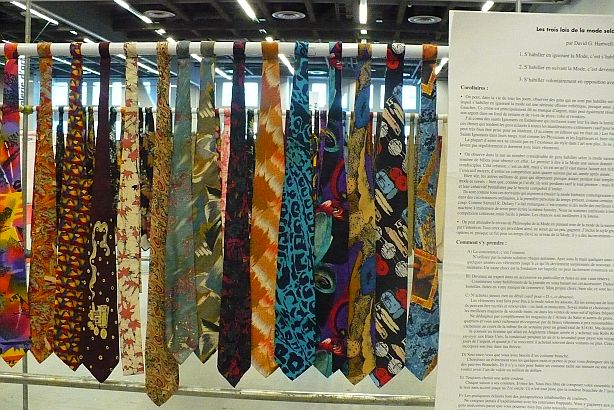
Can't stop thinking about David Hartwell. Most people (rightly) will be talking about his impact on SF, so here are a few links on another subject: his clothes.

Lee Whiteside's photo of David showing his ties at a SF convention (below, with another of his photos further down):

 
David as Fashion Theorist: his three laws, with corollaries (scroll down a bit).

Mary Robinette Kowal on some of the thinking behind his outfits.

And more ties.

And still more ties.

And yet more:


Seeing all this made me quite nostalgic for David all over again. Which is the point, I guess.

Tuesday, September 22, 2015

Quote of the Day: Erev Yom Kippur, 5776

She wept and wept, and the gods drank up her tears, as they have always drunk up our tears, yours and mine and everyone’s, and by their sweetness were sustained for another day.

—John Crowley, Daemonomania (2000)

To those observing Yom Kippur, g'mar chatimah tova.

Friday, January 30, 2015

Quote of the Day

These days, if you have something to say and it won't fit in a single tweet (or a tweetstorm), you have so many more compelling options than blogging. You can post on Facebook if it's just for friends, or Tumblr if it's image-based, or on Medium if you want a think piece shared more widely, or LinkedIn, or any one of a hundred other sites and services that are thirsty for content.

About the last thing you'd do is willingly maintain your own site, especially not in an age where your readers are as likely to be on phones or tablets as desktop browsers. Who still does that kind of one-man operation?

— Chris Taylor

Readers, should any still wander by, will not have failed to notice that this blog has been silent a good long while.  Save for quotes and salutations, the last time I put up any actual content was (quickly checks)... July. Six months ago.

I'm not saying that I, like my polar opposite in the blogging world (as far as, say, "having readers" or "actually putting up content" goes) am quitting, or have already quit.  I am saying that these days when I have something brief to say, I tend to post it on Facebook, where I know at least some people will read it; and when I have something to link to, I tend to link to it on Twitter, where there is a better chance that someone might see it.  And that when I sit down to write long pieces these days (not as often as I'd like, but for reasons of time & energy rather than anything else) I tend to imagine them going places other than here.

Where does this leave me?  I don't know.  Maybe I (like so many quitting bloggers — including Andrew Sullivan! — in the past) will recant quickly.  Maybe this is the last post this blog will receive.  Who knows.  All I'm saying is: when I write these days, it tends to be elsewhere; and when I imagine writing more, as I hope and plan to do, it tends to be imagined towards elsewhere.

I'm not quitting; but I'm not not quitting either.  I am staying silent for now, without any specific promises, one way or the other, about the future.

The most I can promise is that, if this blog resumes regular posting, I will announce that fact on those other mediums.  And that I have every intention of writing attempts in times to come, wherever those end up.

Til later, then, whether or not "later" is also "elsewhere".

Sunday, December 21, 2014

Now We Are Six

Happy Birthday to my beloved son, Joseph Saperstein Frug, who is six today.


When I was One,
I had just begun.

When I was Two,
I was nearly new.

When I was Three,
I was hardly Me.

When I was Four,
I was not much more.

When I was Five,
I was just alive.

But now I am Six, I'm as clever as clever,
So I think I'll be six now for ever and ever.

— A. A. Milne

Disclaimer: the picture above is actually from Thanksgiving, back when Joseph was still "just alive" and not yet "as clever as clever".

Sunday, November 23, 2014

US History 1973 - 2014 Commonplace Book: Lecture 32, America in 2014: Inequality (Con't)

Little piece of cornbread sitting on the shelf:
If you want any more, you can sing it yourself.

—Traditional children's song
Introduction to (and explanation of) this quote series can be found here.  Read this tag to see all of them.

Saturday, November 22, 2014

US History 1973 - 2014 Commonplace Book: Lecture 32, America in 2014: Inequality (Con't)

Let me give you a word of the philosophy of reform. The whole history of the progress of human liberty shows that all concessions yet made to her august claims, have been born of earnest struggle.... If there is no struggle there is no progress. Those who profess to favor freedom and yet depreciate agitation, are men who want crops without plowing up the ground, they want rain without thunder and lightening. They want the ocean without the awful roar of its many waters. This struggle may be a moral one, or it may be a physical one, and it may be both moral and physical, but it must be a struggle. Power concedes nothing without a demand. It never did and it never will.

— Frederick Douglass, 1857
Introduction to (and explanation of) this quote series can be found here.  Read this tag to see all of them.

Friday, November 21, 2014

US History 1973 - 2014 Commonplace Book: Lecture 32, America in 2014: Inequality (Con't)

In the United States, our findings indicate, the majority does not rule -- at least not in the causal sense of actually determining policy outcomes. When a majority of citizens disagrees with economic elites and/or with organized interests, they generally lose. Moreover, because of the strong status quo bias built into the U.S. political system, even when fairly large majorities of Americans favor policy change, they generally do not get it.... [O]ur analyses suggest that majorities of the American public actually have little influence over the policies our government adopts. Americans do enjoy many features central to democratic governance, such as regular elections, freedom of speech and association, and a widespread (if still contested) franchise. But we believe that if policymaking is dominated by powerful business organizations and a small number of affluent Americans, then America’s claims to being a democratic society are seriously threatened.

— Martin Gillens & Benjamin I. Page, "Testing Theories of American Politics: Elites, Interest Groups, and Average Citizens" (forthcoming, Fall, 2014)
Introduction to (and explanation of) this quote series can be found here.  Read this tag to see all of them.

Thursday, November 20, 2014

US History 1973 - 2014 Commonplace Book: Lecture 32, America in 2014: Inequality (Con't)

Since coming back to the United States after three years away in China, I have been asking experts around the country whether America is finally going to hell.... [T]he question wasn’t simply a joke.... I spoke with historians and politicians, soldiers and ministers, civil engineers and broadcast executives and high-tech researchers. Overall, the news they gave was heartening—and alarming, too. Most of the things that worry Americans aren’t really that serious, especially those that involve “falling behind” anyone else. But there is a deeper problem almost too alarming to worry about, since it is so hard to see a solution.... We could correct all these problems—and that is the heart of the problem. America still has the means to address nearly any of its structural weaknesses.... We know that such an investment could happen here—but we also know that it won’t. That is the American tragedy of the early 21st century: a vital and self-renewing culture that attracts the world’s talent, and a governing system that increasingly looks like a joke.... America the society is in fine shape! America the polity most certainly is not.... Our government is old and broken and dysfunctional, and may even be beyond repair.

—James Fallows (2010)
Introduction to (and explanation of) this quote series can be found here.  Read this tag to see all of them.

Wednesday, November 19, 2014

US History 1973 - 2014 Commonplace Book: Lecture 32, America in 2014: Inequality (Con't)

The real fear today is that the world we now live in was intended by those who profit from it.

—John Clute
Introduction to (and explanation of) this quote series can be found here.  Read this tag to see all of them.

Tuesday, November 18, 2014

US History 1973 - 2014 Commonplace Book: Lecture 32, America in 2014: Inequality (Con't)

...And the truth cannot be hid;
Somebody chose their pain,
What needn't have happened did.

—W. H. Auden
Introduction to (and explanation of) this quote series can be found here.  Read this tag to see all of them.

Monday, November 17, 2014

US History 1973 - 2014 Commonplace Book: Lecture 32, America in 2014: Inequality (Con't)

Inequality kills. Between 1990 and 2008, life expectancy for White American men without a college degree fell by three years, and White low-educated women had their lives shortened by more than five years. Only AIDS in southern Africa and the restoration of capitalism in Russia have had a more lethal impact than the US social polarization in the boom years of Clinton and Bush.

— Göran Therborn, The Killing Fields of Inequality
Introduction to (and explanation of) this quote series can be found here.  Read this tag to see all of them.

Sunday, November 16, 2014

US History 1973 - 2014 Commonplace Book: Lecture 32, America in 2014: Inequality (Con't)

The inescapable reality is this: wealth is so concentrated that a large segment of society is virtually unaware of its existence, so that some people imagine that it belongs to surreal or mysterious entities.

—Thomas Piketty, Capital in the Twenty-First Century
Introduction to (and explanation of) this quote series can be found here.  Read this tag to see all of them.

Saturday, November 15, 2014

US History 1973 - 2014 Commonplace Book: Lecture 32, America in 2014: Inequality (Con't)

But we know that people’s frustrations run deeper than these most recent political battles.... They experience in a very personal way the relentless, decades-long trend that I want to spend some time talking about today. And that is a dangerous and growing inequality and lack of upward mobility that has jeopardized middle-class America’s basic bargain -- that if you work hard, you have a chance to get ahead. I believe this is the defining challenge of our time... [T]he basic bargain at the heart of our economy has frayed. In fact, this trend towards growing inequality is not unique to America’s market economy... But this increasing inequality is most pronounced in our country, and it challenges the very essence of who we are as a people.... The combined trends of increased inequality and decreasing mobility pose a fundamental threat to the American Dream, our way of life, and what we stand for around the globe.

—Barack Obama, December, 2013
Introduction to (and explanation of) this quote series can be found here.  Read this tag to see all of them.

Friday, November 14, 2014

US History 1973 - 2014 Commonplace Book: Lecture 32, America in 2014: Inequality (Con't)

It's called the American Dream because you have to be asleep to believe it.

—George Carlin, Life is Worth Loosing (2005)
Introduction to (and explanation of) this quote series can be found here.  Read this tag to see all of them.

Thursday, November 13, 2014

US History 1973 - 2014 Commonplace Book: Lecture 32, America in 2014: Inequality (Con't)

We are the 99%.

—Slogan of Occupy Wall Street
Introduction to (and explanation of) this quote series can be found here.  Read this tag to see all of them.

Wednesday, November 12, 2014

US History 1973 - 2014 Commonplace Book: Lecture 32, America in 2014: Inequality

Good historians, I suspect, whether they think about it or not, have the future in their bones. Besides the question: Why? the historian also asks the question: Whither?

— E. H. Carr
Introduction to (and explanation of) this quote series can be found here.  Read this tag to see all of them.

Tuesday, November 11, 2014

US History 1973 - 2014 Commonplace Book: Lecture 31, Occupy Wall Street & Other Politics of the Obama Years (Con't)

NYC authorities clearly feel #OWS eviction is just and reasonable. That's why they are doing it at 2am and barring all press.

—George Zornick
Introduction to (and explanation of) this quote series can be found here.  Read this tag to see all of them.

Monday, November 10, 2014

US History 1973 - 2014 Commonplace Book: Lecture 31, Occupy Wall Street & Other Politics of the Obama Years (Con't)

To all those across the world currently occupying parks, squares and other spaces, your comrades in Cairo are watching you in solidarity... [W]e are now in many ways involved in the same struggle.... An entire generation across the globe has grown up realising, rationally and emotionally, that we have no future in the current order of things. Living under structural adjustment policies and the supposed expertise of international organisations like the World Bank and IMF, we watched as our resources, industries and public services were sold off and dismantled as the "free market" pushed an addiction to foreign goods, to foreign food even.... The current crisis in America and western Europe has begun to bring this reality home to you as well: that as things stand we will all work ourselves raw, our backs broken by personal debt and public austerity.... Spaces for gathering, leisure, meeting and interacting – these spaces should be the reason we live in cities. Where the state and the interests of owners have made them inaccessible, exclusive or dangerous, it is up to us to make sure that they are safe, inclusive and just....We are all watching one another now, and from Cairo we want to say that we are in solidarity with you, and we love you all for what you are doing.

—Message from Tahir Square occupiers to Occupy Wall Street & other occupations, October 25, 2011
Introduction to (and explanation of) this quote series can be found here.  Read this tag to see all of them.

Sunday, November 09, 2014

US History 1973 - 2014 Commonplace Book: Lecture 31, Occupy Wall Street & Other Politics of the Obama Years (Con't)

Declaration of the Occupation of New York City

This document was accepted by the NYC General Assembly on September 29, 2011

As we gather together in solidarity to express a feeling of mass injustice, we must not lose sight of what brought us together. We write so that all people who feel wronged by the corporate forces of the world can know that we are your allies.

As one people, united, we acknowledge the reality: that the future of the human race requires the cooperation of its members; that our system must protect our rights, and upon corruption of that system, it is up to the individuals to protect their own rights, and those of their neighbors; that a democratic government derives its just power from the people, but corporations do not seek consent to extract wealth from the people and the Earth; and that no true democracy is attainable when the process is determined by economic power. We come to you at a time when corporations, which place profit over people, self-interest over justice, and oppression over equality, run our governments. We have peaceably assembled here, as is our right, to let these facts be known.
  • They have taken our houses through an illegal foreclosure process, despite not having the original mortgage.
  • They have taken bailouts from taxpayers with impunity, and continue to give Executives exorbitant bonuses.
  • They have perpetuated inequality and discrimination in the workplace based on age, the color of one’s skin, sex, gender identity and sexual orientation.
  • They have poisoned the food supply through negligence, and undermined the farming system through monopolization.
  • They have profited off of the torture, confinement, and cruel treatment of countless animals, and actively hide these practices.
  • They have continuously sought to strip employees of the right to negotiate for better pay and safer working conditions.
  • They have held students hostage with tens of thousands of dollars of debt on education, which is itself a human right.
  • They have consistently outsourced labor and used that outsourcing as leverage to cut workers’ healthcare and pay.
  • They have influenced the courts to achieve the same rights as people, with none of the culpability or responsibility.
  • They have spent millions of dollars on legal teams that look for ways to get them out of contracts in regards to health insurance.
  • They have sold our privacy as a commodity.
  • They have used the military and police force to prevent freedom of the press.
  • They have deliberately declined to recall faulty products endangering lives in pursuit of profit.
  • They determine economic policy, despite the catastrophic failures their policies have produced and continue to produce.
  • They have donated large sums of money to politicians, who are responsible for regulating them.
  • They continue to block alternate forms of energy to keep us dependent on oil.
  • They continue to block generic forms of medicine that could save people’s lives or provide relief in order to protect investments that have already turned a substantial profit.
  • They have purposely covered up oil spills, accidents, faulty bookkeeping, and inactive ingredients in pursuit of profit.
  • They purposefully keep people misinformed and fearful through their control of the media.
  • They have accepted private contracts to murder prisoners even when presented with serious doubts about their guilt.
  • They have perpetuated colonialism at home and abroad.
  • They have participated in the torture and murder of innocent civilians overseas.
  • They continue to create weapons of mass destruction in order to receive government contracts.*
To the people of the world,

We, the New York City General Assembly occupying Wall Street in Liberty Square, urge you to assert your power.

Exercise your right to peaceably assemble; occupy public space; create a process to address the problems we face, and generate solutions accessible to everyone.

To all communities that take action and form groups in the spirit of direct democracy, we offer support, documentation, and all of the resources at our disposal.

Join us and make your voices heard!

* These grievances are not all-inclusive. [footnote in the original]
Introduction to (and explanation of) this quote series can be found here.  Read this tag to see all of them.

Saturday, November 08, 2014

US History 1973 - 2014 Commonplace Book: Lecture 31, Occupy Wall Street & Other Politics of the Obama Years (Con't)

Who are the men who really run this land?
And why do they run it with such a thoughtless hand?

—David Crosby, "What Are Their Names" (1971), sung in Zuccotti Park, 2011
Introduction to (and explanation of) this quote series can be found here.  Read this tag to see all of them.

Friday, November 07, 2014

US History 1973 - 2014 Commonplace Book: Lecture 31, Occupy Wall Street & Other Politics of the Obama Years (Con't)

All of a sudden it was cool to be a lefty again.

— Kalle Lasn
Introduction to (and explanation of) this quote series can be found here.  Read this tag to see all of them.

Thursday, November 06, 2014

US History 1973 - 2014 Commonplace Book: Lecture 31, Occupy Wall Street & Other Politics of the Obama Years (Con't)

Shit is fucked up and bullshit.

—Protest sign at Occupy Wall Street (Zuccotti Park), Fall, 2011 (repeated since)
Introduction to (and explanation of) this quote series can be found here.  Read this tag to see all of them.

Wednesday, November 05, 2014

US History 1973 - 2014 Commonplace Book: Lecture 31, Occupy Wall Street & Other Politics of the Obama Years (Con't)

A worldwide shift in revolutionary tactics is underway right now that bodes well for the future. The spirit of this fresh tactic, a fusion of Tahrir with the acampadas of Spain, is captured in this quote:
"The antiglobalization movement was the first step on the road. Back then our model was to attack the system like a pack of wolves. There was an alpha male, a wolf who led the pack, and those who followed behind. Now the model has evolved. Today we are one big swarm of people." - Raimundo Viejo, Pompeu Fabra University, Barcelona, Spain
The beauty of this new formula, and what makes this novel tactic exciting, is its pragmatic simplicity: we talk to each other in various physical gatherings and virtual people's assemblies... The time has come to deploy this emerging stratagem against the greatest corrupter of our democracy: Wall Street, the financial Gomorrah of America. On September 17, we want to see 20,000 people flood into lower Manhattan, set up tents, kitchens, peaceful barricades and occupy Wall Street for a few months. Once there, we shall incessantly repeat one simple demand in a plurality of voices.... It's time for DEMOCRACY NOT CORPORATOCRACY, we're doomed without it.

—Blog post on Adbusters blog, " #OCCUPYWALLSTREET: A shift in revolutionary tactics", July 13, 2011
Introduction to (and explanation of) this quote series can be found here.  Read this tag to see all of them.

Tuesday, November 04, 2014

US History 1973 - 2014 Commonplace Book: Lecture 31, Occupy Wall Street & Other Politics of the Obama Years (Con't)

Republicans were threatening to cause the US government to default in order to force massive cuts in social services intended to head off a largely imaginary debt crisis…President Obama, in turn, had decided the way to appear reasonable in comparison and thus seem as his advisors liked to put it ‘the only adult in the room’ was not to point out that the entire debate was founded on false economic premises, but to prepare a milder, ‘compromise’ version of the exact same program—as if the best way to expose a lunatic is to pretend that 50 percent of his delusions are actually true…. This is how a ragtag group of anarchists, hippies, unemployed college students, pagan tree sitters, and peace activists suddenly managed to establish themselves, by default, as America’s adults in the first place.

—David Graeber, The Democracy Project (2013)
Introduction to (and explanation of) this quote series can be found here.  Read this tag to see all of them.

Monday, November 03, 2014

US History 1973 - 2014 Commonplace Book: Lecture 31, Occupy Wall Street & Other Politics of the Obama Years

JUMP! you fuckers

—Sign on Wall Street, 2008
Introduction to (and explanation of) this quote series can be found here.  Read this tag to see all of them.

Sunday, November 02, 2014

US History 1973 - 2014 Commonplace Book: Lecture 30, The Dark Side: Torture, Detention, Surveillance, Drones & Secrecy in the Bush/Obama Era (Con't)

CARVER: Girl, you can't even call this shit a war.
HERC: Why not?
CARVER: Wars end.

—The Wire, Season 1, Episode 1
Introduction to (and explanation of) this quote series can be found here.  Read this tag to see all of them.

Saturday, November 01, 2014

US History 1973 - 2014 Commonplace Book: Lecture 30, The Dark Side: Torture, Detention, Surveillance, Drones & Secrecy in the Bush/Obama Era (Con't)

War is the health of the State. It automatically sets in motion throughout society those irresistible forces for uniformity, for passionate cooperation with the Government in coercing into obedience the minority groups and individuals which lack the larger herd sense. The machinery of government sets and enforces the drastic penalties; the minorities are either intimidated into silence, or brought slowly around by a subtle process of persuasion which may seem to them really to be converting them. Of course, the ideal of perfect loyalty, perfect uniformity is never really attained. The classes upon whom the amateur work of coercion falls are unwearied in their zeal, but often their agitation instead of converting, merely serves to stiffen their resistance. Minorities are rendered sullen, and some intellectual opinion bitter and satirical. But in general, the nation in wartime attains a uniformity of feeling, a hierarchy of values culminating at the undisputed apex of the State ideal, which could not possibly be produced through any other agency than war. Loyalty - or mystic devotion to the State - becomes the major imagined human value. Other values, such as artistic creation, knowledge, reason, beauty, the enhancement of life, are instantly and almost unanimously sacrificed, and the significant classes who have constituted themselves the amateur agents of the State are engaged not only in sacrificing these values for themselves but in coercing all other persons into sacrificing them.... [F]or the sake of a war of offensive self-defense, undertaken to support a difficult cause to the slogan of "democracy," [the American nation] would reach the highest level ever known of collective effort.... The question whether the American nation would act like an enlightened democracy going to war for the sake of high ideals, or like a State-obsessed herd, has been decisively answered.

— Randolph Bourne (1918)
Introduction to (and explanation of) this quote series can be found here.  Read this tag to see all of them.

Friday, October 31, 2014

US History 1973 - 2014 Commonplace Book: Lecture 30, The Dark Side: Torture, Detention, Surveillance, Drones & Secrecy in the Bush/Obama Era (Con't)

From thousands of classified documents, the National Security Agency emerges as an electronic omnivore of staggering capabilities, eavesdropping and hacking its way around the world to strip governments and other targets of their secrets, all the while enforcing the utmost secrecy about its own operations. It spies routinely on friends as well as foes, as has become obvious in recent weeks; the agency’s official mission list includes using its surveillance powers to achieve “diplomatic advantage” over such allies as France and Germany and “economic advantage” over Japan and Brazil, among other countries.... [T]he focus on counterterrorism is a misleadingly narrow sales pitch for an agency with an almost unlimited agenda. Its scale and aggressiveness are breathtaking.

—The New York Times, November 2, 2013
Introduction to (and explanation of) this quote series can be found here.  Read this tag to see all of them.

Thursday, October 30, 2014

US History 1973 - 2014 Commonplace Book: Lecture 30, The Dark Side: Torture, Detention, Surveillance, Drones & Secrecy in the Bush/Obama Era (Con't)

We’re not going after people – we’re going after their phones, in the hopes that the person on the other end of that missile is the bad guy.

—Anonymous former drone operator, quoted by Jeremy Scahill & Glenn Greenwald (2014)
Introduction to (and explanation of) this quote series can be found here.  Read this tag to see all of them.

Wednesday, October 29, 2014

US History 1973 - 2014 Commonplace Book: Lecture 30, The Dark Side: Torture, Detention, Surveillance, Drones & Secrecy in the Bush/Obama Era (Con't)

I went to the Stasi [East Germany's secret police] archive, and I obtained, through their equivalent of a Freedom of Information Act request, a few files, which I got translated. And I looked at them, and, you know, there were handwritten dozens of pages. But in totality, they were not really as robust as like an average Facebook profile, and certainly not anywhere near as revealing as my Google search results. And... they only had files on one-quarter of the population, which took them a lot of work to surveil those one-quarter. Now we’re in a situation where, clearly, the government and institutions have files on everybody.

—Julia Angwin, author of Dragnet Nation
Introduction to (and explanation of) this quote series can be found here.  Read this tag to see all of them.

Tuesday, October 28, 2014

US History 1973 - 2014 Commonplace Book: Lecture 30, The Dark Side: Torture, Detention, Surveillance, Drones & Secrecy in the Bush/Obama Era (Con't)

As members of the Senate Intelligence Committee we have been provided with the executive branch's classified interpretation of those provisions and can tell you that we believe there is a significant discrepancy between what most people - including many Members of Congress - think the Patriot Act allows the government to do and what government officials secretly believe the Patriot Act allows them to do.... [B]y far the most important interpretation of what the law means is the official interpretation used by the U.S. government and this interpretation is—stunningly—classified.

—Joint letter by Sen Ron Wyden (D-OR) and Sen Mark Udall (D-CO) (2011)
Introduction to (and explanation of) this quote series can be found here.  Read this tag to see all of them.

Monday, October 27, 2014

US History 1973 - 2014 Commonplace Book: Lecture 30, The Dark Side: Torture, Detention, Surveillance, Drones & Secrecy in the Bush/Obama Era (Con't)

I don’t think it’s even fair to call it Bush Lite. It’s Bush. It’s really, really hard to find a difference that’s meaningful and not atmospheric. You see a lot of straining on things trying to make things look repackaged, but they’re really not that different.

— James Jay Carafano, Heritage-foundation security expert

My claim was never that the Obama administration copied or merely tweaked all of the Bush administration policies, but rather... copied most of the Bush counterterrorism program as it stood in January 2009, expanded some of it, and narrowed a bit.... [There are] differences in the rhetorical and justificatory approaches between the two administrations... The continuity of the late Bush and early Obama eras is a qualitative judgment. And that qualitative judgment is informed by the baseline of expectations. President Obama in his 2008 campaign led everyone to believe that he would dramatically change the Bush counterterrorism policies. “Bush’s ‘War’ on Terror Comes to a Sudden End” was the headline in the Washington Post on January 23, 2009, capturing conventional wisdom at the dawn of the new administration. Indeed, people inside the administration believed this as well, and tried hard, especially in the first year, to bring dramatic change on such issues as state secrets, military detention, military commissions, closing GTMO, and more. But dramatic change did not come on these issues. It did not come not because the Obama officials were hypocrites. They were not. Rather, the continuity was driven by a number of factors described in chapter 2 of my book, including the responsibilities and inside information of the presidency, the persistence in outlook of the national security bureaucracy, the alterations to (and legitimation of) Bush administration policies by Congress and courts and related actors, and congressional pushback on Obama initiatives like closing GTMO and civilian trials. We cannot put a number on the extent to which Obama continued Bush – was it 95%?; 85%?; 75%? But very few would have predicted in January 2009 that four years later a secretive Obama administration would be trying the 9/11 conspirators in military commissions; detaining 160 or so people in military detention in GTMO; defending its legal right to do both, and to deny habeas corpus in Afghanistan, in federal court; asserting state secrets doctrine in court on its own authority; pursuing unprecedented prosecutions against government leakers; urging re-authorization (and in some senses expansion) of late Bush-era surveillance policies; and ramping up drone attacks a great deal in a much-expanded global covert war that invite charges of war crimes and related illegalities from U.N. and other international and foreign officials, and NGOs. These are some of the broad-based policy continuities – continuities embedded, importantly, in a presidential war approach to the problem of Islamist terrorism that many hoped Obama would end – that lead most people to think there was large continuity between the Obama and Bush administrations.

—Jack Goldsmith, head of the Office of Legal Council, 2003 - 2004 (2012)
Introduction to (and explanation of) this quote series can be found here.  Read this tag to see all of them.

Sunday, October 26, 2014

US History 1973 - 2014 Commonplace Book: Lecture 30, The Dark Side: Torture, Detention, Surveillance, Drones & Secrecy in the Bush/Obama Era (Con't)

To date we have arrested or otherwise dealt with many key commanders of Al Qaeda. All told, more than 3,000 suspected terrorists have been arrested in many countries. And many others have met a different fate. Let's put it this way: They are no longer a problem to the United States and our friends and allies.

—George W. Bush, State of the Union Address, 2003
Introduction to (and explanation of) this quote series can be found here.  Read this tag to see all of them.

Saturday, October 25, 2014

US History 1973 - 2014 Commonplace Book: Lecture 30, The Dark Side: Torture, Detention, Surveillance, Drones & Secrecy in the Bush/Obama Era

We also have to work, though, sort of the dark side, if you will. We've got to spend time in the shadows in the intelligence world. A lot of what needs to be done here will have to be done quietly, without any discussion, using sources and methods that are available to our intelligence agencies, if we're going to be successful. That's the world these folks operate in, and so it's going to be vital for us to use any means at our disposal, basically, to achieve our objective.

—Vice President Dick Cheney, September 16, 2001

Other orders went out for the care of prisoners of war. [George] Washington and his officers set a high standard in their treatment of Hessian captives at Trenton.... [Washington] often reminded his men that they were an army of liberty and freedom, and that the rights of humanity for which they were fighting should extend even to their enemies.

—David Hackett Fischer, Washington's Crossing
Introduction to (and explanation of) this quote series can be found here.  Read this tag to see all of them.

Friday, October 24, 2014

US History 1973 - 2014 Commonplace Book: Lecture 29, Obama and the Tea Party (Con't)

That a country that once took whiteness as the foundation of citizenship would elect a black president is a victory. But to view this victory as racism’s defeat is to forget the precise terms on which it was secured, and to ignore the quaking ground beneath Obama’s feet....

But one reason Obama rose so quickly was that African Americans are war-weary. It was not simply the country at large that was tired of the old Baby Boomer debates. Blacks, too, were sick of talking about affirmative action and school busing. There was a broad sense that integration had failed us, and a growing disenchantment with our appointed spokespeople. Obama’s primary triumphs in predominantly white states gave rise to rumors of a new peace, one many blacks were anxious to achieve.... Obama offered black America a convenient narrative that could be meshed with the larger American story....

...[S]ince taking office, Obama has virtually ignored race. Whatever the political intelligence of this calculus, it has broad and deep consequences. The most obvious result is that it prevents Obama from directly addressing America’s racial history, or saying anything meaningful about present issues tinged by race, such as mass incarceration or the drug war.... But the intellectual argument doubles as the counterargument. If the fact of a black president is enough to racialize the wonkish world of health-care reform, what havoc would the Obama touch wreak upon the already racialized world of drug policy?...

...Part of Obama’s genius is a remarkable ability to soothe race consciousness among whites. Any black person who’s worked in the professional world is well acquainted with this trick. But never has it been practiced at such a high level, and never have its limits been so obviously exposed. This need to talk in dulcet tones, to never be angry regardless of the offense, bespeaks a strange and compromised integration indeed, revealing a country so infantile that it can countenance white acceptance of blacks only when they meet an Al Roker standard.

And yet this is the uncertain foundation of Obama’s historic victory—a victory that I, and my community, hold in the highest esteem. Who would truly deny the possibility of a black presidency in all its power and symbolism? Who would rob that little black boy of the right to feel himself affirmed by touching the kinky black hair of his president?...

—Ta-Nehisi Coates, "The Fear of a Black President" (2012)
Introduction to (and explanation of) this quote series can be found here.  Read this tag to see all of them.

Thursday, October 23, 2014

US History 1973 - 2014 Commonplace Book: Lecture 29, Obama and the Tea Party (Con't)

No one thought we would have to take every element of the administration and dedicate it to health care both publicly and privately, which is what we ended up having to do.

—White house aide in Obama administration
Introduction to (and explanation of) this quote series can be found here.  Read this tag to see all of them.

Wednesday, October 22, 2014

US History 1973 - 2014 Commonplace Book: Lecture 29, Obama and the Tea Party (Con't)

[Rhetorically addressing southerners:] Your purpose, then, plainly stated, is that you will destroy the Government, unless you be allowed to construe and enforce the Constitution as you please, on all points in dispute between you and us. You will rule or ruin in all events.... The question recurs, what will satisfy them? Simply this: We must not only let them alone, but we must somehow, convince them that we do let them alone. This, we know by experience, is no easy task... [W]hat will convince them? This, and this only: cease to call slavery wrong, and join them in calling it right. And this must be done thoroughly - done in acts as well as in words. Silence will not be tolerated - we must place ourselves avowedly with them.

—Abraham Lincoln, "Cooper Union Speech", February, 1960
Introduction to (and explanation of) this quote series can be found here.  Read this tag to see all of them.

Tuesday, October 21, 2014

US History 1973 - 2014 Commonplace Book: Lecture 29, Obama and the Tea Party (Con't)


The table was a large one, but the three were all crowded together at one corner of it: `No room! No room!' they cried out when they saw Alice coming. `There's plenty of room!' said Alice indignantly, and she sat down in a large arm-chair at one end of the table.

`Have some wine,' the March Hare said in an encouraging tone.

Alice looked all round the table, but there was nothing on it but tea. `I don't see any wine,' she remarked.

`There isn't any,' said the March Hare.

`Then it wasn't very civil of you to offer it,' said Alice angrily.

`It wasn't very civil of you to sit down without being invited,' said the March Hare.

`I didn't know it was your table,' said Alice; `it's laid for a great many more than three.'

—Lewis Carroll, Alice's Adventures in Wonderland, "A Mad Tea-Party"

Alice felt dreadfully puzzled. The Hatter's remark seemed to have no sort of meaning in it, and yet it was certainly English.

—Ibid.
Introduction to (and explanation of) this quote series can be found here.  Read this tag to see all of them.

Monday, October 20, 2014

US History 1973 - 2014 Commonplace Book: Lecture 29, Obama and the Tea Party (Con't)

But the modern right wing, as Daniel Bell has put it, feels dispossessed: America has been largely taken away from them and their kind, though they are determined to try to repossess it and to prevent the final destructive act of subversion. The old American virtues have already been eaten away by cosmopolitans and intellectuals; the old competitive capitalism has been gradually undermined by socialistic and communistic schemers; the old national security and independence have been destroyed by treasonous plots, having as their most powerful agents not merely outsiders and foreigners as of old but major statesmen who are at the very centers of American power. Their predecessors had discovered conspiracies; the modern radical right finds conspiracy to be betrayal from on high.

—Richard Hofstadter, "The Paranoid Style in American Politics" (1964)
Introduction to (and explanation of) this quote series can be found here.  Read this tag to see all of them.

Sunday, October 19, 2014

US History 1973 - 2014 Commonplace Book: Lecture 29, Obama and the Tea Party (Con't)

This is America! How many of you people want to pay for your neighbor's mortgage that has an extra bathroom and can't pay their bills? Raise their hand. President Obama, are you listening?... You know, Cuba used to have mansions and a relatively decent economy. They moved from the individual to the collective. Now, they're driving '54 Chevys, maybe the last great car to come out of Detroit.... We're thinking of having a Chicago Tea Party in July. All you capitalists that want to show up to Lake Michigan, I'm gonna start organizing.

—CNBC Reporter Rick Santelli, February 19, 2009, from the floor of the Chicago Mercantile Exchange
Introduction to (and explanation of) this quote series can be found here.  Read this tag to see all of them.

Saturday, October 18, 2014

US History 1973 - 2014 Commonplace Book: Lecture 29, Obama and the Tea Party (Con't)

The single most important thing we want to achieve is for President Obama to be a one-term president.

—Senate Majority Leader Mitch McConnell, October 29, 2010
Introduction to (and explanation of) this quote series can be found here.  Read this tag to see all of them.

Friday, October 17, 2014

US History 1973 - 2014 Commonplace Book: Lecture 29, Obama and the Tea Party (Con't)

It is a measure of the Obama's administration's ineptitude in communication that the public came to see Geithner, Summers & Co. as tools of Wall Street while at the same time the bankers who were saved from oblivion came to hate the administration for vilifying and scapegoating them.

— Alan S. Blinder, After the Music Stopped
Introduction to (and explanation of) this quote series can be found here.  Read this tag to see all of them.

Thursday, October 16, 2014

US History 1973 - 2014 Commonplace Book: Lecture 29, Obama and the Tea Party (Con't)

If there is anyone out there who still doubts that America is a place where all things are possible, who still wonders if the dream of our founders is alive in our time, who still questions the power of our democracy, tonight is your answer.

It's the answer told by lines that stretched around schools and churches in numbers this nation has never seen, by people who waited three hours and four hours, many for the first time in their lives, because they believed that this time must be different, that their voices could be that difference.

It's the answer spoken by young and old, rich and poor, Democrat and Republican, black, white, Hispanic, Asian, Native American, gay, straight, disabled and not disabled. Americans who sent a message to the world that we have never been just a collection of individuals or a collection of red states and blue states. We are, and always will be, the United States of America.

It's the answer that led those who've been told for so long by so many to be cynical and fearful and doubtful about what we can achieve to put their hands on the arc of history and bend it once more toward the hope of a better day.

—Barack Obama, November 4, 2008
Introduction to (and explanation of) this quote series can be found here.  Read this tag to see all of them.

Wednesday, October 15, 2014

US History 1973 - 2014 Commonplace Book: Lecture 29, Obama and the Tea Party (Con't)

Black man given nation's worst job.

—Onion headline, November 5, 2008
Introduction to (and explanation of) this quote series can be found here.  Read this tag to see all of them.

Tuesday, October 14, 2014

US History 1973 - 2014 Commonplace Book: Lecture 29, Obama and the Tea Party (Con't)

Understanding this reality requires a reminder of how we arrived at this point. As William Faulkner once wrote, "The past isn't dead and buried. In fact, it isn't even past." We do not need to recite here the history of racial injustice in this country. But we do need to remind ourselves that so many of the disparities that exist in the African-American community today can be directly traced to inequalities passed on from an earlier generation that suffered under the brutal legacy of slavery and Jim Crow....

The fact that so many people are surprised to hear that anger in some of Reverend Wright's sermons simply reminds us of the old truism that the most segregated hour in American life occurs on Sunday morning. That anger is not always productive; indeed, all too often it distracts attention from solving real problems; it keeps us from squarely facing our own complicity in our condition, and prevents the African-American community from forging the alliances it needs to bring about real change. But the anger is real; it is powerful; and to simply wish it away, to condemn it without understanding its roots, only serves to widen the chasm of misunderstanding that exists between the races.

In fact, a similar anger exists within segments of the white community. Most working- and middle-class white Americans don't feel that they have been particularly privileged by their race. Their experience is the immigrant experience - as far as they're concerned, no one's handed them anything, they've built it from scratch. They've worked hard all their lives, many times only to see their jobs shipped overseas or their pension dumped after a lifetime of labor. They are anxious about their futures, and feel their dreams slipping away; in an era of stagnant wages and global competition, opportunity comes to be seen as a zero sum game, in which your dreams come at my expense. So when they are told to bus their children to a school across town; when they hear that an African American is getting an advantage in landing a good job or a spot in a good college because of an injustice that they themselves never committed; when they're told that their fears about crime in urban neighborhoods are somehow prejudiced, resentment builds over time.

Like the anger within the black community, these resentments aren't always expressed in polite company. But they have helped shape the political landscape for at least a generation. Anger over welfare and affirmative action helped forge the Reagan Coalition. Politicians routinely exploited fears of crime for their own electoral ends....

The profound mistake of Reverend Wright's sermons is not that he spoke about racism in our society. It's that he spoke as if our society was static; as if no progress has been made; as if this country - a country that has made it possible for one of his own members to run for the highest office in the land and build a coalition of white and black; Latino and Asian, rich and poor, young and old -- is still irrevocably bound to a tragic past. But what we know -- what we have seen - is that America can change. That is true genius of this nation. What we have already achieved gives us hope - the audacity to hope - for what we can and must achieve tomorrow.

—Barack Obama, March 18, 2008
Introduction to (and explanation of) this quote series can be found here.  Read this tag to see all of them.

Monday, October 13, 2014

US History 1973 - 2014 Commonplace Book: Lecture 29, Obama and the Tea Party

Now even as we speak, there are those who are preparing to divide us, the spin masters and negative ad peddlers who embrace the politics of anything goes. Well, I say to them tonight, there's not a liberal America and a conservative America; there's the United States of America. There's not a black America and white America and Latino America and Asian America; there's the United States of America. The pundits, the pundits like to slice and dice our country into red states and blue States: red states for Republicans, blue States for Democrats. But I've got news for them, too. We worship an awesome God in the blue states, and we don't like federal agents poking around our libraries in the red states. We coach little league in the blue states and, yes, we've got some gay friends in the red states. There are patriots who opposed the war in Iraq, and there are patriots who supported the war in Iraq. We are one people, all of us pledging allegiance to the stars and stripes, all of us defending the United States of America.

—Then Illinois State Senator Barack Obama, Democratic Convention, Boston, 2004

[Obama] should take back, in every detail, the speech that made him famous in Boston in 2004, because subsequent events have rendered it either naive or the most grotesque of fantasies.

—Charles P. Pierce, 2014
Introduction to (and explanation of) this quote series can be found here.  Read this tag to see all of them.

Sunday, October 12, 2014

US History 1973 - 2014 Commonplace Book: Lecture 28, The Crash of 2008 and the Great Recession (Con't)

...somewhere in sands of the desert
A shape with lion body and the head of a man,
A gaze blank and pitiless as the sun,
Is moving its slow thighs, while all about it
Reel shadows of the indignant desert birds.

—W. B. Yeats, "The Second Coming"
Introduction to (and explanation of) this quote series can be found here.  Read this tag to see all of them.

Saturday, October 11, 2014

US History 1973 - 2014 Commonplace Book: Lecture 28, The Crash of 2008 and the Great Recession (Con't)

Sadly, the forgetting has already begun. Unrepentant financiers, eager to return to the status quo ante, are whining about excessive regulation. Recalcitrant politicians are bemoaning big government and itching to return to laissez-faire. The public has turned its attention elsewhere.

— Alan S. Blinder, After the Music Stopped
Introduction to (and explanation of) this quote series can be found here.  Read this tag to see all of them.

Friday, October 10, 2014

US History 1973 - 2014 Commonplace Book: Lecture 28, The Crash of 2008 and the Great Recession (Con't)

WAXMAN: ...[T]his is your statement — “I do have an ideology. My judgment is that free, competitive markets are by far the unrivaled way to organize economies. We’ve tried regulation. None meaningfully worked.” That was your quote. You had the authority to prevent irresponsible lending practices that led to the subprime mortgage crisis. You were advised to do so by many others. And now our whole economy is paying its price. Do you feel that your ideology pushed you to make decisions that you wish you had not made?
GREENSPAN: ...Everyone has [an ideology].... The question is whether it is accurate or not. And what I’m saying to you is, yes, I found a flaw. I don’t know how significant or permanent it is, but I’ve been very distressed by that fact.... [A] flaw in the model that I perceived is the critical functioning structure that defines how the world works, so to speak.
WAXMAN: In other words, you found that your view of the world, your ideology, was not right, it was not working?
GREENSPAN: That is — precisely. No, that’s precisely the reason I was shocked, because I had been going for 40 years or more with very considerable evidence that it was working exceptionally well.

—Exchange between Representative Henry Waxman (D - CA) and former Fed Chairman Alan Greenspan, October 23, 2008
Introduction to (and explanation of) this quote series can be found here.  Read this tag to see all of them.

Thursday, October 09, 2014

US History 1973 - 2014 Commonplace Book: Lecture 28, The Crash of 2008 and the Great Recession (Con't)

I'm being called Mr. Bailout. I can't do it again.

— Henry Paulson, September 10 or 11, 2008

The national commitment to the free market lasted one day. It was Monday.

—Rep. Barney Frank (D-MA), Chairman of the House Financial Services Committee, Wednesday, September 17, 2008
Introduction to (and explanation of) this quote series can be found here.  Read this tag to see all of them.

Wednesday, October 08, 2014

US History 1973 - 2014 Commonplace Book: Lecture 28, The Crash of 2008 and the Great Recession

In the end, the more pessimistic you were, the more prescient you were.

— Alan S. Blinder, After the Music Stopped
Introduction to (and explanation of) this quote series can be found here.  Read this tag to see all of them.

Tuesday, October 07, 2014

US History 1973 - 2014 Commonplace Book: Lecture 27, Catastrophic Failure: Enron, Katrina & Politics in the mid-2000s (Con't)

In his testimony, Dr. [Richard] Carmona, [Bush's Surgeon General] said that at first he was so politically naïve that he had little idea how inappropriate the administration’s actions were. He eventually consulted six previous surgeons general, Republican and Democratic, and all agreed, he said, that he faced more political interference than they had. On issue after issue, Dr. Carmona said, the administration made decisions about important public health issues based solely on political considerations, not scientific ones. “I was told to stay away from those because we’ve already decided which way we want to go,” Dr. Carmona said. He described attending a meeting of top officials in which the subject of global warming was discussed. The officials concluded that global warming was a liberal cause and dismissed it, he said. “And I said to myself, ‘I realize why I’ve been invited. They want me to discuss the science because they obviously don’t understand the science,’ ” he said. “I was never invited back.”

—Gardner Harris, "Surgeon General Sees 4-Year Term as Compromised", The New York Times, July 7, 2007
Introduction to (and explanation of) this quote series can be found here.  Read this tag to see all of them.

Monday, October 06, 2014

US History 1973 - 2014 Commonplace Book: Lecture 27, Catastrophic Failure: Enron, Katrina & Politics in the mid-2000s (Con't)

Being poor is knowing exactly how much everything costs....
Being poor is hoping the toothache goes away.
Being poor is knowing your kid goes to friends’ houses but never has friends over to yours....
Being poor is coming back to the car with your children in the back seat, clutching that box of Raisin Bran you just bought and trying to think of a way to make the kids understand that the box has to last....
Being poor is hoping your kids don’t have a growth spurt....
Being poor is making lunch for your kid when a cockroach skitters over the bread, and you looking over to see if your kid saw.
Being poor is believing a GED actually makes a goddamned difference....
Being poor is not taking the job because you can’t find someone you trust to watch your kids....
Being poor is needing that 35-cent raise....
Being poor is six dollars short on the utility bill and no way to close the gap.
Being poor is crying when you drop the mac and cheese on the floor.
Being poor is knowing you work as hard as anyone, anywhere.
Being poor is people surprised to discover you’re not actually stupid.
Being poor is people surprised to discover you’re not actually lazy....
Being poor is people who have never been poor wondering why you choose to be so.
Being poor is knowing how hard it is to stop being poor.
Being poor is seeing how few options you have.
Being poor is running in place.
Being poor is people wondering why you didn’t leave.

—Excerpts from John Scalzi, "Being Poor", September 3, 2005
Introduction to (and explanation of) this quote series can be found here.  Read this tag to see all of them.

Sunday, October 05, 2014

US History 1973 - 2014 Commonplace Book: Lecture 27, Catastrophic Failure: Enron, Katrina & Politics in the mid-2000s (Con't)

TV pictures of starving, dying Americans made the US look like a third world country - or perhaps, arguably, disclosed the third world country that America secretly keeps in its closet.

—Peter Bradshaw
Introduction to (and explanation of) this quote series can be found here.  Read this tag to see all of them.