Friday, March 31, 2006

Friday Posting: Two Blogospheric Traditions

One of the things I like about the blogosphere is its nescient culture and traditions. I haven't done all that many specific blogosphere games (just one meme), but I do like them. And because of various circumstances I can participate, this week, in not one but two blog traditions that I don't usually do.

The first of these is the Friday Random Ten. The notion here is simple: get random songs from your iPod, note the first ten, and post them. I haven't been able to do this until now because I haven't had an iPod. But I was given one for my recent birthday; and after a few weeks most of my music (and some other fun stuff) is now on the iPod. I doubt I'll do it every week, but for now, here is a

FRIDAY RANDOM TEN

1) The Lord of the Rings, unabridged reading by Rob Inglis: the Fellowship of the Ring, Disk 3, Track 20
2) * Ditto, The Return of the King, Disk 11, Track 9 (beginning of chapter 7, "Homeward Bound")
3) Talking Heads, "I'm Not in Love"
4) George Harrison, "All Things Must Pass"
5) Annie (the musical), "It's the Hard Knock Life"
6) Tracy Chapman, "Mountains O' Things"
7) The Beatles, "I Saw Her Standing There" (live version, from the BBC)
8) ** The Hobbit, unabridged reading by Rob Inglis, Disk 6, track 11
9) Pimsleur Mandarin Set II, Unit 13 - Readings Track
10) Eric Clapton, "After Midnight"

* Yes, I have the entire thing on here. It comes up a lot on "random" because they put track dividers every three minutes, so there are a lot of tracks.
** Yes, I have The Hobbit too. Shut up.

This, incidentally, is why I never play my iPod on random -- I have a special playlist called "songs" which includes all but only songs, and if I want random I play that. But as I understand the rules of the Friday Random Ten, one sets random for everything one has on the iPod... which, for me, includes some non-music and leads to some weird choices. So it goes.

The other Friday blog tradition is pet blogging. This began with Kevin Drum's cat blogging, but has since expanded to a lot of different types of Friday blogging (plus parallels on other days too). Well, we don't have any pets... but we do occasionally pet-sit a pair of unrepentant felons known as Weber and Fields. They're with us this week, so here we have

FRIDAY BIRD BLOGGING


Ruler of the Roost


Everything is Tasty


Squabbling (not kissing, despite how it looks)

Happy Friday!

Monday, March 27, 2006

Stanislaw Lem, 1921 - 2006

Via Boing-Boing, I see that Stanislaw Lem, the great Polish SF writer, has died. Reuters has an obit here. To mark his passing, I'm reposting an edited version of this earlier post which included a snippet of one of his works.

Rest in peace.

****

This is a long-time favorite of mine. It's from Stanislaw Lem's novel The Cyberiad, translated by Michael Kandel (pp. 50 - 51 of the Harcourt Brace paperback). In it, the robot inventor Klapaucius comes up with an assignment for his competitor Turl's new electronic bard...

The Assignment:

"Have it compose a poem -- a poem about a haircut! But lofty, noble, tragic, timeless, full of love, treachery, retribution, quiet heroism in the face of certain doom! Six lines, cleverly rhymed, and every word beginning with the letter s!"

The Solution:

Seduced, shaggy Samson snored.
She scissored short. Sorely shorn,
Soon shackled slave, Samson sighed,
Silently scheming,
Sightlessly seeking
Some savage, spectacular suicide.

Well, what do you say to that?

It's a marvelous poem, I think -- in itself, and particularly given the stipulations. But of course it is also an astonishing piece of translation: it is hard to believe it wasn't written in English. (Douglas Hofstadter talks about this aspect of Kandel's translations, though not that I recall in relation to this particular poem, in his delightful book about translation, Le Ton beau de Marot.) So the question becomes: what's the Polish look like? Fortunately, the Polish version of Lem's Cyberiada is online -- it appears in its entirety. At any rate, it gives us:

The Assignment in Polish:

Niech ułoży wiersz o cyberotyce! - rzekł nagle, rozjaśniony. - Żeby tam było najwyżej sześć linijek, a w nich o miłości i o zdradzie, o muzyce, o Murzynach, o wyższych sferach, o nieszczęściu, o kazirodztwie, do rymu i żeby wszystkie słowa były tylko na literę C!!

The Solution in Polish:

Cyprian cyberotoman, cynik, ceniąc czule
Czarnej córy cesarskiej cud ciemnego ciała,
Ciągle cytrą czarował. Czerwieniała cała,
Cicha, co dzień czekała, cierpiała, czuwała...
...Cyprian ciotkę całuje, cisnąwszy czarnulę!!

As for how literal a translation this is, it turns out that Michael Kandel himself has answered this question. Greg Keogh at the Nancy Street Network has a Stanislaw Lem page on which he describes emailing this question to Kandel. Kandel provided the following literal gloss on the Polish:

Cyprian the cyber sex fiend and a cynic, appreciating tenderly the miracle of the dark body of the Negro daughter of Caesar, constantly wove charms with a zither. She blushed all over, silent, waiting every day, suffering, watching ... Cyprian kisses her aunt, have abandoned the black beauty!

(Of course the paradigms given the machine are quite different.)
Unfortunately, Kandel didn't give a literal gloss on the Polish paradigms (the "assignment" as I've called it). But this gives a sense of what the original is like -- and hence what Kandel was up against.

I still think "Seduced, shaggy Sampson snored..." is a terrific little poem. The question is: given that it isn't really a translation of Lem's poem (but rather an English equivalent of it), but one that occurs in a translation of Lem's novel and wasn't offered for independent publication -- who should be credited as the author of the poem? Lem? Kandel? Lem as translated by Kandel? Both in collaboration?

This is, however, an extreme case: the book as a whole is, quite clearly, a translation. And it's brilliant. For a taste of it in English, check out the opening of The Cyberiad, "How the World Was Saved", which is available (in English) on Lem's web site.

Sunday, March 26, 2006

2005 Koufax Awards Ballot

Here are my votes for the 2005 Koufax awards. Some choices were very narrowly decided -- there's a lot of great liberal writing out there. In some categories I wish I had more time to study the various choices in more detail. But in the end I decided to vote based on what I knew and thought at the moment (rather than deciding I was so overwhelmed by good and/or new choices that I wouldn't vote at all). So, without further ado --

Best Blog (non-pro): Hullabaloo
Best Blog Community: Daily Kos
Best Blog (pro/sponsor): Think Progress
Best Group Blog: Pandagon
Best Post: Unclaimed Territory by Glenn Greenwald: Bush's Unchecked Executive Power v. the Founding Principles of the U.S.
Best Series: Scott Lemieux of Lawyers, Guns, and Money for his Supreme Court coverage
Best Writing: Michael Berube Online
Best Expert Blog: Pharyngula
Best Single Issue: Informed Comment
Most Humorous Blog: Fafblog
Most Humorous Post: Kung Fu Monkey: Lunch Discussions #145: The Crazification Factor
More Deserving of Wider Recognition: 3 Quarks Daily
Best New Blog: Unclaimed Territory by Glenn Greenwald

[I cast no vote in the following categories:
Best State or Local Blog
Best Blog Commenter]

If you want to check out the competition, here are the pages with the links to all the finalists: Best Blog (non-pro); Best Blog Community; Best Blog (pro/sponsor); Best Group Blog; Best Post; Best Series; Best Writing; Best Expert Blog; Best Single Issue Blog; Most Humorous Blog; Most Humorous Post; Most Deserving of Wider Recognition; Best New Blog.

Incidentally, so far as I can tell this post by John Scalzi -- Being poor is knowing exactly how much everything costs -- was not ever nominated for best post. Now, I don't vote in rounds before the finals round, because I'm intimidated by how much I don't know. But I think it's a terrible, terrible oversight that Scalzi's post wasn't even nominated; had it ever occurred to me that it wouldn't be I would have done so. If it were on the final ballot, I would vote for it over any of the other contenders for best post this year (good as those are). So consider it my vote for "work most overlooked by the Koufax nominators" and my (uncounted) write-in vote for best post. In the meantime, if you haven't read it. do so. Don't skip the comments, which add a lot.

And the winners are...

Sunday, March 19, 2006

There Are No Excuses

...for those who got the war wrong. Three years into the greatest foreign policy disaster since Vietnam -- quite possibly one that will in the end prove far greater than that unhappy conflict -- none of the disastrous things that have happened were beyond the range of what was widely and loudly foreseen by anti-war voices at the time. I'll say it again: it was widely and loudly foreseen at the time. There are no excuses for getting this one wrong. You can't say you didn't know. This was not something that was tricky at the time or about which you can say, "if only we knew...". Because either you knew, or you damn well should have known, because most of the world was saying it as loudly as they could manage.

It was all perfectly clear.

No, it was not widely known that Saddam had no WMD at all. (But it was widely known that inspectors were on the ground in Iraq and finding nothing; it was widely known that there was no possible threat that could have justified removing them from the country and invading before letting them finish their task.) But WMD was always a category error -- worse, a deliberate category error, a portmanteau designed to rope together genuinely dangerous weapons that we had no reason to think Saddam had (nuclear weapons, biological weapons such as smallpox) with weapons that all sides believed that Saddam possessed -- weapons that, however horrific in their uses, were not a particular threat to the US (chemical weapons). No, we didn't know that Saddam didn't even have chemical weapons. But we knew he didn't have nuclear weapons and that he wasn't on the verge of getting them; we knew, in short, that he wasn't a threat.

And all the rest was simply and widely known, widely spoken at the time. The disastrous ineptitude of the Bush administration and its almost pathological tendency to lie and distort were both well known. The folly of trying to build a liberal democracy at "bayonet point" (to use the phrase that, of all people, Ronald Reagan used to dismiss the notion) was widely known. The caldron of ethnic and religious tensions that would boil over if we invaded was well known too. We knew all this.

And please, don't say: do you wish that Saddam Hussein were still in power? Of course I don't: no more than pro-war proponents really wanted Casey Sheehan and more than 2,300 other coalition troops -- to say nothing of an unknown and uncounted number of Iraqis (a number which, however, is likely to be well over 100,000 people) -- dead. The point is that removing him in this way was a foreseeable and foreseen disaster.

So no: there are no excuses. This is true of course of Bush, the supreme architect of this disaster (who was already talking about having a war for the political benefit before assuming the Presidency: a point which should not be forgotten). It is true of all the many other members of this administration behind the war -- all of whom, in a just world, would stand in the dock at the Hauge for the crime of aggressive war, the supreme crime of which the Nazi leadership were indicted by the U.S. and other at Nuremburg. (Not to mention the horrific crimes committed in the course of the war, which has turned the U.S. into a nation which tortures prisoners (most recent revelations on this matter in today's New York Times.))

But it is true of everyone else too. It is true of the cowardly Democrats who voted for this war (I'm looking at you, Senator Clinton, and you, Senator Kerry). It is true of the editorialists who endorsed it, of the warbloggers who pushed for it. Without the abetting of all of these groups the war would have been, at the least, much harder for Bush to pull off -- if not impossible.

I don't know what we should do now, since given the current disaster there are probably only various different bad options. I strongly suspect that the best course would be a U.S. withdrawal in a speedy a manner as would be consistent with troop safety. I might well be wrong about that. But how to proceed now that this disaster is upon us is not obvious.

Unlike the fact that the war would be a disaster, for all the reasons that almost everyone now acknowledges. That was obvious, three years ago. And for all those who abetted this disaster, there are no excuses. None at all.

Thursday, March 16, 2006

Brief Continuity Update

A couple weeks ago I posted a comics script released under a creative commons license, linking to it both here on my blog and on its own site. The script had taken me perhaps a month to write, on and off. It was for a 24 page comic, intended as a one-shot (i.e. not the beginning of an ongoing comic series), and I called it Continuity #1.

Well, I just found out last night that there is a graphic novel -- an actual, really-drawn-and-not-just-a-script and really-being-published-by-an-honest-to-God-publisher (AiT/Planet Lar) graphic novel -- coming out in June called, yes, Continuity. Not being a regular reader of Previews I hadn't known this. Now, I don't think that a big-time graphic novel like Continuity is going to be threatened by an embryonic little project like my script. And, frankly, it's not the most astonishing title for a comic ever devised ("continuity" being a big topic with comics fans). Still, if I'd known that there was a published book coming out with the title, I'd have chosen a different name for my script. But I didn't know, the script is out there, and I don't plan on changing it now. I doubt anyone will care, frankly. But I thought I should note the coincidence.

If you want to check out the upcoming graphic novel Continuity, the first 25 pages are being offered as a preview (in pdf format); you can find the preview here (direct link). If you want to read my script, you can find it here (direct link).

Sunday, March 12, 2006

Friday Five and Sunday Ten: Good Comics Covers

Tom Spurgeon has an excellent comics news blog called The Comics Reporter. One of the fun features that he does is one called "Five for Friday": he'll come up with a comics-related question to be answered with a list of five -- questions like "List Five of Your Favorite Comics Quotes (Without Attribution)", "Name Five Comics You've Found Non-Comics Readers Feel Are Easy to Read" or "Name Five People You Would Draft Into Making Comics -- No Cartoonists Who Have Worked as Such Since 1985" -- answer it himself, and then post responses from other people which he receives in the day or two after. It's a fun High Fidelity-type game in the comics field, although his comparatively strict deadlines, and my haphazard schedule, means I've only participated once myself.

Well, this week's version (which I, as usual, only saw post-deadline) was the superb question "Name Five Covers You Love". But I wasn't all that crazy about the nominees people put up -- although, truth be told, I only looked at those whose nominators provided links, plus Tom's own list even though he didn't -- because he's the host, y'know. (Although yes, I am enough of a geek that I did know some of the listed covers without links. Shut up.) Incidentally, since I looked up Tom's choices, here, as a public service, are his choices, with links:

1. Amazing Spider-Man #55
2. Weirdo #8
3. Kamandi #23
4. Yummy Fur #18
5. MAD #5
Don't get me wrong -- some of the various choices (both Tom's and other people's) were fine covers. But they weren't what I would have listed. So I decided to put together my own list -- I mean, what's a blog for?

But it's Sunday, it's my blog, and I felt like it... so this is ten, not five. (Actually, I found this incredibly easy. I could have gone to fifty. I love comics covers. Oh, sure, many are atrocious... but that's just Sturgeon's law.)

This isn't, incidentally, my "Top Ten Comics Covers Of All Time". It's just "Ten Covers I Love". I love others, too. On a different day I'd make a different list. But these are all great. In each case, I've given a thumbnail linked to a larger version; in many cases, you really have to click through to get what's good about the cover.


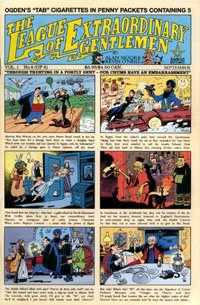
Alan Moore's final cover for the first League of Extraordinary Gentlemen Series retold the entire story so far -- in rhyme -- while also being thematically consistent with the series. It's fabulous.


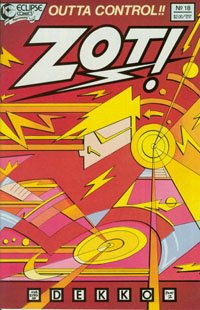
As Scott McCloud later said in Understanding Comics, so much of superhero costumes worked by making a few simple, bright colors iconic. This combines that idea with an awesome abstraction.


This one's just pretty. It's the cover for the second issue of Jessica Abel's La Perdida; I just got the collected version yesterday (yes, I "waited for the trade" -- or in this case the hardback -- and so missed out on this gorgeous cover. Ah well.)


Another cover that tells the story to date -- in this case, by quite literally putting every panel in the earlier 11 issues of the comic on the cover. (No, not that legibly, but if you've read them it will remind you.) It's a rather audacious idea, and it works.


Maurice Sendak meets the Hulk. I didn't read this issue, but this cover's just awesome.


This comic I haven't read either -- I'm not sure that it's even out yet. And no, I probably won't read it. But it's such a cute cover, which almost reprises the extraordinary Flex Mentallo in a single image. (You sort of have to know the history of these two characters to get this one, I'll admit.)


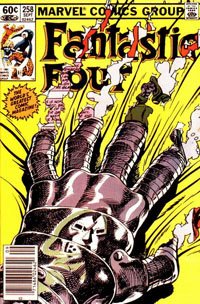
John Byrne did a lot of cute, self-referential covers back in the day, and I like most of them -- his covers for his She Hulk run were quite fun. But I actually read this when it came out. And it's so dynamic -- the perfect superhero cover -- plus, if you look inside the first page is the one revealed by the ripping hand on the cover. Awesome.


A lot of Dave McKean's covers are wonderful. This is just one I particularly liked.


Simple, marvelously iconic, and I love how it begins the zoom that takes up both the cover to issue one and the entirety of the first page.


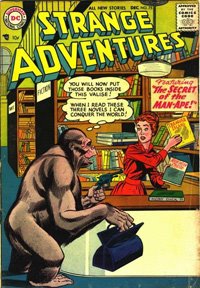
And this is, quite simply, the greatest comics cover ever done. (Although this is a close second, I'll admit: if your curious, the answer is that the latter reprinted a story from the former. It looks like this was fairly common, although sometimes a few changes were required.)

Thursday, March 09, 2006

Nel mezzo del cammin di nostra vita

Those words comprise the first line of Dante's Inferno, and mean (in Allen Mandelbaum's translation) "When I had journeyed half of our life's way". Since Psalm 90:10 says that "the days of our years are threescore years and ten", this has always been interpreted as meaning that Dante was 35 years old (and that the poem took place, therefore, in the year 1300). 35: "half of our life's way" according to David and Dante, two reputable sources.

Today is my thirty-fifth birthday.

Now, even Psalm 90:10 acknowledges the possibility that they might "by reason of strength... be fourscore years". And, of course, the psalmist was writing before modern medicine. Yet even if one goes by Genesis 6:3 ("his days shall be an hundred and twenty years") -- as, for instance, Moses is said to have done; something which I certainly hope (kenina hara!) to achieve -- still one must admit that even so life "is soon cut off, and we fly away."

I suppose this is all just to say that I'm feeling a bit melancholy. Afraid that, like Dante,

mi ritrovai per una selva oscura,
ché la diritta via era smarrita
("I found myself within a shadowed forest,
for I had lost the path that does not stray")

-- and feeling also that

Io non so ben ridir com' i' v'intrai,
tant' era pien di sonno a quel punto
che la verace via abbandonai.
("I cannot clearly say how I had entered
the wood; I was so full of sleep just at
the point where I abandoned the true path.")

Perhaps such feelings are par for the course on "major" birthdays -- defined, due to our counting system, as those divisible by five.

And of course, at the end of the day, I know what the answer to such feelings are -- the only answer that there can be: the answer found in another, older poet (well, older than Dante: not the Psalmist), the odes of Horace: "carpe diem" -- "seize the day".

What else is there?

(Update:)
You say it's your birthday
Well it's my birthday too, yeah...
-- Lennon/McCartney

On a cheerier note, very happy returns to my fellow birthday celebrants: P. Z. Myers, Hayden Bock, Jason Bock (who shares my precise birthday, i.e. not just March 9 but 1971 as well) -- and, heck, all the famous ones too.

Monday, February 27, 2006

Continuity #1: A Creative Commons Comics Script

Continuity1_Script.html
Continuity1_Script.pdf
Continuity1_Script.doc

Above, in a few different formats, are links to a script I've written for a 24-page comic book -- Continuity #1. It's intended as a one-shot, i.e. a single issue without follow-up. I am releasing the script under a creative commons license (Attribution-NonCommercial-ShareAlike 2.5), as described here (human-readable summary) and here (legal text).

This is (to the best of my knowledge) the first time a comics script has been released under a creative commons license. (Lots of complete comics, but no scripts that I've seen.)

The license I've released it under allows anyone (without getting any special permission from me) to read and distribute the strip, so long as they don't release it commercially or attempt to make any money from it. It also allows anyone (again, without getting any special permission from me) to make derivative artworks, so long as 1) I am give adequate credit; 2) those artworks are non-commercial and are 3) released under the same creative commons license that I am releasing this script under. I don't know of any way of writing this into the legal license, but I am in addition asking people who make a derivative work to send me a copy (link to your web site, a scan or jpeg of the artwork, etc.) unless it is wholly for your private practice and not distributed at all. Basically, if anyone draws any of this (or paints or whatever), I'd really like to see it. My email address is sfrug [symbol for at] post.harvard.edu.

The point of the "derivative works" is not to allow people to go write endless stories about these characters (although of course that is allowed, presuming they follow the given restrictions) but to allow any artists who want to to illustrate it. This could be for anything. It could simply be good practice for someone, a way to test out skills and stretch artistic muscles. Perhaps someone who wants to draw a 24 hour comic but doesn't want to write it at the same time could use this script (it might not, therefore, be strictly according to the rules, but what the hey). Or whatever.

I should note, incidentally, that it is possible to release this work commercially and not under a creative commons license if you get my permission. The point of mentioning this is that if anyone wants to illustrate it and try to publish it as an independent, for-sale comic (whether self-published or through some established comic publisher), then I'm certainly open to the idea. We just need to talk terms (which I would imagine as share-and-share-alike). Anyway, if you're interested, do contact me.

For anyone else who is interested, I hope you enjoy reading my script. And please forward it (or a link to it) to anyone else who might be interested!

(A hopefully-permanent version of this post will be found on its own page here.)

RIP Octavia Butler

I just saw on boingboing that Octavia Butler, one of my favorite SF writers, just died on Saturday. I just finished teaching her amazing novel Kindred two weeks ago in my seminar at Cornell; I taught it in the fall, too. One of my students told me Friday -- the day before Butler died -- that it was the first novel she'd read in a long time that she really enjoyed every word of and was never bored by. One of the reasons I began the seminar with it both semesters is because, in addition to being a literarily rich novel with a wonderful portrayal of life in a slave society, it is simply so damn gripping. I always had several students who read through the entire thing the night they began it (they're only required to read a third the first week). It was a great way to get students into the class. It's simply a wonderful, wonderful novel, and I recommend it unreservedly.

Her other books are wonderful, too. Besides Kindred, my favorites are her short stories, particularly the horrifying, unforgettable "Bloodchild". But I've enjoyed every book of hers I've read (not quite all, but close -- I hope to read her most recent (and, I suppose, now last) novel Fledgling soon.)

I even had the honor of meeting her once, briefly, at the SF convention Readercon in 2002. She was polite and charming, although she seemed a little shy.

What's heartbreaking is how young she was -- she was only 58 when she died. It sounds like a simple, horrifying accident.

A wonderful writer has left us far too soon. Rest in peace.


Thursday, February 23, 2006

A Very Cool Idea

Lawrence Lessig teaches law at Stanford and writes on intellectual property issues; he's one of the most prominent advocates of the importance of a freely-available commons in our cultural life. (Full disclosure: Lessig is a friend of my dad, but (to the best of my recollection) I've never met him.) If you're interested in these things, his most recent book, Free Culture, has been released online under a creative commons license; it's well worth reading.

He's had an idea which is, frankly, awesome. He has set up a wiki specifically devoted to criticisms of his own work: the Anti-Lessig Reader. Ironically, it would be hard to think of a better tribute to the spirit of his work: opening creative endeavor to free, voluntary contribution. And of course it shows his genuine dedication to the issues. W. V. Quine wrote that "Unscientific man is beset by a deplorable desire to have been right. The scientist is distinguished by a desire to be right." (Quiddities, "Rhetoric"). Setting up a forum for the critique of one's own work strongly demonstrates a desire to be right rather than a desire to have been right.

And, of course, it's ultimately very smart, because good critiques improve good work -- whether by allowing the creator to better rebut them, or to partially incorporate them, or to adopt them wholesale. Which feeds back into the importance of collaboration in intellectual life -- and, through that, to the importance of the creative commons. Culture and ideas are too important to be owned by corporations.

The big drawback to this idea? There's nothing there yet! I don't know if this is because no one's heard about it, or because Lessig's critics are purposely avoiding it as a forum, or something else, but my (quick) search found precisely one comment. Thus the idea is, so far, better than the reality. Still, bully for Lessig for throwing this up there. May many more follow his example!

It Needs To Be Said

And I feel a particular obligation to say it, given that I've been posting on free speech a lot lately. But since others have said it so well, I will just quote them, adding my "amen":

David Irving was recently sentenced to three years in prison for Holocaust denial. The man is a moral idiot. He is a Holocaust denier, racist and a modern Nazi sympathizer. But he ought not be in jail. I say that not because I respect his views in any way--they are intellectually and morally bankrupt. I say that not out of any personal sympathy for him--he is loathsome. I say that he ought not be in prison because speaking loathsome thoughts should not be a legal offense in a free society. The government of a free society should not police the loathsome expressions of its citizenty. Irving should be socially ostracized and intellectually ridiculed, but not subject to legal sanction. -- Sebastian Holsclaw (via)

Precisely. In addition, Ed Brayton notes that "Austria seems quite intent on engaging in the very fascist behavior they allegedly want to prevent with such laws." Well put.

Monday, February 20, 2006

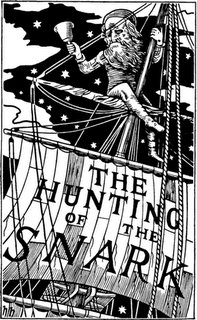
The Hunting of the Snark (Two Fits of Agony)

1. Fit the First


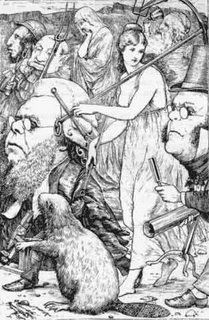
Leon Wieseltier's review of Daniel Dennett's Breaking the Spell seems to be full of ill-founded snark -- although to be absolutely honest I can't say for sure, since I quit reading the review in disgust partway through. I don't think that Breaking the Spell is Dennett's best book, but it certainly deserves better than Wieseltier's supercilious little hit piece. (Wieseltier seems to have a penchant for these: his review of Nicholson Baker's Checkpoint (even farther from being Baker's best book than Breaking the Spell is from being Dennett's) was also a string of cheap shots, flagrant misreadings and enough splutter that you needed an umbrella to read it.) Fortunately some people have a stronger stomach than I and managed to actually finish Wieseltier's review, so that they can shoot it down with all the ferocity of Dick Cheney on a quial hunt. The best huntings of Wieseltier's snark that I've read are Brian Lieter's and P. Z. Myers's; a roundup of others is at Majikthiese. (Update: a third good hunter takes aim at Weiseltier's "digraceful and disrespectful hack job of a review" here.)

2. Fit the Second


In the meantime, for some better-aimed Snark that is less likely to up and Boojum on you, read Alex Ross's lengthy New Yorker essay on Theodore Adorno (from nearly three years ago, but I just came across it). A hilariously snarky essay that's a lot of fun to read. But I must admit I can't tell if the implication in the following three sentences is, A) intentional and meant as a joke; B) an accident of misfired prose (though I blame Adorno for sneaking up behind him and not announcing his presence, really) or C) intentional and meant seriously. I presume (A), because of the snarkiness of the rest of the essay, to say nothing of the usually careful editing of The New Yorker; but still, this is a wild trio of sentences:

Tragically, Adorno was himself a victim of the shock tactics of pop culture. In April, 1969, a group of female activists interrupted his lecture "An Introduction to Dialectical Thinking" by flashing their breasts in his face and taunting him with flowers. He died a few months later, on August 6, 1969.

"Charm it with smiles and with soap" indeed!


Saturday, February 18, 2006

Just Sayin'


Häagen-Dazs light mint chip ice cream may be the best ice cream in the world.

That's all.

Wednesday, February 15, 2006

The Backstroke of the West

...is the title of "Revenge of the Sith", translated into Chinese, and then back-translated into English subtitles on a bootlegged version. A blogger has posted a lot of screen shots (via boingboing), and it is hilarious.

Quite frankly, it looks like a lot more fun then the original movie. It has a sense of humor (sometimes dirty, but always funny), not to mention whimsy.

Two examples. One (which is not on the aforementioned blog post but which boingboing quotes from another reader) is: "An attack from the rear is translated as 'he is coming into my behind.'" And here's another, this time from the main post:


The entire post is worth reading. Hell, if I can find the subtitled version, the film might actually be worth seeing again! This version looks like a lot of fun... (Somewhat different set of screenshots here.)

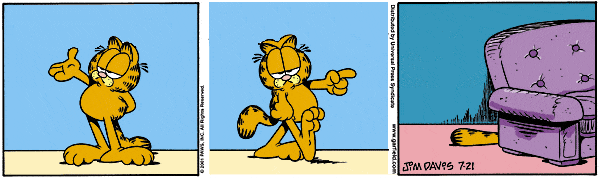
If you think about it, it is actually an (inadvertent) application of an Oulipian technique, revising another piece of art to make a new (and in many cases, including it seems this one, better) work of art. I came across another example recently -- this one more Oubapian than Oulipian -- in this thread about how much better Garfield is with the Garfield's captions removed. This is also worth reading -- the whole thread, actually, since other people apart from the original poster also contribute their own versions. Here are a few examples of this:


Again: surrealism, whimsy, genuine humor, even genuine pathos. A real improvement.

Case study #16,999,838,435 on why a genuine creative commons, including as much of the culture as possible, is important for artistic efforts.

Monday, February 13, 2006

Breaking News! Reason for Cheney Cover-Up Revealed!

CNN is finally reporting why there was a nearly 24 hour delay in announcing that Cheney shot somebody. It turns out that Harry Whittington was a plant. It turns out that Cheney's true victim was someone else:


(It should be noted, however, that earlier there were some other theories.)

Click the image for the full article. Click here to discover other Vice-Presidential victims. (Via boing-boing)

Update: Cheney shoots someone; Jon Stewart reports. You know you want to see this.

Monday, February 06, 2006

Some Things Are Just !@#$%ed Up

Down and Out in the Magic Kingdom by Cory Doctorow (SF author and blogger of boing-boing fame) is available on Amazon.com in a variety of formats. That makes sense: if you want a dead-tree edition, Amazon will sell you one, in hard or soft covers.

But they also will sell you a copy for Microsoft Reader for $9.95.

Why is that !@#$%ed up?

Because Cory Doctorow has made the entire novel available for free on his web site. In a rather bewildering variety of formats. (Now, I have no idea if the Microsoft Reader format is among them... but if you can get to Amazon, you can read html, which is on Doctorow's site.)

So the question is... why would anyone buy the digital file from Amazon? A paper copy, sure -- there's reason to have a paper copy even if you can get a digital one free. But a digital one? Have they sold any? Who bought them?

(It is cool that Doctorow made the whole novel free; he's said that he thinks it increases his sales. In fact, all his novels and many of his short stories are available on his web site; check 'em out!)

Sunday, February 05, 2006

More on the Cartoon War

My informal, partial and unscientific survey of the left blogosphere shows us divided about 50/50 on the cartoon issue. It's almost entirely a matter of emphasis. One side says "yeah, we shouldn't give offense, but the real issue is protecting free speech"; the other side replies "yeah, we should protect free speech, but the real issue is..." (I am cutting the second example short, because it's always easier to caricature one's own side, and I am hesitant to put the latter summary in such a way that will cause people to say 'no, it's not that, it's this!' There have been a number of versions of the latter. I've read them, trying to keep an open mind. But in the end I don't feel very persuaded. Not that I disagree that the Muslim world has legitimate grievances, that some sentiments are genuinely offensive and people should use free speech responsibly, or that there are issues of class, race and power in Europe that make the situation parallel to racism in the U.S. It's just that against sentiments like these --


-- I think those issues pale. For many in the west, free speech is a fundamental value, and we are -- and should -- stand up for it. (Nor do I take the two values to be equivalent: this is not moral relativism here: one strikes me as rationally defensible in a way the other is not. Further, one imposes itself on other people's values and lives in a way the other does not.)

People are openly calling for murder on the streets of London. Not just one sign: many. Not to mention the burning of embassies (three last I saw -- the Danish embassies in Lebanon and Syria, the Norwegian embassy in Syria).

Now I hope that people who say that those voices represent a small fraction of the Muslim world are right -- dear God I hope they're right, because the only hope we have of spreading the values of tolerance and open debate and the acceptance of multiple points of view up to and including blasphemy is in Muslims themselves spreading those ideas. We can't impose them. I take it this is P. Z. Myers's point (although this isn't how he put it.)

But the fight to spread liberal (in the broadest sense of the word) values is only half of the issue. The other issue is defending liberal values where they now exist. I've seen one or two people say things such as "free speech only protects against the government". But this seems to me wildly wrong. The government, perhaps, can only protect against violations by itself. But civil society, and an open and vigorous defense of its values, can protect against other, equally insidious violations. Put simply, the threat of mob violence, or the threat of assassination, can suppress speech as effectively as a government. But we can't let it. The reason that people find P. Z. Myers's response insufficient, I think, is that it ignores this half of the issue: people are trying to suppress speech in liberal societies through threat of violence. Responding to that is a separate, but equally important, thing than liberalizing currently closed societies.

Another thoughtful liberal blogger, Juan Cole, wrote this:

Had the Danish newspaper published antisemitic cartoons that showed, e.g., Moses as an exploitative money lender and brought into question the Holocaust, there would also have been a firestorm of protest. For the secular world, the injuries and unspoken hierarchies of race are what cannot be attacked. Muslims are not, as you will be told, the only community that is touchy about attacks on its holy figures or even just ordinary heros....
Human beings are all alike. Where they are distinctive, it comes out of a special set of historical circumstances. The Muslims are protesting this incident vigorously, and consider the caricatures insupportable. We would protest other things, and consider them insupportable.

I agree that all communities protest some speech. And that the fight for civil society is one that is ongoing and universal. But that Muslims are protesting this incident "vigorously" is not what's bothering people -- at least not what's bothering me. It's that (some) Muslims are protesting this incident violently, and with the threat of violence. I hope that that would not happen in parallel situations; and if it did, I would certainly condemn it equally strongly.

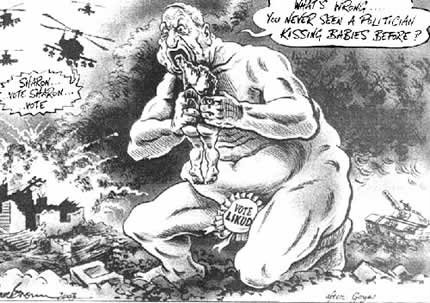
I also think that Juan Cole's parallel about the Moses cartoon is actually demonstrably wrong. Here is a cartoon that plays on a longstanding and viciously antisemitic claim, that Jews eat Christian babies; it apparently appeared in a U.K. newspaper, the Independent (via):


Were there protests? I don't know: I didn't hear about any. But I'm fairly certain that I would have heard about death threats or torching embassies. There wasn't any. And there shouldn't have been any -- even though I agree that that vile cartoon ought not to have been published. Ought not to, because the cartoonist and his/her editor should have known better: but if they don't know better, all we should do -- all we can do -- is protest, and perhaps boycott the paper.

Which is simply a far cry from this:


Yes, as at least one person has pointed out, it looks like all those signs were made by one person or group. And as I said before: I hope so. I hope this is a fringe reaction. I know that there are Muslims who are openly opposing this violence -- and thank God for them. But scenes such as that are still horrifying.

Bigotry against Muslims is a real problem in the west, and we should fight it. Indeed, we must fight it if we are to spread liberal values throughout the world, as I would hope we all want to. (This is true in a double sense: we must fight it, morally, because doing so is mandated by those liberal values; and we must fight it, pragmatically, in order to succeed in spreading those liberal values.) But at the same time those same liberal values mandate that we must utterly reject the notion that people can reach into existing liberal societies and censor people by threatening to murder them. Dear Lord, even to say this makes it sound utterly obvious! But it isn't an idle threat, as the murders of Salman Rushdie's Japanese translator and Theo Van Gogh demonstrate. So it's one we have to confront.

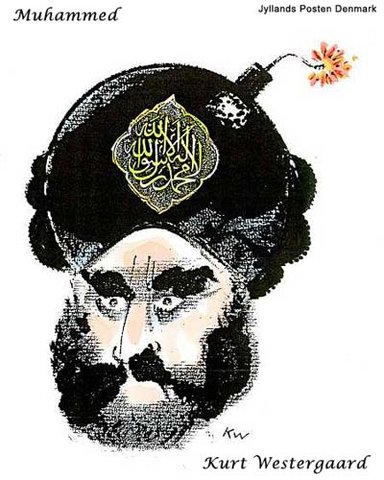
I want to go a bit farther, though, and actively defend my values, which say that presenting a slander or stereotype against a particular group of people is a worse thing than blasphemy -- of any type, against anything. The above antisemitic cartoon falls into the former category, repeating a notion that has led to the oppression and murder of Jews for centuries. Now, some of the cartoons recently published in Europe seem to fall into the former category as well, since they imply that all Muslims are suicide bombers, a notion that could easily lead to the oppression of Muslims if it hasn't already. This cartoon, for example, seems to fall into that category:


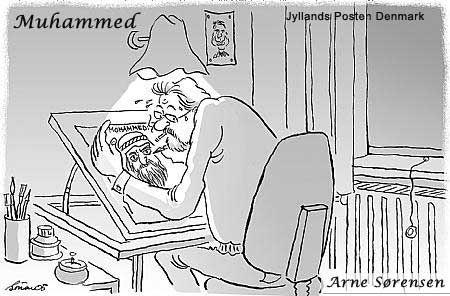
But others of the recently published cartoons pretty clearly don't fall into the former category; they are simply about the prohibition of depicting Mohammed at all -- an issue of blasphemy that does not negatively depict any group of people in any fashion. This cartoon, for example, is rather directly about that:


The whole point of that cartoon is the fear that people have of trespassing on other's religious sensibilities.

And there my values are that we should feel free to do it. Unlike some conservatives who've written about this, I support blasphemy against all religions. I think it's an important part of an open, genuine debate on important things -- and an important counter to the powerful respect that our culture has for religious values as such. Many might disagree, and (peacefully) protest what I say: fine. That's their right. (Maybe they'll even convince me, who knows.) But that's also where there rights end.

Note that there are two issues here. The one is simply the profound immorality of threatening violence as a response to any speech, whatever its nature. This is something which I would hope all societies everywhere could agree on. The second issue is whether blasphemy is an acceptable thing, or if it should be treated the way racist/antisemitic speech is in the west, i.e. reacted to with outrage and (peaceful) protests. Whatever one thinks of the second issue, it is in fact tangential to the first, given what's going on. But the second issue matters, too. This is not something which everyone agrees on; many societies will treat blasphemers as we do racists -- hell, many of those on the right defending free speech in this instance are saying that, while free speech is important, people ought to refrain from blasphemy. And while I do think the first issue, the threat of violence, is what's most important, I think the second one is important too: and here I would want to argue that blasphemy is not like racism/antisemitism, and should not be treated as such. Juan Cole may simply be making the comparison to get across the emotional response of the Muslim world, in which case I'd agree. But if he's saying that we should treat blasphemers the way we do racists, then I very much don't.

The Vatican has issued a statement on the matter, saying: "The right to freedom of thought and expression . . . cannot entail the right to offend the religious sentiment of believers". This is ambiguous as to which of the two issues they are addressing. But either way it's flat wrong. The right to freedom of thought and expression must entail the right to offend the religious sentiment of believers, or it isn't a right to freedom of thought and expression at all. And even if you disagree with my contention that it isn't such a horrible thing for people to blaspheme -- even if you think we should shun and disparage blasphemers the way we do racists and antisemites -- I would hope you would agree that we still must support the right to offend religious sentiments -- without fear of government persecution, of course, but also without fear of violent death. That right, at least, must be protected.

Having linked to a few bloggers with whom I disagree, let me end by endorsing the remarks of one with whom I agree. I give you Josh Marshall:

An open society, a secular society can't exist if mob violence is the cost of giving offense. And that does seem like what's on offer here. That's the crux of this issue -- that the response is threatened violence and more practical demands that such outrages must end. It's back to the fatwa against Salman Rushdie and the Satanic Verses (which, if you're only familiar with it as a 'controversy' is a marvelously good book) -- if on a less literary and more amorphous level. The price of blasphemy is death. And among many in the Muslim world it is not sufficient that those rules apply in their countries. They should apply everywhere. Perhaps something so drastic isn't called for -- at least in the calmer moments or settled counsels. But at least European governments are supposed to clamp down on their presses to heal the breach.... So liberal mores versus theocratic mores. Where's the possible compromise? There isn't any. On the face of it this gets portrayed as an issue of press freedom. But this is much more fundamental. 'Press freedom' is just one cog in the machinery of a society that doesn't believe in or accept the idea of 'blasphemy'. Now, an important cog? Yes. But I think we're fooling ourselves to reduce this to something so juridical and rights based. I don't want to imply this is only a Muslims versus modernity issue. I know not all Muslims embrace these views. More to the point, it's not only Muslims who do. You see it among the haredim in Israel. And I see it with an increasing frequency here in the US. Is it just me or does it seem that more and more often there are public controversies in which 'blasphemy' is considered some sort of legitimate cause of action -- as if 'blasphemy' can actually have any civic meaning in a society like ours. Anyway, you get the idea. Much, probably most of what gets talked about as the 'war on terror' in politics today is a crock -- a stalking horse for political power grabs, a masquerade of rage and revanchism, a running excuse for why we've made so many stupid decisions over the last five years. In some cases, on a more refined plain, it's rooted in intellectual or existential boredom. But beyond all the mumbojumbo about how we're helping ourselves by permanently occupying Iraq and running the country's finances into the ground, there is a conflict. There is a basic rupture in the world. It's not the US or the West versus Islam. At least it's not that simple. In any case, the government in this country is too close to illiberalism, militarism and theocracy for that to work as a model. But it is there -- liberalism and authoritarianism, modernity and theocracy.

Amen, Dr. Marshall! And in the end, those of use who support liberalism versus authoritarianism, modernity versus theocracy on issues here in the U.S. must do so on this issue too.

In our time, one of the great enemies of freedom is theocracy: the imposition of belief on non-believers. And we must fight it wherever we see it. All the more so if we see it burning buildings and threatening murder.

(Update: On the "it's a strange world" side of the equation, several people have asked forms of this question: where in the world are the protestors getting all those Danish flags to burn? It is a bit of a puzzle: I wouldn't know offhand where to get a Danish flag here in Ithaca, New York if I wanted one, and would probably have to go on the net and wait for it to arrive. So where are they all coming from?)

Thursday, February 02, 2006

What Hath the Internet Wrought?

...the end of the telegraph, apparently. With an assist from faxes and FedEx and cheap long-distance calls (and various other culprits too, presumably).

The Telegraph: 1844 - 2006. RIP

(link via)

Supporting Offensive Speech

I suppose everyone's heard by now about the uproar about the European cartoons which have caused great offense among Muslims. I agree with Steve Gilliard that those who speak are responsible for the use of that speech -- but only up to a point. If there was simply outrage at the cartoon(s) in question, then I would agree wholeheartedly that the cartoonist should think about whether what he/she said was wise. If there was simply a boycott of the publication which published the speech -- fine, that seems a legitimate method of protest, if itself of debatable wisdom sometimes (depending on the specifics of the case).

But boycotting the products of a whole country because of offending speech is over the line: it is an attempt to impose one's values on another's society, and is deeply dangerous to the entire notion of free speech or free inquiry. There is no right not to be offended; there is no right not to have one's values blasphemed. You don't need to read (or watch or whatever) what offends you; you don't need to like the person who gave offense. But to try to shut down the discourse by putting pressure on an entire country is beyond the pale.

Even further beyond the pale, of course, is government censorship.

But still further beyond the pale are actual expressions of violence. Once people are threatening murder over speech -- as happened most famously in the case Salman Rushdie, of course, but seems to be happening again in the case of the now-infamous cartoons -- any question of offense go out the window. Then it seems to me the duty of anyone who believes in any sort of free discourse to support the speech in question -- no matter how offensive.

If the speech is bigoted, as Clinton's comparison to antisemitic cartoons suggest -- and I haven't read the cartoons in question, and don't know the context in any event, so I express no opinion one way or the other on this point -- then say so: challenge the speaker: socially shun whoever said them. But trying to force other people to be polite to your Gods or prophets or sacred icons is offensive to our values -- and I would hope offensive to the values of anyone with any concern for free speech. (If someone is actually threatened that's another matter; but there is no question of that here -- except, of course, by the censors, some of whom are threatening kidnapping and murder.)

I find particularly appalling -- indeed, offensive -- the suggestion from many in the Muslim world that there ought not to be offensive depictions of Mohammed. Sorry: you don't get to say that (and you certainly don't get to enforce that). This is no different than the issue about Serrano's Piss-Christ or the allegedly antisemitic film The Passion of the Christ or anything else. -- Except that no one boycotted whole countries, let alone threatened murder, over those issues. In a pluralistic world, people will say things you find offensive. All one can legitimately do is counter with one's own speech, or boycott the specific film/art/newspaper/etc in question. This notion that other people's notion of blasphemy should be respected by everyone is what's outrageous here. Against that, any outrage in the speech itself pales.

Censorship of views one finds offensive is simply wrong. And this attempt by Islamists in Gaza to force censorship elsewhere at the point of a gun is an issue on which we should not retreat.

(Of course this isn't just an Islamic problem. Another cartoon is being attacked this week for being offensive towards American troops by the Joint Chiefs of Staff. It's unclear from the letter whether this is meant to be their personal opinion, or their opinion as members of the Joint Chiefs -- a crucial point. But drawing this line is important, too, and I say: err on the side of free speech. The Joint Chiefs were out of line.)

Update: Via Boing-Boing, the cartoons, with English translations, can be seen here.

Wednesday, February 01, 2006

2,245 and how many more?

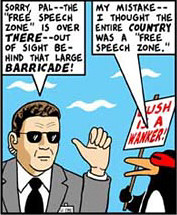
FreeSpeechZone

I didn't watch/listen to the State of the Union last night -- I couldn't stand it. I still can't: I haven't even read the transcript. (I've read summaries, which is the most I could stomach. If you're having a similar problem, perhaps it will help if you read the speech translated into pirate slang.)

But I have to say that I am appalled -- though not in the least surprised -- by Cindy Sheehan's arrest last night. She was arrested for wearing a T-Shirt with the phrase in this post's title to the State of the Union (she had been given a ticket by a Democratic representative). The charge was "unlawful conduct"; she was led away in handcuffs before the speech began.

John Aravosis rightly notes the relevant Supreme Court precedent: Cohen v. California (1971), which ruled that someone wearing a T-shirt which read "Fuck the Draft" in a courthouse was constitutionally protected speech.

So much for the first amendment.

Of course, as I said, I'm not in the least bit surprised. Bush has been having people removed from his speeches for wearing T-shirts and like offenses -- even for the bumper stickers on their cars -- for years. And, yes, some of those were public events, paid for with public money, to which the citizens in question had a ticket. So no surprise. But I am appalled -- as we should all be appalled at all of many ways in which civil liberties have been curtailed during Bush's reign.

Bush's America: a land where free speech is "unlawful conduct".

Impeach Bush; impeach Cheney. Do it now.

(Update: More Sheehan commentary from Digby. And follow the links: Digby links here, which in turn links here. Elsewhere, John has Cindy Sheehan's version of the evening, and a picture of the shirt, here.)