Friday, May 21, 2010

Oh Those Left Wing Extremists!

You know what Dennis Kucinish is up to now? He's sponsoring a bill to make it illegal for the President of the United States* to execute American citizens without trial. (link via)

God, the radicalism! He must be a commie. Or a Muslim. Or Jacobin. Or something. I mean, next thing he'll be trying to outlaw indefinite detention without charge or trial at the whim of the executive. Or even torture!

I mean, how un-American can you get? After all, what did Washington, Franklin, Jefferson and Adams stand for if not "assassination, infinite detention and torture"?

What? Someone in the back said something ... "Life, liberty and the pursuit of happiness?" No, I'm pretty sure that was the Communist Manifesto. Or the Koran. Or at least someone French.

Americans don't believe shit like that.

_________________________
* For those of you keeping score at home, that'd be Barack Obama, folks. Yes, the "liberal" "democrat". Claiming the powers of assassination of American citizens**. Building on Bush's nice base of indefinite detention and torture for the same. Gotta go for the trifecta, dontcha know.

** I'm tempted to point out that the communist manifesto koran french document saying frenchie things whoever-it-was that wrote "life, liberty and the pursuit of happiness" didn't actually restrict those rights to American citizens. They actually thought they belonged to, y'know, everybody. (Well, ok, all men; the word "women" wasn't added until Stanton's 1848 edit.) I might even imply that the people who pledged their "lives, fortunes and sacred honors" to defend those rights would have gone so far as to claim that the U. S. government shouldn't torture, detain without trial or assassinate anyone.

But nah. That'd be just crazy, right?

Monday, May 03, 2010

Ayn Rand, Chinese Christianity, fly fishing, the Front de libération du Québec, Cthulhu Mythos, Historiography of the French Revolution...

...the War in Darfur, Hebrew Printing in America, Justification (in a theological sense), Richard Nixon, Scientology, Marvel comics' Daredevil, Opus Dei, Harold Pinter, Irish Railways, Classical Guitar, the Duwamish tribe of Washington state, and Yellowstone National Park.

What do these things have in common?

There are bibliographies of them listed on Wikipedia.

There are, however, subcategories of bibliographies about Spiderman, the X-Men, Cricket Books & Magazines and Science Publications.

There is also a list of bibliographies with links to bibliographies elsewhere online. It's a bit shorter than the categories list.

Wikipedia is weird and wonderful.

***

Disclaimer #1: I can vouch for the quality of none of these bibliographies.

Disclaimer #2: Wikipedia changes constantly, so some of these -- or even the whole !@#$% category page -- may be gone if you actually check.

Thursday, April 15, 2010

Everybody Tweets

The twitter feed of John Quincy Adams -- verbatim entries from his single-line diary (he kept several) posted 200 years to the day after their writing.

(Via Andrew Sullivan, who mislabels them "colonial" -- thinking of JQA's father, presumably.)

Sunday, April 04, 2010

Every Day is Saturday

An Easter sermon in blog-post form. (via) I'm not a believer and not a Christian, but if I were I think this is the kind I might be. It is, at any rate, a statement of faith that touched this atheist Jew quite deeply.

To those of my readers who celebrate it, a most joyous Easter.

Wednesday, March 17, 2010

Poem of the Day: St. Patrick's Day Edition

Brief historical background: Eamon de Valera was an Irish revolutionary and, later, a President of Ireland; Áras an Uachtaráin is the official residence of the President of Ireland and a symbol of Irish nationalism; Diarmaid and Gráinne are a pair of mythical Irish lovers.

Making Love outside Áras an Uachtaráin

When I was a boy, myself and my girl
Used bicycle up to the Phoenix Park;
Outside the gates we used lie in the grass
Making love outside Áras an Uachtaráin.

Often I wondered what de Valera would have thought
Inside in his ivory tower
If he knew we were in his green, green grass
Making love outside Áras an Uachtaráin.

Because the odd thing was--oh how odd it was--
We both revered Irish patriots
And we dreamed our dreams of a green, green flag
Making love outside Áras an Uachtaráin.

But even had our names been Diarmaid and Gráinne
We doubted de Valera's approval
For a poet's son and a judge's daughter
Making love outside Áras an Uachtaráin.

I see him now in the heat-haze of the day
Blindly stalking us down;
And, levelling an ancient rifle, he says "Stop
Making love outside Áras an Uachtaráin."

-- Paul Durcan
(Text taken from here.)

Happy St. Patrick's Day!

Friday, March 12, 2010

"I would have things as they were in all the days of my life... But if doom denies this to me, then I will have naught"

Via, we have more confirmation that belief in global warming is going down, centered in self-identified Republicans, i.e. that a straightforward scientific question -- for which, and let there be no mistake about this, the evidence is overwhelming -- has become a partisan issue. Peter Daou rants:
This isn't about good faith questioning of science, much as these naysayers pretend it is. It isn't about genuine skepticism, much as they want to believe it is. There is no moral imperative underlying their belief (or lack thereof). It's about unbridled hostility at the suggestion that we must all make shared sacrifices. It's about refusing to acknowledge that the environmental movement has been right to sound the alarm. It's about laziness. And greed. And irresponsibility. And colossal shortsightedness. Forget about the tragedy of the commons, this is the abject and gleeful refutation of common sense. Green-bashing exposes the rot at the core of modern conservatism.
And he's right, of course. It's about greed, for the companies that are manufacturing lie-based doubt like it was coca-cola, sugar-water to increase their profit margin. But for the public at large, it's about partisanship.

And that's the problem. The conservative movement has become a quivering mass of resentment for most of its base (ridden by the greed-driven big-shots who hope to use it to grab more wealth for themselves).* If the democrats believe something, then they'll disbelieve it, even if the science is overwhelming and clear. (Some of this is conscious rejection of pointy-headed egg-heads; more of it, probably, is listening to deceitful propaganda on Fox &c.) They won't admit it's true because admitting its truth would require admitting the necessity of government intervention, the importance of science... and, ultimately, the rot of the conservative movement.

The fact that it's become a partisan issue is what will doom us. Because a huge minority of the most powerful country (and biggest greenhouse-gas-polluter) in the world -- a huge minority in a country where even a small minority can block meaningful political change -- would literally rather destroy the world than admit that liberals and scientists are right or that government is necessary.

They want it to be false, so their lives can be unchanged. And if that's not possible, they'll pile the world on a pyre and light a match.

(Title from J. R. R. Tolkien's Denthor. Older rants on a similar subject can be read here and here.)

______________________
* Note that this has now even been admitted by the Republican National Committee itself, who divide their base into "visceral" givers motivated by "reactionary" feelings and "fear", and "calculated" givers who are motivated by "ego" and "access". -- Admitted, of course, in a private document that they are now disavowing: if you're playing on peoples' fear and egos, you have to pretend you're not for it to work.

Tuesday, January 26, 2010

Top Ten Explanations for the Proposed (Discretionary, Non-Defense) Budget Freeze

1) Scheme to Vindicate Ralph Nader's Historical Reputation by Proving the Uselessness of 2-Party System

2) Decided to Run On "Hopelessness" Just For a Change of Pace -- heck, *anyone* can get elected on "Hope".

3) William Kristol Is Remote Controlling Obama By Use of a Voodoo Doll

4) They sent him a toe. (You want a toe? I'll get you a toe. Hell, I can get you a toe by 3:00 this afternoon, with nail polish.)

5) Choosing political strategy via drunken "pin the tail on the donkey" game always good for a few laughs

6) Onion hacked NYT site again

7) On payroll of the "Palin '12" campaign.

8) Someone told Obama today was opposite day. Or maybe April 1.

9) Obama was vamped sometime in February 2009. (Anyone seen him in daylight recently?)

10) Democrats learned in 1967 that, worried about the declining power of evil, Satan has decided to directly destroy the nation in the event of another genuinely liberal Democratic administration, and have been heroically shooting themselves in the gonads ever since as a secret act of patriotism.

11) A cowardice virus has been released in the Democratic National Headquarters, which is spread to all Democratic candidates, and which sooner or later overcomes the immune system of even the most progressive elected officials.

12) Obama doesn't like being President and is looking for a face-saving way to quit after four years, not eight

Note: "Count-to-ten" functionality for this post provided by the Democratic National Committee.

Update: Breaking! New possible explanation revealed!

Thursday, January 21, 2010

Anger

I've seen Democrats as angry as they are now once before – in November and December of 2000. But although they were frustrated with the passivity of the Gore campaign, much of their anger was directed at George W. Bush. Right now, in contrast, Democrats aren't angry at Republicans. Every ounce of feeling they have is directed at the people who are supposed to represent them, the people who had – and still have! – historic majorities in Congress, yet act as though they're powerless. If Democrats can't show their supporters that they have some spine, those supporters won't be supporters anymore. This fall, they will decline to vote in huge numbers, and a bad midterm election will become a catastrophe. This is a moment of real crisis for Democrats when it comes to their base of support. And I've seen precious little evidence that they realize it.

-- Paul Waldman
Based on my unscientific sampling of opinions from friends and acquaintances and bloggers I read, it seems like there is an enormous anger in the Democratic party base -- not at Republicans, but at Democrats. For acting like spineless wimps. For running and cringing at the first sign of trouble. For not passing the damn Health Care Bill -- Senate version, in the House -- which, for all its deficiencies, is as close as we're going to get in the foreseeable future to decent health care in this country, and without which the Democrats are totally doomed in 2010.

Enormous anger.

Here's one of the best expressions of it I've seen, from (generally moderate and temperate) blogger Ezra Klein. I was going to excerpt it, but it's too good -- here's the whole damn thing:
It's worth taking a step back from health-care reform for a second. What Democrats are doing isn't just abandoning a particular policy issue. They're proving themselves unable to govern.

Democrats spent most of 2009 with 60 votes in the Senate and about 256 in the House. They had a popular new president who was following a disastrous Republican administration and a financial crisis. The opposition party was polling somewhere between foot fungus and spoiled meat. You don't get opportunities like this very often. The Senate majority, in fact, was larger than either party had enjoyed since the 1970s. And what have Democrats accomplished?

Well, not much. You can see a list here. A stimulus that was too small. Ted Kennedy's Serve America Act. Credit card regulations that were largely an acceleration of rules the Federal Reserve was going to impose anyway. I guess they almost passed a compromised health-care bill, but you don't go down in history for almosts.

If Democrats abandon health-care reform in the aftermath of Brown's victory, the lesson will be that they can't govern. No majority within the realm of reason will give them the votes to move their agenda swiftly and confidently. Even the prospect of the most significant legislative achievement in 40 years, an achievement that will save hundreds of thousands of lives, will not keep them from collapsing into chaos when they face adversity.

At that point, what's the pitch for voting for Democrats? That they agree with you? A plumber and I both agree that my toilet should work. But if he can't make it work, I'm not going to pay him any money or invite him into my home. Governance isn't just about ideology. It's also about competence and will. That's where Democrats are flagging.

You could argue that it's not fair to brand "Democrats" as at fault here. There's something to that. The leadership and the president would happily pass and sign legislation. But a party is as a party does. Democrats often run on the need to have enough votes to act. If they can't act even with those votes, then there's a real problem. Would Republicans be so terrorized if they were in a similar circumstance? The GOP forged ahead with its attempts to impeach Bill Clinton even after voters cut them down for it in the 1998 election. Those were some odd priorities, but at least the party was committed to the agenda it ran on. Democrats may not want to go quite that far in terms of party discipline, but they need to get a whole lot further than they are now.
There are a lot of similar posts around -- such as this one from Nate Silver, this one from Publius, the one from Paul Waldman I quoted at the top of this post, this one from Kevin Drum and his anonymous emailing friends, this Obama-focused one from Jonathan Cohn (who also penned this letter to nervous house Democrats), this one from Adam Serwer, this one from David Rees (who is writing as if channeling the Rude Pundit, fair warning), this one from M. J. Rosenberg, and so on and so forth.

Update: Paul Krugman offers his own version here, in his weekly NYT column. (via)

But the point is clear. Flawed as it is, the Senate legislation is now what's on offer. Universal health care is one of the great progressive goals -- has been for decades. The Democrats have a majority in the house. They could just fucking pass it.

And if they don't, if they're too cowardly to do that -- then what good are they? If they can't pass this with such large majorities -- when will they do anything?

Which is why good policy -- the bill is clearly better than the status quo, for all that it's not what I'd want (compromised in an always-futile hope to get Republican votes and in a pathetically necessary maneuver to get Lieberman's, Nelson's, et. al.) -- here meets good politics.

The Democrats will loose seats in November. Everyone gets that. (Most people get why, too: because the stimulus they passed was too small, chopped down from an already-too-small version to an even smaller one in order to placate preening centrists like Lieberman, Nelson, et. al., by a President who never seemed to take negotiation 101: ask for *more* than you want so that they can chop it down later. If they'd passed a sufficient stimulus -- one not only good enough to save us from depression (as the extant one did) but to actually put Americans back to work -- then people wouldn't be so angry and scared and they'd reward the party that did it, rather than the fear-merchants who caused the mess and are now pretending they didn't. It is, in brief, the Economy, stupid -- and the Dems listened to Larry Summers and not Paul Krugman, and were, therefore, stupid. End of story.)

They'll loose seats. But if they have something positive to run on -- a real accomplishment, like the health care bill -- they might loose fewer.

If all they have to run on is a year of trying and compromise, ending in pathetic failure, they will demoralize their base to the point where Sarah Palin could win the bluest district in the goddamn country.

They can still pull this one out. But god damn it, they better do it. Or they -- and the country -- and the world -- are all in really serious trouble.

Oh, and what can we do? Phone our representatives -- not Senators, our representatives -- and demand that they pass the Senate Bill. Like many of my friends and perhaps some of my Noble Readers, I live in a safely Democratic district where my Congressman can usually be counted on to do the right thing -- and am sometimes even frustrated I can't do more by phoning. Now is the time: everyone with a Democrat for a Representative should phone and demand they pass the Senate bill immediately. (Or even those with Republican Representatives, sure -- although it won't do any good, of course.)

There's just too damn much on the line.

Pass the bill.

Tuesday, January 19, 2010

Top 10 Consoling Thoughts About Brown's Win In Massachusetts

10) Conservative Dems wouldn't have let Senate do anything after health care anyway;

9) Dems so good at messing sh$t up that they would probably have still managed to mess up health care even if Brown hadn't won;

8) We all still have a few days to fantasize that Obama & Congress will respond by actually doing stuff (like passing a health care bill that will help millions, or a stimulus that might be big enough to actually create some !@#$ing jobs) -- that is, act like this and this -- rather than by being even more polite, even more bipartisan, even more conservative... that is, by being their usual craven, cringing self.

7) In 2012, Mass Democrats might decide to nominate a candidate with a pulse (or Bobby or Ted Kennedy. Even without a pulse they'd rock.)

6) ...

I dunno. Anyone have any more? 'Cause from where I sit it looks pretty damn grim.

Thursday, January 07, 2010

Because Sometimes You Just Need To Focus On the Positive...

...so after last post's depressing ruminations, here's a totally cheery quote of the day (via):
...the great consolation of the Oy’s, for me and people like me, was – and I mean this in a healthful, life-affirming way – our ruthless and total conquest of the culture. Science fiction, fantasy, superheroes, vampires, zombies and werewolves are the mainstream now. We own your movie theaters, your TV screens, your bestseller lists, even your highfalutin’ literary awards. Even what’s left of the dread New York Literary Establishment has largely succumbed. The remaining anti-fantasm holdouts no longer have the power to infuriate; they are not even tiresome any more because there aren’t enough of them to tire one. On the very rare occasions when one encounters a supposedly serious critic condemning fantastic fiction out of hand, it’s like discovering an eight-track-tape player in a flea market: you marvel that it might still work, but it’s tempered by realizing that it couldn’t play anything that matters to you these days.

-- Jim Henley
I'm not totally convinced -- at least, not yet -- that Henley's right about this. But it's a cheery thought, and I wanted a cheery thought today. So yeah: geeks rule!

Wednesday, January 06, 2010

Failure Has Consequences: A Tale of Three Essays

I read two essays today (when I should have been doing other things, natch) that seemed to do a good job at capturing our political moment, and the precise contours of its problems: one broadly, one narrowly.

The essay with the broader lens was James Fallows's interesting essay in the Atlantic this month on the current notion that America is in decline, and whether it's true or not. It's largely familiar material -- at least to me; I bet it isn't to a lot of people -- but I'd summarize it as follows: we've always had the sense of collapse, and some of the specific problems are familiar; relative decline is an overstated problem; so many of our worries are groundless -- or would be, except that our political system is too !@#$%ed up to fix them, so in actual fact we're screwed.

Fallows doesn't actually end on quite that pessimistic a note. But it's not a stretch from what he actually says, I don't think.

The piece with narrower focus was Harold Meyerson's weekly column on the disappointment with Obama from liberals (via) and why his term has, in fact, not been what liberals would hope. As he puts it:
The legislative torrents of the New Deal and the Great Society -- a few brief years in the 1930s and the '60s that fundamentally reshaped the nation's economy and society -- are the templates that fire the liberal imagination. ... But as the first anniversary of [Obama's] inauguration approaches, it's clear that despite the impending enactment of a genuinely epochal expansion of health care, a progressive era has not burst forth. Major legislation languishes or is watered down. Right-wing pseudo-populism stalks the land. The liberal base is demobilized. The '30s or the '60s it ain't.
I think Meyerson does a decent job of talking about why this is so. But what struck me reading the two essays was the way they outlined the lost possibility that has slipped away -- probably irrevocably.

Fallows mentions, twice, the lost opportunity after 9/11 to remake a now-paralyzed political system and set our country on course for the coming decades:
...if we can’t fix what’s broken, we face a replay of what made the months after the 9/11 attacks so painful: realizing that it was possible to change course and address problems long neglected, and then watching that chance slip away.

In 2001, America endured an event that should have been this era’s Sputnik ; but it wasn’t. It doesn’t help now to rue the lost opportunity, but there is no hiding the fact that it was an enormous loss. What could have been a moment to set our foreign policy and our domestic economy on a path for another 50 years of growth—as Eisenhower helped set a 50-year path with his response to Sputnik —instead created problems that will probably take another 50 years to correct.

But I think Fallows is slightly off on the timing here. Sure, in some sense, 9/11 could have been a moment for national correction such as Sputnik was. But that opportunity was lost with the post-election fight of 2000. Al Gore might have used 9/11 (assuming a more competent government wouldn't have, in fact, stopped it) in this way. But George Bush, with his incompetence, arrogance and above all allegiance to a fundamentally malign political movement was never going to do this. He might have responded less negatively, not creating (in Fallows' apt if over-optimistic summation) "problems that will probably take another 50 years to correct". But he wasn't going to do anything good.

But there was another lost opportunity -- one that, I am increasingly convinced, has genuinely been already lost -- that is far more painful. And that was the possibility of a liberal renewal in January - March of 2009.

Obama not only came into office with a powerful mandate -- a historic election, a mobilized citizenry and high levels of personal popularity -- and not only had impressive majorities in both houses of Congress. He also took office in a genuine period of national crisis: not just two wars, although those are pretty spectacular, but an urgent economic crisis of a sort not seen since the 1930's and a looming environmental catastrophe of a sort never before seen in recorded history.

This, noble readers, was an opportunity.

And he blew it.

Oh, it looks like he's going to get health care passed. But he had to scratch that out, painfully, over a year, while his inadequate economic response drained away people's hope and his own popularity. He's done what he could on the environment, I suppose -- but it is inadequate to stave off disaster, so no points for effort here. And above all the moment is passed: the moment which combined not only Obama's political apogee, but the stunning, undeniable failure of the conservative movement which has poisoned our national politics for more than a generation.

We won't get that back.

The model that was needed, I think, was that of FDR in 1933. FDR also faced a government utterly inadequate to the crises of his moment. But -- without amending the constitution, by extending and transforming existing institutions as well as creating new ones, and above all by changing customs and expectations -- he not only got us through the crises, he also remade the government. To be sure, some of FDR's government-changing gambits failed spectacularly (most famously this). But he nevertheless remade the federal government, what it could do and how it worked, to solve the problems he was confronted with.

Obama? He tried to be bipartisan. And the hope he ran on drained away as he did.

I think this is the failed opportunity that will haunt us for decades to come.

Sure, political realists now talk about how all that Obama can do is what the 60th-most-liberal-Senator is willing to sign off on. And that is, undoubtedly, true -- now. But in the conjunction of genuine crises and a powerful electoral victory, more might have been done -- if Obama had steered the political conversation, and public opinion, well.

There are all sorts of ways this could have been done. For instance: there is reason to think that when the Senate writes its rules each time a new Senate organizes (i.e. every two years) that the filibuster could be eliminated simply by not writing it into the new rules. To be sure, this would be a gross violation of Senate tradition and decorum -- but then, the routine use of the filibuster is (as has been often pointed out, to little avail) just as gross a violation of Senate tradition, a distortion of a formerly little-used provision into a routine supermajority requirement. Meeting one unfairness-and-borderline-rule-breaking with another could have been justified -- in January 2009. Not now.

But the technical details aren't important. They might not even have been necessary, if the proper approach to the politics had been taken. If Obama had told the right story about the crises we were in, about what brought us there, and what his election meant, it might have created a political wave that couldn't have been fought.

But Obama didn't do it. And now it is, I fear, far too late.

(Parenthetically, this is why I think the oppose-the-health-care-bill liberals are ultimately wrong. The better bills of their dreams -- which would, of course, be much better -- were lost last spring, if not before. Now, now, the current cobbled-together sausage is the best that can be done.)

If Obama had used the sense of crisis properly, he could have passed a stimulus large enough not only to stave off catastrophe (as the actual stimulus was) but to have put America back to work (as what he passed was not). And this, more than anything, would have improved his poll numbers, which are now falling in no small part as people (reasonably) begin to ascribe more of the failures of the economy to his and not Bush's column. Political success creates momentum and political capitol: a stimulus bill such as this might have helped us get a better health care bill later.

And more than that: a good stimulus bill would not only have allowed us to begin to attend to the rotting infrastructure that Fallows mentions in his above-linked article. It might also, if done well, have kick-started some of the economic changes we need to begin to cut our greenhouse gas emissions. A good stimulus bill might not have only saved the economy -- it could have begun the most urgent task of all, saving the planet.

And more: a vigorous, successful use of the government to ward off disaster would have combined with the manifest failures of anti-government conservatism (from the negligence that abandoned the victims of Katrina to the deregulation that almost destroyed the world economy) could have been used to do the crucial ideological work of restoring the name of liberalism, tarnished by several decades of conservative lies and propaganda (and, to be fair, some of its own failures remaining from its heyday (outmatched by its successes, but the conservative propaganda have ensured that only the failures are remembered)).

And all this could have been done while changing the political culture, the very way our government works in that one brief moment of opportunity -- as FDR had to change his to build a federal government able to confront the great depression (and the Nazis).

It could have been done. But it wasn't. And when might a chance come again? If Obama muddles through, that won't actually fix what needs fixing. If he fails, he'll be replaced by someone from the party of Sarah Palin -- the most bile-filled, boneheaded and unabashedly crazy political party ever to afflict our Republic. A mediocre political party will be replaced with one that is stupid where it is not malevolent. And by the time they fail again, it will most likely be too late.

Lest anyone claim that this is all retrospective griping, I will point out that this was foreseeable well in advance. The best formulation of it that I've seen was the article by the brilliant historian Rick Perlstein, called "The Liberal Shock Doctrine", from August, 2008. He wrote:
Progressive political change in American history is rarely incremental. With important exceptions, most of the reforms that have advanced our nation's status as a modern, liberalizing social democracy were pushed through during narrow windows of progressive opportunity -- which subsequently slammed shut with the work not yet complete....

[FDR and LBJ] legislated at such a breakneck pace his aides were in awe. Both presidents understood that there are too many choke points -- our minority-enabling constitutional system, our national tendency toward individualism, and our concentration of vested interests -- to make change possible any other way....

...if Barack Obama is elected president with a significant popular mandate, a number of Democrats riding his coattails to the House, and enough senators to scuttle the filibuster of his legislative agenda -- all of which seem entirely possible -- he will inherit a historical opportunity to civilize the United States in ways not seen in a generation....

Weisbrot and Mackenzie's The Liberal Hour is a very aptly named book: a splendid evocation of just how evanescent American moments of reform truly are. They are not unlike an action movie starring Bruce Willis, who has 60 minutes left to defuse a time bomb before everything blows up. Take immediate action, and you might just get reforms that had seemed impossible the day before but are impossible to imagine America without just one and two generations later. Take it slow, however, and you might not get anything at all.
Perlstein spells out the details in the full article. (It includes the apt retort to those who point out that Obama did not run as a radical transformer, namely, that FDR didn't either, and that LBJ in the 1960 election was seen as a conservative Democrat. Obama running as a moderate didn't mean he couldn't have seized the moment when it was offered.)

But what Perlstein wrote then as a hope -- that a moment of progressive activity worthy of the heritage of the New Deal and the Great Society, that might improve our country as the lasting achievements of those eras of reform did -- has become bitter, a lament to what might have been. Perlstein accurately forecasts how conservatives have tried (with depressing success, especially given the failure of their own governance) to undo Obama; he spells what Obama could have done to avoid it.

But Obama didn't do it. And now the moment is lost.

Perlstein's article -- outlining the best hope for our nation's future -- is now a grim reminder of what could have been, but no longer can be.

In politics, it is often said (quoting the title of a famous book) that ideas have consequences; on the same pattern, it is said that elections have consequences. But failure, too, has consequences. Obama had a chance to transform the country for the better -- possibly even save it from decline. And he pissed it away.

Good as Fallows's and Meyerson's essays are, I think that Perlstein's essay -- of seventeen months ago -- encapsulates best what has gone wrong with our politics now.

In January, 2010, it makes for hard reading.

What now? Fallows has some suggestions, none convincing. The moment to informal rewrite the rules of our politics (at least for the better; rewriting them for the worse seems an always-open option) has been lost. Any formal rewriting of them is highly implausible -- and likely to be disastrous even if it could be brought about.

And so the problems that need fixing cannot be fixed. There are too many choke points in our politics: and the conservatives have grasped them, and have us by the throat. The country, and most likely the world, will be long the worse in consequence.

Saturday, December 19, 2009

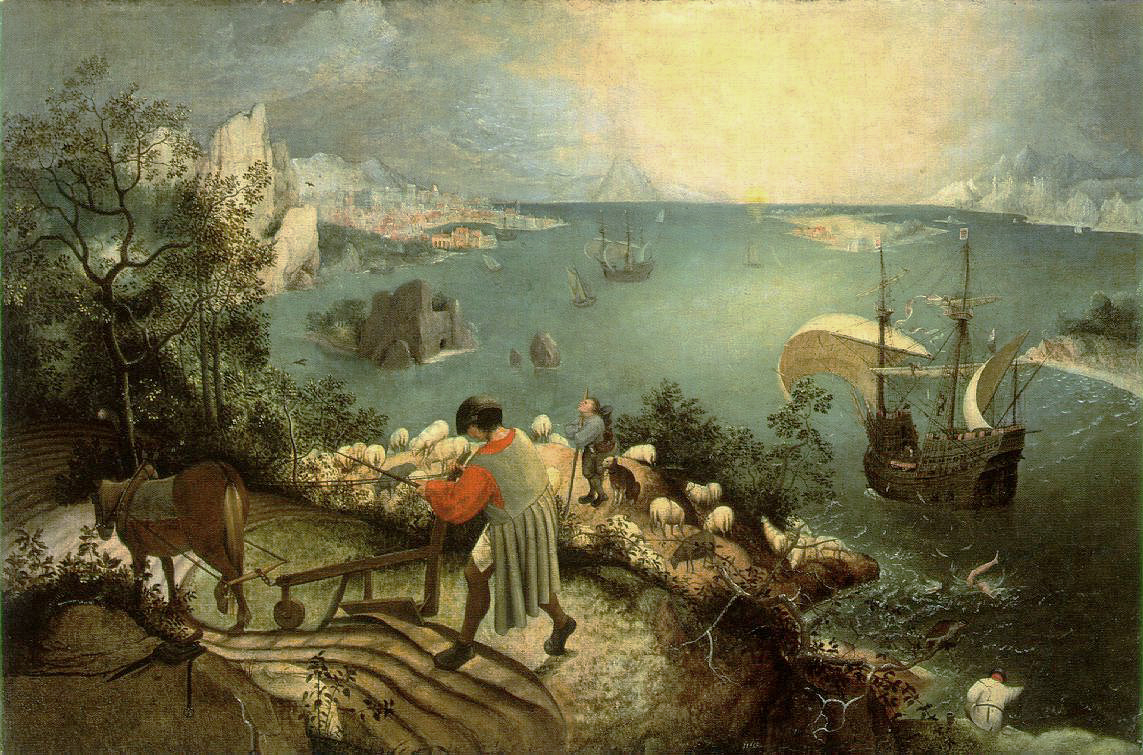
Poem of the Day: Musée des Beaux Arts

Musée des Beaux Arts

About suffering they were never wrong,
The Old Masters; how well, they understood
Its human position; how it takes place
While someone else is eating or opening a window or just
walking dully along;
How, when the aged are reverently, passionately waiting
For the miraculous birth, there always must be
Children who did not specially want it to happen, skating
On a pond at the edge of the wood:
They never forgot
That even the dreadful martyrdom must run its course
Anyhow in a corner, some untidy spot
Where the dogs go on with their doggy life and the torturer's horse
Scratches its innocent behind on a tree.

In Breughel's Icarus, for instance: how everything turns away
Quite leisurely from the disaster; the ploughman may
Have heard the splash, the forsaken cry,
But for him it was not an important failure; the sun shone
As it had to on the white legs disappearing into the green
Water; and the expensive delicate ship that must have seen
Something amazing, a boy falling out of the sky,
Had somewhere to get to and sailed calmly on.

-- W. H. Auden
For some reason, every online text of the poem I saw lacked a capital at the beginning of the final line; having checked the print version in my copies of both Auden's Collected Poems and his Selected Poems, this seems like a repeated mistake. So I fixed it.

The painting (source):


(click for larger version)

(To be honest, I've never liked the painting nearly as much as the poem. But I guess at the end of the day I'm a word person. (Also, I've never seen the original; perhaps it just doesn't come through in the crappy web reproductions.) Interestingly, according to the painting's wikipedia page's reporting of a scholarly article, recent technical analysis indicates that the extant one seems to be a copy of a Bruegel and not the original work.)

A video of Auden himself reading the poem:

Tuesday, December 15, 2009

A Brief, Idle Thought on the Problem of the Senate

The justifiable frustration that many liberals feel at the filibuster -- which is allowing the remnant of a failed political movement to hobble the implementation of its political successor's agenda (which will then allow them to claim, disingenuously, that the replacement failed and that they ought to be allowed to try again) -- has from time to time spilled over into frustration with the Senate itself. Thus a thoughtful liberal writer like Henrik Hertzberg offered a "prayer" that "the number of Americans who realize that more of our problems stem from structure (especially the Senate, and most especially the filibuster) than from politicians’ lack of moral fiber will reach the cusp of a tipping point" -- identifying the Senate itself, not its rules, as the problem.

Like the frustration with the filibuster, frustration with the Senate as a whole is quite justifiable: the Senate is, as has been oft-noted, a counter-majoritarian institution, added to the constitution for all sorts of reasons that would never pass muster today, in part as a check upon the part of the country that some founders feared might some day try to limit or even abolish slavery. It's a bit of an embarrassment, and there are solid reasons for arguing that it ought to be abolished.

But can it be? Article 5 of the U. S. Constitution, which governs the amendment process, makes the fact that "that no state, without its consent, shall be deprived of its equal suffrage in the Senate" the one (remaining*) unamendable aspect of the Constitution. Now, you could argue that technically no state would be deprived of equal suffrage in the Senate if the Senate were abolished; all states would have equal suffrage in it, i.e. none. It's an argument I doubt would pass muster, however. (It's unclear who would rule on the issue -- the Supreme Court, perhaps, but in what context? -- but whoever did, it's not an argument that would carry much weight.) Now, I've always read that clause as implying that an amendment changing the structure of (or abolishing) the Senate would be valid if it were unanimously ratified by all the states -- but even assuming this is right, it seems impossible in any practical sense.

So the Senate is a permanent part of our Constitution, until the Sun goes nova?

Well, maybe not. Here's a thought.

Perhaps the Senate couldn't be constitutionally abolished. But could it be constitutionally turned into the equivalent of the House of Lords? That is, made a rubber-stamp body of no real importance?

I don't see why not, legally speaking. (Of course, IANAL.) Presumably a series of amendments could do this. One might take all specialized functions of the senate (e.g. ratification of judges and treaties) and give them instead to the house. Another might ensure that the Senate's vote is a mere formality (e.g. require that, while a majority of the house would be required to pass legislation, any legislation that comes before the Senate can pass with a minority (of 1/3, say), and that they can't decide not to vote on it; alternatively, say that any bill which gets a 60% majority in the house can go to the President with no action by the Senate). A third might redefine the electoral college to give each state the number of votes of its House delegation (with none for the senate). And so forth. That sort of thing.

So here's my question: would this be legal? It would, I suppose, violate the spirit if not the letter of the "unamendable" stipulation -- but not quite as blatantly as simply operating on an "equal in having no suffrage" theory, and it seems that it might well fly. Certainly many sub-parts of such a plan -- e.g. making judges and treaties ratified by the House not the Senate, changing the electoral college, etc. -- are actually quite defensible; perhaps enough of these put together would do the trick.

So could we turn the Senate into the House of Lords?

-- It's an idle thought, of course: passing this would be, practically speaking, nearly as (if not as) difficult as changing the Senate to a simple majoritarian institution, comparable to the House. It would presumably require the states to call a constitutional convention (assuming the Senate is not going to vote itself into being a rubber stamp) for the purpose of amending the constitution in this way, and then get these amendments ratified, etc.

Still, it's an interesting parlor game. Any constitutional scholars in the house who want to weigh in here?

In the meantime, let's get rid of the filibuster, eh?

________________________
* The one other unamendable bit -- the notion that the slave trade couldn't be prohibited before 1808 -- is now moot, since that year has passed.

Thursday, November 26, 2009

The Annual Giving of Thanks

Serve the LORD with gladness: come before his presence with singing.... Enter into his gates with thanksgiving, and into his courts with praise: be thankful unto him, and bless his name.

-- Psalm 100:2, 4

ANYA: I love a ritual sacrifice.
BUFFY: It's not really a one of those.
ANYA: To commemorate a past event, you kill and eat an animal. It's a ritual sacrifice. With pie.

-- Buffy the Vampire Slayer, "Pangs" by Jane Espenson
As is my personal Thanksgiving tradition, I would like to give thanks to you, Noble Reader, for reading. I am thankful that you have dropped by; I hope you will come back again.

And this year, I am additionally pausing to be thankful that George W. Bush is no longer the President of my country. A good day to remember that, for all the political frustrations and problems of the present moment, despite all my disappointments with and the manifest inadequacies of our current leadership (and they are many), things have been, quite recently, much, much worse. So thank goodness for that.

Have a joyful Thanksgiving, one and all, however (and whether) you celebrate it, and whomever (and however) you give thanks.

Monday, November 23, 2009

Quite a Photograph

I hesitated before (re) posting this, since the views expressed in these signs are not my own (although not entirely divorced from my own either). I wouldn't myself say what these two activists are saying. So I don't want to give the impression that I'm posting this to merely, or simply, agree with it.

But I found the photograph very striking, and couldn't get it out of my head. And I think that the message in these signs points to an aspect of the Israel/Palestine situation which is important and under-recognized, a moral dimension which -- along with others -- must be fully absorbed in any just approach to the situation. So I pass it along, not in complete disagreement, not in complete agreement, but as something worth seeing: an important perspective which (partially, over-simplistically) captures an important aspect of the situation.

So, reposted from Mondoweiss, we have:


(Web site of the woman on the left; web site of the man on the right. Photographer unknown)

Tuesday, November 17, 2009

Fragment of an Unfinished Blog Post

...I have my own views on the subject, of course. Surprisingly strong opinions, really, given that it's not an issue that's really directly connected to me in any way. But in addition to views on the subject, I also have meta-views on my views on this subject. Which is to say, I am also strongly of the opinion that anyone seeking any information on this topic would be crazy to ask me, and foolish to listen to what I had to say if they heard it. However strongly I may feel about the subject, I am also clearly not someone with a good evidentiary basis for considering the topic, nor someone who is all that interesting or insightful or even reliable on these sorts of matters.

And why would you trust my evaluations on the topic but not on the meta-topic? Either I am trustworthy, in which case my views on the meta-topic should prevent you from considering my views; or I am not, in which case the entire set should be thrown out. (And yes, I do have meta-meta-views that my meta views are reliable.)

All that said: here's what I think on the matter...

Friday, November 13, 2009

Quotes of the Day: Three Links in the Chain of Cultural Transmission

Righteous art thou, O Lord, when I plead with thee: yet let me talk with thee of thy judgments: Wherefore doth the way of the wicked prosper? wherefore are all they happy that deal very treacherously? Do evildoers prosper?
Thou hast planted them, yea, they have taken root: they grow, yea, they bring forth fruit: thou art near in their mouth, and far from their reins.
But thou, O Lord, knowest me: thou hast seen me, and tried mine heart toward thee: pull them out like sheep for the slaughter, and prepare them for the day of slaughter.
Jeremiah asks God to drag away his enemies like "sheep for the slaughter."
How long shall the land mourn, and the herbs of every field wither, for the wickedness of them that dwell therein? the beasts are consumed, and the birds; because they said, He shall not see our last end....
Many pastors have destroyed my vineyard, they have trodden my portion under foot, they have made my pleasant portion a desolate wilderness.
They have made it desolate, and being desolate it mourneth unto me; the whole land is made desolate, because no man layeth it to heart.

-- Jeremiah 12:1-4, 10-11 (c. 6th Century B.C.E.)


Justus quidem tu es, Domine, si disputem tecum: verumtamen justa loquar ad te: Quare via impiorum prosperatur? &c.

THOU art indeed just, Lord, if I contend
With thee; but, sir, so what I plead is just.
Why do sinners’ ways prosper? and why must
Disappointment all I endeavour end?
Wert thou my enemy, O thou my friend,
How wouldst thou worse, I wonder, than thou dost
Defeat, thwart me? Oh, the sots and thralls of lust
Do in spare hours more thrive than I that spend,
Sir, life upon thy cause. See, banks and brakes
Now leavèd how thick! lacèd they are again
With fretty chervil, look, and fresh wind shakes
Them; birds build—but not I build; no, but strain,
Time’s eunuch, and not breed one work that wakes.
Mine, O thou lord of life, send my roots rain.

-- Gerard Manley Hopkins (1889)


Hey there mister can you tell me
What happened to the seeds I've sown
Can you give me a reason, sir, as to why they've never grown
They've just blown around from town to town
Back out on these fields
Where they fall from my hand
Back into the dirt of this hard land

Well me and my sister
From Germantown we did ride
We made our bed, sir
From the rock on the mountainside
We been blowin' around from town to town
Lookin' for a place to stand
Where the sun burst through the clouds and fall like a circle
A circle of fire down on this hard land

Now even the rain it don't come 'round
Don't come 'round here no more
And the only sound at night's the wind
Slammin' the back porch door
Yeah it stirs you up like it wants to blow you down
Twistin' and churnin' up the sand
Leavin' all them scarecrows lyin' facedown
In the dirt of this hard land

From a building up on the hill
I can hear a tape deck blastin' "Home on the Range"
I can hear them Bar-M choppers
Sweepin' low across the plains
It's me and you, Frank, we're lookin' for lost cattle
Our hooves twistin' and churnin' up the sand
We're ridin' in the whirlwind searchin' for lost treasure
Way down south of the Rio Grande
We're ridin' 'cross that river in the moonlight
Up onto the banks of this hard land

Hey, Frank, won't you pack your bags
And meet me tonight down at Liberty Hall
Just one kiss from you, my brother
And we'll ride until we fall
Well sleep in the fields
We'll sleep by the rivers
And in the morning we'll make a plan
Well if you can't make it stay hard, stay hungry, stay alive if you can
And meet me in a dream of this hard land

-- Bruce Springsteen (1995)
(video here; just the words don't do justice to this last,
since they were made to be sung...)

Tuesday, November 10, 2009

Happy to Oblige

The world Parker actually wants... is merely a world in which one can walk down an average city street and not be confronted by a 4-year-old in a "Future Porn Star" T-shirt, a world in which most women do not own stripper poles, a world in which most people do not know that sex-equity experts even exist.

-- Profile of Kathleen Parker (via)
I think Kathleen Parker's in luck. I myself, in a lifetime of walking down city streets, have never see a 4-year-old (nor a child of any age) wearing a "future porn star" T-shirt; despite having not looked into the matter, I feel quite certain that most women do not, in fact, own stripper poles (I don't know of anyone who does); and I had remained blissfully unaware of sex-equity experts until I had the misfortune of reading Kathleen Parker sound off about the concept in the above-linked profile. While I admit that my experience may not be typical, my hunch is that Parker's living in her own little utopia here.

I admit, however, that the second list of demands is slightly more problematic:
[The world Parker actually wants is] a world in which most people don't say "vagina" in polite conversation, vice presidents are expected to know something about the country that elected them, abortion is stigmatized but not illegal, and racial profiling is permitted but not celebrated.
Abortion is -- sadly -- terribly stigmatized in this country, but despite recent efforts by our house of representatives, is not quite yet illegal. So Parker's in luck there. On the other fronts, I don't know. Certainly the current vice president knows something about our country -- as did the previous one, although that "something" did not apparently include anything about its constitution nor its ideals. And while I myself personally have no idea how widely "vagina" is said in polite conversation, I suspect that saying it is (like abortion) sadly stigmatized,* so I think Parker's currently safe there too.

But racial profiling is, I have to inform her, not permitted. And based on the evidence of the above linked-profile, it is, indeed, "celebrated" -- at least by "the most widely syndicated female columnist in the nation," Kathleen Parker. So in one respect she has something still to strive for.

_____________________
* Obligatory quote:
Maude Lebowski: The word itself makes some men uncomfortable. Vagina.
The Dude: Oh yeah?
Maude Lebowski: Yes, they don't like hearing it and find it difficult to say whereas without batting an eye a man will refer to his dick or his rod or his Johnson.
The Dude: Johnson?
-- The Big Lebowski (1998)

Friday, October 30, 2009

Quote of the Day -- Hell, Quote of the !@#$%ing Week

Anyone notice that the president signed a $680 BILLION defense appropriations bill in the midst of our heated debates about $90 billion a year for health care?

-- Chris Hayes (via)
(Translated from the Twitter by your Humble Blogger)

Wednesday, October 28, 2009

In Days of Yore People Used To Ponder the Deep Philosphical Questions

...communicants in the congregation were asking themselves not only "What must I do to be saved?" but also "Shall I move to Ohio?"

-- Gordon Wood, Empire of Liberty: A History
of the Early Republic, 1789 - 1815
, p. 605

Tuesday, October 27, 2009

Wasn't the Whole Point of Letting Lieberman Keep His Committee Chair (&c) So That He'd Caucus With the Democrats on Domestic Legislation?

And now Lieberman is saying he will or might (reports differ somewhat) filibuster the health care bill because of the public option.

When Lieberman ignored the results of his party's primary, and ran as a "Connecticut for Lieberman" candidate against the Democrat, and won, he was allowed to keep his Committee Chair & other perks because we might need his vote some day. (For that matter, most of the establishment democrats (including, to his shame, Obama) failed to campaign for the actual Democrat -- campaigning that might have turned the tide and gotten a real Democrat into this crucial seat -- for the same reason.)

When Lieberman endorsed - and campaigned for - the Republican candidate in the Presidential election, he was allowed to keep his Committee Chair & other perks because we might need his vote some day.

Surely "some day" is now. This is the signature piece of domestic legislation that Obama has been working on, that the Democratic caucus has been working on, that progressives in the U.S. have been struggling for since Harry Truman.

All we need Lieberman to do is not filibuster it. He can vote against it. But we need him to allow a vote by the Senate.

If he won't do that, on this... then it seems to me that there is nothing left to wait for. Toss him out of the caucus. Strip his committee chairmanship and seniority. Do everything you can.

I trust the Democrats to do the right thing here like I trust the Red Sox to prevail in the postseason, but it seems to me this is the time to pull out all the stops. After this, there is nothing left to save the firepower for. (And, if he won't be with us on this -- to this limited extent -- he never will.)

Monday, October 26, 2009

Small Asymmetries are an Essential Element of All Great Works of Art

Both introduced and bade goodnight:
Room
Red balloon
Picture of the cow jumping over the moon
Three bears sitting on chairs
Two kittens
Pair of mittens
Little toy house
Young mouse
Comb
Brush
Bowl full of mush
Quiet old lady whispering "hush"

Bade goodnight but not introduced:
Moon
Light
Clocks
Socks
Nobody
Stars
Air
Noises everywhere

Introduced but not bade goodnight:
Telephone

Saturday, October 24, 2009

Quote of the Day

If you’re graduating from college this spring, you’ll be sitting around at the age of thirty-five still suffering from the fact that Susan Collins, Olympia Snowe, Ben Nelson, and Kent Conrad decided to make the stimulus bill stingier in order to better bolster their credentials as preening centrists.

-- Matt Yglesias, "Graduating During a Recession Has Big, Long-Lasting Negative Consequences"

Thursday, October 22, 2009

Refuting the Strongest Argument Against Afghanistan Escalation

Via, Johann Hari makes strong counter-arguments against three basic arguments for Afghanistan escalation. Here is his rebuttal of what he (and I) think is the strongest of the three:
By staying, we are significantly improving Afghan human rights, especially for women. This, for me, is the meatiest argument – and the most depressing. The Taliban are indeed one of the vilest forces in the world, imprisoning women in their homes and torturing them for the "crimes" of showing their faces, expressing their sexuality, or being raped. They keep trying to murder my friend Malalai Joya for the "crime" of being elected to parliament on a platform of treating women like human beings not cattle.

But as she told me last month: "Your governments have replaced the fundamentalist rule of the Taliban with another fundamentalist regime of warlords." Outside Kabul, vicious Taliban who enforce sharia law have merely been replaced by vicious warlords who enforce sharia law. "The situation now is as catastrophic as it was under the Taliban for women," she said. Any Afghan president – Karzai, or his opponents – will only ever in practice be the mayor of Kabul. Beyond is a sea of warlordism, as evil to women as Mullah Omar. That is not a difference worth fighting and dying for.
Click through to read his answer to the other two arguments, the notions that "We need to deprive al-Qa'ida of military bases in Afghanistan, or they will use them to plot attacks against us," and that withdrawing from Afghanistan will reinvigorate Al-Qaida.

As the ghost in the haunted house says to the stupid people who stay anyway in an uncountable number of horror movies: GET OUT.

Monday, October 19, 2009

Quote of the Day

OZ: Didn't figure you for missing school.
WILLOW: You think I'm boring.
OZ: I'd call that a radical interpretation of the text.

-- Joss Whedon, Doppelgangland (Buffy the Vampire Slayer 3.16)

Sunday, October 18, 2009

There is the Potential For Some Seriously !@#$%ed Up Slash Fiction Here

Rule 34 of the internet: "If you can imagine it, there is porn of it."

Rule 34 in the Federal Rules of Civil Procedure "...governs the process of discovery, in particular, the production of electronic and tangible evidence as well as the circumstances under which one party to a lawsuit may enter the land of another party for inspection "or other purposes.""

"Other purposes"? Oh my. Anyone for some Rule 34 p0rn?*

(Rule 34 google search brought to you by Gerry Canavan's reminding me of this news about Marge Simpson. GC links to the actual pictures; click through if you're curious. Not that NSFW, really, but definitely NS. Oh, and that link at the head of this paragraph? Goes to the image search. As Scott Eric Kaufman wrote in a different yet equally apt context, "Just remember those are the only eyes God gave you and some images can't be stabbed out of them no matter how hard you try." Sort of covers this whole subject, actually.)

Unrelated postscript: I really wish blogger's spellcheck would recognize the word 'internet'. I mean, really.

___________________
* Of course, going by the former Rule 34, we can deduce that this already exists somewhere. My brain hurts.

Friday, October 16, 2009

Random Question Inspired By My iPod's Shuffle Feature

When John Lennon thrice sings, in "A Day in the Life" (from Sgt. Pepper -- and not any of those fancy re-mixes either, just the good old-fashioned CD release from 1987), "I read the news today, oh boy", how are we to understand those last two words? Is it a simple groan, or is it sarcastic glee? What struck me is how both meanings would fit equally well with the rest of the song -- the worldweary overwhelm of Lennon's newsreading.

Indeed, I can't quite make up my mind whether there is in fact any difference between those two options, or whether something said with sufficiently sarcastic glee might as well be a groan.

Perhaps one way to capture the difference -- if there really is one -- would be two possible punctuations of the line:
I read the news today (oh boy)
I read the news today -- oh boy!

Any thoughts?

Tuesday, October 13, 2009

Must-read of the Day: Bacevich on Afghanistan

Via Glenn Greenwald, Andrew J. Bacevich writes an op-ed for the Boston Globe about the stakes in Afghanistan:
If the president approves the McChrystal plan he will implicitly:

• Anoint counterinsurgency - protracted campaigns of armed nation-building - as the new American way of war.
• Embrace George W. Bush’s concept of open-ended war as the essential response to violent jihadism (even if the Obama White House has jettisoned the label “global war on terror’’).
• Affirm that military might will remain the principal instrument for exercising American global leadership, as has been the case for decades.

Implementing the McChrystal plan will perpetuate the longstanding fundamentals of US national security policy: maintaining a global military presence, configuring US forces for global power projection, and employing those forces to intervene on a global basis. The McChrystal plan modestly updates these fundamentals to account for the lessons of 9/11 and Iraq, cultural awareness and sensitivity nudging aside advanced technology as the signature of American military power, for example. Yet at its core, the McChrystal plan aims to avert change. Its purpose - despite 9/11 and despite the failures of Iraq - is to preserve the status quo....

If the president assents to McChrystal’s request, he will void his promise of change at least so far as national security policy is concerned.... As the fighting drags on from one year to the next, the engagement of US forces in armed nation-building projects in distant lands will become the new normalcy. Americans of all ages will come to accept war as a perpetual condition, as young Americans already do. That “keeping Americans safe’’ obliges the United States to seek, maintain, and exploit unambiguous military supremacy will become utterly uncontroversial.
I think this puts into words my sense of why I am for deescalation and withdrawal from Afghanistan, as quickly as possible. I don't want the U.S. to be an empire. I want to see us move away from our globe-spanning network of military bases, our quick reliance on the threat of war (and, all too often, on war) as our "number one instrument of diplomacy". I want us not to spend huge sums of money on making weapons. I don't want us engaged in any number of military actions not in response to a direct threat. I want us, in other words, to stand down -- militarily -- unless it's really necessary.

And since no one has articulated why Afghanistan is really necessary -- certainly not from the point of view of American interests, and certainly not in a way consonant with the resources it is taking (and will take) -- we should get out.

Of course, this is a focus on what Afghanistan will mean to us, and to the planet more broadly, and not to the people most directly affected, i.e. those of Afghanistan. This is because I know a fair bit about the U.S., and some about the globe, but very little about Afghanistan. I also think that Americans should make their decisions on these matter on the joint bases of what is best for us, i.e. Americans, and for the planet as a whole, rather than in the interests of any other country -- about which, in any event, we are generally quite ill-equipped to judge. -- Still, I admit that there may be an argument for staying that is made genuinely and convincingly on their behalf -- although given recent politics any such arguments should be, in my view, guilty until proven innocent of being mere pretense for neoconservative (or neoliberal) war mongering and empire building. Imperialists always claim (at least in the modern age) to be acting in the interests of their imperial subjects, but those subjects, oddly enough, rarely see it that way.

So, in the meantime, I'm for trying to wrest America back from its status as an empire and back towards its status as a democratic republic.

Alas, there isn't really a political party that supports this position (the closest you can come is Ron Paul -- and he's odious on lots of other grounds). Our current political debate is more or less divided between insane imperialism (Republicans who want to go to war at the drop of a hat) and sane but still quite imperial imperialism ("centrist" Democrats) -- and Obama is definitely the latter. During the campaign he had mixed messages on this point -- he was able to win because of the space for an anti-Iraq candidate that Hillary Clinton's support of the war had opened up, and the foreign policy people supporting him tended to be Iraq skeptics and otherwise on the somewhat less militaristic side of the spectrum -- but then he brought the hawks on board, appointed Hillary Clinton his Sec of State, and pushed ahead with all the wars and executive power that comes with them. Hoping for much else was fairly far-fetched -- but I hoped for better than we've gotten, and not, I think, for no reason.

Do read the entirety of Bacevich's op-ed. It's a strong articulation of a crucial point -- maybe the crucial point -- in the Afghanistan debate.

Although I must admit I can't bring myself to be as hopeful as Bacevich about there being any possibility other than a decision for more war and the national security state, government of, by and for the military-industrial-political complex. (For more on the "political" angle here, see Greenwald.) I find it almost impossible to imagine the Nobel Peace Prize Laureate choosing anything other than more war -- at the very least, than a continuance of the American empire in all its fetid splendor.

Monday, October 12, 2009

RIP Leila Abu-Saba

Philip Weiss is reporting that Leila Abu-Saba, who blogged at Dove's Eye View, has died (she had been battling cancer for several years). I never got to meet Leila, but she and I exchanged a number of emails -- I'd begun reading her blog at the time of Israel's 2006 war against Lebanon, and she in turn was quite supportive about the various pieces I wrote about the war at the time. I definitely thought of her as a friend, in that odd shadow way that one is friends with people online that we never get to meet.

She was a passionate advocate for peace, and a fine writer. I am terribly sorry to hear of her untimely death, and my thoughts are with her husband and children.

Rest in peace, Leila. Your voice will be greatly missed.

Update: If anyone out there in the ether finds a link to an obituary about Leila, or (particularly) somewhere where I could write a condolence note to her family, I would be very grateful if you would leave a note in the comments. Thanks.

Second Update: Memorial page, at which people can leave memories or condolences, here. Thanks to Julie Feinstein Adams for leaving the web site in comments.

Friday, October 09, 2009

Quotes on the Obama Nobel

"Too tired to work anyway" edition:

• Too long to quote, but I think that Glenn Greenwald has the most balanced, reasonable take.

More briefly:
The especially weird thing about Obama receiving an award for not being GW Bush is that he hasn't actually been doing a very good job of it. As others have pointed out, he's continuing both of Bush's wars, adopting Bush's "surge" tactic for Afghanistan, covering up Bush's torture regime, and continuing Bush's domestic wiretapping.

-- Avram at Making Light

Surely it ought to be a basic criterion for winning a peace prize that you shouldn’t be currently fighting a war, or at the very least that you shouldn’t be increasing your commitment to a war you’re already fighting?

-- D Squared at Crooked Timber

I'd rather Obama had won it after Congress agreed to substantial cuts in greenhouse gases comparable to what Europe is proposing, after he brought Palestinians and Israelis together to accept a two-state solution, after he got the United States out of Afghanistan and reduced the nuclear arm's threat between Pakistan and India, or after he was well on the way to eliminating the world's stockpile of nuclear weapons. Any one of these would have been worthy of global praise.... Giving the Peace Prize to the president before any of these goals has been attained only underscores the paradox of Obama at this early stage of his presidency. He has demonstrated mastery in both delivering powerful rhetoric and providing the nation and the world with fresh and important ways of understanding current challenges. But he has not yet delivered. To the contrary, he often seems to hold back from the fight -- temporizing, delaying, or compromising so much that the rhetoric and insight he offers seem strangely disconnected from what he actually does. Yet there's time. He may yet prove to be one of the best presidents this nation has ever had -- worthy not only of the Peace Prize but of every global accolade he could possibly summon. Just not yet.

-- Robert Reich

Some Analysts Warn Obama's Nobel Peace Prize Complicates War Efforts

-- Headline at Fox News Website (via via)

The Nobel Announcement Was Somewhat Unexpected

In keeping with the theme of the day, I found this delightful story at A Tiny Revolution:
Years ago, a rug cleaner in LA got an early-morning phone call from Stockholm to inform him that he'd won the Nobel Prize in chemistry. Oops, wrong number. The lucky man ended up on the Tonight Show: "I was surprised. I mean, I know I do a darn good job cleaning carpets. I can tell you which chemicals work best for ketchup stains, red wine spills, etc. But the Nobel Prize? I thought, maybe that's a bit excessive." There was an honest man.
I was trying to figure out if Bernard Chazelle was simply making that up, but a bit of googling turned up this independent version of the story:
In the predawn darkness of 16 October 1987, the phone rang in the Altadena, California, bedroom of Donald Cram, owner of a rug-cleaning business. In a fluting voice, an unknown caller congratulated the sleepy Cram on winning the Nobel Prize. Thinking he recognized the voice of a pal known for practical joking, Cram hung up. But the man with the strange accent called back and insisted that Cram's work on molecular structure had indeed taken science's top honor. That's when the former chemistry major groggily realized that his frustrated caller wanted the Los Angeles area's other Donald Cram, the one who taught at the University of California, (UC) Los Angeles, and had an unlisted phone number. [Link added]
...so perhaps it's true after all.

For what?

Honestly, I just saw this headline on Washington Monthly and thought that he must be linking to the Onion or something.

I mean, I think Obama's rhetoric on nuclear reduction is good and all, but he hasn't done much yet.

My first instinct is that giving the prize prospectively -- or, as I've already seen a few people suggest, for not being George Bush and/or John McCain -- lessens the value of the prize more than helps Obama or peace. But who knows.

If the prize is being given for not having a lunatic in charge, shouldn't the recipient have been the American electorate rather than Obama?

(Josh Marshall makes a valiant attempt at defending the "not GW/JM" award here. Update: Steve Benen adds to what Marshall said here.)

Weird.

Update: It's a sad day when I find the snark at the National Review's blog on the mark: "...what about Physics and Chemistry? Are we just going to ignore the president's contributions there?"

Update 2: My precise reaction -- that this reads like it was from the Onion -- has been shared by a large number of others. Which leads to the following idea: wouldn't it be funny -- a sort of meta-joke, as well as a news commentary -- if The Onion simply published this story straight? Just buy the rights to the AP version or something and run it as if it was an Onion story. It would be a good joke on the story, I think, as well as a nod to the Onion's own role in our cultural consciousness...

Friday, October 02, 2009

Funny Enough That It's Worth Posting Almost a Week Late

Anyway, it's before Shavuot, so it's still timely. That's my story and I'm sticking to it.


Swiped from somewhere, but I totally forget where. Sorry.

Happy Shavuot to all those who are celebrating it tonight.

Thursday, October 01, 2009

Quote of the Day: How Small Everything Has Grown

I have never been back to Crossgates. In a way it is only within the last decade that I have really thought over my schooldays, vividly though their memory has haunted me. Nowadays, I believe, it would make very little impression on me to see the place again, if it still exists. And if I went inside and smelled again the inky, dusty smell of the big schoolroom, the rosiny smell of the chapel, the stagnant smell of the swimming bath and the cold reek of the lavatories, I think I should only feel what one invariably feels in revisiting any scene of childhood: How small everything has grown, and how terrible is the deterioration in myself!

-- George Orwell, "Such, Such Were the Joys...", Final Paragraph

Wednesday, September 30, 2009

Some Arguments Are Self-Refuting: Roman Polanski Edition

Robert Harris, from his op-ed in today's NY Times defending Roman Polanski:
Of course what happened cannot be excused, either legally or ethically.
Right. The crime -- which Harris, as is all-too-common among Polanski's defenders, never mentions -- is that Roman Polanski raped a child. Rape, as has been noted, in three separate ways -- rape because she was too young to consent, rape because she was drugged and unable to consent, and rape because she said no. Polanski plea-bargained to the first of the three in order to avoid trial on the entire set; but it all, y'know, happened. Any one of the three would make it rape.*

So this "cannot be excused" -- including legally. Inexcusable.

Which renders the rest of Harris's op-ed utterly moot. If something cannot be excused, then all the excuses offered in practically every other sentence of the op-ed are besides the point.

(In addition to the Salon story linked above -- which I think is the "if you're only going to read one" for this particular issue -- I also recommend this and this, both via these posts, which also contain more sensible points and relevant links.)

I am frankly really shocked at the number of people coming forward to defend a man who has admitted the drugging and raping of a 13-year-old-girl. I kinda thought the underlying facts of this case would scare people off. But there are an awful lot of defenders out there.

Of course, I shouldn't be shocked by the number of filmmakers and writers coming forward to defend Polanski; being a great artist has no relation to being a decent person -- exhibit A here being Polanski himself. But I am shocked nevertheless.

(The basic point in regards to the art/morality connection in this case was well put by Scott Lemieux: "...evaluations of Polanski's art should be kept distinct from his crimes, but this cuts both ways -- the fact that he's produced great art shouldn't give him immunity for a severe violent crime.")

And yeah, like a number of others, the obvious connection which occurs to me here is to the war-criminals in the Bush administration. A rapist shouldn't serve his sentence because he's an important filmmaker, or it was decades ago, or it would politicize art; orderers of torture shouldn't be prosecuted because they were important politicians, or we need to look forward not back, or it would politicize politics. Being unable to return to or leave the U.S. (respectively) and having their reputations sullied are sufficient punishment -- at least for those sorts of people.

Now, I believe in grey areas, and that the law is hardly always just. But I would like to think that torture and rape are two of the areas which we can pretty much all agree are, well, inexcusable.

Yet two large crowds have come forward to defend the perpetrators of these crimes. Half of each crowd would be offended to be compared to the other; another large chunk are simultaneous members of both camps. But the common thread here is that people who aren't just the little people should be allowed to get away with torture and rape.

Because being an artist, or being a high-ranking Republican politician, or simply being a member of the well-connected set, are licences to commit any crimes. Even those.

How can people think this way? What leads people to defend these things?

It's Chinatown.

________________
* I admit there are grey areas in statutory rape laws -- two kids having consensual sex being the prime example here -- where the law and morality are at odds. Even absent the other factors, this -- a 40-year-old man with a 13-year-old girl -- isn't close. With the other factors, bringing it up would be a joke if it weren't so damn evil.

Update to footnote: Two links to over-thought, excessively analyzed, pretentiously-academic-about-common-subject posts that any reader of this blog should like (you can tell from my adjectives that I'm jealous as hell and wish I'd written 'em). Firstly, this explanation of why the grand jury testimony is important to consider even though it's one-sided and one should normally be wary of such things for precisely that reason; and secondly -- and while they're both good if you read only one read this one -- this post about the meaning of statutory rape, which talks about Wittgenstein, famous cognitive psychology experiments and the sort of intellectual slippage that might cause (some of) Polanski's defenders to defend someone who has committed so vile a crime. Who knew that the route to understanding Polanski's seemingly clueless moral defenders was through Wittgenstein and violations of gricean maxims?

Friday, September 25, 2009

Dollhouse: The Good Parts Version (a guide)

"When she was good,
She was very, very good,
And when she was bad she was horrid...."

The first episode of the second season of Joss Whedon's tv show Dollhouse aired tonight, although I haven't seen it yet, because it doesn't go up on hulu until tomorrow sometime (and we don't get broadcast tv).

But in case anyone wants to catch up on Season 1 before watching Season 2 I thought I'd outline for you the good parts version. Because, far more than any Whedon show to date, Dollhouse is really uneven.

Hell, even Whedon & the rest of the Dollhouse crew admitted as much in talking up episode 6, saying that that was when they finally got it right -- stopped telling the self-contained and silly stories of the week (possibly pushed on them by the network executives in a highly misguided attempt to make the show accessible rather than good) and started to tell their overall story.

Now, to be clear, I wouldn't particularly recommend Dollhouse to anyone who isn't already a Whedon fan. Why watch the quite flawed Dollhouse when you can go and watch the sublime Buffy the Vampire Slayer, Firefly and Dr. Horrible's Sing-Along Blog? -- shows that, while not without flaws, are overall the best TV made this side of The Wire. But if you are already a fan of those shows -- or if for whatever reason you don't want to watch them but want to try Dollhouse -- here's how to do it.

Almost the entire narrative arc of the 13-episode Season 1 was contained in 6 episodes. You can definitely tune in to the first of these episodes and get caught up right away. And if you just watch those 6, you'll be watching a very solid, interesting, thought-provoking show. Those 6 are:
1.06 - Man on the Street
1.08 - Needs
1.09 - A Spy in the House of Love
1.11 - Briar Rose
1.12 - Omega
1.13 - Epitaph One

Now I'm not saying you won't miss anything watching only those six. To the degree that there was anything good about the bad episodes of Dollhouse, it was the dribs and drabs of the overall story sprinkled about among otherwise mediocre-to-bad stories of the week. But those six are definitely the best, contain the vast portion of the central story -- and certainly are perfectly understandable on their own.

As of right now, four of those six episodes -- all but the first and the last -- are available on hulu for free. But they take down all but the most recent episodes, so tomorrow when they post the first episode of season two they might take down "Needs". Update: Season one is no longer on hulu, but you can by the show for a couple of bucks an episode at itunes or Amazon, or can rent/buy/netflix them on DVD.

("Epitaph One" isn't on hulu because, for various reasons that are too complicated to go into, it was never aired on U.S. tv, although it was or will be aired in most foreign markets; but it is probably the best episode of Season 1 (although it would make no sense without the other five listed) and should definitely not be skipped.)

I think five of those six episodes are very, very good. The one exception is "Omega", the end of the two-parter that was the conclusion as the show aired on U.S. tv. It's good, although in a number of ways it was a bit disappointing. Still worth watching since it is key to the overall story -- and, again, it's pretty good.

So if you haven't watched Dollhouse, and want to try it, watch those six.

The other seven... well, they vary from quite bad episodes with only a few good touches here and there to flawed episodes that have some genuinely good stuff mixed in with the failures. By common consensus, the first five episodes were simply a bad start to the series; the two later ones I am suggesting skipping were the more stand-alone-ish of the good half of the season. If you want to watch a few more episodes, then the ones I would suggest adding in first are those two -- 1.7, "Echoes" and 1.10 "Haunted". Not great, but both have some good stuff in them. If you want to try one of the five misfire episodes that began the show, I think the best of them was 1.4, "Grey Hour", which had some genuinely nice touches. But don't try it first; start with 1.6, "Man on the Street", to see what the show can do when it's good -- and if you're anything less than utterly committed to it (in which case this entire post doesn't really apply to you, does it) then stick to the six above.

As for season two -- who knows. So far the few reviews I've seen have been mostly positive if not overwhelming. If they can stick to the promise of episodes 6, 8, 9, 11 & 12, it should be a very fun show to watch. If they can match the promise of episode 13, "Epitaph One" -- and the only negative comments I've seen from reviewers of it have been expressed fears that they can do anything to match the promises and expectations set up in that fabulous hour of television -- it will be an amazingly fabulous show -- worthy of the creator of Buffy the Vampire Slayer, Firefly and Dr. Horrible's Sing Along Blog. (If not -- well, we'll always have Sunnydale.)

So if you've liked stuff that Whedon's done in the past -- try Dollhouse. It's good, when it's good. But stick to the path. You know what happens to characters who ignore that advice in stories, and it ain't ever pretty.

(PS: I haven't seen the unaired pilot, included on the dvd, which was scrapped for parts which ended up in many of the later shows in the season. But a number of things I've seen indicate that it started the show out at the level of these six -- only to have Whedon, possibly at the urging of Fox executives, back down to the level of the first five before crawling back up. But it's not apparently good to watch except as an outtake, since it went in a different direction than they ultimately went -- it's not part of the same story. Ah well.)

Update for Season Two (first half):

Of the ten episodes (out of 13 total) that have aired as of this writing (December 19, 2009), no less than seven would fit unproblematically onto the list above, i.e. every episode from #4 ("Belonging") on. Starting with episode four they got their act together and have made a solid show (i.e. it took them just long enough to get them canceled -- or, perhaps, it was the fact of cancellation that made them focus and tell the good central story they have to tell and not waste time with silly stand-alones.)

The second and third episodes of the season are solid stand-alones, comparable to the later-season stand-alones of season one -- i.e. good but skipabble. #3, "Belle Chose", is better than #2, "Instinct", if you're only going to see one. But if you're sticking with the main plot, skip both.

The season opener ("Vows") is complicated: unlike any of the season one episodes, it mixes some key (and awesome) overarching plot material with a pretty blah story-of-the-week plot; basically, the B-plot belongs solidly on this list, while the A-plot belongs solidly on the skip-it list. If you want to watch the B-plot, the way to do it is to hone in on any scene with Amy Acker ("Dr. Claire Saunders") while fast-forwarding past any scene with Eliza Dushku ("Echo") -- with the possible exception of the last ten minutes or so. Otherwise, just watch the whole thing and remember I warned you.

So the current, updated list is:
1.06 - Man on the Street
1.08 - Needs
1.09 - A Spy in the House of Love
1.11 - Briar Rose
1.12 - Omega
1.13 - Epitaph One
2.01 - Vows (*B-plot only*)
2.04 - Belonging
2.05 - The Public Eye
2.06 - The Left Hand
2.07 - Meet Jane Doe
2.08 - A Love Supreme
2.09 - Stop-Loss
2.10 - The Attic