Nothin' to add to the conventional wisdom: it's really close. Could go either way. Gonna be a long spring.
By May I may have no fingernails left at all.
**
On an utterly unrelated note, February is going to be a slow month here at Attempts. Occasional updates but likely nothing too substantive (although who knows).
Wednesday, February 06, 2008

Monday, February 04, 2008
Endorsing Obama
Friends of mine wrote this endorsement and are trying to spread it around. If it speaks to you, please email it to those voting tomorrow (or thereafter), or even post it to your own blog -- they are trying to spread it as widely as possible.
Another good Obama endorsement can be found here.
Get the word out!
Vote!!
Update: I also recommend Hilzoy's Obama endorsement, which addresses the oft-peddled falsehood that Obama has no substance to him -- and does so with terrific positions that I didn't know he'd taken on not-so-high-profile issues (as well as other stuff). Worth a read.
We are supporting Barack Obama for president and we want to urge you to consider voting for him in the primary in your state. There are many reasons we support Obama, but we focus here on what we take to be the most important considerations. We would like very much to hear your views too, whether you agree with us or not.I'm the blogger here at Attempts, and I approve this message.
This is a pivotal time for the United States. The last few years have seen us go down the wrong path on many issues of national and global importance. It is vital that we now choose a president who can bring us back to the right and reasonable path, restoring what we know can be great about our country and repairing the world we live in.
Among Democrats, Hillary Clinton and Barack Obama have very similar policy platforms. Either candidate's policies could in principle deliver what we need -- if they can get it done. "Getting it done" will require four things. First, they must be able to win the presidential election against the Republican nominee. Second, they must be able to forge an effective governing coalition in Congress. Third, they must be able to win the respect of people and leaders around the world. Fourth -- and this may be the most important if elusive factor -- they must be able to inspire all Americans to come together with a sense of common purpose, shared sacrifice, and dedication, to work to make the country and the world a better place.
Obama is our choice because he alone appears likely to succeed on these four criteria. We admit we were first drawn to him because of the "inspiration" factor. When we watch his speeches, or read his books, we are inspired in a way that we have not been by any candidate in our lifetimes. We highly recommend his first book, "Dreams from my Father", written years ago, before he entered national politics. It is actually a good book! When we read it, we couldn't help but feel astonished that someone who writes and thinks so clearly and honestly could actually be running for president. If you haven't watched any of his speeches, watch his South Carolina victory speech:
http://youtube.com/watch?v=-iVAPH_EcmQ
What's important is not how we feel, though, but how Obama makes people feel across the country. You can search on Google with the query "Why I support Barack Obama" (make sure to use quotes) and you will find about 108,000 hits telling similar stories. You will see stories not just from stereotypical Democratic party constituents, but from lifelong Republicans, libertarians, evangelical Christians... people from across the full range of the American political spectrum. You can see video testimonials at youbama.org (we particularly recommend "Why Lorna switched from Clinton to Obama", currently #3 on their most popular list). Obama's impact on the youngest adults is most striking and significant. He is inspiring a whole generation to become active in setting the direction of their country, and this is the best hope we have.
In contrast, if you search Google with "Why I support Hillary Clinton" you will find fewer than 5,000 hits. (Variations on the phrases yield much smaller numbers.) The statements for Clinton are impassioned and genuine, but they are almost all from the stereotypical Democratic base. We have no doubt that many people will vote for Clinton and support her if the choice is between her and a Republican, just because they are committed to the Democratic party. Clinton has fought long and hard for core Democratic party issues, and she is respected as a tireless partisan. But that's the problem: she is the consummate partisan at a time when most Americans feel we need to move beyond the partisanship of the last 15 years. Clinton does not have the potential to transform our political landscape. As Obama has said, and many have said about him, on the day he is inaugurated, our country will see itself differently, and the rest of the world will see us differently too.
Obama's potential as a transformative political force is fundamentally why he is best positioned to succeed on the other points above.
1) Who is most likely to win in the general election? It now seems very likely that John McCain will be the Republican nominee for president in 2008. McCain is a strong candidate, appealing to free-thinking voters (such as ourselves) who are not committed to a particular party. National polls currently show a close race between him and either Clinton or Obama. In the most recent poll we have seen (Washington Post-ABC News), McCain beats Clinton 49-46, but Obama beats McCain 49-46. And yet, more Democratic-leaning voters view Clinton as the stronger candidate in the general election. This perception of her greater "electability" seems to be the source of some of her support, but it is simply mistaken. Obama has a much wider reach into the independents and swing voters who will decide this election. Most importantly, he has received an astonishing degree of support from Republicans,
http://www.washingtonpost.com/wp-dyn/content/article/2008/02/01/AR2008020102663_pf.html
which will be vital in winning the general election and building a new national consensus for how to set our country back on track.
2) Who is most likely to forge an effective governing coalition in Congress, in order to implement the changes we so desperately need?
While Clinton's main strength is as a partisan, Obama's strength is as a coalition builder.
A central theme in Clinton's campaign against Obama is his lack of "experience". Yet Obama has held elected office for longer than Clinton has; and he spent his formative years as a community organizer, which is all about getting people to talk to each other and getting things done against the odds. As an example of how he has been able to apply these skills in political office, look at his work on reforming the death penalty in Illinois (as a state senator). You can read about it at
http://www.cnn.com/2007/POLITICS/11/12/obama.death.penalty.ap
Here's a summary of just one aspect of Obama's contribution: he sponsored a bill that would require all interrogations in capital cases to be videotaped. The bill was initially opposed by police unions and the majority of the legislature, and the Illinois governor said he would not sign it even if it passed. Obama got all the parties to talk to each other and to figure out what they could agree on. He compromised on some implementation issues, but not on the core. The bill ended up passing unanimously and was signed into law.
3) Who is best able to win the respect of people and leaders around
the world?
Here is an excerpt from a New York Times magazine article from last November:
"There are maybe 200 people on the Democratic side who think about foreign policy for a living," as one such figure, himself unaffiliated with a campaign, estimates. "The vast majority have thrown in their lot with Obama." ... Most of them served in the Clinton administration, too, and thus might be expected to support Hillary Clinton. But many of these younger and generally more liberal figures
have decamped to Obama. And they are ardent. As Ivo Daalder, a former National Security Council official under President Clinton who now heads up a team advising Obama on nonproliferation issues, puts it, "There's a feeling that this is a guy who's going to help us transform the way America deals with the world."
Clinton's election, in contrast, would signal "more of the same" to the rest of the world. In part this comes from how she handled her role in the Senate votes authorizing Bush to go to war. She did not project visionary leadership or raise the hard questions that some other Democrats, less concerned about polls and popularity, did at that crucial time. Rather Clinton seemed like someone trying to protect her national electability in a climate of fear. She did not show courage at a time when our country most needed it. Obama did.
In late 2002, while Clinton was voting to authorize Bush's move towards war, Obama was speaking out at anti-war rallies. At a rally in Chicago, he said: "I know that even a successful war against Iraq will require a U.S. occupation of undetermined length, at undetermined costs, with undetermined consequences. I know that an invasion of Iraq without a clear rationale and without strong international support will only fan the flames of the Middle East, and encourage the worst, rather than the best, impulses of the Arab world, and strengthen the recruitment arm of al-Qaida." Of course Obama was not in the Senate at that time; he was not under the same kind of national scrutiny that Clinton was. Yet time and again, Obama has shown that he is willing to speak the truth as he sees it even when it might be unpopular with his audience.
Speaking at Martin Luther King's church in Atlanta, he called on his mostly black audience to recognize homophobia, anti-semitism, and xenophobia as genuine problems in the Black community.
Speaking to a strongly pro-Israel group of American Jews, he recognized that both Israelis and Palestinians have suffered greatly from the failures of peace efforts, and that both sides will have to make heavy sacrifices to achieve peace.
Speaking to auto workers and executives in Detroit, he talked about the "oil addiction" that jeopardizes our national security and about the need for tougher fuel economy standards in US auto manufacturing.
Speaking to teachers' unions, he has endorsed "merit pay", a position the unions are strongly opposed to but which he feels may be essential for bringing better teachers to public schools.
We could go on, but we have probably already worn out your patience. Here is the bottom line for us. This election presents a once-in-a-generation chance to choose a president who can truly make us feel proud to be Americans, who can inspire the full range of Americans to come together to fix our country and achieve its greatest possibilities, and who has the vision and skills needed to make these changes real. It is a chance to say to ourselves and the rest of the world, "Look, we got it right this time!" It felt like that chance would never come, but here it is. Seize it.
Your friends,
Josh Tenenbaum
Mira Bernstein
P.S. If you live in a state that votes on February 5th or later, please go to the polls and vote regardless of how prospects look in your state. Unlike in the general presidential election, every vote counts as delegates are awarded in rough proportion to the number of votes a candidate receives. Every vote can make a difference!
Another good Obama endorsement can be found here.
Get the word out!
Vote!!
Update: I also recommend Hilzoy's Obama endorsement, which addresses the oft-peddled falsehood that Obama has no substance to him -- and does so with terrific positions that I didn't know he'd taken on not-so-high-profile issues (as well as other stuff). Worth a read.
If You Live In California, New York, Massachusetts, Illinois...
...Alabama, Alaska, Arizona, Arkansas, Colorado, Connecticut, Delaware, Georgia, Idaho, Illinois, Kansas, Minnesota, Missouri, New Jersey, New Mexico, North Dakota, Oklahoma, Tennessee or Utah,
Don't forget to vote tomorrow!!
Preferably for Obama.
I'm really busy these days, but I imagine that I'll have something to say about Tuesday's vote either late Tuesday night or Wednesday...
(List source.)
Don't forget to vote tomorrow!!
Preferably for Obama.
I'm really busy these days, but I imagine that I'll have something to say about Tuesday's vote either late Tuesday night or Wednesday...
(List source.)
Thursday, January 31, 2008
Obama in Ithaca: An Anecdotal Report
The lawn signs started going up this week: I don't think I saw any last week, but on Monday I saw several; and now, going around downtown Ithaca, you see a lot of Obama signs.
I haven't yet seen any Clinton signs, however -- which truth to tell I find slightly more discouraging than if I'd seen one or two; strongly out-signing your opponent is a mark of powerful support, but if the opponent has no signs, it implies that they are simply not contesting that district. Ithaca is, of course, a college town, and it seems quite possible that Clinton has simply decided that it's not worth her while to have an office here, when there is so much more favorable terrain nearby.
I stopped by at the Obama office today to pick up my own lawn sign; their headquarters is right at the west end of the Commons, for anyone in the area. There were a few volunteers there, who seemed friendly and enthusiastic and rather new and like everything was still unsettled. I hope to go back to volunteer some this weekend, my (currently terribly busy) work schedule permitting.
It looks likely that we won't know who will be the Democratic nominee next Wednesday -- most likely they'll each win some states and some delegates, and the race will go on. But New York is not a winner-take-all state, so get-out-the-vote operations matter even if it looks inevitable that Clinton will take the state as a whole -- the bigger a percentage Obama gets, the more delegates he'll get in a likely-to-be-long-and-close race.
Judging by the lawn sign situation, it looks like Ithaca will do its part to add to that total next Tuesday.
Update: For a basic explanation of the progressive case for Obama, I highly recommend this endorsement by Christopher Hayes in the Nation. He captures very well both the reasons for progressives to hesitate, and the reasons why -- ultimately -- the choice between Obama and Clinton is fundamentally quite clear. (via)
Thursday, January 24, 2008
Recent Links: Getting the Joke Requires Some Background Edition
Cool stuff to read, watch, see, by categories. This time, two categories: funny, and everything else.
Funny
• Explaining Art to Geeks. This is really !@#$% hilarious, although you actually need to know geeky stuff (e.g. some basic html, something about photoshop, typical internet jokes, etc) to get most of the jokes. My wife and I went through them together and between us we got just about all of them. (Come to think of it, knowing a bit about famous paintings helps too.) Basically, if you find this funny:

...then click through. If not, you still might like it, but you might not. (Link via)
• Kung Fu Monkey delves into a recent mystery. (I had those of you in the know at "Kung Fu Monkey"; for the rest, click through...)
• The Constitution is a Living Document. Just like you need to know a bit about geekery & painting to get the first link in this section, if the phrase "the Constitution is a living document" means nothing to you, then this might not be funny. If it does mean something to you: click through.
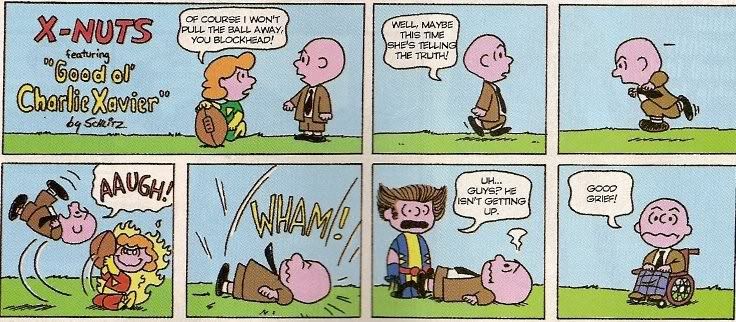
• X-Men/Peanuts mash-up. (See above, re: necessary knowledge; in this case, Peanuts and X-Men...)
• Harold Bloom's Macbeth/George W. Bush mash-up. In the unlikely event that Bloom ever sees this blog post, I may be indirectly responsible for his death, since he'd probably have a heart attack at my calling something he wrote a "mash-up". But the term fits.
• Launching a paper airplane from space. Not humorous, but funny in the "it's a strange world" sense. And cool.
Not Funny
• This profile of Rick Perlstein is a great introduction to one of the really important writers in the blogosphere, and among the historians of contemporary America. (You can real Perlstein's blogging here.)
• Jon Evans on the future of reading. No surprises to regular readers of Cory Doctorow here, but it puts the basics all in one limpidly expressed place.
• I don't think I agree with this critique of Ray Bradbury's Fahrenheit 451 -- certainly not all of it -- but it's interesting, and a good corrective to the vaguely positive memories you may have of the book.
Funny
• Explaining Art to Geeks. This is really !@#$% hilarious, although you actually need to know geeky stuff (e.g. some basic html, something about photoshop, typical internet jokes, etc) to get most of the jokes. My wife and I went through them together and between us we got just about all of them. (Come to think of it, knowing a bit about famous paintings helps too.) Basically, if you find this funny:
• Kung Fu Monkey delves into a recent mystery. (I had those of you in the know at "Kung Fu Monkey"; for the rest, click through...)
• The Constitution is a Living Document. Just like you need to know a bit about geekery & painting to get the first link in this section, if the phrase "the Constitution is a living document" means nothing to you, then this might not be funny. If it does mean something to you: click through.
• X-Men/Peanuts mash-up. (See above, re: necessary knowledge; in this case, Peanuts and X-Men...)
• Harold Bloom's Macbeth/George W. Bush mash-up. In the unlikely event that Bloom ever sees this blog post, I may be indirectly responsible for his death, since he'd probably have a heart attack at my calling something he wrote a "mash-up". But the term fits.
• Launching a paper airplane from space. Not humorous, but funny in the "it's a strange world" sense. And cool.
Not Funny
• This profile of Rick Perlstein is a great introduction to one of the really important writers in the blogosphere, and among the historians of contemporary America. (You can real Perlstein's blogging here.)
• Jon Evans on the future of reading. No surprises to regular readers of Cory Doctorow here, but it puts the basics all in one limpidly expressed place.
• I don't think I agree with this critique of Ray Bradbury's Fahrenheit 451 -- certainly not all of it -- but it's interesting, and a good corrective to the vaguely positive memories you may have of the book.
Saturday, January 19, 2008
Technical Problem Bleg: Quotes Not Working
Over four months ago, I added random quotes to my sidebar. I used a script on a blog that's now taken down. The quote file is here. It all worked fine for four months. And then suddenly yesterday the quotes stopped loading -- all I see now is a blank space. (I tried a couple browsers.) Anyone have any idea why this happened or how to fix it? Thanks --
(I can't think how to post it here without it working, but if anyone is good with this stuff I'll send you an email with the html....)
Update, February 15: ...And then, weeks later -- long after I'd given up and decided to remove the quote widget entirely (although, luckily, before I'd gotten around to actually doing so) -- they spontaneously started working again. Very, very weird. I presume it's something that blogger did to its software or something -- both times. But that is a presumption that is 100% cluelessness, and 0% reality-based, so take it for what it's worth: zip.
Friday, January 18, 2008

Monday, January 14, 2008
Hillary: the Devil Defense
The common English phrase "the devil's advocate" comes from the canonization process in the Catholic Church, where they would appoint
Hillary Clinton, as promised, has unleashed a barrage of negativity on Obama since the New Hampshire campaign -- presumably an attempt to regain front-runner status (which seems to have been successful so far). She is lying about his record on Iraq (via) -- to help disguise the fact that the single most pertinent difference between the two leading Democratic candidates is that one favored the immoral, disastrous war our country is currently engaged in and the other opposed it. She is trying to suppress the vote of voters who oppose her. And perhaps most repulsively, she is currently engaging Bush-backing surrogates to make racial smears (others listed here -- unless you think she's simply 'unlucky' in her advocates all settling on this at once). Clinton's not just gone negative -- she's gone Rove.
Which is the argument in defense -- not of voting for her, but of being thankful for her campaign. Because however many lies she tells, however nastily she smears Obama on racial grounds, the Republicans in the general campaign will do so a thousand times more viciously, more immorally and more mendaciously if Obama is the candidate. (Of course they will. If you think that St. John of McCain is above this sort of thing, then you simply weren't paying attention when McCain ratified American torture or threw himself in Bush's arms for the 2004 election, blessing his Iraq policy to date. McCain will do whatever it takes to win if he's the candidate: he may be the figurehead, but he'll be heading Rove's machine.) So if Obama can't overcome lies and racial slurs to beat Clinton... then he can't do it to beat McCain (or whoever else the Republicans unite behind).
Obama is speaking for a new form of politics. If he can win the Democrats with it, perhaps he can win the country. But since it's crucial for the Democrats to win -- and Clinton, whatever else you can say about her, would be a vastly, vastly lesser evil than every single one of the Republicans -- we need to be sure that the country is ready for it. If we are, then Obama can campaign on hope -- and, perhaps, transform the country's politics in the bargain.
If not, we'll hire the devil's advocate to fight an even greater devil, and let Hillary win a nasty, Rovian fight (probably with a Rovian-sized margin of victory, too).
None of this is to endorse voting for Clinton, of course. The point is that the issue is our national will -- whether we're ready to be better than this. And we can (collectively) decide what that will is: each of us plays an equal part. So if you (all of you, my real readers and my hypothetical ones) go out and vote for Obama, that act will make us a good enough country to do it. If not... then we're not ready yet, and Clinton's the One.
I just hope that, if it comes to that, I can stomach it when I vote for the race-baiter over the warmongering torture-promoter in the general election.
In the meantime, I'll vote for the hope that we're better than this. (To say nothing of the more liberal candidate -- and the one who voted against this hideous war.)
a canon lawyer... to argue against the canonization of the candidate. It was his job to take a skeptical view of the candidate's character, to look for holes in the evidence, to argue that any miracles attributed to the candidate were fraudulent, etc. The Devil's advocate was opposed by God's advocate, whose job was to make the argument in favor of canonization.(John Paul II removed the devil's advocate from the process, allowing far more saints to be canonized -- as Wikipedia notes, a tribute to the role's effectiveness.) The phrase relates doubly to this blog post, as it is not only playing the Devil's Advocate (in arguing, however tangentially, for Hillary) but also arguing for her on the grounds that she is playing one.
Hillary Clinton, as promised, has unleashed a barrage of negativity on Obama since the New Hampshire campaign -- presumably an attempt to regain front-runner status (which seems to have been successful so far). She is lying about his record on Iraq (via) -- to help disguise the fact that the single most pertinent difference between the two leading Democratic candidates is that one favored the immoral, disastrous war our country is currently engaged in and the other opposed it. She is trying to suppress the vote of voters who oppose her. And perhaps most repulsively, she is currently engaging Bush-backing surrogates to make racial smears (others listed here -- unless you think she's simply 'unlucky' in her advocates all settling on this at once). Clinton's not just gone negative -- she's gone Rove.
Which is the argument in defense -- not of voting for her, but of being thankful for her campaign. Because however many lies she tells, however nastily she smears Obama on racial grounds, the Republicans in the general campaign will do so a thousand times more viciously, more immorally and more mendaciously if Obama is the candidate. (Of course they will. If you think that St. John of McCain is above this sort of thing, then you simply weren't paying attention when McCain ratified American torture or threw himself in Bush's arms for the 2004 election, blessing his Iraq policy to date. McCain will do whatever it takes to win if he's the candidate: he may be the figurehead, but he'll be heading Rove's machine.) So if Obama can't overcome lies and racial slurs to beat Clinton... then he can't do it to beat McCain (or whoever else the Republicans unite behind).
Obama is speaking for a new form of politics. If he can win the Democrats with it, perhaps he can win the country. But since it's crucial for the Democrats to win -- and Clinton, whatever else you can say about her, would be a vastly, vastly lesser evil than every single one of the Republicans -- we need to be sure that the country is ready for it. If we are, then Obama can campaign on hope -- and, perhaps, transform the country's politics in the bargain.
If not, we'll hire the devil's advocate to fight an even greater devil, and let Hillary win a nasty, Rovian fight (probably with a Rovian-sized margin of victory, too).
None of this is to endorse voting for Clinton, of course. The point is that the issue is our national will -- whether we're ready to be better than this. And we can (collectively) decide what that will is: each of us plays an equal part. So if you (all of you, my real readers and my hypothetical ones) go out and vote for Obama, that act will make us a good enough country to do it. If not... then we're not ready yet, and Clinton's the One.
I just hope that, if it comes to that, I can stomach it when I vote for the race-baiter over the warmongering torture-promoter in the general election.
In the meantime, I'll vote for the hope that we're better than this. (To say nothing of the more liberal candidate -- and the one who voted against this hideous war.)
Recent Links, Taking-a-Break-from-Primaries Edition
Some non-primary links, since I, at least, am a bit primaried-out for right now -- I'm finding the Clinton-Obama attacks too depressing for words. So first -- and mostly -- some non-political links, and second a few political, but not-involving-the-primary, links.
Non-Political
• The BoingBoing-Did-You-Click-Through?™ link of the day is this video of the various instrumental and vocal tracks of Sgt. Peppers' separated out and played individually. The third track (about the third quarter of the video), which is more-or-less an a cappella version of Sgt. Pepper's, is wonderful and eerie.
• During my recent excursion into Swanwick nonfiction, I found that this wonderful Swanwick essay, 'A Nettlesome Term That Has Long Outlived Its Welcome', is online. The term, incidentally, is "fix-up", a technical term in genre literary criticism for... well, read it and see.
• In genre criticism of a very different sort, here is an interesting John Barnes essay on science fiction as a reaction to what he calls "the seventy-five years war".
• Explaining Tintin scientifically.
• Sleevefaces.
• "How to Survive Writing a Graphic Novel" by Grady Klein.
• Playing Waiting for Godot in New Orleans. (Borderline politics in this one.) If you're a Wire fan, you'll recognize one of the actors as Wendell Pierce -- who plays Bunk Moreland -- and who is, it seems, a New Orleans native.
Political
• Watch out - The Invaders are coming. (Also only borderline politics, but unlike the previous link, I've decided that this one falls on the other side of the border; hence my placement of it...)
• Our wretched health care system is getting (at least comparatively) worse -- we're falling behind other industrialized countries at a regular rate. Ezra Klein calculates that if we'd kept pace, we'd have saved 101,000 people who died but who should have been saved with a decent health care system.
This is getting to be a damn dangerous country to live in.
Worth remembering the stakes as we wade through the muck of this primary system: politics is about real people's lives. And when the bad guys win, people die. It's that simple.
Saturday, January 12, 2008
“Torture is a foreseeable consequence of the military’s detention of suspected enemy combatants"
“Torture is a foreseeable consequence of the military’s detention of suspected enemy combatants.” That sounds like something an enraged leftie would say, right? Arguing against detaining people as "suspected enemy combatants"?
Nope. It's the judgment of a U.S. court (via) -- not, mind you, a judgment that was used to criticize the U.S. for doing something which had torture as a "foreseeable consequence", but to argue that Donald Rumsfeld and others were immune from lawsuits because in ordering the torture of prisoners Rumsfeld was just doing his job. (But torture's illegal, you say? No problem -- "Criminal conduct is not per se outside the scope of employment.")
And that's not all. The court also dismissed the complaints of religious discrimination by the prisoners (who are UK citizens freed in 2004, suing for damages based on their treatment in detention) on the ground that they were not included in the "persons" under the relevant statute -- "effectively ruling that the detainees are not persons at all for purposes of U.S. law" as the plaintiffs' lawyers put it.
Judge Janice Rogers Brown -- a judge widely opposed for being a lunatic conservative -- criticized that part of her colleague's decision, saying that it
This is an appeals court making the ruling -- but there is no earthly reason why the distinctions between the various branches of our government, and our complex judicial system, should be the concern of non-citizens. This was the U.S. government. So if I were the editor of a newspaper -- particularly a foreign newspaper, perhaps a country where some of our citizens had been kidnapped by the U.S. and held without trial in Guantánamo for years -- I would write the headline:
-- and, God help us, I would be telling nothing more than the simple truth.
Say it loud and say it proud: our government tortures people it considers less than human. Just another feather in an already well-feathered cap for Bush's America.
Update: Scott Horton discusses this decision here. (Via Chris Floyd.)
Nope. It's the judgment of a U.S. court (via) -- not, mind you, a judgment that was used to criticize the U.S. for doing something which had torture as a "foreseeable consequence", but to argue that Donald Rumsfeld and others were immune from lawsuits because in ordering the torture of prisoners Rumsfeld was just doing his job. (But torture's illegal, you say? No problem -- "Criminal conduct is not per se outside the scope of employment.")
And that's not all. The court also dismissed the complaints of religious discrimination by the prisoners (who are UK citizens freed in 2004, suing for damages based on their treatment in detention) on the ground that they were not included in the "persons" under the relevant statute -- "effectively ruling that the detainees are not persons at all for purposes of U.S. law" as the plaintiffs' lawyers put it.
Judge Janice Rogers Brown -- a judge widely opposed for being a lunatic conservative -- criticized that part of her colleague's decision, saying that it
leaves us with the unfortunate and quite dubious distinction of being the only court to declare those held at Guantánamo are not ‘person[s].’ This is a most regrettable holding in a case where plaintiffs have alleged high-level U.S. government officials treated them as less than human.Alleged, yes. How could anyone think that treating these people as less than human was what U.S. officials would do -- after all, they were just cleared on the grounds that the torture of the non-persons was, after all, "foreseeable".
This is an appeals court making the ruling -- but there is no earthly reason why the distinctions between the various branches of our government, and our complex judicial system, should be the concern of non-citizens. This was the U.S. government. So if I were the editor of a newspaper -- particularly a foreign newspaper, perhaps a country where some of our citizens had been kidnapped by the U.S. and held without trial in Guantánamo for years -- I would write the headline:
U.S. DECLARES GUANTANAMO PRISONERS LESS THAN HUMAN
Detainee Torture "Foreseeable" Part of U.S. Official's Job, Court Holds
Detainee Torture "Foreseeable" Part of U.S. Official's Job, Court Holds
-- and, God help us, I would be telling nothing more than the simple truth.
Say it loud and say it proud: our government tortures people it considers less than human. Just another feather in an already well-feathered cap for Bush's America.
Update: Scott Horton discusses this decision here. (Via Chris Floyd.)
Thursday, January 10, 2008
Refuting a Dangerous Piece of Pseudo-History
A long time ago by web standards -- y'know, last year! -- I argued that Jonah Goldberg's new book "Liberal Fascism" may be nonsense, but it is dangerous nonsense, and thus what were needed was not mere mockery (lots more linked to in my earlier post), but serious refutations, despite the understandable temptation to laugh the book off as ludicrous.
Well, they're starting to come in. And as much as I appreciate demonstrations of how Jonah's magazine has, historically, supported fascists, what I really wanted to see were hard-hitting direct refutations. David Neiwert (who I mentioned before was planning a review) has just published such a one on the American Prospect web site. It's what was needed -- although he could have easily made it thrice the length, really, and I would have been glad to see him do it. (He's promised to post some extra material on his blog, though, so he may yet do so.) But what he did serves the purpose. Here's a taste:
Update: Niewert has written a lot on Goldberg since I posted this, but I think this is the most significant of his posts. So if you want more, read that. (But read the review first.)
Well, they're starting to come in. And as much as I appreciate demonstrations of how Jonah's magazine has, historically, supported fascists, what I really wanted to see were hard-hitting direct refutations. David Neiwert (who I mentioned before was planning a review) has just published such a one on the American Prospect web site. It's what was needed -- although he could have easily made it thrice the length, really, and I would have been glad to see him do it. (He's promised to post some extra material on his blog, though, so he may yet do so.) But what he did serves the purpose. Here's a taste:
The title alone is enough to indicate its thoroughgoing incoherence: of all the things we know about fascism and the traits that comprise it, one of the few things that historians will readily agree upon is its overwhelming antiliberalism. One might as well write about anti-Semitic neoconservatism, or Ptolemaic quantum theory, or strength in ignorance. Goldberg isn't content to simply create an oxymoron; this entire enterprise, in fact, is classic Newspeak.Read the whole thing. And I recommend linking the words Jonah Goldberg's Liberal Fascism to that particular web article: it's what people interested in those four word really need to read -- an explanation of precisely why they are so laughable, rather than just the mockery they do in fact deserve.
Update: Niewert has written a lot on Goldberg since I posted this, but I think this is the most significant of his posts. So if you want more, read that. (But read the review first.)
Wednesday, January 09, 2008
Hair of the Dog: Day After Linkfest
I'll probably add to this as the day goes on, but here are some interesting things I've read about last night's election upset.
• Glenn Greenwald on how the media is !@#$%ed up. (Also here.)
• Matt Ygelsias has an interesting chart about the polls' reliability, and a brief but crucial comment on the (non) relevance of the Wilder (aka Bradley) Effect.
• Publius starts off talking about gender-backlash, but it turns into a very good brief on why he's for Obama.
• Some good advice for anti-Clinton folks from Kos; via Atrios, who adds:
I certainly know people in real life who a) don't want Clinton to win and b) are tempted to vote for her every time they're exposed to the way she's treated by the deeply broken monsters in our mainstream media.Count me in that camp. I will vote for Obama next month; but it'd be good if this serves to chasten the sexist, appalling media coverage of HRC.
Tuesday, January 08, 2008
Separated At Birth: Election Results... and Cubism?

The Problem with Hope is You Get Crushed if It Fails
If Clinton wins tonight -- as of 9:05p.m. she's ahead with 28% reporting -- I'm going to be quite seriously depressed. Hell, I'm bummed that Obama didn't win in a blow-out as the polls this weekend suggested.
I surprise myself that I care quite this much. On some level they'd probably both be pretty decent candidates & presidents. But I'm feeling like I'm on an emotional roller-coaster.
And yeah, I know it's only one state. This isn't a rational reaction. I'd like to be more rational than this; but evidently I'm not. (I fear my emotions may be typical too: and that Obama's momentum will be seriously stalled even by only a narrow win, let a lone by a loss...)
...If, as is looking likely, Clinton wins tonight, then Dday is right about the possible upside to this. Even for Obama supporters, it's nice to see blowback against sexist and stupid media coverage.
...Congratulations to Senator Clinton on her New Hampshire victory.
What Can Be Made of What Can Be Saved From the Wreckage??
I am a sucker for obscure books, particularly obscure books about other books; I greatly enjoy the nonfiction of Michael Swanwick; I am interested in the makings and unmakings of literary reputation. So when I learned (from Swanwick's blog, chiefly devoted to flogging his forthcoming novel (which I haven't yet read)) that Michael Swanwick was publishing an 18,500 word essay on a famous early twentieth-century fantasist -- James Branch Cabell -- that I had never read,* I was intrigued.
What sold me on it was the first page, which Swanwick posted to his blog. Here are the essentials (although if you want I encourage you to go read it in its entirety, with the supporting details I omitted):
Since it was published only in a limited edition of 217 copies,** I feel a certain obligation to review it: there aren't that many copies out there to be reviewed, after all.
Sad to say, though, my review will be a mixed one.
First of all -- and, among the negatives, chiefly -- the format is totally ridiculous: a $20 (counting shipping) paperback*** of 38 pages, plus another ten pages of (often quite wonderful) footnotes: an 18,500 word essay dressed up as a book. I'd call it a rip-off if I (and everyone else who gets it) weren't quite so clear on what we were getting into. Still, when Swanwick refers (on page 9) to "small-press books created for the sole purpose of separating collectors from their money", I felt uncomfortably like I'd just been had. -- Except how much money can there be in a print run of 217 copies?
Why this essay wasn't released on the web -- perhaps as a pdf -- where it could have gotten a lot more readers, and quite frankly probably made Swanwick more money as an ad for his other books (or even this one) than it made in royalties, is beyond me. I would encourage him to release it on the web now -- although if he does I may sue him for my $20 back in small-claims court. (It is, I grant, a nice enough physical object, with a cool cover too.)
Finally, there is an irony (intentional?) in publishing a book in such a format, since Swanwick's chief argument is that it was Cabell's presentation of his works that doomed his reputation.
Okay, on to the content.
The book is not quite what I thought, namely, the story of how Campbell ruined his reputation; that is dealt with in the first eight (and last few) pages. Swanwick's argument is that, basically, by claiming that all his works made up a single large work -- The Life of Manuel -- Cabell made readers slog through his bad works as well as his good ones, leading most people to decide not to bother, and most of the remainder to be thoroughly turned off. Seems reasonable, although I don't know enough to dispute it****
The bulk of Swanwick's book, then, is a book-by-book evaluation of Cabell's oeuvre (as the title, I suppose, indicates clearly enough). This evaluation is often quiet witty and entertaining, as Swanwick-on-literature tends to be; I can only trust that his judgment is also up to his usual levels, but if it is then one is in good hands.§
But it could be clearer. Swanwick goes, roughly, from Cabell's worst to best works -- except that he starts with Cabell's very best book, and then does the nonfiction first. If you aren't quite familiar with Cabell's oeuvre, then it's quite confusing. (Swanwick doesn't even add that many guiding sentences, of the "Now I'm going to skip the 20's and pick up again with the books he wrote after his 18 volume collected work was published" sort. (That one in particular would have helped.))
Also, while Swanwick does say that the core of Cabell's Life of Manuel sequence is his best work -- and lists them (see below), he also adds that two books "are structurally necessary components" of the sequence without clarifying whether, say, one should start with the lesser but first-in-sequence books or with the best books -- an odd omission indeed for an essay whose chief argument is that Cabell's putting his book in a sequence, by its resultant bulk and hiding of his best work, "discouraged new readers... [and] hindered attempts to consider Cabell fairly". (p. 37). Do I need to begin at the beginning with The Cream of the Jest? Or is Jurgen independent enough to begin with, but then I need to read The Cream of the Jest? Or can I just read the ones Swanwick says are best and get to the " structurally necessary components" later? Swanwick isn't clear -- thus becoming, to a slight degree, an accessory after-the-fact in the self-sabotage that Swanwick so entertainingly argues that Cabell undertook.
And while Swanwick talks about the rewriting Cabell did for his collected edition, he isn't clear about whether one needs to get the rewritten texts (are the others still around? In libraries, probably, if nothing else) or if the additions are hindrances, or too minor to matter.
Finally, while Swanwick says that Cabell's best works are worthy of attention, he didn't make me feel it, quite. He describes the plots of the various books, but in a way that makes them sound sort of familiar and not worth seeking out; he says the books are witty, and he quotes a few examples to prove it -- but not enough to make me want to seek them out. A good essay of this sort, I'd say, should make you want to go read the good works of the writer; and this didn't, quite.
I suspect these last few complaints add up to the fact that this is not a good introduction to Cabell's work -- although it's title and declared purpose make it seem like it ought to be a good one. I suspect that, because of its format maybe, Swanwick only expected Cabell fans to read it -- and for them I'd certainly recommend it. But if you don't already have a sense of the general shape of Cabell's series, Swanwick's book will provide only a hazy one. And while I do now have a sense of what Cabell books Swanwick thinks I should read, I don't feel all that moved to go read them -- not more so, say, than if Swanwick had written them an enthusiastic blurb. Partly this is because Swanwick spends so much energy on Cabell's faults that that is a large impression remaining from the book -- moreso, really, than Cabell's virtues, which Swanwick claims but doesn't describe, at least not in enough depth for my taste.
But What Can Be Saved From the Wreckage? was a very entertaining read on its own -- interesting and at times (for me, anyway) laugh-out-loud funny; and perhaps that is enough. If not a great brief for Cabell's work, it is a good brief for Swanwick's criticism -- which someone should collect in some more-accessible form. Certainly, when Swanwick gets around to wrecking his own not-inconsiderable-if-perhaps-not-quite-up-to-Cabell-levels reputation by compiling a collected edition of his own works, I certainly hope he'll include this one.
Frankly, if he'd released it on the web, I'd just have linked and said that he could've been clearer about some things. Since he didn't... you have this review.
Still, since copies are limited, and non-Cabell readers might be interested in Swanwick's bottom line, and since the sentences are clearly within the limits quotable in a review for copyright purposes... Here is Swanwick's final verdict:
Update: Michael Swanwick kindly answers three of my questions from this review in his post on his blog.
_____________________________
* Well, I read a chapter and a half of one of his books -- I don't even remember which one -- once; I was in somebody's office and it caught my eye. The chapter didn't encourage me to go find another copy, although it wasn't bad, and I don't even remember now which book it was -- based on Swanwick's description, though, I think it was The High Place.
** 200 copies in trade paperback, and 17 copies in a limited edition signed not only by the author, publisher and introducer of the study, but by its late subject as well, something accomplished by finding 17 of his signed books, cutting the signature out, and pasting them in the new publication.
I got the trade paperback.
*** Technically the book is only $15. But since it's being sold only by its publisher, for all practical purposes you have to pay $20 including the $5 shipping (assuming you live in the U.S.), unless you live close enough to the publisher's address in Upper Montclair, New Jersey to walk over and pick up your copy.
**** Although those who do have; Neil Gaiman (who I've seen praise Cabell elsewhere) said of Swanwick's book: "I love Michael's essay, although I'm not entirely convinced by it. (Michael feels that Cabell doomed himself to obscurity. I think it was more time, and fashion what dun it.)"
§ Okay, I admit I said that partly because Swanwick refers rather snarkily to Cabell's use, in a nonfiction work, of "...the first person plural, the second person singular, and the Mandarin "one"" (p. 14) Well, how else is one supposed to say that in English? And "Mandarin"? I swear, when I hit that sentence I thought for a full two seconds that Cabell somehow used yi a lot before I got what he actually meant.
What sold me on it was the first page, which Swanwick posted to his blog. Here are the essentials (although if you want I encourage you to go read it in its entirety, with the supporting details I omitted):
There are, alas, an infinite number of ways for a writer to destroy himself. James Branch Cabell chose one of the more interesting. Standing at the helm of the single most successful literary career of any fantasist of the twentieth century, he drove the great ship of his reputation straight and unerringly onto the rocks.Sounded like a good story. I ordered it; it came yesterday, and I read it last night.
It is hard to imagine today the magnitude of James Branch Cabell’s fame in the early part of the last century... Yet he died as good as forgotten....
This remarkable feat of self-obliteration was accomplished through diligence, hard work, and a perverse brilliance of timing on Cabell’s part. His chief tool was a uniform edition of his works.
Since it was published only in a limited edition of 217 copies,** I feel a certain obligation to review it: there aren't that many copies out there to be reviewed, after all.
Sad to say, though, my review will be a mixed one.
First of all -- and, among the negatives, chiefly -- the format is totally ridiculous: a $20 (counting shipping) paperback*** of 38 pages, plus another ten pages of (often quite wonderful) footnotes: an 18,500 word essay dressed up as a book. I'd call it a rip-off if I (and everyone else who gets it) weren't quite so clear on what we were getting into. Still, when Swanwick refers (on page 9) to "small-press books created for the sole purpose of separating collectors from their money", I felt uncomfortably like I'd just been had. -- Except how much money can there be in a print run of 217 copies?
Why this essay wasn't released on the web -- perhaps as a pdf -- where it could have gotten a lot more readers, and quite frankly probably made Swanwick more money as an ad for his other books (or even this one) than it made in royalties, is beyond me. I would encourage him to release it on the web now -- although if he does I may sue him for my $20 back in small-claims court. (It is, I grant, a nice enough physical object, with a cool cover too.)
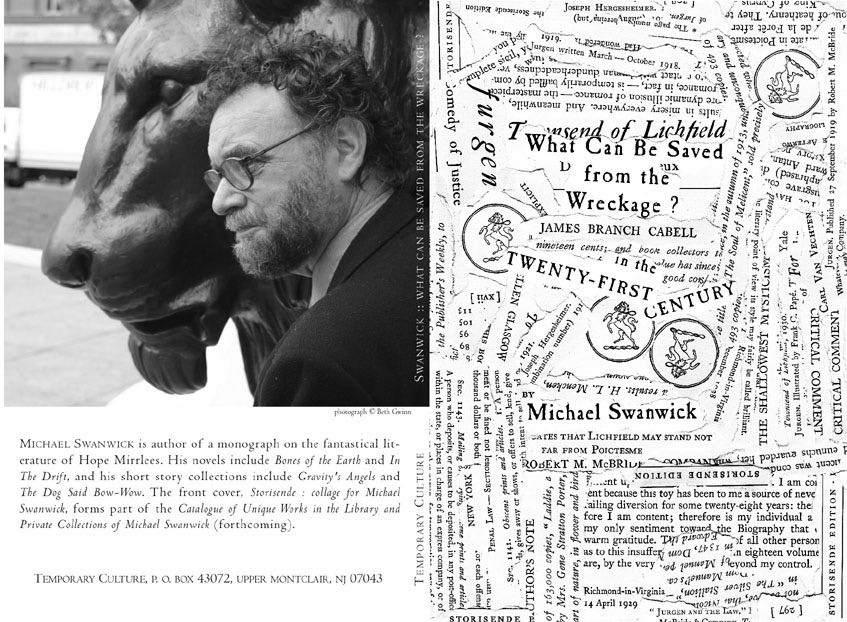
Finally, there is an irony (intentional?) in publishing a book in such a format, since Swanwick's chief argument is that it was Cabell's presentation of his works that doomed his reputation.
Okay, on to the content.
The book is not quite what I thought, namely, the story of how Campbell ruined his reputation; that is dealt with in the first eight (and last few) pages. Swanwick's argument is that, basically, by claiming that all his works made up a single large work -- The Life of Manuel -- Cabell made readers slog through his bad works as well as his good ones, leading most people to decide not to bother, and most of the remainder to be thoroughly turned off. Seems reasonable, although I don't know enough to dispute it****
The bulk of Swanwick's book, then, is a book-by-book evaluation of Cabell's oeuvre (as the title, I suppose, indicates clearly enough). This evaluation is often quiet witty and entertaining, as Swanwick-on-literature tends to be; I can only trust that his judgment is also up to his usual levels, but if it is then one is in good hands.§
But it could be clearer. Swanwick goes, roughly, from Cabell's worst to best works -- except that he starts with Cabell's very best book, and then does the nonfiction first. If you aren't quite familiar with Cabell's oeuvre, then it's quite confusing. (Swanwick doesn't even add that many guiding sentences, of the "Now I'm going to skip the 20's and pick up again with the books he wrote after his 18 volume collected work was published" sort. (That one in particular would have helped.))
Also, while Swanwick does say that the core of Cabell's Life of Manuel sequence is his best work -- and lists them (see below), he also adds that two books "are structurally necessary components" of the sequence without clarifying whether, say, one should start with the lesser but first-in-sequence books or with the best books -- an odd omission indeed for an essay whose chief argument is that Cabell's putting his book in a sequence, by its resultant bulk and hiding of his best work, "discouraged new readers... [and] hindered attempts to consider Cabell fairly". (p. 37). Do I need to begin at the beginning with The Cream of the Jest? Or is Jurgen independent enough to begin with, but then I need to read The Cream of the Jest? Or can I just read the ones Swanwick says are best and get to the " structurally necessary components" later? Swanwick isn't clear -- thus becoming, to a slight degree, an accessory after-the-fact in the self-sabotage that Swanwick so entertainingly argues that Cabell undertook.
And while Swanwick talks about the rewriting Cabell did for his collected edition, he isn't clear about whether one needs to get the rewritten texts (are the others still around? In libraries, probably, if nothing else) or if the additions are hindrances, or too minor to matter.
Finally, while Swanwick says that Cabell's best works are worthy of attention, he didn't make me feel it, quite. He describes the plots of the various books, but in a way that makes them sound sort of familiar and not worth seeking out; he says the books are witty, and he quotes a few examples to prove it -- but not enough to make me want to seek them out. A good essay of this sort, I'd say, should make you want to go read the good works of the writer; and this didn't, quite.
I suspect these last few complaints add up to the fact that this is not a good introduction to Cabell's work -- although it's title and declared purpose make it seem like it ought to be a good one. I suspect that, because of its format maybe, Swanwick only expected Cabell fans to read it -- and for them I'd certainly recommend it. But if you don't already have a sense of the general shape of Cabell's series, Swanwick's book will provide only a hazy one. And while I do now have a sense of what Cabell books Swanwick thinks I should read, I don't feel all that moved to go read them -- not more so, say, than if Swanwick had written them an enthusiastic blurb. Partly this is because Swanwick spends so much energy on Cabell's faults that that is a large impression remaining from the book -- moreso, really, than Cabell's virtues, which Swanwick claims but doesn't describe, at least not in enough depth for my taste.
But What Can Be Saved From the Wreckage? was a very entertaining read on its own -- interesting and at times (for me, anyway) laugh-out-loud funny; and perhaps that is enough. If not a great brief for Cabell's work, it is a good brief for Swanwick's criticism -- which someone should collect in some more-accessible form. Certainly, when Swanwick gets around to wrecking his own not-inconsiderable-if-perhaps-not-quite-up-to-Cabell-levels reputation by compiling a collected edition of his own works, I certainly hope he'll include this one.
Frankly, if he'd released it on the web, I'd just have linked and said that he could've been clearer about some things. Since he didn't... you have this review.
Still, since copies are limited, and non-Cabell readers might be interested in Swanwick's bottom line, and since the sentences are clearly within the limits quotable in a review for copyright purposes... Here is Swanwick's final verdict:
...the only serious claims [James Branch Cabell] makes upon posterity lie in his Poictesme books.... Further, these works, the Biography of the Life of Manuel if you wish, are not eighteen in number but six, of which the best are Jurgen, The Silver Stallion, and Figures of Earth. The Cream of the Jest and Something About Eve are structurally necessary components of the True Life and The High Place belongs somewhere in there as well. Not far below these are The Way of Eden and possibly a short story or three. (p. 37)And there you have it. I have taken the liberty of adding links to those works in Swanwick's Cabell canon that are on-line, so that Cabell's better books, anyway, may reach a larger audience than 217 readers -- even, just possibly, through this very review.
Update: Michael Swanwick kindly answers three of my questions from this review in his post on his blog.
_____________________________
* Well, I read a chapter and a half of one of his books -- I don't even remember which one -- once; I was in somebody's office and it caught my eye. The chapter didn't encourage me to go find another copy, although it wasn't bad, and I don't even remember now which book it was -- based on Swanwick's description, though, I think it was The High Place.
** 200 copies in trade paperback, and 17 copies in a limited edition signed not only by the author, publisher and introducer of the study, but by its late subject as well, something accomplished by finding 17 of his signed books, cutting the signature out, and pasting them in the new publication.
I got the trade paperback.
*** Technically the book is only $15. But since it's being sold only by its publisher, for all practical purposes you have to pay $20 including the $5 shipping (assuming you live in the U.S.), unless you live close enough to the publisher's address in Upper Montclair, New Jersey to walk over and pick up your copy.
**** Although those who do have; Neil Gaiman (who I've seen praise Cabell elsewhere) said of Swanwick's book: "I love Michael's essay, although I'm not entirely convinced by it. (Michael feels that Cabell doomed himself to obscurity. I think it was more time, and fashion what dun it.)"
§ Okay, I admit I said that partly because Swanwick refers rather snarkily to Cabell's use, in a nonfiction work, of "...the first person plural, the second person singular, and the Mandarin "one"" (p. 14) Well, how else is one supposed to say that in English? And "Mandarin"? I swear, when I hit that sentence I thought for a full two seconds that Cabell somehow used yi a lot before I got what he actually meant.
Monday, January 07, 2008
Which is Greater -- the Historical Stupidity or the Political Stupidity?
Hillary Clinton today, from Politico (via):
...Damn.
Even the Politico itself felt compelled to add:
If I wasn't already solidifying on Obama, this might push me over. I say again: damn.
Update: Josh Marshall claims that Hillary's remarks were taken out of context -- although he admits that her wording was ambiguous. I'm not sure I'm convinced by Marshall's reading -- she was answering a question about King, not Kennedy -- but if he's right then at what she said was reasonable enough. I just don't know if that's what she said (it's almost certainly what she wishes she'd said...) Later: Ben Smith defends his original interpretation here.
Update 2: Yglesias accepts Marshall's interpretation, but notes that saying your opponent is like JFK is a poor political argument, even if there is some merit to it as a criticism. Meanwhile, another blogger accepts the basic LBJ v. MLK interpretation, spelling out a bit more than I did above how offensive it is and why. (via)
Update 3: Steve Benen sides with the MLK/LBJ interpretation, and links to Oliver Willis doing the same. I'm about ready to write off Marshall's interpretation as special pleading -- what Clinton wishes she'd said, but not what she did say.
... and still more MLK/LBJ talk from Mark Kleiman. (via)
As for the other Clinton story of today: ...whereas this whole "crying" thing strikes me as just silly -- should be a non-issue -- and, yes, shame on Edwards for his response. This will only get play because of the sexism/herd instinct of the media. (Although I must admit that when I read that the question she was answering was "Who does your hair?", even I find it kind of funny...)
Clinton rejoined the running argument over hope and "false hope" in an interview in Dover this afternoon, reminding Fox's Major Garrett that while Martin Luther King Jr. spoke on behalf of civil rights, President Lyndon Johnson was the one who got the legislation passed.King didn't act, only spoke? Obama's "only" like King?
Hillary was asked about Obama's rejoinder that there's something vaguely un-American about dismissing hopes as false, and that it doesn't jibe with the careers of figures like like John F. Kennedy and King.
"Dr. King's dream began to be realized when President Johnson passed the Civil Rights Act," Clinton said. "It took a president to get it done."
..."The power of that dream became real in people's lives because we had a president" capable of action, Clinton said.
...Damn.
Even the Politico itself felt compelled to add:
Clinton didn't explicitly compare herself to Johnson, or Obama to King. But it seems an odd example for the argument between rhetoric and action, as there's little doubt which figure's place in history and the American imagination is more secure.Word.
If I wasn't already solidifying on Obama, this might push me over. I say again: damn.
Update: Josh Marshall claims that Hillary's remarks were taken out of context -- although he admits that her wording was ambiguous. I'm not sure I'm convinced by Marshall's reading -- she was answering a question about King, not Kennedy -- but if he's right then at what she said was reasonable enough. I just don't know if that's what she said (it's almost certainly what she wishes she'd said...) Later: Ben Smith defends his original interpretation here.
Update 2: Yglesias accepts Marshall's interpretation, but notes that saying your opponent is like JFK is a poor political argument, even if there is some merit to it as a criticism. Meanwhile, another blogger accepts the basic LBJ v. MLK interpretation, spelling out a bit more than I did above how offensive it is and why. (via)
Update 3: Steve Benen sides with the MLK/LBJ interpretation, and links to Oliver Willis doing the same. I'm about ready to write off Marshall's interpretation as special pleading -- what Clinton wishes she'd said, but not what she did say.
... and still more MLK/LBJ talk from Mark Kleiman. (via)
As for the other Clinton story of today: ...whereas this whole "crying" thing strikes me as just silly -- should be a non-issue -- and, yes, shame on Edwards for his response. This will only get play because of the sexism/herd instinct of the media. (Although I must admit that when I read that the question she was answering was "Who does your hair?", even I find it kind of funny...)
In Which I Am Beat to the Punch
So William "always wrong" Kristol has his first NYT column today, in which (among other things) he says:
Oh, wait.
So I thought I'd dig up a quote about what a regular guy Bush was, just to pair it with Kristol's... and what I found is that the blogosphere is already on the case, here. So, instead, here are some links about Kristol's debut.
Matt Yglesias has what is proboably the quote of the day:
In contrast, Eddie-George -- who also gives us a "shorter Kristol": 'the hicks are on to something' -- focuses on a different part of the column:
More on Kristol's NYT debut:
• Tristero uses the side-by-side placement of Krugman and Kristol to show how pathetic the latter is.
• And Mustang Bobby tells us not to worry about Kristol's claim that Huckabee could do well in the general election:
• A lot of bloggers focused their ire on how badly written Kristol's first column was. Both James Fallows at the Atlantic Montly and Greg Sargent at the Horses's Mouth focus on Kristol's reliance on cliche, although Attaturk puts it more pithily:
• MJ Rosenberg talks about the kind of conservative that Kirstol is:
And, since a key part of the Conservative M.O. is to deny and rewrite the past, here are some links on Kristol's past:
• Think Progress has Kristol's previous opinion of the NYT.
• Tom Tomorrow recounts Kristol's past claims in handy cartoon form.
• Media Matters link to some of Kristol's past lies here.
The NYT really has covered itself in glory this time, eh?
Update: For the humorous take on Kristol's debut, see this column at BTC News -- really quite funny. If you want more, see The Rude Pundit (who, as always, lives up to his name). (Links via.) Oh, and by the way William "campaign manager for Alan Keyes" Kristol misattributed a quote in his very first column.
There will be no Clinton Restoration. A nation turns its grateful eyes to you.-- because, of course, that decade of peace and prosperity really was a nightmare. But what really took the cake was this line:
After the last two elections, featuring the well-born George Bush and Al Gore and John Kerry, Americans — even Republicans! — are ready for a likable regular guy. Huckabee seems to be that.--And my first thought is that some prankster broke into the NY computers and added this sentence as parody; I mean, I know that lying and rewriting the historical record is second nature for conservative hacks, but surely even William "Pathological Liar" Kristol wouldn't...
Oh, wait.
So I thought I'd dig up a quote about what a regular guy Bush was, just to pair it with Kristol's... and what I found is that the blogosphere is already on the case, here. So, instead, here are some links about Kristol's debut.
Matt Yglesias has what is proboably the quote of the day:
[Kristol is] the kind of guy who when he goes out on a weird limb and says Mike Huckabee would have a good chance of winning in a general election, you immediately start wondering why he's saying that. "Because he believes it" doesn't tend to rank very high on the list. That's his rep, and based on his record it seems like a deserved rep. But when you read your morning paper and find yourself wondering why, exactly, its authors are trying to mislead you, then your morning paper is suddenly not so useful.So what does it mean? A lot of bloggers read Kristol's column as the Republican establishment okaying a Huckabee candidacy, i.e. they see Kristol's column as interesting from a barometrical perspective (as the New Republic once said of Tom Friedman.) (Update: Yglesias proposes an answer to his own question here.)
In contrast, Eddie-George -- who also gives us a "shorter Kristol": 'the hicks are on to something' -- focuses on a different part of the column:
Republican Plan B(loomberg) is being hatched. And Kristol's closing paragraph is a very clear warning that he would support it if Huckabee wins the nomination
More on Kristol's NYT debut:
• Tristero uses the side-by-side placement of Krugman and Kristol to show how pathetic the latter is.
• And Mustang Bobby tells us not to worry about Kristol's claim that Huckabee could do well in the general election:
Mr. Kristol sounds like someone who is trying to convince himself and his fellow Republicans of something he doesn't quite believe himself; that Mike Huckabee is the best of a very bad lot and the best chance they have of winning the election.
• A lot of bloggers focused their ire on how badly written Kristol's first column was. Both James Fallows at the Atlantic Montly and Greg Sargent at the Horses's Mouth focus on Kristol's reliance on cliche, although Attaturk puts it more pithily:
Bill Kristol cannot write worth a shit. He makes Bobo Brooks read like Walter Lippman. He quotes Michelle Malkin, which is sort of like Theodore Bilbo quoting Simon Legree.
• MJ Rosenberg talks about the kind of conservative that Kirstol is:
Perhaps the Times thought it was getting George Will, an elegant writer who is a conservative not a GOP party hack. I'm a liberal and sometimes Will drives me crazy but Will's columns are never identical to a press release from the chairman of the RNC. That is all Kristol's are. Pure party pap. James Carville without the cleverness or humor. But the Times would never hire Carville or any Democratic sloganeer because it was thought that political slogans didn't belong on the op-ed page, not by a regular columnist anyway. But that is what they have in Kristol.
And, since a key part of the Conservative M.O. is to deny and rewrite the past, here are some links on Kristol's past:
• Think Progress has Kristol's previous opinion of the NYT.
• Tom Tomorrow recounts Kristol's past claims in handy cartoon form.
• Media Matters link to some of Kristol's past lies here.
The NYT really has covered itself in glory this time, eh?
Update: For the humorous take on Kristol's debut, see this column at BTC News -- really quite funny. If you want more, see The Rude Pundit (who, as always, lives up to his name). (Links via.) Oh, and by the way William "campaign manager for Alan Keyes" Kristol misattributed a quote in his very first column.
Sunday, January 06, 2008
Repost: Covering Cerebus
The Newsarama comics blog just put up a list of various critics' choices of the best comics criticism of 2007. One of those critics, Derik A. Badman, was kind enough to choose my eight-part series, Covering Cerebus, as his favorite. To celebrate this, I thought I'd repost links to the series for anyone who missed it.
You can read the Newsarama best-of list here. Derik has a list of his runner-ups here (including, yes, another Attempts entry, my piece on page four of City of Glass); Derik also posts his thoughts on the Newsarama post here.
If anyone already read the Cerebus series, and is looking for more comics criticism by me, I think my best work in this area are the twelve entries to date in my series on 100 Great Comics Pages. (Derik asked me in email if more are forthcoming; the answer is: yes, definitely; but probably not soon -- they take too long, and this is a busy semester for me.) I also have some thoughts on teaching graphic novels, in particular Howard Cruse's marvelous Stuck Rubber Baby, here.
Meanwhile, here are the links to my series, "Covering Cerebus":
Part One: In Which I Walk the Standard Line
Part Two: In Which We Get to the Good, Although Recommendation is Withheld
Part Three: In Which the Covers Are Used to Illustrate the Books
Part Four: In Which I Continue to Illustrate the Books with the Covers
Part Five: In Which Further Books Are Judged by Their Covers
Part Six: Books. Covers. Judgments. Further.
Part Seven: In Which Covers Are Discussed Apart From Their Contents
Part Eight: A Conclusion, in Which Recommendations Are At Last Made, with General Ruminations about the Nature of Love
Appendix: Cerebus Links
(Anyone looking for an abridged version can safely skip parts five through seven, and still have the rest make sense.)
Thanks, Derik! And everyone else -- Enjoy!
Interesting Comments on the Democratic Primary
Not sure I agree with these, but they seemed interesting.
First, the pessimistic view of the Obama phenomenon, which (like so many others) I am high on right now:
Second, an idea for HRC. Someone asked me this weekend what I'd advise her to do if she asked. Putting aside my jesting-but-not-really-joking answer of the moment -- "drop out" -- this advice from Jane Hamshire seems like the best strategy for Clinton I've seen:
First, the pessimistic view of the Obama phenomenon, which (like so many others) I am high on right now:
I feel a bit like I'm sitting in the middle of the dot com boom right now, with people telling me I don't understand the new economy which operates by different rules. Profits are no longer important, there are boundariless organizations, and it's going to be a long prosperous boom with no more business cycles. And I'm the curmodgen saying that the rules of politics, the nasty and hyperpartisan right-wing, have not been repealed.A terrifying thought. But is Clinton the answer? I don't see that. And Obama's "ride-above-the-fray" approach may work better than Stoller thinks: right-wing attacks have backfired before, and may simply serve to remind people of the negativity that Obama claims he can transcend. So I dunno. Still interesting.
Second, an idea for HRC. Someone asked me this weekend what I'd advise her to do if she asked. Putting aside my jesting-but-not-really-joking answer of the moment -- "drop out" -- this advice from Jane Hamshire seems like the best strategy for Clinton I've seen:
Clinton needs to do something dramatic. Take the bull by the horns, show that she's not just an overly scripted politician who will never do anything that's isn't "safe." An excellent way to do that would be to leave the campaign trail and go back to Washington with Chris Dodd to filibuster retroactive immunity for the telecoms. The message that "nobody should be above the law," that she'll fight for accountability and won't be held hostage by big money interests would be a powerful one. She'd certainly grab all the media attention by doing so, and force Obama to either follow her lead or stay behind on the campaign trail while she goes to Washington and fights for the constitution -- neither of which have good optics. It would be decidedly un-Penn like, unsafe and virtually impossible to poll. But it might be just the kind of shaking up that her campaign -- and the race as a whole -- would benefit from....Of course, this is the left blogosphere's cause and style (we loved us some Chris Dodd last December), so maybe this is just the echo chamber. But this sounds right to me: a good move that Obama would have a hard time responding to. (In contrast, much as I'd love to see him do it, it'd be dumb for Obama to do this now, and break his momentum.) I think the chances she'll do this are about nil. But it seems like something she could do to shake up what is otherwise a bad trend line for her.
Friday, January 04, 2008
Bird Blogging: Houseguests Edition
We have houseguests this week: two additional birds who are here, along with our regular overlords companions. So it seems like a good week to indulge in some Friday bird blogging.
I present to you: a not-very-still life with four birds (plus non-avian bird perch):

Up on the stick are our regular houseguests Weber and Fields (their namesakes are introduced here); down on Sara's arm are our live-in lovebirds Snark and Boojum (and their namesakes are introduced here).
And because I love these four-bird shots, and it's my blog, here's another:

And a close-up of Weber and Fields:

And of Snark and Boojum:

(Snark is the upper one, who is lighter green; Boojum is lower, and more blue-ish.)
Happy Friday!
I present to you: a not-very-still life with four birds (plus non-avian bird perch):

And because I love these four-bird shots, and it's my blog, here's another:

And a close-up of Weber and Fields:

And of Snark and Boojum:

Happy Friday!
Subscribe to:
Posts (Atom)