Monday, May 01, 2006

Best of the Blogosphere, Part 1: John Holbo reads David Frum

(First in an occasional and entirely whimsical series. (Update: Later entries here.))

Bloggers, I am convinced, have done some damn fine writing in the past few years. The nature of the medium being what it is, however, the products of the past are too often swallowed up in the same void that devours day-old newspapers and month-old magazines. On the other hand, the nature of the medium also means that the rescue is easy: the material is there. One just has to link to it.

So, from time to time -- and I really have no idea how often, I might not do another for year, I might do another tomorrow -- I want to link to an old post that is worth reading -- indeed, worth rereading if one has already read it. To make sure that instant acclaim is not the standard, I will limit myself to posts at least a year old. (I know, I know: a pretty short time to ensure classic status. This is the internet, people. Way of the digital world.)

And, thanks to the most recent post by Michael Bérubé (most recent as of this writing), we have our first contender. Dr. Bérubé links to an old post by John Holbo which I really liked when I first read it. I just reread it: it really holds up. So, the first official Attempts Best of the Blogosphere™ post is: John Holbo reads David Frum in "Dead Right".

The basic set-up is this. Thanks to a recommendation by Josh Marshall (the link from Holbo's post is broken; use that if you want to read Marshall, although it's really just a passing comment) John Holbo went and read David Frum's Dead Right. Holbo then discusses Frum's philosophy, filled with ample and not-terribly-clearly-formatted quotations (the latter is my only gripe about the post really). Holbo decides that Frum hasn't really thought his underlying political philosophy through very well, and thus he

...attribute[s] rather outrageous views to Frum, not because I actually think he holds them but because I think he does NOT. These outrageous views are the views he WOULD hold if, perchance, he upheld and investigated only the most immediate ramifications of the bits and snippets of philosophy he espouses.
Hilarity ensues. But the insightful sort of hilarity that really good, biting comedy gives you. -- Really. Go read it.

The post exemplifies a few of the literary quirks of the nascent blogosphere, and I thought I might mention them briefly. First and foremost, it features a lot of very long quotations -- clearly in a copyright-allowable-way (being criticism, and only a snippet of the entire book), but in a way that in a traditional formal essay would seem excessive. But this isn't done because Holbo has nothing to contribute. On the contrary: he has a lot to say, but wants to A) be fair (in a fashion) to Frum, and B) let Frum hang himself by his own words.* (The Donner Party comes up. 'Nuff said.) This is a style of reading which, when done in its entirety to a short piece is referred to in the blogosphere as fisking. This isn't that -- he's only doing a tiny bit of a full-length book. But it is done with all the snark a good fisking entails... but having a dead serious intellectual point behind it (as, indeed, the best snark does).

I really wonder if David Frum ever read it. Part of me is inclined to doubt it, since he hasn't given up being a pundit and devoted the rest of his life to standing on corners and cleaning car windshields for spare change, which would be a reasonable response to this essay, I think. Nor does a quick google bring up any indication that he did -- just other people praising Holbo's post. But part of me thinks he must have read it. It was too widely passed around at the time for him not to have caught wind of it. So what did he think? What could he possibly have thought?

Goodness knows. But you can find out what you think: read the post!

Much Later Update: I just recently found out (via this thread) that John Holbo actually wrote a follow-up post to the one I highlighted here. Like many sequels, it's not as good as the original, but still, if you liked the first, it's worth taking a look at.

-------------
* Although at various points he quotes a full paragraph from other writers too. The idea here, I take it, is quite simply that the point has been made well, so why not simply quote it? This isn't written for money or tenure or anything like that, but just to convey ideas. So there's no reason not to simply rely on the words of others if they do the job well.

Thursday, April 27, 2006

Books & Cartoons to Watch out For

One of my favorite cartoonists (which, granted, is a long list) is Alison Bechdel. Her major work up to this point has been a biweekly comic strip called Dykes to Watch Out For. The first few years of this strip were individual cartoons which, frankly, I don't find all that interesting. But in 1987 she introduced some regular characters and made the strip an ongoing serial -- "half op-ed column and half endless, serialized Victorian novel" Bechdel calls it. And it was at that point that it really took off. It's been collected in ten to twelve books so far, and I highly recommend checking it out.

Ten to twelve? Why not be more precise?

I hear you cry. Well, the first of her books, Dykes to Watch Out For, collects cartoons and strips from before the ongoing serial (but which were -- confusingly -- already running under the "Dykes to Watch Out For" name) -- so whether it counts or not is arguable. The ongoing serial strip begins in the second book, More Dykes to Watch Out For. Honestly, however, the strip gets better as it goes along -- both the narrative complexity and Bechdel's drawing improves dramatically. I'd recommend beginning with the third book -- New, Improved! Dykes to Watch out For -- but if your drawing-standards are exacting you might want to skip ahead a few volumes farther -- say, to book five, Spawn of Dykes to Watch Out For (although her drawing has continued to improve as time goes on).

The one other odd-woman-out so far as the collections are concerned is The Indelible Alison Bechdel: Confessions, Comix, and Miscellaneous Dykes to Watch Out For. This isn't one of the standard collections. It includes a lot of Bechdel's other cartoons (of varying quality). It also includes what are, basically, outtakes from the regular strips: the strips from a monthly calendar she produced for a number of years, and other oddities like that. It's a fun book, but read the main sequence first.

So: the main sequence of the serial is collected in ten books; the other two books with 'Dykes to Watch Out For' somewhere in their title are secondary, but bring the number to twelve. See?

You also don't have to buy the books to try the strip. Most of the recent strips are on the web. For a long time they were run on the web site Planet Out, and they have an archive of them here -- containing strips #303 - #480. (Actually, although they don't have links to them for some reason, three more strips -- 481, 482 and 483 -- are also online there.) In the last few months, however, Planet Out has -- for some inexplicable reason -- stopped running the strip. The last few entries have been posted on Bechdel's Flicker photo stream as she looks for a new online home for the strip.

So you can use the online archives to see if you like the strip -- although, be warned: it is an ongoing story, best read in large chunks, and you'll be coming in right in the middle of a lot of story lines, without the helpful recap that Bechdel includes at the opening of each of the collections. I, personally, really prefer reading them on dead trees. But it's a good way to sample, I suppose. For a sample of the sample, here are a few personal favorites of mine: 304, 374, 420, 434. Although, to repeat: it really works best in much larger chunks -- in the end, it's really one long work (with a slightly shaky artistic beginning -- and it is far from the only comics for which this could be said.)

But. The key words in the sentence "Her major work up to this point has been a biweekly comic strip called 'Dykes to Watch Out For'" are "up to this point". Because her first full-length graphic novel is coming out in two months or so. It's a memoir, titled Fun Home: A Family Tragicomic, and based on the publisher's description it looks like it's largely about Bechdel's relationship with her father. All I've seen of it so far are the two sample panels that the publisher includes on the page. But I suspect that it may be Bechdel's best work yet, surpassing even her wonderful strip.

You see, in many of her later collections of Dykes to Watch Out For, Bechdel includes, after the regular strip, a "novella" featuring the major characters in a longer story (one which is usually referred to, but not narrated, in the biweekly serial) -- examples have included the birth of one of the main characters' child; a hectic day on which several of the main characters all move houses/apartments; a retrospective about how the characters met; and the story of a fundraiser held to help the bookstore run by one of the main characters (and worked in by several others) stay out of bankruptcy. And I've always thought that these novellas are the very best of the work -- that the greater length really allows Bechdel to shine.

Now, granted, I will dearly miss Mo & all the rest -- they're great characters, and some part of me would have preferred that Bechdel try a full-length novel about 'em rather than a memoir. But even so: it sounds like an extraordinary story, and I bet that the extra length will really allow Bechdel to do some fascinating stuff. (It's also more color-full than her normal work: instead of black-and-white, it will be two-color, i.e. blue-and-black-and-white, which is actually a wonderful look, I think, which has been used to good effect by many cartoonists.)


Anyway, it should be coming out some time soon. Watch out for it -- I know I will be. In the meantime, if you haven't read it before, check out Bechdel's ongoing strip.

[Update. I've been meaning to post a comprehensive review, but it's looking like I won't get around to it, so let me sum up and say that Fun Home is absolutely terrific, a truly marvelous book, and that I recommend it unreservedly to everybody.]

Wednesday, April 26, 2006

Buying Books Online: Links and Notes

There are some things that one just assumes everyone knows. I've worked hard at learning not to do this over the years, but I still have a long ways to go (and I don't really ever expect to get all the way there). Chatting with a newly-made friend today, I found out that she didn't know about all sorts of online resources to buy books with that I sort of assumed everyone knew about. So here are a few links I know of that I find helpful when shopping for books. If anyone knows any I left out, please leave them in the comments!

The first and most basic tool I use are two sites which themselves aggregate other online search engines. There are more than these two sites, but in my experience checking too many one hits diminishing returns, since they all check more or less the same databases. But there isn't complete overlap -- sometimes one will have a surprising hole (e.g. not finding all editions of a book but just some, not finding a book on some site that the other metasearch engine will find it on, etc), so it's worth checking more than one. So I use these two:
http://www.allbookstores.com
http://www.anybook4less.com
These sites aren't perfect -- the errors mentioned above will sometimes occur on both -- but in general they do a fairly good job, I think.

Most of the rest of the sites I know of are ones which those two will point you towards. But still, for anyone who wants to check them directly, there are a number of sites which allow you to search many used book stores across the U.S. (and, often, in England & elsewhere -- pay attention to where it's coming from, as it may affect shipping time and/or price!). The biggest of these, I believe is:
http://www.abebooks.com/
--but another one is:
http://www.alibris.com/
And Amazon.com, of course, does the same thing, as well as selling you new books (and barbecue grills and underwear and probably short-range missiles). Finally, while not strictly speaking just for used books, a lot of used books appear on:
http://www.half.ebay.com/

The other thing to take into account, of course, is shipping cost. Most of these sites will give you a discount if you buy more than one book from the same store (i.e. the same actual, physical used book store, not just the same online portal) so it's worth searching around to see if you can combine books. In general, abebooks has somewhat higher shipping prices than alibris, which in turn is a bit higher than half.com; and if you find a book on one, it's worth checking the others since the same copy is often listed on multiple sites. On the other hand, I often find that ordering books from multiple stores is cheaper than combining orders, even factoring in multiple shipping costs.

For new books, overstock.com has Amazon-like prices on a lot of things, but only charges $1.40 per book for shipping, so if you're buying under $25 (the amount at which amazon will ship for free), it's worth trying that. In contrast, ebay often has outrageous shipping prices -- a lot of ebay sellers seem to fold a lot of their actual merchandise price into their shipping cost (presumably to hide it when sorting ebay by price or on search engines such as the above, or simply to try and sucker people who don't pay attention), so pay particular attention when buying books on ebay (this is even aside from the auction factor -- I'm talking now just about the ebay "stores" which sell you things immediately.)

Those are some of the web sites I use. Again, if anyone has any others, please leave them in comments!

Thursday, April 20, 2006

Talking Blogging Heads

File under 'everyone is blogging now': David Byrne blogs -- yeah, that David Byrne. (via)


Update: When I posted this, it had escaped my attention that there really was something called "blogging heads" -- or, rather, BloggingHeads TV. David Byrne isn't involved in that, though.

And as an addendum to the "everybody's blogging" list, you can add John Crowley.

Wednesday, April 19, 2006

History Might Be Kind to Bush

Now that's a headline that I suspect my at-the-moment-purely-hypothetical regular readers never thought they'd see from me -- and one which, with one possible exception (hi, Uncle John!), they would all object seriously to. But while I admit second place to no one in my horror at the damage that the Bush administration has done to my beloved country, I think that Bush, the ultimate gentleman's-C-student, might get away with less blame than we, now, would think warranted. Let me explain.

The thought arose because I read two excellent essays back-to-back. The first was the recent Rolling Stone article by the fine historian Sean Wilentz considering whether Bush really is the worst president in U.S. history. His answer, it will probably surprise few to learn, is yes. Or, more precisely:

No historian can responsibly predict the future with absolute certainty. There are too many imponderables still to come in the two and a half years left in Bush's presidency to know exactly how it will look in 2009, let alone in 2059. There have been presidents -- Harry Truman was one -- who have left office in seeming disgrace, only to rebound in the estimates of later scholars. But so far the facts are not shaping up propitiously for George W. Bush.

I think a fair summary of his arguments might be that while the race is far from over, at the moment Bush is well ahead with no obstacles between him and the finish line. If any conservatives wish to object, they should at least consider Wilentz's considered argument and explain why they don't agree. He has a lot of evidence on his side. He's very persuasive. He persuaded me. (Although admittedly I already thought so.)

So why might history be kind to Bush? The answer, I think, lies in the two types of problems we face at the moment.

Now, I say "two types", but -- of course, of course -- there really are not two types, but a whole spectrum ranging from one extreme to another, quite possibly a multi-dimensional spectrum at that, one with wormholes by which problems on one side can leap instantly to the other and bridges which draw seemingly separated problems into a single whole. Granted. But of course the whole point of simplifications is to help us think through ungraspable complexities, and I think there's some use to this one, so bear with me.

The first sort are problems which we either would not have had had Al Gore ascended to the presidency which he had rightfully won or -- shading out on the spectrum -- which we might have made progress on with democrats in charge. The war in Iraq, the disastrous deficit, the erosion of long-held civil liberties and most of the other nearly-uncountable damages of the Bush administration fall in the first half of this category. The long-term issue of Jihadism, the issue of basic civil rights for our gay and lesbian citizens and the health-care crisis are (although this is category is harder to speak with confidence about) in the second half -- problems which Gore would at the least have quite clearly been better on, and problems which, had mainstream liberal thinking been pursued (respectively: 1) Get Osama without getting sidetracked, work on locking down nukes and other dangerous weapons, court rather than inflame moderate Muslim opinion; 2) just give them equal rights damnit; 3) single-payer) might well have been more-or-less solved. Of course the political Gore was a cowardly creature, hardly the courageous figure that emerged after his loss, and of course he would have had a hard-right Republican congress (and VP) to deal with, all of which would have limited his options. But there would have been hope.

And, frankly, on these issues there still is a great deal of hope. Iraq is likely going to be a horror for a generation to come, blood which will forever saturate Bush's hands, but America might well extract itself from that situation soon after Bush's term -- little consolation to the people of Iraq, but some to us. As for all the other problems, I have high hopes that the present full-scale meltdown of the all-conservative government might just possibly lead to a resurgence of muscular American liberalism, which might actually make some progress on them. So on these issues we can, at least, hope -- and fight to make hopes real.

But then there are the second set of problems -- problems which no mainstream American political thinking has any reasonable answers for. Problems which even when given lip service by the left, there is little chance of achieving anything on in the foreseeable future. These are the problems that make me think that we are living in the period of the Decline and Fall of the American Empire -- if not of our civilization. I am, I know, a pessimist, and given to apocalyptic thinking. Nevertheless, the words of Hari Seldon often ring in my ears:

The appearance of strength is all about you. It would seem to last forever. However, Mr. Advocate, the rotten tree-trunk, until the very moment when the storm-blast breaks it in two, has all the appearance of might it ever had. The storm blast whistles through the branches of the Empire even now. Listen with the ears of psychohistory, and you will hear the creaking.

What problems are these? Well, there are many, and detailing them is more than I can do here and now. So let's just take one: global warming.

Global warming, Noble Reader, is a serious !@#$%ing problem. Scientists are increasingly convinced that we may hit a "tipping point" at which beyond efforts to mitigate it will be, frankly, too late. Al Gore is reportedly saying in his new movie that we may have only a decade to act before reaching that point. Some scientists are saying we may not even have that long -- that we might already have reached it. (You won't hear too much of that, because people tend to want to inspire action -- since, after all, we can't be sure that it's too late. But the whispers are there, if you listen.)

This is where the second essay which I read comes in. It's a blog post by Brad Plumer (via), who talks about what would be needed, practically, to slow global warming -- and how, while it might well be technically possible, is currently beyond the political pale -- "the goal looks attainable in theory, but in practice may be far out of reach," in his words. Simply because of the level of change in our society -- and in every society, worldwide -- which would be required.

And the actual results could be disastrous. -- I haven't the heart, right now, to go into the details. But this could be an epoch-making change in human history -- even apart from fears of peak oil, or any of the other large-scale problems that seem to bear down on us.

It seems likely -- or, as Dr. Wilentz might put it, "there are too many imponderables still to come... to know exactly... but so far the facts are not shaping up propitiously" -- that our era will seem in retrospect to be one long, slow-motion disaster, where ecological damage accumulated, and we collectively fiddled as our planet burned.

In which case Bush might actually get off easily. After all, while the Democrats would clearly be better on Iraq, on terrorism, on the economy, on health care, on civil liberties -- on a whole host of issues -- it seems unlikely that the corporate-beholden party could have done enough on global warming to make a real difference. Oh, they might well have pushed forward with Kyoto -- if the Republican congress would have let them. But even Kyoto was just a start: and it seems unlikely that they would have done more.

(Maybe -- maybe -- Al Gore, who has cared about this issue more and longer than almost any politician of national reputation, would have made it the defining issue of his presidency, had he secured it, as he has of his non-presidency. But he certainly didn't run on it. And, now, we'll almost certainly never know.)

In this case, Bush is likely to be remembered as simply one more disastrous leader who failed to lead. Oh, sure, worst than most -- probably worst than all. But who remembers which of the late Roman emperors was the worse? It is the vast rush of decline, not the short-term problems of any particular rule, that we recall. The Iraq war will be seen as simply one of the more egregious examples of the global tribulation that energy problems caused; the U.S. budget deficit will be seen as the almost-inevitable consequence of a global empire of military bases; signs of theocracy will be seen as the expected reaction to a declining civilization. Bush will fade into the background of horror -- a large figure in it, but still simply another one.

Bush, in short, might be saved from being damned by history because we might all be judged, collectively, so harshly that any individual looks small in the overall picture. Bush might be saved because the genuine disasters of his rule might fade into the background of larger and more permanent disasters.

But not to worry. If we assume Bush is, at this point, shooting the moon (as in the game of hearts), and -- figuring he can't possibly be good, at least trying for first-place in the worst-ever sweepstakes -- there is hope for him yet. At this point Bush looks like he might simply fade into the background of general waste and destruction. But if he goes ahead with his rumored plans to start an unprovoked, aggressive nuclear war against Iran, I suspect the consequences will be dire enough that they will stick out even amongst the general problems that future historians will see. Or if his utterly reckless disregard of actual U.S. security, combined with his active pissing off of the entire world, particularly of the Muslim world, lead to another devastating terrorist attack -- even, to fixate on one of my most serious and longest-running nightmares, a nuclear terrorist attack -- then that, too, will vault him over the top of the genuinely awful. So there is -- after a fashion -- hope for Bush yet.

For the rest of us, I'm not so sure.

More Iran Links

Since I published my first two posts on the possibility of Bush attacking Iran, lots of people have said good stuff on the topic. Here are links to some of what I've seen, read and thought worth reading.

• Matt Ygelsias makes the basic case against war.

• The Union of Concerned Scientists has an animation explaining why nuclear 'bunker buster' bombs are likely not to work. (via)

• Billmon followed up his first post with a lot more on this topic; in particular This is Not a Drill, The Flight Forward and The Spiral Conflict.

• Glenn Greenwald notes that Bush thinks he has the authorization to attack Iran and talks about how the script for Iraq is being run again without any authorization in the aptly titled 'Lucy, Charlie Brown & the Football'.

• File under 'great minds think alike': both Glenn Greenwald and Billmon have written about right's use of the Neville Chamberlin metaphor.

• Digby speculates on whether Bush has already covertly begun the war; Majikthise, in contrast, speculates that the current retired general's rebellion aginst Rumsfeld might be an attempt to prevent the war. Digby also reminds us of the connection to neoconservative beliefs.

• Arthur Silber in anger and despair: Morality, Humanity and Civilization: "Nothing remains...but memories" and Lunatic World.

• William Rivers Pitt is scaring a lot of people with his essay about Iran's blowback capacity. Read and see why.

• Paul Krugman. 'Nuff said.

• Finally, here's something funny to chear you up after reading all that.

(Update: links added.)

Wednesday, April 12, 2006

"What if we started a nuclear war and nobody noticed?"

For a long time, Billmon was hands-down my favorite blogger. Nowadays he's been more or less on hiatus, save for the very occasional posted quote. But recently he posted a long piece on Hersh's reporting on Bush's war planning, and it is really worth a read. He begins by wondering why it hasn't attracted more attention --

...I've been at least a little bit surprised by the relatively muted reaction to the news that the Cheney Administration and its Pentagon underlings are racing to put the finishing touches on plans for attacking Iran – plans which may include the first wartime use of nuclear weapons since Nagasaki.... Even by the corrupt and debased standards of our times, this is a remarkable thing. The U.S. government is planning aggressive nuclear war (the neocons can give it whatever doublespeak name they like, but it is what it is); those plans have been described in some detail in a major magazine and on the front page of the Washington Post; the most the President of the United States is willing to say about it is that the reports are "speculative" (which is not a synonym for "untrue") and yet as I write these words the lead story on the CNN web site is: "ABC pushes online TV envelope"...

-- adds a few remarks on why we should take this seriously, and then goes on to speculate how it might be received by the U.S. public:

Never again would American rulers (or their foreign counterparts) be able to hide behind the comfortable fiction that the United States is just primus inter pares – first among equals. A country that nukes other countries merely on the suspicion that they may pose a future security threat isn't the equal of anybody. America would stand completely alone: hated by many, feared by all, admired only by the world’s other tyrants...

[But] It’s entirely possible the near-term consequences wouldn't appear as cataclysmic as you might expect from such a world-shaking event – except, of course, for those poor souls unlucky enough to be living near or downwind from one of Iran's suspected nuclear weapons facilities... But barring another 9/11, or a worldwide financial meltdown, the day after a nuclear strike on Iran might not look that much different than the day before, at least to the folks back home. ...

What I'm suggesting here is that it is probably naive to expect the American public to react with horror, remorse or even shock to a U.S. nuclear sneak attack on Iran, even though it would be one of the most heinous war crimes imaginable, short of mass genocide. Iran has been demonized too successfully – thanks in no small part to the messianic delusions of its own end-times president – for most Americans to see it as a victim of aggression, even if they were inclined to admit that the United States could ever be an aggressor. And we know a not-so-small and extremely vocal minority of Americans would be cheering all the way, and lusting for more.

More to my point, though, I think it's possible that even something as monstrously insane as nuclear war could still be squeezed into the tiny rituals that pass for public debate in this country – the game of dueling TV sound bites that trivializes and then disposes of every issue.

We’ve already seen a lengthy list of war crimes and dictatorial power grabs sink into that electronic compost heap: the WMD disinformation campaign, Abu Ghraib, the torture memos, the de facto repeal of the 4th amendment. Again, why should a nuclear strike be any different? I can easily imagine the same rabid talk show hosts spouting the same jingoistic hate speech, the same bow-tied conservative pundits offering the same recycled talking points, and the same timid Beltway liberals complaining that while nuking Iran was the right thing to do, the White House went about it the wrong way. And I can already hear the same media critics chiding those of us in left Blogostan for blowing the whole thing out of proportion. It’s just a little bunker buster, after all....

It’s possible, of course, that I’m dead wrong about the short-term effects of a strike on Iran. It could quickly lead to economic catastrophe and a wider war, or evolve into a full-fledged U.S. invasion and occupation of Iran – i.e. “regime change.”...

But my thought exercise – What if we started a nuclear war and nobody noticed? – is still useful, if only as a reminder of how easy it can be to lead gullible people down a path that ends in a place no sane human being would ever want to go. A nation that can live with the idea of launching a nuclear first strike isn’t likely to have much trouble with the rest of the program – particularly when its people, like their leader, are convinced they’ve been chosen to save the world.

I've only offered a bit of it here. The stuff I've cut is all good too. You really ought to go read the whole thing. It's worth it.

Tuesday, April 11, 2006

Party On, Snow Monkeys!

So I'm at home, busily cleaning for Passover (which starts tomorrow night), I decide to take a break, open a blog, and -- via Majikthise -- come across this wonderful story by Carol Vinzant about snow monkeys in the New York City Zoo having a (pre) holiday feast:

Security has been tight this week at the Central Park Zoo, with ticket takers, staff, and guards on the lookout for suspicious packages of cookies, pretzels, hot-dog buns, and pound cake. Observant Jews have till Wednesday to clear their houses of hametz (leavened products) before Passover, and every year many of them take their castoffs to the zoo. Baffled zoo staff note that the snow monkeys are the main beneficiaries of the pre-holiday pig-out, apparently because the polar bear’s glass wall is too high and the sea lions would only be interested if offered gefilte fish. “If a big group comes in carrying bags, admission is going to notice,” says zoo spokesperson Kate McIntyre.

The small, pink-faced snow monkeys (Japanese macaques) may not mind the interruption to their grooming routine and carefully prepared diet of fruits, greens, and nuts, but their caretakers sure do. Standard protocol is to politely ask food-throwers to stop. If they persist, security hovers and asks again (last year, one food-flinger said, “I don’t answer to you; I answer to a higher power”), but they are rarely ejected. “They really don’t know why they shouldn’t do it,” says one zoo volunteer. “They think they’re doing a good deed. I can’t say they like it when I tell them to stop. My answer to them is to take it to a shelter.” Other volunteers aren’t so tolerant. “If we see them do it, we should either frisk them for food or throw them out,” insists one.

But Yula Kapetanakos, an assistant curator, notes that the observant visitors don’t throw anything that bad. The real risk for the animals in eating too much people food is that they will get fat and lazy. Often the monkeys become so sated after their pre-Passover feast that they won’t go inside later for dinner.

Rabbi Moshe Elefant of Orthodox Union says there’s no religious imperative to give the food to animals. Still, “our tradition is not to waste food,” he says. “If we could give it to some animals to eat, that’s the best.” And since the run-up to Passover is so busy, Elefant says, the zoo’s just convenient. It’s more common for Orthodox families to go to city zoos in the middle four days of Passover, when the kids are out of school. Kapetanakos says the main things thrown by the big crowds then are bananas and matzo, that Passover staple. But Rabbi Elefant says, “I’m not sure how many animals are up for matzo.”

I just love that the monkeys are getting a pre-Pesach pig-out. And the fact that New York Magazine managed to come up with the Nabokovianly-named "Rabbi Elefant" for a story about Jews and the Zoo is just icing on the kosher-for-passover cake.

Happy Passover, everybody!

Monkey Eating Cake Like Object In Bundi
Disclaimer: this monkey is not in the New York
Zoo, is probably not a snow monkey, and almost
certainly was not given this cake before Passover.


A gorilla enjoys (?) a matzah. (Image source.) As
David Carter would say, standard disclaimer
about gorillas not being monkeys applies.

Sunday, April 09, 2006

Will Bush Nuke Iran?

According to an article by Seymour Hersh in the forthcoming issue of The New Yorker, Bush is seriously considering attacking Iran to eliminate its purported nuclear weapons program. Attacking Iran with nuclear weapons. I haven't kept a scorecard, but my impression is that Hersh's reporting has been rather reliable over the past few years. And I do know that the Bush administration has been serious about developing "usable" nuclear weapons -- in particular the bunker-busters they are reportedly considering using against Iran.

I think that Hersh's article is probably the scariest thing I've read in a good long while. Possibly even the scariest thing I've read during the entire Bush Administration. Obviously, Iran getting nukes would be a bad thing.* But that hardly means that bombing Iran would be a better option. (Sometimes there are no good options.) The horrific possibilities -- Iranian loss of life, the reaction of the rest of the world, the likelihood of terrible retaliatory attacks on Americans (in Iraq, in the "homeland" through terrorism, or elsewhere), to say nothing of increased support for the Iranian regime and increased Iranian determination to develop the bomb -- are so numerous that it boggles the mind. So even if Iran is on the verge of getting a nuclear weapon, I don't think we should bomb them. (We should negotiate seriously and in good faith, which it's hardly clear we've been doing.)

But of course these are the people that brought you the Iraq war, complete with we'll-be-welcomed-as-liberators, Mission Accomplished and all the rest. These are the people who are talking about bombing Iran causing the fall of the (Iranian) government, rather than a rallying around the government (which has traditionally been the response to bombing -- bombing has over and over again rallied civilians to even terrible governments; the thought it would work this time is nuts -- but then, these people are nuts). I hope no one dismisses this because it's simply too crazy. These people are crazy. I don't know if they will do this, but it's quite clear that they might. His poll numbers are low -- but that to them might be an argument for not against. Our army's bleeding in Iraq -- but since they seem to genuinely believe that there won't be retaliation, that the government will fall, they may think we can do both. There are systems of self-reinforcing thought at play here that may lead them to do it, blind or oblivious to the horrors they will unleash.

The one ray of hope in the article was the possibility that protests by senior military officers might force the batshit crazy civilians to back down. God I hope so. It's like Dr. Strangelove in reverse -- the loonies are the civilian government, the few sane people are the military.

The article's quite new, so so far the blogospheric response has been minimal -- at least in terms of substantive posts: most of what I've seen so far are basically expressions of horror. Digby and Tristero say a bit more; Jonathan Schwarz at This Modern World points us to this Washington Post article which adds a bit to Hersh's piece; and Think Progress points us to this summary of Hersh's article. The last link came from Atrios, who also drew my attention to the article in the first place; he points out the scale of likely world reaction. If I get a chance -- and see any additional good blogosphere discussion of this -- I'll try to add links.

Absa-fracking-lutely terrifying.

Update: P. Z. Myers comments (& follows up); as does Mahablog. Also Kip Manley. Matt Stoller has a brief comment. Also, two important pre-Hersh posts on this topic: Steve Clemons says that Israel is calmer than the Americans about Iran; and Kevin Drum mentions a few other articles discussing the increasing likelihood of a U.S. attack on Iran.

Additional Update: Crooks & Liars has the video of Hersh on CNN; TalkLeft quotes highlights of the transcript of the CNN interview, and the conclusion of a briefing paper about what the consequences would be. Hersh's interview made the bombing seem quite likely, but a specifically nuclear bombing rather unlikely -- due to military pressure on Bush. And, via Andrew Sullivan, the Times of London has a source confirming Hersh's reporting on the planning for a strike.

Still More: Josh Marshall explains why Bush administration denials mean "absolutely nothing"; Amanda also thinks of Dr. Strangelove. James Fallows in this month's Atlantic talks about why attacking Iran would be a bad idea. More commentary from: Max Sawicky; Todd Gitlin; Matt Yglesias; Helmut.

--------
*I actually think that anyone having nukes is a bad thing, and that the nuclear non-proliferation treaty should be pursued in good faith, i.e. that the nuclear powers (including us) should be getting rid of their weapons. That they should be illegal, just like chemical and biological weapons are, with intrusive inspections (of everyone, including us) to verify. And that this would be the best way to prevent the ultimate terrorist scenario, a nuclear attack on a city. But that's a different post.

Thursday, April 06, 2006

Music of Pain, Music of Anger

I clicked through because of politics.

I'd heard of the Dixie Chicks before -- frequently, of course, due to the public uproar around their (incredibly mild, really) comments about Bush -- but I'd never heard them before. Oh, I'd had a vague sense that maybe I ought to, but that feeling was basically all about politics: feeling that I ought to support people where the

...words that I said,
Send somebody so over the edge,
That they'd write me a letter sayin' that I better,
Shut up an' sing or my life will be over?

But I had no real impulse to listen to them because, well, they sang country music. And I didn't listen to country music. Oh, I liked the song I heard after Johnny Cash died, but I didn't have any big impulse to go find more. Just wasn't on my radar. One might think it should be, since it is (as Xander called it) "the music of pain" -- and there were certainly times in my life when I needed that. But it wasn't.

So when I saw Atrios's post on the Dixie Chicks's upcoming album, I clicked on the link to listen to a single from the album because of their politics -- and I thought, what the hell, if I can listen online, I might as well give it a try. I didn't even notice the single's title.

The first thing I noticed was that the song, "Not Ready to Make Nice Now", was awesome. So I started paying attention to it because of the music.

And I listened to the lyrics. I thought, instantly, based on just the chorus, that it was a subtle reference to the controversy over their anti-Bush remarks -- probably allegorized to a love affair, these things were, but still that it was about them. Then I went and read the lyrics -- and, no, there's no allegory, the lyrics are !@#$% about that controversy, straight up.

It also didn't sound like country music. And I saw that one of the band recently said that "We don't feel a part of the country scene any longer, it can't be our home any more... we now consider ourselves part of the big rock 'n' roll family." Indeed, a fan site said that the single "bear[s] little resemblance to the Chicks' original bluegrass/Western sound."

The musicians of pain are now playing the music of anger: rock.

And yeah, I love the lyrics --

I'm not ready to make nice;
I'm not ready to back down.
I'm still mad as hell,
An' I don't have time,
To go round and round and round.
It's too late to make it right;
I prob'ly wouldn't if I could.
'Cause I'm mad as hell:
Can't bring myself,
To do what it is you think I should.

-- but I haven't played it over and over for more than an hour because of the lyrics. I listened once because of the politics, but it's not the politics any more. It's the music -- the piece -- the entire song.

So give "Not Ready to Make Nice" a listen
. It's just awesome.

Hell, I may need to buy the whole album.


Friday, March 31, 2006

Friday Posting: Two Blogospheric Traditions

One of the things I like about the blogosphere is its nescient culture and traditions. I haven't done all that many specific blogosphere games (just one meme), but I do like them. And because of various circumstances I can participate, this week, in not one but two blog traditions that I don't usually do.

The first of these is the Friday Random Ten. The notion here is simple: get random songs from your iPod, note the first ten, and post them. I haven't been able to do this until now because I haven't had an iPod. But I was given one for my recent birthday; and after a few weeks most of my music (and some other fun stuff) is now on the iPod. I doubt I'll do it every week, but for now, here is a

FRIDAY RANDOM TEN

1) The Lord of the Rings, unabridged reading by Rob Inglis: the Fellowship of the Ring, Disk 3, Track 20
2) * Ditto, The Return of the King, Disk 11, Track 9 (beginning of chapter 7, "Homeward Bound")
3) Talking Heads, "I'm Not in Love"
4) George Harrison, "All Things Must Pass"
5) Annie (the musical), "It's the Hard Knock Life"
6) Tracy Chapman, "Mountains O' Things"
7) The Beatles, "I Saw Her Standing There" (live version, from the BBC)
8) ** The Hobbit, unabridged reading by Rob Inglis, Disk 6, track 11
9) Pimsleur Mandarin Set II, Unit 13 - Readings Track
10) Eric Clapton, "After Midnight"

* Yes, I have the entire thing on here. It comes up a lot on "random" because they put track dividers every three minutes, so there are a lot of tracks.
** Yes, I have The Hobbit too. Shut up.

This, incidentally, is why I never play my iPod on random -- I have a special playlist called "songs" which includes all but only songs, and if I want random I play that. But as I understand the rules of the Friday Random Ten, one sets random for everything one has on the iPod... which, for me, includes some non-music and leads to some weird choices. So it goes.

The other Friday blog tradition is pet blogging. This began with Kevin Drum's cat blogging, but has since expanded to a lot of different types of Friday blogging (plus parallels on other days too). Well, we don't have any pets... but we do occasionally pet-sit a pair of unrepentant felons known as Weber and Fields. They're with us this week, so here we have

FRIDAY BIRD BLOGGING


Ruler of the Roost


Everything is Tasty


Squabbling (not kissing, despite how it looks)

Happy Friday!

Monday, March 27, 2006

Stanislaw Lem, 1921 - 2006

Via Boing-Boing, I see that Stanislaw Lem, the great Polish SF writer, has died. Reuters has an obit here. To mark his passing, I'm reposting an edited version of this earlier post which included a snippet of one of his works.

Rest in peace.

****

This is a long-time favorite of mine. It's from Stanislaw Lem's novel The Cyberiad, translated by Michael Kandel (pp. 50 - 51 of the Harcourt Brace paperback). In it, the robot inventor Klapaucius comes up with an assignment for his competitor Turl's new electronic bard...

The Assignment:

"Have it compose a poem -- a poem about a haircut! But lofty, noble, tragic, timeless, full of love, treachery, retribution, quiet heroism in the face of certain doom! Six lines, cleverly rhymed, and every word beginning with the letter s!"

The Solution:

Seduced, shaggy Samson snored.
She scissored short. Sorely shorn,
Soon shackled slave, Samson sighed,
Silently scheming,
Sightlessly seeking
Some savage, spectacular suicide.

Well, what do you say to that?

It's a marvelous poem, I think -- in itself, and particularly given the stipulations. But of course it is also an astonishing piece of translation: it is hard to believe it wasn't written in English. (Douglas Hofstadter talks about this aspect of Kandel's translations, though not that I recall in relation to this particular poem, in his delightful book about translation, Le Ton beau de Marot.) So the question becomes: what's the Polish look like? Fortunately, the Polish version of Lem's Cyberiada is online -- it appears in its entirety. At any rate, it gives us:

The Assignment in Polish:

Niech ułoży wiersz o cyberotyce! - rzekł nagle, rozjaśniony. - Żeby tam było najwyżej sześć linijek, a w nich o miłości i o zdradzie, o muzyce, o Murzynach, o wyższych sferach, o nieszczęściu, o kazirodztwie, do rymu i żeby wszystkie słowa były tylko na literę C!!

The Solution in Polish:

Cyprian cyberotoman, cynik, ceniąc czule
Czarnej córy cesarskiej cud ciemnego ciała,
Ciągle cytrą czarował. Czerwieniała cała,
Cicha, co dzień czekała, cierpiała, czuwała...
...Cyprian ciotkę całuje, cisnąwszy czarnulę!!

As for how literal a translation this is, it turns out that Michael Kandel himself has answered this question. Greg Keogh at the Nancy Street Network has a Stanislaw Lem page on which he describes emailing this question to Kandel. Kandel provided the following literal gloss on the Polish:

Cyprian the cyber sex fiend and a cynic, appreciating tenderly the miracle of the dark body of the Negro daughter of Caesar, constantly wove charms with a zither. She blushed all over, silent, waiting every day, suffering, watching ... Cyprian kisses her aunt, have abandoned the black beauty!

(Of course the paradigms given the machine are quite different.)
Unfortunately, Kandel didn't give a literal gloss on the Polish paradigms (the "assignment" as I've called it). But this gives a sense of what the original is like -- and hence what Kandel was up against.

I still think "Seduced, shaggy Sampson snored..." is a terrific little poem. The question is: given that it isn't really a translation of Lem's poem (but rather an English equivalent of it), but one that occurs in a translation of Lem's novel and wasn't offered for independent publication -- who should be credited as the author of the poem? Lem? Kandel? Lem as translated by Kandel? Both in collaboration?

This is, however, an extreme case: the book as a whole is, quite clearly, a translation. And it's brilliant. For a taste of it in English, check out the opening of The Cyberiad, "How the World Was Saved", which is available (in English) on Lem's web site.

Sunday, March 26, 2006

2005 Koufax Awards Ballot

Here are my votes for the 2005 Koufax awards. Some choices were very narrowly decided -- there's a lot of great liberal writing out there. In some categories I wish I had more time to study the various choices in more detail. But in the end I decided to vote based on what I knew and thought at the moment (rather than deciding I was so overwhelmed by good and/or new choices that I wouldn't vote at all). So, without further ado --

Best Blog (non-pro): Hullabaloo
Best Blog Community: Daily Kos
Best Blog (pro/sponsor): Think Progress
Best Group Blog: Pandagon
Best Post: Unclaimed Territory by Glenn Greenwald: Bush's Unchecked Executive Power v. the Founding Principles of the U.S.
Best Series: Scott Lemieux of Lawyers, Guns, and Money for his Supreme Court coverage
Best Writing: Michael Berube Online
Best Expert Blog: Pharyngula
Best Single Issue: Informed Comment
Most Humorous Blog: Fafblog
Most Humorous Post: Kung Fu Monkey: Lunch Discussions #145: The Crazification Factor
More Deserving of Wider Recognition: 3 Quarks Daily
Best New Blog: Unclaimed Territory by Glenn Greenwald

[I cast no vote in the following categories:
Best State or Local Blog
Best Blog Commenter]

If you want to check out the competition, here are the pages with the links to all the finalists: Best Blog (non-pro); Best Blog Community; Best Blog (pro/sponsor); Best Group Blog; Best Post; Best Series; Best Writing; Best Expert Blog; Best Single Issue Blog; Most Humorous Blog; Most Humorous Post; Most Deserving of Wider Recognition; Best New Blog.

Incidentally, so far as I can tell this post by John Scalzi -- Being poor is knowing exactly how much everything costs -- was not ever nominated for best post. Now, I don't vote in rounds before the finals round, because I'm intimidated by how much I don't know. But I think it's a terrible, terrible oversight that Scalzi's post wasn't even nominated; had it ever occurred to me that it wouldn't be I would have done so. If it were on the final ballot, I would vote for it over any of the other contenders for best post this year (good as those are). So consider it my vote for "work most overlooked by the Koufax nominators" and my (uncounted) write-in vote for best post. In the meantime, if you haven't read it. do so. Don't skip the comments, which add a lot.

And the winners are...

Sunday, March 19, 2006

There Are No Excuses

...for those who got the war wrong. Three years into the greatest foreign policy disaster since Vietnam -- quite possibly one that will in the end prove far greater than that unhappy conflict -- none of the disastrous things that have happened were beyond the range of what was widely and loudly foreseen by anti-war voices at the time. I'll say it again: it was widely and loudly foreseen at the time. There are no excuses for getting this one wrong. You can't say you didn't know. This was not something that was tricky at the time or about which you can say, "if only we knew...". Because either you knew, or you damn well should have known, because most of the world was saying it as loudly as they could manage.

It was all perfectly clear.

No, it was not widely known that Saddam had no WMD at all. (But it was widely known that inspectors were on the ground in Iraq and finding nothing; it was widely known that there was no possible threat that could have justified removing them from the country and invading before letting them finish their task.) But WMD was always a category error -- worse, a deliberate category error, a portmanteau designed to rope together genuinely dangerous weapons that we had no reason to think Saddam had (nuclear weapons, biological weapons such as smallpox) with weapons that all sides believed that Saddam possessed -- weapons that, however horrific in their uses, were not a particular threat to the US (chemical weapons). No, we didn't know that Saddam didn't even have chemical weapons. But we knew he didn't have nuclear weapons and that he wasn't on the verge of getting them; we knew, in short, that he wasn't a threat.

And all the rest was simply and widely known, widely spoken at the time. The disastrous ineptitude of the Bush administration and its almost pathological tendency to lie and distort were both well known. The folly of trying to build a liberal democracy at "bayonet point" (to use the phrase that, of all people, Ronald Reagan used to dismiss the notion) was widely known. The caldron of ethnic and religious tensions that would boil over if we invaded was well known too. We knew all this.

And please, don't say: do you wish that Saddam Hussein were still in power? Of course I don't: no more than pro-war proponents really wanted Casey Sheehan and more than 2,300 other coalition troops -- to say nothing of an unknown and uncounted number of Iraqis (a number which, however, is likely to be well over 100,000 people) -- dead. The point is that removing him in this way was a foreseeable and foreseen disaster.

So no: there are no excuses. This is true of course of Bush, the supreme architect of this disaster (who was already talking about having a war for the political benefit before assuming the Presidency: a point which should not be forgotten). It is true of all the many other members of this administration behind the war -- all of whom, in a just world, would stand in the dock at the Hauge for the crime of aggressive war, the supreme crime of which the Nazi leadership were indicted by the U.S. and other at Nuremburg. (Not to mention the horrific crimes committed in the course of the war, which has turned the U.S. into a nation which tortures prisoners (most recent revelations on this matter in today's New York Times.))

But it is true of everyone else too. It is true of the cowardly Democrats who voted for this war (I'm looking at you, Senator Clinton, and you, Senator Kerry). It is true of the editorialists who endorsed it, of the warbloggers who pushed for it. Without the abetting of all of these groups the war would have been, at the least, much harder for Bush to pull off -- if not impossible.

I don't know what we should do now, since given the current disaster there are probably only various different bad options. I strongly suspect that the best course would be a U.S. withdrawal in a speedy a manner as would be consistent with troop safety. I might well be wrong about that. But how to proceed now that this disaster is upon us is not obvious.

Unlike the fact that the war would be a disaster, for all the reasons that almost everyone now acknowledges. That was obvious, three years ago. And for all those who abetted this disaster, there are no excuses. None at all.

Thursday, March 16, 2006

Brief Continuity Update

A couple weeks ago I posted a comics script released under a creative commons license, linking to it both here on my blog and on its own site. The script had taken me perhaps a month to write, on and off. It was for a 24 page comic, intended as a one-shot (i.e. not the beginning of an ongoing comic series), and I called it Continuity #1.

Well, I just found out last night that there is a graphic novel -- an actual, really-drawn-and-not-just-a-script and really-being-published-by-an-honest-to-God-publisher (AiT/Planet Lar) graphic novel -- coming out in June called, yes, Continuity. Not being a regular reader of Previews I hadn't known this. Now, I don't think that a big-time graphic novel like Continuity is going to be threatened by an embryonic little project like my script. And, frankly, it's not the most astonishing title for a comic ever devised ("continuity" being a big topic with comics fans). Still, if I'd known that there was a published book coming out with the title, I'd have chosen a different name for my script. But I didn't know, the script is out there, and I don't plan on changing it now. I doubt anyone will care, frankly. But I thought I should note the coincidence.

If you want to check out the upcoming graphic novel Continuity, the first 25 pages are being offered as a preview (in pdf format); you can find the preview here (direct link). If you want to read my script, you can find it here (direct link).

Sunday, March 12, 2006

Friday Five and Sunday Ten: Good Comics Covers

Tom Spurgeon has an excellent comics news blog called The Comics Reporter. One of the fun features that he does is one called "Five for Friday": he'll come up with a comics-related question to be answered with a list of five -- questions like "List Five of Your Favorite Comics Quotes (Without Attribution)", "Name Five Comics You've Found Non-Comics Readers Feel Are Easy to Read" or "Name Five People You Would Draft Into Making Comics -- No Cartoonists Who Have Worked as Such Since 1985" -- answer it himself, and then post responses from other people which he receives in the day or two after. It's a fun High Fidelity-type game in the comics field, although his comparatively strict deadlines, and my haphazard schedule, means I've only participated once myself.

Well, this week's version (which I, as usual, only saw post-deadline) was the superb question "Name Five Covers You Love". But I wasn't all that crazy about the nominees people put up -- although, truth be told, I only looked at those whose nominators provided links, plus Tom's own list even though he didn't -- because he's the host, y'know. (Although yes, I am enough of a geek that I did know some of the listed covers without links. Shut up.) Incidentally, since I looked up Tom's choices, here, as a public service, are his choices, with links:

1. Amazing Spider-Man #55
2. Weirdo #8
3. Kamandi #23
4. Yummy Fur #18
5. MAD #5
Don't get me wrong -- some of the various choices (both Tom's and other people's) were fine covers. But they weren't what I would have listed. So I decided to put together my own list -- I mean, what's a blog for?

But it's Sunday, it's my blog, and I felt like it... so this is ten, not five. (Actually, I found this incredibly easy. I could have gone to fifty. I love comics covers. Oh, sure, many are atrocious... but that's just Sturgeon's law.)

This isn't, incidentally, my "Top Ten Comics Covers Of All Time". It's just "Ten Covers I Love". I love others, too. On a different day I'd make a different list. But these are all great. In each case, I've given a thumbnail linked to a larger version; in many cases, you really have to click through to get what's good about the cover.


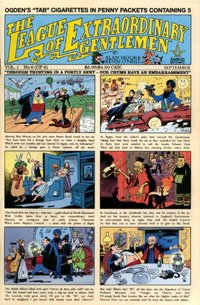
Alan Moore's final cover for the first League of Extraordinary Gentlemen Series retold the entire story so far -- in rhyme -- while also being thematically consistent with the series. It's fabulous.


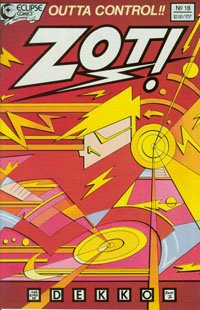
As Scott McCloud later said in Understanding Comics, so much of superhero costumes worked by making a few simple, bright colors iconic. This combines that idea with an awesome abstraction.


This one's just pretty. It's the cover for the second issue of Jessica Abel's La Perdida; I just got the collected version yesterday (yes, I "waited for the trade" -- or in this case the hardback -- and so missed out on this gorgeous cover. Ah well.)


Another cover that tells the story to date -- in this case, by quite literally putting every panel in the earlier 11 issues of the comic on the cover. (No, not that legibly, but if you've read them it will remind you.) It's a rather audacious idea, and it works.


Maurice Sendak meets the Hulk. I didn't read this issue, but this cover's just awesome.


This comic I haven't read either -- I'm not sure that it's even out yet. And no, I probably won't read it. But it's such a cute cover, which almost reprises the extraordinary Flex Mentallo in a single image. (You sort of have to know the history of these two characters to get this one, I'll admit.)


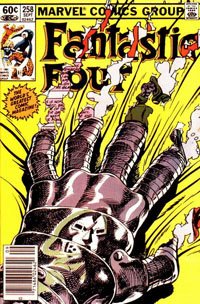
John Byrne did a lot of cute, self-referential covers back in the day, and I like most of them -- his covers for his She Hulk run were quite fun. But I actually read this when it came out. And it's so dynamic -- the perfect superhero cover -- plus, if you look inside the first page is the one revealed by the ripping hand on the cover. Awesome.


A lot of Dave McKean's covers are wonderful. This is just one I particularly liked.


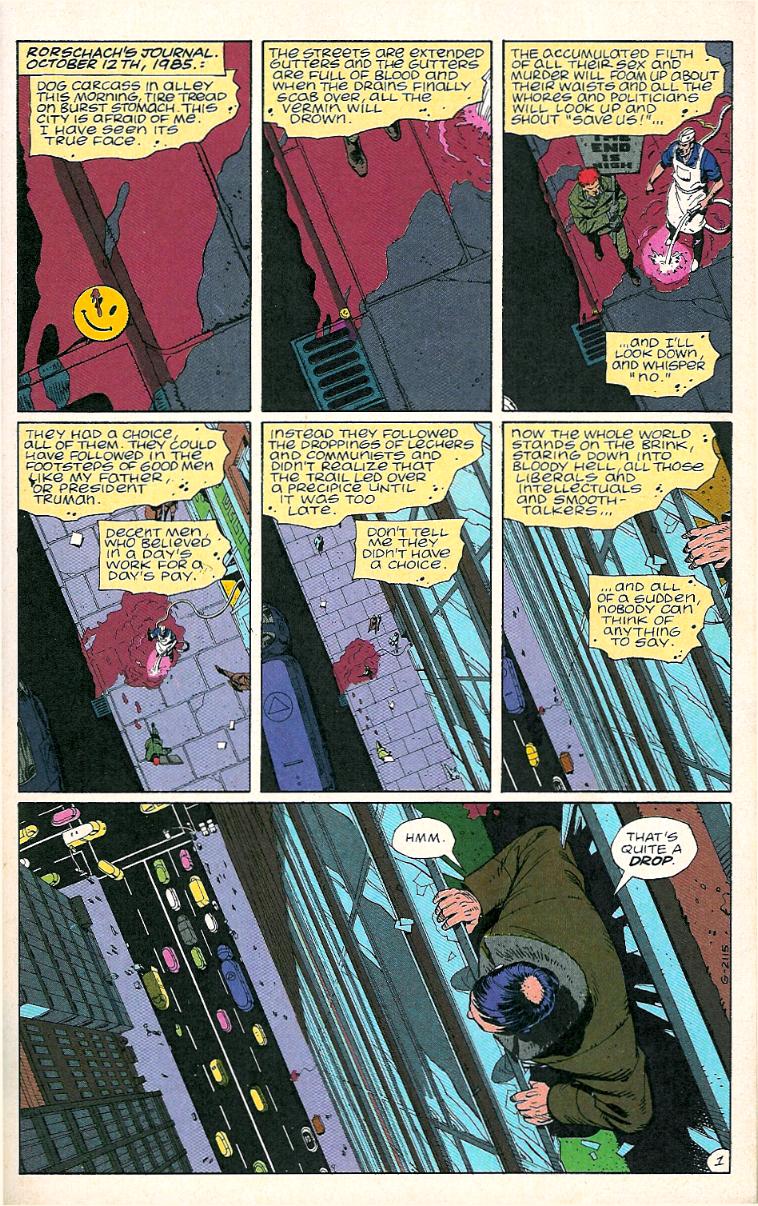
Simple, marvelously iconic, and I love how it begins the zoom that takes up both the cover to issue one and the entirety of the first page.


And this is, quite simply, the greatest comics cover ever done. (Although this is a close second, I'll admit: if your curious, the answer is that the latter reprinted a story from the former. It looks like this was fairly common, although sometimes a few changes were required.)

Thursday, March 09, 2006

Nel mezzo del cammin di nostra vita

Those words comprise the first line of Dante's Inferno, and mean (in Allen Mandelbaum's translation) "When I had journeyed half of our life's way". Since Psalm 90:10 says that "the days of our years are threescore years and ten", this has always been interpreted as meaning that Dante was 35 years old (and that the poem took place, therefore, in the year 1300). 35: "half of our life's way" according to David and Dante, two reputable sources.

Today is my thirty-fifth birthday.

Now, even Psalm 90:10 acknowledges the possibility that they might "by reason of strength... be fourscore years". And, of course, the psalmist was writing before modern medicine. Yet even if one goes by Genesis 6:3 ("his days shall be an hundred and twenty years") -- as, for instance, Moses is said to have done; something which I certainly hope (kenina hara!) to achieve -- still one must admit that even so life "is soon cut off, and we fly away."

I suppose this is all just to say that I'm feeling a bit melancholy. Afraid that, like Dante,

mi ritrovai per una selva oscura,
ché la diritta via era smarrita
("I found myself within a shadowed forest,
for I had lost the path that does not stray")

-- and feeling also that

Io non so ben ridir com' i' v'intrai,
tant' era pien di sonno a quel punto
che la verace via abbandonai.
("I cannot clearly say how I had entered
the wood; I was so full of sleep just at
the point where I abandoned the true path.")

Perhaps such feelings are par for the course on "major" birthdays -- defined, due to our counting system, as those divisible by five.

And of course, at the end of the day, I know what the answer to such feelings are -- the only answer that there can be: the answer found in another, older poet (well, older than Dante: not the Psalmist), the odes of Horace: "carpe diem" -- "seize the day".

What else is there?

(Update:)
You say it's your birthday
Well it's my birthday too, yeah...
-- Lennon/McCartney

On a cheerier note, very happy returns to my fellow birthday celebrants: P. Z. Myers, Hayden Bock, Jason Bock (who shares my precise birthday, i.e. not just March 9 but 1971 as well) -- and, heck, all the famous ones too.

Monday, February 27, 2006

Continuity #1: A Creative Commons Comics Script

Continuity1_Script.html
Continuity1_Script.pdf
Continuity1_Script.doc

Above, in a few different formats, are links to a script I've written for a 24-page comic book -- Continuity #1. It's intended as a one-shot, i.e. a single issue without follow-up. I am releasing the script under a creative commons license (Attribution-NonCommercial-ShareAlike 2.5), as described here (human-readable summary) and here (legal text).

This is (to the best of my knowledge) the first time a comics script has been released under a creative commons license. (Lots of complete comics, but no scripts that I've seen.)

The license I've released it under allows anyone (without getting any special permission from me) to read and distribute the strip, so long as they don't release it commercially or attempt to make any money from it. It also allows anyone (again, without getting any special permission from me) to make derivative artworks, so long as 1) I am give adequate credit; 2) those artworks are non-commercial and are 3) released under the same creative commons license that I am releasing this script under. I don't know of any way of writing this into the legal license, but I am in addition asking people who make a derivative work to send me a copy (link to your web site, a scan or jpeg of the artwork, etc.) unless it is wholly for your private practice and not distributed at all. Basically, if anyone draws any of this (or paints or whatever), I'd really like to see it. My email address is sfrug [symbol for at] post.harvard.edu.

The point of the "derivative works" is not to allow people to go write endless stories about these characters (although of course that is allowed, presuming they follow the given restrictions) but to allow any artists who want to to illustrate it. This could be for anything. It could simply be good practice for someone, a way to test out skills and stretch artistic muscles. Perhaps someone who wants to draw a 24 hour comic but doesn't want to write it at the same time could use this script (it might not, therefore, be strictly according to the rules, but what the hey). Or whatever.

I should note, incidentally, that it is possible to release this work commercially and not under a creative commons license if you get my permission. The point of mentioning this is that if anyone wants to illustrate it and try to publish it as an independent, for-sale comic (whether self-published or through some established comic publisher), then I'm certainly open to the idea. We just need to talk terms (which I would imagine as share-and-share-alike). Anyway, if you're interested, do contact me.

For anyone else who is interested, I hope you enjoy reading my script. And please forward it (or a link to it) to anyone else who might be interested!

(A hopefully-permanent version of this post will be found on its own page here.)

RIP Octavia Butler

I just saw on boingboing that Octavia Butler, one of my favorite SF writers, just died on Saturday. I just finished teaching her amazing novel Kindred two weeks ago in my seminar at Cornell; I taught it in the fall, too. One of my students told me Friday -- the day before Butler died -- that it was the first novel she'd read in a long time that she really enjoyed every word of and was never bored by. One of the reasons I began the seminar with it both semesters is because, in addition to being a literarily rich novel with a wonderful portrayal of life in a slave society, it is simply so damn gripping. I always had several students who read through the entire thing the night they began it (they're only required to read a third the first week). It was a great way to get students into the class. It's simply a wonderful, wonderful novel, and I recommend it unreservedly.

Her other books are wonderful, too. Besides Kindred, my favorites are her short stories, particularly the horrifying, unforgettable "Bloodchild". But I've enjoyed every book of hers I've read (not quite all, but close -- I hope to read her most recent (and, I suppose, now last) novel Fledgling soon.)

I even had the honor of meeting her once, briefly, at the SF convention Readercon in 2002. She was polite and charming, although she seemed a little shy.

What's heartbreaking is how young she was -- she was only 58 when she died. It sounds like a simple, horrifying accident.

A wonderful writer has left us far too soon. Rest in peace.


Thursday, February 23, 2006

A Very Cool Idea

Lawrence Lessig teaches law at Stanford and writes on intellectual property issues; he's one of the most prominent advocates of the importance of a freely-available commons in our cultural life. (Full disclosure: Lessig is a friend of my dad, but (to the best of my recollection) I've never met him.) If you're interested in these things, his most recent book, Free Culture, has been released online under a creative commons license; it's well worth reading.

He's had an idea which is, frankly, awesome. He has set up a wiki specifically devoted to criticisms of his own work: the Anti-Lessig Reader. Ironically, it would be hard to think of a better tribute to the spirit of his work: opening creative endeavor to free, voluntary contribution. And of course it shows his genuine dedication to the issues. W. V. Quine wrote that "Unscientific man is beset by a deplorable desire to have been right. The scientist is distinguished by a desire to be right." (Quiddities, "Rhetoric"). Setting up a forum for the critique of one's own work strongly demonstrates a desire to be right rather than a desire to have been right.

And, of course, it's ultimately very smart, because good critiques improve good work -- whether by allowing the creator to better rebut them, or to partially incorporate them, or to adopt them wholesale. Which feeds back into the importance of collaboration in intellectual life -- and, through that, to the importance of the creative commons. Culture and ideas are too important to be owned by corporations.

The big drawback to this idea? There's nothing there yet! I don't know if this is because no one's heard about it, or because Lessig's critics are purposely avoiding it as a forum, or something else, but my (quick) search found precisely one comment. Thus the idea is, so far, better than the reality. Still, bully for Lessig for throwing this up there. May many more follow his example!